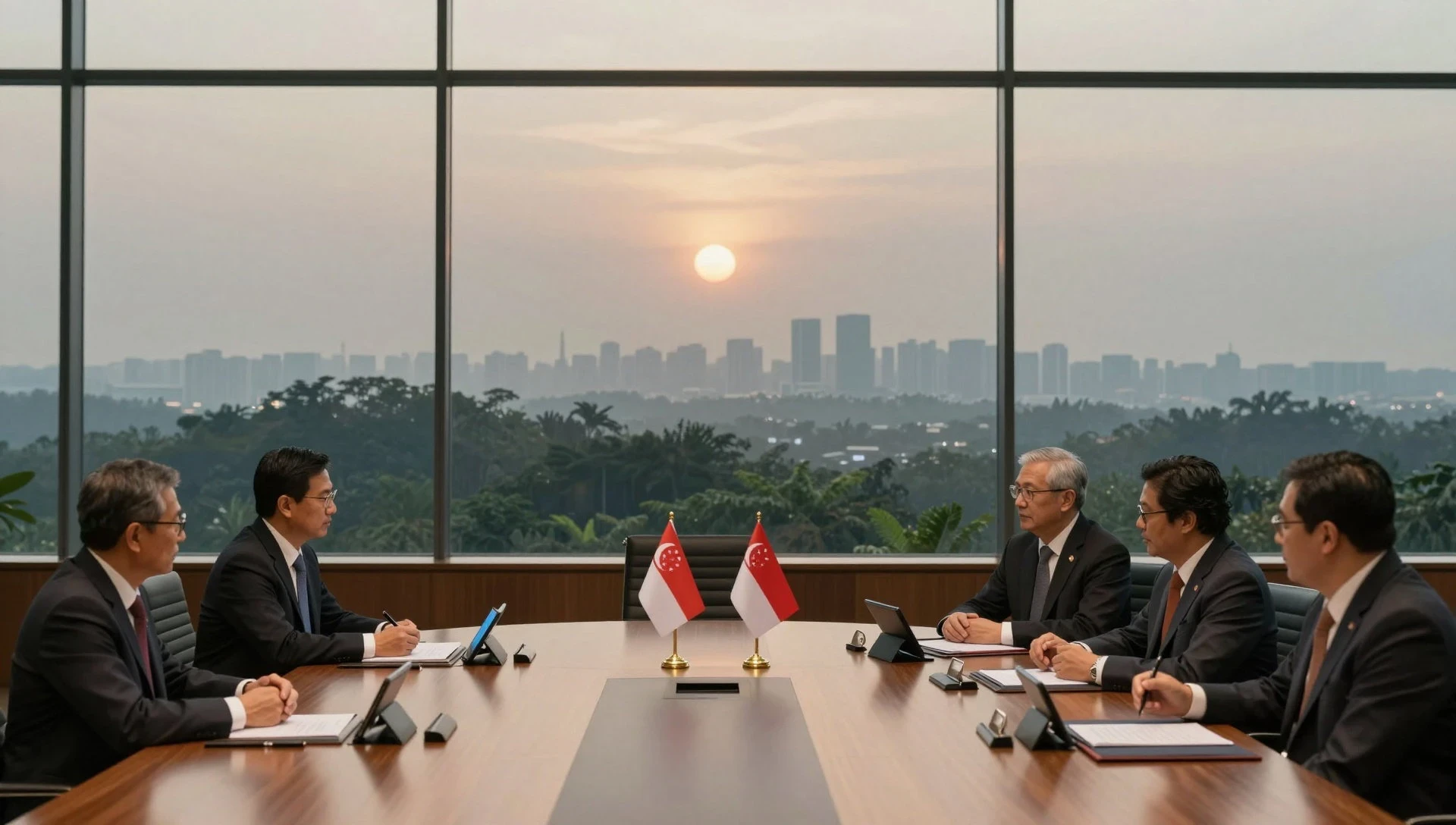
Singapore has activated its haze management protocols as Indonesia pushes back against criticism from neighbouring states, a convergence of environmental emergency and diplomatic friction that has defined Southeast Asian relations for nearly three decades.
The Reuters dispatch of 30 October 2026 frames the episode as twin pressure: transboundary smoke drifting across the Strait of Malacca, and a Jakarta government willing to contest the narrative rather than absorb it quietly. Neither dimension is new, yet their simultaneity matters.
Haze episodes historically expose the gap between ASEAN's consensual diplomacy and the sovereign sensitivities of its largest member.
On This Page
The underlying mechanics are well documented. Peatland and forest fires, concentrated in Sumatra and Kalimantan, generate particulate matter that seasonal winds carry toward Malaysia and Singapore. The 1997 episode alone imposed an estimated US$9 billion in regional economic losses, while the 2015 crisis cost Indonesia roughly US$16 billion and Singapore several hundred million.
What distinguishes 2026 is the political overlay: an Indonesian administration treating external criticism as interference, and a Singaporean state preparing domestic contingencies while calibrating its public language with unusual care.
This analysis examines the haze cycle as a governance problem rather than a weather event. It weighs the diplomatic postures of both governments, the economic exposure of a city-state dependent on uninterrupted aviation and outdoor labour, and the institutional machinery — from the 2002 ASEAN Agreement on Transboundary Haze Pollution to Singapore's Transboundary Haze Pollution Act — that has repeatedly proven easier to draft than to enforce.
TL;DR Singapore's haze preparations and Indonesia's combative response to neighbouring criticism reflect a recurring structural conflict between environmental accountability and sovereign autonomy in Southeast Asia. Seasonal peat fires generate measurable economic and health costs across borders, yet enforcement mechanisms remain weak because ASEAN operates on consensus and non-interference. Singapore's Transboundary Haze Pollution Act offers extraterritorial leverage but is rarely tested; Indonesia's defensive posture reflects domestic political incentives and development pressures. The 2026 episode is less an anomaly than a stress test of regional governance, with outcomes shaped by weather, electoral cycles, and the willingness of both states to convert rhetoric into enforceable commitments.
The Structural Anatomy of a Recurring Transboundary Crisis
Haze is best understood as an industrial byproduct of land conversion, not a natural disaster. Fire is the cheapest method for clearing degraded peatland for palm oil and pulpwood plantations, and drained peat burns underground for weeks, producing fine particulate matter that travels hundreds of kilometres.
The economics are perverse: private operators capture the land value while respiratory illness, school closures, and flight cancellations are socialised across borders.
Meteorology, Peat, and the Physics of Regional Exposure
During the southwest monsoon, prevailing winds funnel emissions from central Sumatra directly over Peninsular Malaysia and Singapore. The Pollutant Standards Index, which Singapore uses to communicate risk, weights PM2.5 heavily because particles below 2.5 micrometres penetrate lung tissue and enter the bloodstream.
Readings above 300 are classified hazardous, and the 2015 episode pushed Singapore's 24-hour PSI past 300 for consecutive days.
Peat subsidence compounds the problem across years. Once drained, peat oxidises and loses volume, so each fire season leaves the landscape more flammable than the last. Restoration is technically feasible but slow and expensive, requiring rewetting, canal blocking, and community fire brigades.
Indonesia's Peatland Restoration Agency, established in 2016, reported progress on roughly two million hectares before funding and institutional continuity became uncertain.
Climate variability adds a stochastic layer. El Niño years suppress rainfall across the maritime continent, extending the dry window in which fires spread. Forecasters cannot predict the severity of any given season with precision, which means Singapore must maintain standing readiness rather than episodic response. The city-state's haze contingency plans therefore operate continuously, not seasonally.
Diplomatic Posture: Jakarta's Defensive Turn
Indonesia's response to neighbouring complaints has historically oscillated between cooperation and deflection. Officials have variously acknowledged the problem, blamed Malaysian and Singaporean plantation interests operating on Indonesian soil, and asserted that sovereign territory management is not subject to external instruction.
The 2026 posture appears to lean toward the third register, framing criticism as regional ingratitude given Indonesia's size and economic weight.
That framing carries domestic political utility. Fire clearance is tied to livelihoods in provinces where central authority is contested, and enforcement against well-connected concession holders is politically costly. Publicly conceding that Indonesian land management harms neighbours invites scrutiny of patronage networks.
Deflection abroad therefore functions as protection at home, a pattern visible across successive administrations regardless of coalition composition.
There is also a status dimension. Indonesia is the region's largest economy and population, and its officials resist arrangements that imply tutelage by smaller states. Singapore, with roughly 6 million residents against Indonesia's 280 million, occupies an awkward position when issuing complaints: economically significant, diplomatically nimble, but structurally unable to compel compliance. That asymmetry shapes every negotiation.
Singapore's Preparedness Doctrine
Singapore cannot prevent haze, so it manages consequences. Contingency planning spans air quality monitoring networks, stockpiles of N95 masks, school closure protocols, and coordination with Changi Airport on visibility thresholds. The Ministry of Health issues respiratory advisories calibrated to PSI bands, and employers face guidance on outdoor work suspension. These measures are rehearsed rather than improvised.
The legal instrument is the Transboundary Haze Pollution Act 2014, which permits prosecution of entities — including foreign companies — whose conduct causes haze in Singapore, and allows regulators to request information and impose fines.
The statute is extraterritorial in ambition but has been invoked sparingly, reflecting the difficulty of evidence gathering and the diplomatic cost of pursuing Indonesian firms in Singaporean courts.
Preparedness also has an economic logic. Singapore's GDP depends on aviation, tourism, shipping, and outdoor construction, all of which degrade under sustained haze. The 2015 episode disrupted flights and prompted event cancellations.
For a state with no natural resources, continuity of services is a strategic asset, and haze contingency spending is framed accordingly as insurance rather than environmental expenditure.
We Also Published
Governance, Law, and the Limits of Regional Machinery
The institutional architecture for addressing haze exists on paper and underperforms in practice. The 2002 ASEAN Agreement on Transboundary Haze Pollution entered into force in 2003, yet Indonesia ratified it only in 2014, eleven years later.
The agreement establishes monitoring, assessment, and joint emergency response, but contains no binding emissions targets and no dispute resolution with teeth. Its secretariat coordinates; it does not compel.
The 2002 Agreement and Its Enforcement Gap
ASEAN's foundational norm of non-interference constrains what any member can demand of another. The haze agreement reflects this: it obliges parties to cooperate, not to achieve specified outcomes. Compliance is voluntary, reporting is uneven, and the ASEAN Specialised Meteorological Centre in Singapore provides forecasting that is useful but advisory. No mechanism exists to sanction a member whose territory generates sustained transboundary pollution.
Singapore's unilateral statute was partly a response to this vacuum. By creating civil and criminal liability for foreign entities, it sought leverage outside ASEAN's consensus framework. The law's deterrent effect is debated: no major prosecution has reached final judgment, and enforcement requires evidence of specific concessions burning specific land, which Indonesian authorities are not obliged to supply.
Scholars have proposed alternatives, including payment for ecosystem services, supply-chain certification for palm oil, and joint peatland restoration financing. Each addresses a real incentive but none substitutes for enforcement.
The Roundtable on Sustainable Palm Oil certifies growers, yet smallholders and informal operators — responsible for a substantial share of fire-setting — sit largely outside certification schemes.
Economic Interdependence as Leverage and Constraint
Singapore is among Indonesia's largest foreign investors, particularly in Batam, Bintan, and the broader Riau Islands. That capital relationship gives Singapore commercial influence but also creates vulnerability: aggressive legal action against Indonesian firms could chill investment and invite retaliation. The result is a calibrated approach, with public statements measured and private diplomacy carrying the substantive pressure.
Trade flows cut both ways. Indonesian agricultural exports to Singapore, including palm oil derivatives, are significant, and Singapore's food security depends partly on regional supply chains. Haze policy therefore sits at the intersection of environmental protection, investment promotion, and food resilience. Officials must weigh each decision against multiple mandates, which explains the preference for preparedness over confrontation.
Regional bodies offer limited additional leverage. The ASEAN Plus Three mechanisms and the Asian Development Bank have funded peatland projects, but financing is fragmented and monitoring weak. Without a shared measurement standard, disputes over attribution persist, and attribution is the precondition for any liability regime, whether judicial or diplomatic.
Health, Productivity, and the Social Cost Ledger
Epidemiological studies link sustained PM2.5 exposure to respiratory and cardiovascular morbidity, with measurable increases in clinic visits during severe episodes. Singapore's hospitals report elevated asthma presentations when PSI exceeds 100.
Children, the elderly, and outdoor workers bear disproportionate risk, and the distributional consequences are regressive: low-income households cannot afford air purifiers or relocate during spikes.
Productivity losses are harder to quantify but economically material. Construction sites halt, delivery services slow, and tourism receipts dip. Singapore's economy is services-heavy, and outdoor-dependent sectors employ significant numbers of migrant workers whose health protections are uneven.
The social cost ledger therefore extends beyond headline GDP figures to include healthcare expenditure and long-run labour capacity.
Indonesia bears the largest domestic burden. Fire-related acute respiratory infections affect hundreds of thousands annually during severe seasons, and the economic cost falls on provinces with limited fiscal capacity.
Central transfers rarely match the scale of the problem, which reinforces local incentives to tolerate fire clearance as a livelihood strategy rather than suppress it.
- 01
- 02
- 03
- 04
Scenarios, Signals, and What to Watch
The 2026 episode will be resolved by weather as much as by policy. Monsoon onset timing determines how long fires burn, and diplomatic temperature determines whether cooperation resumes or hardens.
Neither variable is fully controllable, which is why analysts track a small set of observable indicators rather than rely on official statements, which are calibrated for domestic audiences and rarely disclose operational detail.
Reading the Diplomatic Signals
Watch the language of Indonesia's environment ministry and foreign ministry for divergence. When the two speak in different registers, it usually signals internal contestation over whether to concede or deflect.
Similarly, the frequency of Singapore's public advisories, as distinct from private diplomatic notes, indicates how much pressure the government believes it must visibly apply.
Third-party involvement matters. Malaysia's posture often determines whether Indonesia faces a united front or a divided one. If Kuala Lumpur and Singapore coordinate messaging, Jakarta's room for deflection narrows. If they diverge, Indonesia can play neighbours against each other, a familiar pattern in ASEAN diplomacy that has repeatedly diluted collective pressure.
Corporate behaviour offers another signal. Announcements of peatland restoration investment, or their absence, reveal whether concession holders expect enforcement to tighten. Supply-chain audits commissioned by buyers in Singapore and Malaysia can create commercial incentives independent of state action, and these often move faster than treaty negotiations.
Institutional Reform and Its Prospects
Meaningful reform would require either binding regional commitments or credible unilateral enforcement. Neither is imminent. ASEAN's consensus rule makes binding targets unlikely, and Singapore's statute remains a deterrent of uncertain strength. The more plausible path is incremental: better peatland restoration financing, tighter supply-chain standards, and improved fire detection using satellite data.
Technology offers partial relief. Satellite monitoring now detects thermal anomalies within hours, enabling faster suppression. Machine learning models can forecast fire risk from rainfall, land-use, and drainage data, though deployment requires local capacity that many Indonesian districts lack. Investment in these systems is cheaper than disaster response but competes for the same budgets.
The deeper obstacle is political economy. Fire clearance persists because it is profitable and enforcement is selective. Until the incentives facing concession holders and smallholders change, haze will recur regardless of diplomatic choreography. Preparedness in Singapore and defensiveness in Jakarta are rational responses to a structure neither state can unilaterally alter.
Conclusion: A Stress Test Without a Resolution
The 2026 haze episode exposes a governance structure that manages symptoms while leaving causes intact. Singapore's preparations are competent and necessary, but they address consequences rather than origins. Indonesia's defensive response is politically intelligible, yet it defers the institutional reforms that would reduce fire frequency over time. Both states are behaving rationally within a framework that rewards deflection and penalises concession.
What would change the equilibrium is not better diplomacy but altered incentives. If peatland restoration became profitable, if certification excluded fire-linked supply, if satellite detection triggered automatic consequences, the calculus would shift. None of these conditions currently holds.
Until they do, the region should expect recurrence, with severity determined largely by rainfall and only marginally by policy.
The analytical takeaway is that transboundary haze is a collective action problem dressed as a diplomatic dispute. Treating it as the latter produces statements; treating it as the former would require enforceable commitments that ASEAN's architecture cannot currently supply. Singapore prepares, Indonesia deflects, and the peat continues to burn.
From our network :
- Mobile Learning and VR in English: What Global Evidence Reveals About Effective Language TechnologyA systematic review across 14 countries reveals which language-learning technologies genuinely work. Mobile learning, AI, and VR show measurable benefits when pedagogically integrated. This evidence-based guide helps educators and learners select technology that delivers real return on investment.
- How AI Agents Will Change the Way We Manage Personal FinancesExplore how AI agents are transforming personal finance through automated budgeting, bill payment, and investment management, while examining the critical security protocols and governance frameworks required for safe deployment.
- University Language Proficiency Exams: Why Institutional Tests Demand Different Preparation Than IELTS and TOEFLDiscover why university-specific language proficiency examinations differ fundamentally from IELTS and TOEFL, and learn strategic preparation approaches for institutional assessment success.
- Live Online English Classes for Kids: Do They Actually Reduce Anxiety?A ten-week study reveals that synchronous online English classes can significantly reduce child language anxiety while improving listening and reading skills. Discover what makes these programs effective and how parents can select the right one.
- The Final Descent: How ESA Retired the Legendary Cluster Constellation After 24 Years of Space Weather ScienceAfter 24 years mapping Earth’s magnetosphere, ESA’s Cluster mission concluded with a precisely controlled reentry over the South Pacific. This analysis explores the scientific legacy, engineering decisions, and debris mitigation principles behind one of space exploration’s most responsible retirements.
- Committed Mediterranean Precipitation Decline: Why Emissions Cuts Alone Cannot Restore Winter RainsNew NOAA research reveals that Mediterranean winter rains may decline irreversibly even with emissions cuts. Explore the science of committed climate change and regional impacts.
- Forbidden Matrix Patterns and Visible Lattice Points: A Geometric DictionaryExplore how multidimensional 0–1 matrices encode geometric truths, linking forbidden patterns to visible lattice points and hypergraph theory, with applications in combinatorics and computational geometry.
- The Hidden Cost of AI Convenience: Why Over-Permissioned Agents Are a Security Time BombDiscover why AI agents with excessive permissions create dangerous single points of failure, and learn how implementing least privilege principles can protect your organization from exploitation.
- CISA’s Ten-Advisory Wave: Why Generic Patching Fails in OT and How to Build Product-Specific PlaybooksCISA released ten ICS advisories in one week, exposing critical infrastructure risks. Generic patching fails in OT. Learn to build product-specific remediation playbooks.
RESOURCES
- Singapore, Indonesia eye haze task force, reaffirm ties ... - Reutersreuters.com6 days ago ... ... Indonesia, in Singapore, October 13, 2026. REUTERS ... transboundary haze generated by Indonesia's most intense forest fires in 11…
- Singapore, Indonesia Ready to Address Bilateral Issues Including ...thediplomat.com4 days ago ... ... Indonesia, and potentially take action against them under its Transboundary Haze Pollution Act. ... © 2026 Diplomat Media Inc.…
- Southeast Asia's toxic haze spurs calls for legal action ... - Al Jazeeraaljazeera.comOct 22, 2026 ... In 2016, Singapore and Indonesia became embroiled in a diplomatic dispute after the city-state's environmental agency attempted to summon the ...
- Indonesia Haze Crisis: Can Malaysia and Singapore Hold Indonesia ...diplomacyandlaw.comOct 9, 2026 ... At its June 25, 2026 meeting, ASEAN's Sub-Regional Ministerial Steering Committee on Transboundary Haze Pollution in the Mekong Sub-Region ...
- Indonesia Needs to Do More to Tackle the Region's Transboundary ...thediplomat.comOct 2, 2026 ... Singapore, Indonesia Ready to Address Bilateral Issues Including Haze, Minister Says ... © 2026 Diplomat Media Inc. All Rights Reserved.
- Twenty-Seventh Meeting of the Sub-Regional Ministerial Steering ...asean.orgJul 9, 2026 ... ... 2026 in Bali, Indonesia. ... The Twenty-seventh Meeting of the Technical Working Group on Transboundary Haze Pollution (27th TWG)…
- Indonesian authorities have informed officers from the Singapore ...instagram.comMay 10, 2026 ... ... transboundary haze affecting Indonesia and the region. #singapore ... haze on 19 October 2026. View all 26 comments.
- Singapore's Top Envoy on Mission to Soothe Indonesian Angstbloomberg.com4 days ago ... ... Singapore also proposing amendments to the Transboundary Haze Pollution Act to give the framework the force of law. Singapore's…
- 'Clean air is not a favour': Indonesia's neighbours fed up with acrid ...theguardian.comOct 16, 2026 ... ... Indonesia. 'Clean air is not a favour': Indonesia's neighbours fed up with acrid haze as Singapore threatens to prosecute.…
- Indonesia haze chokes neighbours, but little legal recoursefrance24.comOct 1, 2026 ... Singapore's investigations into four Indonesian companies over their alleged role in the 2015 transboundary haze ... © 2026 Copyright ...
- Singapore wields 'quiet diplomacy' in minister's surprise visit to ...scmp.com4 days ago ... Singapore wields 'quiet diplomacy' in minister's surprise visit to Indonesia amid haze tensions ... transboundary haze. Protests led by ...
- Asia Specific | The Asean diplomacy behind the Indonesian hazebbc.comOct 20, 2026 ... ... Indonesian forests create outside of the haze season deepened the row. Singapore has a Transboundary Haze Pollution Act that…
- Singapore, Indonesia eye haze task force, reaffirm ties amid ... - WHBLwhbl.com6 days ago ... The visit to Jakarta by Singapore Foreign Minister Vivian Balakrishnan came amid mounting frustrations in the city-state over the transboundary ...
- Singapore reaches out to cool diplomatic row - Asia & Pacificthejakartapost.com5 days ago ... ... Indonesia's position ahead of transboundary haze talks at the ASEAN summit, according to an expert.
- Indonesia's wildfire crisis: Haze spreads across Southeast Asia as ...thesoutheastasiadesk.comAug 28, 2026 ... Indonesia's 2026 forest fires spark a regional transboundary haze emergency. Discover the public health, diplomatic, and policy impacts ...
- 01
- 02
- 03
- 04
- 05
- 06
- 07
- 08
0 Comments