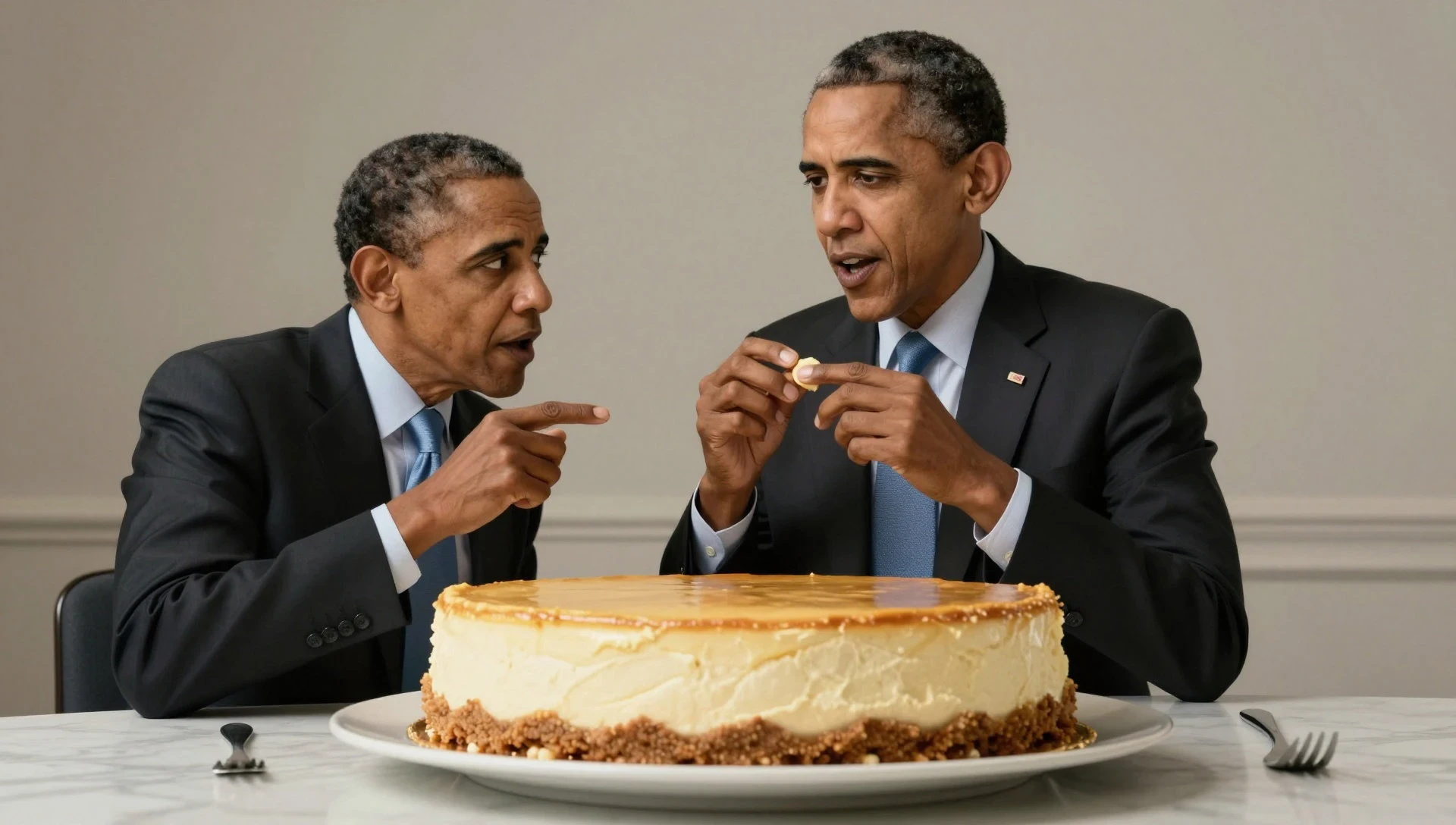
A single joke about interior décor escalated into a national argument about taste, class, and economic empathy in October 2026, when former President Barack Obama compared the Trump administration's White House renovations to the aesthetic of Saddam Hussein's palaces.
Campaigning in Ohio for Democratic candidates, Obama said the gilded Oval Office detailing looked "like Saddam Hussein opened a Cheesecake Factory," a line that fused two unrelated symbols — authoritarian excess and American chain-restaurant abundance — into one compact insult.
The remark traveled faster than any policy critique he delivered that day, and the White House answered within hours rather than days.
On This Page
The exchange matters less for what it says about gold medallions than for what it reveals about how political disputes now attach themselves to consumer brands. The Cheesecake Factory, founded in 1978 by David Overton and operating 218 U.S. locations, became an involuntary participant: its famously oversized menu was repurposed by the official White House account as a metaphor for presidential achievement.
Treasury Secretary Scott Bessent then staged a lunch at a Cheesecake Factory near the White House, ordering a French Dip Cheeseburger, converting a restaurant visit into a counterargument about elitism.
Vice President JD Vance labeled Obama "super elitist," while Obama, speaking in Georgia, noted the administration seemed more aggrieved by the restaurant comparison than by his charges of corruption.
Beneath the theatrics sits a substantive question about affordability. Obama framed the past two years as "chaos and cruelty and corruption," tying White House spending on ballrooms and gold fixtures to households squeezed by a cost-of-living crisis and the economic fallout of the war in Iran.
The administration's response inverted that frame, presenting artisanal craftsmanship and business success as virtues rather than excess. What follows examines the rhetorical mechanics, the brand collateral, and the political arithmetic of a controversy that cost nothing to start and proved difficult to end.
TL;DR A campaign joke by Barack Obama comparing Trump's White House décor to "Saddam Hussein opened a Cheesecake Factory" triggered a rapid, multi-front response from the administration, including a White House social post mocking the chain's menu and a Treasury Secretary lunch photo-op. The dispute converted a restaurant brand into a political symbol and shifted debate from renovation spending to questions of elitism and affordability. The episode demonstrates how cultural signifiers — gold fixtures, oversized menus, coastal vacation habits — now carry more political weight than policy detail, and how quickly consumer brands become collateral in partisan messaging.
The Rhetorical Architecture of a Décor Insult
Obama's comparison worked because it stacked two recognizable visual vocabularies against each other. Saddam Hussein's palaces were synonymous with gilded opulence funded by state resources; the Cheesecake Factory is synonymous with maximalist American commercial décor — one writer described its interiors as "as if ancient Egypt and Tuscany had a baby in Las Vegas."
Merging them produced an image that required no explanation and resisted rebuttal, since disputing a joke risks confirming its premise. The line also carried an implicit economic argument: gold leaf in the Oval Office reads differently when grocery prices dominate household budgets.
The mechanics of the comparison
The joke's efficiency lies in its compression. It names no policy, cites no figure, and levels no formal accusation, yet it implies waste, vanity, and detachment in six words. Political rhetoric of this type bypasses fact-checking because its claims are aesthetic rather than empirical.
Obama reinforced the frame with concrete imagery — gold medallions on the Oval Office fireplace, a ballroom larger than the White House itself — giving audiences visual anchors that persist after the soundbite fades.
Timing amplified the effect. Delivering the line during a campaign stop for Democratic candidates positioned it as mobilization rhetoric rather than commentary, aimed at voters already primed to question administration priorities. The setting also insulated Obama from the expectation of presidential decorum that would apply in a formal address.
Campaign venues tolerate sharper humor, and the audience's laughter became part of the message's distribution, ensuring clips circulated widely before any official response could be drafted.
The Saddam Hussein reference added a deliberate edge. Hussein's regime was defined by cult of personality and extravagant construction projects, so invoking him signals authoritarian self-indulgence rather than mere bad taste. That connotation is what the White House chose to ignore publicly, focusing instead on the restaurant half of the analogy.
Obama later noted this selectivity, observing that the president seemed unbothered by the Hussein comparison while reacting sharply to the Cheesecake Factory mention.
Why the White House answered in kind
The administration's response treated the joke as a status contest rather than a policy dispute. Trump defended the renovations by citing "the finest artisans in the world" and claiming the White House was in its best condition since 1792, a framing that emphasized craftsmanship and heritage over cost.
He dismissed Obama personally as "not a smart guy," shifting from décor to character. The official White House account posted a photograph of the Cheesecake Factory's menu with the caption that "the only thing bigger than the menu is the list of President Trump's accomplishments."
Vice President JD Vance reframed the exchange around class, calling Obama "super elitist" and suggesting the trait was involuntary. That move attempted to flip the affordability argument: if Obama mocks a mainstream restaurant chain, he signals distance from ordinary consumers.
Treasury Secretary Scott Bessent reinforced the theme by eating lunch at a Cheesecake Factory near the White House on Monday, ordering a French Dip Cheeseburger, praising the meal, and suggesting the "Martha's Vineyard set" try it — an apparent reference to the Obamas' habitual island holidays.
Bessent extended the counterattack to architecture, criticizing the new Obama Presidential Center in Chicago as resembling "Darth Vader's tomb." The remark mirrored Obama's own method, answering an aesthetic insult with an aesthetic insult.
Together, these responses formed a coordinated message: the administration is populist in its tastes, its critics are coastal and condescending, and the argument over gold fixtures is really an argument over who understands working Americans.
The counter-punch and its limits
Obama's follow-up in Georgia on Wednesday reframed the controversy as a tell. He expressed surprise that the White House was more upset about the Cheesecake Factory remark than about his criticisms of policy and corruption, noting the president's indifference to the Saddam Hussein comparison.
That observation converted the administration's reaction into evidence for his original thesis: that image management outranks substantive accountability in current political practice.
The counter-punch has limits, however. By continuing the theme across two states, Obama kept a joke alive that had already served its purpose, risking the appearance of grievance. Each repetition also invited fresh administration responses, extending the news cycle in a direction that favored entertainment over economics. The affordability argument — the one with measurable stakes — receded with every additional mention of cheesecake.
Both sides thus traded in the same currency: symbolic association. Neither produced cost estimates for the renovations, comparisons of White House spending across administrations, or data on household budgets. The dispute's resolution came not through argument but through exhaustion, as audiences tired of the exchange before either camp conceded anything of substance.
The Cheesecake Factory as Political Collateral
A restaurant chain with 218 U.S. locations and a menu running to hundreds of items occupies an unusual position in American culture: ubiquitous, affordable enough for middle-class families, and visually distinctive enough to be instantly recognizable in a photograph. That combination made it an ideal prop for both sides.
For Obama, it signified gaudy abundance; for the administration, it signified mainstream accessibility. Neither meaning originated with the company, which issued no statement and had no role in the dispute beyond existing.
Brand identity under partisan pressure
The Cheesecake Factory's design language — ornate columns, warm lighting, oversized portions — has long been a cultural shorthand for American excess in a benign register. Its menu, often cited as among the longest in casual dining, functions as a symbol of choice and abundance.
When the White House posted an image of that menu, it relied on the same recognizability Obama had invoked, confirming the brand's utility as a shared reference point even while disputing the valuation placed on it.
Brand exposure of this kind is double-edged. Millions of impressions arrived without marketing expenditure, but the associations were chosen by politicians rather than the company. Consumer research consistently shows that brands drawn into partisan conflict risk alienating one segment of customers regardless of their silence.
The chain's non-response was therefore a calculated default: any statement would have amplified the political frame and invited further commentary on décor, pricing, or corporate identity.
The episode also illustrates a structural feature of contemporary media. Consumer brands occupy so much shared visual space that they function as ready-made metaphors, available to any speaker seeking instant recognition. A politician who wants to evoke abundance, excess, or ordinariness can reach for a chain restaurant faster than for statistics. The cost of that convenience falls on the brand, which gains visibility without control over meaning.
Elitism, taste, and the affordability frame
The administration's class-based counterattack depended on a specific reading of consumer preference. If a Cheesecake Factory meal signals connection to ordinary life, then mocking the restaurant implies distance from it. Bessent's lunch, staged near the White House and reported with menu detail, enacted that logic.
The "Martha's Vineyard set" reference sharpened it, contrasting an exclusive island with a suburban chain, though the Obamas' vacations are a familiar target rather than a novel one.
Obama's original argument also rested on class positioning, but in the opposite direction. Gold medallions and a ballroom larger than the White House suggest spending disconnected from household strain. The two frames are mirror images: each accuses the other of failing to understand ordinary Americans, and each uses consumption choices as evidence.
Neither addresses the underlying affordability data that would settle the question of which administration's policies better served squeezed households.
This substitution of taste for economics is not new, but its current intensity reflects a media environment where visual signifiers travel further than budget tables. A gold fixture photographs well; a cost-of-living index does not.
The result is a politics in which aesthetic judgments serve as proxies for policy argument, efficient in reach and imprecise in content.
We Also Published
What the Dispute Reveals About Political Communication
The episode's most instructive feature is its speed and asymmetry. A joke delivered on a campaign stage generated a presidential rebuttal, a social media post from an official government account, a vice-presidential class critique, and a cabinet secretary's staged lunch within days.
The administration's response volume exceeded the original provocation by a wide margin, a pattern that typically signals sensitivity rather than confidence. Each reply extended the story's life and reinforced the frame Obama had chosen.
Asymmetric response and narrative control
When a joke draws four official responses, the responses become the story. Audiences remember the menu photograph and the French Dip Cheeseburger more readily than they remember any policy argument, because images outlast quotations.
The administration's decision to engage on aesthetic terrain ceded the terms of debate: instead of contesting affordability claims with data, it contested taste with counter-taste, accepting the premise that consumption choices reveal political character.
Obama's Georgia remarks exploited this dynamic by treating the reaction itself as evidence. If the White House prioritizes a restaurant comparison over corruption allegations, the argument runs, its priorities are misplaced. That inference requires no proof beyond the observable sequence of events, which is why it landed. The joke became a test, and the response supplied the result.
Narrative control in such exchanges is largely a function of restraint. The side that says less often appears stronger, because silence implies confidence and repetition implies anxiety. Here, neither side exercised restraint, and the resulting volume obscured whatever substantive disagreement existed about renovation spending, war costs, or household budgets.
Affordability as the submerged issue
Both camps invoked affordability without quantifying it. Obama cited a cost-of-living crisis and the economic effects of the war in Iran; the administration cited business success and craftsmanship. Neither produced figures on renovation costs, comparative White House budgets, or inflation-adjusted household income. The affordability frame thus functioned as context rather than argument, establishing stakes without measuring them.
This gap is characteristic of symbolic politics. Voters respond to signals about which leaders understand their circumstances, and those signals are conveyed through cultural cues more reliably than through statistics. A politician who eats at a chain restaurant communicates accessibility; one who vacations on an exclusive island communicates distance. The cues are crude but efficient, and they operate independently of policy records.
The risk is that symbolic competition displaces the policy work that would actually address affordability. Attention spent on décor and menus is attention not spent on housing costs, wage growth, or energy prices.
The dispute was entertaining, memorable, and almost entirely devoid of information voters could use to evaluate either administration's economic performance.
Brands, metaphors, and the cost of visibility
For the Cheesecake Factory, the episode offered a case study in involuntary political association. The chain's 218 locations and four-decade history made it recognizable enough to serve as shorthand, and its elaborate décor made it visually compatible with the comparison Obama drew.
The company's silence preserved neutrality but did not prevent either side from assigning meaning to its menu, its interiors, or its parking lots.
Other consumer brands face similar exposure whenever their visual identity overlaps with political symbolism. The practical lesson is that recognizability is a liability as well as an asset: the more instantly a brand can be pictured, the more easily it can be conscripted into arguments it never chose.
Crisis communication guidance in such cases generally favors minimal engagement, since any response confirms the association and prolongs the story.
The deeper point concerns the vocabulary of American political speech. When leaders reach for restaurants, hotels, and vacation destinations to describe governance, they signal that cultural identity has become the primary axis of political conflict.
Policy differences are real, but they are increasingly argued through proxies that photograph well and require no expertise to interpret.
- 01
- 02
- 03
- 04
Lessons for future exchanges
Three patterns emerge from this episode. First, humor from a former president carries unusual weight because it cannot be dismissed as partisan routine; it reads as observation rather than attack. Second, rapid multi-voice responses multiply a story's reach, and coordinated counter-messaging can appear defensive when the original provocation was light.
Third, consumer brands caught in such disputes have little control over meaning and considerable incentive to stay quiet.
For voters, the practical takeaway is a caution about substituting cultural signals for policy evaluation. A gold fixture says nothing about tax policy; a restaurant menu says nothing about inflation. Both are efficient communication devices and poor evidence.
The affordability crisis that framed the entire exchange remains measurable, and the measurements were absent from every speech and statement surveyed here.
The dispute will be remembered as a colorful footnote, but its structure is instructive. Political conflict increasingly runs through symbols that are cheap to invoke, impossible to verify, and highly shareable.
Understanding that structure is more useful than adjudicating which side had the better joke, because the next exchange will follow the same pattern with different props.
From our network :
- CISA’s Ten-Advisory Wave: Why Generic Patching Fails in OT and How to Build Product-Specific PlaybooksCISA released ten ICS advisories in one week, exposing critical infrastructure risks. Generic patching fails in OT. Learn to build product-specific remediation playbooks.
- Live Online English Classes for Kids: Do They Actually Reduce Anxiety?A ten-week study reveals that synchronous online English classes can significantly reduce child language anxiety while improving listening and reading skills. Discover what makes these programs effective and how parents can select the right one.
- University Language Proficiency Exams: Why Institutional Tests Demand Different Preparation Than IELTS and TOEFLDiscover why university-specific language proficiency examinations differ fundamentally from IELTS and TOEFL, and learn strategic preparation approaches for institutional assessment success.
- The Hidden Cost of AI Convenience: Why Over-Permissioned Agents Are a Security Time BombDiscover why AI agents with excessive permissions create dangerous single points of failure, and learn how implementing least privilege principles can protect your organization from exploitation.
- Committed Mediterranean Precipitation Decline: Why Emissions Cuts Alone Cannot Restore Winter RainsNew NOAA research reveals that Mediterranean winter rains may decline irreversibly even with emissions cuts. Explore the science of committed climate change and regional impacts.
- Mobile Learning and VR in English: What Global Evidence Reveals About Effective Language TechnologyA systematic review across 14 countries reveals which language-learning technologies genuinely work. Mobile learning, AI, and VR show measurable benefits when pedagogically integrated. This evidence-based guide helps educators and learners select technology that delivers real return on investment.
- Forbidden Matrix Patterns and Visible Lattice Points: A Geometric DictionaryExplore how multidimensional 0–1 matrices encode geometric truths, linking forbidden patterns to visible lattice points and hypergraph theory, with applications in combinatorics and computational geometry.
- The Final Descent: How ESA Retired the Legendary Cluster Constellation After 24 Years of Space Weather ScienceAfter 24 years mapping Earth’s magnetosphere, ESA’s Cluster mission concluded with a precisely controlled reentry over the South Pacific. This analysis explores the scientific legacy, engineering decisions, and debris mitigation principles behind one of space exploration’s most responsible retirements.
- How AI Agents Will Change the Way We Manage Personal FinancesExplore how AI agents are transforming personal finance through automated budgeting, bill payment, and investment management, while examining the critical security protocols and governance frameworks required for safe deployment.
RESOURCES
- Cheesecake Factory, tan suits, and the staying power of culture warsaxios.com5 days ago ... With less than a week until a potentially historic midterm election, the political discourse is being dominated not by war…
- Trump, Bessent and Obama fight over a Cheesecake Factory joke ...plataformamedia.com4 days ago ... The political dispute stems from comments Obama made during a campaign stop in Cleveland, Ohio, where he mocked Trump's reported…
- Jeff Cohen's Direct Action Network - Facebookfacebook.com4 days ago ... Was this simply a perfectly timed political joke ... Barack Obama's Cheesecake Factory joke vs Trump's White House renovations and…
- Obama doubles down on 'Cheesecake Factory' joke after criticism ...fox10tv.com4 days ago ... Cheese. He said it's telling that the White House did not dispute his main argument that Trump cares about trivialities,…
- How Obama rage-baited Trump into a fumble - Los Angeles Timeslatimes.com3 days ago ... Obama rage-baited Trump with the Cheesecake Factory. It was clever ... Obama is masterful at political strategy, and this wasn't…
- In Georgia, Obama doubles down on 'Cheesecake Factory' joke ...wrdw.com4 days ago ... He said it's telling that the White House did not dispute his main argument that Trump cares about trivialities, not…
- Obama and Trump's Cheesecake Factory feud continues at dueling ...edition.cnn.com4 days ago ... Dueling rallies: Former President Barack Obama took shots at President Donald Trump at a rally in Georgia, calling out White…
- Obama Cheesecake Factory Memes Turned a Rally Joke Into a ...thunderdungeon.com7 days ago ... The Saddam Hussein Cheesecake Factory Is a Brand Now. My favorite branch of the Obama Cheesecake Factory memes skipped the…
- Obama says The Cheesecake Factory was his 'jam' - Business Insiderbusinessinsider.com4 days ago ... Obama defended his Cheesecake Factory credentials after his joke about Trump's decor sparked backlash from Republicans and the White House.
- Obama mocks Trump's response to Cheesecake Factory jibe. 'They ...theguardian.com5 days ago ... They did not dispute what I said about them being directly ... Barack Obama mocked the Trump administration's response to…
- Obama: Trump Was Upset By "Cheesecake Factory" Joke But Didn't ...yahoo.com5 days ago ... Real Clear Politics. Follow. Obama: Trump Was Upset By "Cheesecake Factory" Joke But Didn't Dispute My Claims About Inflation And…
- Obama's Great Skewering of Trump | The New Yorkernewyorker.com3 days ago ... The former President's riff on Saddam Hussein, the Cheesecake Factory, and our gold-besotted leader was not only funny but politically ...
- Obama says Cheesecake Factory was his 'jam for about a decade'usatoday.com4 days ago ... Former President Barack Obama said he "lived" at the Cheesecake Factory when his daughters were young after his joke drew…
- Obama jokes he couldn't have raised daughters without ...news.meaww.com4 days ago ... Obama jokes about raising daughters with Cheesecake Factory visits ... The comments came amid a wider political dispute over Trump's ...
- Obama on Trump White House: 'Like Saddam Hussein opened a ...reddit.comOct 24, 2026 ... He's got the White House looking like Saddam Hussein opened a Cheesecake Factory.” “Remember that whole thing about drain the…
- 01
- 02
- 03
- 04
- 05
- 06
- 07
- 08
0 Comments