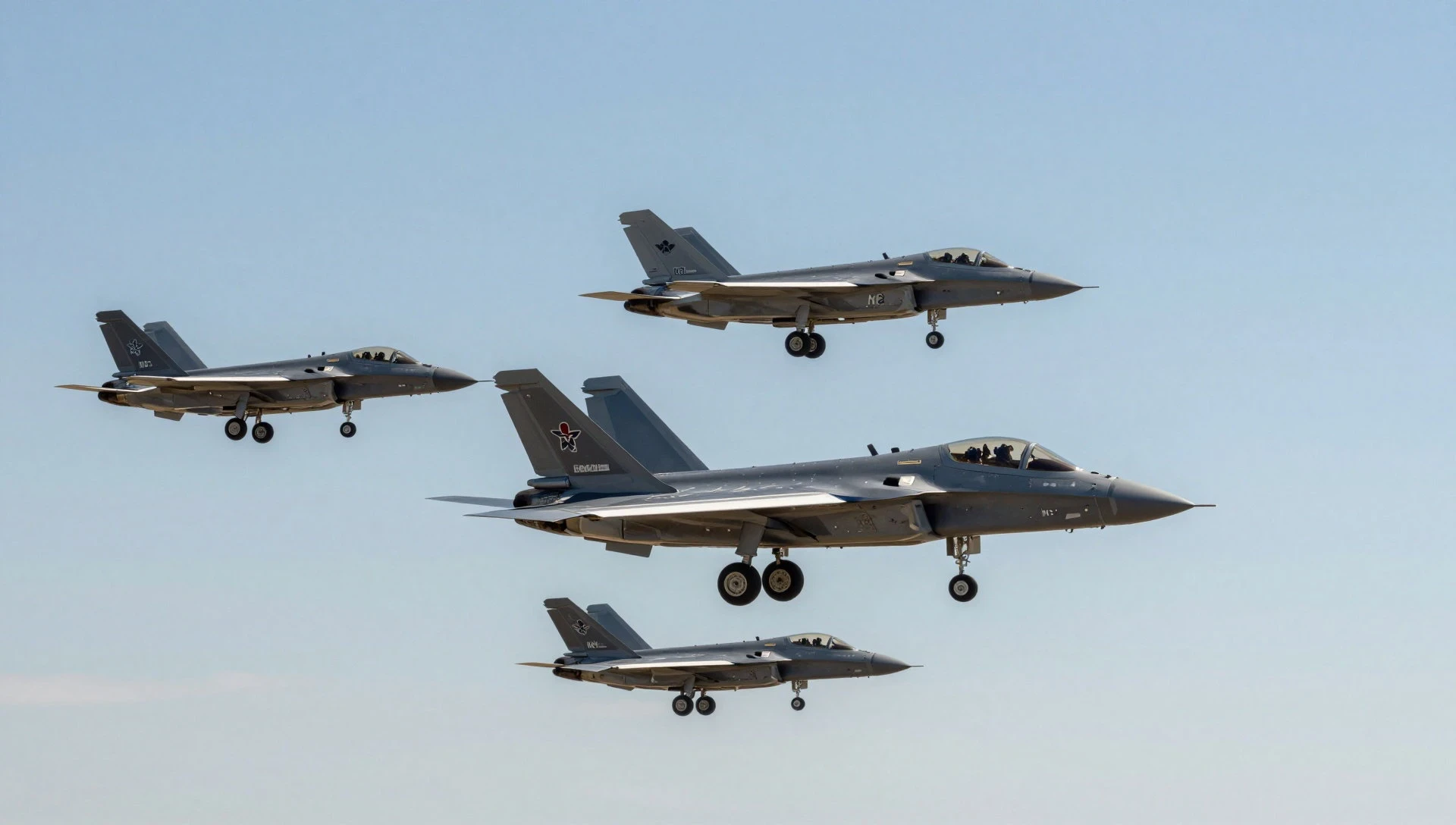
The KF-21 Boramae's first formation flight with United States aircraft over the Yellow Sea marks a measurable inflection point in South Korea's transition from licensed aircraft manufacturing to sovereign combat aviation design. The sortie paired a KF-21 from the 156th Fighter Squadron, 16th Fighter Wing, with a U.S.
Air Force U-2S Dragon Lady reconnaissance platform and F-35 and F-16 fighters, while Seoul contributed its own F-35, F-15K and FA-50 airframes. The timing was deliberate: the flight occurred shortly before the allies opened their twice-yearly Freedom Flag combined air drills on Monday.
Read narrowly, the event is a familiar interoperability exercise. Read structurally, it is the public debut of an indigenous platform inside a coalition air architecture that has been dominated for seven decades by American airframes and American logistics.
On This Page
- The KF-21 Program: Industrial Logic and Sovereign Design
- Interoperability Signaling: The Formation Flight in Context
- Production Trajectory and Strategic Implications
- Delivery Rates and Manufacturing Capacity
- Legacy Fleet Replacement Comparison
- Alliance Burden-Sharing and Export Horizons
- Interoperability Dimensions Validated by the Sortie
- Risk Factors and the Road to 2030
- Program Risk Register and Mitigation Levers
- Strategic Scorecard: What the Formation Flight Changed
South Korea completed development of the KF-21 in July, closing a program launched in 2015 to retire its aging U.S.-made F-4 and F-5 fleets. The first production model joined the 16th Fighter Wing last month, with further deliveries planned through mid- to late 2027 and more than 100 aircraft targeted by early 2030.
The numbers explain why the formation flight carries weight beyond symbolism. A fleet exceeding 100 airframes positions the KF-21 as the central pillar of the Republic of Korea Air Force rather than a niche supplement, and that scale determines training pipelines, maintenance economics and coalition doctrine.
This analysis examines the program's industrial logic, the interoperability signal sent to Washington and Pyongyang, and the delivery schedule that will test whether Seoul can sustain production at the pace its fleet plan requires.
TL;DR South Korea's KF-21 Boramae flew in formation with U.S. Air Force aircraft for the first time over the Yellow Sea, days before the Freedom Flag combined drills. The sortie integrated a KF-21 from the 16th Fighter Wing with a U-2S, F-35s and F-16s, alongside South Korean F-35, F-15K and FA-50 jets. Development concluded in July after a 2015 launch aimed at replacing F-4 and F-5 fleets; the first production model arrived last month, with more than 100 aircraft planned by early 2030.
The KF-21 Program: Industrial Logic and Sovereign Design
The KF-21 represents a deliberate break from dependency. Previous South Korean fighter acquisitions were purchases or licensed builds of foreign designs, which left Seoul exposed to export controls, upgrade schedules and pricing set elsewhere.
The 2015 launch of an indigenous program reframed airpower as an industrial capability rather than a procurement line item, with the F-4 and F-5 retirement providing the operational justification.
From Licensed Assembly to Indigenous Airframe
Korea Aerospace Industries assembled the FA-50 and earlier trainers under foreign partnership arrangements, accumulating composite manufacturing and systems integration experience without owning the core design authority. The KF-21 shifts that boundary.
Seoul now controls configuration decisions, upgrade pathways and export permissions for its principal future fighter, a distinction that matters more than any single performance specification.
Development completion in July followed roughly eleven years of design, prototyping and flight testing. That cadence is competitive by global standards, where clean-sheet fighters routinely consume fifteen to twenty years before production.
The compressed timeline reflects both concentrated funding and a design philosophy that prioritized proven subsystems over experimental ones, reducing technical risk at the cost of some generational ambition.
The program's industrial footprint extends beyond the airframe. Domestic suppliers contribute radar, electronic warfare suites and mission software, creating a defense electronics base that can be sustained independently of foreign licensing cycles. This vertical integration is the strategic dividend that procurement alone could never deliver to Seoul's defense establishment.
Fleet Replacement Arithmetic
The retirement of F-4 and F-5 airframes created a quantitative gap that the KF-21 must close. Those legacy platforms, many decades old, performed interception and ground attack roles at high maintenance cost per flight hour.
Replacing them with a domestically produced multirole fighter restores squadron counts while reducing dependence on obsolete supply chains.
Deployment of more than 100 KF-21 jets by early 2030 implies an average delivery rate of roughly fifteen to twenty aircraft annually once full-rate production stabilizes. That figure is achievable for a mature line but demanding for a first-of-type program, and it will be the clearest test of Korean aerospace manufacturing discipline.
Design Trade-offs and Export Potential
The KF-21 was engineered as a multirole platform with stealth-informed shaping rather than a full low-observable design, a compromise that keeps costs and technical risk manageable. This positioning places it in the same competitive tier as advanced fourth-generation-plus fighters, where price and availability often outweigh marginal survivability gains.
Export prospects follow directly from that positioning. Nations seeking modern fighters without the political conditions attached to American or European purchases represent a natural market, and Seoul's willingness to transfer technology could prove decisive. Indonesia's participation in the program signals the model's appeal to regional partners seeking industrial benefits alongside hardware.
Interoperability Signaling: The Formation Flight in Context
The Yellow Sea sortie functioned as a live interoperability test rather than a ceremonial photo opportunity. Pairing the KF-21 with a U-2S reconnaissance aircraft, F-35 stealth fighters and F-16 multirole jets required compatible communications, identification protocols and tactical procedures across two air forces. The U.S. Seventh Air Force framed the flight as evidence of combined readiness on the peninsula.
Platform Mix and Coalition Integration
The composition of the formation reveals the intended role architecture. The U-2S supplies high-altitude intelligence collection, the F-35 contributes stealth and sensor fusion, and the F-16 provides affordable sortie mass.
South Korea's F-15K adds heavy strike capacity while the FA-50 offers light attack and training continuity, with the KF-21 slotted as the emerging centerpiece.
Integrating a new indigenous type into this ecosystem is harder than flying alongside it. Data links, electronic identification and rules of engagement must be validated before a platform can participate meaningfully in combined operations.
Conducting the formation flight immediately before Freedom Flag allowed the KF-21 to enter the drills with prior validation rather than starting cold.
A South Korean Air Force official described the flight as experience-building ahead of the exercises, a candid acknowledgment that the platform remains in its familiarization phase. That framing is analytically important: the KF-21 is not yet a fully operational coalition asset, but a maturing system being introduced incrementally into established procedures.
Deterrence Messaging and Regional Reaction
For Pyongyang, the imagery carries an unambiguous message. A South Korean-designed fighter flying in formation with American stealth aircraft demonstrates that Seoul's indigenous defense industry can now produce front-line combat capability at scale, reducing the technological asymmetry that North Korea has long sought to exploit through asymmetric systems.
For Washington, the flight validates a burden-sharing model in which allies contribute capable, interoperable platforms rather than relying solely on American airpower. The U.S. Air Force's public statement emphasized combined readiness, language that signals approval of Seoul's growing self-sufficiency within the alliance framework rather than concern about duplication.
Freedom Flag and the Exercise Calendar
Freedom Flag is held twice yearly and exists to synchronize tactics, logistics and command procedures between the two air forces. Placing the KF-21's debut formation flight immediately before the drills allowed planners to fold a new platform into an established exercise rhythm, testing integration under realistic conditions rather than scripted demonstration.
Exercise calendars shape procurement decisions more than public statements do. A platform that can join combined drills without disrupting schedules becomes easier to fund and easier to export. The KF-21's participation therefore serves both operational readiness and the program's commercial credibility, since prospective buyers watch exercise integration closely.
We Also Published
Production Trajectory and Strategic Implications
The KF-21's future depends less on its first formation flight than on whether Korean industry can deliver airframes at the promised rate. The 16th Fighter Wing received the first production model last month, and deployments scheduled for mid- to late 2027 will establish whether the manufacturing line sustains momentum.
Fleet targets beyond 100 aircraft by early 2030 set the benchmark against which the program will be judged.
Delivery Rates and Manufacturing Capacity
Meeting the 2030 target requires Korea Aerospace Industries to move from low-rate initial production to steady output without the quality escapes that frequently accompany ramp-up. Historical fighter programs suggest that the transition from first delivery to full-rate production typically consumes three to five years, a window consistent with Seoul's stated schedule.
Supply chain resilience will determine whether that schedule holds. Domestic content reduces exposure to foreign export controls but concentrates risk in a smaller supplier base, where a single component shortfall can halt final assembly. Diversifying critical suppliers while preserving indigenous design authority is the central industrial challenge of the coming decade.
Alliance Burden-Sharing and Export Horizons
Washington's endorsement of the KF-21 reflects a broader shift in alliance economics. Allies that field interoperable, domestically produced systems absorb a larger share of regional deterrence costs, freeing American assets for other theaters. Seoul's program therefore aligns with U.S. force posture priorities rather than competing with them.
Export ambitions extend that logic commercially. Countries evaluating fighters face a market dominated by a handful of suppliers with long lead times and political conditions. A Korean alternative offering competitive pricing, faster delivery and technology transfer occupies genuine white space, particularly in Southeast Asia and the Middle East.
- 01
- 02
- 03
- 04
Risk Factors and the Road to 2030
Three variables will determine whether the KF-21 fulfills its fleet plan. Production ramp reliability governs delivery counts, subsystem maturity governs operational availability, and export orders govern long-term unit economics. Failure in any one area raises costs for the others, a coupling that makes program management unusually consequential.
Technical risk remains concentrated in sensors and software rather than airframe structure. Radar performance, electronic warfare effectiveness and mission system integration determine combat relevance, and these areas typically require iterative refinement after initial fielding. Budgeting for spiral upgrades from the outset is therefore essential rather than optional.
The KF-21's first formation flight with U.S. aircraft is best understood as a threshold event rather than a culmination. It confirms that a Korean-designed fighter can operate inside a coalition formation, that Seoul's industrial base can deliver production airframes, and that Washington accepts the platform as a legitimate alliance asset. Each of those confirmations was uncertain a decade ago.
What remains unresolved is scale and tempo. Delivering more than 100 aircraft by early 2030, sustaining subsystem upgrades and converting exercise participation into genuine operational integration will determine whether the KF-21 becomes the backbone of Korean airpower or an expensive symbol.
The evidence so far supports cautious optimism, but the production line, not the parade formation, will deliver the final verdict.
From our network :
- The Final Descent: How ESA Retired the Legendary Cluster Constellation After 24 Years of Space Weather ScienceAfter 24 years mapping Earth’s magnetosphere, ESA’s Cluster mission concluded with a precisely controlled reentry over the South Pacific. This analysis explores the scientific legacy, engineering decisions, and debris mitigation principles behind one of space exploration’s most responsible retirements.
- CISA’s Ten-Advisory Wave: Why Generic Patching Fails in OT and How to Build Product-Specific PlaybooksCISA released ten ICS advisories in one week, exposing critical infrastructure risks. Generic patching fails in OT. Learn to build product-specific remediation playbooks.
- The Hidden Cost of AI Convenience: Why Over-Permissioned Agents Are a Security Time BombDiscover why AI agents with excessive permissions create dangerous single points of failure, and learn how implementing least privilege principles can protect your organization from exploitation.
- How AI Agents Will Change the Way We Manage Personal FinancesExplore how AI agents are transforming personal finance through automated budgeting, bill payment, and investment management, while examining the critical security protocols and governance frameworks required for safe deployment.
- University Language Proficiency Exams: Why Institutional Tests Demand Different Preparation Than IELTS and TOEFLDiscover why university-specific language proficiency examinations differ fundamentally from IELTS and TOEFL, and learn strategic preparation approaches for institutional assessment success.
- Live Online English Classes for Kids: Do They Actually Reduce Anxiety?A ten-week study reveals that synchronous online English classes can significantly reduce child language anxiety while improving listening and reading skills. Discover what makes these programs effective and how parents can select the right one.
- Forbidden Matrix Patterns and Visible Lattice Points: A Geometric DictionaryExplore how multidimensional 0–1 matrices encode geometric truths, linking forbidden patterns to visible lattice points and hypergraph theory, with applications in combinatorics and computational geometry.
- Committed Mediterranean Precipitation Decline: Why Emissions Cuts Alone Cannot Restore Winter RainsNew NOAA research reveals that Mediterranean winter rains may decline irreversibly even with emissions cuts. Explore the science of committed climate change and regional impacts.
- Mobile Learning and VR in English: What Global Evidence Reveals About Effective Language TechnologyA systematic review across 14 countries reveals which language-learning technologies genuinely work. Mobile learning, AI, and VR show measurable benefits when pedagogically integrated. This evidence-based guide helps educators and learners select technology that delivers real return on investment.
RESOURCES
- S. Korea's indigenous KF-21 fighter jet conducts 1st formation flight ...koreaherald.com3 days ago ... The KF-21 Boramae, assigned to the 156th Fighter Squadron, 16th Fighter Wing, conducted the joint aerial formation flight with US…
- Setting the Tempo: Exercise Freedom Flag Underway at Kunsanacc.af.mil3 days ago ... ... U.S. Air Force F-16 Fighting Falcon assigned to the 8th Fighter Wing, a Republic of Korea air force KF-21…
- Korea's indigenous KF-21 fighter jet conducts 1st formation flight ...koreatimes.co.kr3 days ago ... The KF-21 Boramae, assigned to the 156th Fighter Squadron, 16th Fighter Wing, conducted the joint aerial formation flight with U.S.…
- South Korea's KF-21 fighter jet flies first formation mission with U.S. ...koreajoongangdaily.com3 days ago ... South Korea's indigenous KF-21 Boramae fighter jet completed its first formation flight with U.S. Air Force F-35s, F-16s and a…
- Exercise Freedom Flag Underway at Kunsan [Image 4 of 9] - DVIDSdvidshub.net5 days ago ... ... 21 Boramae assigned to the 16th Fighter Wing ... A formation of five U.S. Air Force aircraft flying in…
- A U.S. Air Force F-16CM Fighting Falcon and U-2S Dragon Lady ...facebook.com5 days ago ... A U.S. Air Force F-16CM Fighting Falcon and U-2S Dragon Lady fly in formation with a Republic of Korea Air…
- South Koreas KF-21 flies with US Air Force jets for first time - Aju Pressm.ajupress.com3 days ago ... A U.S. U-2 reconnaissance aircraft (center) and a South Korean KF-21 Boramae fighter jet (third from right) fly in formation…
- South Korea's homegrown KF-21 fighter conducts first formation ...defensehere.com3 days ago ... ... formation flight with U.S. Air Force jets last Friday. The U.S. side deployed the U-2S Dragon Lady, a high-altitude…
- F-35A Lightning II and KF-21 Boramae [960 x 841] - Redditreddit.comNov 26, 2022 ... ROKAF KF-21, F-35A and F-15K flying alongside USAF U-2 and F-16s during Freedom Flag 26-2 exercise in South Korea, Oct…
- US and ROK aircraft kicked off Freedom Flag 26-2 with a combined ...facebook.com9 hours ago ... ... KF-21 Boramae has taken to the skies with U.S. aircraft. First time ... flying training with F-35As from the…
- KF-21 Makes First Flight With U.S. Fighters, Advancing Allied ...defencesecurityasia.com2 days ago ... South Korea's KF-21 Boramae has completed its first formation flight with U.S. ... The United States Seventh Air Force described…
- KF-21 Boramae Block 0 (prototype) two-seater #006 [8288×4662]reddit.comOct 20, 2023 ... ROKAF KF-21, F-35A and F-15K flying alongside USAF U-2 and F-16s during Freedom Flag 26-2 exercise in South Korea, Oct…
- S. Korea Accepts First KF-21 Boramae Production Fighter Jetthedefensepost.comSep 24, 2026 ... The Republic of Korea Air Force has officially received its first mass-produced KF-21 Boramae fighter jet.
- South Korea's KF-21 flies with US aircraft for first time | UA.NEWSua.news3 days ago ... South Korea's KF-21 Boramae fighter jet has for the first time flown in formation with US Air Force aircraft over…
- KAI KF-21 Boramae - Wikipediaen.wikipedia.org... flight at the 3rd Training Wing in Sacheon, occurring just 21 days after its official rollout ceremony. This flight, conducted by Republic of…
- 01
- 02
- 03
- 04
- 05
- 06
- 07
- 08
0 Comments