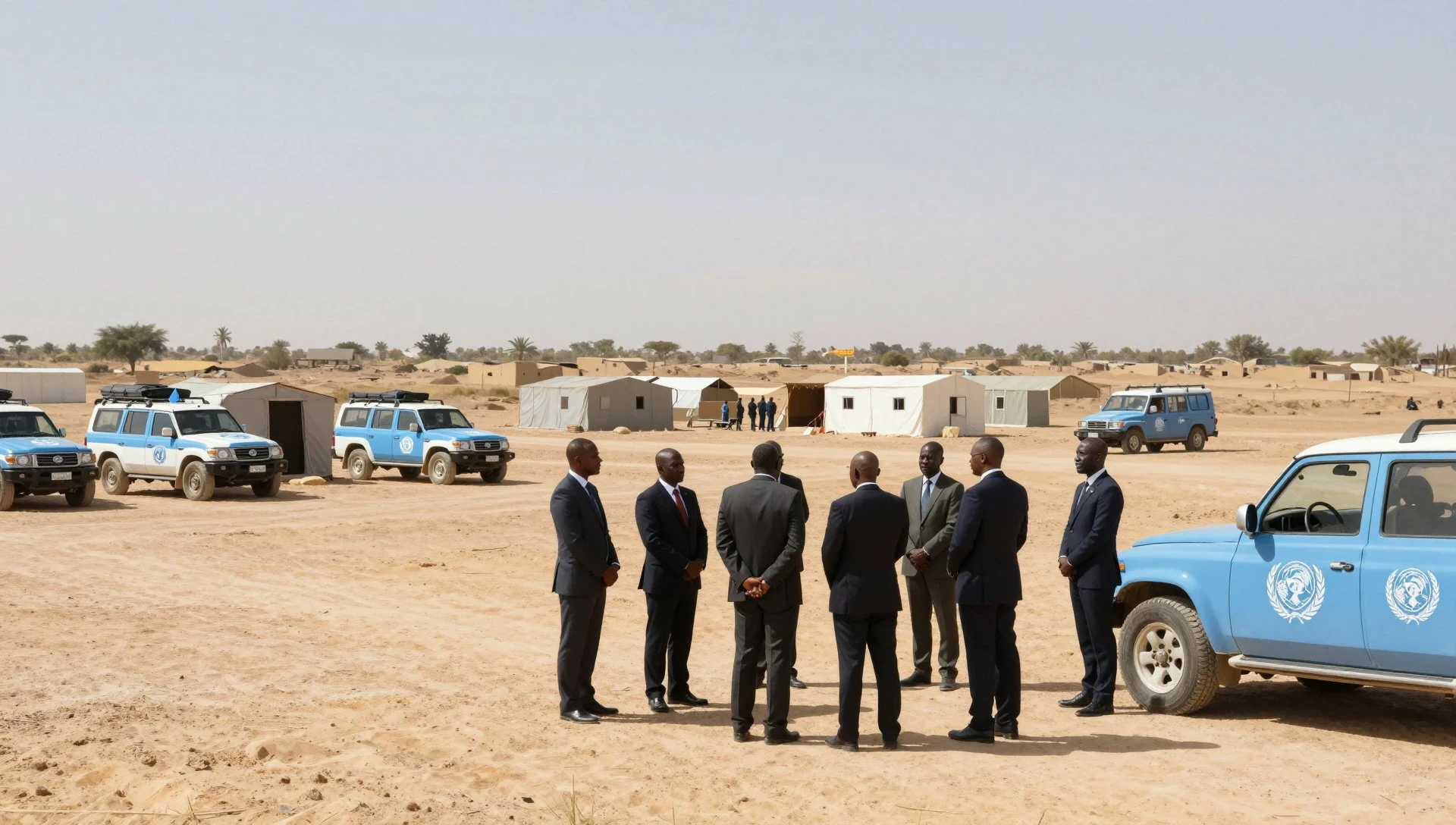
The United Nations political mission in Somalia formally concluded after more than three decades of successive deployments, and no agreed successor has been identified to mediate the disputes that still divide the country's rival leaders.
The closure marks the end of an unbroken institutional presence that began as a civilian political office in 1995 and evolved into a full advisory mission. Its departure leaves a contested presidency, an active insurgency and a deepening drought converging without a neutral broker in place.
The Somali government frames the transition as proof of sovereign capacity, having formally requested the closure in 2024. The Security Council approved a two-year handover of mission functions to Somali institutions and other UN bodies, a phased arrangement rather than an abrupt exit.
On This Page
- The Mission's Record: Three Decades of Institution-Building
- The Political Vacuum: Contested Mandates and No Mediator
- Security and Humanitarian Stress: The Insurgency and the Drought
- Al-Shabaab's Rural Control and Urban Attacks
- Drought, Displacement and Shrinking Aid
- Reading the Handover: Sovereignty Versus Capacity
- Risk Matrix: Political, Security and Humanitarian Exposure
- Comparative Lens: Other UN Transitional Exits
- Comparative UN Political Mission Exits
- What to Watch in the Two-Year Handover
- Handover Watchlist: Indicators and Thresholds
- Key Figures and Dates at a Glance
Yet opposition figures and independent analysts read the timing differently, noting that the president's legal right to remain in office is itself disputed and that Al-Shabaab continues to control large rural territories.
This analysis examines the mission's record, the institutional vacuum its departure creates, and the security and humanitarian pressures that will test Somali governance next. It weighs the government's sovereignty argument against the structural risks documented by analysts, and it situates the handover within Somalia's longer arc from state collapse in 1991 to the federal framework adopted in 2012. The evidence points to a transition whose political timing is more consequential than its administrative mechanics.
TL;DR The UN political mission in Somalia ended after more than 30 years, with no agreed replacement to mediate election disputes between rival leaders. The government calls the closure a sovereignty milestone; critics warn it coincides with a contested presidential mandate, an active Al-Shabaab insurgency and worsening drought. A two-year handover transfers advisory functions to Somali institutions and other UN bodies, while African Union troops and UN aid agencies remain. The core risk is not the loss of administrative support but the absence of a neutral mediator at a moment of acute political and humanitarian stress.
The Mission's Record: Three Decades of Institution-Building
Somalia's central government collapsed after dictator Mohamed Siad Barre was overthrown in 1991, and fighting among clan-based factions left the country without a functioning central authority. War and hunger devastated communities, prompting the United States to launch Operation Restore Hope in 1992 to protect famine relief deliveries.
The following year, 18 American soldiers died in the "Black Hawk Down" battle in Mogadishu, which helped end that US military mission.
UN peacekeepers withdrew in March 1995 without securing a lasting political settlement, and the organization pivoted to a civilian political office designed to encourage reconciliation. That office ultimately helped Somali leaders end the formal transitional period in 2012, when a provisional constitution was adopted, a new federal parliament formed and a president elected. Successive political missions then supported elections, justice institutions and regional administrations sharing power with the national government.
From Peacekeeping Failure to Political Advisory Role
The 1995 withdrawal established a durable template: the UN would advise rather than enforce. This shift reflected hard lessons from the peacekeeping era, when external troops became parties to clan conflict rather than arbiters of it.
The civilian office model proved more sustainable precisely because it carried no combat mandate and depended on Somali invitation rather than international imposition.
That advisory posture produced measurable institutional output over two decades. The 2012 framework ended a transitional period that had repeatedly extended itself, and it created the federal architecture that still structures Somali politics.
The mission's value lay less in enforcing outcomes than in convening rivals and supplying technical legitimacy to compromises Somali leaders had already accepted in principle.
Elections, Justice and Federalism Support
Successive missions supported electoral processes, justice institutions and the regional administrations that share power with Mogadishu. In 2016, the mission backed a regional team helping implement a ceasefire between forces from Puntland and Galmudug, two rival regional administrations in central Somalia.
Such interventions were technical and diplomatic rather than military, and they depended on both parties accepting UN facilitation.
Federalism support carried particular weight because Somalia's power-sharing model distributes authority between Mogadishu and member states. Disputes over that distribution have repeatedly threatened national cohesion, and the mission often served as the only accepted neutral convener.
Its departure removes a standing mechanism for managing those disputes before they escalate into armed confrontation between regional forces.
The Limits: Institutions Without Authority
Rebuilding institutions did not resolve disputes over political authority or secure government control across the country. Al-Shabaab, an Al-Qaeda-linked group, controls large rural areas and carries out attacks in Mogadishu and other cities.
An officer who survived an ambush in southern Somalia told the Associated Press that at least 20 soldiers were killed in the latest attack on Monday.
The government disclosed no troop casualties, and the reported figures could not be independently verified. That information asymmetry is itself instructive: security reporting remains contested, and casualty claims serve political as well as informational purposes.
Institutional reconstruction, in short, produced formal structures without the enforcement capacity or territorial reach that would make those structures authoritative.
The Political Vacuum: Contested Mandates and No Mediator
A dispute remains over whether President Hassan Sheikh Mohamud and parliament can legally stay in office. Under the previous four-year terms, Mohamud's mandate was due to end on May 15 and parliament's on April 14.
Parliament approved constitutional changes extending both terms to five years, a move that converts a technical question of tenure into a live constitutional controversy.
The departing mission had advised Somali leaders and helped resolve political disputes, a function that is difficult to replace through ordinary diplomacy. Its closure therefore removes the standing convener that rival factions had grown accustomed to using.
The government's sovereignty argument is coherent in principle, but it assumes that domestic institutions can absorb a mediation role they have not previously exercised independently.
Constitutional Term Extension and Its Discontents
Extending presidential and parliamentary terms from four years to five alters the electoral calendar and, by extension, the bargaining timeline among clans and federal member states. Opposition figures argue that a parliament cannot extend its own mandate without broader consensus, particularly when the sitting president's legitimacy is already contested. The legal text and the political settlement have diverged.
Constitutional amendments passed by parliament carry formal validity but limited legitimacy when major stakeholders are excluded. In Somalia's consociational system, durable outcomes require buy-in from federal member states and clan elders, not merely a parliamentary majority. The term extension thus risks being read as a unilateral consolidation rather than a neutral administrative adjustment.
Why a Neutral Broker Mattered
The mission's mediation value rested on its perceived neutrality and its institutional memory of prior compromises. When Puntland and Galmudug forces clashed in 2016, a UN-supported regional team helped implement a ceasefire that neither side could have brokered alone. That kind of facilitation requires a party trusted by both sides and unaligned with either.
Without such a broker, disputes over authority are more likely to be settled through pressure, patronage or force. Regional bodies and bilateral partners can mediate, but each carries its own strategic interests and is therefore viewed with suspicion by at least one faction. The absence of a standing neutral channel raises the cost of every future negotiation.
Regional Actors and the AU's Continuing Role
African Union troops will continue supporting Somali forces fighting militants, and UN aid agencies will remain in the country. A separate UN office will continue providing supplies, transport and other support to African Union troops and some Somali security units. These residual arrangements preserve logistics and combat support but not political mediation.
The distinction matters analytically: security support and political facilitation are different functions requiring different mandates and skill sets. The AU presence addresses the insurgency but cannot credibly arbitrate between Somali political rivals, given its combat role alongside government forces. The handover therefore preserves the coercive layer while removing the diplomatic one.
We Also Published
Security and Humanitarian Stress: The Insurgency and the Drought
Al-Shabaab's control of large rural areas and its urban attack campaign constitute the most immediate security constraint on Somali governance. The reported ambush in southern Somalia, in which an officer said at least 20 soldiers were killed, illustrates the persistence of lethal attacks despite years of international support. Government silence on casualties complicates independent assessment of the insurgency's current tempo.
Recurring drought and flooding compound the insecurity, and families have fled failed harvests and dead livestock as hunger deepens and aid funding shrinks. The humanitarian and security shocks reinforce each other: displacement weakens livelihoods, which increases recruitment pools for militants and strains already thin state capacity. The mission's closure lands squarely within this compounding crisis.
Al-Shabaab's Rural Control and Urban Attacks
The group's territorial footprint in rural areas gives it revenue, recruitment and freedom of movement that government forces have not reversed. Urban attacks in Mogadishu and other cities impose persistent security costs and undermine confidence in state protection. Counter-insurgency progress therefore depends on sustained external military support, which the AU continues to provide.
Yet military pressure alone has not produced a political settlement with insurgent factions, and the mission's advisory role in reconciliation is now absent. Analysts have long argued that Somalia's conflict requires a political track alongside the military one. Removing the neutral facilitator weakens that track precisely when the military campaign continues.
Drought, Displacement and Shrinking Aid
Recurring drought and flooding have displaced families dependent on livestock and rain-fed agriculture, and hunger is deepening as aid funding contracts. Humanitarian agencies remain in the country, but their capacity is constrained by financing rather than mandate. The result is a protection gap that widens as need rises.
Climate shocks are not episodic in Somalia but structural, and each failed season erodes coping mechanisms permanently. Aid funding shortfalls therefore translate directly into excess mortality and displacement. The political mission's departure does not cause this crisis, but it removes a coordinating actor accustomed to linking humanitarian and political analysis.
Reading the Handover: Sovereignty Versus Capacity
The government's characterization of the closure as a milestone in managing its own affairs reflects a legitimate aspiration and a defensible reading of the 2024 request. Sovereignty arguments carry real weight, and indefinite international missions can substitute for rather than build domestic institutions. The question is whether capacity exists at the moment of transfer.
The evidence suggests a mixed picture: formal institutions exist, but authority over territory and political disputes remains contested. A two-year handover period provides a window for building mediation capacity, though no mechanism has been agreed to do so.
Whether the transition proves durable will depend less on the paperwork than on whether Somali leaders can resolve the mandate dispute without an external convener.
Comparative Lens: Other UN Transitional Exits
Comparable UN political missions have closed in Liberia, Sierra Leone and Timor-Leste, generally after sustained peace and functioning electoral transfers. The common precondition was a political settlement accepted by rival elites before departure. Somalia's closure differs because the mandate dispute remains unresolved and the insurgency is active.
Timor-Leste's transition succeeded because security had stabilized and political rivals had agreed on rules. Liberia's mission drew down after successive peaceful elections transferred power between parties. Somalia lacks both conditions, which makes the timing of its handover the central analytical question rather than the handover itself.
What to Watch in the Two-Year Handover
Three indicators will reveal whether the handover builds capacity or merely transfers paperwork. First, whether Somali institutions convene rival leaders over the mandate dispute without external facilitation. Second, whether federal member states accept the term extension or contest it through institutional channels. Third, whether aid funding stabilizes enough to prevent drought-driven displacement from accelerating.
A fourth indicator concerns security: whether AU support transitions to Somali-led operations without loss of territorial control. Each indicator is observable and time-bound within the two-year window. Together they offer a practical test of the sovereignty argument the government has advanced, and they will determine whether the closure is remembered as a milestone or a missed transition.
From our network :
- The Hidden Cost of AI Convenience: Why Over-Permissioned Agents Are a Security Time BombDiscover why AI agents with excessive permissions create dangerous single points of failure, and learn how implementing least privilege principles can protect your organization from exploitation.
- Mobile Learning and VR in English: What Global Evidence Reveals About Effective Language TechnologyA systematic review across 14 countries reveals which language-learning technologies genuinely work. Mobile learning, AI, and VR show measurable benefits when pedagogically integrated. This evidence-based guide helps educators and learners select technology that delivers real return on investment.
- University Language Proficiency Exams: Why Institutional Tests Demand Different Preparation Than IELTS and TOEFLDiscover why university-specific language proficiency examinations differ fundamentally from IELTS and TOEFL, and learn strategic preparation approaches for institutional assessment success.
- Committed Mediterranean Precipitation Decline: Why Emissions Cuts Alone Cannot Restore Winter RainsNew NOAA research reveals that Mediterranean winter rains may decline irreversibly even with emissions cuts. Explore the science of committed climate change and regional impacts.
- How AI Agents Will Change the Way We Manage Personal FinancesExplore how AI agents are transforming personal finance through automated budgeting, bill payment, and investment management, while examining the critical security protocols and governance frameworks required for safe deployment.
- Forbidden Matrix Patterns and Visible Lattice Points: A Geometric DictionaryExplore how multidimensional 0–1 matrices encode geometric truths, linking forbidden patterns to visible lattice points and hypergraph theory, with applications in combinatorics and computational geometry.
- The Final Descent: How ESA Retired the Legendary Cluster Constellation After 24 Years of Space Weather ScienceAfter 24 years mapping Earth’s magnetosphere, ESA’s Cluster mission concluded with a precisely controlled reentry over the South Pacific. This analysis explores the scientific legacy, engineering decisions, and debris mitigation principles behind one of space exploration’s most responsible retirements.
- Live Online English Classes for Kids: Do They Actually Reduce Anxiety?A ten-week study reveals that synchronous online English classes can significantly reduce child language anxiety while improving listening and reading skills. Discover what makes these programs effective and how parents can select the right one.
- CISA’s Ten-Advisory Wave: Why Generic Patching Fails in OT and How to Build Product-Specific PlaybooksCISA released ten ICS advisories in one week, exposing critical infrastructure risks. Generic patching fails in OT. Learn to build product-specific remediation playbooks.
RESOURCES
- UN political mission leaves Somalia after 31 years | AP Newsapnews.com4 days ago ... UN political mission ends in Somalia with no agreed replacement to handle election dispute ... closing more than three decades…
- UN political mission ends in Somalia with no agreed replacement to ...washingtonpost.com4 days ago ... An unresolved election dispute drags on. A dispute remains over whether President Hassan Sheikh Mohamud and parliament can legally stay…
- Africa Media Review for October 29, 2026africacenter.orgUN Political Mission Ends in Somalia with No Agreed Replacement to Handle Election Dispute ... political mission in Somalia ends Saturday, closing more ...
- UN political mission ends in #Somalia amid unresolved election ...facebook.com4 days ago ... Daily_Brief: #UN political mission ends in #Somalia amid unresolved election dispute Addis Abeba — The United Nations' political mission in ...
- UN political mission ends in Somalia with no agreed replacement to ...ca.news.yahoo.com4 days ago ... ... political mission in Somalia closes Saturday ... UN political mission ends in Somalia with no agreed replacement to handle…
- UN political mission ends in #Somalia amid unresolved election ...addisstandard.com2 days ago ... The closure comes amid an unresolved dispute over President Hassan Sheikh Mohamud's tenure, continued fighting against Al-Shabaab militants and ...
- Conflict With Al-Shabaab in Somalia - Council on Foreign Relationscfr.orgThe UN Transitional Assistance Mission in Somalia closes on October 31; the mission was charged with resolving political disputes ... elections for April ...
- International partners urge resolution of political dispute, focus on ...unsom.unmissions.orgOct 2, 2021 ... Closure of UNSOM. The United Nations Assistance Mission in Somalia (UNSOM) was established on 3 June 2013. Its mandate ended…
- Special Political Missions | Security Council - the United Nationsmain.un.orgThe United Nations Political Office for Somalia (UNPOS) was established ... closure of the United Nations Mission for Justice Support in Haiti (MINUJUSTH).
- Somalia Faces a Mediation Gap as the UN Political Mission Closesgeostrategicmedia.com2 days ago ... The Associated Press reports that the mission is closing without an agreed replacement to mediate disputes between the federal government…
- Consideration of the situation in Somalia and AUSSOM Operationsamaniafrica-et.orgDec 14, 2025 ... ... Mission in Somalia (AUSSOM). The session is expected to begin ... political and security matters, including the 2026 elections.…
- UNTMIS Leaves Somalia on 31 October With the Constitution and ...thesomalidigest.com4 days ago ... UNTMIS, the UN political mission Mogadishu asked to leave, closes on 31 October with the constitution, the election timetable and…
- Following Contentious Debate, Security Council Fails to Adopt ...press.un.org3 days ago ... The future of the United Nations peacekeeping mission in the disputed ... mission and risks setting back progress on the…
- Thirty-Four years of the UN in Somalia, and a debt scare that isn'tsomalia.substack.com2 days ago ... The last UN political mission closes today. It deserves an honest farewell. · UN Secretary-General spokesperson, 26 Oct 2026: ·…
- UN Political Mission Ends in Somalia with No Agreed Replacement ...capitalethiopia.com1 day ago ... UN Political Mission Ends in Somalia with No Agreed Replacement to Handle Election Dispute ... mission in Somalia ends Saturday,…
- 01
- 02
- 03
- 04
- 05
- 06
- 07
- 08
0 Comments