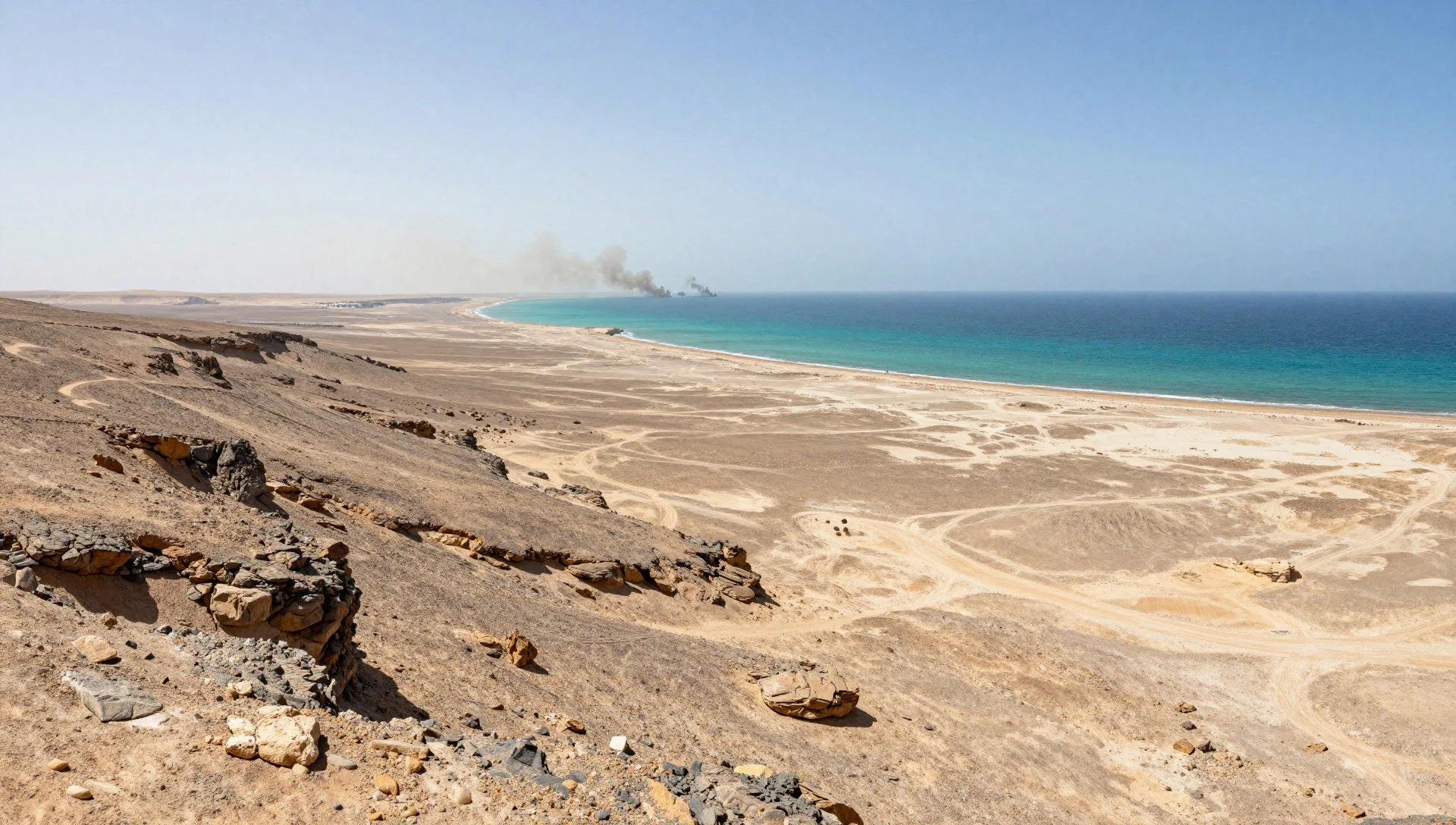
A terse Sky News bulletin, dated 3 November 2026 and filed for North American and United Kingdom audiences, reports that the United States military conducted what it characterised as limited strikes on Qeshm Island in Iran. The strikes occurred hours before the US midterm elections were scheduled to open.
The original dispatch supplied no detail on targets, casualties, munitions, or official justification, leaving interpretation to inference and context.
That scarcity of information is itself the story. When a government attaches the word "limited" to a use of force, it is making a political claim as much as a military one, signalling intended restraint while preserving escalation options.
On This Page
- The Strategic Geography That Makes Qeshm Consequential
- Reading the Word "Limited" as Strategic Communication
- The Electoral Calendar and the Domestic Politics of Force
- Iran's Response Options and the Escalation Ladder
- Markets, Energy Security, and the Hormuz Risk Premium
- Verification, Law, and the Duty of Care in Reporting
- What the Silence Reveals and What Comes Next
The timing, compressed against a national vote, invites scrutiny of motive, message discipline, and the domestic political economy of military action.
This analysis reconstructs the episode's meaning from open-source logic, historical precedent, and the strategic geography of the Persian Gulf. It examines Qeshm's position at the Strait of Hormuz, the signalling grammar of calibrated strikes, the electoral calendar, and the legal and market consequences that follow when ambiguity is deliberately maintained.
TL;DR The United States struck Qeshm Island in Iran hours before midterm elections, describing the action as limited and releasing no further detail. The episode is best read as a signalling exercise: a calibrated use of force designed to demonstrate capability and resolve while capping escalation risk and shaping domestic political perception. Qeshm's location at the Strait of Hormuz gives any strike there outsized strategic weight, and the deliberate ambiguity around targets and casualties preserves leverage. Markets, allies, and legal observers will parse the silence as carefully as the strike itself.
The Strategic Geography That Makes Qeshm Consequential
Qeshm is Iran's largest island, positioned in the Strait of Hormuz, the chokepoint through which roughly a fifth of global petroleum liquids transit by sea. Any military action on or near Qeshm therefore carries weight far beyond its landmass, because the island sits astride the world's most consequential energy corridor.
Why the Strait of Hormuz Amplifies Every Signal
The strait narrows to a few kilometres of navigable channel, and Iran has long cultivated the capacity to disrupt shipping through mines, fast attack craft, and coastal defence systems. A strike on Qeshm implicitly references that capability, reminding Washington's adversaries and partners alike of the stakes embedded in the waterway.
Energy markets treat Hormuz risk as a premium embedded in tanker rates, insurance, and crude pricing. Even a limited strike that leaves shipping untouched can move those variables, because traders price the probability of escalation rather than the strike's immediate physical effects on infrastructure or transit.
The Island's Military and Civilian Dual Character
Qeshm hosts civilian infrastructure, including a free trade zone, alongside facilities associated with Iran's maritime and aerospace forces. That duality complicates targeting claims and explains why a government might withhold detail: specificity invites verification, and verification invites dispute over civilian harm.
Iranian authorities have historically publicised or minimised damage depending on political need, while independent monitors struggle to confirm claims in restricted areas. The absence of casualty figures in the initial report is therefore not unusual; it is the default condition of early reporting on strikes in denied environments.
Reading the Word "Limited" as Strategic Communication
Official language in armed conflict is rarely accidental. Calling a strike "limited" tells domestic audiences that escalation is not intended, tells adversaries that restraint is conditional, and tells allies that consultation, however compressed, occurred. The adjective functions as a boundary marker around an otherwise open-ended act.
The Grammar of Calibrated Force
Calibrated strikes follow a recognisable pattern: a discrete target set, a short duration, and a public statement that pairs the action with a rationale. When the rationale is withheld, the signal becomes the strike itself, and interpretation is delegated to the adversary, the market, and the electorate.
Scholars of coercive diplomacy describe this as costly signalling, where a state accepts some risk to demonstrate resolve credibly. The cost need not be large; it must be visible. A strike on Qeshm is visible, geographically legible, and deniable in scope, which is precisely what makes it useful.
Ambiguity as Leverage
Withholding target and casualty information preserves optionality. If damage proves modest, Washington can claim proportionality; if Iran retaliates, the initial silence becomes evidence of forbearance. Ambiguity also denies adversaries the propaganda material that confirmed civilian harm would supply.
Iran faces a parallel calculation. A muted response risks appearing weak domestically; an escalatory response risks inviting further strikes. Tehran's public statements in the hours after such incidents typically emphasise defiance while leaving the operational response unspecified, mirroring the ambiguity it confronts.
The Electoral Calendar and the Domestic Politics of Force
Timing is the most legible fact in the report. Strikes hours before midterm elections place the action inside a domestic political frame whether or not policymakers intended it. Voters, opponents, and commentators will inevitably read the operation through partisan lenses, and the administration's silence amplifies rather than suppresses that reading.
Rally Effects and Their Limits
Political science has long documented rally-round-the-flag effects, where public approval of a president rises briefly after military action. The effect is typically modest, short-lived, and strongest when the action is framed as defensive and bipartisan support materialises quickly.
A limited strike with no announced rationale struggles to generate a durable rally. It may energise a base already inclined toward toughness, while opponents characterise it as a distraction or an abuse of incumbency. The net electoral effect is therefore uncertain and probably small.
Incumbency, Information, and Accountability
Democratic accountability depends on information, and the report supplies almost none. Legislators from both parties will demand briefings; oversight committees will ask whether the action fell within existing authorisations. The answers will shape whether the strike is remembered as statesmanship or as improvisation.
International law adds another layer. Under the UN Charter, uses of force require either Security Council authorisation or a credible claim of self-defence. A strike described only as "limited" leaves the legal basis unstated, inviting allies to distance themselves and lawyers to debate proportionality after the fact.
Iran's Response Options and the Escalation Ladder
Tehran's reply will determine whether the episode remains a footnote or becomes a turning point. Iran has historically favoured asymmetric responses, calibrated to impose costs without triggering overwhelming retaliation. Its options range from rhetorical condemnation to proxy action, maritime harassment, or a direct missile response.
Asymmetric Retaliation and Deniability
Iran's network of aligned groups across the region offers plausible deniability and graduated pressure. Attacks on shipping, drone incursions, or strikes on US facilities in neighbouring states can signal resolve while keeping the confrontation below the threshold of open war between capitals.
Each rung on the escalation ladder carries risk of miscalculation. A proxy attack that kills personnel invites a larger American response; a maritime incident that disrupts oil flows draws in global powers. Tehran must weigh domestic credibility against the danger of a spiral it cannot control.
Diplomacy as Cover and Off-Ramp
Oman and Qatar have historically served as channels between Washington and Tehran, and both have strong incentives to prevent a Hormuz crisis. Quiet mediation may already be underway, offering each side a face-saving exit that converts a strike into a bargaining chip.
For Iran, a diplomatic off-ramp can be framed domestically as resistance rewarded; for Washington, it can be framed as deterrence restored. The viability of that framing depends on how much detail eventually emerges about what the strikes actually hit and why.
- 01
- 02
- 03
- 04
Markets, Energy Security, and the Hormuz Risk Premium
Financial markets process geopolitical ambiguity faster than governments clarify it. Crude benchmarks, tanker insurance, and Gulf equity indices will react to the strike within hours, pricing a probability distribution over escalation rather than a single expected outcome. Volatility itself becomes the tradable variable.
How Traders Price Unclear Intentions
When details are scarce, traders widen confidence intervals. Options markets for crude oil will show elevated implied volatility, and shipping insurers will reassess war-risk premiums for Hormuz transits. These moves can reverse quickly if de-escalation signals appear.
Equity markets in the Gulf, particularly Saudi and Emirati indices, are sensitive to regional security perceptions. A limited strike that leaves infrastructure untouched may produce only a brief dip, but a retaliatory cycle would reprice sovereign risk across the region.
Energy Infrastructure and Chokepoint Exposure
Qeshm's proximity to shipping lanes means even symbolic strikes carry infrastructural implications. Insurers, charterers, and refiners will model scenarios involving partial closure, convoy escorts, and rerouting, each of which raises delivered costs for Asian and European buyers.
The strategic petroleum reserves of major importers provide a buffer, but buffers are finite and psychological. A sustained risk premium at Hormuz functions as a tax on global growth, transmitted through freight, fuel, and food prices to consumers far from the Gulf.
Verification, Law, and the Duty of Care in Reporting
The report's brevity raises a professional question for journalists and analysts: how should consequential security events be reported when verified detail is absent? The responsible answer is to state clearly what is known, attribute claims to their source, and resist the temptation to fill gaps with speculation dressed as fact.
Open-Source Verification in Denied Environments
Analysts will turn to satellite imagery, flight-tracking data, maritime traffic patterns, and local social media to corroborate the strike. Each source carries its own reliability profile, and conclusions should be expressed with explicit confidence levels rather than asserted as certainty.
Timing claims are especially checkable. If the strike occurred hours before polls opened, aircraft movements and official statements should align with that window. Discrepancies between allied capitals' accounts would themselves be informative about consultation and coordination.
Legal Frameworks and Accountability
International humanitarian law requires distinction between military objectives and civilian objects, and proportionality in assessing incidental harm. Without target details, outside observers cannot evaluate compliance, which is precisely why transparency obligations matter after hostilities.
Domestic law in the United States adds reporting requirements to Congress under the War Powers framework. The administration's eventual notification will reveal whether the action was treated as a discrete counterterrorism operation or as something requiring broader authorisation.
What the Silence Reveals and What Comes Next
The most instructive feature of this episode is its informational restraint. A government confident in its legal and strategic position usually explains itself; a government managing multiple audiences simultaneously often does not. The silence is a calculated allocation of ambiguity across domestic, regional, and international constituencies.
Scenarios for the Coming Weeks
Three broad paths are plausible. In the first, Iran responds symbolically and both sides step back, allowing the strike to fade into the background of the electoral aftermath. In the second, proxy violence escalates gradually, producing a slow-burn crisis.
The third path, direct confrontation, remains least likely but most consequential. It would require a miscalculation on either side, and the compressed timeline around the vote reduces the space for careful signalling. Diplomacy's task is to widen that space before it closes.
Questions That Will Define the Record
Was Congress briefed in advance, and under what authority? Did allies receive notice, and did any object? What precisely was struck, and what evidence supports the claim of limited scope? The answers will determine how history files this episode.
Until those answers arrive, professional judgment counsels precision about uncertainty. The strike happened; its meaning is contested; its consequences are contingent. Readers deserve that clarity rather than confident narrative built on a single terse bulletin.
From our network :
- University Language Proficiency Exams: Why Institutional Tests Demand Different Preparation Than IELTS and TOEFLDiscover why university-specific language proficiency examinations differ fundamentally from IELTS and TOEFL, and learn strategic preparation approaches for institutional assessment success.
- Mobile Learning and VR in English: What Global Evidence Reveals About Effective Language TechnologyA systematic review across 14 countries reveals which language-learning technologies genuinely work. Mobile learning, AI, and VR show measurable benefits when pedagogically integrated. This evidence-based guide helps educators and learners select technology that delivers real return on investment.
- Live Online English Classes for Kids: Do They Actually Reduce Anxiety?A ten-week study reveals that synchronous online English classes can significantly reduce child language anxiety while improving listening and reading skills. Discover what makes these programs effective and how parents can select the right one.
- The Hidden Cost of AI Convenience: Why Over-Permissioned Agents Are a Security Time BombDiscover why AI agents with excessive permissions create dangerous single points of failure, and learn how implementing least privilege principles can protect your organization from exploitation.
- How AI Agents Will Change the Way We Manage Personal FinancesExplore how AI agents are transforming personal finance through automated budgeting, bill payment, and investment management, while examining the critical security protocols and governance frameworks required for safe deployment.
- The Final Descent: How ESA Retired the Legendary Cluster Constellation After 24 Years of Space Weather ScienceAfter 24 years mapping Earth’s magnetosphere, ESA’s Cluster mission concluded with a precisely controlled reentry over the South Pacific. This analysis explores the scientific legacy, engineering decisions, and debris mitigation principles behind one of space exploration’s most responsible retirements.
- CISA’s Ten-Advisory Wave: Why Generic Patching Fails in OT and How to Build Product-Specific PlaybooksCISA released ten ICS advisories in one week, exposing critical infrastructure risks. Generic patching fails in OT. Learn to build product-specific remediation playbooks.
- Committed Mediterranean Precipitation Decline: Why Emissions Cuts Alone Cannot Restore Winter RainsNew NOAA research reveals that Mediterranean winter rains may decline irreversibly even with emissions cuts. Explore the science of committed climate change and regional impacts.
- Forbidden Matrix Patterns and Visible Lattice Points: A Geometric DictionaryExplore how multidimensional 0–1 matrices encode geometric truths, linking forbidden patterns to visible lattice points and hypergraph theory, with applications in combinatorics and computational geometry.
RESOURCES
- U.S. military carries out limited strikes on Iran's Qeshm Island, U.S. ...nbcnews.com11 hours ago ... The strikes, which appeared to be limited as opposed to a full return to hostilities, came on the eve of…
- U.S. strikes Iranian targets in Strait of Hormuz, U.S. official tells APpbs.org16 hours ago ... ... U.S. official said Monday, on the eve of crucial midterm elections. Iranian state television reported that explosions were heard…
- US strikes Iranian island ahead of midterm elections - BBCbbc.com8 hours ago ... US officials described the attacks on Qeshm Island as limited and defensive, according to CBS, the BBC's US partner.
- US strikes Iran's Qeshm Island as Vance voices optimism about a dealtheguardian.com16 hours ago ... The US launched limited strikes on Iran's Qeshm Island late on ... Iranian attacks on US planes had been mounted…
- U.S. Strikes Iran's Qeshm Island as Trump Talks Down War Riskswsj.com17 hours ago ... The U.S. attacked Iran's Qeshm Island on Monday, U.S. officials said, in the latest of a series of limited strikes…
- U.S. military carries out limited strikes on Iran's Qeshm Islandnbclosangeles.com14 hours ago ... The officials said the U.S. attacks, which came on the eve of crucial U.S. midterm elections and as the Middle…
- US military conducts strikes on Iran's Qeshm Island in ... - CNNcnn.com17 hours ago ... Earlier this month, Trump said that the US would not attack Iran before the midterms, but did not rule out…
- U.S. strikes Iran's Qeshm Island as Vance seeks settlement - CNBCcnbc.com16 hours ago ... U.S. military carried out attacks on Iran's Qeshm Island on Monday, even as the Trump administration has been underplaying war…
- The US military carried out limited strikes on Iran's Qeshm Island on ...facebook.com8 hours ago ... What did they defend in Iran? 4h · 8 likes. Jason Gann. Another war won right before midterms tomorrow. 7h…
- Limited US defensive strikes reported in Strait of Hormuz amid ...abcnews4.com17 hours ago ... Iranian state television reported that explosions were heard on Qeshm Island. ... U.S. wouldn't launch strikes on Iran before the…
- US strikes Iran's Qeshm Island on eve of midterm electionsafricanews.com13 hours ago ... The strikes appeared to be limited as opposed to a return to full hostilities but followed President Donald Trump previously…
- The US military carried out limited strikes on Iran's Qeshm Island on ...instagram.com8 hours ago ... ... Iran never gets a nuclear weapon. Trump has said he won't strike before the midterms, and US officials reportedly…
- US carries out 'defensive' strikes on Iran's Qeshm Island, officials sayreuters.com18 hours ago ... The strikes appeared to be limited and were not a resumption of major combat operations, a US official said.
- US carried out limited, defensive strikes on Iran's Qeshm Islandwrtv.com17 hours ago ... Earlier this month, Trump said that the U.S. would not attack Iran before the midterms, but did not rule out…
- U.S. Military Strikes Iran's Qeshm Island in What U.S. Officials Call a ...nytimes.com3 hours ago ... The action was limited, the officials said, with no immediate plans to escalate. The strikes come on the eve of…
- 01
- 02
- 03
- 04
- 05
- 06
- 07
- 08
0 Comments