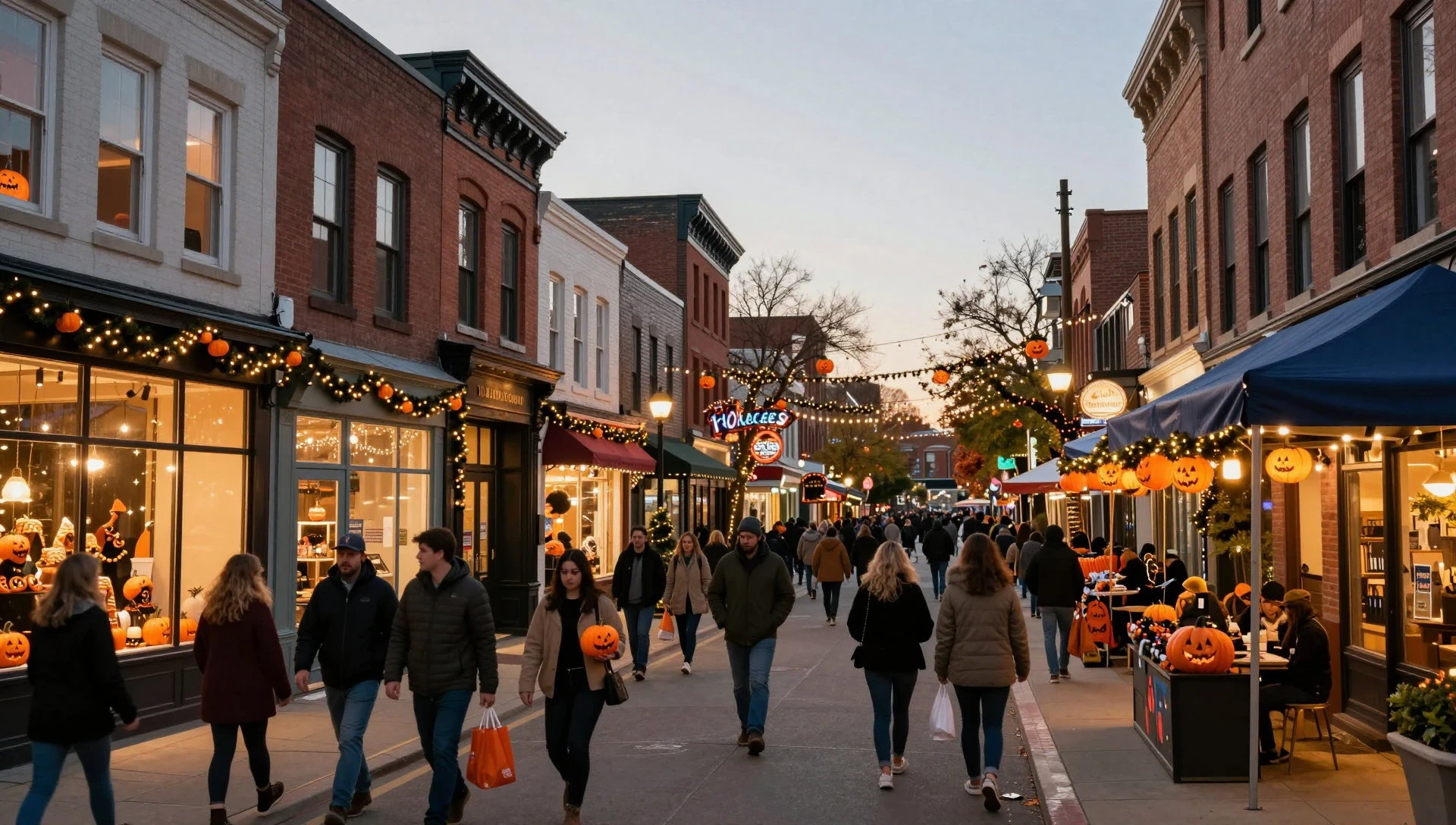
Downtown Windsor’s Halloween night tells a story far larger than costumes and candy. A local business owner, speaking to CTV News, described a core bustling with crowds and, more tellingly, regaining its commercial rhythm after years of uneven recovery.
That single observation carries weight because it frames a question every mid-sized North American city is wrestling with: how does a downtown prove it is genuinely back?
The report is deliberately modest. It offers no sales figures, no footfall counts, no year-over-year comparisons. What it does provide is qualitative testimony from someone with direct commercial exposure to the district.
On This Page
Read carefully, that testimony functions as an early signal, the kind of anecdotal evidence that often precedes hard data by a quarter or two in urban retail cycles.
This analysis unpacks what the Windsor report actually communicates, why Halloween matters disproportionately to downtown economies, and how business owners, planners, and investors should interpret momentum claims that arrive without numbers attached.
The aim is not to inflate a single evening into a trend, but to place it inside the broader mechanics of downtown revitalization across North America.
TL;DR A downtown Windsor business owner told CTV News that Halloween night drew large crowds and that the core is "gaining momentum," though no sales or visitor figures were disclosed. The remark is best read as qualitative sentiment rather than measured performance. Halloween functions as a low-cost, high-visibility stress test for downtown districts, generating footfall that reveals pedestrian infrastructure, safety perception, and merchant coordination. Without hard data, the claim should be treated as an encouraging leading indicator that requires validation through subsequent reporting, municipal footfall counters, and merchant revenue trends.
What the Windsor Report Actually Says, and What It Leaves Out
The source material is a short television news item, and its brevity is itself informative. A single business owner characterized downtown Windsor as busy on Halloween evening and described the district as finding its rhythm again. No figures on sales, visitor counts, or spending were included in the report.
The Evidentiary Weight of a Single Voice
One owner’s impression is not a dataset, but it is not nothing either. Merchants sit at the point where pedestrian traffic converts, or fails to convert, into revenue. Their read on an evening’s atmosphere often captures texture that turnstile counters miss entirely, including dwell time and spending confidence.
Still, professional discipline requires labeling this correctly. It is sentiment evidence, gathered informally and reported without methodology. Analysts should treat it as a hypothesis-generating signal, useful for framing questions about Windsor’s recovery, but insufficient on its own to support claims about district-wide performance.
Why the Absence of Numbers Matters
Downtown revitalization debates are frequently distorted by anecdote in both directions. Optimists cite crowded evenings; pessimists cite vacant storefronts. Neither claim survives scrutiny without measurement. The Windsor report sits firmly in the anecdotal column, which makes it honest but limited.
That limitation is not a criticism of the reporting. Television news operates on compressed timelines and often relies on available voices. The professional takeaway is that readers should mentally tag such claims as unverified, then watch for the quantitative follow-up that either confirms or complicates the narrative.
Halloween as a Stress Test for Downtown Retail Districts
Halloween occupies a peculiar position in the retail calendar. It generates concentrated evening footfall without requiring heavy consumer spending, which makes it an unusually clean test of whether people feel safe and willing to come downtown after dark. Crowds on October 31 signal permission, not just festivity.
The Economics of a Single Evening
Direct Halloween spending in Canada is modest relative to the winter holidays, but the evening’s value lies elsewhere. Restaurants, bars, and convenience retailers capture incremental traffic from families and revellers moving through the core. The real return is the impression created for future visits.
For a district rebuilding its reputation, a well-managed Halloween delivers marketing that money struggles to buy. Visitors who experience a lively, orderly downtown on a festive night update their mental map of the area. That perceptual shift can influence where they shop, dine, and spend on ordinary weekends for months afterward.
Safety Perception and Pedestrian Confidence
Downtown recovery in North American cities is frequently constrained less by retail supply than by perception. Empty sidewalks breed hesitation; crowded ones breed confidence. Halloween temporarily inverts the usual evening pattern, filling streets with people whose presence reassures the next wave of visitors.
That dynamic explains why business owners instinctively cite crowd size rather than revenue. Crowds are visible proof that the district’s social infrastructure, its lighting, policing, transit access, and event coordination, is functioning. When those systems hold on a busy night, merchants read it as evidence the core can handle growth.
The "Gaining Momentum" Claim in Context
The phrase gaining momentum deserves scrutiny because it implies direction over time. Momentum language suggests a district that has passed its lowest point and is now accumulating positive change. In Windsor’s case, that framing aligns with a broader North American pattern of downtown cores recovering unevenly after pandemic-era disruption.
What Momentum Means for Commercial Real Estate
For landlords and prospective tenants, momentum translates into negotiating leverage. A district perceived as rising can support higher rents and shorter vacancy periods. Conversely, a district stuck in narrative limbo struggles to attract the anchor tenants that would confirm its recovery.
This is why qualitative claims carry commercial consequences. When a business owner tells television cameras the core is finding its rhythm, that statement enters the local investment conversation. It reassures existing leaseholders and signals to outside operators that the district’s risk profile may be improving.
Distinguishing Recovery From Seasonal Noise
A single festive evening cannot establish a trend. Downtowns routinely fill on Halloween, New Year’s Eve, and during summer festivals, then empty again. The professional question is whether the crowd represents a seasonal spike or part of a rising baseline that persists into ordinary Tuesdays.
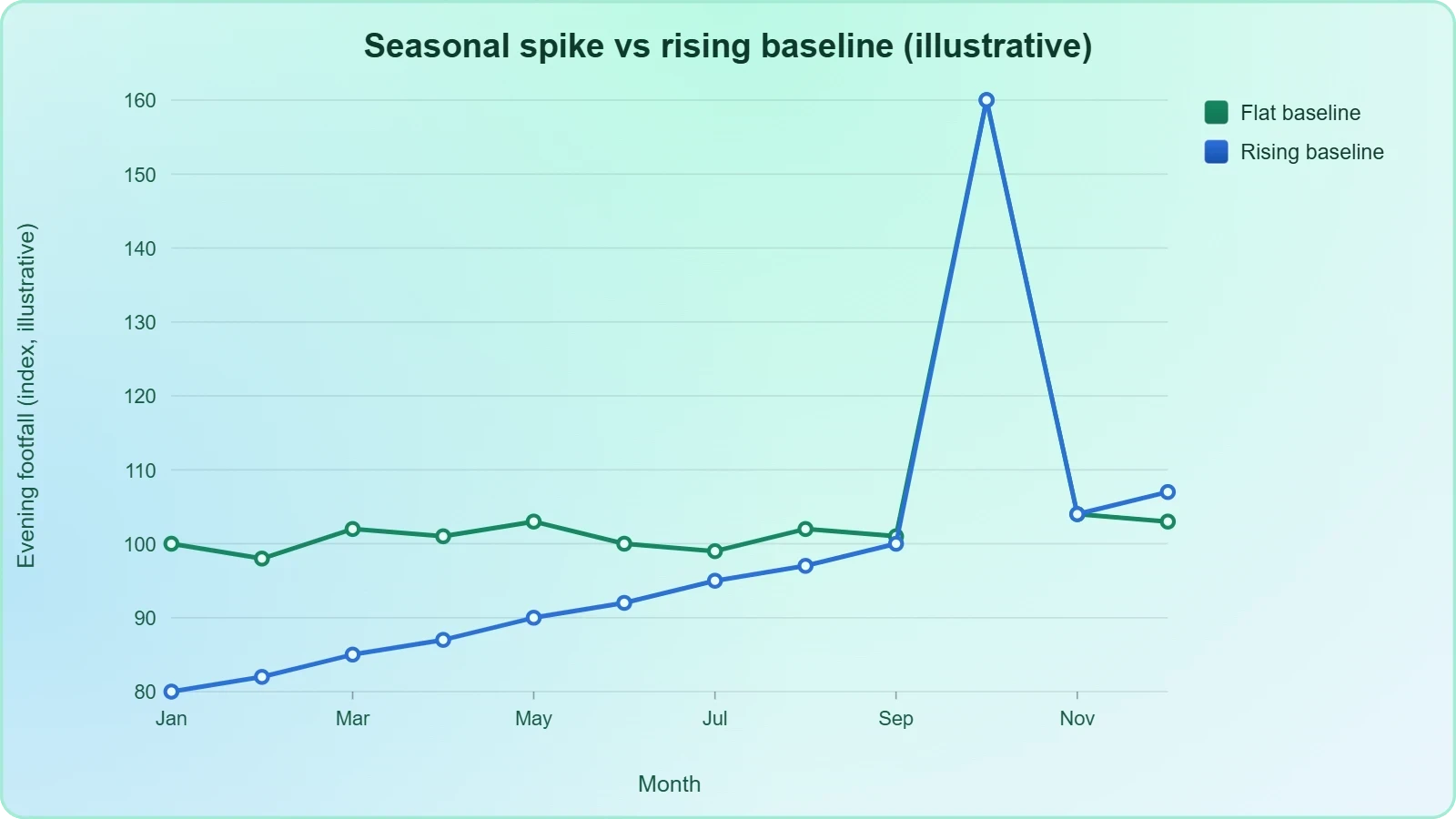
Answering that requires longitudinal data: monthly footfall counts, vacancy rates, transit ridership, and merchant revenue. Windsor’s report supplies none of these, so the momentum claim remains plausible but unproven. It is a signal worth tracking, not a conclusion worth banking on.
How Mid-Sized Cities Rebuild Their Cores
Windsor belongs to a category of mid-sized North American cities whose downtowns depend heavily on local patronage rather than tourism. These districts cannot rely on destination retail or international visitors. Their recovery hinges on residents choosing the core over suburban alternatives for dining, entertainment, and services.
Events as Anchors for Habit Formation
Festivals and seasonal events serve a strategic function beyond immediate revenue. They create occasions that pull residents downtown who might otherwise default to suburban shopping centres. Repeated positive experiences gradually rebuild the habit of visiting the core, which is the foundation of durable recovery.
Halloween fits this model neatly because it requires minimal commercial infrastructure. Streets, storefronts, and a bit of coordination suffice. The low barrier to entry means even a district in early recovery can host a credible event, generating the crowd density that signals vitality to both residents and prospective tenants.
The Coordination Problem Behind Every Crowded Night
Crowds do not assemble by accident. A busy Halloween implies functioning coordination among merchants, police, transit agencies, and property owners. Lighting, road closures, waste management, and security all must align. When they do, the district demonstrates operational competence that reassures future investors.
That coordination is often invisible in news coverage, yet it is the real asset. A downtown that can manage a festive evening smoothly has built institutional muscle it can deploy for larger events, seasonal markets, and the everyday street-level management that keeps a core attractive.
- 01
- 02
- 03
- 04
Reading Local Business Sentiment Without Overreaching
Business sentiment is a legitimate economic input, but it requires careful handling. Surveys such as those published by central banks and industry associations show sentiment often leads hard data by several months. An owner’s optimism can therefore be an early warning of improvement, or a lagging echo of a good night.
Triangulating Anecdote With Data
The professional approach is triangulation. Pair merchant sentiment with municipal footfall counters, point-of-sale aggregates, and commercial vacancy statistics. When multiple independent sources point the same direction, confidence rises. When they diverge, the anecdote deserves skepticism rather than amplification.
Windsor’s report offers only the first leg of that triangle. That does not make it worthless; it makes it a starting point. Readers should note the claim, then watch whether subsequent coverage includes the numbers that would confirm or complicate the owner’s impression of a district finding its rhythm.
Why Local Media Coverage Shapes Recovery
Local television coverage exerts an influence that extends beyond information. Positive portrayals of a downtown encourage residents to visit and reassure businesses considering relocation. Negative coverage does the reverse. Media narratives thus become part of the recovery mechanism itself, not merely a record of it.
This creates a responsibility for both journalists and readers. Reporters should seek quantification where possible; audiences should distinguish enthusiasm from evidence. A balanced diet of qualitative color and hard numbers produces the clearest picture of whether a downtown’s momentum is real or rhetorical.
What Comes Next for Windsor’s Core
The most useful reading of the Windsor report is forward-looking. A crowded Halloween and an owner’s optimism establish a baseline expectation: that the district will build on the evening rather than treat it as an isolated success. The next twelve months will reveal whether momentum compounds or fades.
Turning One Good Night Into a Pattern
Sustainable recovery depends on repetition. Districts that string together consistent event programming, reliable street maintenance, and a stable tenant mix convert occasional visitors into regulars. Windsor’s challenge is to make the Halloween experience representative rather than exceptional.
Business improvement associations and municipal economic development offices typically hold the levers here. Coordinated marketing, small grants for storefront improvements, and predictable event calendars all help. The goal is a downtown where a busy evening no longer merits a news story because it has become unremarkable.
The Metrics That Will Settle the Question
Ultimately, data will settle what sentiment can only suggest. Windsor’s downtown recovery will be confirmed when weekday footfall rises, vacancy falls, and merchants report growth across ordinary months. Until then, the owner’s comment stands as an encouraging but provisional signal.
That is a reasonable place to leave the story. A city’s core is rebuilt night by night, crowd by crowd, and lease by lease. Halloween 2026 provided one data point in that long sequence, and the professional response is to note it, verify it, and watch what follows.
From our network :
- Mobile Learning and VR in English: What Global Evidence Reveals About Effective Language TechnologyA systematic review across 14 countries reveals which language-learning technologies genuinely work. Mobile learning, AI, and VR show measurable benefits when pedagogically integrated. This evidence-based guide helps educators and learners select technology that delivers real return on investment.
- Live Online English Classes for Kids: Do They Actually Reduce Anxiety?A ten-week study reveals that synchronous online English classes can significantly reduce child language anxiety while improving listening and reading skills. Discover what makes these programs effective and how parents can select the right one.
- Committed Mediterranean Precipitation Decline: Why Emissions Cuts Alone Cannot Restore Winter RainsNew NOAA research reveals that Mediterranean winter rains may decline irreversibly even with emissions cuts. Explore the science of committed climate change and regional impacts.
- University Language Proficiency Exams: Why Institutional Tests Demand Different Preparation Than IELTS and TOEFLDiscover why university-specific language proficiency examinations differ fundamentally from IELTS and TOEFL, and learn strategic preparation approaches for institutional assessment success.
- The Final Descent: How ESA Retired the Legendary Cluster Constellation After 24 Years of Space Weather ScienceAfter 24 years mapping Earth’s magnetosphere, ESA’s Cluster mission concluded with a precisely controlled reentry over the South Pacific. This analysis explores the scientific legacy, engineering decisions, and debris mitigation principles behind one of space exploration’s most responsible retirements.
- Forbidden Matrix Patterns and Visible Lattice Points: A Geometric DictionaryExplore how multidimensional 0–1 matrices encode geometric truths, linking forbidden patterns to visible lattice points and hypergraph theory, with applications in combinatorics and computational geometry.
- How AI Agents Will Change the Way We Manage Personal FinancesExplore how AI agents are transforming personal finance through automated budgeting, bill payment, and investment management, while examining the critical security protocols and governance frameworks required for safe deployment.
- The Hidden Cost of AI Convenience: Why Over-Permissioned Agents Are a Security Time BombDiscover why AI agents with excessive permissions create dangerous single points of failure, and learn how implementing least privilege principles can protect your organization from exploitation.
- CISA’s Ten-Advisory Wave: Why Generic Patching Fails in OT and How to Build Product-Specific PlaybooksCISA released ten ICS advisories in one week, exposing critical infrastructure risks. Generic patching fails in OT. Learn to build product-specific remediation playbooks.
RESOURCES
- Downtown businesses see Halloween surge, owner says core is ...ctvnews.ca19 hours ago ... Downtown businesses see Halloween surge, owner says core is gaining momentum ... Windsor's downtown core was packed with people on…
- Downtown businesses see Halloween surge, owner says core is ...am800cklw.com1 day ago ... Downtown businesses see Halloween surge, owner says core is gaining momentum ... Windsorites choosing to dine out, attend events and…
- Gordie Howe International Bridge - MOMENTUMgordiehoweinternationalbridge.comNov 24, 2020 ... the Downtown Windsor Accelerator in partnership with BakerTilly Live. The program kicked off at the Sandwich. Business Development Summit on.
- AM 800 CKLW | Windsor's Information Station - iHeartRadioam800cklw.com4 hours ago ... Downtown businesses see Halloween surge, owner says core is gaining momentum. November 02, 2026 at 12:56p.m. EST. Windsor-Detroit Tunnel celebrates…
- ADMISSIONS INFORMATION - Plymouth Church Schoolplymouthchurchschool.orgPlymouth Church School is open to children ages two through five. We offer a variety of opportunities to visit our beautiful school. · Tours…
- AM800 CKLW on X: "Downtown businesses see Halloween surge ...x.com1 day ago ... Downtown businesses see Halloween surge, owner says core is gaining momentum https://t.co/hqlFs45Vck.
- TRUNK OR TREAT IS COMING TO HOME BAKED! The Central ...facebook.comSep 30, 2026 ... TRUNK OR TREAT IS COMING TO HOME BAKED! The Central Maine Small Business Momentum Network is getting together for a…
- Greenfield Seeks Downtown Momentum - BusinessWestbusinesswest.comApr 27, 2026 ... ... downtown sector's business network. Goldsher and Sauser originally ... The Great Halloween Drive-Thru Returns to Windsor for Its Sixth…
- Downtown Windsor crowd on busy night - Facebookfacebook.com3 days ago ... But, is it only THIS BUSY because it's Halloween Weekend?????? Because i haven't seen it THIS BUSY since I worked…
- City of Monroe Presents Incentive Payment to Windsor Windows ...monroenc.orgSep 19, 2025 ... Trick-or-Treating Comes to Downtown Monroe at This Year's Halloween Happenings. City of Monroe News Posted on October 01, 2026. Lexington ...
- Downtown Poughkeepsie BID Launches with First Friday Revivalchronogram.comMay 23, 2026 ... The newly launched Downtown Poughkeepsie Business Improvement District aims to tackle downtown's ... 2026 Hudson Valley Halloween Events ...
- Strengthen The Core - Downtown Windsor Revitalization Planletstalk.citywindsor.caOct 21, 2026 ... Focus on cleanliness and activations to attract new investments, businesses, residents and visitors to downtown. The in-depth development ...
- Windsor-Essex residents head to the polls for municipal election dayguelph.ctvnews.caOct 26, 2026 ... ... Momentum continues to be on the Democratic side: political analyst ... Mayor ...
- Mayor's Update: August 29, 2025 - Westfield, NJwestfieldnj.govThere's a lot of momentum on the horizon as we look ahead to the fall, with even more business openings, as well as Tour…
- Mohegan Sun: Casino & Resort in CTmohegansun.comExplore the thrill of Mohegan Sun! Play games in our casino and online in CT, where we offer the best in slots, table games,…
- 01
- 02
- 03
- 04
- 05
- 06
- 07
- 08
0 Comments