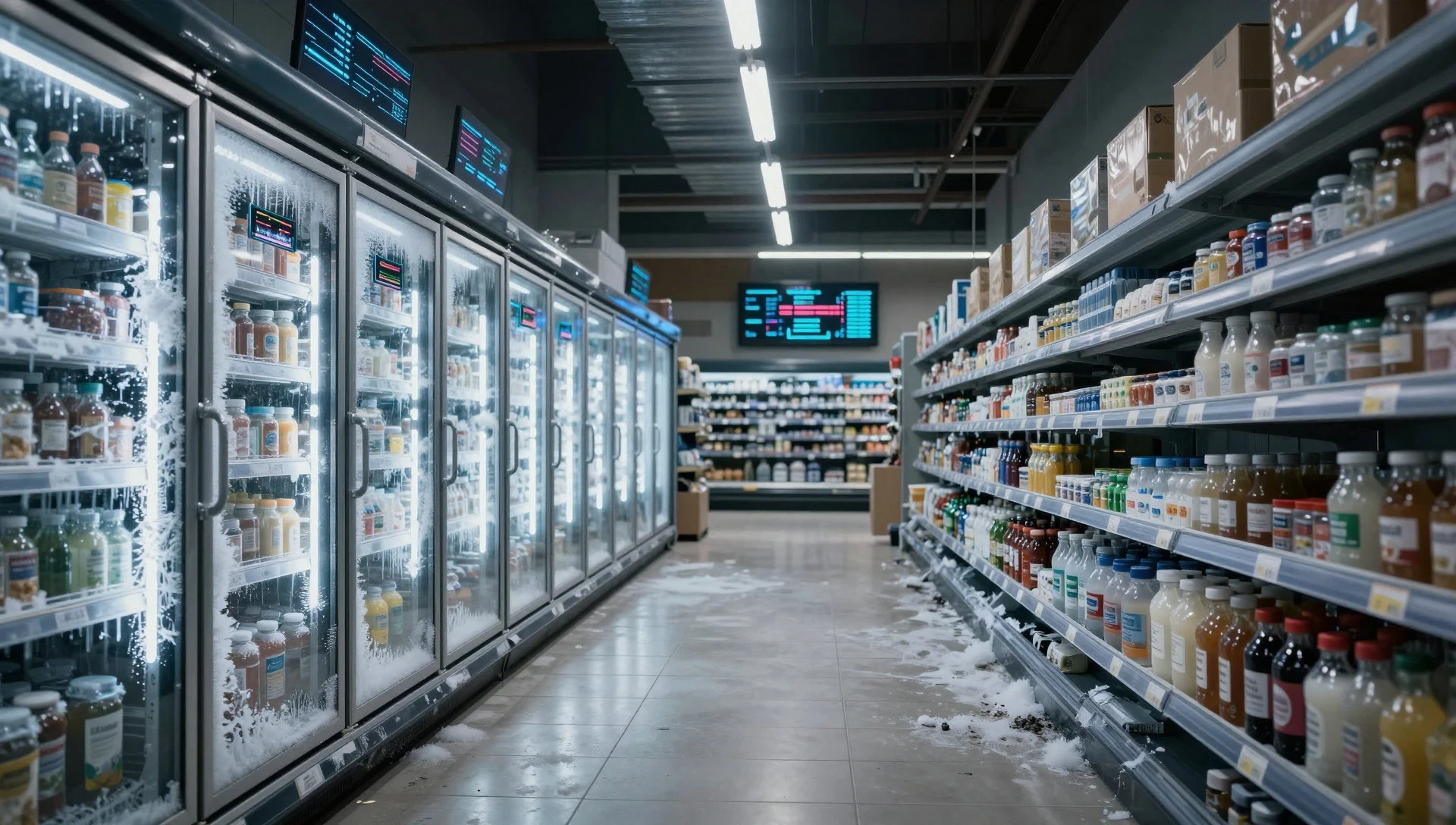
Across Belgium, Sweden, Luxembourg and France, a quiet but consequential disruption has been unfolding inside supermarket aisles rather than on battlefields or trading floors. Refrigeration systems in several stores reportedly malfunctioned, sending freezer and chiller temperatures climbing toward 50 degrees Celsius in some locations and rendering frozen and fresh food unsellable. Authorities are now investigating whether these failures were orchestrated cyberattacks rather than ordinary equipment faults.
The incidents matter far beyond spoiled inventory. Modern grocery chains depend on networked, remotely monitored cold-chain infrastructure to keep perishable goods safe, and that same connectivity creates an attack surface that adversaries can exploit with minimal physical access.
When a thermostat becomes a target, the consequences ripple through food safety, consumer trust, insurance exposure and supply-chain continuity in ways that traditional security models rarely anticipate.
On This Page
- The Anatomy of a Refrigeration Cyber Incident
- Europe's Pattern of Attacks on Cold-Chain Infrastructure
- The Economics of Spoilage and Insurance Exposure
- Regulatory and Legal Dimensions Across Jurisdictions
- Building Defensive Depth in Operational Technology
- What the Refrigeration Incidents Signal for the Wider Economy
This analysis examines what the European refrigeration incidents reveal about industrial control security, why food retail has become an attractive target, and how operators can reconcile operational efficiency with genuine resilience. It also considers the regulatory and insurance dimensions that will shape how boards respond when the next temperature alarm sounds.
TL;DR Supermarket refrigeration systems across Belgium, Sweden, Luxembourg and France experienced sudden temperature spikes, with some stores reportedly reaching 50 degrees Celsius and losing frozen and fresh stock. Investigators suspect coordinated cyberattacks against remotely controlled cooling infrastructure, following a similar French incident the previous month. The episode exposes how connected cold-chain systems concentrate operational, safety and reputational risk, and why food retailers must treat refrigeration controls as critical security assets rather than routine facilities equipment.
The Anatomy of a Refrigeration Cyber Incident
Refrigeration control systems sit at the intersection of information technology and physical operations, which is precisely what makes them difficult to defend. A typical supermarket relies on networked controllers, sensors and remote monitoring platforms that let facility managers adjust setpoints, receive alarms and diagnose faults without visiting every store. That convenience is also the vulnerability.
How Connected Cooling Systems Become Targets
Most modern refrigeration plants expose controllers to wide-area networks so that vendors and maintenance teams can intervene remotely. If credentials are weak, firmware is outdated or network segmentation is absent, an intruder can alter setpoints or disable alarms.
The result is not a dramatic explosion but a slow, silent rise in temperature that destroys inventory before anyone notices.
Security researchers have long warned that building management and industrial control protocols were designed for reliability, not adversarial conditions. Authentication is often minimal, and legacy devices may never receive patches.
Attackers who understand these weaknesses can move laterally from a corporate network into store-level controllers, turning a routine IT breach into a physical operational crisis.
Why Temperature Spikes Are Operationally Catastrophic
Frozen food depends on uninterrupted cold chains, and even brief excursions above safe thresholds can trigger mandatory disposal. Retailers must then absorb the cost of lost stock, emergency restocking and potential regulatory scrutiny.
In severe cases, compromised refrigeration can also create food-safety hazards that expose customers and invite litigation far beyond the original disruption.
The economics are unforgiving because grocery margins are thin and spoilage losses are immediate. A single store losing its freezer inventory may write off tens of thousands of euros, while a coordinated multi-store event multiplies that figure. Insurers increasingly ask whether such losses stem from negligence in securing remote access, complicating claims and renewals.
Europe's Pattern of Attacks on Cold-Chain Infrastructure
The European incidents did not emerge in isolation. France had already confronted a cyberattack targeting the systems that manage freezers and refrigerators, establishing a template that appears to have been replicated or imitated elsewhere.
When similar failures surface across multiple countries within weeks, investigators must weigh coordinated campaigns against opportunistic exploitation of shared vulnerabilities.
From France to the Benelux and Nordics
Belgian supermarket chains confirmed system problems on a Monday, with media reporting that freezer and fridge temperatures rose sharply and spoiled frozen and fresh food. Sweden and Luxembourg soon reported comparable disruptions.
The geographic spread suggests either a common technology vendor, shared remote-access architecture or deliberate targeting of a sector rather than a single company.
Cross-border coordination complicates response because incident notification rules, privacy laws and critical-infrastructure designations differ by jurisdiction. A retailer operating in four countries may face four separate reporting obligations while managing one technical remediation.
Regulators will need to determine whether these events constitute a coordinated campaign and how to share threat intelligence without exposing victims.
Attribution Challenges and the Danger of Assumption
Authorities have described the events as possible cyberattacks, a deliberately cautious formulation. Attribution in industrial control incidents is notoriously difficult because attackers can route through compromised third parties, and equipment failures can mimic malicious activity. Premature conclusions risk misdirecting resources or triggering diplomatic friction before forensic evidence matures.
Yet caution should not breed complacency. Whether the cause proves criminal, hacktivist or state-linked, the defensive lessons remain identical: segment operational technology, enforce strong authentication, monitor setpoint changes and rehearse manual fallback procedures.
The uncertainty around attribution is precisely why resilience must be built into systems rather than bolted on after attribution is settled.
The Economics of Spoilage and Insurance Exposure
Food retail operates on narrow margins where spoilage is a routine cost managed through forecasting and discipline. A cyber-induced temperature excursion transforms that manageable line item into an unpredictable liability, because losses can occur simultaneously across many stores and overwhelm normal restocking capacity. The financial damage compounds when customer trust erodes.
Direct Losses Versus Indirect Costs
Direct losses include discarded frozen and fresh inventory, emergency procurement and overtime labor for cleanup. Indirect costs are often larger: reputational damage, regulatory inquiries into food safety, contractual penalties with suppliers and the expense of accelerated security remediation. Boards that budget only for spoiled stock underestimate the true exposure by a wide margin.
Insurance markets are responding with sharper questions about operational technology controls. Underwriters increasingly request evidence of network segmentation, multi-factor authentication for remote access and documented incident response plans. Retailers unable to demonstrate these measures may face higher premiums, exclusions for cyber-physical events or outright coverage refusals.
Pricing the Risk of Remote Control
Remote controllability delivers real efficiency, allowing centralized monitoring and rapid fault resolution across hundreds of sites. Yet it concentrates risk: a single compromised credential can influence many stores at once. The economic calculus therefore requires valuing convenience against correlated loss, a trade-off that spreadsheet-driven facilities planning rarely captures explicitly.
A useful framing treats each remotely accessible controller as a potential single point of failure with a measurable expected loss. If ##P## is the probability of compromise and ##L## the loss per event, expected exposure approximates ##E = P \times L##. Aggregating across a store estate reveals how quickly individually small probabilities become a material enterprise risk.
Regulatory and Legal Dimensions Across Jurisdictions
European regulators have spent years tightening rules around critical infrastructure and digital operational resilience, and food distribution increasingly falls within their scope. A cyber-induced refrigeration failure raises questions under network security directives, food safety regulations and consumer protection law simultaneously, creating a compliance puzzle that spans multiple agencies.
Notification Duties and Food Safety Law
Retailers discovering compromised refrigeration must decide quickly whether to notify cybersecurity authorities, food safety inspectors and affected customers. Delays can breach statutory timelines, while over-notification may trigger unnecessary recalls. The legal exposure grows when spoiled food reaches consumers because alarms were disabled or temperature logs were falsified by attackers.
Food safety frameworks generally require documented temperature control and traceability. If an intrusion erases or corrupts those records, regulators may treat the retailer as non-compliant regardless of the attack's origin. Legal teams therefore need forensic capabilities that preserve evidence while satisfying disclosure obligations, a balance that requires advance planning rather than improvisation.
Accountability When Third Parties Manage Systems
Many retailers outsource refrigeration monitoring to facility management vendors, which complicates liability allocation. Contracts often contain vague security clauses that neither party tested against realistic attack scenarios. When an incident occurs, the retailer bears public reputational harm while the vendor may escape meaningful financial consequence absent clear contractual obligations.
Regulators are beginning to scrutinize supply-chain security more aggressively, and boards should expect questions about vendor due diligence. Practical steps include contractual security baselines, audit rights, incident notification windows and indemnity provisions tied to control failures. These measures convert vague assurances into enforceable accountability that survives the heat of an actual crisis.
- 01
- 02
- 03
- 04
Building Defensive Depth in Operational Technology
Securing refrigeration is fundamentally an operational technology problem, and the discipline differs from conventional IT security. Controllers prioritize availability and longevity, often running for a decade without patching. Defenders must therefore design compensating controls that assume legacy equipment will remain imperfect while still preventing a single breach from cascading across an estate.
Segmentation, Authentication and Monitoring
Network segmentation remains the highest-leverage control, isolating store controllers from corporate systems and the public internet. Strong authentication for remote access, ideally with multi-factor verification, blocks the credential abuse that enables most intrusions. Continuous monitoring of setpoint changes and alarm suppression can detect manipulation before food spoils.
Practical hardening also includes disabling unused services, rotating vendor credentials and maintaining offline backups of controller configurations. Manual override procedures must be documented and rehearsed so staff can stabilize temperatures when remote systems fail. These measures are inexpensive relative to spoilage losses and dramatically reduce the blast radius of any compromise.
Incident Response and Manual Fallback
Response plans should treat refrigeration failure as a foreseeable scenario with defined escalation paths, vendor contacts and disposal protocols. Staff need authority to act on temperature anomalies without waiting for corporate approval. Tabletop exercises that simulate a multi-store event reveal coordination gaps that no policy document can anticipate.
Finally, organizations should feed incident lessons into procurement, requiring security baselines in every refrigeration contract. Resilience emerges from layered defenses, trained people and honest assessment of residual risk. The European incidents offer a timely reminder that the cold chain is now a cyber-physical system deserving the same scrutiny as payment networks.
What the Refrigeration Incidents Signal for the Wider Economy
These disruptions are a small but instructive chapter in a broader shift toward cyber-physical risk. As buildings, utilities, logistics and retail infrastructure become remotely manageable, the boundary between digital intrusion and physical consequence dissolves. Food retail is simply an early, visible example of a vulnerability that spans the economy.
Lessons for Critical Infrastructure Operators
Operators in energy, water and transport share the same architectural weaknesses: legacy controllers, remote access and thin security budgets. The refrigeration incidents demonstrate that attackers need not target glamorous systems to cause meaningful harm. Disruption of ordinary services can generate disproportionate public attention and regulatory pressure.
Policymakers should treat cold-chain infrastructure as part of the food security perimeter, deserving the same resilience expectations as power grids. That means funding for small and mid-sized retailers, shared threat intelligence and clear incident reporting channels. Without such support, security will remain uneven across the market.
Preparing for the Next Temperature Alarm
For executives, the practical takeaway is to inventory every remotely accessible operational system and ask who can change its settings. If the answer is unclear, the organization has an unmanaged risk. Assigning ownership, enforcing authentication and rehearsing response convert abstract concern into measurable preparedness.
The European investigations may ultimately confirm deliberate attack or reveal mundane failure. Either way, the episode has already demonstrated that refrigeration is a security domain, not merely a facilities expense. Retailers that internalize this lesson will protect both their inventories and their reputations when the next alarm sounds.
From our network :
- Live Online English Classes for Kids: Do They Actually Reduce Anxiety?A ten-week study reveals that synchronous online English classes can significantly reduce child language anxiety while improving listening and reading skills. Discover what makes these programs effective and how parents can select the right one.
- University Language Proficiency Exams: Why Institutional Tests Demand Different Preparation Than IELTS and TOEFLDiscover why university-specific language proficiency examinations differ fundamentally from IELTS and TOEFL, and learn strategic preparation approaches for institutional assessment success.
- Mobile Learning and VR in English: What Global Evidence Reveals About Effective Language TechnologyA systematic review across 14 countries reveals which language-learning technologies genuinely work. Mobile learning, AI, and VR show measurable benefits when pedagogically integrated. This evidence-based guide helps educators and learners select technology that delivers real return on investment.
- CISA’s Ten-Advisory Wave: Why Generic Patching Fails in OT and How to Build Product-Specific PlaybooksCISA released ten ICS advisories in one week, exposing critical infrastructure risks. Generic patching fails in OT. Learn to build product-specific remediation playbooks.
- The Final Descent: How ESA Retired the Legendary Cluster Constellation After 24 Years of Space Weather ScienceAfter 24 years mapping Earth’s magnetosphere, ESA’s Cluster mission concluded with a precisely controlled reentry over the South Pacific. This analysis explores the scientific legacy, engineering decisions, and debris mitigation principles behind one of space exploration’s most responsible retirements.
- Committed Mediterranean Precipitation Decline: Why Emissions Cuts Alone Cannot Restore Winter RainsNew NOAA research reveals that Mediterranean winter rains may decline irreversibly even with emissions cuts. Explore the science of committed climate change and regional impacts.
- Forbidden Matrix Patterns and Visible Lattice Points: A Geometric DictionaryExplore how multidimensional 0–1 matrices encode geometric truths, linking forbidden patterns to visible lattice points and hypergraph theory, with applications in combinatorics and computational geometry.
- The Hidden Cost of AI Convenience: Why Over-Permissioned Agents Are a Security Time BombDiscover why AI agents with excessive permissions create dangerous single points of failure, and learn how implementing least privilege principles can protect your organization from exploitation.
- How AI Agents Will Change the Way We Manage Personal FinancesExplore how AI agents are transforming personal finance through automated budgeting, bill payment, and investment management, while examining the critical security protocols and governance frameworks required for safe deployment.
RESOURCES
- New cyberattack on supermarket fridges sweeps across Europereuters.com1 day ago ... STOCKHOLM/BRUSSELS/LONDON, Nov 2 (Reuters) - A hacking attack on European supermarkets spread across the continent on Monday, hitting fridges ...
- Supermarkets across Europe hit by new fridge cyberattacksnbcnews.com1 day ago ... Supermarkets across Europe hit by new fridge cyberattacks ... The incidents caused temperature spikes and spoiled food at stores in…
- Cyberattack Hits Hundreds of Supermarket Refrigeration Systems in ...nytimes.comOct 13, 2026 ... The attack targeted a Danish software system in more than 400 supermarkets, forcing some shops to throw out frozen produce.…
- Suspected cyberattacks trigger supermarket fridge failures across ...aljazeera.com1 day ago ... Suspected cyberattacks have triggered temperatures to rise in grocery store refrigeration systems in a growing number of countries across Europe ...
- Shop fridges and freezers across Europe hit by fresh suspected ...theguardian.com1 day ago ... Supermarket chains in at least seven European countries have said the temperatures of refrigerators and freezers in some of their…
- Shop freezers in seven European countries hit by cyber-attack - BBCbbc.com1 day ago ... Dozens of supermarkets across seven European countries have been hit by a cyber-attack affecting their refrigerators and freezers.
- Cyberattacks disrupt refrigeration systems at European supermarketspbs.orgOct 13, 2026 ... French Finance Minister Roland Lescure told Parliament on Tuesday that about 700 of the country's 10000 supermarkets were affected.
- Fridge cyberattack hits supermarkets across Europe - AFP.comafp.com1 day ago ... A suspected cyberattack hit grocery stores across at least nine European countries on Monday, prompting the EU to warn of…
- New Wave of Refrigeration Cyberattacks Hits Supermarkets Across ...thehackernews.com12 hours ago ... Hackers altered supermarket refrigeration settings across Europe, forcing food withdrawals and exposing weaknesses in remote controls.
- More grocery stores in Europe report fridge and freezer temperature ...cbsnews.com1 day ago ... The incidents come less than three weeks after several French supermarket chains said they were hit by a cyberattack that…
- New European Cyberattack: Supermarket Refrigerators ... - Forbesforbes.com1 day ago ... Topline. Supermarkets across Europe were again targeted in cyberattacks Monday, which heated refrigerators to temperatures above 120 degrees ...
- Cyberattack hits 700 supermarkets in France, sparking investigationapnews.comOct 13, 2026 ... PARIS (AP) — Cyberattacks disrupted European supermarket chains, affecting refrigeration systems at hundreds of stores in France and forcing ...
- Cyber attack on supermarket refrigeration in France : r/UKPreppersreddit.comOct 12, 2026 ... Not sure how many UK supermarkets use the same kit but I'd be prepared for cold chain disruption in the…
- Supermarket fridges hit with cyberattacks across Europe - CNBCcnbc.com8 hours ago ... Supermarkets were hit by cyberattacks across several European countries on Monday, including Belgium and Sweden. · This is the second…
- A fresh wave of cyberattacks has hit Europe's supermarket ...techcrunch.com1 day ago ... The cyberattacks follow earlier refrigerator hacks in France last month that caused food spoilage at hundreds of supermarkets by deliberately ...
- 01
- 02
- 03
- 04
- 05
- 06
- 07
- 08
0 Comments