
When roughly half of American adults now converse with AI chatbots, and about 42% of those users treat them as an information source, the question of electoral reliability becomes a civic matter rather than a technical curiosity.
A study released in November 2026 by the nonprofit Innovating for the Public Good, conducted with the Dewey Square Group and reported by NPR, tested seven major chatbots against the kinds of questions voters actually ask before casting a ballot.
The findings reveal a landscape where confident, fluent prose frequently conceals outdated deadlines, misstated rules, and factual slips that could quietly disenfranchise the people who trust them most.
On This Page
- The Study Behind the Headlines: Scope, Sponsors, and Method
- Decoding the Error Rates: What 13.9% and 5.1% Really Mean
- Claude and Copilot: Anatomy of the Largest Error Share
- Industry Responses and the Limits of Self-Correction
- What This Means for Voters Navigating Conversational Search
- Governance, Transparency, and the Road Ahead
The research arrived at a charged moment, with midterm elections approaching and AI assistants embedded in search engines, browsers, and mobile operating systems. Researchers posed questions about projected winners, policy platforms, candidate backgrounds, controversies, and voting logistics to Google AI Mode, AI Overviews, Claude, Copilot, Gemini, ChatGPT, and Perplexity.
The results were not uniformly poor, but the distribution of errors proved revealing: accuracy depended far more on which chatbot answered than on what was asked, suggesting that model design choices, safety layers, and retrieval pipelines shape electoral information quality in ways users cannot see.
What follows examines the study's methodology, its error taxonomy, the specific failures of Claude and Copilot, the industry responses, and the broader implications for democratic participation in an era of conversational search.
The analysis also considers what voters, developers, and regulators can reasonably do when authoritative-sounding machines become intermediaries between citizens and the ballot box.
TL;DR A November 2026 study by Innovating for the Public Good tested seven leading AI chatbots on election-related questions and found that 13.9% of answers about voting logistics were outdated or inaccurate, while 5.1% of all answers contained at least one clear factual error. Claude and Copilot generated roughly three-quarters of the clear errors, with Claude wrong or outdated on voting questions one in three times. Because chatbots answer with confidence, even modest error rates can cause voters to miss deadlines or skip required steps, prompting calls for stronger safeguards and user caution.
The Study Behind the Headlines: Scope, Sponsors, and Method
The investigation was commissioned by Innovating for the Public Good, a nonprofit focused on technology and civic welfare, and executed by researchers at the Dewey Square Group, a public affairs firm with deep experience in electoral communication. NPR reported the findings, giving the study wide visibility ahead of the midterms.
The design was straightforward but demanding: replicate the natural language questions a voter might type into a chatbot and evaluate the responses against verified election information.
Seven systems were tested, spanning the major commercial providers. These included Google AI Mode and AI Overviews, Anthropic's Claude, Microsoft Copilot, Google Gemini, OpenAI's ChatGPT, and Perplexity. The breadth matters because these products reach hundreds of millions of users through search results, browser sidebars, and standalone apps, often without users realizing they are interacting with a generative model rather than a curated database.
Question Categories and Evaluation Criteria
Researchers organized their prompts around the practical concerns of voters: who is projected to win, what candidates stand for, how contenders compare, what controversies surround them, and how voting actually works. Each answer was then checked against official sources such as state election offices and verified reporting.
The team distinguished between harmless imprecision and errors capable of changing behavior, a distinction that anchors the study's most alarming statistics.
The October data collection window is significant because election rules, polling places, and deadlines shift in the final weeks before a vote. A model trained on older snapshots or retrieving stale pages can appear current while quietly lagging reality.
The researchers therefore treated outdated information as a distinct failure mode, separate from outright fabrication, and tracked both across the question set.
Why the Sample Size and Timing Matter
Testing in October, immediately before the midterms, captures the period when voter uncertainty peaks and reliance on quick answers is highest. A model that performs adequately in a calm summer month may degrade when news cycles accelerate and official pages update frequently. The study's timing thus functions as a stress test under realistic conditions rather than a laboratory exercise.
Because the researchers asked questions similar to those a voter might ask, the results generalize more credibly than benchmark scores on curated trivia. Real voters phrase questions loosely, omit context, and expect direct answers.
That conversational style is precisely where retrieval-augmented systems can stumble, pulling plausible but mismatched passages and presenting them with unwarranted certainty.
Decoding the Error Rates: What 13.9% and 5.1% Really Mean
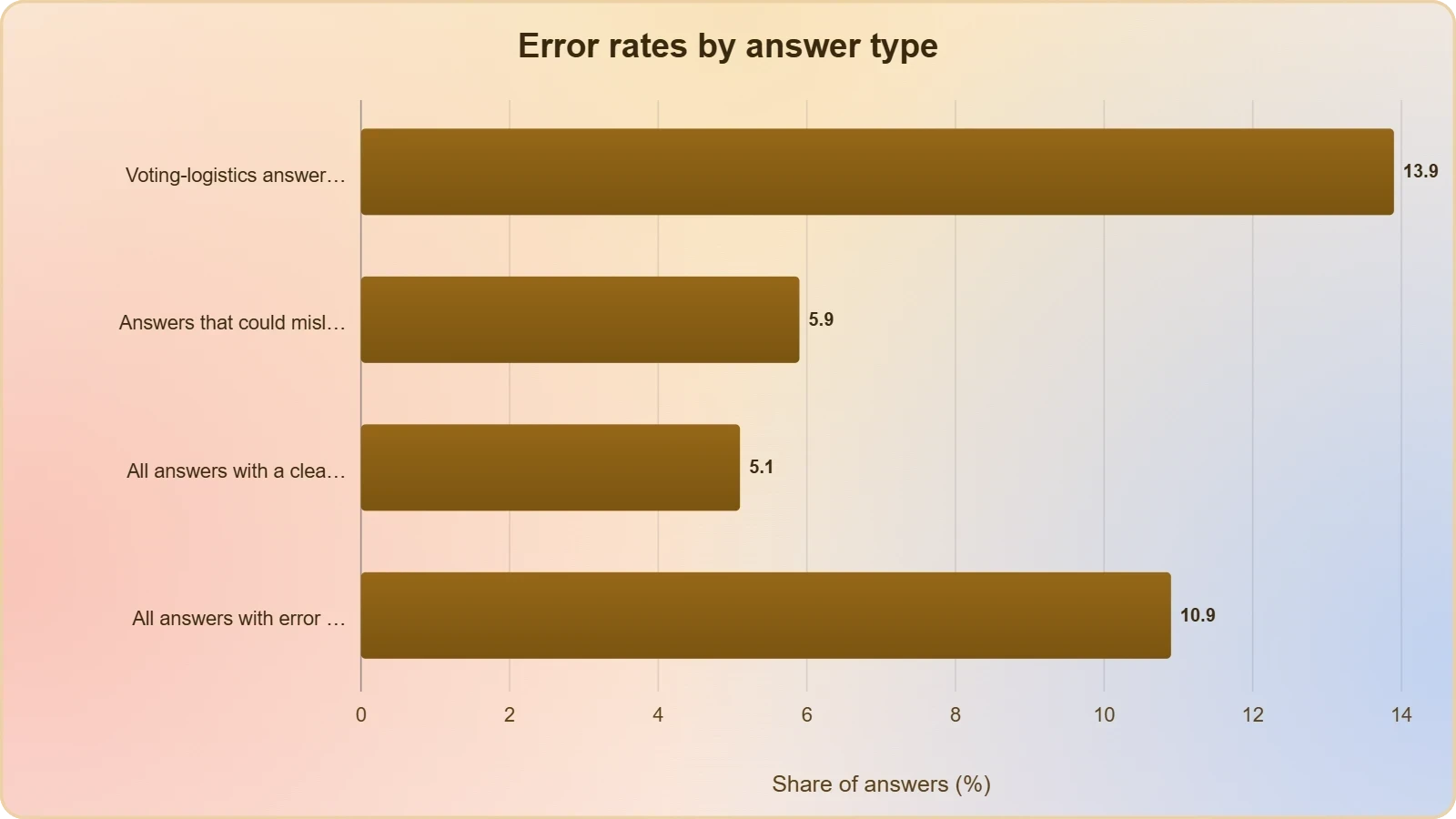
Headline percentages can obscure as much as they reveal, so the study's error taxonomy deserves careful reading. On questions about voting logistics, 13.9% of chatbot answers were outdated or inaccurate, a figure that rises sharply in perceived severity because logistics questions concern deadlines, locations, and eligibility.
Separately, 5.9% of answers contained errors capable of misleading a voter into missing a deadline, voting on the wrong day, or skipping a required step.
Across the full question set, 5.1% of answers contained at least one clear factual error, while 10.9% contained either a clear error or a misleading claim. These are not catastrophic rates in isolation, but they compound across millions of users.
If even a fraction of the roughly half of American adults who use chatbots rely on them for voting guidance, the absolute number of misinformed citizens becomes substantial and unevenly distributed.
Outdated Information Versus Outright Fabrication
The distinction between stale and invented content matters for remedy. Outdated answers often stem from retrieval systems surfacing old pages or training data that predates rule changes, which better indexing and freshness signals can address.
Fabrications, by contrast, reflect model behavior that fills gaps with plausible detail, requiring different interventions such as refusal policies, citation requirements, and confidence calibration.
Voting logistics are especially vulnerable to staleness because rules change late, sometimes weeks before an election, and vary by district. A model that confidently cites a registration deadline from a previous cycle is not hallucinating in the classic sense; it is retrieving real but obsolete information. For the voter, the practical consequence is identical: a missed window and lost participation.
The Compounding Risk of Authoritative Tone
Tim Chambers, a principal at Dewey Square Group, described the error rates as "extremely troubling," emphasizing that chatbots answer in an authoritative and convincing manner despite meaningful mistakes. Tone is the multiplier here.
A hesitant answer invites verification; a fluent, well-structured answer with confident phrasing discourages it, particularly when the user is hurried or unfamiliar with official sources.
This dynamic is well documented in human factors research: automation bias leads people to accept machine output that appears competent, especially under time pressure. Elections impose exactly that pressure, with deadlines that do not forgive.
The study's concern is therefore less about any single wrong answer than about the systemic habit of trust that conversational interfaces cultivate.
Claude and Copilot: Anatomy of the Largest Error Share
The study's most striking distributional finding is that Claude and Copilot together produced roughly three-quarters of the clear errors. On voting questions specifically, Claude gave wrong or outdated information one in three times, Copilot one in four, and ChatGPT one in ten.
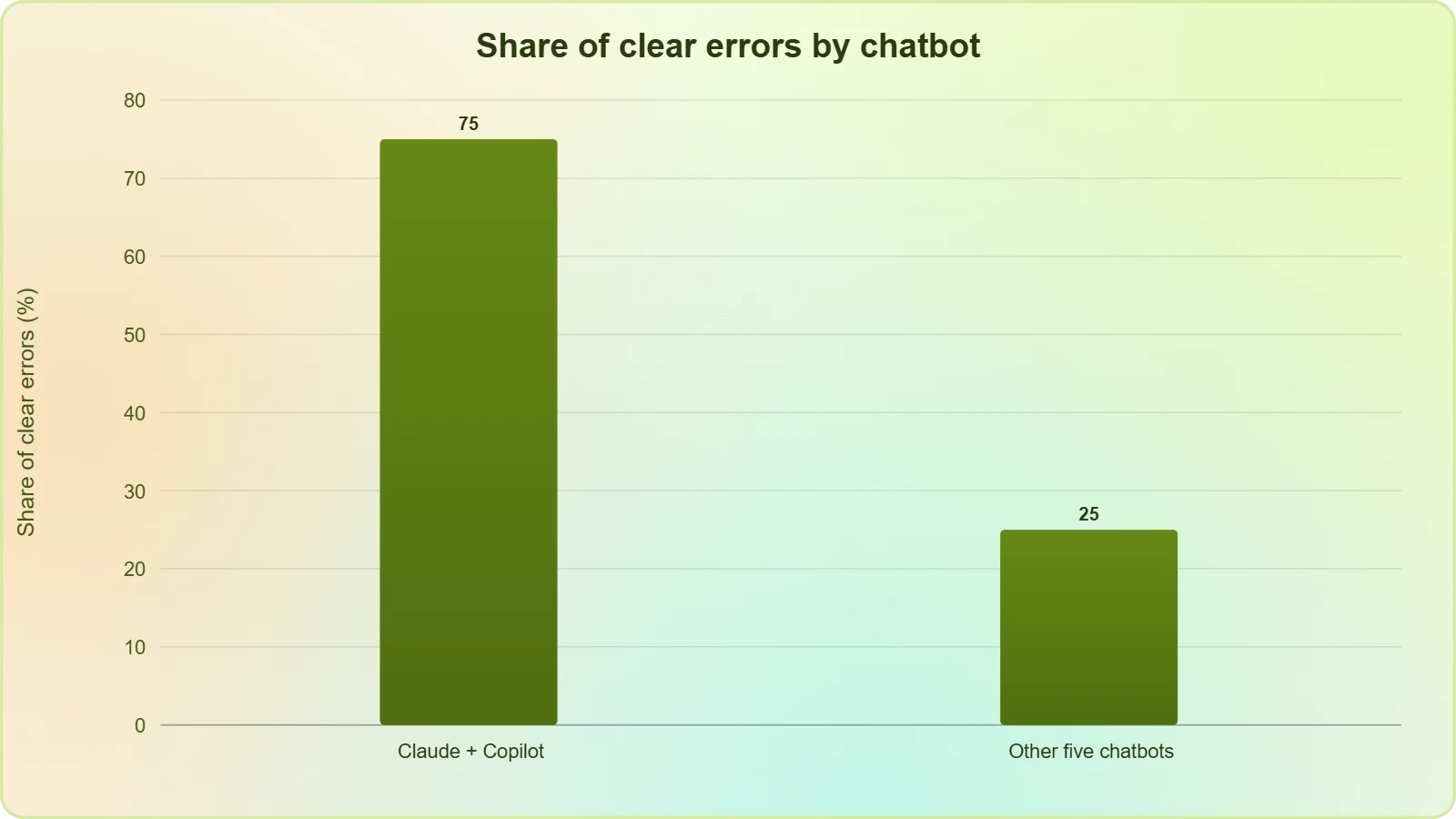
These gaps are too large to attribute to random variation, pointing instead to differences in retrieval strategy, refusal behavior, and safety tuning across providers.
One documented example involved Claude providing incorrect voter registration deadlines for Michigan's 4th congressional district, listing dates later than the actual deadlines. An error of that shape is especially dangerous because it extends a window that has already closed, converting a voter's reasonable planning into a missed opportunity. The specificity of the district makes the failure more instructive than a generic mistake.
Why Model Architecture Shapes Electoral Accuracy
Chatbots differ in how aggressively they search the live web, how they rank retrieved sources, and when they decline to answer. A system that prioritizes recency and official domains will generally outperform one that leans on parametric memory.
Similarly, a model tuned to hedge on uncertain topics may frustrate users but protect them from confident falsehoods about deadlines.
Safety layers add another variable. Anthropic's Michael Aciman told NPR that because part of the research used an Application Programming Interface, some of Claude's safeguards may not have been active.
That explanation highlights a genuine complexity: the same model can behave differently across surfaces, so evaluations must specify whether they test the consumer app, the API, or both.
The API Versus Web Interface Question
IFPG responded to Anthropic's caveat by noting it conducted a separate internal study comparing Claude's responses through its API and its web interface, finding the results comparable. That rebuttal strengthens the study's central claim while acknowledging the methodological nuance. Comparable performance across surfaces suggests the observed error pattern is not merely an artifact of testing configuration.
For developers and researchers, the episode is a reminder that evaluation transparency matters. Publishing prompts, model versions, access methods, and grading rubrics allows independent replication. Without that detail, providers can reasonably dispute findings, and the public debate devolves into competing assertions rather than shared evidence about how these systems actually behave.
- 01
- 02
- 03
- 04
Industry Responses and the Limits of Self-Correction
Microsoft spokesperson Jessica Dash said the company has improved how Copilot responds to election-related questions and continues to test and refine them. That statement reflects a familiar pattern: providers acknowledge issues, describe ongoing work, and emphasize iteration.
The question is whether such improvements are sufficient when the underlying architecture still permits confident errors on high-stakes civic queries.
Anthropic's response focused on testing conditions, noting that API access may have bypassed some safeguards. IFPG's internal comparison of API and web interface results found them comparable, which narrows the escape route but does not eliminate the broader lesson. Providers need evaluation regimes that mirror real user behavior, including the messy, deadline-driven questions people actually ask.
What Providers Can Realistically Change
Several levers are available. Retrieval systems can prioritize official election domains and enforce freshness checks on deadline-related content. Models can be trained to cite sources and to decline when authoritative information is unavailable.
Interfaces can surface disclaimers and direct links to state election offices, converting a chatbot answer into a starting point rather than a final authority.
None of these measures is free. Aggressive refusal frustrates users and reduces engagement, while strict source allowlists can miss legitimate local reporting. The design challenge is to calibrate caution to stakes, treating a question about registration deadlines differently from a question about a candidate's favorite book. That calibration requires product decisions, not just model improvements.
The Case for Independent Auditing
Self-reported improvements are difficult to verify without external scrutiny. Independent audits, ideally with published prompts and reproducible grading, create accountability that internal testing cannot. The IFPG study demonstrates the value of such work, even as providers dispute specific methodological choices. A standing audit regime around elections would make these evaluations routine rather than episodic.
Regulators have begun to take interest in AI transparency, though electoral applications remain lightly governed in most jurisdictions. Voluntary commitments and industry standards can fill some gaps, but they depend on sustained public attention.
Once the news cycle moves on, incentives to invest in election-specific accuracy may weaken, leaving the same vulnerabilities in place for the next contest.
What This Means for Voters Navigating Conversational Search
For individual voters, the practical takeaway is straightforward: treat chatbot answers about elections as leads, not conclusions. Verify deadlines, polling locations, and eligibility rules directly with state or county election offices.
The few minutes required for verification are trivial compared with the cost of arriving at the wrong place on the wrong day, or discovering too late that a registration window has closed.
Pew Research Center data cited in the study indicates about half of American adults have used AI-powered chatbots, and roughly 42% of those users turn to them for information. That combination of widespread adoption and informational reliance creates a large population exposed to whatever accuracy these systems deliver.
Digital literacy efforts should therefore include specific guidance on election queries, not just generic skepticism toward online content.
Practical Verification Habits
Voters can adopt a simple protocol. Ask the chatbot for its sources, then open those sources directly rather than trusting the summary. Cross-check any date against the official state election website.
When a chatbot offers a confident answer with no citation, treat that confidence as a warning sign rather than a guarantee of reliability.
Community organizations and newsrooms can reinforce these habits by publishing short guides that pair chatbot use with verification steps. Election officials might also consider publishing machine-readable rule summaries that retrieval systems can ingest more reliably. Such collaboration would reduce staleness at the source rather than relying solely on downstream model behavior.
The Civic Cost of Quiet Errors
Missed deadlines and skipped steps rarely announce themselves. A voter who trusts an incorrect registration date simply does not appear in the rolls, and the failure is invisible in aggregate data.
This quiet attrition is precisely what makes the study's 5.9% misleading-answer rate concerning, because its effects are dispersed and difficult to trace back to any single cause.
Democratic participation depends on procedural confidence, and procedural confidence depends on accurate information. When the intermediary is a fluent machine that occasionally errs without signaling uncertainty, the burden of vigilance shifts to citizens who may not know they need it. That asymmetry between confident output and hidden error is the study's deepest concern.
Governance, Transparency, and the Road Ahead
The regulatory landscape for AI in elections remains fragmented. Some jurisdictions require disclosure of AI-generated political content, but few impose accuracy standards on chatbot responses to voter questions. The IFPG study suggests that voluntary improvement, while welcome, may not be enough to protect voters who rely on these tools during compressed election timelines.
A more durable approach would combine independent auditing, published evaluation methodologies, and clearer expectations for high-stakes domains. Election information is not a niche use case; it is a public good whose integrity affects everyone.
Treating it with the same seriousness applied to medical or financial advice would represent a meaningful shift in product priorities.
Designing for High-Stakes Domains
High-stakes domains share a common feature: errors are costly and often irreversible. Systems serving those domains typically incorporate verification steps, explicit uncertainty, and escalation paths to authoritative sources. Chatbots could adopt similar patterns for election queries, routing users to official tools rather than attempting to reproduce their content from memory.
Such routing is technically feasible and commercially viable, but it requires providers to accept that some questions are better answered elsewhere. That acceptance runs against the grain of products designed to keep users engaged within a single interface.
Resolving the tension is a strategic choice, and the study's findings give providers a clear reason to make it.
What the Next Election Cycle Will Reveal
The coming cycles will test whether the reported improvements materialize under real conditions. Independent researchers should repeat the audit, publish comparable metrics, and track whether error rates decline meaningfully. Without longitudinal data, the public cannot distinguish genuine progress from public relations, and providers cannot be held to measurable standards.
For now, the IFPG findings stand as a documented warning. Seven widely used chatbots, tested with realistic voter questions in the final weeks before an election, produced error rates high enough to change outcomes for some users. The remedy lies in better retrieval, honest uncertainty, independent scrutiny, and voters who verify before they vote.
From our network :
- Mobile Learning and VR in English: What Global Evidence Reveals About Effective Language TechnologyA systematic review across 14 countries reveals which language-learning technologies genuinely work. Mobile learning, AI, and VR show measurable benefits when pedagogically integrated. This evidence-based guide helps educators and learners select technology that delivers real return on investment.
- CISA’s Ten-Advisory Wave: Why Generic Patching Fails in OT and How to Build Product-Specific PlaybooksCISA released ten ICS advisories in one week, exposing critical infrastructure risks. Generic patching fails in OT. Learn to build product-specific remediation playbooks.
- The Hidden Cost of AI Convenience: Why Over-Permissioned Agents Are a Security Time BombDiscover why AI agents with excessive permissions create dangerous single points of failure, and learn how implementing least privilege principles can protect your organization from exploitation.
- How AI Agents Will Change the Way We Manage Personal FinancesExplore how AI agents are transforming personal finance through automated budgeting, bill payment, and investment management, while examining the critical security protocols and governance frameworks required for safe deployment.
- University Language Proficiency Exams: Why Institutional Tests Demand Different Preparation Than IELTS and TOEFLDiscover why university-specific language proficiency examinations differ fundamentally from IELTS and TOEFL, and learn strategic preparation approaches for institutional assessment success.
- Committed Mediterranean Precipitation Decline: Why Emissions Cuts Alone Cannot Restore Winter RainsNew NOAA research reveals that Mediterranean winter rains may decline irreversibly even with emissions cuts. Explore the science of committed climate change and regional impacts.
- Forbidden Matrix Patterns and Visible Lattice Points: A Geometric DictionaryExplore how multidimensional 0–1 matrices encode geometric truths, linking forbidden patterns to visible lattice points and hypergraph theory, with applications in combinatorics and computational geometry.
- Live Online English Classes for Kids: Do They Actually Reduce Anxiety?A ten-week study reveals that synchronous online English classes can significantly reduce child language anxiety while improving listening and reading skills. Discover what makes these programs effective and how parents can select the right one.
- The Final Descent: How ESA Retired the Legendary Cluster Constellation After 24 Years of Space Weather ScienceAfter 24 years mapping Earth’s magnetosphere, ESA’s Cluster mission concluded with a precisely controlled reentry over the South Pacific. This analysis explores the scientific legacy, engineering decisions, and debris mitigation principles behind one of space exploration’s most responsible retirements.
RESOURCES
- How AI chatbots can mislead with election advice - NPRnpr.org23 hours ago ... Millions of Americans are turning to AI for election information, but chatbots are getting voting facts wrong and recommending candidates, ...
- Attorney General James Warns Voters Against Relying on AI ...ag.ny.govNov 1, 2024 ... OAG Testing of Chatbots Revealed Inaccurate Voting Information ... “My office's testing of AI chatbots found many providing false or…
- How to Detect and Guard Against Deceptive AI-Generated Election ...brennancenter.orgMay 16, 2024 ... Avoid getting election information from generative AI chatbots and search engines that consistently integrate generative AI, and instead go ...
- Attorney General James Warns New Yorkers About AI-Generated ...ag.ny.govOct 14, 2026 ... As AI Fakes Become Harder to Spot and Chatbots Provide Incorrect Information, AG James Releases Updated Guide for Voters. October…
- Chatbot info on U.S. elections is inaccurate, misleading and ... - PBSpbs.orgFeb 27, 2024 ... ... chatbots for basic information, including about how their voting ... AI chatbots to communicate with voters to adding AI-generated…
- AI chatbots giving misleading voting advice in run-up to election - BBCbbc.comMay 5, 2026 ... ... AI tools for voting advice could be met with inaccurate information. Asking Artifical Intelligence (AI) chatbots for advice is…
- Stress-Testing AI Chatbot Responses on Voting with a Disabilitycdt.orgSep 16, 2024 ... Similarly, misleading or biased information about voting rights or election procedures, including the role of election officials and what ...
- We asked AI chatbots to make voter guides. They invented races ...washingtonpost.com6 days ago ... The results weren't great. AI chatbots frequently provided incorrect information, according to The Post's analysis of more than 3,000 AI- ...
- AI chatbots are serving up wildly inaccurate election information ...cbsnews.comFeb 27, 2024 ... New AI-powered tools produce inaccurate election information more than half the time, including answers that are harmful or incomplete, ...
- Election voting advice from AI chatbots 'inaccurate and unreliable'theguardian.comJul 21, 2026 ... AI chatbots provide inaccurate, inconsistent and unreliable guidance to voters asking which party they should back, a study suggests, often ...
- False election information from AI chatbots — expert explains what ...news.vt.eduSep 6, 2024 ... Anyone who uses artificial intelligence (AI)-driven chatbots or voice assistants for election information should know these tools might ...
- Millions of Americans are turning to AI for election information, but ...facebook.com22 hours ago ... Let's go back to the good old days. Before internet, influencers and chat bots. When men had to actually build…
- AI chatbots got questions about the 2024 election wrong 27% of the ...nbcnews.comJun 7, 2024 ... A study found that AI including Google's Gemini and OpenAI's ChatGPT gave incorrect information 27% of the time when asked…
- AI Chatbots Provide False Information About November Electionsvoanews.comMar 1, 2024 ... Americans planning on voting for president in November shouldn't trust popular artificial intelligence-powered chatbots for even the most ...
- One third of information provided by chatbots during the election ...demos.co.ukMay 21, 2026 ... ... AI chatbots sharing inaccurate information about elections and candidates. Public trust is very low: Half 49% do not trust…
- 01
- 02
- 03
- 04
- 05
- 06
- 07
- 08
0 Comments