American voters went to the polls on Tuesday in midterm elections that will determine which party controls the House of Representatives and the Senate, a contest widely interpreted as a referendum on President Donald Trump's second term.
The balloting unfolded against a backdrop of legal confrontation in California, where a federal judge intervened just one day before voting to restrain federal pressure on state election officials. Control of Congress, the composition of key committees, and the practical reach of presidential authority all hang on the outcome.
Democrats entered the day widely expected to capture the House, while the Senate remained genuinely uncertain. The arithmetic is unforgiving: Democrats need to gain three seats in the House and four in the Senate to take the majority.
On This Page
- Why the 2026 Midterms Carry Outsized Political Weight
- The California Ballot Dispute and Federal Intervention
- Michigan's Senate Race and the Politics of Endorsement
- The President's Closing Argument and the Reflecting Pool
- What Divided Government Would Mean in Practice
- Reading the Results: Signals Beyond the Seat Count
Should Republicans lose either chamber, the president's capacity to pass legislation would be materially constrained, reshaping the legislative agenda for the remainder of his term. Historical precedent suggests such a double switch is rare, occurring only three times since World War II.
The campaign's closing hours carried unusual drama. In California, Governor Gavin Newsom publicly warned the president against interfering in the state's elections, accusing him of attempting to reject 20,000 ballots and intimidate election workers.
In Michigan's Senate race, Democratic Representative Haley Stevens endorsed Republican Mike Rogers rather than supporting Abdul Al-Sayed, who had defeated her in the primary. President Trump, meanwhile, chose the Reflecting Pool in Washington as the backdrop for an event aimed at countering a predicted Democratic win.
TL;DR The 2026 US midterm elections place control of both chambers of Congress before the voters, with Democrats favored to take the House and the Senate genuinely in play. The results will define the legislative limits of President Trump's second term, while a last-minute federal ruling in California and an unusual cross-party endorsement in Michigan illustrate how legal and political pressure converged on election day. Historically, simultaneous midterm flips are rare, making this cycle a notable test of voter sentiment.
Why the 2026 Midterms Carry Outsized Political Weight
Midterm elections routinely punish the party holding the White House, yet the 2026 cycle carries consequences beyond the customary pattern of losses. Both chambers are competitive, and the president has framed the contest as a personal validation.
The outcome will determine whether the administration can advance its legislative program or confront a divided government for the balance of the term.
The Arithmetic of Congressional Control
Democrats must gain three seats in the House and four in the Senate to secure majorities. Those thresholds are modest in absolute terms but demanding in practice, given the geographic distribution of competitive districts and the staggered Senate map. Every seat therefore acquires disproportionate value, and turnout in a handful of states effectively decides national policy.
Control of either chamber confers far more than symbolic victory. Committee chairmanships, subpoena power, and the ability to schedule or block legislation all flow from the majority. A single chamber in opposition can stall nominations, frustrate appropriations, and force the executive branch into negotiation or unilateral action.
Historical Patterns of Simultaneous Flips
Since World War II, the House and Senate have both switched party control in the same midterm election only three times: 1946, 1994, and 2006. In each instance, voters sought change or registered broad dissatisfaction with the sitting president.
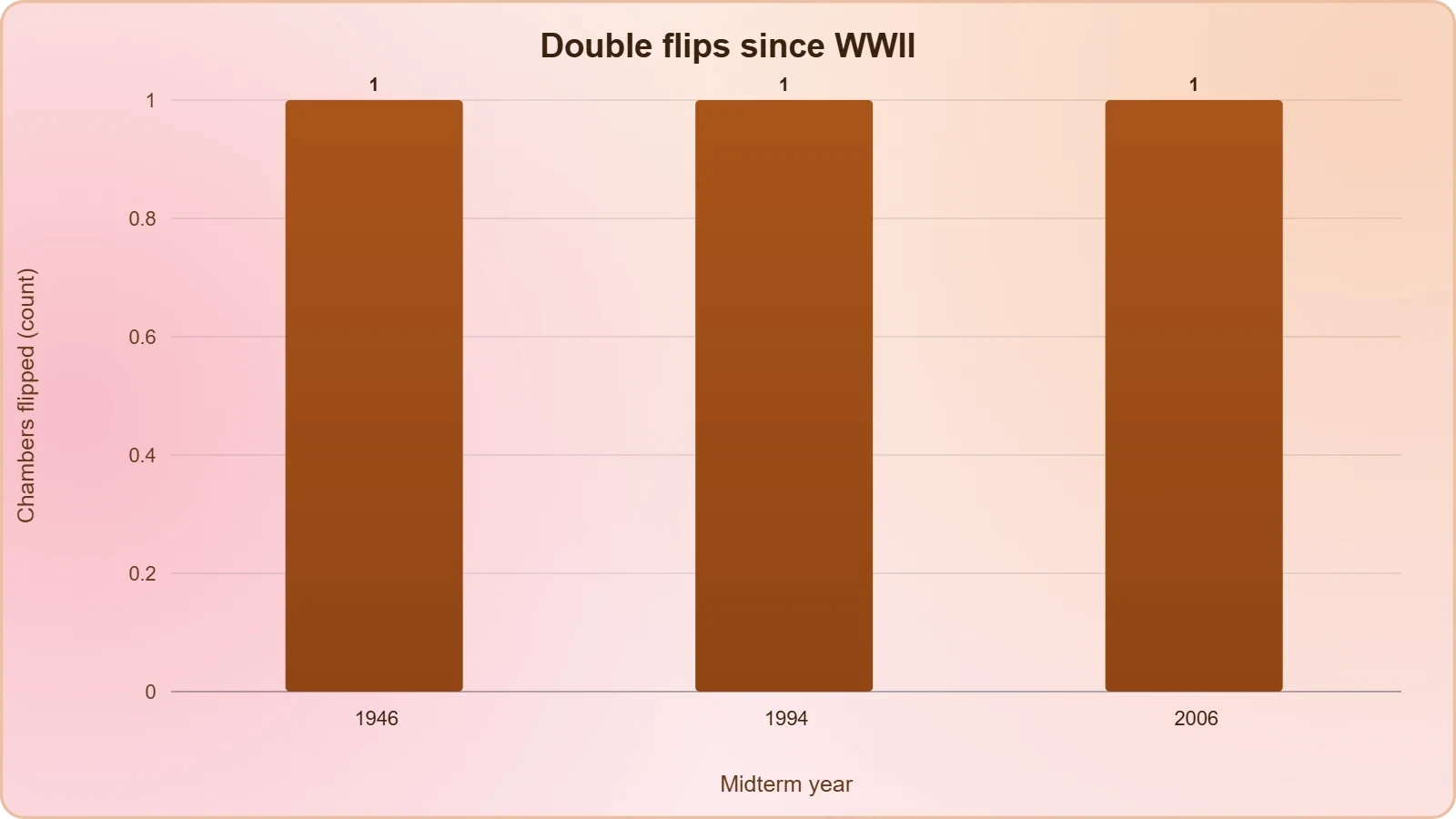
The rarity of the pattern underscores how unusual a double flip would be, and how much it would signal about the national mood.
Each of those cycles followed a distinct political logic. The 1946 election reflected postwar economic anxiety, 1994 produced the Contract with America, and 2006 turned on war fatigue and scandal. The common thread is not ideology but a decisive shift in public confidence, which makes the historical comparison instructive rather than predictive.
The California Ballot Dispute and Federal Intervention
California became the cycle's most visible legal battleground. Governor Gavin Newsom warned President Trump against interfering in the state's elections, stating in an Instagram post that the president was trying to reject 20,000 California ballots and intimidate election workers.
Newsom said California would respond to any interference, framing the dispute as a defense of state electoral autonomy.
The Federal Push and the Court's Rebuke
The Trump administration had tried and failed to stop California from counting 20,000 ballots from people the federal government identified as likely noncitizens. On Monday, US District Judge James Boasberg ordered the administration to stop asking California election officials to set aside ballots cast by people on its lists of suspected noncitizens. The ruling landed one day before the elections.
Boasberg found that the lists were flawed and included many people who had been wrongly listed as noncitizens. The finding matters because it converts an administrative dispute into a question of accuracy and due process.
When federal lists carry errors, the burden of those errors falls on eligible voters whose ballots are challenged at the last moment.
Implications for Election Administration
The episode raises durable questions about how federal agencies share data with state election offices. Lists compiled for one purpose can migrate into another with little scrutiny, and the consequences are immediate when they arrive days before a vote. Courts become the final arbiter when administrative processes lack adequate safeguards.
For election administrators, the ruling reinforces the value of documented verification before any ballot is set aside. For voters, it illustrates how legal battles over eligibility can overshadow the act of voting itself. The broader lesson concerns the fragility of trust when claims of irregularity outpace the evidence supporting them.
Michigan's Senate Race and the Politics of Endorsement
Michigan's Senate contest produced one of the cycle's more striking developments. Democratic Representative Haley Stevens endorsed Republican Mike Rogers instead of supporting Abdul Al-Sayed, who had defeated her in the primary.
The endorsement crossed party lines in a state central to any Senate majority calculation, and it signaled that primary divisions can persist well beyond the vote itself.
Primary Rivalries That Outlast the Ballot
Endorsements normally follow partisan logic, so a Democratic incumbent backing a Republican rival stands out. The move reflects the depth of the primary contest and the durability of personal and ideological grievances. It also complicates the assumption that parties consolidate neatly once nominations are settled, particularly in closely watched Senate races.
For voters, such signals can be clarifying or alienating depending on their priorities. For strategists, they represent a variable that national polling rarely captures. The Michigan episode suggests that local dynamics can override national narratives, and that candidate relationships matter as much as party labels in determining outcomes.
What Divided Coalitions Mean for Turnout
A divided coalition does not automatically translate into defeat, but it does raise the cost of mobilization. When prominent figures withhold support, their followers may stay home or defect, and the resulting turnout gap can decide a close race. Michigan's experience offers a case study in how elite signaling shapes grassroots enthusiasm.
The broader implication concerns party cohesion in an era of fragmented media and personalized politics. Loyalty to individuals increasingly competes with loyalty to institutions, and endorsements become strategic instruments rather than ceremonial gestures. In a Senate contest decided by margins, those instruments can carry decisive weight.
The President's Closing Argument and the Reflecting Pool
President Trump chose the Reflecting Pool in Washington as the backdrop for an event aimed at countering a predicted Democratic win in the midterms. The setting carried symbolic weight, placing the presidency at the center of a national monument and framing the contest as a defense of the office itself. The choice of imagery was as deliberate as the message.
Symbolism as Political Communication
Presidential settings are never neutral. A monument-lined pool evokes continuity, authority, and national memory, and it invites viewers to see the incumbent as custodian of those values. In a cycle where the president's name was not on the ballot, such staging substitutes for direct electoral stakes and personalizes an otherwise institutional contest.
The strategy also carries risk. Grand settings can appear disconnected from household concerns, and voters focused on prices or services may find monumentalism beside the point. The effectiveness of symbolic politics depends on whether the audience shares the frame being offered, and midterm electorates are notably heterogeneous.
Framing a Referendum on the Second Term
Because the results are widely seen as a test of the president's second term, the closing argument mattered beyond any single race. A predicted Democratic win in the midterms would be read as a verdict on the administration's direction, and the president's event sought to preempt that interpretation by casting the vote as a choice about national identity.
Whether that framing persuades depends on the salience of other issues. When economic anxiety and legal controversies dominate the news, symbolic appeals compete with concrete grievances. The closing days thus became a contest over which frame would define the election in voters' minds as they entered the booth.
- 01
- 02
- 03
- 04
What Divided Government Would Mean in Practice
If Republicans lose either chamber, it would limit President Trump's ability to pass legislation. Divided government converts ambition into negotiation, and the practical effect is felt across appropriations, nominations, and regulatory oversight. A single opposition chamber can slow an agenda without fully stopping it, producing stalemate punctuated by narrow deals.
Legislative Gridlock and Executive Countermeasures
When Congress resists, presidents turn to executive instruments: agency rulemaking, waivers, and enforcement priorities. These tools are powerful but vulnerable to legal challenge and to reversal by subsequent administrations. The result is a policy environment shaped less by statute than by litigation and administrative discretion, which raises questions of durability and legitimacy.
Gridlock also redistributes influence toward the states. Governors and legislatures become laboratories for policy, and interstate conflict intensifies when federal standards stall. California's confrontation over ballots illustrates how state-federal friction can escalate quickly when national institutions are contested and trust is thin.
Oversight, Investigations, and Institutional Trust
A chamber in opposition gains subpoena power and the capacity to investigate the executive branch. Oversight can expose misconduct and inform voters, but it can also harden partisan lines and consume legislative time. The balance between accountability and paralysis depends on how both parties conduct themselves after the votes are counted.
Public trust is the ultimate variable. Institutions derive authority from confidence, and repeated disputes over election administration erode that confidence on all sides. The midterms therefore test not only party fortunes but the resilience of the procedures through which Americans settle their differences peacefully.
Reading the Results: Signals Beyond the Seat Count
Seat counts will dominate the headlines, but the deeper signal lies in the composition of the electorate and the margins in competitive districts. Turnout patterns, suburban shifts, and the performance of incumbents all reveal how voters weighed the president's record against their own priorities. Those details shape the interpretation that follows election night.
Turnout, Margins, and the Suburban Vote
Midterm turnout typically lags presidential years, and the gap is unevenly distributed. Suburban voters, who have swung between parties in recent cycles, often determine which way close districts fall. Their behavior offers the clearest evidence of whether the election represented a broad rebuke or a narrow, localized adjustment.
Margins matter as much as outcomes. A narrow majority constrains a party's room to maneuver, while a decisive one confers a mandate. Analysts will examine whether winning candidates outperformed their party's baseline, which indicates personal strength, or merely rode a national wave, which indicates a referendum on the incumbent.
Legal Contests and the Integrity of the Count
Given the California dispute, post-election litigation is a realistic prospect. Courts may be asked to resolve challenges to individual ballots or to administrative procedures, and each ruling will be scrutinized for consistency and evidence.
The credibility of the count depends on transparent processes and on judges applying settled law without regard to outcome.
Ultimately, the midterms test whether institutions can absorb intense political pressure without losing public confidence. The answer will not be found in a single result but in how officials, litigants, and voters conduct themselves in the days that follow. That conduct, more than any seat tally, will define the cycle's legacy.
From our network :
- University Language Proficiency Exams: Why Institutional Tests Demand Different Preparation Than IELTS and TOEFLDiscover why university-specific language proficiency examinations differ fundamentally from IELTS and TOEFL, and learn strategic preparation approaches for institutional assessment success.
- The Final Descent: How ESA Retired the Legendary Cluster Constellation After 24 Years of Space Weather ScienceAfter 24 years mapping Earth’s magnetosphere, ESA’s Cluster mission concluded with a precisely controlled reentry over the South Pacific. This analysis explores the scientific legacy, engineering decisions, and debris mitigation principles behind one of space exploration’s most responsible retirements.
- Live Online English Classes for Kids: Do They Actually Reduce Anxiety?A ten-week study reveals that synchronous online English classes can significantly reduce child language anxiety while improving listening and reading skills. Discover what makes these programs effective and how parents can select the right one.
- How AI Agents Will Change the Way We Manage Personal FinancesExplore how AI agents are transforming personal finance through automated budgeting, bill payment, and investment management, while examining the critical security protocols and governance frameworks required for safe deployment.
- Mobile Learning and VR in English: What Global Evidence Reveals About Effective Language TechnologyA systematic review across 14 countries reveals which language-learning technologies genuinely work. Mobile learning, AI, and VR show measurable benefits when pedagogically integrated. This evidence-based guide helps educators and learners select technology that delivers real return on investment.
- The Hidden Cost of AI Convenience: Why Over-Permissioned Agents Are a Security Time BombDiscover why AI agents with excessive permissions create dangerous single points of failure, and learn how implementing least privilege principles can protect your organization from exploitation.
- Forbidden Matrix Patterns and Visible Lattice Points: A Geometric DictionaryExplore how multidimensional 0–1 matrices encode geometric truths, linking forbidden patterns to visible lattice points and hypergraph theory, with applications in combinatorics and computational geometry.
- CISA’s Ten-Advisory Wave: Why Generic Patching Fails in OT and How to Build Product-Specific PlaybooksCISA released ten ICS advisories in one week, exposing critical infrastructure risks. Generic patching fails in OT. Learn to build product-specific remediation playbooks.
- Committed Mediterranean Precipitation Decline: Why Emissions Cuts Alone Cannot Restore Winter RainsNew NOAA research reveals that Mediterranean winter rains may decline irreversibly even with emissions cuts. Explore the science of committed climate change and regional impacts.
RESOURCES
- 2026 House Election Interactive Map - 270toWin.com270towin.com... House races in the midterm 2026 election ... 2026 US House Control on Polymarket ›. Democrats. 220. 196. Republicans. no 2026 election.
- United States Congress elections, 2026 - Ballotpediaballotpedia.orgElections to the U.S. Congress will take place on November 3, 2026. All 435 districts in the U.S. House of Representatives and 33 seats…
- 2026 Midterm Elections: Healthcare Policy Outlook for 2027 and ...hklaw.comSep 14, 2026 ... ... midterm elections. At the same time, control of the U.S. Congress remains highly contested. Republicans hold narrow majorities in…
- What history tells us about the 2026 midterm elections | Brookingsbrookings.eduAug 28, 2025 ... Moreover, Democrats would have to achieve a net gain of four seats to take over control of the Senate, which…
- The 2026 Midterms: Key Dates and Events - Bipartisan Policy Centerbipartisanpolicy.orgFeb 27, 2026 ... South Carolina will hold a special primary election on August 11 to select a replacement Republican candidate for the state's…
- Congressional elections and midterm elections | USAGovusa.govOct 6, 2026 ... The next midterm elections will be in November 2026. U.S. House of Representatives elections. Members of the U.S. House of…
- 2026 Midterm Elections Scenario Analysis: Control of Congressbhfs.comThe November midterm elections are rapidly approaching, with the uncertain control of the House and Senate that could have wide-ranging impacts.
- The Trump Administration Is Interfering in the 2026 Midterm ...americanprogress.orgAug 12, 2026 ... ... elections and that Congress did not delegate authority to USPS to control mail voting. The U.S. Court of Appeals…
- US Public Opinion and the Midterm Congressional Electionsgmfus.orgApr 1, 2026 ... The US public prefers Democratic control of Congress ... What the 2026 Election Says About US Democracy. The 2026 midterm…
- California U.S. House: Races to watch in 2026 midterm electioncalmatters.org6 hours ago ... Democrats hope to leverage voter discontent with President Donald Trump and oust Republicans from control of the chamber. The road…
- Early voting begins in US midterm elections that could flip control of ...abc7ny.comSep 18, 2026 ... 2026 midterm elections: Virginia early voting begins Friday. Voters in states like Idaho, Minnesota, South Dakota can cast absentee ballots ...
- Midterm Elections Are Nine Months Awaycfr.orgFeb 3, 2026 ... As a result, it is reasonable to worry that if control of the House or Senate comes down to a…
- Midterm Elections 2026: Congress Polls, Charts and Morenbcnews.com3 hours ago ... Senate battlegrounds. See how candidates are polling in competitive races for the U.S. Senate, seats critical to control of the…
- What the US midterms could mean for Trump's powerchathamhouse.orgSep 9, 2026 ... Any change of control in the US Congress would also precipitate ... © Chatham House, The Royal Institute of International…
- Democrats' advantage is clear with less than a month to go in the ...npr.orgOct 6, 2026 ... The president's party tends to lose House seats in midterm elections ... GOP expands House majority and flips Senate control.…
- 01
- 02
- 03
- 04
- 05
- 06
- 07
- 08
0 Comments