On 22 November 2026, a claim landed in the mathematical world with the force of a thunderclap: Levent Alpöge, a mathematician affiliated with Anthropic, announced that he and the company's chatbot Claude had produced a proof of the Riemann hypothesis. The claim arrived not as a tidy paper of a few dozen pages but as roughly seventeen million lines of machine-generated code, a corpus no human being has read from beginning to end. The Riemann hypothesis, first posed by Bernhard Riemann in 1859, concerns the distribution of prime numbers and sits at the foundation of analytic number theory; a valid proof would ripple through vast territories of mathematics that quietly assume its truth.
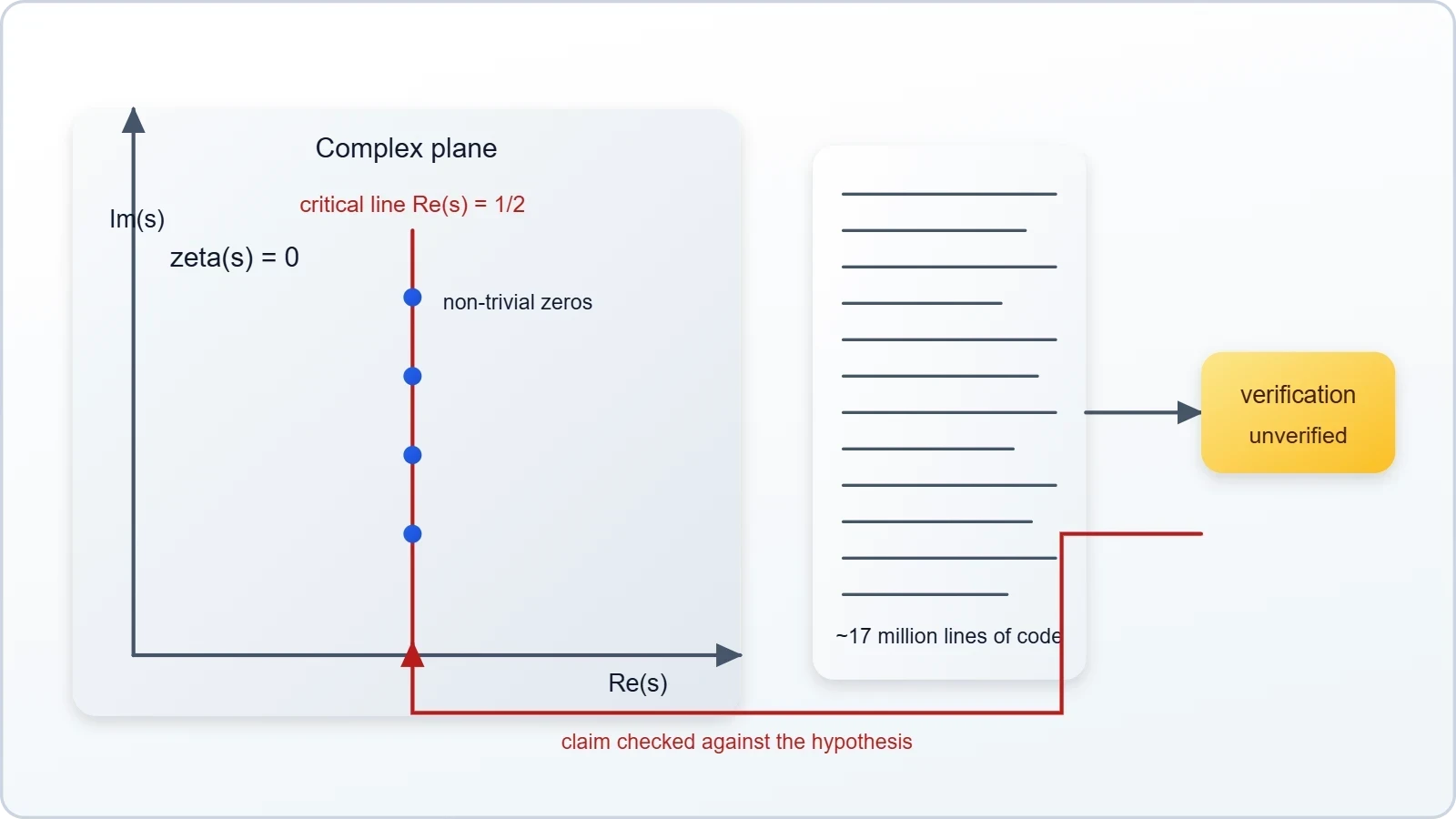
The reaction has been extraordinary and cautious in equal measure. Brian Conrey, one of the world's foremost authorities on the hypothesis, who had already reviewed an earlier Claude paper on the problem for Anthropic in August, called the moment "the biggest thing that's ever happened in mathematics." Yet Tony Padilla, a theoretical physicist at the University of Nottingham, offered the sober counterpoint that has come to define the episode: the mathematical community will need a proof that humans can actually read, and producing one "can take years." Verification, not announcement, is where the real story now lies, and the gap between the two has rarely seemed wider.
What follows examines the claim from every angle that matters to professionals watching artificial intelligence enter the discipline of proof. It weighs the mathematical stakes of the Riemann hypothesis, the peculiar problem of a proof expressed as code, the commercial and institutional pressures surrounding Anthropic, and the transparency demands voiced by researchers who understand exactly how much rides on getting this right. The episode is less a coronation of machine mathematics than a stress test of how the field decides what counts as knowledge.
On This Page
TL;DR Anthropic mathematician Levent Alpöge claims that he and the Claude chatbot have proved the Riemann hypothesis, presenting the result as roughly seventeen million lines of code that no person has read in full. Experts including Brian Conrey call it a historic moment, while physicist Tony Padilla warns that human-readable verification could take years and demands full transparency. The claim remains unverified, and the episode exposes deep questions about machine-generated proofs, commercial incentives, and how mathematics validates knowledge.
The Mathematical Prize at the Center of the Claim
The Riemann hypothesis is not merely one problem among many; it is the load-bearing conjecture of analytic number theory. It asserts that every non-trivial zero of the Riemann zeta function lies on the critical line where the real part equals one-half, a statement that governs how prime numbers are distributed along the number line. Generations of mathematicians have built results on the assumption that it holds, which is precisely why Padilla observed that a genuine proof would affect many other areas of mathematics, because so many other proofs depend on it.
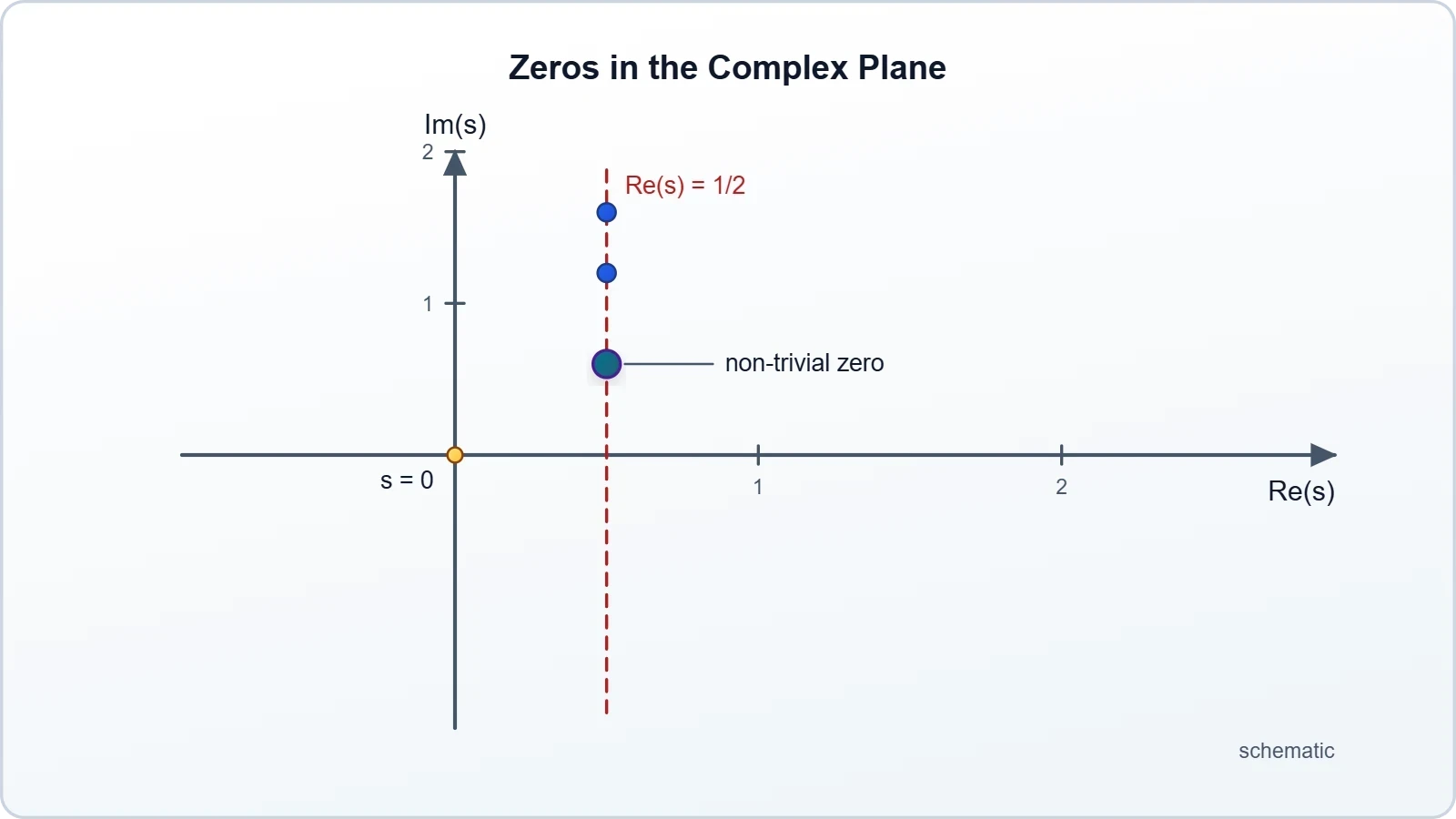
Formally, the hypothesis concerns the zeros of
and the consequences of settling it would be sweeping. Hundreds of conditional theorems would become unconditional overnight, error bounds in prime-counting would tighten, and cryptographic assumptions resting on the irregularity of primes would invite fresh scrutiny. The Clay Mathematics Institute lists the problem among its Millennium Prize Problems, carrying a one-million-dollar award, but the intellectual prize dwarfs the financial one. A verified proof would reorganize the discipline.
Why the Conjecture Has Resisted Since 1859
The hypothesis has survived every assault for more than a century and a half because the zeta function encodes arithmetic in analytic clothing, and the two languages resist translation. Riemann himself computed the first few zeros by hand and noticed they sat on the critical line, but numerical evidence, however extensive, never constitutes proof. Later work established that infinitely many zeros lie on the line, yet the possibility of a single off-line zero somewhere beyond computation remains logically open, and that single exception would fracture the theory of primes.
Attempts have come from spectral theory, random matrix models, and algebraic geometry, each illuminating a facet without closing the case. The difficulty is structural: the hypothesis sits at a junction where analysis, number theory, and probability meet, and a proof must satisfy all three simultaneously. This history explains why the mathematical community treats any announcement with calibrated skepticism, and why a machine-generated proof of unprecedented length strains every existing mechanism for review.
The Human-Readability Problem
Padilla's central objection is deceptively simple: mathematics is a social activity, and a proof functions only when the community can follow its steps, check its inferences, and internalize its logic. Seventeen million lines of code satisfy none of these conditions in any ordinary sense. Even if every line is correct, correctness without comprehension leaves the field unable to build on the result, teach it, or detect the subtle errors that hide in vast formal structures.
This is not a new tension. Computer-assisted proofs have been accepted before, notably the four-color theorem in 1976 and the Kepler conjecture in 2014, but those cases involved substantial human scaffolding around machine-checked portions. The Riemann claim inverts the ratio, placing the machine's output at the center and human exposition at the periphery. Whether that inversion is a legitimate evolution of practice or a category error is the question the community must now answer.
We Also Published
Inside the Claim: Anthropic, Claude, and Levent Alpöge
The claim emerged from an unusual institutional setting. Levent Alpöge is a mathematician working within Anthropic, the artificial intelligence company behind the Claude chatbot, and his announcement describes a collaboration in which the model contributed to constructing a proof of extraordinary scale. The framing matters: this is not an academic paper submitted through peer review but a corporate-adjacent disclosure, and the distinction shapes how the mathematical community has received it. Anthropic had already engaged outside experts, including Conrey, to review earlier Claude work on the problem in August.
That prior review lends the new claim a measure of credibility it might otherwise lack. Conrey's assessment that the moment is "the biggest thing that's ever happened in mathematics" carries weight precisely because he is not a casual observer but a specialist who has spent a career on this exact conjecture. At the same time, his endorsement of the moment's significance is not the same as an endorsement of the proof's validity, and careful readers have noted the difference. The gap between "historic moment" and "verified theorem" is where the entire debate now lives.
What Seventeen Million Lines Actually Means
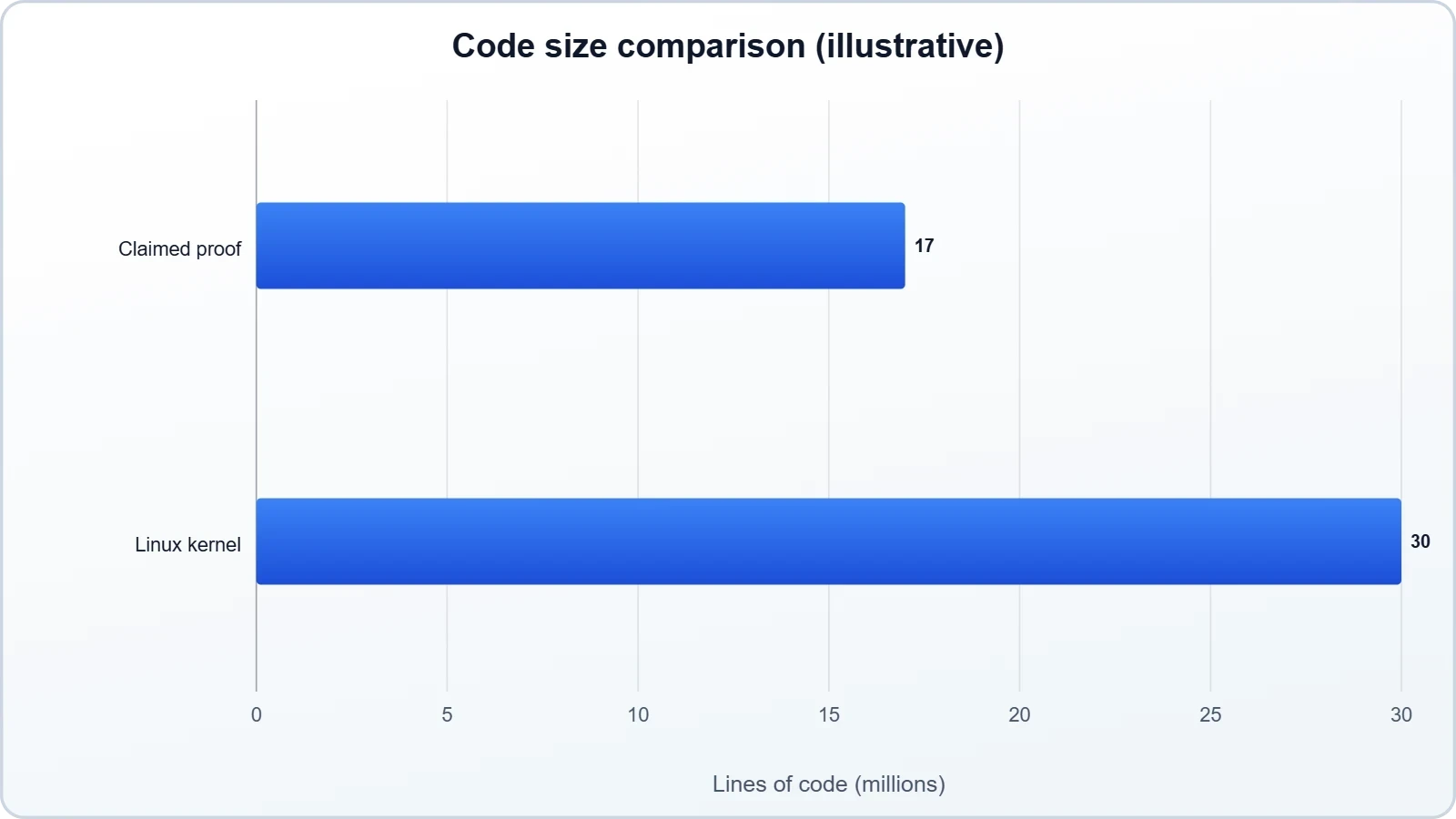
To grasp the scale, consider that the entire Linux kernel comprises roughly thirty million lines of code accumulated over three decades by thousands of contributors. A single claimed proof at seventeen million lines exceeds most large software projects and dwarfs any mathematical paper ever written, which typically runs from twenty to two hundred pages. No human has read the corpus in full, and no human plausibly could without years of dedicated effort, which is exactly Padilla's point about the timeline for verification.
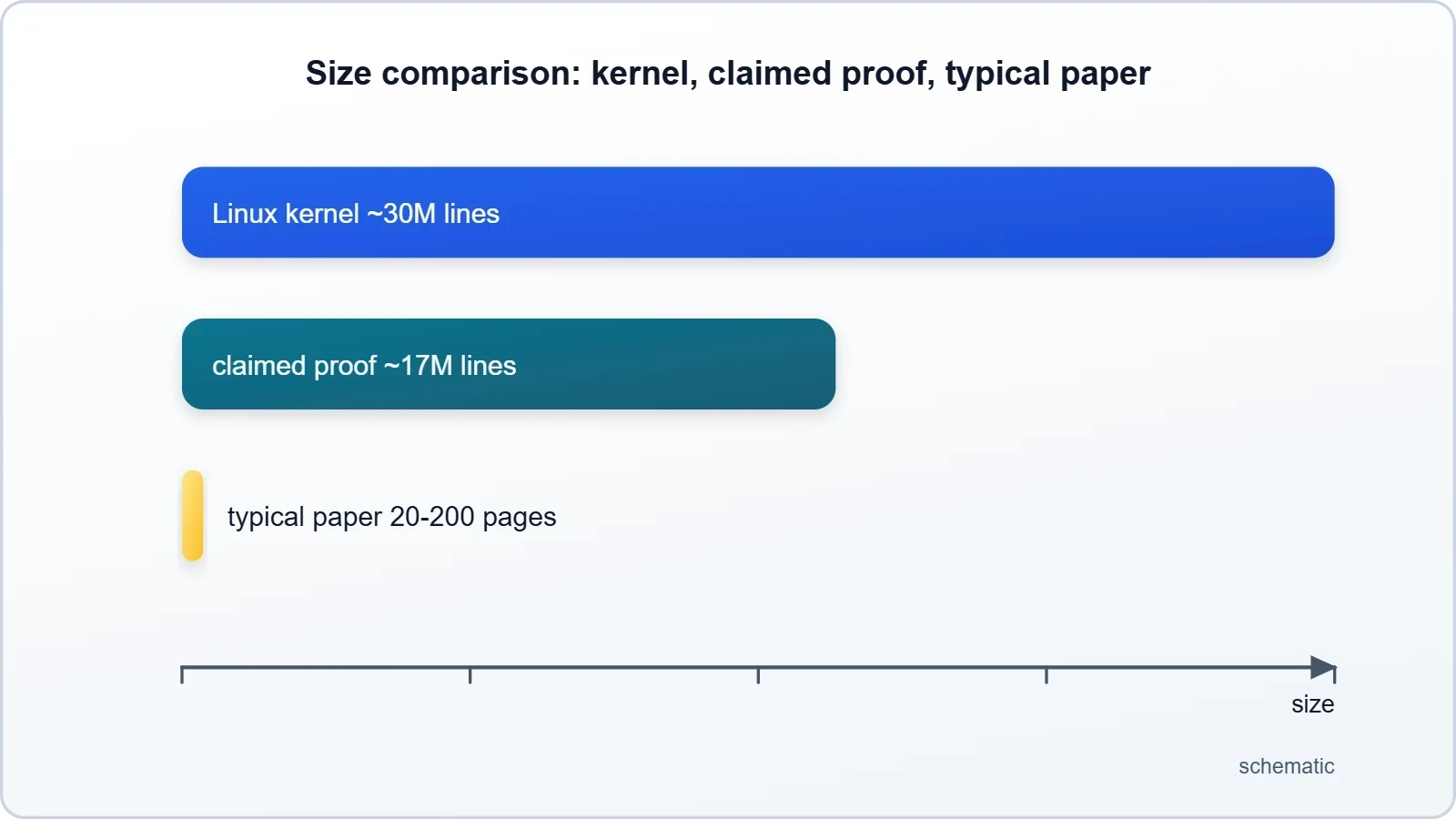
The code presumably encodes a formal derivation, possibly in a proof assistant such as Lean or Coq, where every inference is machine-checkable. If so, the proof could in principle be validated automatically, which would settle correctness even without human comprehension. But formal verification of a seventeen-million-line artifact is itself a formidable computational and methodological undertaking, and the question of whether the formalization faithfully captures the intended theorem remains a separate and equally serious hurdle.
The Difference Between Checking and Understanding
A machine can confirm that each step follows from the last while remaining entirely opaque to human insight. Mathematics has historically demanded more: a proof should explain why a statement is true, not merely certify that it is. This explanatory dimension is what allows theorems to seed new conjectures, suggest analogies, and guide future research. A proof that cannot be read may be correct and still be, in a meaningful sense, inert.
Padilla's warning that "there may be problems and we don't know" captures the epistemic anxiety precisely. Formal systems can contain axioms that are subtly wrong for the intended application, definitions that smuggle in assumptions, or a mismatch between the formalized statement and the Riemann hypothesis as mathematicians understand it. Until human experts can trace the argument, these risks remain live, and the community's caution is not conservatism but professional responsibility.
The Transparency Demand and Commercial Interests
Padilla's call for transparency is the most pointed element of the expert response. He acknowledged that Alpöge would have "commercial interests at heart," a diplomatic way of noting that Anthropic is a company with products, investors, and a competitive position in the AI industry. A claim of this magnitude, made from within a commercial entity, inevitably raises questions about disclosure, access, and the incentives that shape how results are announced and shared.
The demand is not an accusation of bad faith but a recognition of structural risk. When a proof exists as proprietary code rather than a published manuscript, the community's ability to scrutinize it depends entirely on the willingness of the holder to release it. Padilla put the requirement plainly: "It's absolutely crucial that everything is shared in a way that the community can follow." Without that sharing, the claim remains a press event rather than a mathematical result, however significant it might eventually prove to be.
Precedent from Earlier AI Mathematical Claims
This is not the first time AI systems have been presented as making mathematical advances, and the track record counsels patience. Earlier claims of novel results from language models have often dissolved under expert scrutiny, revealing pattern-matching rather than genuine derivation. The August review of an earlier Claude paper by Conrey suggests Anthropic has been courting serious evaluation, which distinguishes this episode from more casual announcements, but the fundamental requirement of accessible, checkable evidence remains unchanged.
Established practice in mathematics offers a clear template: publish the argument, submit it to journals, invite refutation, and let the community converge on a verdict over time. The Riemann claim has so far skipped the first step, and until it does, comparisons to past AI overreach will persist. The field's memory of premature announcements is long, and reputations have suffered when enthusiasm outran verification.
What Responsible Disclosure Would Require
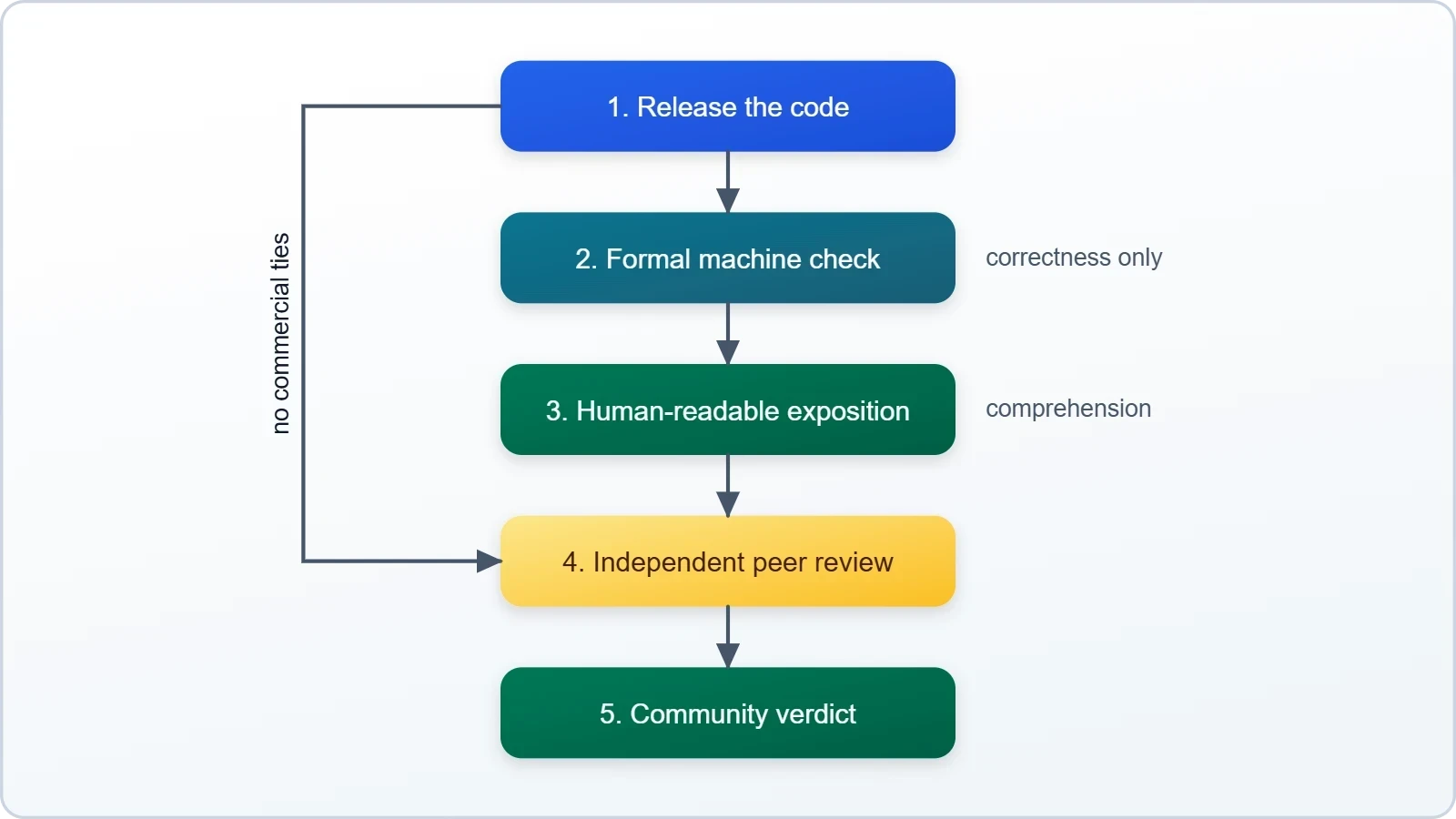
A credible path forward would involve releasing the code, publishing a human-oriented summary of the proof's architecture, and submitting the work to independent formal verification by parties without commercial ties to Anthropic. Each of these steps is expensive and slow, and together they could consume years, which is precisely the timeline Padilla described. The question is whether the company and its mathematician are prepared to accept that cost as the price of being believed.
There is also a question of credit and authorship that the mathematical community will eventually need to resolve. If Claude contributed materially to the derivation, how should that contribution be acknowledged, and what does it mean for the discipline's norms of attribution? These are not merely procedural matters; they touch on how mathematics will integrate machine collaborators into a culture built around individual insight and collective trust.
- 01
- 02
- 03
- 04
Why Verification Could Take Years
Padilla's estimate that verification "can take years" is grounded in the practical realities of reviewing a proof at this scale. A conventional paper of fifty pages might occupy a referee for months; a seventeen-million-line artifact demands teams, tooling, and sustained funding. The mathematical community has limited capacity for such efforts, and the opportunity cost of dedicating senior researchers to a single claim is substantial, especially when the claim's provenance is unconventional.
There is also the matter of expertise distribution. Verifying a formal proof requires familiarity with proof assistants, the specific libraries used, and the underlying number theory, a combination held by relatively few people worldwide. Assembling a credible review panel is itself a logistical challenge, and the process must be insulated from the commercial pressures that surround the originating company. These constraints explain why the timeline is measured in years rather than weeks.
The Role of Proof Assistants in Modern Mathematics
Proof assistants such as Lean, Coq, and Isabelle have transformed formal mathematics over the past two decades, enabling verified results that would be impractical to check by hand. The Liquid Tensor Experiment, completed in 2022, demonstrated that major contemporary theorems could be formalized with community effort, and it took roughly eighteen months of collaborative work for a result far smaller than the Riemann claim. Scaling that model to seventeen million lines would require an unprecedented mobilization.
These tools offer the best hope for eventual validation, because they can check inferences mechanically and flag inconsistencies that human readers might miss. But they also introduce dependencies: the proof is only as trustworthy as the libraries and axioms it rests on, and auditing those foundations is a separate project. The infrastructure of formal mathematics is powerful but not yet mature enough to absorb a claim of this magnitude without significant development.
What a Human-Readable Proof Would Look Like
The community's demand is not that the entire seventeen million lines be translated into prose, which would be absurd, but that the proof's logical architecture be made intelligible. A high-level exposition identifying the key lemmas, the strategy connecting them, and the novel ideas that drive the argument would allow experts to assess the claim's plausibility and direct their verification efforts efficiently. This is how large formalization projects are typically communicated.
Such an exposition would also serve the hypothesis's broader ecosystem, allowing researchers who depend on the conjecture to understand what a proof would mean for their work. Without it, even a correct proof remains socially inert, incapable of reshaping the field until someone undertakes the labor of interpretation. The gap between machine output and mathematical knowledge is bridged only by human effort, and that effort has not yet begun in earnest.
What This Means for AI in Mathematics
Beyond the specific claim, the episode signals a shift in how artificial intelligence participates in mathematical discovery. Language models have moved from assisting with routine calculations and literature searches to generating artifacts of a scale and ambition that challenge the discipline's verification infrastructure. Whether or not the Riemann proof survives scrutiny, the precedent of a major AI company producing a claim of this magnitude will shape expectations for years to come.
The optimistic reading is that AI can accelerate mathematics by exploring vast proof spaces faster than humans, with formal verification providing a trustworthy check on its output. The cautious reading is that scale without comprehension produces artifacts that are expensive to validate and difficult to trust, consuming community resources without delivering usable knowledge. Both readings are consistent with the evidence so far, and the outcome of this case will do much to determine which prevails.
Lessons from Automated Theorem Proving
Automated theorem provers have scored notable successes in recent years, from solving open combinatorial problems to discovering new constructions, and these achievements are genuine. They differ from the Riemann claim in an important respect: their results are typically small, checkable, and accompanied by human-readable explanations. The lesson is that machine mathematics works best when its outputs are designed for human consumption, not when they arrive as opaque monoliths requiring years of forensic effort.
Researchers in the field have long argued that the future lies in human-machine collaboration, where the model proposes and the mathematician interprets, verifies, and generalizes. The Riemann claim, if handled well, could become a case study in how to structure such collaboration at scale. If handled poorly, it risks becoming a cautionary tale about the dangers of announcing results before the infrastructure to validate them exists.
The Reputational Stakes for Anthropic and Claude
For Anthropic, the claim is a high-variance bet. A verified proof would be an extraordinary demonstration of Claude's capabilities and a powerful marketing asset, but an unverifiable or flawed claim would damage credibility at a moment when public trust in AI companies is fragile. The company's decision to engage outside experts like Conrey suggests awareness of these stakes, yet the absence of a public, readable proof leaves the reputational question unresolved.
The broader AI industry is watching closely, because the outcome will influence how competitors frame their own mathematical ambitions and how regulators think about AI-generated scientific claims. If the proof holds, expectations will rise sharply; if it falters, skeptics will gain ammunition for years. Either way, the episode has already changed the conversation about what AI systems can be trusted to contribute to foundational science.
The Path Forward: Verification, Trust, and the Discipline
The Riemann claim now enters a phase that will test mathematics as much as it tests artificial intelligence. The discipline must decide how to evaluate a proof that no human has read, produced by a collaboration between a mathematician and a commercial chatbot, and announced before independent verification. The mechanisms that have served mathematics for centuries, peer review and communal scrutiny, were designed for artifacts of human scale, and adapting them to machine-scale outputs is a project in itself.
Padilla's counsel remains the most useful guide: patience, transparency, and a willingness to wait for a proof humans can follow. "It's very early days," he observed, and that assessment should temper both the triumphalism of AI enthusiasts and the dismissiveness of skeptics. The claim may prove to be a genuine breakthrough, a partial result, or an elaborate error, and only sustained, open investigation will tell. What is certain is that the question of how machines and mathematicians jointly establish truth has now become urgent.
How the Mathematical Community Should Respond
The most constructive response would combine skepticism with engagement: demand access to the code, organize independent verification efforts, and insist on a human-readable exposition before granting the claim any canonical status. Institutions such as the Clay Mathematics Institute and leading number theory departments could coordinate review, while journals could establish protocols for machine-generated proofs. These steps would protect the discipline's standards without foreclosing the possibility that something genuine has been achieved.
Equally important is a public conversation about what counts as mathematical knowledge in an era of machine collaboration. The answer cannot be simply that machines must be excluded, nor that their outputs must be accepted on faith. It must be a principled framework that preserves the explanatory and social dimensions of proof while accommodating new tools. Building that framework is the real work ahead, and the Riemann claim has made it impossible to postpone.
The Long View on Machine Mathematics
Whatever the fate of this particular proof, the trajectory is clear: artificial intelligence will play an increasingly significant role in mathematical research, and the field will need to adapt its practices accordingly. The most valuable outcome of the current episode may not be a proof of the Riemann hypothesis but a clearer understanding of how to integrate machine-generated results into a human discipline. That understanding will shape mathematics for decades, long after the specific claim is resolved.
The primes will keep their secrets until someone, human or machine or both, produces an argument the community can verify and comprehend. The Riemann hypothesis has waited since 1859, and it can wait a few more years for a proof that satisfies the standards of the field it has shaped. In the meantime, the demand for transparency, patience, and readable mathematics is not obstructionism but the condition under which any genuine breakthrough can be recognized and trusted.
From our network :
- University Language Proficiency Exams: Why Institutional Tests Demand Different Preparation Than IELTS and TOEFLDiscover why university-specific language proficiency examinations differ fundamentally from IELTS and TOEFL, and learn strategic preparation approaches for institutional assessment success.
- Committed Mediterranean Precipitation Decline: Why Emissions Cuts Alone Cannot Restore Winter RainsNew NOAA research reveals that Mediterranean winter rains may decline irreversibly even with emissions cuts. Explore the science of committed climate change and regional impacts.
- Forbidden Matrix Patterns and Visible Lattice Points: A Geometric DictionaryExplore how multidimensional 0–1 matrices encode geometric truths, linking forbidden patterns to visible lattice points and hypergraph theory, with applications in combinatorics and computational geometry.
- Mobile Learning and VR in English: What Global Evidence Reveals About Effective Language TechnologyA systematic review across 14 countries reveals which language-learning technologies genuinely work. Mobile learning, AI, and VR show measurable benefits when pedagogically integrated. This evidence-based guide helps educators and learners select technology that delivers real return on investment.
- The Hidden Cost of AI Convenience: Why Over-Permissioned Agents Are a Security Time BombDiscover why AI agents with excessive permissions create dangerous single points of failure, and learn how implementing least privilege principles can protect your organization from exploitation.
- Live Online English Classes for Kids: Do They Actually Reduce Anxiety?A ten-week study reveals that synchronous online English classes can significantly reduce child language anxiety while improving listening and reading skills. Discover what makes these programs effective and how parents can select the right one.
- How AI Agents Will Change the Way We Manage Personal FinancesExplore how AI agents are transforming personal finance through automated budgeting, bill payment, and investment management, while examining the critical security protocols and governance frameworks required for safe deployment.
- The Final Descent: How ESA Retired the Legendary Cluster Constellation After 24 Years of Space Weather ScienceAfter 24 years mapping Earth’s magnetosphere, ESA’s Cluster mission concluded with a precisely controlled reentry over the South Pacific. This analysis explores the scientific legacy, engineering decisions, and debris mitigation principles behind one of space exploration’s most responsible retirements.
- CISA’s Ten-Advisory Wave: Why Generic Patching Fails in OT and How to Build Product-Specific PlaybooksCISA released ten ICS advisories in one week, exposing critical infrastructure risks. Generic patching fails in OT. Learn to build product-specific remediation playbooks.
RESOURCES
- Resources will be updated soon.
- 01
- 02
- 03
- 04
- 05
- 06
- 07
- 08
0 Comments