The death of Maja Janeska in 2022, and the decision by a specialised organised crime unit in Gauteng to formally investigate it, sits at the intersection of two worlds that rarely meet in public view: the regulated tobacco trade and the shadow economy that surrounds it. Janeska was the girlfriend of a cigarette tycoon, and she died from a gunshot wound to the head. For years the case generated headlines, speculation and quiet frustration among those who believed the circumstances deserved a more searching inquiry. The transfer of the matter to detectives who specialise in syndicates, racketeering and contract violence signals that investigators now treat the death as something more than an isolated tragedy.
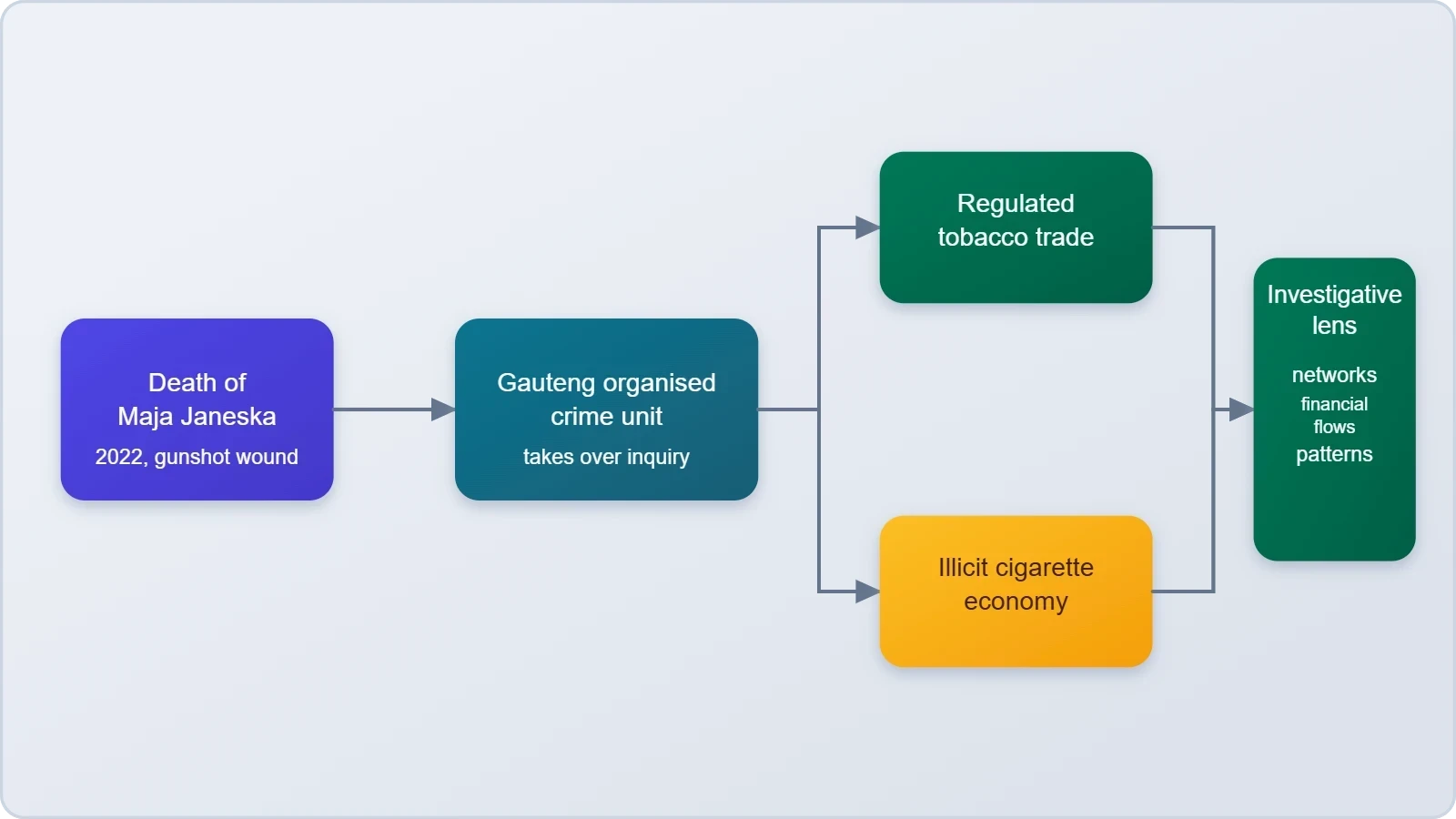
That shift matters because organised crime units do not ordinarily absorb cases without a reason. Their caseloads are built around patterns, not accidents, and their involvement implies a working hypothesis that the killing may connect to financial interests, intimidation or the broader ecosystem of illicit cigarette distribution that has long troubled South African law enforcement. The public record remains thin, and officials have released no further details about the circumstances of her death or the status of the investigation. Yet the institutional choice itself is a form of disclosure, telling observers which investigative lens is now being applied to a death that has resisted easy explanation.
Understanding this story requires more than following a single police docket. It requires an appreciation of how South Africa's tobacco sector became a battleground, how organised crime units operate within the SAPS, and why the timing of an investigation can carry as much meaning as its eventual findings. The paragraphs that follow examine the case through those wider frames, weighing what is known against what remains unverified, and considering what the involvement of organised crime detectives implies for a family still seeking answers and for a public accustomed to unresolved questions.
On This Page
TL;DR A specialised organised crime unit in Gauteng is investigating the 2022 death of Maja Janeska, girlfriend of a cigarette tycoon, who died from a gunshot wound to the head. No further details on circumstances or investigative status have been released. The assignment of syndicate-focused detectives suggests authorities may be examining links to the illicit tobacco economy, contract violence or financial motives rather than treating the death as isolated. The case illustrates how South Africa's cigarette trade has become entangled with organised crime, and why institutional choices in policing carry evidentiary weight even when official statements remain sparse.
The Case at the Centre of the Inquiry
At its simplest, the matter concerns a woman's violent death and a police service's decision about which unit should own the file. Maja Janeska died in 2022 from a gunshot wound to the head, and her connection to a prominent cigarette tycoon placed the case immediately within a media spotlight that has never fully dimmed. The Gauteng organised crime unit's involvement, reported by News24, reframes the inquiry around syndicate behaviour rather than individual circumstance. That reframing is significant because it changes the questions detectives ask, the witnesses they pursue and the financial trails they choose to follow.
What Is Known and What Remains Unconfirmed
The confirmed facts are narrow. Janeska died in 2022 of a gunshot wound to the head. A specialised organised crime unit operating in Gauteng is now investigating the death. No further details about the circumstances or the status of the investigation have been released by authorities. Everything beyond those points, including whether anyone has been arrested, whether a suspect has been identified, or whether the case has previously been reviewed by other units, remains outside the public domain. Responsible analysis must therefore distinguish carefully between the documented record and the speculative narratives that have circulated since 2022.
This scarcity of official information is itself a feature of organised crime investigations. Detectives working on syndicate cases routinely withhold detail to protect informants, preserve the integrity of financial evidence and avoid tipping off persons of interest. The silence should not be read as inactivity. It more often reflects a deliberate evidentiary strategy in which public statements are treated as a risk to be managed rather than a courtesy to be extended. For journalists and analysts, that means the institutional signal, the assignment of the case, carries more weight than any single press release.
Why the Unit Assignment Changes the Analytical Frame
Organised crime units are structured around a different logic than general detectives. They map networks, trace money, examine patterns of intimidation and coordinate with prosecutors who specialise in racketeering statutes. When such a unit takes over a death investigation, the implicit premise is that the killing may be connected to a wider criminal enterprise or to interests that extend beyond the victim's immediate relationships. That premise does not establish guilt or even a theory of the case, but it does tell the public which analytical tools are now being applied to a death that has lingered unresolved for years.
The assignment also carries resource implications. Specialised units are finite, and their attention is rationed. A case absorbed by organised crime detectives typically receives sustained investigative capacity, forensic accounting support and access to intelligence holdings that ordinary units cannot easily reach. For a family seeking closure, that represents a meaningful shift in the prospects of the matter. For observers of South African policing, it offers a window into how the service prioritises cases where commercial and criminal interests appear to overlap.
South Africa's Illicit Cigarette Economy
No discussion of a cigarette tycoon's circle can ignore the industry's recent history in South Africa. The tobacco trade has been one of the country's most contested commercial arenas, marked by a national sales ban during the COVID-19 lockdown, a surge in illicit distribution, and sustained disputes over taxation and licensing. Those conditions created fertile ground for networks that blend legitimate business, informal retail and outright smuggling. When violent deaths occur near figures associated with that economy, investigators naturally consider whether commercial rivalries, debt or enforcement disputes played a role, even where no such link has been publicly established.
The Lockdown Ban and Its Aftermath
The 2020 prohibition on cigarette sales remains the defining episode in the modern history of the sector. Overnight, a legal market worth billions of rand was pushed underground, and illicit supply chains that had operated at the margins expanded rapidly to meet demand. Analysts and industry bodies estimated that a substantial share of cigarettes sold during and after the ban were untaxed, depriving the state of significant revenue. The episode demonstrated how quickly regulatory shocks can entrench criminal distribution networks, and it left a legacy of disputed market shares, contested enforcement and heightened suspicion among competitors.
That legacy matters for any investigation touching the tobacco trade. A market shaped by smuggling, counterfeit brands and informal distribution generates exactly the kinds of disputes that can escalate into intimidation or violence. It also produces a dense web of financial relationships that are difficult to untangle, involving wholesalers, transporters, warehouse operators and retailers whose records may be incomplete. Organised crime detectives are equipped for precisely this kind of complexity, which is one reason their involvement in a death investigation connected to the sector attracts attention.
How Illicit Trade Generates Investigative Complexity
Illicit trade is not a single crime but a cluster of them. It involves customs fraud, tax evasion, money laundering and, frequently, the corruption of officials who are supposed to police it. Each element produces its own evidentiary trail, and each trail can lead in unexpected directions. Investigators examining a death in this environment must consider whether the victim was connected to a dispute over territory, a debt, a betrayal or a perceived threat to someone's commercial position. None of these possibilities has been publicly confirmed in the Janeska case, but they define the analytical space that organised crime detectives now occupy.
The complexity also explains why such cases move slowly. Financial records must be obtained across jurisdictions, witnesses may be reluctant to speak, and the line between legitimate business practice and criminal conduct can be genuinely difficult to draw. South African authorities have repeatedly acknowledged the challenge of policing illicit tobacco, and the sector's history suggests that progress comes in increments rather than breakthroughs. A specialised unit's involvement is therefore best understood as a commitment of capacity rather than a promise of swift resolution.
How Organised Crime Units Work
Understanding what the Gauteng unit's involvement means requires some familiarity with how specialised detective work functions inside the South African Police Service. Organised crime units are not simply elite general detectives. They operate with a distinct methodology centred on networks, financial flows and the coordination of multiple cases that may share actors or infrastructure. Their mandate typically covers racketeering, extortion, illegal mining, drug trafficking, vehicle theft syndicates and, increasingly, the violent enforcement mechanisms that such enterprises rely upon. A death investigation absorbed into this framework is treated as a potential node in a larger map.
Mandate, Methods and Intelligence Sharing
The methods are recognisable to anyone who follows serious crime investigations internationally. Detectives build link charts, analyse communication records, pursue financial disclosures and cultivate informants inside criminal networks. They work closely with prosecutors to ensure that evidence gathered is admissible under organised crime legislation, and they coordinate with other agencies on matters such as tax and customs. In South Africa, the Directorate for Priority Crime Investigation, commonly known as the Hawks, handles many such matters at national level, while provincial units address regionally concentrated syndicates. The Gauteng unit's role places this case within that provincial enforcement architecture.
Intelligence sharing is the connective tissue of this work. A single piece of information about a vehicle, a phone number or a financial transaction can link apparently unrelated cases across provinces. That is why the assignment of a case to an organised crime unit can produce progress that years of general investigation did not. It is also why such units are cautious about public disclosure: revealing what they know can compromise the links they are still trying to establish. The absence of detail in the Janeska matter is consistent with that operational discipline rather than evidence of neglect.
Accountability and Public Scrutiny
Specialised units operate under a dual obligation. They must protect the integrity of investigations, and they must answer to a public that has a legitimate interest in how deaths are investigated. South Africa's police oversight bodies, including the Independent Police Investigative Directorate and parliamentary portfolio committees, provide formal channels for that accountability. In high-profile matters, the balance between secrecy and transparency is especially delicate, because public confidence in the outcome depends on the perception that the inquiry is thorough, independent and properly resourced. Any eventual finding will be judged as much on process as on result.
The historical record offers cautionary lessons. Several prominent South African cases have languished for years before being reassigned or revived, and public patience has worn thin in the process. The Madlanga Commission, referenced in coverage of this matter, forms part of the wider context of state inquiries into institutional conduct that have shaped public expectations about accountability. Against that backdrop, the organised crime unit's involvement will be watched closely, not only for what it uncovers about one death but for what it demonstrates about the police service's willingness to pursue difficult cases wherever they lead.
We Also Published
- 01
- 02
- 03
- 04
The Wider Context of High-Profile Deaths
South Africa has a long and painful familiarity with deaths that become public causes. Cases involving prominent business figures, political connections or apparent contract violence tend to generate intense initial coverage, followed by years of procedural silence and occasional bursts of renewed attention. The pattern is not unique to South Africa, but its frequency there has shaped public expectations in distinctive ways. Families often become the most persistent advocates for investigation, pressing for reassignment, forensic review or independent oversight when conventional channels appear to stall. The Janeska case fits this broader pattern of prolonged uncertainty punctuated by institutional developments.
Patterns in Contract Violence and Intimidation
Contract violence, where a killing is commissioned rather than committed in the heat of the moment, presents particular investigative difficulties. The chain between the person who orders a killing and the person who carries it out is deliberately long, with intermediaries who insulate the principals. Prosecutions therefore depend heavily on financial evidence, communications analysis and the willingness of participants to cooperate. Organised crime units are built for exactly this kind of work, which is why their involvement in a death with possible commercial dimensions is treated as a meaningful escalation rather than a routine administrative step.
Intimidation operates alongside violence as a tool of commercial control. Threats, property damage and targeted harassment can achieve compliance without leaving a body, and they are notoriously difficult to prosecute. In sectors where illicit competition is common, the boundary between aggressive business practice and criminal intimidation can blur. Investigators examining a death in such an environment must therefore reconstruct not only the immediate events but the wider climate of pressure in which the victim lived. That reconstruction takes time and depends on testimony that may be hard to obtain.
Media Attention, Public Memory and Institutional Response
Media coverage plays an ambiguous role in these cases. Sustained attention can keep a matter alive and create pressure for resources, but it can also generate speculation that complicates fair investigation and prejudices eventual proceedings. Responsible reporting distinguishes between confirmed facts and circulating claims, and it recognises that the absence of new information is not the same as the absence of activity. The News24 report on the organised crime unit's involvement exemplifies this careful approach, conveying the institutional development without embellishing the underlying circumstances.
Public memory is selective, and cases that fade from headlines can nonetheless remain active in police files. The revival of attention when a unit is reassigned or a new lead emerges reflects the fact that investigations are not linear. For the family of a victim, each institutional development carries hope and risk in equal measure. For the wider public, such moments offer a reminder that the administration of justice is a long process shaped by resources, priorities and the persistence of those who refuse to let a case be forgotten.
Reading the Evidence Responsibly
In a matter where official information is scarce, the discipline of responsible analysis becomes essential. Readers encounter a steady stream of claims about the Janeska case, some sourced to anonymous figures, others recycled from social media. Distinguishing between documented fact and assertion is not pedantry; it is the difference between informed commentary and the amplification of rumour. The confirmed record consists of the victim's identity, the year and cause of death, and the involvement of a Gauteng organised crime unit. Any analysis that goes beyond those points must be explicitly framed as inference rather than established fact.
Distinguishing Fact, Inference and Speculation
Inference is legitimate when it is grounded in institutional knowledge. It is reasonable to infer that organised crime detectives are examining possible links to syndicate activity, because that is what such units do. It is not reasonable to infer that a specific person ordered a killing, because no such finding has been made public. The distinction matters both ethically and practically. Speculation that names individuals can cause real harm, complicate investigations and expose publishers to legal risk. Careful analysis confines itself to what the institutional record supports and treats the rest as questions awaiting evidence.
Statistical context can help calibrate expectations without substituting for evidence. South Africa records tens of thousands of murders annually, and only a fraction result in prosecution, let alone conviction. Cases involving commercial dimensions and specialist units may fare better than average, but the base rates remain sobering. Recognising that context is not cynicism; it is a realistic appraisal of the challenges facing any investigation. It also underscores why the assignment of specialist capacity is treated as significant news rather than a routine procedural note.
What Responsible Coverage Looks Like
Responsible coverage of unresolved deaths follows a recognisable pattern. It reports confirmed developments accurately, attributes claims to their sources, avoids naming individuals who have not been formally implicated, and provides context about the institutions involved. It also acknowledges uncertainty explicitly rather than filling gaps with narrative convenience. The News24 report on this case adheres to those standards, conveying the essential development while noting that no further details have been released. That restraint is a service to readers, who are better served by accurate limits than by confident speculation.
For analysts and commentators, the obligation extends to explaining why a development matters without overstating what it proves. The organised crime unit's involvement tells us something about how the police service is framing the case; it does not tell us what happened in 2022. Keeping that distinction clear allows readers to follow the story as it develops without being misled by premature conclusions. It also preserves the possibility of a fair process, which is ultimately in everyone's interest, including the victim's family and the public that expects justice to be done properly.
What Comes Next for the Investigation
The immediate future of the case depends on factors that are largely invisible to the public. Investigators will be pursuing financial records, interviewing witnesses and assessing whether any existing intelligence connects the death to known networks. Progress may be announced in stages, or it may remain concealed until a prosecution is ready to proceed. The absence of a public timeline is normal in organised crime matters, and observers should resist the temptation to interpret silence as failure. What can be said with confidence is that the case now sits with detectives whose professional formation is oriented toward exactly the kind of complexity it presents.
Possible Pathways and Their Implications
Several pathways are conceivable. The investigation could produce evidence linking the death to commercial disputes within the tobacco trade, leading to charges against individuals connected to illicit distribution. It could conclude that the death was unrelated to the victim's association with the industry, in which case the organised crime lens would have served as a process of elimination. It could also remain unresolved, as many complex cases do, with periodic reviews and no definitive public accounting. Each pathway carries different implications for public confidence in the police service and for the family's search for closure.
Whatever the outcome, the process itself will be scrutinised. South African civil society organisations, legal commentators and parliamentary oversight bodies have become adept at tracking the progress of high-profile matters and comparing rhetoric against results. That scrutiny is a form of accountability that operates alongside formal mechanisms, and it can influence how resources are allocated and how decisions are explained. For the police service, demonstrating that a difficult case received genuine specialist attention is itself a reputational asset, independent of whether charges ultimately follow.
Implications for Public Trust and Accountability
Public trust in policing is built through accumulated evidence of competence and integrity. A single case rarely transforms that trust, but a pattern of unresolved high-profile deaths can erode it steadily. The decision to assign organised crime detectives to the Janeska matter can therefore be read as an investment in institutional credibility as well as an investigative step. If the case advances, it will reinforce the message that specialist capacity is deployed where it is needed. If it stalls without explanation, it will add to the stock of public scepticism that already surrounds several other unresolved matters.
Accountability ultimately depends on transparency at the right moments. Investigators need operational space, but the public needs periodic assurance that a case has not been quietly shelved. Striking that balance is a governance challenge as much as a policing one, and it requires leadership willing to communicate what can be communicated without compromising the work. The coming months will reveal whether the organised crime unit's involvement produces that kind of communication or whether the case returns to the long silence that has characterised so many similar matters in South Africa's recent history.
From our network :
- University Language Proficiency Exams: Why Institutional Tests Demand Different Preparation Than IELTS and TOEFLDiscover why university-specific language proficiency examinations differ fundamentally from IELTS and TOEFL, and learn strategic preparation approaches for institutional assessment success.
- Live Online English Classes for Kids: Do They Actually Reduce Anxiety?A ten-week study reveals that synchronous online English classes can significantly reduce child language anxiety while improving listening and reading skills. Discover what makes these programs effective and how parents can select the right one.
- CISA’s Ten-Advisory Wave: Why Generic Patching Fails in OT and How to Build Product-Specific PlaybooksCISA released ten ICS advisories in one week, exposing critical infrastructure risks. Generic patching fails in OT. Learn to build product-specific remediation playbooks.
- How AI Agents Will Change the Way We Manage Personal FinancesExplore how AI agents are transforming personal finance through automated budgeting, bill payment, and investment management, while examining the critical security protocols and governance frameworks required for safe deployment.
- Committed Mediterranean Precipitation Decline: Why Emissions Cuts Alone Cannot Restore Winter RainsNew NOAA research reveals that Mediterranean winter rains may decline irreversibly even with emissions cuts. Explore the science of committed climate change and regional impacts.
- Mobile Learning and VR in English: What Global Evidence Reveals About Effective Language TechnologyA systematic review across 14 countries reveals which language-learning technologies genuinely work. Mobile learning, AI, and VR show measurable benefits when pedagogically integrated. This evidence-based guide helps educators and learners select technology that delivers real return on investment.
- The Final Descent: How ESA Retired the Legendary Cluster Constellation After 24 Years of Space Weather ScienceAfter 24 years mapping Earth’s magnetosphere, ESA’s Cluster mission concluded with a precisely controlled reentry over the South Pacific. This analysis explores the scientific legacy, engineering decisions, and debris mitigation principles behind one of space exploration’s most responsible retirements.
- Forbidden Matrix Patterns and Visible Lattice Points: A Geometric DictionaryExplore how multidimensional 0–1 matrices encode geometric truths, linking forbidden patterns to visible lattice points and hypergraph theory, with applications in combinatorics and computational geometry.
- The Hidden Cost of AI Convenience: Why Over-Permissioned Agents Are a Security Time BombDiscover why AI agents with excessive permissions create dangerous single points of failure, and learn how implementing least privilege principles can protect your organization from exploitation.
RESOURCES
- Resources will be updated soon.
- 01
- 02
- 03
- 04
- 05
- 06
- 07
- 08
0 Comments