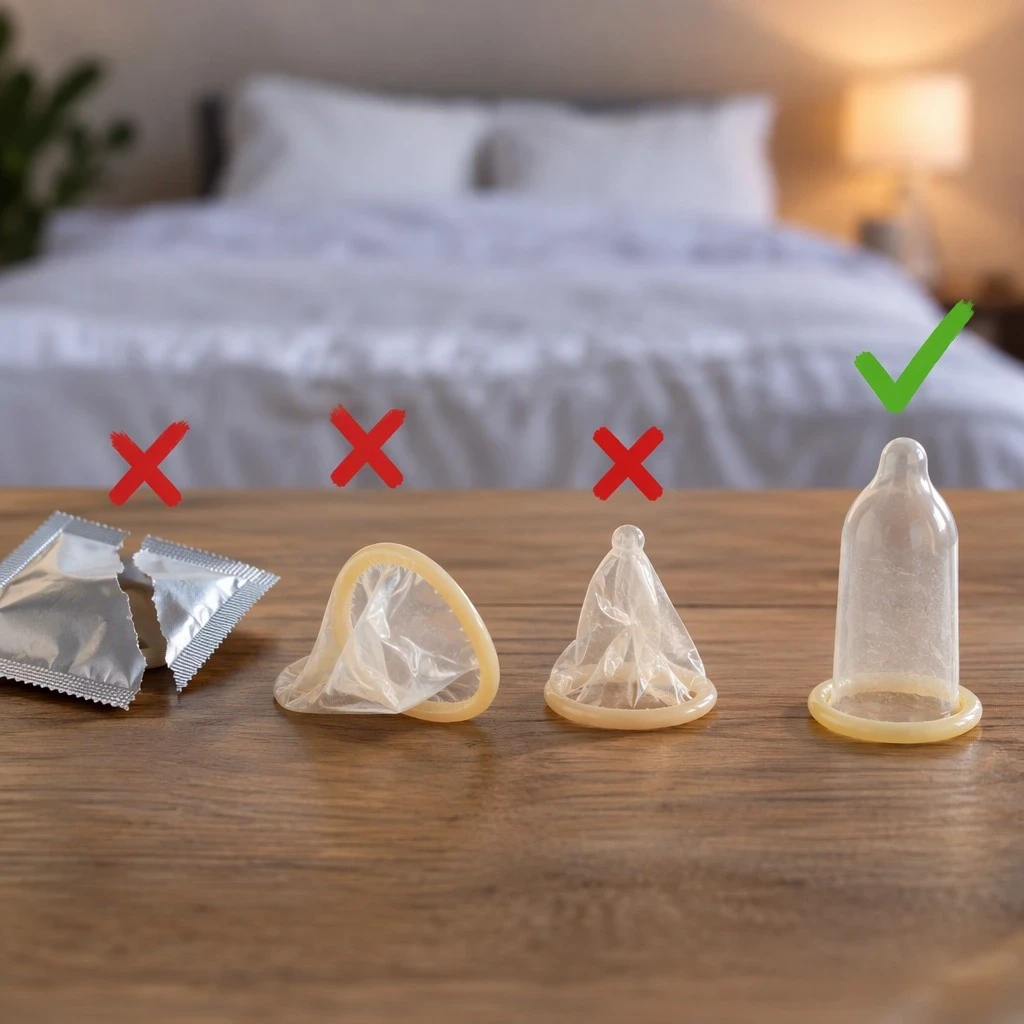
Condoms remain one of the most accessible and effective tools for preventing both unintended pregnancy and sexually transmitted infections, yet their real-world performance depends almost entirely on how they are handled before and during use. The gap between laboratory efficacy and everyday outcomes is rarely a story about product failure; it is a story about human error, rushed decisions, and small oversights that compound into significant risk. Understanding the mechanics of that gap is the first step toward closing it, because most of the mistakes people make are entirely preventable once they are named and explained.
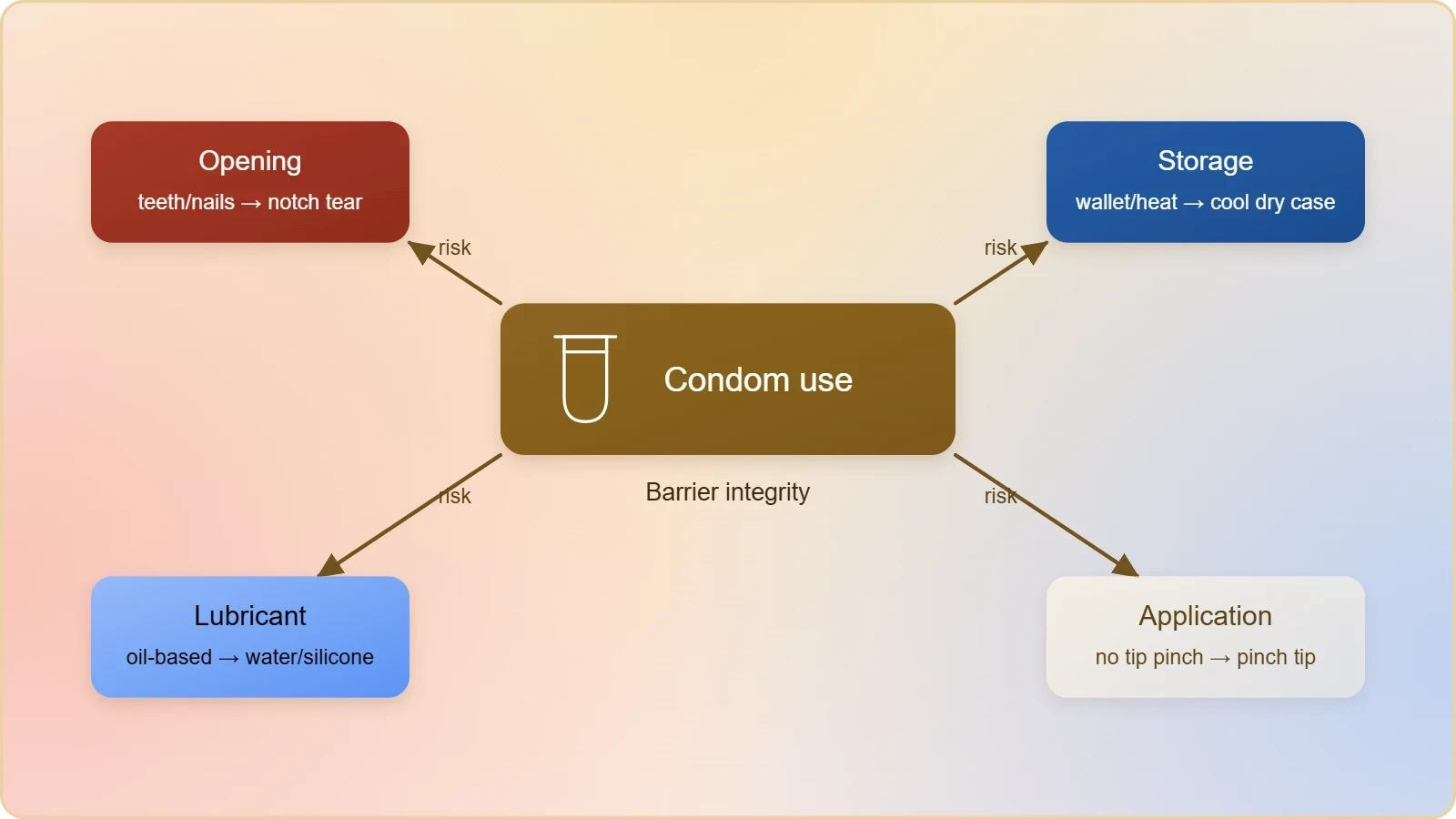
What follows is a careful examination of the recurring errors that undermine condom reliability, from the deceptively simple act of opening a packet to the chemistry of the lubricant chosen alongside it. Each mistake is paired with a practical correction, grounded in how latex and polyisoprene actually behave under stress, heat, and friction. The intent is not to lecture but to equip: readers deserve clear, non-judgmental guidance that translates directly into more confident and consistent use. When people understand why a rule exists, they are far more likely to follow it under pressure.
Reliability, in this context, is a system rather than a single object. Storage conditions, expiry awareness, correct sizing, lubrication compatibility, and post-use handling all interact, and a weakness in any one link can compromise the whole. By treating condom use as a chain of small, learnable habits, this analysis reframes safety as something achievable through attention rather than perfection. The sections ahead move methodically through the most common pitfalls, offering fixes that are simple enough to remember and specific enough to matter.
On This Page
TL;DR Most condom failures trace back to avoidable handling errors rather than manufacturing defects. Opening packets with teeth or nails, storing condoms in hot wallets or glove compartments, using oil-based lubricants with latex, ignoring expiry dates, and rolling the condom on incorrectly all weaken the barrier or cause breakage. Simple corrections — pinching the tip, checking the date, choosing water- or silicone-based lubricant, and storing condoms in a cool dry place — dramatically improve reliability. This guide walks through each mistake, explains the underlying mechanism, and provides a practical fix so that protection works the way it is supposed to.
The Hidden Fragility of a Sealed Packet
A condom packet looks robust, but its integrity is more delicate than most people assume. The foil is designed to protect against light, air, and abrasion, yet it offers little resistance to sharp edges. When a packet is torn open with teeth, fingernails, or scissors, microscopic nicks can appear along the latex beneath, creating stress points that fail under pressure. The fix is almost embarrassingly simple: use the serrated edge or fingertips to tear along the designated notch, and never improvise with tools that introduce risk where none is needed.
Why the Opening Method Matters
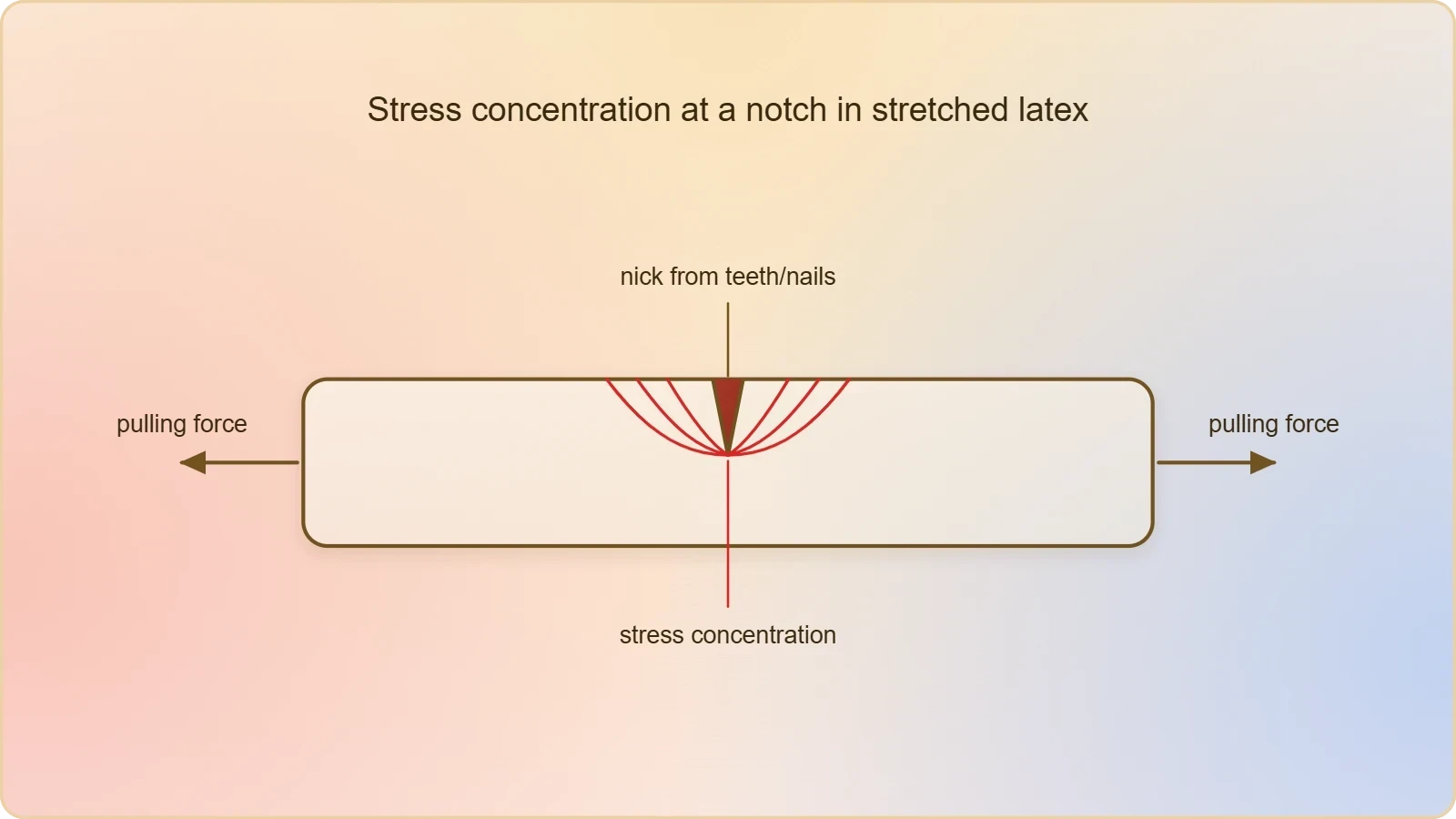
The physics behind this is straightforward. Latex is an elastic polymer that stretches to accommodate movement, but a small cut concentrates stress at its tip, much like a notch in a sheet of material being pulled apart. Engineers describe this as stress concentration, and the effect is dramatic: a tiny defect can reduce the force required to rupture the material by a large margin. In practical terms, a condom that survived manufacturing inspection can fail during use because of a nick introduced in the seconds it took to open the wrapper.
Beyond the physical damage, rushed opening often signals a broader pattern of haste that carries into application. People who tear packets carelessly are more likely to skip the tip-pinch, forget to check orientation, or apply the condom after contact has already begun. Slowing down for those few seconds is therefore doubly protective: it preserves the barrier and sets a deliberate tone for everything that follows. Good technique begins before the condom is even unrolled.
Expiry Dates and Degradation
Every condom carries an expiration date, and it is not decorative. Latex degrades over time, particularly when exposed to heat, friction, or ultraviolet light, and an expired condom may have lost the elasticity that allows it to stretch without tearing. The degradation is invisible; a condom that looks and feels normal can already be compromised. Checking the date on the packet before use takes a moment and eliminates an entire category of avoidable failure, especially for condoms that have been sitting in a drawer or wallet for months.
Expiry awareness also intersects with storage habits. A condom kept in a back pocket through a hot summer may age faster than its printed date suggests, because temperature accelerates the chemical breakdown of the polymer. The printed date assumes reasonable storage conditions, and when those conditions are violated, the date becomes optimistic rather than reliable. Treating the expiry date as a ceiling rather than a guarantee is the more prudent approach, particularly for condoms carried daily.
We Also Published
Storage Conditions and the Slow Erosion of Latex
Where a condom lives between purchase and use matters more than most people realize. Latex is a natural polymer that responds to its environment, and prolonged exposure to heat, sunlight, humidity, or mechanical friction gradually reduces its elasticity. A condom stored in a wallet for weeks is subjected to body heat, sitting pressure, and the abrasion of coins and cards, all of which take a quiet toll. The same condom may look pristine when finally opened, yet its molecular structure has already been weakened in ways the eye cannot detect.
The Wallet and Glove Compartment Problem
The wallet habit persists because it is convenient, and convenience is a powerful teacher. But a wallet is essentially a small oven and grinder combined: body heat keeps it warm, sitting compresses its contents, and the friction of daily handling adds wear. A glove compartment is worse, reaching temperatures that can accelerate latex degradation dramatically during summer months. Neither location is catastrophic in a single instance, but repeated exposure over weeks produces cumulative damage that undermines the barrier precisely when it is needed most.
The practical alternative is unglamorous but effective: keep a small supply in a cool, dry place at home, and if portability is essential, use a dedicated hard case designed for the purpose. These cases shield condoms from compression and friction while keeping them accessible. Rotating stock so that older condoms are used first prevents the quiet accumulation of expired or degraded items at the back of a drawer, a common and easily overlooked source of failure.
Heat, Light, and Humidity
Ultraviolet light and humidity are the quieter adversaries. Sunlight degrades latex through photochemical reactions that break polymer chains, which is why condoms are packaged in opaque foil rather than clear plastic. Humidity promotes the growth of mold and can affect the lubricant coating, while dry heat makes the latex brittle. A bathroom cabinet, often warm and steamy, is a surprisingly poor storage choice for the same reasons it is a poor place for medications. A bedroom drawer away from windows offers a far more stable environment.
Temperature stability matters as much as absolute temperature. Fluctuations cause the material to expand and contract repeatedly, and this cycling introduces micro-stress that accumulates over time. A condom kept at a consistent, moderate temperature retains its properties far longer than one subjected to daily swings between a cold car and a heated room. The principle is simple: treat condoms like any temperature-sensitive product and store them where conditions remain steady and moderate.
Lubrication Chemistry and Compatibility
Lubricant choice is where chemistry meets consequence, and it is among the most consequential decisions in condom use. Latex and polyisoprene are compatible with water-based and silicone-based lubricants, but oil-based products — including petroleum jelly, baby oil, massage oils, and many lotions — chemically degrade the latex within minutes. The result is a condom that weakens, stretches abnormally, and can rupture during use. The mechanism is not subtle: oils act as solvents that disrupt the polymer network, and the damage is often invisible until failure occurs.
Oil-Based Lubricants and Latex Breakdown
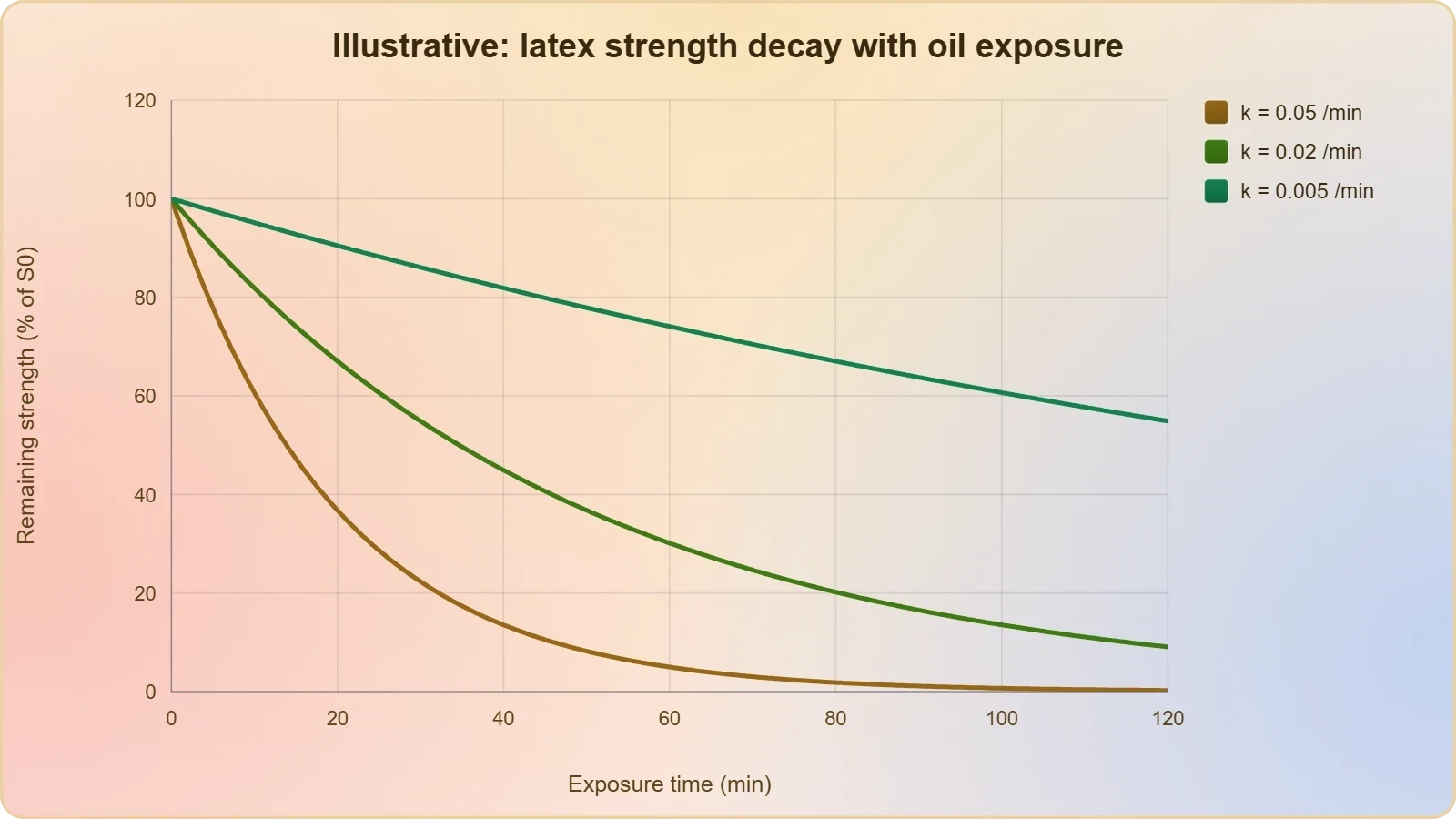
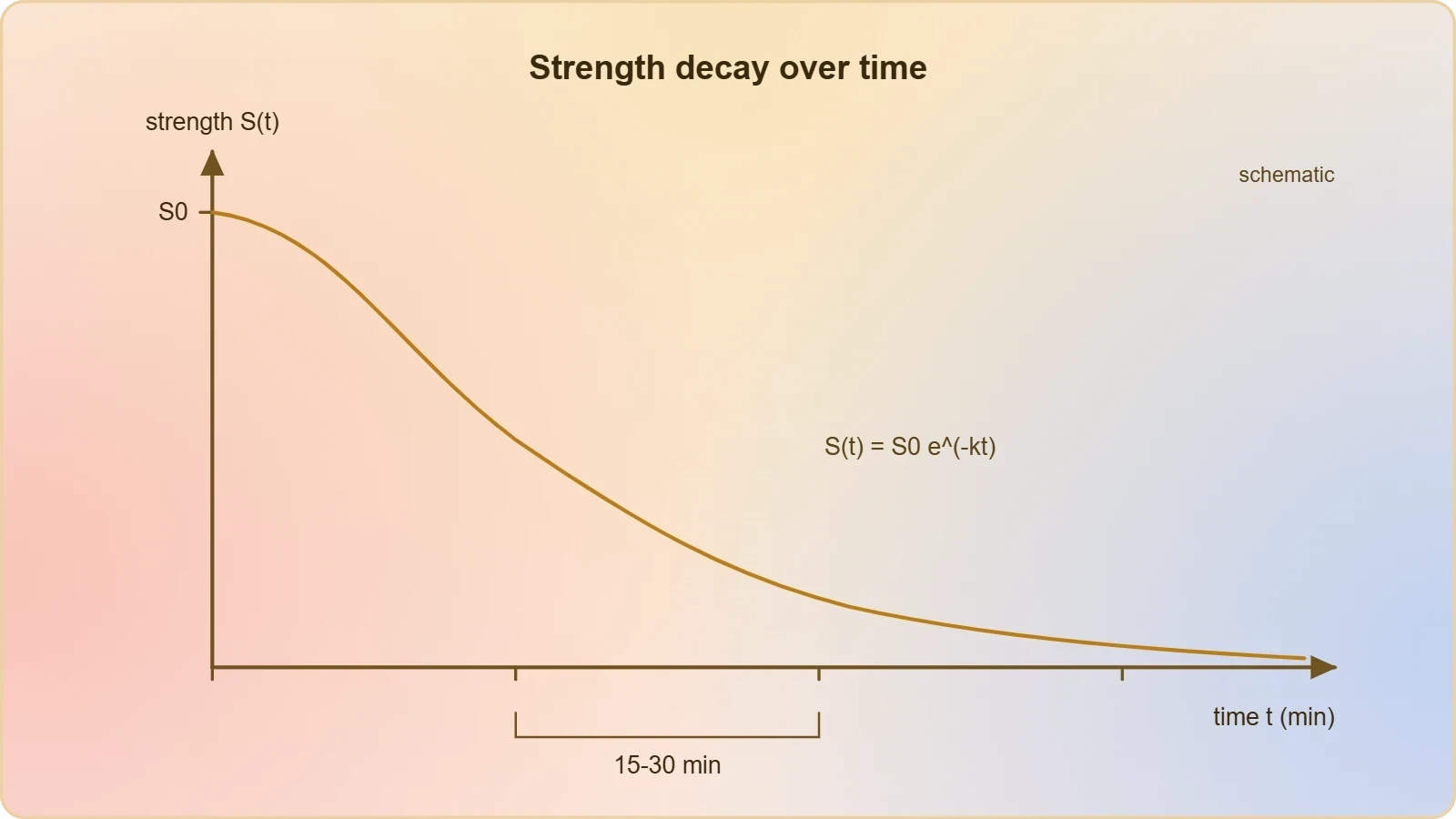
The degradation process can be modeled as a reduction in tensile strength over exposure time, where the remaining strength ##S(t)## decays according to an exponential relationship:
Here ##S_0## represents the initial tensile strength, ##k## is a rate constant that depends on the specific oil and temperature, and ##t## is exposure time in minutes. For many oil-based products, ##k## is large enough that meaningful weakening occurs within the first fifteen to thirty minutes of contact, which is well within the duration of typical use. This is why the incompatibility is treated as absolute rather than a matter of degree: even brief contact can compromise the barrier beyond safe limits.
Water-based lubricants avoid this problem entirely because water does not dissolve the latex polymer. Silicone-based lubricants are likewise compatible and offer the advantage of lasting longer without drying out, though they should not be used with silicone toys. The practical rule is memorable: if a lubricant contains oil, it does not belong near a latex condom. Reading the ingredient list rather than trusting the front label is the reliable way to apply this rule, since marketing language can obscure what is actually inside the bottle.
Too Little, Too Much, and the Wrong Place
Lubrication errors run in both directions. Insufficient lubricant increases friction, and friction is a leading cause of breakage, particularly during prolonged intercourse. Excess lubricant applied to the outside can reduce sensation and cause the condom to slip, while lubricant applied to the inside can allow the condom to slide off. The balanced approach is a small amount inside the tip before rolling on, followed by a generous application outside. Reapplying water-based lubricant during use maintains the protective film as it gradually absorbs or dries.
Timing matters as well. Applying lubricant after the condom is already in place is standard practice, but applying it to the penis before rolling on the condom can cause the condom to slip during application. The sequence that works best is consistent: unroll the condom with the tip pinched, then apply lubricant to the exterior. This ordering keeps the condom securely seated while ensuring friction is minimized where it matters most, reducing the twin risks of breakage and slippage in a single habit.
- 01
- 02
- 03
- 04
Application Errors and the Tip-Pinch Principle
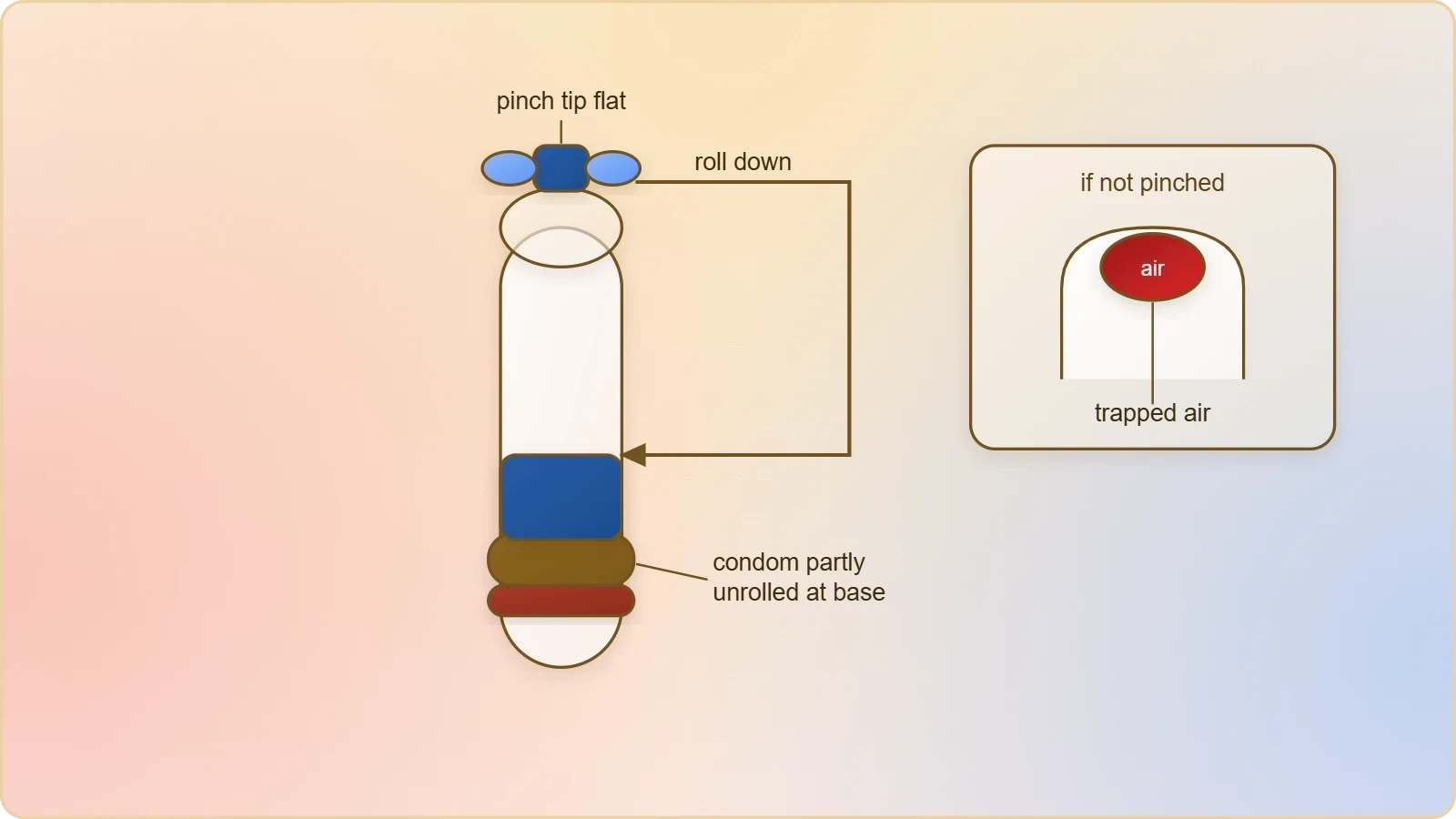
The moment of application is where technique separates reliable protection from false confidence. The single most common error is failing to pinch the tip of the condom before rolling it down, which traps air in the reservoir. That trapped air becomes a pressurized pocket during intercourse, and pressure seeks release — often through a rupture at the tip. Pinching the reservoir flat before rolling eliminates the pocket and leaves room for ejaculate to collect safely. It is a two-second action with outsized protective value.
Orientation, Unrolling, and Air Pockets
Rolling a condom on the wrong way is a mistake that often goes unnoticed until it is too late. If the condom will not unroll smoothly, it is almost certainly inside out, and the correct response is to discard it rather than flip it over. Flipping exposes the outside of the condom to pre-ejaculate, defeating the purpose of the barrier. A fresh condom costs far less than the risk it prevents, and treating a mis-oriented condom as disposable is a habit worth cultivating deliberately.
Air pockets can also form along the shaft if the condom is unrolled without smoothing. These pockets reduce contact and can cause the condom to shift during use. Smoothing the condom downward as it unrolls, working from the tip toward the base, ensures even seating and eliminates trapped air. The motion is simple but requires attention, and attention is precisely what rushed application lacks. Practicing the motion when there is no pressure makes it automatic when pressure arrives.
Sizing, Fit, and the Illusion of One Size
Condoms come in a range of sizes, and fit is not a minor detail. A condom that is too tight can break under tension, while one that is too loose can slip off entirely. Both failures are common and both are avoidable through honest sizing. The nominal width, measured in millimeters, is the key specification, and it varies more than many people expect. Choosing a condom that fits properly is not vanity; it is a functional requirement for the barrier to perform as designed.
Fit also affects sensation and comfort, which in turn affect consistency of use. A poorly fitting condom is more likely to be removed mid-use or avoided altogether, and inconsistent use is the largest single contributor to real-world failure rates. Taking the time to identify a comfortable size and style is therefore an investment in adherence, not just in physical integrity. Comfort and safety are aligned here rather than opposed, which makes the sizing conversation easier to have.
Removal, Disposal, and the Aftermath
The final phase of condom use is routinely neglected, yet it carries its own risks. After ejaculation, the condom should be held firmly at the base while withdrawing, before the erection subsides. Withdrawing without that grip allows the condom to slip off and spill, which can introduce exposure that the entire preceding effort was meant to prevent. The hold-at-base technique is simple, but it requires presence of mind at a moment when attention naturally drifts, which is precisely why it deserves explicit mention.
The Withdrawal Window
Timing is the subtle variable here. Waiting too long after ejaculation allows the erection to subside, loosening the condom's grip and increasing the chance of slippage. Withdrawing promptly, while still firm, keeps the condom seated and the contents contained. The window is not long, and it is easy to miss in the relaxed aftermath, but the consequence of missing it is a spill that can undo an otherwise flawless sequence of precautions. Prompt, deliberate withdrawal is the closing move of good technique.
Disposal is the last link in the chain and the easiest to get wrong. Condoms should be tied off at the base, wrapped in tissue, and placed in a waste bin rather than flushed. Flushing causes blockages in plumbing and sewage systems, and condoms do not break down readily in water. They should also never be reused, regardless of cleaning attempts, because the latex has been stretched and stressed beyond recovery. A single-use object, treated as such, performs its function reliably.
Checking for Breakage
After removal, a quick inspection for visible tears is a sensible habit. If a breakage is discovered, the appropriate response is not panic but prompt action: emergency contraception should be considered as soon as possible, and STI testing should be arranged at an appropriate interval. Knowing this in advance removes the hesitation that can delay response during a stressful moment. Preparedness is not pessimism; it is the practical expression of responsibility toward oneself and one's partner.
Breakage checks also feed back into technique. If breaks recur, the cause is usually identifiable: insufficient lubrication, an air pocket, an ill-fitting condom, or an incompatible lubricant. Treating each break as diagnostic information rather than random misfortune turns a frustrating experience into a solvable problem. Over time, this reflective approach produces the kind of practiced competence that makes protection feel effortless rather than anxious, and that competence is ultimately what sustained safety depends upon.
Building Reliable Habits Through Awareness
Every mistake examined here shares a common structure: it is small, habitual, and invisible until something goes wrong. That is precisely why awareness matters more than willpower. People who understand why the tip must be pinched, why oil degrades latex, and why heat weakens the polymer are far more likely to build the right habits automatically. Knowledge converts a set of rules into an intuitive practice, and intuitive practice survives the distraction and urgency that accompany real intimacy. Education, in this domain, is not a luxury but a core component of prevention.
From Knowledge to Consistent Practice
Consistency is the bridge between knowing and doing. A person may know that wallets are poor storage, yet still carry a condom in one out of convenience. Closing that gap requires environmental design: keeping a proper case by the bed, restocking regularly, and placing condoms where they will be seen and used. These small structural choices reduce reliance on memory and discipline, which are unreliable under pressure. Good design beats good intentions, and the same principle that governs safety systems elsewhere applies with equal force here.
Communication is the other half of consistency. Discussing condom use with a partner in advance, before the moment arrives, removes the awkwardness that leads to skipped steps. A brief, matter-of-fact conversation about preferences, lubrication, and comfort establishes shared expectations and makes the practical details feel ordinary rather than clinical. Partners who have talked about it are more likely to remind each other gently when a step is missed, turning safety into a collaborative practice rather than an individual burden.
The Broader Public Health Picture
At the population level, these individual habits aggregate into measurable outcomes. Condoms are among the most cost-effective public health interventions available, and their effectiveness depends on correct and consistent use across large numbers of people. When common errors are widespread, the gap between perfect-use and typical-use effectiveness widens, and that gap translates into preventable infections and unintended pregnancies. Addressing the errors directly, through clear education and accessible guidance, is one of the highest-leverage actions available to sexual health programs.
The tone of that education matters as much as its content. Shame and alarm tend to reduce engagement, while practical, non-judgmental guidance invites it. Framing condom use as a skill to be learned rather than a test to be passed respects the intelligence of the audience and acknowledges that everyone makes mistakes. The goal is not perfection but improvement, and steady improvement across a population produces substantial cumulative benefit. Small corrections, repeated widely, change outcomes at scale.
From our network :
- How AI Agents Will Change the Way We Manage Personal FinancesExplore how AI agents are transforming personal finance through automated budgeting, bill payment, and investment management, while examining the critical security protocols and governance frameworks required for safe deployment.
- University Language Proficiency Exams: Why Institutional Tests Demand Different Preparation Than IELTS and TOEFLDiscover why university-specific language proficiency examinations differ fundamentally from IELTS and TOEFL, and learn strategic preparation approaches for institutional assessment success.
- Committed Mediterranean Precipitation Decline: Why Emissions Cuts Alone Cannot Restore Winter RainsNew NOAA research reveals that Mediterranean winter rains may decline irreversibly even with emissions cuts. Explore the science of committed climate change and regional impacts.
- The Final Descent: How ESA Retired the Legendary Cluster Constellation After 24 Years of Space Weather ScienceAfter 24 years mapping Earth’s magnetosphere, ESA’s Cluster mission concluded with a precisely controlled reentry over the South Pacific. This analysis explores the scientific legacy, engineering decisions, and debris mitigation principles behind one of space exploration’s most responsible retirements.
- CISA’s Ten-Advisory Wave: Why Generic Patching Fails in OT and How to Build Product-Specific PlaybooksCISA released ten ICS advisories in one week, exposing critical infrastructure risks. Generic patching fails in OT. Learn to build product-specific remediation playbooks.
- Forbidden Matrix Patterns and Visible Lattice Points: A Geometric DictionaryExplore how multidimensional 0–1 matrices encode geometric truths, linking forbidden patterns to visible lattice points and hypergraph theory, with applications in combinatorics and computational geometry.
- Mobile Learning and VR in English: What Global Evidence Reveals About Effective Language TechnologyA systematic review across 14 countries reveals which language-learning technologies genuinely work. Mobile learning, AI, and VR show measurable benefits when pedagogically integrated. This evidence-based guide helps educators and learners select technology that delivers real return on investment.
- The Hidden Cost of AI Convenience: Why Over-Permissioned Agents Are a Security Time BombDiscover why AI agents with excessive permissions create dangerous single points of failure, and learn how implementing least privilege principles can protect your organization from exploitation.
- Live Online English Classes for Kids: Do They Actually Reduce Anxiety?A ten-week study reveals that synchronous online English classes can significantly reduce child language anxiety while improving listening and reading skills. Discover what makes these programs effective and how parents can select the right one.
RESOURCES
- Resources will be updated soon.
- 01
- 02
- 03
- 04
- 05
- 06
- 07
- 08
0 Comments