
Bangladesh's stock market has spent the better part of a decade promising a digital transformation, yet the lived experience of most retail investors remains stubbornly anchored to paper, queues, and physical signatures. The country's brokerage industry is not uniformly resistant to change; rather, it is split between a technologically ambitious minority and a much larger group of firms that cannot justify the capital expenditure required to modernise. This divergence has produced a two-tier marketplace in which the quality of an investor's experience depends less on regulation or market conditions than on which brokerage house happens to hold their account. Understanding that split is essential to understanding why participation in the Dhaka Stock Exchange remains narrower than the size of the economy would suggest.
The mechanics of the gap are concrete and measurable. Opening a beneficiary owner account once required a personal visit, handwritten forms, and documentary proof; today a handful of brokerages allow the entire process to be completed online, and some bank-owned firms permit existing customers to open an account with a single click. Deposits and withdrawals tell a similar story, with virtual account systems and automated purchase-limit top-ups available at a few institutions while others still demand manual reconciliation. Mobile trading has existed since 2016, when the Dhaka Stock Exchange launched its own application, and roughly fifty brokerages have since introduced order management systems, yet a substantial share of investors continue to place orders by telephone and then submit signed physical copies within twenty-four hours.
What makes this story more than a routine technology-adoption narrative is the economics underneath it. Saiful Islam, president of the DSE Brokers Association of Bangladesh, attributes the slow pace directly to persistently low turnover, noting that roughly seventy percent of trading volume is concentrated among just thirty-five brokerage houses. Firms outside that circle simply lack the revenue base to fund platforms, cybersecurity, and compliance tooling. The association has therefore asked the regulator to relax documentation requirements so that opening a BO account becomes as frictionless as opening a mobile financial services account, and it wants fully digital trading within a year. Whether that ambition is realistic depends on forces far beyond the brokerage floor.
On This Page
- The Structural Roots of Bangladesh's Brokerage Digital Divide
- Paperwork, Signatures, and the Regulatory Bottleneck
- Mobile Trading, Order Management, and the Adoption Gap
- Consolidation, TREC Holders, and the Future of the Brokerage Trade
- Investor Access, Market Depth, and the Wider Economic Stake
- Reading the Signals: What Comes Next for Bangladesh's Market
TL;DR Bangladesh's brokerage industry is modernising unevenly. A small cluster of bank-owned and well-capitalised firms now offers one-click BO account opening, virtual funding accounts, and online withdrawals, while many independent brokerages still require physical paperwork and signed order slips. Low market turnover, concentrated among roughly thirty-five firms controlling seventy percent of volume, has starved smaller brokers of the revenue needed to invest in technology. The DSE Brokers Association wants the regulator to simplify documentation and eliminate physical signatures, aiming for fully digital trading within a year. Until that happens, investor access to the stock market will continue to depend on which brokerage house they happen to choose.
The Structural Roots of Bangladesh's Brokerage Digital Divide
The digital divide inside Bangladesh's brokerage sector is not a story of lazy firms refusing to modernise. It is a story about revenue arithmetic. Brokerage houses earn primarily from commissions on trades, and when turnover is thin, commissions are thin with it. Saiful Islam's observation that about seventy percent of turnover is concentrated among thirty-five brokerage houses describes a market in which the remaining firms operate on margins too slender to support the fixed costs of a modern trading platform. Technology investment is not a one-time purchase; it requires continuous spending on servers, security, regulatory reporting, and skilled staff. Firms without scale cannot sustain that spending, and so they fall further behind, which in turn pushes more investors toward the firms that already dominate.
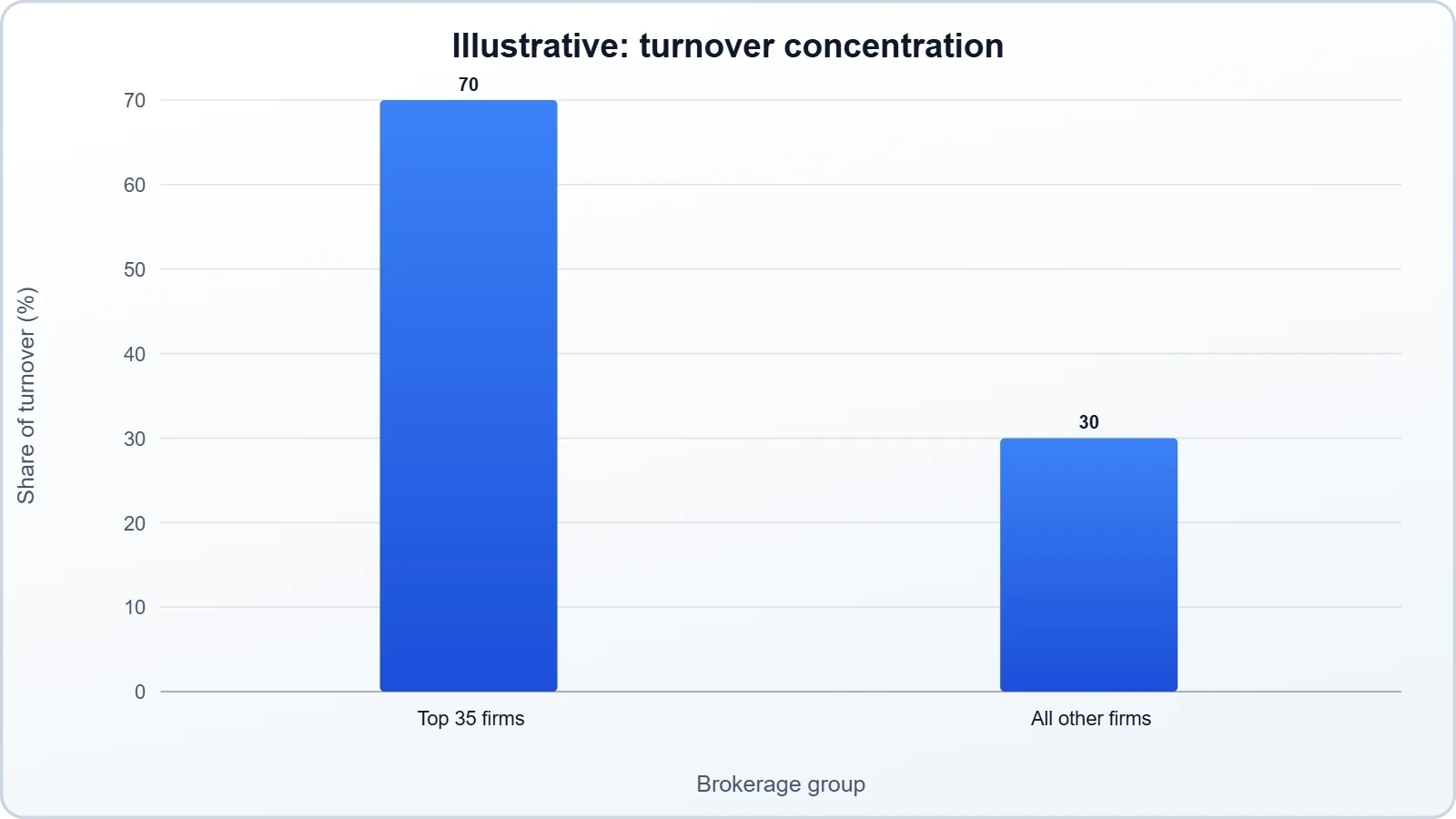
This concentration creates a self-reinforcing loop that deserves careful attention. Investors naturally gravitate toward brokerages offering convenience, so the technologically advanced firms capture a growing share of new accounts. That additional volume funds further investment, widening the gap. Meanwhile, the lagging firms lose both clients and the revenue that might have financed their own modernisation. The result is a market that looks competitive on paper, with dozens of licensed participants, but functions as an oligopoly in practice. Regulators face a delicate choice: pushing consolidation through mergers could create stronger, better-capitalised firms, but it also risks reducing competition and leaving investors in underserved districts with even fewer options than they have today.
Why Low Turnover Constrains Technology Spending
Turnover is the lifeblood of any brokerage business, and Bangladesh's has been subdued for years. When daily traded value is modest, commission income spreads thinly across a large number of licensed intermediaries. A firm handling a small fraction of total volume may struggle to cover even its basic operating costs, let alone the capital expenditure required for an order management system, a mobile application, and the cybersecurity infrastructure that modern platforms demand. This is why the DBA's argument carries weight: the problem is not unwillingness but incapacity, and no amount of regulatory exhortation will conjure revenue that the market does not generate.
The concentration statistic sharpens the point considerably. If roughly seventy percent of turnover flows through thirty-five firms, the remaining participants are competing for a residual pool that cannot possibly sustain all of them at a modern standard. Some of these firms survive on client relationships built over decades, servicing investors who value personal contact over digital convenience. That model is not inherently illegitimate, but it leaves those clients locked out of facilities that investors elsewhere take for granted. The market therefore produces two classes of investor experience, divided not by wealth or sophistication but by the accident of which brokerage they chose, often years ago.
The Bank-Owned Advantage and Its Limits
Bank-owned and non-bank financial institution brokerages occupy a privileged position in this landscape. Their parent institutions already operate core banking platforms, customer verification systems, and payment rails, so extending those capabilities into brokerage services is incremental rather than transformative. Md Moniruzzaman of Prime Bank Securities describes a one-click BO account opening process and a virtual account system that automatically credits transferred funds to an investor's share purchase limit. Withdrawal requests can be submitted online through the back-office system, and the firm plans to permit withdrawals of up to Tk 1 lakh at any time without delay. These are meaningful conveniences that materially reduce friction for retail investors.
Yet the bank-owned model has its own constraints. Technology levels among bank and NBFI-owned brokerages are broadly similar to one another, which suggests a ceiling imposed by shared parent-company systems and compliance frameworks rather than by ambition. More importantly, bank-owned brokerages serve customers who already hold accounts with the parent bank, which excludes large segments of the population from the one-click experience. The convenience is real but bounded, and it does not solve the problem of investors in districts where no brokerage branch exists at all. Saiful Islam's question about how such investors might participate remains unanswered by the bank-owned model, however polished its interface.
Paperwork, Signatures, and the Regulatory Bottleneck
Regulation sits at the centre of this story, sometimes as an enabler and sometimes as a drag. The requirement that investors submit a signed physical copy of every order within twenty-four hours of execution is a case in point. It is a rule born of an era when paper was the only reliable audit trail, and it now imposes a burden that disproportionately affects investors who have embraced mobile trading. The Bangladesh Securities and Exchange Commission has signalled repeatedly that it intends to scrap the physical signature requirement, and its chairman has said so on several occasions. Until the rule actually changes, however, the digital experience remains incomplete by design.
The DBA's request to relax documentation for BO account opening follows similar logic. If opening a mobile financial services account requires nothing more than a national identity card and a mobile phone, there is no principled reason why opening a brokerage account should demand a sheaf of papers and a personal appearance. The association's stated ambition is a process simple enough to be completed remotely by anyone, anywhere in the country. That goal is technically achievable today; the obstacle is procedural and institutional rather than technological. Regulatory reform, in other words, may deliver more immediate gains than any amount of private investment in platforms.
What the Twenty-Four-Hour Signature Rule Costs Investors
The signature rule imposes costs that are easy to overlook. An investor who buys shares through a mobile application at nine in the evening must still produce a signed physical document and deliver it to the brokerage within a day. For city residents with a branch nearby, this is an inconvenience. For investors in districts without brokerage offices, it can be an insurmountable barrier, effectively nullifying the benefit of mobile trading. The rule also creates operational overhead for brokerages, which must process, store, and reconcile paper documents alongside their digital records, adding cost precisely where margins are thinnest.
Removing the requirement would not eliminate the need for audit trails; it would simply allow those trails to be digital. Electronic signatures, authenticated order logs, and time-stamped confirmations already provide stronger evidentiary value than a handwritten signature on a printed slip. The persistence of the paper rule therefore reflects institutional caution rather than genuine risk management. Regulators understandably worry about fraud and dispute resolution, but the experience of other South Asian markets suggests that digital authentication can meet those concerns without imposing physical burdens on investors. The question is one of political will and administrative capacity, not technical feasibility.
Mobile Trading, Order Management, and the Adoption Gap
The Dhaka Stock Exchange launched its mobile trading application in 2016, a genuinely forward-looking move for the region. Since then, roughly fifty brokerages have introduced their own order management systems and branded mobile applications, giving their clients the ability to place orders, monitor portfolios, and access research from a handset. On paper, this represents substantial progress. In practice, the benefit is confined to clients of those fifty firms, and the remaining brokerages offer no such facility at all. An investor whose brokerage has not built an app is effectively excluded from the digital market regardless of how many platforms exist elsewhere in the industry.
This adoption gap has consequences that extend beyond convenience. Investors who cannot trade digitally are slower to react to market movements, less able to diversify across instruments, and more dependent on telephone conversations with dealers who may be handling many clients simultaneously. The result is an uneven playing field in which outcomes are shaped by infrastructure rather than by investment skill. It also distorts market liquidity, because order flow from digitally enabled clients arrives faster and in larger volumes than flow from clients still reliant on phone calls and paper confirmations. Over time, this reinforces the concentration of volume among the firms that invested early.
Institutional Investors and the Scale Advantage
Richard D'Rozario, a director of the Dhaka Stock Exchange, offers a useful historical perspective. The market was initially dominated by individual investors, he notes, but institutional investors gradually gained a larger share as the market expanded. The reason is straightforward: institutions can make substantial investments in technology even when they incur losses, because they operate at a scale that absorbs such costs. A pension fund or asset manager building a trading infrastructure does so as part of a broader operating budget, not as a bet on commission revenue from a single brokerage. That asymmetry helps explain why institutional participation has grown while retail access remains fragmented.
The implication for policy is significant. If institutional investors continue to expand their share while retail investors remain dependent on uneven brokerage infrastructure, the market's character will shift in ways that may not serve broader economic goals. Deep retail participation is generally considered a marker of a healthy capital market, providing companies with a wider funding base and giving households a stake in national growth. Achieving that in Bangladesh requires not only better platforms but also a regulatory environment that makes participation cheap, simple, and safe for people who have never bought a share before. The DBA's one-year timeline for full digital trading is ambitious, but it points in the right direction.
- 01
- 02
- 03
- 04
Consolidation, TREC Holders, and the Future of the Brokerage Trade
Talk of brokerage house mergers in Bangladesh has circulated for years, and the digital divide gives that conversation fresh urgency. A market with dozens of undercapitalised intermediaries, each unable to fund modern infrastructure, is not serving investors well. Consolidation could create fewer but stronger firms with the balance sheets to invest properly. The counterargument is equally serious: mergers reduce choice, and in a country where branch networks are already sparse outside major cities, fewer independent brokerages could mean worse access for investors in smaller towns. The policy challenge is to encourage consolidation where it strengthens capability without creating local monopolies that leave investors stranded.
The role of TREC holders, the licensed trading right entitlement certificate owners who constitute the exchange's membership, complicates any reform. These licences carry value, and their holders have legitimate interests in preserving them. Any merger framework must therefore address valuation, succession, and the treatment of firms that are technically solvent but operationally obsolete. Regulators in other frontier markets have navigated similar transitions by offering voluntary consolidation incentives, phased capital requirements, and shared infrastructure arrangements that let smaller firms access platforms without building them. Bangladesh could adapt such approaches rather than forcing a disruptive shakeout that harms investors in the process.
What Full Digital Trading Would Require
The DBA's goal of fully digital trading within a year is achievable in principle but demanding in practice. It requires regulatory amendments to eliminate physical signatures, a simplified BO account opening process that can be completed remotely, interoperable payment rails connecting bank accounts to brokerage accounts, and a baseline technology standard that every licensed firm must meet. Each element is individually feasible; sequencing them correctly is the harder task. Regulators must also ensure that cybersecurity standards keep pace, because digital onboarding and trading create new vectors for fraud that paper-based processes did not present in the same way.
Shared infrastructure offers one promising route. Rather than requiring every brokerage to build its own order management system, the exchange or a consortium could provide a common platform that smaller firms access on a subscription basis. This model has worked in other markets where scale is limited, allowing small intermediaries to offer modern services without bearing the full cost of development. It would also simplify regulatory oversight, since the exchange could monitor activity across all participating firms through a single system. Such an approach would not eliminate competition, but it would ensure that competition occurs on service quality rather than on basic technological availability.
We Also Published
Investor Access, Market Depth, and the Wider Economic Stake
Behind the technical questions of platforms and paperwork lies a larger economic question. A stock market exists to channel household savings into productive enterprise, and it can only do that if ordinary people can participate without unreasonable friction. Bangladesh has a large and growing middle class, a high rate of mobile financial services adoption, and a young population comfortable with digital tools. The demand for accessible investing clearly exists. What is missing is the infrastructure and regulatory permission to meet it. Every investor deterred by a branch visit or a signed order slip represents capital that stays in a savings account rather than funding a listed company's expansion.
The digital divide among brokerages therefore has consequences that reach well beyond the firms themselves. It affects the depth of the market, the quality of price discovery, and the ability of companies to raise equity at fair valuations. It also shapes public perception: when investors hear that the stock market is difficult to access or that facilities vary wildly between brokers, many simply stay away. Closing the gap is not merely a matter of convenience for existing participants; it is a precondition for the market playing the role that policymakers say they want it to play in national development.
Practical Steps for Investors Navigating an Uneven Market
For investors already in the market, the practical implication is to choose a brokerage deliberately rather than by habit. Asking whether a firm offers online BO account opening, a functioning mobile application, and digital withdrawal requests is now a reasonable baseline. Investors should also confirm whether their brokerage can process orders without requiring a physical signature, and if not, whether it has plans to change. Those with accounts at lagging firms may find that switching is simpler than waiting for their current broker to modernise, particularly since the top firms are actively courting new clients with better digital facilities.
For those outside the market, the calculus is different. The regulatory changes under discussion could make entry considerably easier within a year, and waiting for simplified documentation may be sensible for investors who are not in a hurry. What matters is that the direction of travel is clear: Bangladesh's stock market is moving toward digital onboarding and paperless trading, however unevenly. Investors who understand the landscape can position themselves to benefit from that transition rather than being caught on the wrong side of it. The firms that invest in technology today are likely to be the ones serving most of the market tomorrow.
Reading the Signals: What Comes Next for Bangladesh's Market
The trajectory is not in doubt, only the pace. Every stakeholder quoted in this debate, from the DBA leadership to the exchange directors to the securities regulator, agrees that digital trading is the destination. The disagreements concern timing, sequencing, and who bears the cost of transition. The DBA wants full digital trading within a year and has asked for documentation relief to make it possible. The BSEC has signalled openness to scrapping physical signatures. The exchange has already demonstrated that mobile trading works. What remains is the unglamorous work of amending rules, upgrading systems, and persuading reluctant firms that the investment is worth making.
For observers of frontier markets, Bangladesh offers a instructive case study in how technology adoption interacts with market structure. The barrier is not a lack of digital ambition among the most capable firms, nor a lack of demand among investors. It is the concentration of revenue in too few hands, which leaves the majority of licensed intermediaries unable to fund the transition. Solving that requires either consolidation, shared infrastructure, or both. Whichever path is chosen, the measure of success will be simple: whether an investor in a district without a brokerage branch can open an account, place an order, and withdraw proceeds without ever touching a piece of paper.
From our network :
- The Final Descent: How ESA Retired the Legendary Cluster Constellation After 24 Years of Space Weather ScienceAfter 24 years mapping Earth’s magnetosphere, ESA’s Cluster mission concluded with a precisely controlled reentry over the South Pacific. This analysis explores the scientific legacy, engineering decisions, and debris mitigation principles behind one of space exploration’s most responsible retirements.
- The Hidden Cost of AI Convenience: Why Over-Permissioned Agents Are a Security Time BombDiscover why AI agents with excessive permissions create dangerous single points of failure, and learn how implementing least privilege principles can protect your organization from exploitation.
- Live Online English Classes for Kids: Do They Actually Reduce Anxiety?A ten-week study reveals that synchronous online English classes can significantly reduce child language anxiety while improving listening and reading skills. Discover what makes these programs effective and how parents can select the right one.
- University Language Proficiency Exams: Why Institutional Tests Demand Different Preparation Than IELTS and TOEFLDiscover why university-specific language proficiency examinations differ fundamentally from IELTS and TOEFL, and learn strategic preparation approaches for institutional assessment success.
- Committed Mediterranean Precipitation Decline: Why Emissions Cuts Alone Cannot Restore Winter RainsNew NOAA research reveals that Mediterranean winter rains may decline irreversibly even with emissions cuts. Explore the science of committed climate change and regional impacts.
- CISA’s Ten-Advisory Wave: Why Generic Patching Fails in OT and How to Build Product-Specific PlaybooksCISA released ten ICS advisories in one week, exposing critical infrastructure risks. Generic patching fails in OT. Learn to build product-specific remediation playbooks.
- Forbidden Matrix Patterns and Visible Lattice Points: A Geometric DictionaryExplore how multidimensional 0–1 matrices encode geometric truths, linking forbidden patterns to visible lattice points and hypergraph theory, with applications in combinatorics and computational geometry.
- How AI Agents Will Change the Way We Manage Personal FinancesExplore how AI agents are transforming personal finance through automated budgeting, bill payment, and investment management, while examining the critical security protocols and governance frameworks required for safe deployment.
- Mobile Learning and VR in English: What Global Evidence Reveals About Effective Language TechnologyA systematic review across 14 countries reveals which language-learning technologies genuinely work. Mobile learning, AI, and VR show measurable benefits when pedagogically integrated. This evidence-based guide helps educators and learners select technology that delivers real return on investment.
RESOURCES
- Resources will be updated soon.
- 01
- 02
- 03
- 04
- 05
- 06
- 07
- 08
0 Comments