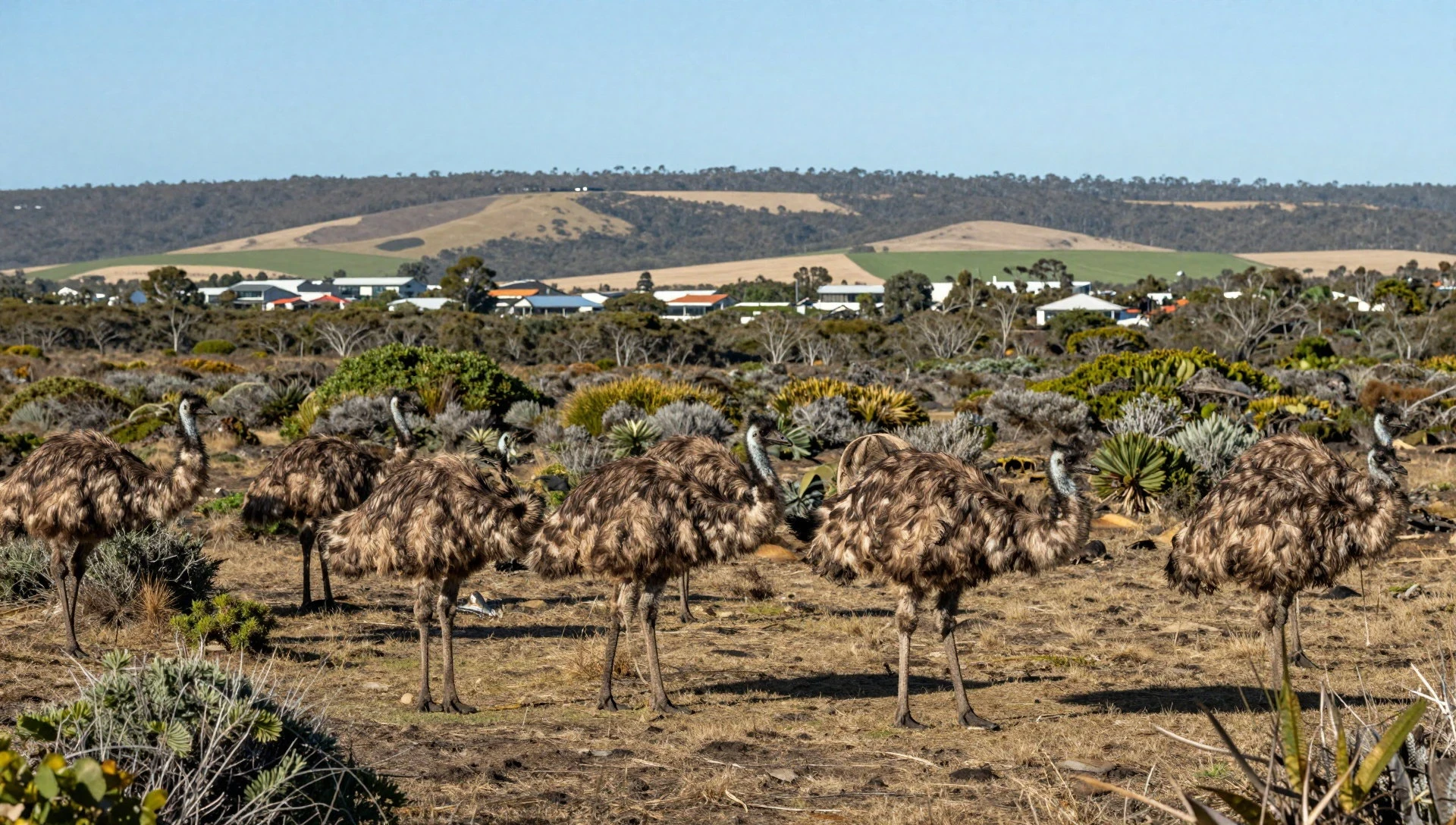
A single emu in the coastal township of Bluewater, north Queensland, has generated a nine-month dispute that exposes the friction between suburban development, wildlife habituation and the limits of local regulatory authority.
Mal Richards, a pensioner, reports that a female emu known locally as Eric waits for him before 6am when he collects his newspaper, follows him around his yard and obstructs routine chores despite a locked fence and secured property. The bird's persistence has turned a novelty into a daily logistical problem.
The case matters because it sits at the intersection of three jurisdictions that each disclaim responsibility. Richards has contacted the Townsville City Council, the state Department of Primary Industries and the environment department without resolution.
On This Page
Meanwhile, the Department of the Environment, Tourism, Science and Innovation says rangers have monitored the emu and found no concerning behaviour, while the council notes that local laws permit emu keeping on blocks larger than 2,000 square metres where other laws and adequate enclosure requirements are satisfied.
What follows examines the incident as a case study in wildlife habituation, regulatory fragmentation and community risk perception. It weighs the evidence on emu behaviour, the legal thresholds governing captive native animals in Queensland, and the practical safety guidance offered by wildlife educator Jackie Hasling.
The analysis also considers why a bird described as friendly can still generate genuine anxiety among residents, schoolchildren and drivers.
TL;DR A Bluewater pensioner says a locally famous female emu named Eric has followed him for roughly nine months, entering his secured yard and disrupting daily routines. Three authorities have declined to act: rangers report no concerning behaviour, and council rules allow emu keeping on blocks above 2,000 square metres with adequate enclosures. Wildlife experts believe the bird was likely hand-raised, making her unusually tame rather than aggressive. The dispute illustrates how habituation, fragmented jurisdiction and community affection for an animal can leave an individual resident without a clear remedy.
The Anatomy of a Nine-Month Neighbourhood Dispute
The Richards complaint is unusual less for its subject than for its duration. Nine months of repeated incursions, documented through reports to three separate agencies, produced no enforcement action and no relocation.
That outcome reflects neither indifference nor incompetence so much as the absence of a legal trigger: none of the agencies involved has identified behaviour that meets a threshold for intervention.
Timeline and Reported Incidents
Richards describes a consistent pattern beginning before dawn. The emu reportedly waits for him when he collects his newspaper before 6am, then follows him around the yard while he attempts chores.
He states that he has secured the property and locked the fence, yet the bird continues to gain entry, suggesting either climbing capability, gap exploitation or repeated fence breaches.
The pensioner's concerns centre on physical risk rather than malice. He cites the bird's claws and large feet and says he does not trust it, even while acknowledging that it appears friendly.
That distinction matters: perceived friendliness in a habituated animal does not eliminate the mechanical hazard of a large ratite with powerful legs.
Community reports add context. A local Facebook page carries numerous posts about sightings and warnings urging drivers to slow down near the bird. One resident described Eric as the town mascot; another said schoolchildren at a bus stop had to climb a fence to escape when the emu tried to approach them.
No injury has been reported in the available account. That absence is significant for any regulatory assessment, because agencies typically act on evidence of harm or credible threat rather than on nuisance alone. The dispute therefore remains, legally speaking, a matter of tolerance rather than danger.
The Regulatory Gap Between Council and State
The Townsville City Council's position is narrowly framed. Local laws do not prevent someone from keeping an emu on blocks larger than 2,000 square metres, provided other laws are met, including an adequate enclosure. The council is effectively saying the bird's presence is lawful if those conditions hold.
The Department of the Environment, Tourism, Science and Innovation adds a monitoring dimension. A spokesperson said rangers had been monitoring an emu in Bluewater that had not been seen behaving in a concerning way, and asked residents to give the bird space and avoid feeding it or allowing access to food.
The Department of Primary Industries was also contacted, according to the report, without action. The resulting picture is a three-agency perimeter in which each body can point to the others or to an absent legal trigger. Richards, meanwhile, remains followed by what he describes as someone else's pet emu.
This fragmentation is not unique to Queensland. Native wildlife kept as pets or habituated through feeding routinely falls between companion-animal rules, biosecurity frameworks and local government bylaws. The gap widens when the animal is popular, recognisable and treated by the community as an informal mascot rather than a nuisance.
Why No Enforcement Trigger Was Met
Regulatory action against a native animal typically requires evidence of aggression, injury or a declared risk to public safety. The environment department's statement that the emu had not been seen behaving in a concerning way effectively closes that avenue. Monitoring, not removal, becomes the default response.
Council rules operate on a different axis: land use and enclosure adequacy. If the bird's owner holds a block above 2,000 square metres and maintains an adequate enclosure, the keeping itself is lawful. Richards's complaint concerns incursion onto his land, which is a trespass and fencing question rather than an animal-keeping question.
The result is a classic mismatch between the harm experienced and the legal categories available. A resident can document daily disruption, droppings on the driveway and safety worries for schoolchildren, yet none of these map cleanly onto a statutory trigger that compels intervention by any single agency.
Hasling's assessment reinforces the point. She does not think Eric is aggressive and describes her as a well-known local emu probably raised as a pet, which may make her friendlier than wild emus. Friendliness, in regulatory terms, is not a hazard classification.
We Also Published
Emu Behaviour, Habituation and Real Risk
Understanding the dispute requires separating three questions that public discussion often conflates: whether the bird is aggressive, whether it is dangerous, and whether it is a nuisance. The evidence in the Bluewater case points to a habituated animal that is neither aggressive nor harmless, and unambiguously a nuisance to at least one household.
What Hand-Rearing Does to Wild Behaviour
Emus are large ratites capable of substantial speed and powerful kicking. A hand-raised bird loses the wariness that ordinarily keeps wild emus at distance from humans, and instead associates people with food, routine and safety. That association explains why Eric reportedly waits for Richards before 6am and follows him around the yard.
Habituation is not affection in any reciprocal sense. The bird has learned that humans are predictable and non-threatening, and its approach behaviour persists because nothing in its environment punishes it. Feeding, whether deliberate or incidental through accessible food, accelerates the process and is precisely what the environment department asked residents to avoid.
The schoolchildren incident illustrates the practical consequence. A tame emu approaching a bus stop is not attacking, but children climbing a fence to escape a large bird is a foreseeable outcome of habituation in a public space. The risk is behavioural and mechanical rather than predatory.
Hasling's guidance is calibrated to this reality. If an emu acts in a threatening way, she advises backing away slowly, giving it space, holding up a rake or stick to look taller, and putting something like a tree between yourself and the bird. These are de-escalation tactics, not defensive combat instructions.
Safety Protocols When a Large Bird Approaches
Hasling's advice is practical and consistent with standard wildlife guidance. Back away slowly rather than running, give the bird space, and hold up a rake or stick to appear taller. Interposing an object such as a tree between yourself and the bird reduces the chance of contact.
The logic is straightforward. Emus respond to perceived threats and to flight distance; sudden movements and cornering escalate encounters. Appearing larger and creating barriers restores the distance the animal would normally maintain if it had not been habituated to human proximity.
Feeding is the controllable variable. The environment department explicitly asked residents not to feed the emu or give it access to food. Every accessible food source reinforces approach behaviour and makes future incursions more likely, regardless of fencing quality or council rules.
For households in the affected area, the practical measures are unglamorous: secure bins, remove accessible food, maintain fencing integrity and brief children on slow retreat rather than panic. None of these resolves the underlying ownership question, but they reduce the frequency of contact.
Community Attachment, Nuisance and the Limits of Local Law
Eric's status as a local celebrity complicates any resolution. A Facebook page with numerous sighting posts, warnings for drivers to slow down and at least one resident calling the bird the town mascot indicates genuine community affection. That affection is not irrational, but it shapes the political cost of removal or relocation.
The Mascot Effect on Dispute Resolution
When an animal becomes a symbol, complaints about it acquire a social dimension. A pensioner asking for relief can be characterised as opposing a beloved local figure rather than seeking enforcement of a legitimate nuisance claim. The mascot effect raises the reputational price of action for any agency.
This dynamic is common in wildlife disputes. Charismatic animals attract informal guardians who monitor, photograph and defend them, while affected residents experience the same animal as an unmanaged hazard. The asymmetry in visibility favours the animal and disadvantages the complainant.
Richards's own account reflects the tension. He acknowledges the bird seems friendly while insisting he does not trust it. That is not contradiction but a reasonable distinction between temperament and physical capability in an animal with claws and large feet.
Resolution, if it comes, will likely require mediation rather than enforcement. Identifying the owner, verifying enclosure adequacy and agreeing on feeding restrictions are administrative steps that could reduce contact without relocating a popular bird.
What Comparable Wildlife Disputes Reveal
Comparable cases involving habituated native animals suggest a predictable trajectory. Initial tolerance gives way to repeated complaints, agencies monitor without acting, and resolution arrives only through owner identification, fencing upgrades or voluntary relocation. Enforcement is rare unless injury occurs.
The 2,000 square metre threshold in the council's position is instructive. It implies that emu keeping is contemplated on larger semi-rural blocks, which describes much of Bluewater's character. The rule assumes space and enclosure, not necessarily containment against a determined bird.
Fencing is the practical weak point. Richards reports a locked fence and continued entry, which suggests either gaps, climbing or the bird's ability to exploit weak points. A containment standard that works for poultry may not suffice for a large ratite with strong legs.
Feeding restrictions are the cheapest lever available. If residents and visitors stop providing food, approach behaviour should attenuate over time. That outcome depends on voluntary compliance, which is precisely why the department's public request matters more than any single enforcement action.
- 01
- 02
- 03
- 04
Practical Remedies and Their Trade-offs
For the affected household, remedies fall into three categories: physical containment, behavioural discouragement and administrative escalation. Containment means auditing fence lines and gates for gaps a large bird can exploit. Discouragement means removing food attractants and avoiding reinforcement through feeding.
Administrative escalation means documenting each incursion with dates, times and photographs, then submitting a formal nuisance complaint that forces a written response. Documentation converts anecdote into evidence and creates a record that agencies must address, even if the eventual answer is no action.
Relocation remains the most contentious option. It would resolve the immediate dispute but remove a bird the community treats as a mascot, and it raises welfare questions for a hand-raised animal poorly equipped for wild independence. The trade-offs are genuine on both sides.
The likeliest outcome is incremental: better fencing, stricter feeding discipline and continued monitoring. That will not satisfy a pensioner followed to his newspaper each morning, but it reflects the realistic ceiling of what fragmented local law can deliver without an injury to justify stronger measures.
Broader Lessons for Wildlife Governance
The Bluewater case is small but diagnostic. It shows that habituation, community affection and fragmented jurisdiction can combine to leave an individual complainant without a remedy even when the underlying facts are undisputed. The bird is present, the incursions are real, and the law is silent.
A more coherent framework would assign a single lead agency for habituated native animals, require owner identification and enclosure verification, and create a documented nuisance pathway with defined response times. None of these changes requires new wildlife policy, only clearer allocation of existing authority.
For residents, the lesson is procedural. Early documentation, formal written complaints and consistent feeding restrictions are more effective than repeated phone calls to agencies that each believe another body holds the file. Evidence creates the trigger that anecdote cannot.
For communities, the lesson is about the cost of affection. Treating a large wild animal as a mascot is understandable, but it shifts risk onto specific households. A town that celebrates Eric should also ensure the bird's containment and feeding are managed, so that admiration does not become someone else's daily burden.
Conclusion: A Small Case With a Larger Signal
The Bluewater emu dispute will not reshape wildlife law, but it illustrates a recurring pattern with precision. A habituated animal, a community that adores it and three agencies with narrow mandates produce a stalemate that leaves one resident exposed. The facts are modest; the governance lesson is not.
Richards's experience also clarifies what nuisance means in practice. It is not a single dramatic incident but the accumulation of small disruptions: early-morning waiting, yard-following, droppings on the driveway and the persistent uncertainty of an animal that will not stay out. Cumulative burden rarely triggers statutory action.
Hasling's guidance remains the most immediately useful contribution. Backing away slowly, giving space, appearing taller with a rake or stick and placing a tree between yourself and the bird are proportionate responses to a tame but physically capable animal. They reduce risk without requiring removal.
The environment department's request to avoid feeding is equally important. Feeding is the mechanism that created the problem and the lever most likely to soften it. If Bluewater residents treat Eric as a mascot, the responsible expression of that affection is distance and no handouts, not encouragement.
Ultimately, the case argues for clearer allocation of authority over habituated native animals. A single lead agency, a documented nuisance pathway and verified enclosure standards would give residents a defined route and give communities a framework for enjoying wildlife without transferring risk to their neighbours.
From our network :
- Forbidden Matrix Patterns and Visible Lattice Points: A Geometric DictionaryExplore how multidimensional 0–1 matrices encode geometric truths, linking forbidden patterns to visible lattice points and hypergraph theory, with applications in combinatorics and computational geometry.
- The Final Descent: How ESA Retired the Legendary Cluster Constellation After 24 Years of Space Weather ScienceAfter 24 years mapping Earth’s magnetosphere, ESA’s Cluster mission concluded with a precisely controlled reentry over the South Pacific. This analysis explores the scientific legacy, engineering decisions, and debris mitigation principles behind one of space exploration’s most responsible retirements.
- How AI Agents Will Change the Way We Manage Personal FinancesExplore how AI agents are transforming personal finance through automated budgeting, bill payment, and investment management, while examining the critical security protocols and governance frameworks required for safe deployment.
- CISA’s Ten-Advisory Wave: Why Generic Patching Fails in OT and How to Build Product-Specific PlaybooksCISA released ten ICS advisories in one week, exposing critical infrastructure risks. Generic patching fails in OT. Learn to build product-specific remediation playbooks.
- University Language Proficiency Exams: Why Institutional Tests Demand Different Preparation Than IELTS and TOEFLDiscover why university-specific language proficiency examinations differ fundamentally from IELTS and TOEFL, and learn strategic preparation approaches for institutional assessment success.
- Live Online English Classes for Kids: Do They Actually Reduce Anxiety?A ten-week study reveals that synchronous online English classes can significantly reduce child language anxiety while improving listening and reading skills. Discover what makes these programs effective and how parents can select the right one.
- Mobile Learning and VR in English: What Global Evidence Reveals About Effective Language TechnologyA systematic review across 14 countries reveals which language-learning technologies genuinely work. Mobile learning, AI, and VR show measurable benefits when pedagogically integrated. This evidence-based guide helps educators and learners select technology that delivers real return on investment.
- The Hidden Cost of AI Convenience: Why Over-Permissioned Agents Are a Security Time BombDiscover why AI agents with excessive permissions create dangerous single points of failure, and learn how implementing least privilege principles can protect your organization from exploitation.
- Committed Mediterranean Precipitation Decline: Why Emissions Cuts Alone Cannot Restore Winter RainsNew NOAA research reveals that Mediterranean winter rains may decline irreversibly even with emissions cuts. Explore the science of committed climate change and regional impacts.
RESOURCES
- Description of Key Species Groups in the East Marine Regiondcceew.gov.au... Queensland marine wildlife stranding and mortality database annual report, 2001–2002, III: Marine turtles, Conservation Technical and Data Report 2002 ...
- Northmost Australiagutenberg.net.auCAPE YORK TO NEW GUINEA = QUEENSLAND 4-MILE MAP, SHEET 21B, WITH ADDITIONS FROM ADMIRALTY CHARTS. SHOWS SEA ROUTES OF "SAN PEDRO" (TORRES), 1606;…
- In Bad Company, and other stories - Project Gutenberggutenberg.orgThose squatters who 'bowed not the knee to Baal,' and fought out the contest, with sheds half full of 'learners,' and strangers from other…
- Northmost Australia Volume Igutenberg.net.auCape York to New Guinea = Queensland 4-mile Map, Sheet 21B, with Additions from Admiralty Charts. Shows Sea Routes of "San Pedro" (Torres), 1606;…
- than born became states including american - Stanford Universitydownloads.cs.stanford.edu... local april held party show november line century best football based ... law 2013 five said old country what road do — 2005…
- vocab.txt - CMU School of Computer Sciencecs.cmu.edu... emu 52110 emt 58959 emv 74125 rune 101402 emp 43361 ems 44574 emr 44614 ... queensland 1916 non-musical 107378 pelosi 17091 ryzhkov 78675…
- words-333333 - cs.Princetoncs.princeton.edu... local 270014141 those 269448880 using 268180843 results 266789622 office ... law 215560453 control 215178488 water 215000515 history 214997918 pictures ...
- Character‑BERT - Hugging Facehuggingface.co... local law different million within times play top april d country august ... queensland description collaboration shell statistics criticized snow ...
- Nature - watch free online documentaries - ihavenotv.comihavenotv.comTells the story of human/wildlife conflict in the Western Corridor of the Serengeti, Africa. ... local wildlife, and, ultimately, our own world. S1E1 •…
- unigrams.txt - Hugging Facehuggingface.co... BLUEWATER BLUEWATER'S BLUEWORTHY BLUEY BLUFF BLUFF'S BLUFFE BLUFFED BLUFFER ... DISPUTE DISPUTED DISPUTER DISPUTES DISPUTIN DISPUTING DISPUTINGS ...
- THURSDAY, MAY 23 – MONDAY, MAY 27 - ABAIabainternational.orgMay 25, 2019 ... ... local tax regulations. To determine the tax-exempt status of your ... Law School). Monday, May 27, 8:00 am. Philosophical,…
- 500000+ words - Larry Hoskenlahosken.san-francisco.ca.us... law 65735 many 65450 line 65212 your 65205 used 64919 song 64863 government ... local 46336 2016 46319 smith 46312 held 46266 spanish…
- vocab_100k.txtkeithv.com... bluewater bluey bluff bluffed bluffer bluffing bluffs bluing bluish blum ... dispute disputed disputes disputing disqualification disqualified ...
- bing.txt - FTP Directory Listingftp.cs.princeton.edu... law 1866380 software 1866380 del 1862087 computer 1857804 mo 1849269 ... local 1276439 bad 1273503 low 1270574 adult 1270574 jr 1267652 falls 1264736 ...
- English Wikipediamre.no... local 743142 november 740747 took 738791 service 737841 december 734544 ... law 634941 still 631854 air 626730 published 621642 said 619414 road 619059 ...
- 01
- 02
- 03
- 04
- 05
- 06
- 07
- 08
0 Comments