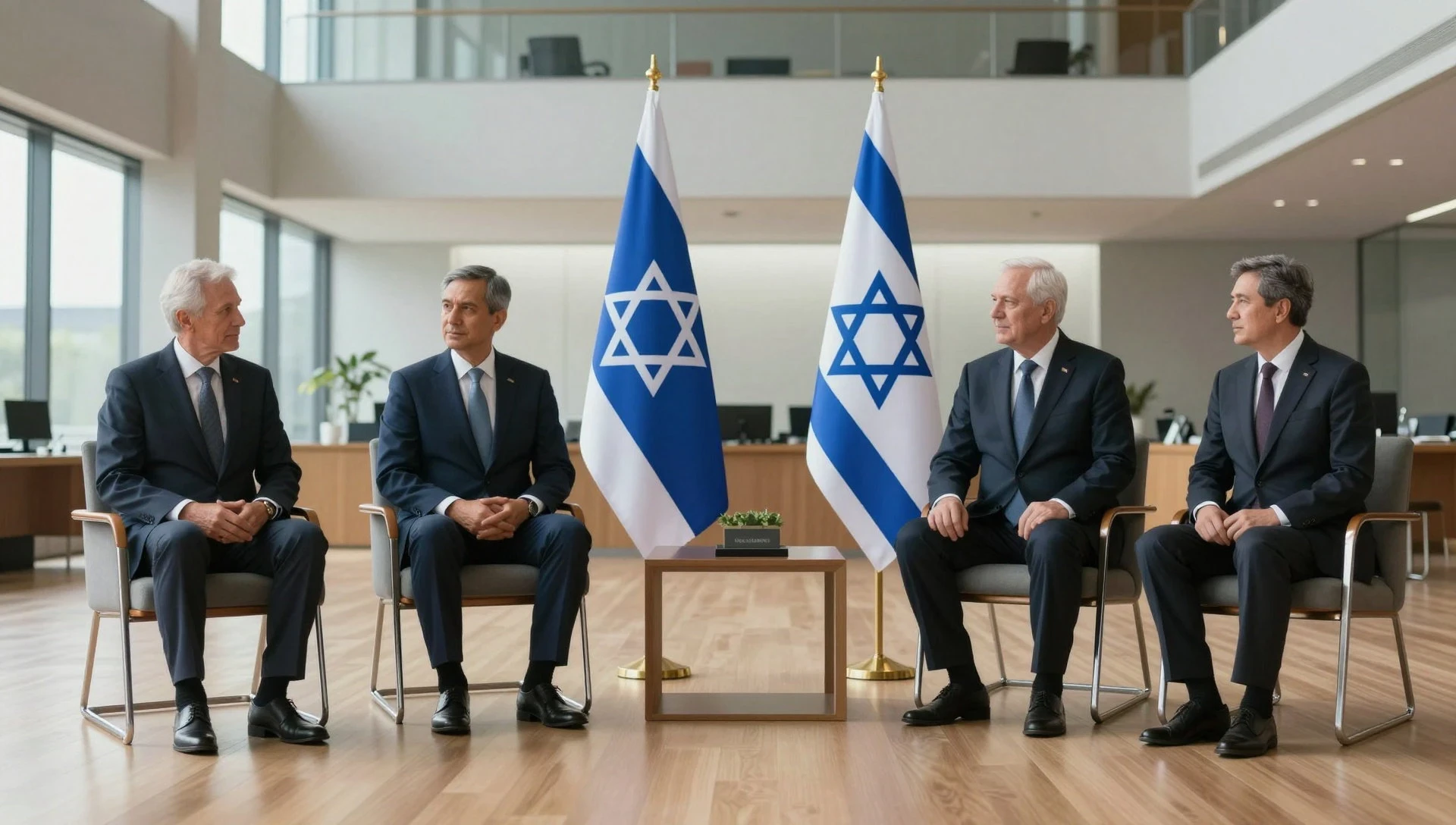
Germany's response to Israel's inconclusive 2026 parliamentary election reveals a deliberate diplomatic posture: public silence while private channels remain active. Two days after voting closed, neither the right-wing bloc led by incumbent Prime Minister Benjamin Netanyahu nor the opposition bloc led by former military chief Gadi Eisenkot commanded a clear path to a 61-seat Knesset majority.
Berlin's restraint is not indifference but calculation, reflecting a relationship bound by Holocaust memory and now tested by diverging views on Gaza aid, settlement expansion, and the composition of Israel's next cabinet.
The German government's caution carries measurable stakes. Development Minister Reem Alabali Radovan, speaking from Lebanon, warned that winter conditions in Gaza make humanitarian delivery urgent and that assistance cannot wait for coalition arithmetic to resolve.
On This Page
Her intervention, alongside Foreign Minister Johann Wadephul's pointed reminder that Israel is obligated under international law to protect Palestinian rights, signals a government managing two imperatives simultaneously: historical loyalty to Israel as a state, and growing distance from specific Israeli policies.
This analysis examines the election's structural deadlock, Germany's calibrated diplomatic method, and the regional consequences of prolonged coalition negotiations. It weighs the kingmaker role of Arab-majority parties against Netanyahu's refusal to partner with them, and it tracks how Berlin's non-recognition of Palestinian statehood coexists with sharper criticism of settler violence. The evidence points to a German policy in transition, hedging against outcomes it cannot control.
TL;DR Israel's 2026 election produced no decisive majority, leaving both Netanyahu's right-wing bloc and Eisenkot's opposition bloc short of a governing coalition. Germany has declined public comment while maintaining ambassador-level contacts, prioritizing humanitarian access to Gaza over electoral commentary. Berlin opposes inclusion of far-right figures such as Bezalel Smotrich, will not recognize Palestinian statehood for now, and faces a scenario where Arab-majority parties could play kingmaker—an option Netanyahu's bloc has explicitly rejected.
The Electoral Deadlock and Its Coalition Arithmetic
Israel's parliamentary election returned a fragmented Knesset in which neither major bloc crossed the threshold for stable government. Netanyahu's coalition, dependent on religious hardliners, and Eisenkot's opposition camp each fell short of the 61 seats required.
The result is not a rejection of either leader so much as a structural impasse, and coalition talks are expected to be protracted and acrimonious.
Bloc Strength and the Majority Threshold
The arithmetic of the 120-seat Knesset makes every faction consequential. A governing coalition requires 61 mandates, and both blocs must court smaller parties whose demands range from budget portfolios to religious legislation.
The gap between bloc totals and the majority line determines negotiating leverage, and that gap is narrow enough to make each seat decisive.
Turnout was notably high, a fact Jürgen Hardt of the Christian Democratic Union welcomed publicly. High participation strengthens the mandate of whichever coalition eventually forms, but it also complicates claims that any single bloc speaks for the electorate. The distribution of votes, not their volume, is what constrains government formation.
Coalition negotiations in Israel historically run for weeks, sometimes months. Each additional week of caretaker government delays budget decisions, ministerial appointments, and policy implementation. For external partners like Germany, this means dealing with an interim administration whose authority is limited precisely when humanitarian and security questions demand resolution.
The Arab-Majority Kingmaker Scenario
Arab-majority parties led by Palestinian citizens of Israel recorded historic gains, and they are conventionally grouped with the opposition camp. Their expanded representation creates a mathematical possibility that they could supply the votes needed to tip coalition formation toward Eisenkot. That possibility, however, collides with a political veto.
Netanyahu's bloc has explicitly excluded cooperation with these parties, which removes one arithmetic route to a majority and narrows the remaining combinations. The exclusion transforms a numerical opportunity into a structural constraint, forcing negotiators to search for coalitions among smaller Jewish-majority factions with narrower ideological overlap.
The significance extends beyond seat counts. A community long positioned at the margins of Israeli coalition politics now holds leverage that cannot be ignored, even if it is currently refused. Whether that leverage converts into governing influence depends on whether the opposition bloc can assemble 61 seats without triggering the same exclusions.
Why Negotiations Will Be Difficult
Coalition talks face three compounding pressures: ideological distance between potential partners, personal rivalries among bloc leaders, and the policy demands of religious parties whose support Netanyahu's bloc requires. Each pressure point raises the price of agreement and lengthens the timeline, which in turn extends the caretaker government's limited mandate.
Religious hardliners within the right-wing bloc seek concessions on matters ranging from budget allocations to religious legislation, and those demands shape what any Netanyahu-led government would look like. For Berlin, the composition question is not abstract: it determines whether figures like Finance Minister Bezalel Smotrich enter the next cabinet.
Hardt's assessment that Israel would be best served by a government closer to the center reflects a view widely held among Germany's conservative foreign policy establishment. He simultaneously affirmed that the decision belongs to Israeli voters and elected politicians, a formulation that pairs substantive preference with procedural respect.
We Also Published
Germany's Calibrated Diplomatic Method
Berlin's approach combines institutional continuity with tactical silence. A foreign ministry spokesperson declined comment at the regular government press conference, noting instead that Germany has maintained contact with numerous Israeli officials and politicians through its ambassador.
This is diplomacy conducted through channels rather than podiums, preserving relationships across the political spectrum until a government emerges.
Historical Responsibility as Policy Foundation
Wadephul's statement that Germany and the Jewish state are linked by history, and that Germany will work well with any future government, anchors policy in Holocaust remembrance. That framing establishes a baseline commitment independent of who governs, which explains why Berlin avoids commentary that could be read as favoring one Israeli faction over another.
The historical foundation does not, however, produce unconditional alignment. Germany has recently distanced itself publicly from Netanyahu's policies, and Wadephul's invocation of international law after the Hebron operation marked a substantive shift in tone. Historical responsibility now coexists with legal critique, a combination that requires careful calibration.
This dual posture is legible in the sequencing of German statements. General commitments to the relationship come first and remain constant; specific criticisms follow and are tied to concrete events such as settlement violence or military operations. The structure allows Berlin to criticize conduct without questioning the partnership itself.
Humanitarian Urgency in Gaza and the West Bank
Alabali Radovan's warning from Lebanon reframes the election as a humanitarian variable rather than a purely political event. Winter conditions will intensify need in Gaza, and aid organizations require expanded access to deliver essential assistance. Her argument is that suffering does not pause for coalition negotiations, and neither should relief.
She also addressed the rise in attacks by Israeli settlers on Palestinians in the occupied West Bank and East Jerusalem, stating that radical settler violence must stop and that the interim government must end the situation.
Her language was direct, and it placed responsibility on the current caretaker administration rather than deferring to future leaders.
The legal context is unambiguous: all settlement activity in the occupied Palestinian territories is considered illegal under international law. German officials have increasingly cited this framework explicitly. The Hebron operation, during which roughly 3,000 Palestinians were driven from their homes after the reported killing of two Israeli soldiers, prompted Wadephul's clearest statement on Palestinian rights.
Signals on Recognition and Cabinet Composition
Berlin has signaled that it will not recognize a Palestinian state for now, distinguishing itself from several European countries that have moved toward recognition. This position is a deliberate hold, preserving leverage and aligning with a preference for negotiated outcomes rather than unilateral steps. It also shields Germany from domestic criticism on either flank.
On cabinet composition, German hopes are explicit: the future Israeli government should not include religious extremists or far-right politicians such as Smotrich. This preference is stated as a hope rather than a condition, reflecting the limits of external influence over coalition formation in a sovereign democracy.
The combination of non-recognition and opposition to far-right inclusion defines a narrow German lane. Berlin wants a center-leaning Israeli government, continued humanitarian access, and reduced settler violence, while declining to recognize Palestinian statehood or dictate coalition choices. Each element constrains the others.
- 01
- 02
- 03
- 04
Regional Consequences and the Road Ahead
The election's consequences radiate beyond Jerusalem and Berlin. A prolonged caretaker government in Israel delays decisions on Gaza reconstruction, West Bank security, and relations with regional partners. Germany's humanitarian warning, delivered from Lebanon, illustrates how coalition delays translate into material hardship for civilians and operational uncertainty for aid organizations.
Timeline Risk and Humanitarian Cost
Each week without a formed government extends the interim administration's limited authority. Aid organizations need expanded access to Gaza, and winter conditions will not accommodate political schedules. The German development minister's insistence that assistance cannot wait for coalition talks frames delay itself as a policy outcome with measurable human costs.
Settler violence adds a second dimension of risk. Alabali Radovan's call for the interim government to end the situation acknowledges that caretaker authorities retain security responsibilities even without a full mandate. Inaction during negotiations would compound the harm and complicate the next government's starting position.
The Hebron operation's displacement of roughly 3,000 Palestinians demonstrates how quickly security events can reshape diplomatic discourse. Wadephul's statement that Israel is obligated to uphold and protect Palestinian rights was a direct response to that operation, and it established a reference point for future German commentary.
What Berlin Will Watch
Three variables will determine German engagement with the next Israeli government. First, whether the coalition includes far-right figures such as Smotrich. Second, whether humanitarian access to Gaza expands before winter deepens. Third, whether settler violence is curbed by the incoming administration or continues unchecked.
Berlin's preference for a center-leaning government, articulated by Hardt, aligns with its broader interest in predictable partnership. A coalition closer to the center would ease German criticism on settlements and reduce friction over international law. A government dependent on religious hardliners would sharpen the tensions already visible.
The non-recognition stance on Palestinian statehood gives Germany room to maneuver. It preserves the option of coordinated European action later while avoiding a step that would complicate relations with whichever coalition forms. This is hedging executed through sequencing rather than through ambiguity.
Structural Meaning of the Moment
The episode captures a broader pattern in German foreign policy: continuity of commitment paired with increasing specificity of criticism. Germany will work with any future Israeli government, as Wadephul stated, but it has named the cabinet compositions it hopes to avoid and the conduct it considers unlawful.
Israel's election produced no resolution, only a set of unresolved combinations. Germany's response mirrors that condition, offering no public verdict while maintaining private channels. Both governments are waiting, and the cost of waiting falls most heavily on civilians in Gaza and the West Bank.
From our network :
- Committed Mediterranean Precipitation Decline: Why Emissions Cuts Alone Cannot Restore Winter RainsNew NOAA research reveals that Mediterranean winter rains may decline irreversibly even with emissions cuts. Explore the science of committed climate change and regional impacts.
- The Hidden Cost of AI Convenience: Why Over-Permissioned Agents Are a Security Time BombDiscover why AI agents with excessive permissions create dangerous single points of failure, and learn how implementing least privilege principles can protect your organization from exploitation.
- CISA’s Ten-Advisory Wave: Why Generic Patching Fails in OT and How to Build Product-Specific PlaybooksCISA released ten ICS advisories in one week, exposing critical infrastructure risks. Generic patching fails in OT. Learn to build product-specific remediation playbooks.
- University Language Proficiency Exams: Why Institutional Tests Demand Different Preparation Than IELTS and TOEFLDiscover why university-specific language proficiency examinations differ fundamentally from IELTS and TOEFL, and learn strategic preparation approaches for institutional assessment success.
- How AI Agents Will Change the Way We Manage Personal FinancesExplore how AI agents are transforming personal finance through automated budgeting, bill payment, and investment management, while examining the critical security protocols and governance frameworks required for safe deployment.
- Forbidden Matrix Patterns and Visible Lattice Points: A Geometric DictionaryExplore how multidimensional 0–1 matrices encode geometric truths, linking forbidden patterns to visible lattice points and hypergraph theory, with applications in combinatorics and computational geometry.
- The Final Descent: How ESA Retired the Legendary Cluster Constellation After 24 Years of Space Weather ScienceAfter 24 years mapping Earth’s magnetosphere, ESA’s Cluster mission concluded with a precisely controlled reentry over the South Pacific. This analysis explores the scientific legacy, engineering decisions, and debris mitigation principles behind one of space exploration’s most responsible retirements.
- Live Online English Classes for Kids: Do They Actually Reduce Anxiety?A ten-week study reveals that synchronous online English classes can significantly reduce child language anxiety while improving listening and reading skills. Discover what makes these programs effective and how parents can select the right one.
- Mobile Learning and VR in English: What Global Evidence Reveals About Effective Language TechnologyA systematic review across 14 countries reveals which language-learning technologies genuinely work. Mobile learning, AI, and VR show measurable benefits when pedagogically integrated. This evidence-based guide helps educators and learners select technology that delivers real return on investment.
RESOURCES
- Germany: Chancellor Friedrich Merz faces tough times aheaddw.comSep 22, 2026 ... Coalition talks in GermanyFriedrich MerzFar-right populism in EuropeBerlinGerman election ... Israel election: Authorities dispute ...
- Iran Spotlights How Trump Is Fracturing the Transatlantic Allianceamericanprogress.orgMar 12, 2026 ... ... Israel campaign against Iran, yet few feel able to challenge Washington openly. ... In one recent state election in…
- Germany takes cautious approach on Israeli election results - DW.comdw.com3 days ago ... German politicians have been slow to respond as they wait to see who is likely to comprise the next coalition.…
- Germany's Merz wants to push ahead reforms after state election ...reuters.comMar 23, 2026 ... SPD leaders Lars Klingbeil, finance minister in Merz's coalition and Baerbel Bas, the labour minister, said there needed to be…
- Saxony-Anhalt Election: What It Means for Germany and the EUepc.euSep 7, 2026 ... ISRAEL, NEWS & POLITICS, SOCIAL EU, UNITED KINGDOM, FUNDAMENTAL ... Germany, its presence does not strengthen democratic coalition‑building.
- What's at stake for the AfD and Merz in Germany's three September ...atlanticcouncil.orgSep 1, 2026 ... Germany's state-election season starts with a big test in Sachsen ... coalition's failure to present a credible answer to these…
- Iran-Israel Escalation at Sea: The Need for an International Coalition ...washingtoninstitute.orgAug 9, 2021 ... Iran-Israel Escalation at Sea: The Need for an International Coalition Response ... Farzin Nadimi, a Senior Fellow with The Washington…
- The Battle Over Israel's Future in the 2026 Elections - Giga- Hamburggiga-hamburg.deThe coalition's pre-election reforms risk reshaping ... German and EU policymakers should therefore consider how future engagement with Israel can respond ...
- German far-right party set for regional election triumph but uncertain ...pbs.orgSep 6, 2026 ... ... coalitions. Germany's states have extensive powers. Germany's 16 ... Read Oct 30 Israel's election results are in. Here's what…
- How Far-Right Election Gains Are Changing Europecfr.orgOct 15, 2024 ... Far-right parties are making significant strides in Austria and Germany, pulling EU policies in a rightward direction.
- What Is Germany's AfD, and What Does Its Rise Mean for Jews? | AJCajc.orgSep 8, 2026 ... The result was nevertheless the AfD's strongest showing in a German state election ... Germany's longstanding commitment to Israel's security.…
- Europe's mixed response to Iran war draws Trump's fury toward U.S. ...nbcnews.comMar 8, 2026 ... Some European leaders have remained in Trump's good graces for now. Germany's conservative Chancellor Friedrich Merz, who sat beside Trump…
- German far-right AfD wins Saxony-Anhalt election, falls short of ...aljazeera.comSep 6, 2026 ... US-Israel war on Iran · Yemen conflict · Middle East · Africa · Asia · Asia ... The AfD has…
- “A Matter of Survival”: Germany's New Coalition Governmentthenation.comApr 18, 2025 ... ... response of many progressives following the February 23 snap German elections. The center right CDU/CSU alliance (with 208 seats)…
- Why Germany Isn't Punishing Russia Harder - Foreign Policyforeignpolicy.comSep 9, 2026 ... What if No One Wins the Israeli Election? Netanyahu's opponents are ahead but will struggle to form a coalition. This ...
- 01
- 02
- 03
- 04
- 05
- 06
- 07
- 08
0 Comments