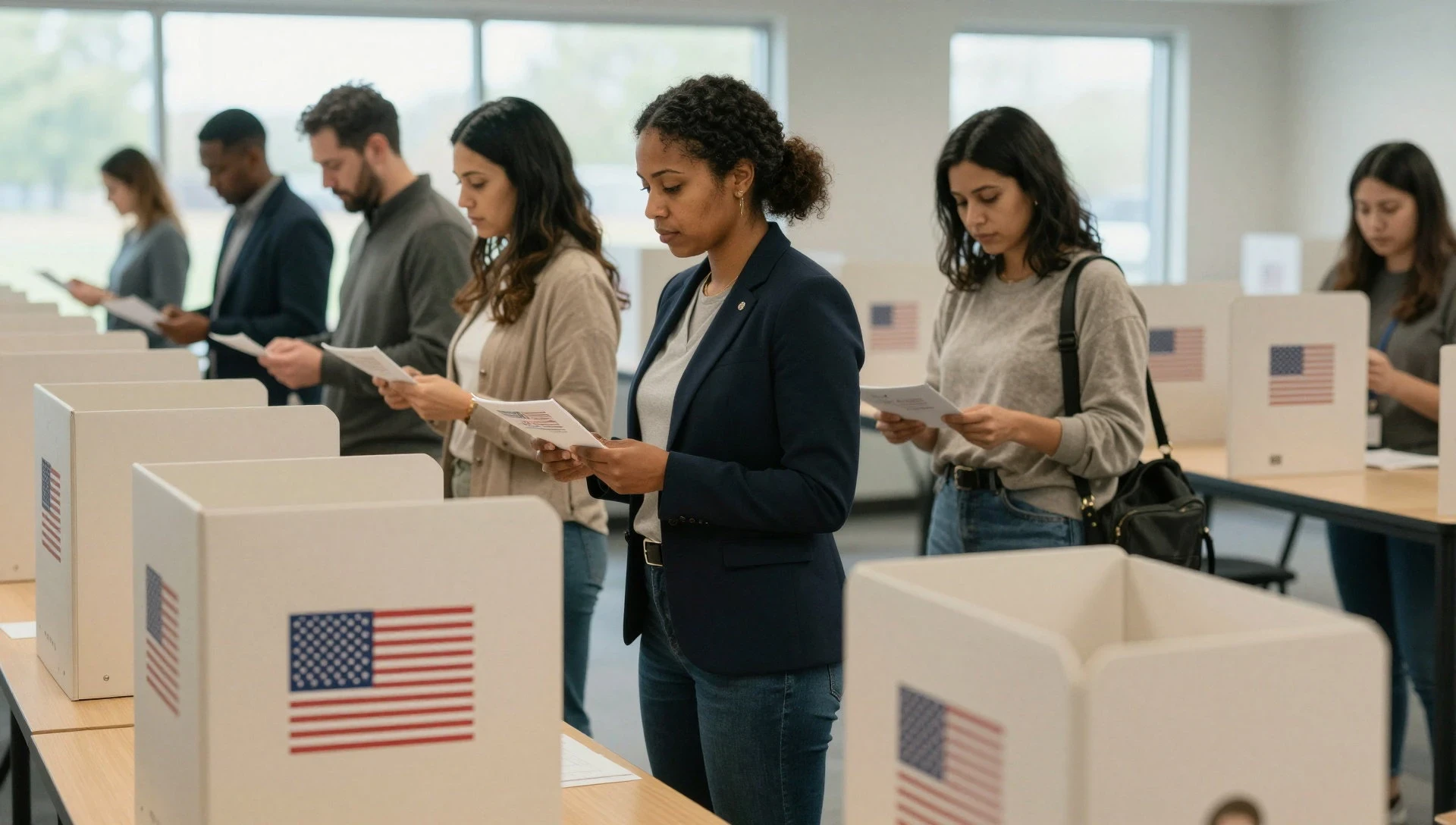
The final stretch of a midterm election cycle rarely produces a single, tidy narrative, and the reporting captured here illustrates why. Donald Trump and Hillary Clinton both returned to the campaign trail as early-voting participation climbed, an Alaska inquiry widened its scope, and Michigan Democrats fell into an internal dispute.
Each item is local in origin yet national in consequence, because turnout mechanics, legal scrutiny and party cohesion all feed the same arithmetic on election night.
Read together, these four developments describe a system under simultaneous pressure from mobilization, litigation and factional strain. Early voting converts a single election day into a rolling, weeks-long process, which changes how campaigns allocate money and how investigators and lawyers time their interventions.
On This Page
The Alaska inquiry and the Michigan dispute show that institutional conflict does not pause for the ballot; it accelerates as deadlines tighten and stakes become concrete rather than theoretical.
This analysis separates the signal from the noise. It examines what rising early-voting numbers actually measure, why a widening Alaska inquiry matters beyond one state, and how a Michigan Democratic split exposes the coalition-management problem facing the party nationally.
Evidence, comparative turnout figures and structural comparisons anchor each section, so the reader can weigh claims rather than absorb headlines.
TL;DR Three concurrent developments — Trump and Clinton campaign events amid rising early voting, a widening Alaska inquiry, and an internal split among Michigan Democrats — describe an election entering its decisive phase. Early voting shifts turnout from a single day to a rolling process, rewarding campaigns with superior data and logistics. The Alaska inquiry signals that legal and administrative scrutiny intensifies as ballots are cast, while the Michigan dispute shows coalition management is as consequential as persuasion. Together they indicate that mobilization capacity, legal exposure and party discipline, not rhetoric alone, will determine outcomes.
Turnout Mechanics and the Return of National Campaign Figures
Early voting has fundamentally altered the temporal structure of American elections. What was once a single-day turnout event is now a rolling process spanning weeks, with ballots cast under varying rules across states.
When Trump and Clinton both stage events as early-voting numbers rise, they are responding to a measurable shift in when persuadable voters actually decide and act.
What Rising Early-Voting Numbers Actually Measure
Raw early-vote counts are frequently misread as enthusiasm indicators. In practice they measure procedural access as much as voter intent, since states with permissive mail and in-person early rules mechanically generate higher pre-election totals.
A rise in early ballots can reflect expanded eligibility, changed habits, or genuine intensity, and separating these requires comparison with prior cycles.
Campaigns treat early-vote data as a targeting instrument rather than a scoreboard. Once a supporter has voted, that household drops out of persuasion and get-out-the-vote contact lists, freeing resources for the remaining universe.
The operational advantage therefore accrues to campaigns with superior voter-file hygiene and faster data reconciliation, not simply to those with louder rallies.
Timing matters because early voting compresses the persuasion window. A late-breaking controversy reaches fewer uncommitted voters if most ballots are already cast, which changes the calculus for both opposition research and crisis response. This is why legal filings and investigative disclosures cluster around the opening of early voting rather than its close.
The comparative evidence is instructive. States with universal mail balloting routinely report pre-election turnout exceeding half of total eventual votes, while restrictive states concentrate participation on election day. Any claim that a national early-vote surge proves a particular outcome must therefore be tested against state-level rules before it is credited.
Why Trump and Clinton Reappear as Surrogates
Both figures function as turnout instruments rather than neutral commentators. Trump's rallies target low-propensity voters who respond to spectacle and grievance, while Clinton's events emphasize institutional stakes and coalition maintenance. Deploying them simultaneously suggests both parties believe the remaining undecided universe is small and that base activation is the decisive lever.
Surrogate campaigning carries measurable trade-offs. A polarizing headliner can lift base turnout while alienating suburban swing voters, so placement matters: rallies are typically scheduled in districts where the base-to-swing ratio favors activation. The reappearance of both figures therefore signals a closing argument built on differential turnout rather than persuasion.
Historical comparison supports this reading. In cycles where early voting exceeded a third of total ballots, late campaign travel concentrated in media markets serving already-motivated partisans. The pattern repeats here: events are calibrated to remind committed supporters to vote early, not to convert the genuinely undecided.
Resource allocation follows the same logic. Money spent on get-out-the-vote operations during early voting yields higher marginal returns than late advertising, because a cast ballot cannot be changed. Campaigns that misjudge this sequencing often discover, too late, that their persuasion budget arrived after most targets had already voted.
The Operational Arithmetic of a Rolling Election
Consider the basic turnout identity that campaigns model when planning early-vote strategy. Total participation equals the sum of early ballots and election-day ballots, and each component responds to different interventions:
Because ##V_{early}## is locked once cast, the marginal return on persuasion falls as early voting progresses, while the return on mobilization rises. Campaigns that track this derivative correctly shift resources toward contact and ballot-chase operations, and those that do not waste money persuading voters who have already decided.
The practical consequence is a race for data quality. Ballot-chase programs, which contact voters whose mail ballots are rejected for signature or procedural defects, can recover measurable shares of votes. In close contests, these recovered ballots frequently exceed the margin of victory, making administrative competence a genuine electoral variable.
Legal Scrutiny, Institutional Strain and the Alaska Inquiry
Investigations that widen during an election period carry consequences beyond their immediate subject. The Alaska inquiry's expansion introduces uncertainty into a state with distinctive electoral geography, where remote districts and small margins make administrative decisions unusually consequential. Legal process and ballot counting now proceed on parallel tracks.
What a Widening Inquiry Signals
An inquiry expands when initial findings generate new leads, additional witnesses, or jurisdictional overlap. That progression is procedural rather than conclusive: widening does not establish wrongdoing, but it does indicate that investigators believe the matter exceeds its original scope. The distinction matters for public interpretation.
Timing is the contested variable. Disclosures that surface during voting raise legitimate questions about evidentiary sufficiency and improper influence, and both concerns can be valid simultaneously. The professional standard is to separate what is documented from what is alleged, and to note which stage of the process each claim occupies.
Alaska's structural features amplify any such dispute. Its reliance on mail balloting in remote areas, its small population, and its ranked-choice framework mean that procedural rulings can shift outcomes more than in larger, more forgiving states. A widening inquiry therefore carries disproportionate weight relative to its apparent scale.
Comparative perspective helps. In states where margins routinely exceed tens of thousands of votes, investigative developments rarely alter results. Where margins fall into the hundreds, administrative and legal decisions become outcome-determinative, and the credibility of the process itself becomes the central political question.
Alaska's Distinctive Electoral Geography
Alaska combines sparse population, extreme distances and a ranked-choice voting system, producing an electoral environment where logistics and procedure carry unusual weight. Ballot transmission in remote villages can take days, and cure deadlines become decisive when margins are narrow. Administrative competence is therefore a first-order variable.
Ranked-choice tabulation adds a second layer of complexity. Elimination rounds redistribute ballots in ways that can reverse initial leads, which means early tallies are frequently misleading. Any inquiry touching tabulation or ballot handling in such a system attracts heightened scrutiny because the mechanism itself is less familiar to the public.
The state's political culture reinforces this sensitivity. Alaska voters have historically valued independence and procedural transparency, and both parties compete for a genuinely fluid electorate. An inquiry that appears partisan risks damaging credibility across the spectrum, which raises the cost of mishandling disclosure.
Nationally, the Alaska case functions as a test of institutional resilience. If procedural disputes are resolved through documented, reviewable steps, confidence survives. If they are resolved through assertion and counter-assertion, the damage extends well beyond one state's results and into the broader legitimacy of the process.
Legal Risk as a Campaign Variable
Campaigns now model legal exposure as a planning input rather than an externality. Litigation timelines, disclosure obligations and investigative developments are mapped against the voting calendar, and communications strategy is adjusted accordingly. Legal risk has become a line item with measurable electoral consequences.
The asymmetry is important. An inquiry can generate sustained media coverage without producing findings, and that coverage itself influences perception. Defenders emphasize the absence of conclusions; critics emphasize the fact of investigation. Both are describing the same procedural reality from different vantage points.
Professional practice favors restraint in interpretation. The defensible position is to report the stage of the process, the specific conduct under review, and the evidentiary standard that applies. Anything beyond that substitutes speculation for analysis and degrades the informational value of the reporting.
For voters, the practical implication is that legal developments should be weighed as probabilities rather than verdicts. An expanded inquiry raises uncertainty; it does not resolve it. Treating procedural news as conclusive is the most common analytical error in election coverage, and it is avoidable with disciplined reading.
We Also Published
- 01
- 02
- 03
- 04
Coalition Management and the Michigan Democratic Split
Internal disputes are the least visible and most consequential form of electoral strain. The Michigan Democratic split reported alongside these developments reflects a familiar pattern: coalition partners who agree on opposition but diverge on priorities, personnel or process. Such fractures consume resources and complicate messaging at precisely the wrong moment.
Anatomy of an Intraparty Dispute
Intraparty conflicts typically originate in one of three places: ideological disagreement over policy, procedural disputes over candidate selection, or personal rivalries among officeholders. Each produces different dynamics. Policy disputes can be negotiated; procedural disputes often harden into questions of legitimacy; personal rivalries tend to persist regardless of outcome.
Michigan's political geography sharpens these tensions. The state spans union-heavy industrial corridors, affluent suburban counties and rural districts with distinct priorities, and a coalition that wins statewide must hold all three. Any factional split therefore carries immediate geographic consequences for turnout and resource allocation.
The timing compounds the difficulty. Disputes that surface during early voting cannot be resolved before ballots are cast, which means the damage is partially locked in. Campaigns in this position typically shift toward damage limitation and base consolidation rather than expansion.
Comparative evidence suggests that visible splits cost roughly a few percentage points among the faction's most committed supporters, which is decisive in a state decided by narrow margins. The cost is not uniform: it concentrates among activists and donors rather than the broader electorate.
Michigan as a National Bellwether
Michigan's electoral profile makes it a reliable indicator of broader coalition health. It combines a strong organized-labor tradition, a large suburban middle class and significant rural territory, and winning statewide requires assembling all three into a durable majority. A visible split therefore signals stress in the national coalition's component parts.
The state's recent electoral history has been decided by narrow margins, which raises the cost of any internal friction. When a contest is decided by tens of thousands of votes, a few thousand demobilized activists or withheld donations can be decisive. Coalition management becomes arithmetic rather than sentiment.
National implications follow directly. If Michigan Democrats cannot reconcile their factions, similar tensions likely exist in comparable states with analogous demographics. The dispute is therefore best read as an early indicator rather than an isolated incident, and its resolution will be watched accordingly.
Resolution typically requires either a negotiated settlement on process or a decisive intervention by senior leadership. Both consume time and attention that would otherwise go to persuasion. The opportunity cost is the real damage, and it is rarely quantified in post-election analysis.
Reading Three Signals Together
Mobilization, legal scrutiny and coalition discipline are not separate stories; they are three inputs into the same outcome function. Early voting determines who participates, legal process determines which ballots count and under what conditions, and coalition discipline determines whether a party's supporters actually turn out.
The interaction effects matter more than any single factor. A campaign with superior turnout data but a fractured coalition wastes its advantage, while a party with legal exposure and narrow margins finds procedural decisions amplified. Strength in one dimension cannot fully compensate for weakness in another.
For analysts, the disciplined approach is to track each dimension separately and then model their interaction. Headlines tend to collapse the three into a single narrative, which obscures the specific mechanism driving any given development. Precision here is not pedantry; it is the difference between prediction and commentary.
The broader lesson concerns institutional load. Elections now carry simultaneous burdens of mobilization, adjudication and coalition maintenance, and each places demands on the same finite organizational capacity. Systems that manage all three competently produce legitimate outcomes; those that do not generate disputes that outlast the cycle itself.
From our network :
- Live Online English Classes for Kids: Do They Actually Reduce Anxiety?A ten-week study reveals that synchronous online English classes can significantly reduce child language anxiety while improving listening and reading skills. Discover what makes these programs effective and how parents can select the right one.
- Forbidden Matrix Patterns and Visible Lattice Points: A Geometric DictionaryExplore how multidimensional 0–1 matrices encode geometric truths, linking forbidden patterns to visible lattice points and hypergraph theory, with applications in combinatorics and computational geometry.
- Committed Mediterranean Precipitation Decline: Why Emissions Cuts Alone Cannot Restore Winter RainsNew NOAA research reveals that Mediterranean winter rains may decline irreversibly even with emissions cuts. Explore the science of committed climate change and regional impacts.
- CISA’s Ten-Advisory Wave: Why Generic Patching Fails in OT and How to Build Product-Specific PlaybooksCISA released ten ICS advisories in one week, exposing critical infrastructure risks. Generic patching fails in OT. Learn to build product-specific remediation playbooks.
- The Final Descent: How ESA Retired the Legendary Cluster Constellation After 24 Years of Space Weather ScienceAfter 24 years mapping Earth’s magnetosphere, ESA’s Cluster mission concluded with a precisely controlled reentry over the South Pacific. This analysis explores the scientific legacy, engineering decisions, and debris mitigation principles behind one of space exploration’s most responsible retirements.
- The Hidden Cost of AI Convenience: Why Over-Permissioned Agents Are a Security Time BombDiscover why AI agents with excessive permissions create dangerous single points of failure, and learn how implementing least privilege principles can protect your organization from exploitation.
- Mobile Learning and VR in English: What Global Evidence Reveals About Effective Language TechnologyA systematic review across 14 countries reveals which language-learning technologies genuinely work. Mobile learning, AI, and VR show measurable benefits when pedagogically integrated. This evidence-based guide helps educators and learners select technology that delivers real return on investment.
- University Language Proficiency Exams: Why Institutional Tests Demand Different Preparation Than IELTS and TOEFLDiscover why university-specific language proficiency examinations differ fundamentally from IELTS and TOEFL, and learn strategic preparation approaches for institutional assessment success.
- How AI Agents Will Change the Way We Manage Personal FinancesExplore how AI agents are transforming personal finance through automated budgeting, bill payment, and investment management, while examining the critical security protocols and governance frameworks required for safe deployment.
RESOURCES
- 2026 Early Voting - UF Election Lab - University of Floridaelection.lab.ufl.edu23 minutes ago ... If you use these statistics you MUST provide reasonable attribution and cannot use these data for commercial purposes — such…
- Tracking the 2026 Early Vote: Midterm Elections - NBC Newsnbcnews.com1 hour ago ... 54,834,584 mail-in and early in-person votes cast nationally · 60,734,302 mail-in ballots requested or sent nationally.
- Early Voting - UF Election Labelection.lab.ufl.eduMcDonald with the UF Election Lab disseminates early voting statistics for all of the United States. ... Midterm Elections. 2026 General · 2022 General.…
- Early vote analysis: Mail ballot concerns are changing how ...nbcnews.comOct 9, 2026 ... US-VOTE-ELECTION. Fulton County, Georgia, election workers process ... Just months before the first mail ballots of the midterm elections ...
- Voter turnout is soaring in some key states, AP analysis showsapnews.comOct 21, 2026 ... Nationally, more than 13 million mail-in and early in-person votes have been cast, compared with 9 million at the same…
- Division of Elections - NJ Voter Information Portalnj.gov... Election and early voting period. 12/18/23 ... Official Special General Election Results: U.S. House of Representatives 10th Congressional District
- Find Early Voting Times and Locations | Nashville.govnashville.govPrior to most elections, we offer multiple locations across our county where registered Davidson County voters may cast their ballots early. The Early Voting ...
- Early voting begins in U.S. midterm elections that could flip control of ...pbs.orgSep 18, 2026 ... Educate your inbox. Subscribe to Here's the Deal, our politics newsletter for analysis you won't find anywhere else.
- Early Voting - 2026 Statewide General Election - SC Votesscvotes.govFind the Early Voting Turnout Report for Statewide Primaries on the Voter Registration and Participation Statistics page. Early Voting Centers - 2026 Statewide ...
- Voting in Louisianasos.la.govView early voting locations to know where to vote early and find your voting precinct to know where to vote on Election Day. Download…
- Tracking the Early Vote in the 2026 Midterm Electionsnytimes.com2 days ago ... But there are limits to what early voting can tell us. Each state has its own rules, and those rules…
- Upcoming Election Summary - State Board of Elections - Kentucky.govelect.ky.govHelp America Vote Act (HAVA) · Voter List Maintenance · County Election Plans · E ... To find out when and where early voting…
- What you need to know about the 2026 US midterm elections | Reutersreuters.comOct 23, 2026 ... Early voting has been underway for weeks ahead of the November 3, 2026, midterm elections, when US voters will elect…
- Voter Registration in 2022 Highest in 20 Years for Congressional ...census.govMay 2, 2023 ... High Registration and Early Voting in 2022 Midterm Elections. High ... U.S. Congressional Election Voter Registration, Turnout: 2002-2022.
- Elections Division - Secretary of the Commonwealth of Massachusettssec.state.ma.usVote Early · Vote Absentee · Find a Ballot Drop Box · Track Your Mail-in Ballot ... elections@sec.state.ma.us. . William Francis Galvin. Secretary of…
- 01
- 02
- 03
- 04
- 05
- 06
- 07
- 08
0 Comments