The Binance disclosure of a $6.3 billion cryptocurrency theft, executed through a fabricated job interview, marks one of the most consequential security failures in the short history of digital asset exchanges. What separates this incident from routine phishing campaigns is the patience and theatricality of the deception: attackers posing as a fictitious company's project director and human resources representative cultivated trust over weeks, sharing social media profiles, personal photographs and video calls before delivering a malicious "assignment" to an engineer working on his corporate laptop. The breach did not exploit a flaw in Binance's code so much as a flaw in human judgment under the guise of professional opportunity.
The attribution matters as much as the mechanics. The FBI has identified the intrusion as the work of TraderTraitor, a North Korean state-sponsored unit with a documented history of targeting crypto platforms to fund a sanctioned regime. Binance's own timeline shows an earlier, failed attempt in June that was detected and blocked, yet the intelligence gathered during that probe apparently informed the September operation. That sequence reveals a persistent adversary learning from rejection rather than retreating, and it exposes how perimeter defenses can be defeated by an attacker willing to invest months in a single employee relationship.
Beyond the headline figure, the episode raises uncomfortable questions about custody, reimbursement and accountability in an industry that markets itself on decentralization. Binance has replaced most of the stolen assets from its own reserves and commissioned an independent cybersecurity review, but its admission that "this should not have happened" acknowledges a gap between the security posture it advertised and the reality of its operational controls. The following analysis examines the anatomy of the attack, the economics of the loss, the regulatory aftershocks and the defensive lessons that every organization handling digital value must absorb.
On This Page
- The Anatomy of a Recruiter Impersonation Attack
- The Financial Scale and Mechanics of a $6.3 Billion Loss
- Attribution, Geopolitics and the TraderTraitor Network
- Regulatory Aftershocks and the Push for Stricter Oversight
- Hardening the Human Layer: Defensive Lessons for Every Organization
- The Broader Implications for Digital Asset Custody
- Conclusion: Accountability in an Era of Industrial-Scale Cyber Theft
TL;DR North Korean hackers believed to be the TraderTraitor unit breached Binance by impersonating recruiters and sending a malicious coding assignment to an engineer during a fake second-round interview, ultimately stealing more than $6.3 billion in customer cryptocurrency. Binance detected an earlier June intrusion, replaced most of the stolen assets from its own funds, and has ordered an independent security review. The case illustrates the rising sophistication of social-engineering attacks against crypto infrastructure and the urgent need for hardened endpoint controls, verified hiring pipelines and transparent incident disclosure across the digital asset industry.
The Anatomy of a Recruiter Impersonation Attack
Social engineering has always been the quiet workhorse of cybercrime, but the Binance case demonstrates how far the discipline has evolved from crude email lures toward fully staged corporate theatre. The attackers did not simply send a suspicious link; they constructed an entire fictional employer, complete with a project director persona, an HR representative and a chief executive, then walked their target through a plausible multi-stage hiring process. Each interaction served a dual purpose, advancing the recruitment narrative while harvesting personal details that would later make the malicious payload feel routine rather than anomalous.
The critical pivot occurred during the supposed second interview, conducted on a popular social chat application while the engineer sat at his work laptop. Asking a candidate to download and complete a technical assignment is entirely normal in software recruitment, which is precisely why the request succeeded. The assignment carried malicious code that gave the intruders a foothold inside Binance's environment. Security researchers have long warned that the hiring funnel is an under-guarded attack surface, because candidates are conditioned to comply with instructions from prospective employers and because recruitment often happens on personal devices and consumer messaging platforms outside corporate monitoring.
Why the June Failure Made September More Dangerous
Binance's assessment reveals a June intrusion attempt that its defenses detected and stopped, but the company concedes the hackers still learned about Binance and its systems during that episode. This is the counterintuitive cost of successful defense: every blocked attack yields reconnaissance. The adversary returned three months later with a tailored approach aimed at a specific employee, suggesting the earlier probe was never abandoned but converted into intelligence gathering. Organizations that treat a thwarted breach as a closed incident rather than the opening move of a longer campaign leave themselves exposed to precisely this kind of patient, iterative assault.
The timeline also underscores how attribution and response lag behind exploitation. The theft occurred last week, the FBI linked the operation to TraderTraitor, and Binance published its initial assessment on Tuesday, by which point most stolen assets had already been replaced from company funds. That speed of reimbursement is commendable from a customer-protection standpoint, yet it also raises a governance question: when an exchange absorbs multibillion-dollar losses internally, who ultimately bears the cost, and does swift restitution reduce the incentive to disclose the full extent of control failures?
The TraderTraitor Playbook and State-Sponsored Crypto Theft
TraderTraitor is not a new name in threat intelligence. The unit has been linked to a sustained campaign against cryptocurrency exchanges, wallet providers and blockchain developers, typically using fake job offers, trojanized software updates and supply-chain compromises to gain access. North Korea's interest in digital assets is well documented: stolen cryptocurrency provides a sanctions-resistant funding channel for state programs. What distinguishes the Binance incident is scale. A single successful recruitment deception yielded more than $6 billion, a figure that dwarfs most conventional bank heists and illustrates why crypto platforms have become priority targets for nation-state actors.
The operational security failures on the victim side are equally instructive. An engineer conducting a job interview on a work laptop, downloading an unknown file from a consumer chat app, represents a chain of small deviations from best practice that compounded into catastrophe. Endpoint detection, application allow-listing, network segmentation and strict separation between personal recruitment activity and corporate infrastructure could each have interrupted the kill chain. The lesson is not that employees are naive but that security architectures must assume attackers will eventually reach a trusted insider through entirely legitimate-seeming social channels.
The Financial Scale and Mechanics of a $6.3 Billion Loss
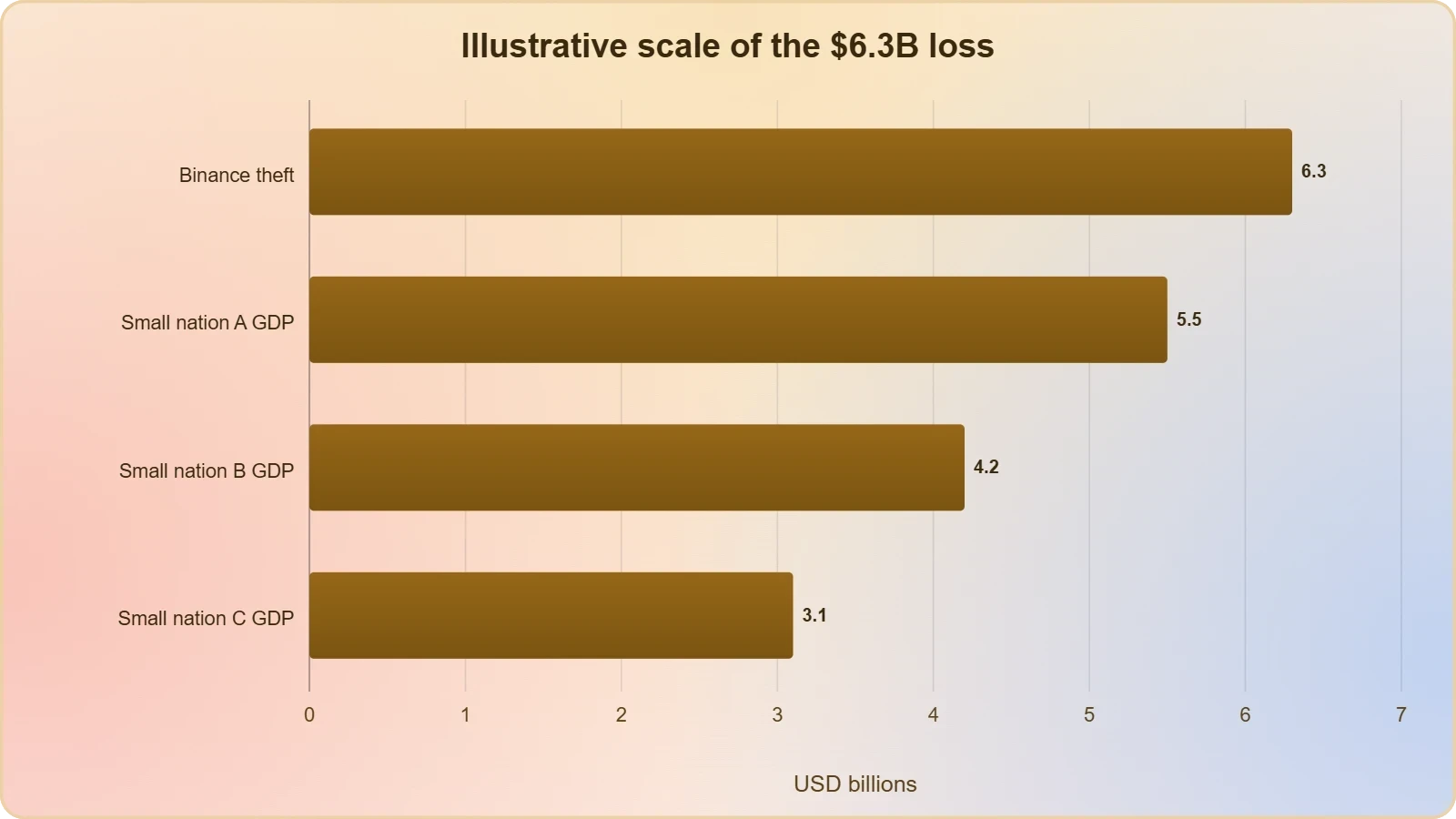
To appreciate the magnitude of this theft, consider that $6.3 billion exceeds the annual gross domestic product of several small nations and approaches the total market capitalization of many mid-tier listed companies. For a single exchange, absorbing a loss of that size without customer haircuts requires either enormous reserves or external capital support. Binance stated on Monday that it had already replaced most of the stolen cryptocurrencies using its own funds, a commitment that protects user balances in the short term but raises questions about the sustainability of self-insurance at this scale and the precedent it sets for future incidents.
The mechanics of the theft also deserve scrutiny. The report describes hackers using the malicious assignment to "build an attack" that ultimately drained customer holdings, implying a period of lateral movement and privilege escalation rather than an instantaneous smash-and-grab. That dwell time is where detection should have occurred. Custody of customer assets at a centralized exchange concentrates risk in a way that decentralized protocols theoretically avoid, yet the practical reality is that most retail users still rely on custodial platforms for liquidity and convenience. The Binance episode is therefore a stress test of the custodial model itself.
Reimbursement, Reserves and the Question of Moral Hazard
Replacing stolen assets from corporate funds is the right gesture toward customers, but it creates a subtle moral hazard. If users believe an exchange will always make them whole, they may discount the importance of counterparty risk and keep larger balances on centralized platforms than prudence would suggest. Meanwhile, the exchange bears the loss, which must ultimately be recovered through fees, reserves or investor capital. Transparency about the size of the hole and the source of the replacement funds would help markets price exchange risk more accurately, but few platforms volunteer that level of disclosure during a crisis.
There is also the question of insurance. Traditional financial institutions transfer catastrophic operational risk to insurers and reinsurers, but crypto exchanges operate in a thin and expensive insurance market where coverage limits are modest relative to the assets under custody. A $6.3 billion event likely exceeds the capacity of any single policy available to a crypto platform today. That gap between exposure and coverage is a structural vulnerability of the industry, and it explains why a single social-engineering success can threaten an institution's solvency rather than merely dent its quarterly earnings.
Market Confidence and the Contagion Question
Whenever a major exchange discloses a breach of this size, the immediate market question is whether customers will withdraw en masse. Bank runs in crypto are faster than in traditional banking because withdrawals are programmable and visible on-chain in real time. Binance's rapid reimbursement was clearly designed to short-circuit a panic, and the fact that it could cover most losses from its own balance sheet signals substantial reserves. Still, confidence is a fragile asset, and the disclosure that an engineer's laptop was the entry point may prompt institutional clients to reassess their operational security assumptions about custodians.
Contagion risk extends beyond Binance itself. Lending protocols, market makers and payment processors that hold balances on the exchange may face liquidity strain if withdrawals spike. Stablecoin issuers whose tokens are widely used in exchange settlement could see redemption pressure. Regulators, already inclined toward stricter oversight of crypto intermediaries, will likely cite this incident as evidence that self-regulation has failed. The second-order effects on market structure and policy may ultimately prove more consequential than the direct loss, reshaping how digital asset businesses are capitalized, audited and supervised.
Attribution, Geopolitics and the TraderTraitor Network
The FBI's identification of TraderTraitor places this breach within a broader pattern of North Korean cyber operations aimed at financing the state through digital asset theft. Unlike ransomware crews motivated by profit, state-sponsored units operate with strategic patience and diplomatic cover, making deterrence extraordinarily difficult. Sanctions can target wallets and intermediaries, but stolen crypto can be laundered through mixers, over-the-counter brokers and decentralized exchanges faster than law enforcement can trace it. The Binance case thus sits at the intersection of cybersecurity, geopolitics and international financial enforcement.
Attribution itself is a contested exercise. The FBI's conclusion rests on technical indicators, infrastructure overlaps and prior campaign signatures, but public disclosure rarely includes the full evidentiary chain. For Binance, accepting the attribution is strategically useful because it frames the incident as an act of state aggression rather than a private-sector negligence story. For policymakers, the case strengthens arguments for mandatory incident reporting, tighter know-your-customer rules for exchanges and coordinated international action against crypto laundering networks. The geopolitical framing does not erase the operational failures, but it does shape how blame and remedy are distributed.
Sanctions Enforcement and the Limits of Wallet Blacklisting
Wallet blacklisting has become the primary tool for denying North Korean actors access to the legitimate crypto economy. Exchanges maintain lists of flagged addresses and freeze associated funds, but sophisticated launderers route assets through chains of intermediate wallets, cross-chain bridges and privacy tools that complicate tracing. The $6.3 billion figure implies a laundering challenge of unprecedented scale, one that will occupy blockchain analytics firms for months. Enforcement works best when it is fast and coordinated, yet the gap between theft and attribution in this case shows how quickly stolen funds can move before countermeasures activate.
There is also a diplomatic dimension. North Korea's crypto thefts fund weapons programs in violation of United Nations resolutions, yet enforcement depends on the cooperation of jurisdictions that host exchanges, mixers and brokers. Some states lack the capacity to act; others lack the will. The Binance incident may accelerate efforts to harmonize crypto regulation across the G20 and to impose stricter due diligence on virtual asset service providers. Whether such coordination can outpace the attackers remains an open question, but the scale of this loss makes business-as-usual increasingly untenable.
What State Sponsorship Means for Corporate Defense
Defending against a state-sponsored adversary is fundamentally different from defending against opportunistic criminals. Nation-state units can sustain campaigns for years, absorb failures, and tailor attacks to individual employees using open-source intelligence. The Binance engineer was not targeted at random; the attackers likely researched his role, his skills and his career ambitions before approaching him. Corporate security programs that focus on malware signatures and perimeter firewalls are poorly suited to this threat model. What matters more is threat intelligence sharing, behavioral monitoring, strict device hygiene and a culture in which employees feel safe reporting suspicious recruitment contacts without fear of blame.
The human element cuts both ways. An engineer eager to advance his career is a natural target, and the attackers exploited that ambition with a polished, flattering recruitment narrative. Organizations can reduce exposure by requiring that all recruitment for sensitive roles run through verified corporate channels, by prohibiting the download of unsolicited files onto work devices, and by training staff to recognize that a job offer arriving through a consumer chat app is itself a red flag. None of these measures is novel, but the Binance case shows how rarely they are enforced in practice.
We Also Published
- 01
- 02
- 03
- 04
Regulatory Aftershocks and the Push for Stricter Oversight
A breach of this magnitude inevitably invites regulatory scrutiny, and the Binance incident arrives at a moment when crypto oversight is already tightening across major jurisdictions. Legislators will ask why a single employee's laptop could serve as a gateway to billions in customer assets, whether the exchange's security controls met reasonable standards, and how quickly customers were informed. The answers will shape forthcoming rules on operational resilience, incident reporting timelines and the capital buffers that custodial platforms must maintain against cyber losses.
Regulators face their own credibility challenge. Crypto exchanges have long argued that they are capable of self-governance, and Binance's rapid reimbursement is evidence of financial capacity. But capacity is not the same as competence, and the admission that the attack "should not have happened" suggests that internal controls lagged behind the platform's scale. A credible regulatory response would combine mandatory third-party security audits, standardized disclosure of material incidents within tight deadlines, and clear liability rules when customer assets are compromised through employee-targeted social engineering.
Incident Disclosure Rules and the Transparency Deficit
Timing is everything in incident disclosure. Binance published its initial assessment on Tuesday, days after the theft and after the FBI had already attributed the attack. Customers learned the broad outlines through media reporting before the exchange's own account arrived. Regulators in the United States and Europe are moving toward mandatory disclosure windows measured in days rather than weeks, modeled on securities and banking rules. The crypto industry has resisted such requirements, arguing that premature disclosure aids attackers, but the Binance case illustrates the cost of opacity to users who need to make informed decisions about their funds.
Transparency also concerns the adequacy of reserves. If an exchange can replace $6 billion from its own balance sheet, it presumably holds substantial capital, but the public has no audited view of that buffer. Proof-of-reserves attestations, which became popular after earlier exchange collapses, are limited because they show assets without proving liabilities. A more rigorous regime would require independent audits of both sides of the balance sheet, regular penetration testing and public disclosure of material control failures. Until then, customers are asked to trust assurances they cannot verify.
Capital Buffers and Operational Resilience Standards
Traditional banks hold capital against operational risk, and regulators stress-test them against cyber scenarios. Crypto exchanges operate under a patchwork of rules that vary by jurisdiction, and many are not subject to consolidated supervision. The Binance loss suggests that a cyber incident can be large enough to threaten an exchange's solvency, which is precisely the kind of risk that capital buffers are designed to absorb. Requiring custodial platforms to hold reserves against cyber losses, and to insure a portion of that exposure, would impose costs but also impose discipline on an industry that has grown faster than its risk management.
Operational resilience standards go beyond capital. They include segregation of duties, mandatory security training for engineers, endpoint hardening, network segmentation and tested incident response playbooks. Regulators could require attestations that these controls exist and are independently verified. The challenge is designing rules that are specific enough to be meaningful without freezing innovation or driving activity to less regulated venues. The Binance incident provides a concrete case study that regulators can use to calibrate those rules, and industry participants should expect the bar to rise.
Hardening the Human Layer: Defensive Lessons for Every Organization
The most durable lesson from the Binance breach is that security is ultimately a human discipline. Firewalls, encryption and multi-factor authentication matter, but they can all be bypassed when a trusted employee is persuaded to act against his own organization's interests. The attackers succeeded because they understood psychology better than the defenders understood their own exposure. Organizations that treat security as a purely technical problem will keep losing to adversaries who treat it as a social one. The remedy begins with acknowledging that every employee with system access is a potential entry point and designing controls accordingly.
Practical hardening starts with device hygiene. Work laptops should not be used for personal job searches, and downloads from consumer messaging applications should be blocked by default. Recruitment for sensitive roles should run through verified corporate channels with known contacts, and any unsolicited approach should be reported to security teams. These measures are inexpensive relative to the losses they prevent, yet they are frequently ignored because they inconvenience employees. The Binance case demonstrates that the inconvenience of a blocked download is trivial compared with the cost of a $6.3 billion breach.
Zero Trust, Endpoint Controls and the Limits of Perimeter Defense
Zero trust architecture assumes that no user or device is inherently trustworthy, requiring continuous verification of identity and context. Had Binance applied strict zero trust principles, the engineer's laptop might have been unable to execute an unknown binary or reach sensitive systems without additional authentication. Endpoint detection and response tools could have flagged the malicious assignment before it ran. Application allow-listing would have blocked it outright. These controls are well understood, but they are often deployed unevenly, leaving gaps that attackers exploit through the path of least resistance, which is usually a person rather than a server.
Perimeter defense alone is insufficient because the perimeter has dissolved. Employees work from home, communicate on consumer platforms and access systems from personal networks. Security teams must therefore instrument endpoints, monitor behavior and segment networks so that a single compromised device cannot reach the crown jewels. The Binance engineer's laptop apparently provided a bridge into systems holding billions in customer assets, which suggests insufficient segmentation. Defense in depth means that even a successful initial compromise should encounter multiple barriers before reaching the assets that matter most.
Building a Culture of Reporting and Continuous Verification
Employees who fear punishment for reporting mistakes will hide them, and hidden mistakes become breaches. Binance's public apology and its decision to commission an independent review are steps toward accountability, but the internal culture that allowed an engineer to download an unknown file onto a work laptop deserves examination. Organizations should reward vigilance, run realistic phishing and social-engineering simulations, and make it easy to report suspicious contacts without stigma. Security awareness is not an annual training module; it is a continuous practice embedded in how people work every day.
Continuous verification extends to third parties. Vendors, contractors and recruitment partners all interact with employees and systems, and each relationship is a potential vector. Due diligence should include security assessments, contractual obligations to report incidents, and clear protocols for handling files and credentials. The fictitious company in the Binance case existed only in the attackers' imagination, but real third parties can be compromised just as easily. A supply-chain-aware security posture treats every external interaction as a risk to be managed rather than a courtesy to be extended.
The Broader Implications for Digital Asset Custody
Binance's experience forces a reckoning with the custodial model that dominates retail crypto. Centralized exchanges offer liquidity, user-friendly interfaces and recovery options that decentralized alternatives struggle to match, but they concentrate risk in a single organization and a single set of employees. When that concentration fails, the consequences are measured in billions. The industry's response cannot be limited to better firewalls; it must include structural changes in how assets are held, how losses are mutualized and how customers are informed about the risks they are implicitly accepting.
One path forward is greater use of multi-party computation and hardware security modules that require multiple approvals for large withdrawals. Another is mandatory segregation of customer assets from corporate reserves, with independent custodians providing additional oversight. A third is insurance-linked products that transfer catastrophic risk to capital markets. Each approach has trade-offs in cost, speed and complexity, but the status quo, in which a single engineer's mistake can drain billions, is clearly unsustainable. The market will eventually price these risks, but regulation can accelerate the process.
Decentralization as a Partial Answer, Not a Panacea
Decentralized finance advocates will argue that this breach vindicates their model, since smart contracts remove the human intermediary that was exploited. There is truth in that claim, but it is incomplete. DeFi protocols have suffered their own catastrophic losses through code exploits, oracle manipulation and governance attacks, and they often lack the reserves to reimburse users. The choice is not simply between centralized and decentralized custody but between different failure modes. A mature industry needs both models to improve, with centralized exchanges hardening their human layer and decentralized protocols hardening their code.
Hybrid models may offer the most practical path. Exchanges could custody assets in multi-signature wallets controlled by independent parties, with smart contracts enforcing withdrawal limits and time delays. Customers could verify reserves on-chain while benefiting from the liquidity and support of a centralized venue. Such designs are technically feasible today, and the Binance incident may accelerate their adoption. The key insight is that no single control is sufficient; resilience comes from layering technical, procedural and governance safeguards so that no single failure, human or machine, can compromise the whole.
What Customers Should Demand From Custodians
Individual users are not powerless. They can ask exchanges for proof-of-reserves audits, inquire about insurance coverage and demand clear disclosure of incident response plans. They can diversify custody across multiple platforms and self-custody a portion of their holdings. They can also pay attention to how quickly and transparently a platform communicates during a crisis, because that behavior is a leading indicator of institutional competence. The Binance case shows that even large, well-resourced exchanges can be breached, so customers should assume some risk exists and manage it accordingly rather than relying on assurances.
Institutional clients have even greater leverage. Pension funds, asset managers and corporate treasuries that hold crypto should conduct operational due diligence on their custodians, including site visits, penetration test reviews and contractual protections. They should require notification timelines, indemnification clauses and the right to audit. The Binance breach will likely prompt many institutions to revisit these arrangements, and custodians that can demonstrate robust controls will win business. Competition on security, rather than merely on fees and product breadth, would be a healthy development for the industry.
Conclusion: Accountability in an Era of Industrial-Scale Cyber Theft
The Binance breach will be remembered as a turning point because it demonstrated that social engineering can produce losses previously associated only with systemic financial crises. A fake job interview, a downloaded assignment and a single compromised laptop were enough to move $6.3 billion out of customer accounts. The exchange's decision to replace most of the stolen assets from its own funds prevented immediate harm to users, but it did not restore the trust that such an incident erodes. Accountability now requires more than an apology and a review; it requires demonstrable changes in how people, processes and technology are governed.
For the wider industry, the lesson is that security must be treated as a core business function rather than a compliance checkbox. Exchanges that compete on product features while underinvesting in operational resilience are accumulating hidden liabilities that will eventually surface. Regulators, customers and investors all have a role in demanding better. The attackers, meanwhile, will continue to innovate, and the next campaign may target a different employee, a different platform or a different vulnerability. The only durable defense is a culture and architecture that assume compromise is possible and design accordingly.
Ultimately, the Binance case is a story about human trust exploited at industrial scale. The engineer who downloaded the assignment was not uniquely careless; he was doing what candidates do when a seemingly legitimate employer asks them to complete a task. The failure lay in systems that allowed a routine professional interaction to become a gateway to billions. Fixing that requires technical controls, yes, but also a deeper recognition that in digital finance, the human layer is both the greatest asset and the most fragile perimeter. Organizations that internalize this lesson will be better prepared for the attacks that are certainly coming.
From our network :
- University Language Proficiency Exams: Why Institutional Tests Demand Different Preparation Than IELTS and TOEFLDiscover why university-specific language proficiency examinations differ fundamentally from IELTS and TOEFL, and learn strategic preparation approaches for institutional assessment success.
- Forbidden Matrix Patterns and Visible Lattice Points: A Geometric DictionaryExplore how multidimensional 0–1 matrices encode geometric truths, linking forbidden patterns to visible lattice points and hypergraph theory, with applications in combinatorics and computational geometry.
- Committed Mediterranean Precipitation Decline: Why Emissions Cuts Alone Cannot Restore Winter RainsNew NOAA research reveals that Mediterranean winter rains may decline irreversibly even with emissions cuts. Explore the science of committed climate change and regional impacts.
- How AI Agents Will Change the Way We Manage Personal FinancesExplore how AI agents are transforming personal finance through automated budgeting, bill payment, and investment management, while examining the critical security protocols and governance frameworks required for safe deployment.
- The Hidden Cost of AI Convenience: Why Over-Permissioned Agents Are a Security Time BombDiscover why AI agents with excessive permissions create dangerous single points of failure, and learn how implementing least privilege principles can protect your organization from exploitation.
- CISA’s Ten-Advisory Wave: Why Generic Patching Fails in OT and How to Build Product-Specific PlaybooksCISA released ten ICS advisories in one week, exposing critical infrastructure risks. Generic patching fails in OT. Learn to build product-specific remediation playbooks.
- The Final Descent: How ESA Retired the Legendary Cluster Constellation After 24 Years of Space Weather ScienceAfter 24 years mapping Earth’s magnetosphere, ESA’s Cluster mission concluded with a precisely controlled reentry over the South Pacific. This analysis explores the scientific legacy, engineering decisions, and debris mitigation principles behind one of space exploration’s most responsible retirements.
- Live Online English Classes for Kids: Do They Actually Reduce Anxiety?A ten-week study reveals that synchronous online English classes can significantly reduce child language anxiety while improving listening and reading skills. Discover what makes these programs effective and how parents can select the right one.
- Mobile Learning and VR in English: What Global Evidence Reveals About Effective Language TechnologyA systematic review across 14 countries reveals which language-learning technologies genuinely work. Mobile learning, AI, and VR show measurable benefits when pedagogically integrated. This evidence-based guide helps educators and learners select technology that delivers real return on investment.
RESOURCES
- Resources will be updated soon.
- 01
- 02
- 03
- 04
- 05
- 06
- 07
- 08
0 Comments