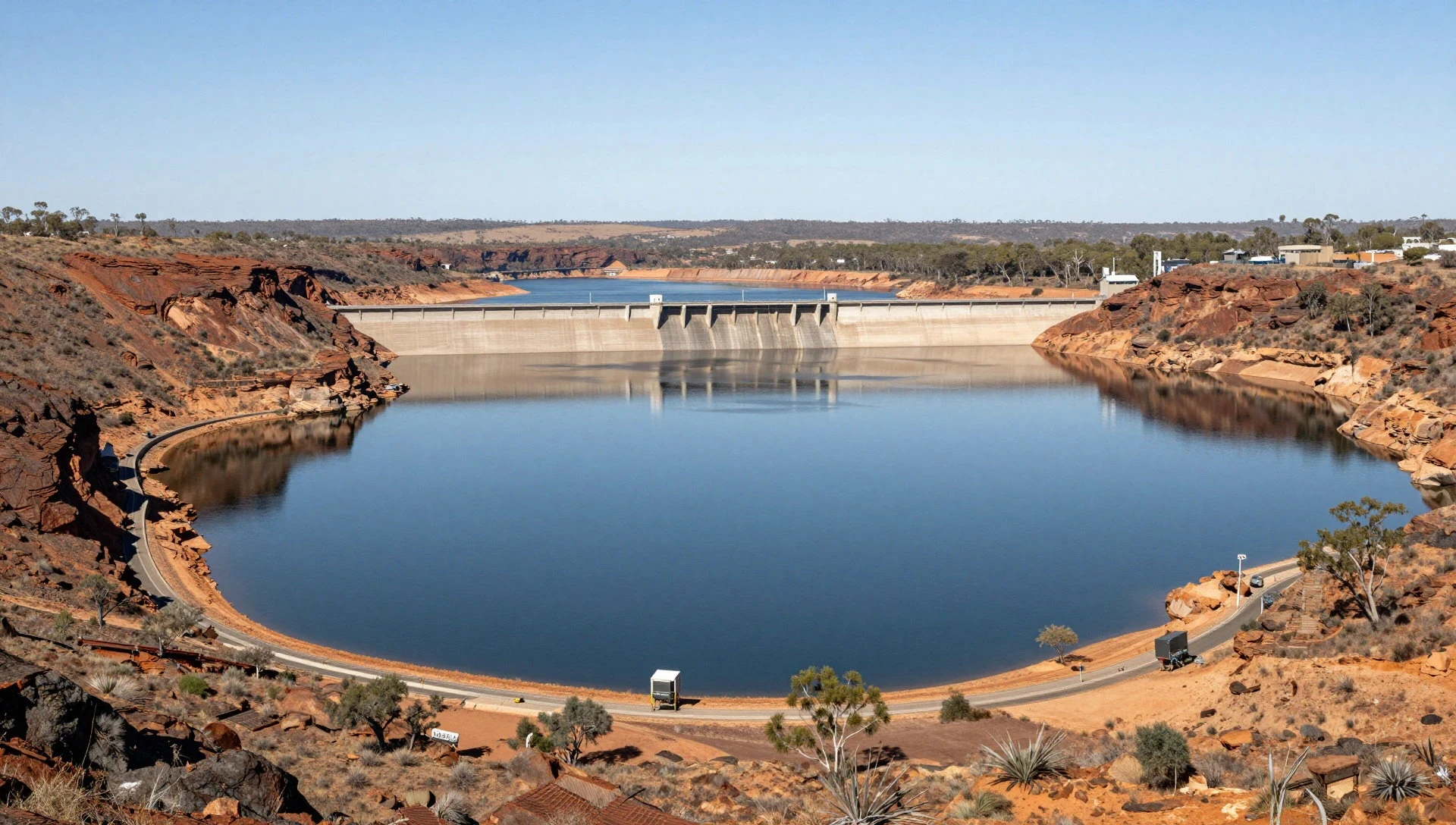
Julius Dam, the concrete multiple-arch structure straddling the Leichhardt River in north-west Queensland, reached its fiftieth year of service in October 2026, a milestone that measures far more than the durability of engineering.
The dam was conceived after the 1971 drought exposed the fragility of Mount Isa's single-source water system, when Lake Moondarra alone could not sustain a city and a mining economy expanding in tandem.
Construction ran from 1973 to 1976, drawing hundreds of workers from Scotland, England and Ireland who settled on site with their families, and the structure was formally commissioned on 8 October 1976.
On This Page
Its significance rests on a design decision that remains unusual in Australian water infrastructure. Julius Dam uses a concrete multiple-arch and buttress configuration, chosen partly because hauling conventional materials to such a remote location was prohibitively difficult. Sunwater, the operator, notes it is the only dam of its kind in Queensland.
The structure holds 107,500 megalitres, and excess water can pass directly over its concrete arches during heavy rain rather than through a separate spillway, a feature that has proven its worth repeatedly.
The dam's role has widened well beyond its original mandate. A 113-kilometre pipeline completed in 1998 carries water to mining operations including the Ernest Henry copper and gold mine near Cloncurry, while a further 38-kilometre pipeline finished in 2010 gave Cloncurry a year-round supply.
Lake Moondarra remains Mount Isa's primary source, with Julius Dam providing supplementary volume when required. This analysis examines the engineering logic, the economic function and the maintenance outlook that will determine whether the asset serves a second half-century.
TL;DR Julius Dam in north-west Queensland marks 50 years since its 1976 commissioning, built after the 1971 drought revealed that Lake Moondarra could not alone sustain Mount Isa's population and mining growth. Its concrete multiple-arch and buttress design, the only one of its kind in Queensland, reduced material transport burdens to a remote site and allows floodwater to pass over the arches rather than through a separate spillway. Capacity stands at 107,500 megalitres, supplemented by a 113-kilometre pipeline (1998) serving the Ernest Henry mine and a 38-kilometre pipeline (2010) supplying Cloncurry. Sunwater reports annual spills for the past decade and frames the dam as an assurance-of-supply asset underpinning regional expansion, while engineers stress that continued maintenance is the decisive variable for its next decades of operation.
The Engineering Logic Behind a Rare Dam Design
Julius Dam belongs to a small family of concrete multiple-arch and buttress dams, a form rarely deployed in Australia because it demands precise load distribution across many slender elements rather than mass alone.
Each arch spans between buttresses that transfer water pressure into the foundation, so the structure resists force through geometry and compression instead of sheer concrete volume. For a remote Queensland site in the 1970s, that economy of material mattered as much as structural performance.
Why Material Transport Shaped the Design
Sunwater attributes the design choice partly to the difficulty of moving materials to the isolated Leichhardt River site, where conventional earthfill or mass concrete would have required enormous haulage volumes. A multiple-arch system reduces the total concrete and fill needed while preserving strength, effectively trading material quantity for engineering precision. The result is a structure that could be built within the logistical constraints of 1970s outback Queensland.
Labour logistics were equally demanding. Hundreds of workers, including significant numbers from Scotland, England and Ireland, lived on site with their families during the 1973–1976 construction window. That arrangement created a temporary settlement as much as a construction camp, and it illustrates how remote infrastructure projects of the era depended on imported skilled labour. The dam's completion on 8 October 1976 closed a five-year response to the 1971 drought.
The design's signature behaviour appears during floods. Rather than routing excess water through a separate spillway channel, Julius Dam permits water to flow directly over its concrete arches when inflows exceed capacity.
Professor Alexander Scheuermann, a geotechnical engineering specialist at the University of Queensland, has explained that this overtopping arrangement lets floodwater pass without damaging the structure. It is an unusual configuration that converts a potential vulnerability into a controlled release path.
That overtopping capability has been exercised frequently. William Weaver, Sunwater's north region general manager of operations, reports that the dam has spilled every year for the past decade, driven by seasonal monsoon and cyclone rainfall across the catchment.
A structure that spills annually is not a passive reservoir but an active component of flood management, and its arches have now absorbed a decade of consecutive wet-season loading without reported structural failure.
The Overtopping Mechanism and Flood Performance
Allowing water to cross a dam crest is normally a design failure mode, which is why most structures separate spillways from the main wall. Julius Dam inverts that convention by engineering the arches themselves to tolerate overtopping flows.
The approach works because the arch geometry distributes hydraulic load into the buttresses and foundation rather than concentrating stress at a crest line.
Professor Scheuermann's assessment that floodwater can pass over the structure without damage rests on this load path. The practical evidence is the record of consecutive annual spills over the past decade, a period encompassing multiple monsoon and cyclone events.
Each spill tests the concrete, the abutments and the downstream scour protection simultaneously, and the absence of reported structural compromise is itself a data point.
That said, overtopping dams require disciplined inspection regimes. Repeated wetting and drying cycles, abrasion from sediment-laden floodwater and foundation seepage all accumulate over decades. Scheuermann has emphasised that continued maintenance will be essential to the dam's future, a caution that applies with particular force to a structure whose flood defence is inseparable from its primary water-retention function.
The design also carries a capacity implication. Because flood flows pass over the arches, the reservoir's operating envelope is defined by storage volume rather than spillway discharge capacity. At 107,500 megalitres, Julius Dam holds roughly the equivalent of tens of thousands of Olympic swimming pools, a scale that gives Mount Isa meaningful buffering against the multi-year dry spells that motivated its construction.
We Also Published
Water Security as Economic Infrastructure
The 1971 drought supplied the founding argument for Julius Dam: a city and a mining industry cannot depend on a single reservoir in a region where rainfall arrives in concentrated, unreliable bursts. Lake Moondarra had served Mount Isa since the 1950s, but the drought demonstrated that one source offered no redundancy.
Julius Dam was built to supplement that supply, and redundancy rather than raw volume is the correct way to read its original purpose.
From City Supply to Mine Supply
The dam's economic function transformed in 1998, when a 113-kilometre pipeline began delivering water to mining operations, including the Ernest Henry copper and gold mine near Cloncurry. That connection converted a municipal water asset into industrial infrastructure, linking reservoir storage directly to mineral production.
For a region whose economy rests on extraction, water reliability is a production input as decisive as power or labour.
A second pipeline, 38 kilometres long and completed in 2010, extended year-round supply to Cloncurry itself. Together the two pipelines represent a deliberate strategy of spreading the dam's yield across municipal and industrial users rather than reserving it for Mount Isa alone.
Each connection increases the number of stakeholders dependent on the structure's continued performance, which in turn raises the cost of failure.
Lake Moondarra nonetheless remains Mount Isa's main water source, with Julius Dam providing additional volume when needed. This hierarchy matters for how the system is managed: the newer dam functions as a reliability backstop and industrial supplier, not a replacement.
Weaver's description of the dam as providing assurance and certainty of supply captures that role precisely, framing water security as a precondition for growth rather than a standalone service.
The growth argument is measurable in the region's industrial trajectory. Mining operations near Cloncurry depend on piped water that would otherwise require costly alternative sources, and Cloncurry's residential and commercial expansion rests on a supply that no longer varies with seasonal rainfall.
Infrastructure of this kind rarely appears in productivity statistics directly, yet its absence would constrain output across every sector it touches.
Drought History and the Redundancy Argument
The 1971 drought is the pivotal event in this story, because it converted a theoretical risk into an observed failure of supply margin. Lake Moondarra, adequate in normal years, could not meet combined municipal and mining demand under drought conditions.
Julius Dam was the institutional response: a second reservoir that could be drawn upon when the primary source fell short.
Redundancy of this kind carries a cost that is easy to overlook in wet years. A supplementary reservoir must be maintained, monitored and staffed even when it is not the primary supply, and its value appears only during the droughts that justify its existence.
The fifty-year record suggests the investment has been vindicated, though the accounting is inherently asymmetric: the benefit is the crisis that did not occur.
Climate variability in north-west Queensland sharpens the argument. The region oscillates between intense monsoon and cyclone rainfall and prolonged dry periods, a pattern that produces both the annual spills Weaver describes and the drought conditions that motivated construction.
Infrastructure designed for the dry extreme must nonetheless survive the wet extreme, and Julius Dam's overtopping arches are the mechanism that reconciles those opposing demands.
Sunwater's expectation that the dam will continue supporting regional growth rests on this dual capability. A reservoir that spills every year is not wasting water in any meaningful economic sense; it is demonstrating that the catchment delivers more than the storage can hold during the wet season, which is precisely the condition that makes the stored volume reliable during the dry.
Maintenance, Longevity and the Next Fifty Years
Fifty years of service is a respectable interval for concrete infrastructure, but it is not a terminal point. Dams age through mechanisms that are slow, cumulative and largely invisible without instrumentation: alkali-aggregate reaction, foundation seepage, concrete degradation and the wear imposed by repeated overtopping flows.
The question facing Sunwater is not whether Julius Dam has performed, but whether the maintenance regime can extend that performance across another half-century.
What Sustained Operation Requires
Professor Scheuermann's emphasis on continued maintenance identifies the central variable. Multiple-arch dams concentrate stress at the junctions between arches and buttresses, and those junctions are where inspection effort must be directed.
Ongoing maintenance in this context means systematic structural monitoring, timely repair of concrete surfaces and verification that foundation conditions have not shifted.
Sunwater frames its maintenance commitment as intended to keep the dam operating for decades, language that acknowledges the asset's strategic value rather than treating it as a legacy liability.
That framing aligns with the dam's expanded role: with pipelines connecting it to a major mine and to Cloncurry, the consequences of extended downtime now extend well beyond Mount Isa's municipal supply.
The economics favour maintenance over replacement. Constructing a comparable storage asset in a remote location today would involve costs that the 1970s project avoided through design economy and on-site labour. Preserving the existing structure is therefore the lower-cost path, provided the maintenance programme is adequately funded and technically rigorous. Deferred maintenance, by contrast, converts a manageable expense into a capital crisis.
There is also an institutional dimension. The dam's fiftieth anniversary is an occasion for public recognition, but the substantive test lies in budget allocations and inspection schedules that receive no ceremony.
Weaver's assurance-and-certainty framing is ultimately a promise about the future, and promises about water supply are kept or broken through maintenance decisions made long before any drought arrives.
Lessons for Remote Infrastructure
Julius Dam offers a transferable lesson about designing for logistics rather than for convention. The multiple-arch form was selected because materials were hard to move, not because it was the default choice.
That willingness to let site constraints drive structural selection produced a dam that remains unique in Queensland and that has now demonstrated five decades of service.
A second lesson concerns workforce. The construction effort relied on hundreds of workers, many recruited from Scotland, England and Ireland, who lived on site with their families. Remote projects today face different labour conditions, but the underlying requirement is unchanged: assembling skilled people in places without existing amenities is a project risk that must be planned for explicitly.
A third lesson is that supplementary infrastructure tends to acquire primary importance over time. Julius Dam was built to back up Lake Moondarra, yet it now supplies a major mine and an entire town through pipelines built decades after commissioning.
Infrastructure planners rarely anticipate the full set of dependencies that a reservoir will eventually support, which argues for generous design margins.
The final lesson is about time horizons. Fifty years is long enough to validate a design and short enough that the original engineers' assumptions remain relevant. Sunwater's stated intention to keep the dam operating for decades, combined with Scheuermann's maintenance warning, defines the practical agenda: treat the anniversary as a checkpoint rather than a conclusion, and fund the work that keeps concrete sound.
What the Anniversary Reveals About Water Policy
Anniversaries of infrastructure invite celebration, but they also expose the assumptions embedded in original planning. Julius Dam was built on a straightforward premise: a growing mining city required more water than one reservoir could reliably provide.
Five decades later, that premise has been validated and then exceeded, as pipelines extended the dam's reach to a major mine and to Cloncurry's year-round supply.
The dam's record also illustrates a broader principle in water policy. Security of supply is not achieved by a single large asset but by a portfolio: primary storage, supplementary storage, distribution pipelines and maintenance capacity.
Julius Dam occupies the supplementary tier, yet its contribution to regional confidence is disproportionate because it removes the single-point-of-failure risk that the 1971 drought exposed.
Weaver's language of assurance and certainty is worth taking literally. Certainty of supply lowers the perceived risk of investment in mining and associated services, and that perception has real economic consequences in a region where capital decisions span decades.
The dam's value therefore includes an intangible component that no capacity figure captures, though the pipeline investments of 1998 and 2010 give it tangible form.
The next fifty years will test a different set of variables. Maintenance funding, inspection rigour and the willingness to treat a fifty-year-old structure as a living asset rather than a completed project will determine outcomes.
Scheuermann's warning is not alarmist; it is the standard condition of concrete infrastructure in a climate that alternates between deluge and drought.
From our network :
- The Hidden Cost of AI Convenience: Why Over-Permissioned Agents Are a Security Time BombDiscover why AI agents with excessive permissions create dangerous single points of failure, and learn how implementing least privilege principles can protect your organization from exploitation.
- Mobile Learning and VR in English: What Global Evidence Reveals About Effective Language TechnologyA systematic review across 14 countries reveals which language-learning technologies genuinely work. Mobile learning, AI, and VR show measurable benefits when pedagogically integrated. This evidence-based guide helps educators and learners select technology that delivers real return on investment.
- University Language Proficiency Exams: Why Institutional Tests Demand Different Preparation Than IELTS and TOEFLDiscover why university-specific language proficiency examinations differ fundamentally from IELTS and TOEFL, and learn strategic preparation approaches for institutional assessment success.
- Forbidden Matrix Patterns and Visible Lattice Points: A Geometric DictionaryExplore how multidimensional 0–1 matrices encode geometric truths, linking forbidden patterns to visible lattice points and hypergraph theory, with applications in combinatorics and computational geometry.
- Live Online English Classes for Kids: Do They Actually Reduce Anxiety?A ten-week study reveals that synchronous online English classes can significantly reduce child language anxiety while improving listening and reading skills. Discover what makes these programs effective and how parents can select the right one.
- The Final Descent: How ESA Retired the Legendary Cluster Constellation After 24 Years of Space Weather ScienceAfter 24 years mapping Earth’s magnetosphere, ESA’s Cluster mission concluded with a precisely controlled reentry over the South Pacific. This analysis explores the scientific legacy, engineering decisions, and debris mitigation principles behind one of space exploration’s most responsible retirements.
- Committed Mediterranean Precipitation Decline: Why Emissions Cuts Alone Cannot Restore Winter RainsNew NOAA research reveals that Mediterranean winter rains may decline irreversibly even with emissions cuts. Explore the science of committed climate change and regional impacts.
- CISA’s Ten-Advisory Wave: Why Generic Patching Fails in OT and How to Build Product-Specific PlaybooksCISA released ten ICS advisories in one week, exposing critical infrastructure risks. Generic patching fails in OT. Learn to build product-specific remediation playbooks.
- How AI Agents Will Change the Way We Manage Personal FinancesExplore how AI agents are transforming personal finance through automated budgeting, bill payment, and investment management, while examining the critical security protocols and governance frameworks required for safe deployment.
RESOURCES
- Fifty years on, Julius Dam remains a lifeline for outback communitiesabc.net.au1 day ago ... ... secure water supplies for communities and mining operations across North West Queensland. What's next? Sunwater expects the dam to…
- “No more water worries" when Julius Dam was officially ... - Facebookfacebook.com1 day ago ... Fifty years on, Julius Dam continues to sustain outback communities ... #JuliusDam #Birthday #50Years #RegionalQueensland · Bruce Purdon and ...
- Fifty years on, Julius Dam continues to sustain outback communitiesau.headtopics.com1 day ago ... When Julius Dam opened in 1976, it was hailed as the answer to Mount Isa's water shortages.
- Julius Dam 50 years on for north west Queensland - Facebookfacebook.com1 day ago ... The post highlights the dam's vital role in providing a reliable water source for regional communities, supporting agriculture, mining, and ...
- Queensland - The best state in Australia - Redditreddit.com... julius-dam-50-years-water-outback-communities/107318856 · r/queensland - Fifty years on, Julius Dam remains a lifeline for outback communities. Upvote 11
- Southern Gulf: Queensland water plans and settings - CSIROcsiro.auDec 17, 2024 ... Moondarra Dam and Julius Dam water supply schemes – that are both located on the Leichhardt River. These supply a…
- r/queensland - Redditreddit.com... julius-dam-50-years-water-outback-communities/107318856 · r/queensland - Fifty years on, Julius Dam remains a lifeline for outback communities. Upvote 15
- ️ Caught up with Australia's own Mr 4X4, Pat Callinan, the other ...instagram.comAug 14, 2025 ... LAKE JULIUS is 50 years old A reminder of when Queensland built infrastructure to get industry going. Now the government…
- River model calibration for the Southern Gulf catchments - CSIROcsiro.auapproximately 29 GL/year on average. Water restrictions to reduce water use from Lake Moondarra and Julius Dam during periods of low storage levels were ...
- Halting Chowilla Dam: salt, science, and River Murray politics in the ...tandfonline.comJul 20, 2025 ... Announced by South Australian Premier Thomas Playford in 1960, the plan to build Chowilla Dam on the River Murray aimed…
- Pioneering spirit for a brighter tomorrow - Thiess 90 Yearshistory.thiess.comJulius Dam, Mt Isa ... The plant forms part of the Western Corridor Recycled Water which will provide an alternative water supply for South…
- North West Queensland Regional Drought Resilience Plan 2024-2030agriculture.gov.auWater storage and water security was a key issue raised by multiple stakeholders. ... last 50 years. By 2070, Burketown may have more than…
- Russ Phillips - Global Technology, Security & Transformation ...uk.linkedin.comsecurity executive with more than 25 years of leadership experience spanning enterprise technology, cyber security ... South East Queensland Water. Dec 1998 - Nov ...
- Australia's National Climate Risk Assessment | 2025 - UNFCCCunfccc.intnoticeable in extreme flood events: the 50-year return period flood ... • Multi-year droughts heighten water security risks due to infrastructure ...
- 2019 Monsoon Trough Rainfall and Flood Reviewigem.qld.gov.auincreasing risks to water supply security and dam safety. ... Department of Energy and Water Supply 2014, Regional Water Supply Security Assessment, Queensland.
- 01
- 02
- 03
- 04
- 05
- 06
- 07
- 08
0 Comments