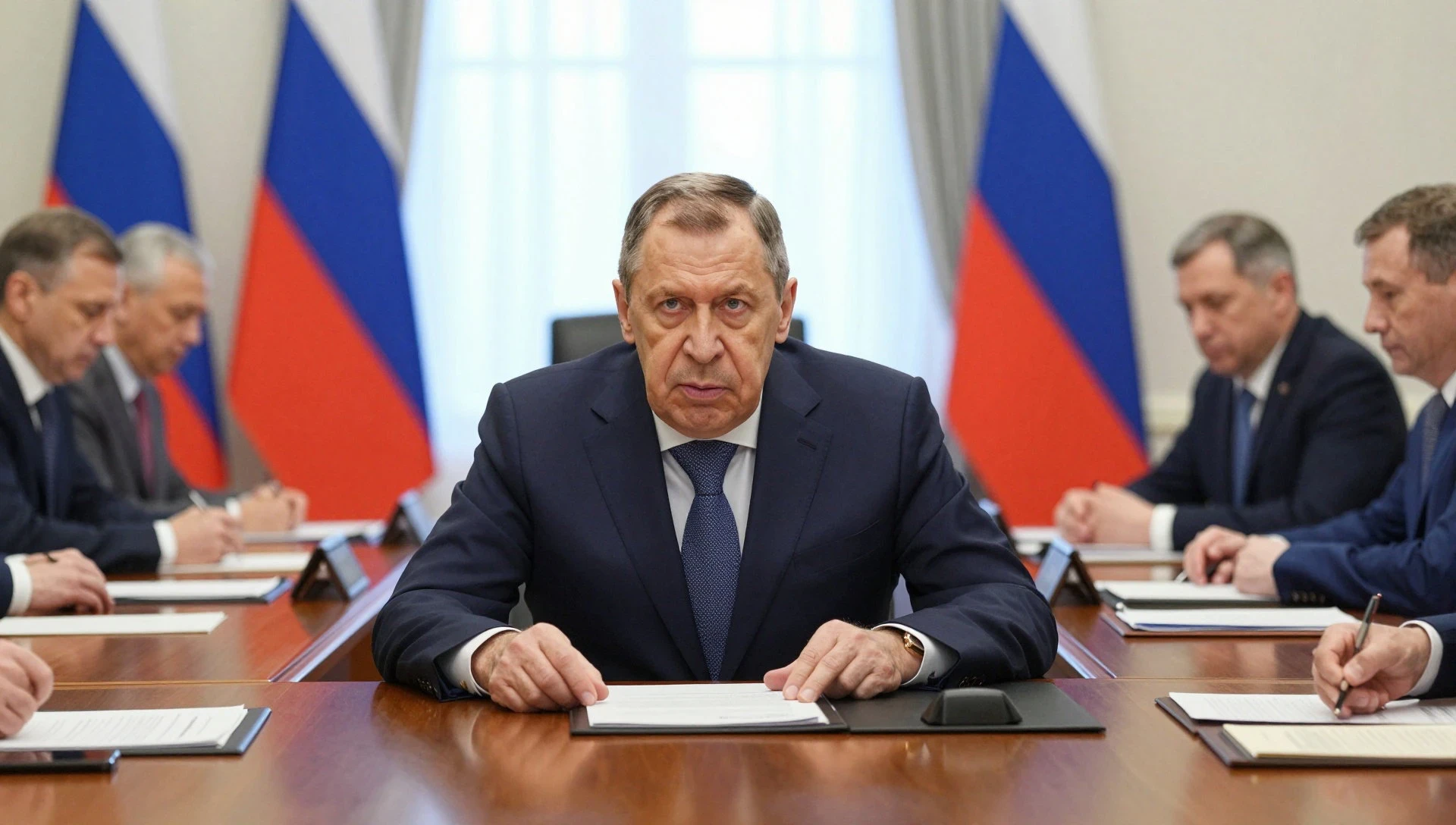
Russian Foreign Minister Sergey Lavrov has articulated a negotiating posture that is simultaneously open and rigid: Moscow will examine proposals advanced by United States envoys Steve Witkoff and Jared Kushner, yet it will not entertain political concessions as the price of any settlement.
The statement, delivered to a cohort of newly graduated diplomatic service officers and reported by TASS, constitutes less a policy shift than a calibrated restatement of Russia's bargaining architecture under conditions of sustained Western pressure.
Lavrov's framing merits close analytical attention because it separates transactional inducements from structural political commitments, a distinction that carries substantial implications for how any future agreement might be constructed.
On This Page
- The Diplomatic Architecture of Conditional Openness
- Economic Inducements and the Sanctions Question
- Europe, Ukraine, and the Persistence of Positional Difference
- Strategic Culture and the Logic of Self-Reliance
- Global Order, Multipolarity, and the Limits of Transactionalism
- Conclusion: A Transactional Posture with Structural Limits
The remarks acquire additional significance from their institutional setting. Addresses to graduating diplomats function as doctrinal signalling devices in Russian foreign policy practice, transmitting expectations to the next cadre of negotiators while communicating positions to external audiences.
Lavrov's observation that incoming American presidents are not bound by their predecessors' decisions suggests an attempt to exploit the discontinuity of United States electoral politics as a bargaining lever.
This is a recognisable tactic in protracted negotiations, wherein one party seeks to reset the reference point for concessions by invoking the provisional character of the counterpart's commitments.
What emerges from the statement is a doctrine of asymmetric transactionalism. Russia appears prepared to accept arrangements yielding economic or financial benefit, including sanctions relief and the normalisation of commercial channels, provided such arrangements do not require explicit political capitulation.
The insistence that Moscow must rely on itself, rather than anticipate a globally favourable political configuration, introduces a note of strategic realism that qualifies any expectation of imminent détente. The following analysis examines the diplomatic, economic, and geopolitical dimensions of this posture in detail.
TL;DR Sergey Lavrov has indicated that Russia will consider proposals from United States negotiators Steve Witkoff and Jared Kushner, but will reject any arrangement requiring political concessions from Moscow. The statement, delivered to graduating diplomats and reported by TASS, distinguishes transactional economic inducements from structural political commitments, invokes the discontinuity of American presidential politics as a bargaining lever, and counsels strategic self-reliance. Europe's approach to Ukraine talks is characterised as unchanged. The posture suggests a transactional but politically rigid negotiating framework, with implications for sanctions policy, settlement architecture, and the durability of any future agreement.
The Diplomatic Architecture of Conditional Openness
Lavrov's formulation establishes a negotiating framework best described as conditional openness. The willingness to receive proposals is genuine in the sense that it imposes no prior commitment, yet the explicit exclusion of political concessions defines the boundary beyond which engagement ceases.
This architecture permits Moscow to remain present at the negotiating table without conceding the substantive positions that Western capitals regard as prerequisites for any durable settlement.
The Function of Envoy-Level Engagement
The naming of Steve Witkoff and Jared Kushner as the bearers of American proposals is analytically consequential. Both figures operate outside the conventional diplomatic corps, a configuration that may afford flexibility unavailable to career officials constrained by institutional positions.
Envoy-level channels of this kind can explore formulations that formal diplomatic tracks cannot entertain without appearing to legitimise them.
Such channels also introduce risks of misalignment between informal understandings and official policy. When proposals travel through personal emissaries rather than established bureaucratic pathways, the durability of any resulting arrangement depends heavily on the continued political standing of those emissaries. Lavrov's acknowledgement of the envoys therefore signals receptivity to the channel while implicitly testing its reliability.
The historical record of special envoy diplomacy suggests that personal channels can accelerate exploration but rarely substitute for institutional ratification. Agreements reached through such means require subsequent anchoring in formal treaty or executive instruments to acquire binding force.
Moscow's evident awareness of this distinction informs its insistence that proposals be evaluated on substantive rather than procedural grounds.
Furthermore, the identity of the envoys carries domestic political resonance within the United States. Figures associated with a particular administration's inner circle signal the political provenance of any proposal, allowing Moscow to assess whether the offer reflects durable American intent or the preferences of a transient coalition. This calculus reinforces Lavrov's emphasis on presidential discontinuity.
Political Concessions as a Defined Red Line
The categorical rejection of political concessions constitutes the load-bearing element of the statement. Political concessions in the Russian context would encompass territorial adjustments, changes to constitutional arrangements, or acceptance of external supervision over domestic governance. By pre-emptively excluding such items, Lavrov narrows the negotiating space to economic and financial variables.
This narrowing performs a dual function. Externally, it communicates to Western counterparts that sanctions relief and commercial normalisation are the available currency of exchange. Internally, it reassures domestic constituencies that engagement with Washington does not entail capitulation on questions framed as existential. The red line is thus simultaneously a diplomatic instrument and a legitimating device.
Analytically, the distinction between political and economic concessions is less stable than the statement implies. Sanctions relief, investment guarantees, and financial reintegration all carry political consequences, redistributing leverage and reshaping the domestic coalitions that sustain policy. Moscow's framing may therefore understate the political content embedded in ostensibly economic transactions.
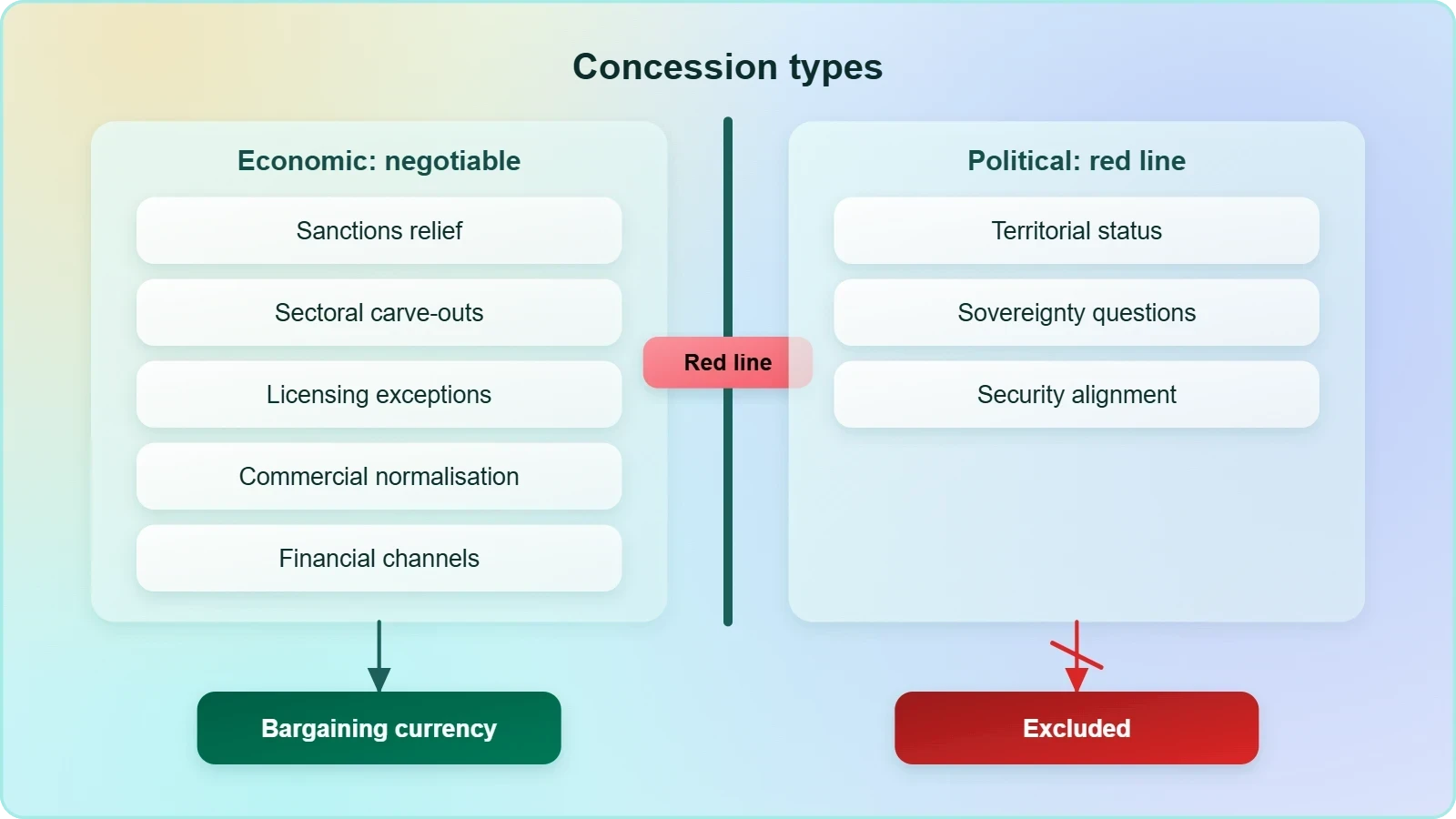
Negotiators on the Western side face a corresponding dilemma. If economic inducements inevitably carry political effects, then the Russian distinction may function as a rhetorical device rather than a substantive boundary.
The credibility of the red line will be tested precisely at the point where economic benefits begin to alter the political equilibrium that Moscow seeks to preserve.
The Invocation of Presidential Discontinuity
Lavrov's reference to the non-binding character of predecessors' decisions on incoming American presidents is a sophisticated bargaining move. It invites Washington to treat prior commitments, including security guarantees and sanctions architectures, as revisable. The implication is that a new administration could offer terms unavailable to its predecessor without loss of credibility.
This argument exploits a genuine feature of the American constitutional order, wherein executive agreements lack the durability of ratified treaties. Yet the leverage it generates is contingent on the willingness of an incoming administration to accept the framing.
Should Washington insist on continuity of commitments, the argument loses force and may even invite suspicion of bad faith.
The tactic also carries a reflexive dimension. By emphasising the revisability of American commitments, Lavrov implicitly acknowledges the revisability of Russian ones, a symmetry that Western negotiators may invoke in turn. The argument thus cuts in both directions, a feature that limits its utility as a one-sided instrument of pressure.
From a game-theoretic perspective, the invocation of discontinuity resembles a move designed to shift the bargaining equilibrium by altering the perceived cost of non-agreement. If Moscow can persuade Washington that a future administration might offer better terms, the current administration faces pressure to pre-empt that outcome. Whether such pressure materialises depends on domestic political configurations beyond either party's control.
Strategic Self-Reliance as Doctrinal Anchor
The assertion that Russia should not expect a globally favourable political configuration, and must instead rely on itself, functions as a doctrinal anchor for the entire statement. It tempers any expectation of imminent relief and prepares domestic audiences for prolonged adversity. Self-reliance here is less an economic programme than a psychological posture.
This doctrine resonates with longer traditions in Russian strategic culture, which recurrently emphasise autonomy in the face of external encirclement. Its contemporary articulation, however, is calibrated to the specific conditions of sanctions and technological restriction.
The emphasis on self-sufficiency signals that Moscow does not regard external concessions as the primary route to recovery.
The doctrinal element also disciplines expectations within the Russian elite. By cautioning against anticipation of a favourable global environment, Lavrov pre-empts the disappointment that might follow failed negotiations. The statement thus performs an anticipatory function, insulating the leadership from blame should engagement with Washington prove fruitless.
Yet self-reliance as doctrine coexists uneasily with the evident interest in economic inducements from the United States. If Moscow genuinely expected no external benefit, the willingness to consider proposals would be superfluous. The tension suggests that the doctrinal language serves to strengthen bargaining position rather than to describe an achievable autarkic condition.
Economic Inducements and the Sanctions Question
The willingness to consider proposals offering economic or financial benefits directs attention to the sanctions architecture that has structured Russia's external economic relations since 2022. Sanctions relief constitutes the most plausible currency of exchange in any transactional settlement, yet its provision involves complex coordination among multiple jurisdictions. Lavrov's formulation implicitly acknowledges that economic normalisation, rather than political restructuring, represents the realistic domain of bargaining.
Sanctions Relief as Bargaining Currency
Comprehensive sanctions regimes are difficult to dismantle once entrenched, because they generate institutional constituencies and legal commitments across allied jurisdictions. Any relief offered by Washington would require coordination with European and other partners whose domestic legal frameworks embed restrictive measures. The transaction costs of unwinding sanctions therefore exceed those of imposing them.
Moscow's evident interest in economic inducements must be read against this asymmetry. Even a credible American offer of relief would confront implementation hurdles that limit its immediate value. Lavrov's insistence on political concessions as a separate and excluded category may reflect an awareness that economic benefits are themselves slow to materialise and uncertain in scope.
The sequencing question is equally consequential. If sanctions relief is conditioned on prior political movement, and political movement is excluded, the negotiating space collapses. Lavrov's framework appears designed to invert this sequencing, seeking economic benefits as an entry point rather than a reward for political change. Whether Western counterparts accept such inversion remains the central uncertainty.
Partial relief mechanisms, including sectoral carve-outs and licensing arrangements, offer intermediate possibilities that avoid the binary of comprehensive relief or none. Such mechanisms could provide tangible economic benefit while preserving the political restrictions that Moscow rejects. The technical complexity of these instruments, however, renders them vulnerable to political disruption.
Financial Channels and Commercial Normalisation
Beyond formal sanctions, the restoration of financial channels and commercial normalisation constitutes a distinct category of potential inducement. Banking correspondences, payment systems, and investment flows were disrupted by restrictive measures and by private-sector de-risking that persists independently of official policy. Rebuilding these channels requires confidence that exceeds legal permission.
The private sector's reluctance to re-engage constitutes a structural obstacle that official agreements cannot easily overcome. Firms that exited Russian markets incurred costs and reputational exposure; their return would require assurances of stability that political uncertainty undermines. Lavrov's framework, by excluding political concessions, may inadvertently perpetuate the very uncertainty that deters commercial normalisation.
Financial reintegration also raises questions of currency and settlement infrastructure. Alternatives to established systems have been developed, but their scalability and acceptance remain limited. A genuine normalisation would require reintegration into the architectures from which Russia has been partially excluded, a process with political implications that the statement does not address.
Investment guarantees present a further dimension. Foreign investors considering Russian assets would seek protection against expropriation and political risk, protections that typically rest on bilateral treaties and international arbitration.
The credibility of such protections depends on the political relationship that the negotiating framework seeks to compartmentalise, revealing again the instability of the economic-political distinction.
The Domestic Political Economy of Engagement
Within Russia, the prospect of economic relief interacts with domestic constituencies that have adapted to sanctions conditions. Import substitution, redirected trade, and new commercial networks have generated interests that may resist normalisation. Lavrov's statement, addressed to future diplomats, may also be calibrated to manage these domestic expectations.
The beneficiaries of redirected trade and parallel imports occupy positions that would be eroded by a return to conventional commercial patterns. Their influence within the policy process constrains the leadership's freedom to trade economic normalisation for other objectives. The domestic political economy thus imposes limits on the transactional flexibility that the statement appears to advertise.
Conversely, constituencies harmed by restricted access to technology and capital favour engagement. The balance between these groups shapes the credibility of Moscow's willingness to accept economic inducements. Lavrov's emphasis on self-reliance may serve to reassure the former while leaving room for the latter, a balancing act characteristic of internal coalition management.
Public opinion adds a further layer. Prolonged confrontation has been accompanied by narratives that frame external pressure as evidence of Russia's importance and resilience. A settlement perceived as capitulation would risk domestic backlash, which explains the insistence that any deal avoid political concessions. The domestic audience is thus a constituent of the red line itself.
Technology Transfer and Industrial Policy
Technology access represents a specific and consequential dimension of economic inducement. Restrictions on semiconductors, machinery, and software have imposed measurable costs on Russian industry, and their relaxation would carry substantial value. Yet technology transfer involves security considerations that blur the economic-political distinction more sharply than most other domains.
Export controls are administered by multiple jurisdictions and embedded in alliance frameworks. Their relaxation would require coordination that extends beyond bilateral United States-Russia relations. Lavrov's framework, focused on American proposals, may underestimate the multilateral character of the restrictions that most constrain Russian industrial capacity.
Industrial policy responses, including domestic development programmes and partnerships with non-Western suppliers, have partially substituted for restricted technologies. These substitutes are imperfect but create path dependencies that reduce the marginal value of future Western transfers. The inducement value of technology access may therefore decline over time, altering the bargaining calculus.
Dual-use technologies present the sharpest version of the problem. Items with both civilian and military applications are subject to the most stringent controls and the most intense political scrutiny. Any proposal involving their transfer would immediately raise the political questions that Lavrov's framework seeks to exclude, demonstrating the limits of compartmentalisation.
We Also Published
Europe, Ukraine, and the Persistence of Positional Difference
Lavrov's observation that Europe's approach to Ukraine talks has not changed serves as a compact assessment of a stalled diplomatic track. The statement implies that Brussels and key European capitals maintain positions incompatible with Russian expectations, and that no evolution is anticipated. This assessment frames Europe as a constant rather than a variable in the negotiating equation.
The European Union's Institutional Position
The European Union's position on Ukraine has been institutionalised through successive sanctions packages, financial commitments, and political declarations. Institutionalisation creates path dependencies that constrain member states' freedom to adjust course, even when individual capitals might prefer flexibility. Lavrov's assessment of immutability reflects this structural rigidity.
Enlargement of the sanctions coalition and the embedding of restrictive measures in accession processes further entrench the European position. Candidate countries align with restrictive measures as part of their integration trajectory, extending the coalition beyond the Union's current membership. This widening makes any coordinated relaxation more complex than the original imposition.
Yet European positions are not monolithic. Member states differ in their exposure to Russian energy, their historical relationships, and their domestic political configurations. Lavrov's undifferentiated characterisation may simplify a more variegated reality, though the direction of European policy has remained consistent despite these differences.
The institutional calendar also matters. European elections, budgetary cycles, and leadership transitions create windows of potential adjustment. Lavrov's statement, by denying the prospect of change, may serve to justify Russian intransigence rather than to describe European reality with precision. The assessment is thus partly performative.
Ukraine's Agency and Negotiating Position
Any settlement architecture must accommodate Ukraine's position, which the statement addresses only indirectly. Ukraine's stated objectives and its Western support base constrain the terms that any external negotiation can impose. Lavrov's framework, focused on bilateral United States-Russia engagement, may understate Ukraine's capacity to shape outcomes.
The principle of nothing about Ukraine without Ukraine has been repeatedly affirmed by Western partners, though its practical application varies. A bilateral understanding between Washington and Moscow would require translation into a framework acceptable to Kyiv, a translation process with substantial potential for failure. The statement does not address this translation problem.
Ukraine's military and economic sustainability depends on continued Western support, giving its partners leverage that they have not always exercised. Conversely, Ukraine's agency limits the concessions that external parties can offer on its behalf. The negotiating geometry is therefore triangular rather than bilateral, complicating the transactional logic that Lavrov's statement implies.
Territorial questions present the sharpest version of the problem. Any arrangement involving territorial adjustment would constitute precisely the political concession that Lavrov excludes, yet territorial questions are central to Ukrainian and European positions. The framework's exclusion of political concessions thus collides with the core substance of the conflict.
Frozen Conflict Scenarios
In the absence of comprehensive settlement, scenarios of frozen or suspended conflict warrant consideration. Such scenarios would involve the cessation of active hostilities without resolution of underlying political questions, an outcome that could accommodate Lavrov's exclusion of political concessions. The durability of such arrangements, however, is historically limited.
Frozen conflicts generate their own institutional and economic dynamics, including the entrenchment of dividing lines and the emergence of grey-zone economies. These dynamics may serve the interests of parties seeking to avoid resolution, but they impose costs on populations and on the international order. The statement does not address these longer-term consequences.
For Russia, a frozen conflict could preserve territorial gains without requiring formal political settlement, aligning with the stated framework. For Ukraine and its partners, such an outcome would represent an unacceptable consolidation of aggression. The divergence on this point illustrates why the negotiating space remains narrow despite the openness to proposals.
Historical precedents of frozen conflicts suggest that they persist until a shift in the underlying balance of power or in the political configurations of the parties. Lavrov's emphasis on self-reliance and on the non-binding character of predecessors' decisions may reflect an expectation that such shifts will eventually favour Moscow. The framework is thus oriented toward endurance rather than resolution.
Arms Control and Security Architecture
Security architecture questions, including arms control and military posture, intersect with the political concessions that Lavrov excludes. Arrangements limiting missile deployments or force postures would constitute political commitments with security implications. Their exclusion narrows the scope for stabilisation measures that might otherwise accompany a settlement.
The erosion of arms control treaties has removed the frameworks through which such questions were historically managed. Rebuilding them would require political engagement that the statement's framework does not contemplate. The absence of such frameworks increases the risk of miscalculation and unintended escalation, a cost that the negotiating posture does not acknowledge.
Confidence-building measures, transparency arrangements, and incident-prevention protocols offer lower-level possibilities that might survive the exclusion of political concessions. These technical instruments can reduce risk without resolving underlying disputes. Whether they can be negotiated within the stated framework remains uncertain, given their dependence on political goodwill.
The broader security architecture of Europe, including NATO's posture and the status of non-member states, constitutes a domain where Russian and Western positions diverge fundamentally. Lavrov's statement does not engage with these questions directly, but its exclusion of political concessions implies that Russian positions on them are not negotiable. The implication constrains the scope of any settlement.
- 01
- 02
- 03
- 04
Strategic Culture and the Logic of Self-Reliance
The doctrinal emphasis on self-reliance connects Lavrov's statement to longer currents in Russian strategic culture. Recurrent themes of autonomy, encirclement, and the unreliability of external partners have shaped Russian foreign policy across regimes and centuries. The contemporary articulation adapts these themes to the specific conditions of sanctions, technological restriction, and diplomatic isolation.
Historical Antecedents of Autarkic Doctrine
Autarkic impulses in Russian economic and strategic thought predate the Soviet period, appearing in debates over industrialisation and in the recurrent pursuit of strategic independence. The Soviet experience institutionalised these impulses through a command economy and a separate technological base. Post-Soviet liberalisation partially reversed them, but the reversal proved fragile.
The 2014 sanctions and their post-2022 intensification reactivated autarkic reflexes, prompting import substitution programmes and the development of alternative financial infrastructure. These programmes have achieved partial success, particularly in agriculture and some industrial sectors, while remaining dependent on external technology in others. The doctrine thus describes an aspiration rather than an accomplished condition.
Historical antecedents also include the recurrent experience of invasion and the strategic depth that Russian territory provides. These experiences inform a security culture that prioritises buffers and rejects external supervision. Lavrov's exclusion of political concessions resonates with this culture, framing such concessions as existential rather than transactional.
The autarkic tradition coexists with a long history of technological and cultural borrowing from the West. This tension between borrowing and autonomy has structured Russian modernisation debates for centuries. The current emphasis on self-reliance represents a swing toward autonomy, but the pendulum has moved before and may move again.
Elite Socialisation and Diplomatic Doctrine
The setting of Lavrov's remarks, a meeting with graduating diplomats, highlights the role of elite socialisation in transmitting doctrine. Diplomatic academies inculcate not only technical skills but also interpretive frameworks through which events are understood. The address thus shapes how the next cohort will approach negotiations.
Doctrinal transmission through such settings ensures continuity across personnel changes. Even as individual diplomats rotate through postings, shared frameworks persist, producing recognisable patterns in Russian negotiating behaviour. Lavrov's statement can be read as an explicit articulation of frameworks that are normally transmitted implicitly.
The socialisation function also extends to signalling within the elite. By addressing graduates publicly, the foreign minister communicates positions to a wider audience of officials and analysts. The statement thus performs an internal coordinating function alongside its external diplomatic purpose, aligning expectations across the foreign policy establishment.
Comparative analysis of diplomatic academies suggests that such institutions play a significant role in shaping strategic culture. The Russian tradition, with its emphasis on formal doctrine and historical narrative, may amplify this role. Lavrov's address fits within a recognisable genre of doctrinal communication to the diplomatic corps.
Information Operations and Narrative Framing
The public character of the statement, reported by a state news agency, indicates an informational dimension alongside its diplomatic content. By articulating a framework publicly, Moscow establishes a reference point against which future proposals can be measured. Public positioning constrains subsequent flexibility but also signals resolve.
Narrative framing shapes how the statement is received by different audiences. For domestic audiences, the emphasis on self-reliance and the rejection of concessions projects strength. For international audiences, the openness to proposals signals reasonableness while the red line defines limits. The dual framing is characteristic of strategic communication.
The choice of TASS as the reporting channel ensures wide domestic distribution and signals official provenance. Statements reported through state agencies carry different weight from those emerging through other channels, indicating that the content reflects considered policy rather than informal commentary. The provenance thus reinforces the statement's authority.
Information operations also involve the management of expectations regarding American intentions. By naming specific envoys and characterising their proposals as worthy of consideration, the statement shapes perceptions of American engagement. Whether this framing accurately reflects the proposals' content is a separate question from its rhetorical function.
Implications for Future Negotiating Rounds
The framework articulated by Lavrov establishes parameters for future negotiating rounds, should they occur. Economic and financial items are placed within the negotiable domain, while political items are excluded. This parameterisation simplifies the agenda but also narrows the space for comprehensive settlement, since the core disputes are political.
Negotiators operating within this framework would confront the challenge of translating economic arrangements into political outcomes without explicit political concessions. Creative drafting might blur the distinction, but the underlying substance would remain contested. The framework's utility thus depends on whether economic measures can produce political effects indirectly.
The emphasis on presidential discontinuity suggests that Moscow may prefer to await political change in Washington rather than conclude an agreement on current terms. This preference introduces a temporal dimension to the negotiating strategy, prioritising patience over urgency. Whether such patience is sustainable depends on economic and military trajectories.
Future rounds will also test the credibility of the stated openness. If proposals are received and rejected on grounds that extend beyond the stated red line, the framework's sincerity will be questioned. Conversely, if proposals yield tangible engagement, the framework will be validated as a basis for dialogue. The next phase will therefore be diagnostic.
Global Order, Multipolarity, and the Limits of Transactionalism
The statement's broader significance lies in what it reveals about Russian conceptions of the international order. The emphasis on self-reliance and the scepticism regarding favourable global configurations reflect a worldview in which multipolarity is competitive rather than cooperative. Within this worldview, transactional engagement with individual counterparts coexists with structural rivalry.
Multipolarity as Competitive Framework
Russian advocacy of multipolarity has consistently framed the concept as a corrective to Western dominance rather than as a vision of cooperative pluralism. The statement's realism about global configurations aligns with this framing, treating the international environment as a domain of contestation. Transactional engagement is thus embedded within a competitive structure.
Within this framework, bilateral deals with the United States do not imply acceptance of a shared order but rather tactical manoeuvring within a contested one. Lavrov's openness to proposals coexists with the expectation of continued rivalry. The combination is coherent if multipolarity is understood as a competitive rather than a cooperative condition.
The competitive framing has implications for the durability of any agreement. If the relationship is fundamentally adversarial, agreements become provisional instruments rather than foundations for stable cooperation. The emphasis on presidential discontinuity reinforces this provisionality, treating commitments as revisable by design rather than by exception.
Other powers observe this framework with interest, assessing its implications for their own positioning. The transactional approach may appeal to states that prefer bilateral deals to multilateral frameworks, while alarming those that depend on predictable rules. The statement thus has systemic implications beyond the bilateral relationship it addresses.
Relations with Non-Western Partners
Russia's relations with non-Western partners, particularly China and India, constitute a significant context for the statement. Economic and financial inducements from the United States must be weighed against relationships that have deepened during the sanctions period. The framework's silence on these relationships is analytically notable.
Deepened ties with non-Western partners create dependencies that constrain the value of Western inducements. If trade and financial flows have been redirected, partial restoration of Western channels may yield diminishing returns. The statement's emphasis on economic benefits must therefore be assessed against the reconfiguration that has already occurred.
Conversely, the diversification of partnerships provides Moscow with alternatives that strengthen its bargaining position vis-à-vis Washington. The willingness to consider proposals does not imply dependence on their acceptance. This asymmetry may explain the confident tone of the statement despite the pressure that sanctions impose.
The relationships also carry political significance, as partners may view a Western settlement with ambivalence. Alignment with Russia's positions has costs for partners, and a sudden settlement could disrupt their calculations. The statement's framework does not address these third-party considerations, which may constrain its implementation.
Institutional Frameworks and Their Erosion
The erosion of multilateral institutions constitutes a background condition for the statement. Frameworks that once structured United States-Russia engagement, including arms control treaties and cooperative councils, have weakened or collapsed. The transactional approach fills the vacuum left by institutional erosion.
Institutional erosion increases the importance of personal channels and ad hoc arrangements, which the statement's reference to envoys reflects. Yet such arrangements lack the durability and legitimacy of institutional frameworks. The reliance on them may therefore perpetuate the instability that institutional erosion has produced.
Rebuilding institutional frameworks would require political engagement that the statement's framework excludes. The exclusion thus contributes to the persistence of the vacuum, even as the statement acknowledges the need for some channel of communication. The tension between transactional practice and institutional need remains unresolved.
Other institutions, including those of the Global South, may assume roles vacated by weakened Western-centred frameworks. The statement does not address this possibility, but its implications for Russian strategy are significant. Institutional pluralism could provide alternatives that reduce dependence on bilateral engagement with Washington.
Scenarios for the Next Phase
Several scenarios for the next phase can be distinguished analytically. In one, envoy-level engagement produces limited economic arrangements that fall short of comprehensive settlement. In another, proposals are rejected and the transactional channel closes. In a third, engagement produces a broader framework that addresses some political questions indirectly.
The first scenario appears most consistent with the stated framework, which prioritises economic items and excludes political ones. Limited arrangements could include humanitarian measures, partial sanctions relief, or technical cooperation. Their significance would lie less in their substance than in their demonstration that engagement is possible.
The second scenario would validate scepticism regarding the framework's sincerity and reinforce the emphasis on self-reliance. It would also accelerate the redirection of economic ties away from Western partners. The probability of this scenario depends on the content of proposals and on domestic political configurations in both capitals.
The third scenario, while least consistent with the stated framework, cannot be excluded. Negotiations often develop logics that transcend initial parameters, and indirect formulations can address political questions without explicit concessions. The framework's rigidity may therefore prove more flexible in practice than in statement.
Conclusion: A Transactional Posture with Structural Limits
Lavrov's statement delineates a negotiating posture that is transactional in its openness to economic inducements and rigid in its exclusion of political concessions. The posture is coherent within its own terms, distinguishing negotiable from non-negotiable items and invoking the discontinuity of American politics as a bargaining lever. Its coherence, however, coexists with structural limits that constrain its practical utility.
The principal limit is the instability of the economic-political distinction. Economic measures carry political consequences, and political questions have economic dimensions. A framework that seeks to compartmentalise them may prove difficult to operationalise, particularly when the core disputes are political in character. The distinction functions rhetorically but may not survive negotiation.
A second limit is the multilateral character of the constraints that most affect Russia. Sanctions, export controls, and financial restrictions are embedded in alliance frameworks that extend beyond bilateral United States-Russia relations. Bilateral proposals cannot deliver relief that requires multilateral coordination, a constraint that the statement does not acknowledge.
A third limit is the agency of other parties, particularly Ukraine and European states. A bilateral understanding between Washington and Moscow would require translation into a framework acceptable to them, a translation process with substantial potential for failure. The statement's focus on American proposals may understate this requirement.
These limits do not render the posture incoherent, but they qualify its prospects. The statement is best read as an opening position rather than a settlement blueprint, establishing parameters for engagement while preserving room for manoeuvre.
Its significance lies in the parameters it sets and in the doctrinal continuities it reveals, rather than in any imminent prospect of agreement.
From our network :
- The Final Descent: How ESA Retired the Legendary Cluster Constellation After 24 Years of Space Weather ScienceAfter 24 years mapping Earth’s magnetosphere, ESA’s Cluster mission concluded with a precisely controlled reentry over the South Pacific. This analysis explores the scientific legacy, engineering decisions, and debris mitigation principles behind one of space exploration’s most responsible retirements.
- Mobile Learning and VR in English: What Global Evidence Reveals About Effective Language TechnologyA systematic review across 14 countries reveals which language-learning technologies genuinely work. Mobile learning, AI, and VR show measurable benefits when pedagogically integrated. This evidence-based guide helps educators and learners select technology that delivers real return on investment.
- University Language Proficiency Exams: Why Institutional Tests Demand Different Preparation Than IELTS and TOEFLDiscover why university-specific language proficiency examinations differ fundamentally from IELTS and TOEFL, and learn strategic preparation approaches for institutional assessment success.
- Forbidden Matrix Patterns and Visible Lattice Points: A Geometric DictionaryExplore how multidimensional 0–1 matrices encode geometric truths, linking forbidden patterns to visible lattice points and hypergraph theory, with applications in combinatorics and computational geometry.
- How AI Agents Will Change the Way We Manage Personal FinancesExplore how AI agents are transforming personal finance through automated budgeting, bill payment, and investment management, while examining the critical security protocols and governance frameworks required for safe deployment.
- The Hidden Cost of AI Convenience: Why Over-Permissioned Agents Are a Security Time BombDiscover why AI agents with excessive permissions create dangerous single points of failure, and learn how implementing least privilege principles can protect your organization from exploitation.
- Committed Mediterranean Precipitation Decline: Why Emissions Cuts Alone Cannot Restore Winter RainsNew NOAA research reveals that Mediterranean winter rains may decline irreversibly even with emissions cuts. Explore the science of committed climate change and regional impacts.
- CISA’s Ten-Advisory Wave: Why Generic Patching Fails in OT and How to Build Product-Specific PlaybooksCISA released ten ICS advisories in one week, exposing critical infrastructure risks. Generic patching fails in OT. Learn to build product-specific remediation playbooks.
- Live Online English Classes for Kids: Do They Actually Reduce Anxiety?A ten-week study reveals that synchronous online English classes can significantly reduce child language anxiety while improving listening and reading skills. Discover what makes these programs effective and how parents can select the right one.
RESOURCES
- Russian foreign minister says Moscow will consider US proposals ...aa.com.tr7 days ago ... Sergey Lavrov says Russia would assess any proposals based on their economic and financial benefits | Anadolu.
- Russian Foreign Minister Sergey Lavrov says Moscow will review ...facebook.com8 days ago ... ... political concessions. TRT World - Russia open to US proposals but rules out political concessions, Lavrov says. TRTWORLD.COM. TRT…
- Russia open to US proposals but rules out political concessions ...trtworld.comRussian Foreign Minister Sergey Lavrov has confirmed that Moscow will consider proposals brought by United States envoys Steve Witkoff and Jared Kushner but ...
- Russia is open to deals with US, but not political concessions - Lavroven.sputniknews.africa8 days ago ... Russia is ready to consider economic and financial proposals from US envoys Steve Witkoff and Jared Kushner but will make…
- Ukrainian strikes damaging economy, but Russia is 'quickly ...trtworld.comJun 12, 2026 ... “They (Ukraine) are certainly causing us some damage, but we are recovering quickly. They won't be able to cause us…
- Lavrov Rules Out Political Concessions Ahead of Witkoff's Russia Visitunited24media.com8 days ago ... ... political compromises. Russian Foreign Minister Sergey Lavrov stated that Moscow intends to hear what proposal Witkoff brings, while ...
- Lavrov Says Russia Will Consider US Proposals but Rules Out ...swedenherald.com8 days ago ... Russia will listen to what the US envoy brings back from the Oslo meeting, but rules out political concessions.
- Ukraine, Russia and U.S. to discuss fraught issue of territorial ... - PBSpbs.orgJan 23, 2026 ... Ukraine, Russia and U.S. to discuss fraught issue of territorial concessions ... Russia remains unresolved, the peace proposals are "nearly…
- Trump urged Ukraine's Zelenskiy to make concessions to Russia in ...reuters.comOct 19, 2025 ... US president proposed ceasefire on frontlines when Zelenskiy said "no" to giving up territories, source adds; Trump talked about security ...
- Russia ready to listen to US proposals, rules out political concessionsen.apa.az8 days ago ... Moscow will see what US negotiators Steve Witkoff and Jared Kushner propose but will not make any political concessions, Russian…
- U.S. Envoy Witkoff To Hold Peace Talks With Putin | KFI AM 640kfiam640.iheart.com7 days ago ... ... Lavrov has stated Russia will listen to U.S. proposals but ruled out political concessions. President Donald Trump has called…
- Budapest summit postponed as Putin rejects Trump's ceasefire ...atlanticcouncil.orgOct 21, 2025 ... Just days after US President Donald Trump announced plans for a new summit with Russian counterpart Vladimir Putin, their proposed…
- US envoy in Russia for Putin talks after 'positive' Zelenskyy meetingeuronews.com7 days ago ... Russia has ruled out making political concessions to Washington ... Russian Foreign Minister Sergei Lavrov said Moscow would examine proposals ...
- Russia ready to listen to US proposals, rules out political concessionstass.com8 days ago ... Moscow will see what US negotiators Steve Witkoff and Jared Kushner propose but will not make any political concessions, Russian…
- Dan Tsubouchi on X: "WItkoff meeting Putin now in Moscow. BUT ...x.com7 days ago ... BUT ahead of the meeting, Lavrov made it clear Russia isn't making any political concessions and wants to see how…
- 01
- 02
- 03
- 04
- 05
- 06
- 07
- 08
0 Comments