
When the AFIS 2026 finance summit convened in Luanda, Angola, on 3 November 2026, it delivered a message that resonates far beyond the conference hall: Africa's financial sector must stop treating the real economy as a peripheral client and start treating it as the central mission. The gathering brought together bankers, policymakers, development financiers and business leaders to confront a persistent structural paradox — a continent rich in resources, entrepreneurs and young workers, yet chronically underfinanced in the productive sectors that generate employment and durable wealth. The summit's call for banks to increase their involvement in funding businesses and productive activity was not a polite suggestion; it was a diagnosis of a financial system that has grown comfortable with safer, less transformative pursuits.
That diagnosis deserves careful unpacking, because the phrase "support the real economy" carries substantial analytical weight. In practical terms, it means directing credit toward manufacturing, agribusiness, logistics, energy, technology and small enterprises rather than allowing capital to circulate primarily through government securities, short-term trade finance and speculative instruments. Across much of the continent, banks have gravitated toward sovereign lending because it offers attractive yields with minimal credit risk, a rational response to weak insolvency frameworks, thin collateral registries and volatile macroeconomic conditions. The Luanda summit effectively asked whether that equilibrium has become self-defeating, starving the very enterprises that would eventually become the banks' most reliable long-term customers.
This analysis examines the summit's core message, the structural forces that produced it, and the practical pathways through which African finance could genuinely serve productive enterprise. It considers the risk-management reforms, regulatory incentives, blended-finance models and institutional changes that would be required to move from rhetoric to lending. It also weighs the counterarguments — that banks cannot responsibly lend into weak legal environments, and that summits rarely change balance sheets. The stakes are considerable: Africa's financial deepening will determine whether the continent's demographic dividend becomes an economic transformation or a prolonged disappointment.
On This Page
- The Luanda Summit and the Real Economy Imperative
- Why African Banks Lean Toward Sovereign and Low-Risk Assets
- Blended Finance and Development Institutions as Catalysts
- Regulatory Reform and the Incentive Architecture
- Fintech, Capital Markets and Alternative Channels
- From Summit Declarations to Measurable Outcomes
- The Broader Significance for African Development
TL;DR The AFIS 2026 summit in Luanda urged African financial institutions to shift capital toward the real economy — funding businesses, manufacturing and productive sectors rather than concentrating on sovereign exposure and low-risk instruments. The call reflects a deeper structural problem: Africa's banks are liquid but cautious, constrained by weak collateral systems, high perceived credit risk and regulatory frameworks that reward safety over productive lending. Meaningful change will require insolvency reform, credit infrastructure, blended finance and regulatory incentives that make productive lending commercially rational. The summit's significance lies less in its declarations than in whether it accelerates the institutional reforms that determine where African capital actually flows.
The Luanda Summit and the Real Economy Imperative
The AFIS 2026 summit in Luanda placed a single, uncomfortable question at the center of African finance: what is the financial system actually for? The answer offered by participants was unambiguous — it should finance production, enterprise and employment, not merely circulate capital among governments and large corporates. This framing matters because it reframes banking from a compliance and treasury function into a development instrument. The summit's language, urging institutions to increase involvement in funding businesses and productive sectors, implicitly acknowledged that current lending patterns fall short of that standard across much of the continent.
What the Summit Actually Signaled
The Luanda gathering did not announce new facilities, capital commitments or binding targets, and that absence is itself informative. Summits of this kind function as agenda-setting instruments, aligning expectations among regulators, bankers and policymakers before national reforms are drafted. By publicly calling on banks to support the real economy, AFIS 2026 created a reference point that finance ministries and central banks can invoke when designing credit incentives or revising capital rules. The signal is directional rather than operational, but directional signals often precede the policy changes that reshape lending behavior over multi-year horizons.
Angola's role as host adds a layer of symbolism worth noting. As a major oil exporter pursuing economic diversification, Angola embodies the challenge the summit described: an economy with substantial financial resources but limited channels for deploying them into non-oil productive activity. Hosting the summit in Luanda situated the conversation within a country actively wrestling with exactly the transition the agenda recommends. That geographic context gives the summit's message a credibility that a gathering in a mature financial center might have lacked, grounding the discussion in the realities of a resource-dependent economy seeking broader industrial footing.
The Gap Between Liquidity and Productive Credit
African banking systems are not uniformly capital-starved; many are liquid, profitable and well-capitalized by regulatory standards. The problem is allocation rather than availability. A substantial share of bank balance sheets is absorbed by government securities, interbank placements and short-tenor trade instruments that generate reliable margins without demanding deep credit assessment capabilities. Productive lending — to a manufacturer seeking equipment finance, an agribusiness requiring seasonal working capital, or a technology firm needing growth capital — demands exactly those capabilities, along with longer tenors and more sophisticated risk pricing that many institutions have not built.
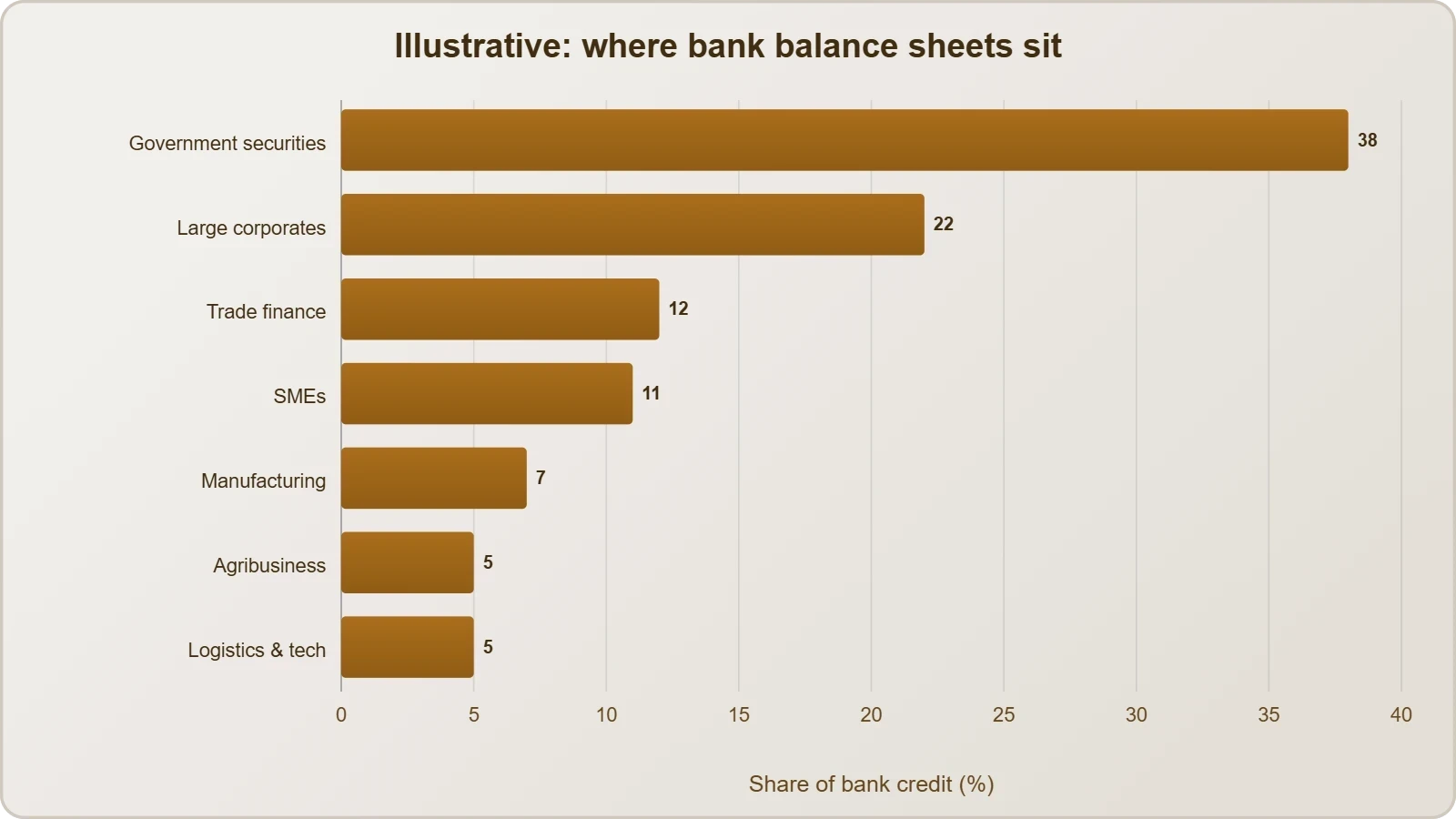
This allocation pattern creates a quiet trap. Banks that avoid productive lending never develop the sector expertise, credit histories and workout experience that would make such lending safer over time. The absence of capability becomes self-justifying: institutions cite unfamiliarity and risk as reasons to abstain, and abstention perpetuates unfamiliarity. Breaking this cycle requires deliberate investment in credit infrastructure and sector knowledge, often supported by development finance institutions that can absorb early-stage risk and demonstrate commercial viability to skeptical boards and regulators.
Why African Banks Lean Toward Sovereign and Low-Risk Assets
Understanding why the summit's call was necessary requires examining the incentives that shape bank behavior. Lending to governments offers a combination that productive lending struggles to match: predictable repayment, liquid secondary markets in many jurisdictions, favorable regulatory risk weights, and yields that reflect sovereign risk premiums rather than borrower creditworthiness. When a bank can earn a comfortable spread by holding treasury bills, the commercial case for building a manufacturing credit team, hiring sector analysts and accepting longer tenors becomes considerably harder to make to a board focused on return on equity and non-performing loan ratios.
The Regulatory and Macroeconomic Pull
Regulatory frameworks reinforce this orientation in subtle but powerful ways. Capital adequacy rules typically assign low risk weights to sovereign exposure, making government securities capital-efficient relative to SME loans that may carry 100 percent or higher risk weights. Provisioning requirements, loan classification rules and stress-testing methodologies often treat unsecured productive lending more harshly than secured sovereign holdings. The cumulative effect is a regulatory architecture that, however prudently designed, tilts the playing field against exactly the lending the Luanda summit advocated. Recalibrating those incentives is a technical exercise with profound consequences for credit allocation.
Macroeconomic volatility compounds the problem. In economies where inflation, exchange rates and policy rates move sharply, long-tenor fixed-rate lending becomes hazardous for both borrower and lender. Banks respond by shortening tenors and preferring floating-rate or index-linked instruments, which suits trade finance and sovereign holdings but fits poorly with industrial investment that requires five- to ten-year horizons. This is why the summit's agenda cannot be separated from monetary stability: credible inflation targeting and deeper local-currency debt markets are preconditions for the term transformation that productive lending demands.
Collateral, Insolvency and the Cost of Caution
Collateral regimes represent one of the most concrete obstacles. Where land titling is incomplete, movable asset registries are weak, and enforcement through courts is slow or unpredictable, lenders rationally demand collateral they can readily seize and value. Most African SMEs cannot meet that standard, holding equipment, inventory and receivables that legal systems struggle to perfect as security. The result is a credit gap that is less about bank conservatism than about the absence of the legal plumbing that makes lending enforceable. Reforming collateral law and building modern secured-transaction registries would expand the lendable universe without requiring banks to accept imprudent risk.
Insolvency frameworks matter equally. When business failure is punished through protracted, unpredictable proceedings, both lenders and entrepreneurs behave defensively. Banks price in recovery uncertainty through higher rates and tighter conditions; entrepreneurs avoid formal credit and the disclosure it entails. Efficient restructuring regimes, specialized commercial courts and clear priority rules for secured creditors reduce the risk premium embedded in productive lending. These are unglamorous institutional reforms, but they determine whether a bank can lend to a growing firm at a rate the firm can afford to repay from operations rather than from desperation.
We Also Published
Blended Finance and Development Institutions as Catalysts
If commercial banks cannot unilaterally absorb the risk of pioneering productive lending, blended finance offers a bridge. Development finance institutions, multilateral banks and guarantee funds can take first-loss positions, provide partial credit guarantees or fund technical assistance that builds lender capability. When a guarantee covers a defined share of portfolio losses, a bank's expected loss calculation changes materially, potentially shifting a marginal SME portfolio from unviable to acceptable. The Luanda summit's emphasis on real-economy support implicitly points toward these structures, since declarations alone cannot alter the arithmetic that governs credit committees.
Guarantees, First-Loss Tranches and Risk Sharing
Risk-sharing mechanisms have a mixed record, and honest assessment matters. Well-designed guarantee schemes with clear eligibility criteria, credible counterparties and disciplined monitoring have demonstrably expanded lending in several markets. Poorly designed schemes, by contrast, have subsidized lending that banks would have made anyway, or have absorbed losses without generating learning that improves future underwriting. The difference lies in structure: guarantees that require banks to retain meaningful skin in the game, price risk transparently and share data with the guarantor tend to build durable capability rather than temporary volume.
First-loss tranches in securitized SME portfolios represent a more sophisticated variant. A development institution absorbs the initial losses on a pooled portfolio, allowing the bank to originate with confidence while retaining the senior exposure. This structure transfers risk without transferring origination responsibility, preserving the bank's incentive to underwrite carefully. Over successive cycles, the performance data generated by such pools can inform better pricing and eventually allow the bank to hold more risk itself. The mechanism is not a subsidy but a temporary risk bridge that converts uncertainty into measurable, priceable experience.
Building Credit Infrastructure That Outlasts Programs
The most durable contribution development institutions can make is infrastructural rather than financial. Funding credit bureau development, movable asset registries, digital identity systems and standardized financial reporting for SMEs creates public goods that reduce information asymmetry across the entire market. A bank contemplating a loan to a small manufacturer benefits enormously from a functioning bureau that reveals the borrower's repayment history, and from a registry that confirms whether the pledged equipment is already encumbered. These systems lower the cost of assessing risk for every lender simultaneously, producing effects that no single guarantee facility can replicate.
Technical assistance deserves similar emphasis. Credit assessment for productive enterprises requires skills — cash-flow analysis, sector benchmarking, covenant design — that many African banks have not cultivated because their lending has concentrated elsewhere. Structured training programs, secondments from development banks and shared underwriting platforms can accelerate capability building. The summit's call for greater real-economy involvement is, at bottom, a call for institutional learning, and learning requires investment in people and systems rather than merely in capital. Banks that treat this as a compliance exercise will miss the commercial opportunity that productive lending represents over the coming decades.
Regulatory Reform and the Incentive Architecture
Regulators occupy a pivotal position in this debate, and the Luanda summit's message implicitly challenges them as much as the banks. Capital rules, provisioning standards, exposure limits and liquidity requirements collectively determine the relative attractiveness of different asset classes. If productive lending carries materially higher capital charges than sovereign exposure, banks will allocate accordingly regardless of exhortation. Prudential frameworks need not be loosened to accommodate real-economy lending; they need to be calibrated so that risk weights and provisioning reflect genuine risk differences rather than historical convention or fiscal convenience.
Recalibrating Capital and Provisioning Rules
Several concrete adjustments merit consideration. Risk-weight schedules could recognize the diversification benefits of granular SME portfolios, which behave differently from concentrated large exposures. Provisioning rules could distinguish between secured and unsecured productive lending more precisely, and could reward robust credit assessment with reduced expected-loss estimates. Regulatory sandboxes could allow banks to pilot new lending models with proportionate supervision before full-scale rollout. None of these changes requires abandoning prudence; each requires regulators to examine whether current rules accurately price the risks they purport to measure.
There is also a supervisory culture dimension. Examiners who penalize any deviation from sovereign-heavy portfolios, or who treat SME lending as inherently suspect, shape bank behavior as powerfully as formal rules. Supervisory guidance that explicitly recognizes productive lending as a legitimate, desirable activity — provided it is properly underwritten — can shift internal bank conversations. The summit's public framing of real-economy support as a priority gives supervisors license to articulate that position, converting a general aspiration into supervisory expectation that credit committees must weigh.
Monetary Stability and Local-Currency Markets
Productive lending ultimately depends on monetary conditions that make long-term commitments feasible. Where inflation is volatile and local-currency yield curves are truncated, banks cannot lend at fixed rates for the horizons industrial investment requires. Developing deep local-currency debt markets — through credible inflation targeting, predictable government issuance calendars and institutional investor participation — extends the yield curve and provides benchmarks against which productive loans can be priced. This is slow, technical work, but it is the foundation on which real-economy finance rests, and it deserves prominence in any serious follow-up to the Luanda agenda.
Exchange-rate management adds another layer. Persistent currency instability discourages lending to firms whose revenues are domestic while their equipment costs are imported, since currency mismatch can destroy otherwise sound borrowers. Macroprudential measures that limit unhedged foreign-currency borrowing, combined with policies that build reserves and reduce external vulnerability, create conditions in which domestic-currency productive lending becomes safer. The summit's call cannot be divorced from this macroeconomic context; finance ministries and central banks must treat monetary and financial stability as prerequisites for the credit expansion the continent needs.
- 01
- 02
- 03
- 04
Fintech, Capital Markets and Alternative Channels
Banks are not the only institutions capable of financing the real economy, and the summit's focus on banks should not obscure the broader financial architecture. Capital markets, fintech lenders, leasing companies, microfinance institutions and pension funds all allocate capital, and each faces its own constraints and opportunities. Deepening equity markets would give growing firms an alternative to debt, reducing the leverage that makes bank lending risky. Developing corporate bond markets would allow larger enterprises to borrow directly, freeing bank balance sheets for smaller borrowers that cannot access capital markets. The real-economy agenda is therefore a system-wide agenda, not merely a banking one.
The Role of Digital Lending and Mobile Finance
Digital financial services have already demonstrated that technology can compress the cost of serving small borrowers. Mobile money platforms, transaction-based credit scoring and automated lending decisions have extended formal credit to segments that traditional banks found uneconomic to serve. These models generate alternative data — payment histories, inventory flows, utility records — that substitute for the collateral and audited accounts that SMEs typically lack. Their limitation is scale and tenor: most digital lending remains short-term and small-ticket, useful for working capital but insufficient for the equipment and expansion finance that productive transformation requires.
Integrating digital capability with bank balance sheets offers a promising hybrid. Banks possess funding capacity and regulatory standing; fintechs possess data analytics and low-cost origination. Partnerships in which banks fund portfolios originated and monitored by technology platforms can combine the strengths of both while distributing risk appropriately. Regulatory frameworks need to accommodate these arrangements without allowing arbitrage, ensuring that credit assessment standards and consumer protections apply consistently regardless of the originating channel. The summit's real-economy objective is better served by a diverse, interoperable financial ecosystem than by a single institutional type.
Pension Funds and Long-Term Capital
Africa's institutional investors — pension funds, insurance companies and sovereign wealth funds — hold growing pools of long-term savings that are often invested conservatively in government securities or offshore assets. Channeling a portion of these resources into productive domestic investment, including infrastructure and private equity, would address the tenor mismatch that constrains bank lending. The obstacles are familiar: limited pipeline of bankable projects, valuation and governance concerns, and regulatory investment limits. Addressing them requires patient collaboration between institutional investors, project developers and regulators, but the potential to finance long-horizon productive activity is substantial.
Private equity and venture capital play a complementary role, providing equity and quasi-equity to firms that cannot support debt. These markets remain thin across much of the continent, constrained by exit uncertainty, currency risk and limited local limited-partner capital. Development institutions have supported fund formation, but the ecosystem needs domestic institutional participation to become self-sustaining. A firm that can raise equity is a better credit risk for banks, so deepening equity markets indirectly supports the banking agenda the Luanda summit advanced. The channels are distinct, but the objective — financing productive enterprise — is shared.
From Summit Declarations to Measurable Outcomes
The history of development finance is littered with communiqués that produced little beyond press coverage, and the Luanda summit will be judged by whether it escapes that pattern. The absence of specific commitments in the original report is not disqualifying — agenda-setting gatherings often precede detailed policy work — but it does mean that follow-through must be tracked deliberately. What would meaningful progress look like? Several indicators are observable and could be monitored over the coming years, providing a basis for assessing whether the real-economy agenda translated into changed balance sheets rather than merely changed rhetoric.
Indicators Worth Monitoring
The most direct measure is the share of bank credit flowing to productive sectors — manufacturing, agribusiness, logistics, technology and SMEs — relative to sovereign and large-corporate exposure. Movements in this ratio, tracked across major African banking systems, would reveal whether allocation is genuinely shifting. Secondary indicators include the growth of SME loan portfolios, the tenor distribution of new lending, the volume of loans supported by guarantee schemes, and the development of credit bureau coverage. Each captures a different dimension of the transition, and together they provide a reasonably comprehensive picture of whether the financial system is becoming more productive.
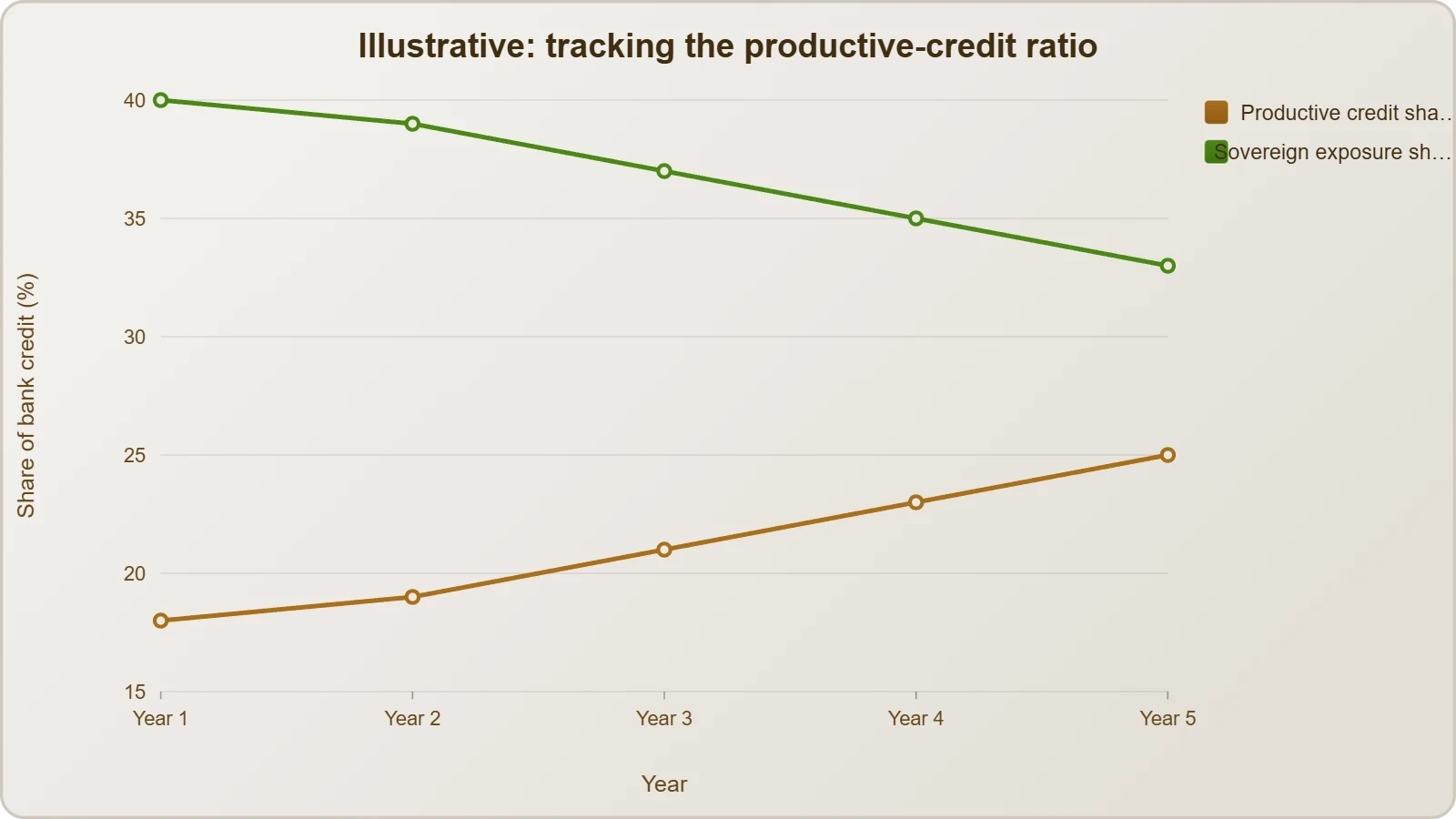
Qualitative indicators matter as well. The establishment of specialized SME credit units within banks, the hiring of sector analysts, the introduction of cash-flow-based lending methodologies and the publication of real-economy lending targets all signal institutional commitment. Regulatory actions — revised risk weights, new collateral registries, updated supervisory guidance — provide evidence that policymakers are responding. None of these indicators alone proves transformation, but their convergence would suggest that the summit's message penetrated beyond conference halls into the operational and regulatory machinery that actually determines credit allocation.
The Risk of Symbolism Without Substance
A candid assessment must acknowledge the risk that the Luanda agenda becomes symbolic. Banks face genuine constraints that exhortation cannot dissolve, and summits cannot substitute for the institutional reforms that would relax those constraints. If follow-up consists of further declarations without corresponding investment in credit infrastructure, legal reform and regulatory recalibration, the real-economy agenda will remain aspirational. The summit's value, then, depends on whether it catalyzes the unglamorous institutional work that makes productive lending feasible — or merely adds another communiqué to the archive of good intentions.
There is also a distributional dimension worth noting. Real-economy lending that concentrates on large, established firms would satisfy the letter of the summit's call while leaving the broader enterprise landscape untouched. Genuine support for the real economy implies reaching the SMEs and productive ventures that generate most employment, which requires exactly the collateral, data and capability investments discussed above. The measure of success is not merely that banks lend more to businesses, but that they lend to the businesses that most need capital and can use it productively. That distinction should anchor any serious evaluation of the summit's legacy.
The Broader Significance for African Development
Set against the continent's demographic trajectory, the Luanda summit's agenda acquires strategic weight. Africa's working-age population is expanding rapidly, and the continent must create productive employment at scale to convert that expansion into prosperity. Enterprises need capital to grow, hire and invest; financial systems that withhold capital from productive activity constrain the entire development trajectory. The summit's call for banks to support the real economy is therefore not a technical banking matter but a development imperative, connecting financial sector policy to the employment and income outcomes that determine whether the continent's potential is realized.
Finance, Industrialization and Structural Transformation
Structural transformation — the shift of labor and output toward higher-productivity sectors — has historically been financed by banking systems willing to lend beyond trade and sovereign exposure. Manufacturing, agro-processing and modern services require capital investment that cannot be funded from retained earnings alone. Where finance is unavailable or prohibitively expensive, promising firms remain small, informal and labor-intensive in the least productive sense. The real-economy agenda is thus an industrialization agenda in financial clothing, and its success or failure will shape whether African economies diversify or remain dependent on commodity extraction and low-value services.
Regional integration adds a further dimension. The African Continental Free Trade Area creates larger markets that reward scale and specialization, but capturing those gains requires firms with the capital to invest in capacity and meet regional demand. Financial systems that finance only domestic trade and government deficits will leave that opportunity unexploited. Cross-border banking groups, regional development banks and harmonized regulatory frameworks can support the financing of regional value chains, extending the real-economy agenda beyond national borders. The Luanda summit's continental framing invites exactly this broader perspective on what financing productive enterprise entails.
A Realistic Assessment of What Summits Can Achieve
Summits do not lend money, and it would be naive to expect a conference in Luanda to transform African banking by itself. What summits can do is shift the terms of debate, legitimize priorities and create reference points that reformers can invoke. The AFIS 2026 gathering placed real-economy finance squarely on the continental agenda, framing it as a responsibility of the financial sector rather than an optional charitable activity. That framing matters because it changes the questions regulators, boards and finance ministries ask: not whether banks are profitable, but whether their profitability is aligned with productive investment.
The realistic path forward combines sustained institutional reform with patient capital and honest measurement. Collateral registries, insolvency courts, credit bureaus and local-currency markets must be built. Guarantee schemes and development finance must bridge early-stage risk. Regulators must calibrate rules to reflect genuine risk. Banks must invest in capabilities they have neglected. And the results must be tracked against indicators that reveal whether productive lending is actually expanding. None of this is dramatic, but it is the substance behind the summit's call, and it is where the real work of financing Africa's economy will occur.
The Luanda summit will ultimately be remembered not for what was said in November 2026 but for what followed. If African financial institutions, regulators and development partners treat its message as a mandate for institutional investment in productive credit, the gathering will have marked a genuine turning point. If it joins the archive of well-intentioned communiqués, the continent's financing gap will persist. The choice between those outcomes rests on the unglamorous, incremental work of building financial systems that serve the enterprises on which shared prosperity depends.
From our network :
- Mobile Learning and VR in English: What Global Evidence Reveals About Effective Language TechnologyA systematic review across 14 countries reveals which language-learning technologies genuinely work. Mobile learning, AI, and VR show measurable benefits when pedagogically integrated. This evidence-based guide helps educators and learners select technology that delivers real return on investment.
- The Hidden Cost of AI Convenience: Why Over-Permissioned Agents Are a Security Time BombDiscover why AI agents with excessive permissions create dangerous single points of failure, and learn how implementing least privilege principles can protect your organization from exploitation.
- Forbidden Matrix Patterns and Visible Lattice Points: A Geometric DictionaryExplore how multidimensional 0–1 matrices encode geometric truths, linking forbidden patterns to visible lattice points and hypergraph theory, with applications in combinatorics and computational geometry.
- CISA’s Ten-Advisory Wave: Why Generic Patching Fails in OT and How to Build Product-Specific PlaybooksCISA released ten ICS advisories in one week, exposing critical infrastructure risks. Generic patching fails in OT. Learn to build product-specific remediation playbooks.
- University Language Proficiency Exams: Why Institutional Tests Demand Different Preparation Than IELTS and TOEFLDiscover why university-specific language proficiency examinations differ fundamentally from IELTS and TOEFL, and learn strategic preparation approaches for institutional assessment success.
- How AI Agents Will Change the Way We Manage Personal FinancesExplore how AI agents are transforming personal finance through automated budgeting, bill payment, and investment management, while examining the critical security protocols and governance frameworks required for safe deployment.
- Live Online English Classes for Kids: Do They Actually Reduce Anxiety?A ten-week study reveals that synchronous online English classes can significantly reduce child language anxiety while improving listening and reading skills. Discover what makes these programs effective and how parents can select the right one.
- The Final Descent: How ESA Retired the Legendary Cluster Constellation After 24 Years of Space Weather ScienceAfter 24 years mapping Earth’s magnetosphere, ESA’s Cluster mission concluded with a precisely controlled reentry over the South Pacific. This analysis explores the scientific legacy, engineering decisions, and debris mitigation principles behind one of space exploration’s most responsible retirements.
- Committed Mediterranean Precipitation Decline: Why Emissions Cuts Alone Cannot Restore Winter RainsNew NOAA research reveals that Mediterranean winter rains may decline irreversibly even with emissions cuts. Explore the science of committed climate change and regional impacts.
RESOURCES
- Banking and Monetary Policy in Ghana: Has Finance Served the ...tandfonline.comSep 4, 2025 ... Banking and Monetary Policy in Ghana: Has Finance Served the Real Economy? ... economy of financial dependence in africa: history…
- AFIS 2026: In Angola, African finance faces the challenge of funding ...theafricareport.com1 day ago ... AFIS 2026: In Angola, African finance faces the challenge of funding the real economy · A new financial architecture for…
- The impact of banking sector stability on the real economysciencedirect.comPolitical risk and bank stability in the Middle East and North Africa region. 2020, Pacific Basin Finance Journal. Citation Excerpt : Inline with the…
- African Development Bank Group to champion domestic capital ...afdb.orgOct 21, 2026 ... AFIS Side Event – "Making NAFAD Work for Africa's Real Economy": Building on the summit's strategic discussions, the Bank will…
- Net-Zero Banking Resources – United Nations Environmentunepfi.org... financing in various carbon-intensive sectors of the real economy. Download ... Drawing from banks' transition finance approaches and input from NZBA member banks ...
- South Africa's Efforts to Improve Financial Stability and Inclusion ...worldbank.orgSep 21, 2018 ... ... finance for the real economy. “The program will support Government's ... Financial Sector Conduct Authority, as well as the…
- How to Deepen Financial Systems in Africa - World Bank Blogsblogs.worldbank.orgSep 14, 2011 ... The role that finance has as a lubricant for the real economy likewise exacerbates the effect of financial fragility on…
- UNEP FI Regional Roundtable Africa and Middle East 2025unepfi.orgThe event convened 250+ banks, insurers, investors, policymakers, civil society organisations, and academia to discuss the advancement of sustainable finance, ...
- The AFRICA FINANCIAL INDUSTRY SUMMIT-AFIS will hold its first ...ifc.org... banking and financial markets. ... AFIS' objective is to build a robust financial industry that serves the real economy and sustainable development.
- Trade finance is an important part of ...instagram.com2 days ago ... ... the world. Over the coming weeks, Financing Africa's Real Economy will show how UBA UK is supporting these flows…
- Ping An Digital Bank Deepens Trade Finance to Serve the Real ...panafricanvisions.comOct 21, 2026 ... ... Bank Deepens Trade Finance to Serve the Real Economy with Financial Services. Font ResizerAa. PAN AFRICAN VISIONS · Politics ...
- Green Swan 2023: Climate transition in the real economy - the BISbis.org... Bank of Chile, the Network for Greening the Financial System and the South African Reserve Bank. The third edition of Green Swan Conference…
- NGFS publishes input paper on integrating adaptation and ...ngfs.netJul 22, 2025 ... An enabling environment by public actors, and strong real economy ... African Reserve Bank and Chief Executive Officer of the…
- World's Best Banks 2021: Africa - Global Finance Magazinegfmag.comMay 4, 2021 ... “Our long history with Africa is rooted in the financing of the real economy,” he says. He adds that, due…
- The African Development Bank Group will participate in the Africa ...x.comOct 27, 2026 ... The African Development Bank Group will participate in the Africa Financial Summit (AFIS) 2026. ... "Making NAFAD Work for Africa's…
- 01
- 02
- 03
- 04
- 05
- 06
- 07
- 08
0 Comments