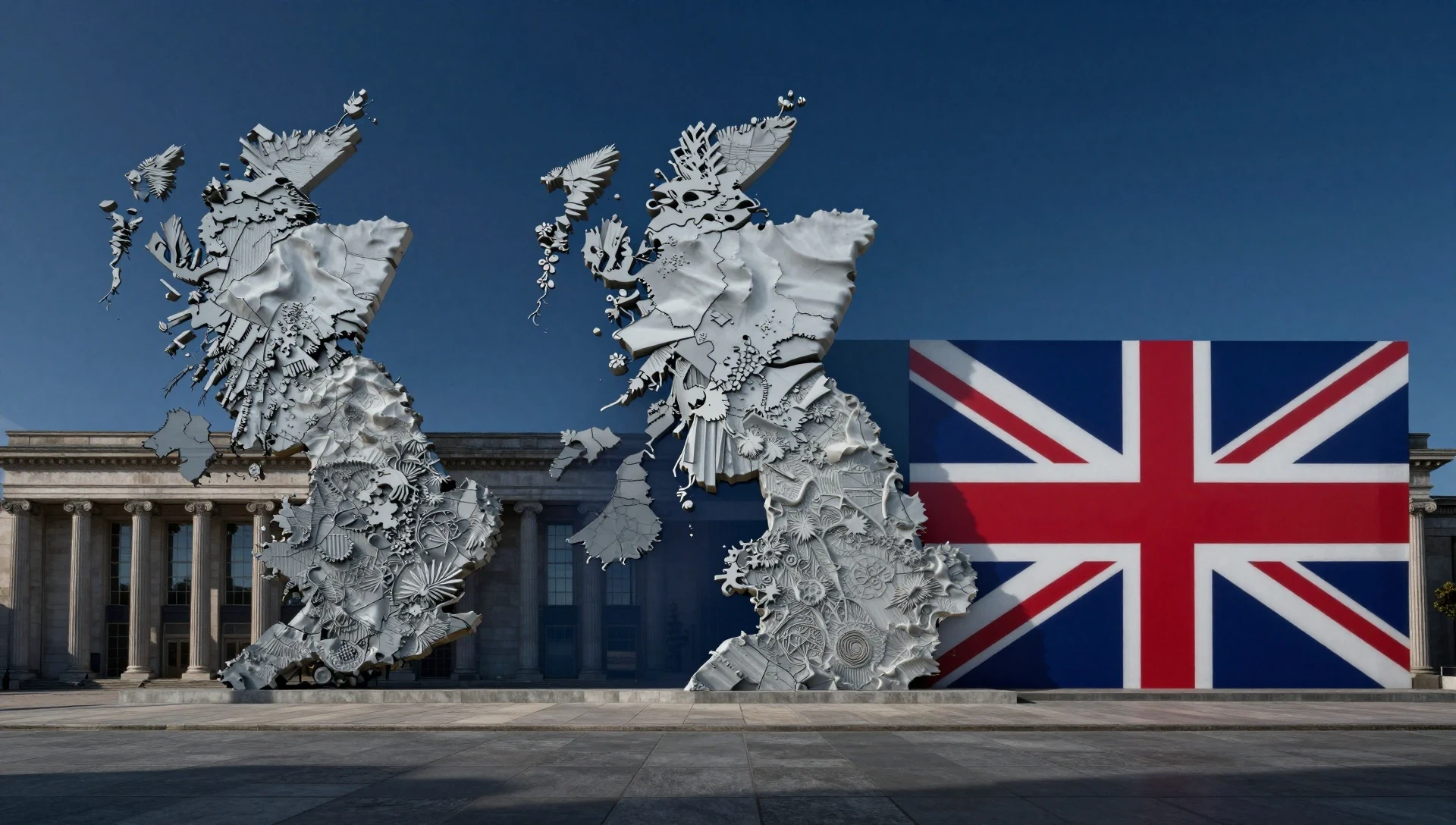
Fifty years separate two moments that now appear structurally linked. In October 1976, Jim Sillars and a breakaway group of left-wing Scots gathered in Stirling to launch the Scottish Labour Party, an experiment that fused socialism with home rule and collapsed within months.
In November 2026, Andy Burnham stood in Motherwell during SNP conference season to offer cooperation on further devolution, meeting John Swinney and Rhun ap Iorwerth to align devolved power with reindustrialisation. The symmetry is not coincidental; it is diagnostic.
The intervening half-century contains a decisive reversal. The SNP entered the 1970s as a Eurosceptic force campaigning against EEC membership in 1975, then repositioned itself by the 1990s as the party of "independence in Europe," a phrase Sillars carried with him when he joined the SNP and became deputy leader in 1991.
On This Page
Europe moved from liability to asset, and Scotland's self-definition increasingly ran against an England drifting toward Euroscepticism. That realignment still governs the strategic terrain Burnham is now testing.
What follows examines the 1976 precedent, the mechanics of the devolution offer, and the European dimension that shaped the 2014 referendum result. The analysis rests on historical sequence, electoral arithmetic and constitutional logic rather than commentary, because the SNP's dilemma is structural: a party built on separation must now operate inside a Union it cannot yet leave.
TL;DR Andy Burnham's devolution overture to John Swinney and Rhun ap Iorwerth revives a 1976 formula — socialist home rule inside a wider European framework — that previously failed under Jim Sillars. The SNP's own history shows how quickly European positioning can invert: Eurosceptic in 1975, pro-EU by 1991. Europe remained pivotal in 2014, when voters rejected independence partly to preserve EU citizenship. Burnham's offer therefore functions simultaneously as threat and opportunity for nationalist strategy.
The 1976 Precedent and the Architecture of Home Rule
The Scottish Labour Party's founding in early 1976 represented a calculated gamble on a gap in the electoral market. Sillars believed socialism and self-government could be sold as a single proposition to working-class Scotland, and early media coverage suggested appetite existed.
The party's rapid disintegration, culminating in the near-violent October conference where far-left activists were expelled, exposed the fragility of that coalition.
From Breakaway to Collapse
The party's failure was organisational as much as ideological. It attracted attention but could not convert trade union structures or constituency machinery into durable support, and internal discipline broke down within months of launch.
Sillars removed far-left activists at the 1976 conference, yet the visible disorder damaged credibility with precisely the voters the project needed.
Collapse followed swiftly, and the episode might have been forgotten had its central idea not survived its vehicle. "Independence in Europe" outlived the party that coined it, migrating with Sillars into the SNP and eventually into mainstream nationalist doctrine. The lesson for contemporary strategists is that institutional failure does not necessarily kill a framing device.
Burnham's Motherwell speech echoes the 1976 synthesis with notable precision. Combining devolved power with reindustrialisation addresses the same constituency — left-leaning voters who want practical self-government rather than constitutional rupture. The difference is that Burnham operates from within Labour, offering cooperation rather than schism, which lowers the political cost of the proposition.
The Devolution Offer in Practice
The Friday meeting between Burnham, Swinney and ap Iorwerth established a tripartite framing: devolved administrations working jointly on industrial policy. This construction deliberately avoids the binary of independence versus status quo, substituting a graduated model in which Scotland and Wales gain fiscal and industrial capacity without treaty-level separation. Such gradualism historically unsettles nationalist parties.
For the SNP, the offer is awkward because it delivers tangible powers while removing the grievance that sustains momentum. A devolution settlement that visibly improves industrial outcomes weakens the case for the constitutional break, and the party cannot easily reject cooperation without appearing to prioritise separation over prosperity.
Yet acceptance carries its own risk. Embedding the SNP in intergovernmental machinery designed by Labour normalises the Union as a working framework, and each joint announcement becomes evidence that Scotland can pursue reindustrialisation without statehood. The strategic trap is procedural rather than rhetorical.
Why the Parallel Matters
The comparison matters because it isolates what changed. In 1976, home rule required a new political vehicle and failed on organisational grounds; in 2026, the vehicle already exists in Labour and the SNP, and the contest concerns which party owns the delivery narrative. Institutional maturity, not ideological novelty, now determines outcomes.
There is also a demographic dimension. The 1976 project appealed to industrial working-class Scotland during deindustrialisation's first shock; Burnham's reindustrialisation agenda targets the same communities four decades into structural decline. The policy vocabulary has shifted from nationalisation to supply-chain sovereignty, but the electoral geography is recognisably identical.
Finally, the precedent warns against overreading conference-season rhetoric. Sillars attracted substantial coverage before collapsing; Burnham's Motherwell speech may prove equally ephemeral. Durable constitutional change historically requires legislative vehicles and referendum mandates, neither of which the current overture supplies.
We Also Published
The European Reversal and the 2014 Referendum
Europe supplies the second structural thread. The SNP's transformation from EEC opponent in 1975 to pro-EU advocate by the 1990s was not a philosophical conversion but a strategic repositioning, enabled by Brussels' growing emphasis on small nations and minority cultures. Scotland's self-definition against an increasingly Eurosceptic England reinforced the shift.
From Euroscepticism to Independence in Europe
The 1975 referendum campaign placed the SNP firmly against continued EEC membership, a position consistent with its emphasis on national sovereignty and fishing communities. Within two decades, the party had inverted that stance entirely, adopting the argument that European integration made independence compatible with open borders and shared institutions.
Sillars' arrival accelerated the change. Having promoted "independence in Europe" within the Scottish Labour Party, he carried the doctrine into the SNP after 1976 and became deputy leader in 1991, by which point the framing had become party orthodoxy. The migration of an idea across a collapsed party is the decisive transmission mechanism.
External context reinforced internal argument. The EU's regional policy, structural funds and minority-language programmes gave nationalists concrete evidence that Brussels treated small nations as legitimate actors, while Westminster appeared centralising. Europe thus became a resource for legitimising separation rather than a constraint upon it.
The 2014 Calculus
The 2014 referendum tested the doctrine under adversarial conditions. Voters were told an independent Scotland would constitute a new state required to reapply for EU membership, a prospect involving uncertain terms, possible currency complications and a gap in citizenship rights. That warning proved electorally potent.
Scots rejected independence partly to protect their European passports, an outcome that inverted nationalist expectations. Rather than Europe easing the path to statehood, the risk of losing EU citizenship became a reason to remain within the United Kingdom, demonstrating how contingent the European argument remains.
The arithmetic of that campaign still constrains strategy. Any future referendum must resolve the reapplication question credibly, and the 2016 Brexit vote complicated rather than simplified it: Scotland voted Remain while England voted Leave, creating a grievance but also a paradox, since independence would require joining an EU that Scotland had just been removed from.
Implications for Current Strategy
The European file now cuts both ways. Brexit supplies a durable grievance, since Scotland voted Remain and has been removed from the EU against its majority preference, but re-entry terms remain uncertain and would likely require Schengen and euro commitments that complicate the fiscal case for independence.
Burnham's devolution offer exploits this ambiguity. By focusing on reindustrialisation rather than constitutional status, it shifts debate toward competences that devolution can deliver immediately, sidestepping the EU reapplication question that damaged the 2014 campaign. That is tactically astute and constitutionally evasive.
The SNP's response will reveal whether the party prioritises the European framing or the independence outcome. If it accepts cooperation while continuing to argue that full statehood is necessary for EU membership, it must explain why devolved industrial policy cannot achieve equivalent results within the Union.
Electoral Arithmetic and the Strategic Dilemma
Constitutional arguments ultimately resolve through parliamentary arithmetic. The SNP's dominance at Holyrood rests on proportional representation and a fragmented opposition, while its Westminster representation depends on concentrated constituencies. Devolution negotiations that strengthen Holyrood's fiscal capacity therefore alter the terms of that dual mandate.
Vote Shares and Constitutional Majorities
Referendum outcomes require sustained majority support, not plurality. The 2014 result established that a narrow lead in opinion polling is insufficient, and subsequent surveys have rarely shown independence consistently above the threshold required to justify a second vote. Constitutional change demands durable, cross-community consent.
Devolution, by contrast, can be delivered through legislation and intergovernmental agreement without a referendum. That asymmetry favours Burnham's approach: incremental powers are achievable within a parliamentary term, whereas independence requires a multi-year campaign with uncertain legal authority for any future plebiscite.
The electoral consequence is that the SNP must compete on delivery rather than destiny. Voters who support devolution but oppose separation constitute a substantial bloc, and a Labour offer that visibly delivers industrial investment could consolidate that group behind the Union for a generation.
Threat and Opportunity for Nationalists
Burnham's intervention is simultaneously threat and opportunity. The threat is that cooperation normalises the Union and drains urgency from the constitutional question; the opportunity is that any devolution settlement exposes Westminster's resistance to further powers, potentially reviving grievance if negotiations stall.
Nationalist strategy has historically thrived on blocked routes. When Westminster refuses concessions, the SNP gains a grievance narrative; when it grants them, the party must find new grounds for separation. Burnham's offer therefore tests whether the SNP can convert delivery into a renewed case for statehood.
The 1976 precedent suggests the answer is not automatic. Sillars' party failed because it could not translate intellectual coherence into electoral traction, and the SNP faces an analogous challenge: a coherent European argument that has repeatedly failed to secure majority consent when tested at the ballot box.
- 01
- 02
- 03
- 04
What to Watch Next
Three indicators will reveal whether Burnham's overture becomes substantive. First, whether joint industrial bodies acquire statutory footing and budget lines; second, whether the SNP treats cooperation as a platform or a concession; third, whether polling shows devolution supporters shifting toward the Union on delivery grounds.
Historical precedent suggests caution about early signals. The 1976 party generated headlines within weeks and collapsed within months, while the SNP's European reversal took fifteen years to complete. Constitutional realignments operate on longer cycles than conference speeches, and the current moment may be an opening rather than a settlement.
The underlying question remains unresolved: whether Scotland's route to greater self-government runs through Brussels, through Westminster cooperation, or through neither. Burnham has offered a third path, and the SNP must decide whether to walk it or define itself against it.
From our network :
- How AI Agents Will Change the Way We Manage Personal FinancesExplore how AI agents are transforming personal finance through automated budgeting, bill payment, and investment management, while examining the critical security protocols and governance frameworks required for safe deployment.
- Committed Mediterranean Precipitation Decline: Why Emissions Cuts Alone Cannot Restore Winter RainsNew NOAA research reveals that Mediterranean winter rains may decline irreversibly even with emissions cuts. Explore the science of committed climate change and regional impacts.
- Mobile Learning and VR in English: What Global Evidence Reveals About Effective Language TechnologyA systematic review across 14 countries reveals which language-learning technologies genuinely work. Mobile learning, AI, and VR show measurable benefits when pedagogically integrated. This evidence-based guide helps educators and learners select technology that delivers real return on investment.
- The Final Descent: How ESA Retired the Legendary Cluster Constellation After 24 Years of Space Weather ScienceAfter 24 years mapping Earth’s magnetosphere, ESA’s Cluster mission concluded with a precisely controlled reentry over the South Pacific. This analysis explores the scientific legacy, engineering decisions, and debris mitigation principles behind one of space exploration’s most responsible retirements.
- University Language Proficiency Exams: Why Institutional Tests Demand Different Preparation Than IELTS and TOEFLDiscover why university-specific language proficiency examinations differ fundamentally from IELTS and TOEFL, and learn strategic preparation approaches for institutional assessment success.
- The Hidden Cost of AI Convenience: Why Over-Permissioned Agents Are a Security Time BombDiscover why AI agents with excessive permissions create dangerous single points of failure, and learn how implementing least privilege principles can protect your organization from exploitation.
- CISA’s Ten-Advisory Wave: Why Generic Patching Fails in OT and How to Build Product-Specific PlaybooksCISA released ten ICS advisories in one week, exposing critical infrastructure risks. Generic patching fails in OT. Learn to build product-specific remediation playbooks.
- Forbidden Matrix Patterns and Visible Lattice Points: A Geometric DictionaryExplore how multidimensional 0–1 matrices encode geometric truths, linking forbidden patterns to visible lattice points and hypergraph theory, with applications in combinatorics and computational geometry.
- Live Online English Classes for Kids: Do They Actually Reduce Anxiety?A ten-week study reveals that synchronous online English classes can significantly reduce child language anxiety while improving listening and reading skills. Discover what makes these programs effective and how parents can select the right one.
RESOURCES
- Where now for the SNP and its independence strategy after election ...reddit.comJul 6, 2024 ... 18 votes, 216 comments. The SNP's independence strategy lies in tatters after the Scottish public rejected its importance at the…
- Different MP, same Westminster attitude. Andy Burnham is already ...facebook.comJul 5, 2026 ... Rather than taking this bait, the SNP, Greens, and Alba must unite under a single leader as Team Independence. Every…
- Scottish government has 'no idea' what Burnham's devolution plan ...bbc.comJun 30, 2026 ... SNP ministers have reacted with scepticism to the Labour MP's proposal to redistribute power across the UK.
- The Burnham government needs a new strategy for the Unioninstituteforgovernment.org.ukJul 23, 2026 ... Naturally, Burnham will not always agree with counterparts from the Scottish National Party ... As a champion for devolution, Burnham…
- The Lesley Riddoch Podcastpodcasts.apple.comKey Topics Discussed: Badenoch's Devolution Review & Burnham's Conference ... Ahead of the SNP conference, Fraser and Lesley discuss Tony Giugliano's motion on ...
- Supreme Court's Scottish referendum verdict doesn't end Sunak's ...instituteforgovernment.org.ukNov 24, 2022 ... ... SNP will place independence at the centre of their next general election campaign. ... The Burnham government needs a…
- SNP CONFERENCE - Indy Groundhog Day? - Spotifyopen.spotify.comOct 16, 2026 ... Independence Groundhog Day: Alex argues that the SNP is recycling the same strategies while failing to persuade Scotland to change…
- John Swinney: Scotland is at the limits of devolution - Holyroodholyrood.comOct 8, 2025 ... SNP delegates will discuss and vote on the party's independence strategy on Saturday. Commenting on the speech, Scottish Conservative deputy ...
- Zed on X: "So what is the SNP strategy for independence now? I ...x.com3 days ago ... The First Minister's promised to work "constructively and collaboratively" with Andy Burnham to devolve further powers to Scotland. The Prime ...
- Scottish devolution: from national to regional?bennettschool.cam.ac.ukOct 19, 2026 ... But Burnham has also used the opportunity to draw attention to the SNP's ... independence referendum, which the SNP will…
- Burnham rules out second Scottish independence referendumtelegraph.co.ukOct 16, 2026 ... SNP confirms it will work with Burnham on devolution ... A senior Scottish minister has confirmed the SNP will work…
- Boris Johnson's verbal incontinence a huge boost for Nicola Sturgeontheguardian.comNov 17, 2020 ... PM's disparaging remarks about devolution will only boost support for SNP and Scottish independence. ... strategy. The pro-union forces ...
- Scottish independence - Wikipediaen.wikipedia.org... devolution and those who wanted to maintain a full central Westminster government. In the SNP, there was division between those who saw devolution…
- Burnham Comes to Scotland - by Kirsty Hugheskirstyhughes.substack.comOct 15, 2026 ... As Andy Burnham comes to Scotland just when the SNP holds its annual conference, is the independence debate about to…
- 01
- 02
- 03
- 04
- 05
- 06
- 07
- 08
0 Comments