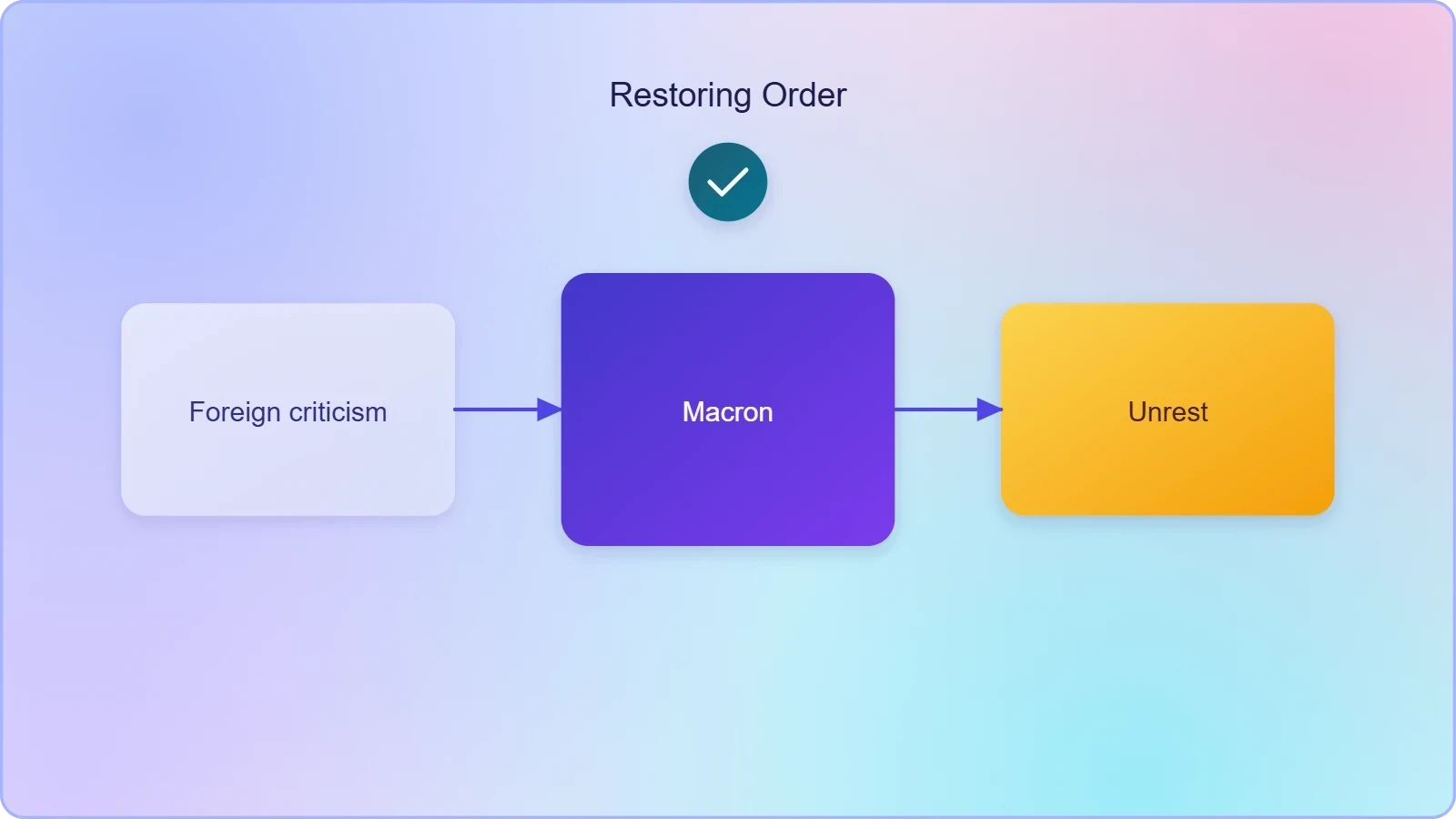
Emmanuel Macron's declaration that France will restore order after a fresh wave of unrest, coupled with his blunt dismissal of foreign criticism as "stupid," captures a defining tension in contemporary French governance.
The president's language signals a deliberate pivot toward sovereign assertiveness, framing internal security as a matter of national prerogative rather than international consultation. This posture carries weight far beyond a single news cycle, because it touches the raw nerve of how modern democracies reconcile domestic disorder with external scrutiny.
The unrest referenced in the Reuters report evokes the long shadow of the Yellow Vests movement, a decentralized revolt that began over fuel taxes and metastasized into a broader indictment of economic inequality and metropolitan elitism.
On This Page
- The Political Meaning of "Restoring Order" in France
- Why Macron Called Foreign Criticism "Stupid"
- Economic Fallout and Investor Confidence
- Geopolitical Ramifications for Europe and Beyond
- Public Opinion, Populism, and the 2027 Horizon
- Historical Parallels and the Republican Playbook
- Strategic Outlook: What Comes Next for France
Macron's vow to restore order therefore reads as both a practical commitment to public safety and a political message aimed at reassuring investors, allies, and French voters alike. Understanding this episode requires reading between the diplomatic lines, because the original dispatch offered sparse detail while implying a much richer political subtext.
What follows is a rigorous examination of the strategic, economic, and geopolitical dimensions of Macron's stance. We dissect the meaning of "order" in the French republican tradition, the calculus behind branding foreign criticism "stupid," and the implications for European stability, investor confidence, and the credibility of France's institutions.
Each section connects the headline to the deeper structural forces shaping French politics in an era of populist volatility and global interdependence.
TL;DR Macron's pledge to restore order and his rejection of foreign criticism as "stupid" reflect a calculated defense of French sovereignty amid renewed unrest. The episode underscores the tension between domestic security imperatives and international scrutiny, signaling a president determined to project control while insulating France's internal affairs from external judgment. Investors and allies should read the rhetoric as a stability signal wrapped in nationalist defiance.
The Political Meaning of "Restoring Order" in France
The phrase "restore order" resonates deeply within French political culture, invoking a republican tradition that prizes state authority as the guarantor of liberty and equality. When a president deploys this language, he is not merely promising police deployment; he is asserting the primacy of the state over factional disorder. This rhetorical move positions the executive as the indispensable steward of national cohesion.
Republican Sovereignty and the Security Imperative
France's centralized model concentrates enormous responsibility in the presidency, meaning any promise to restore order becomes a personal test of leadership credibility. Macron's vow therefore functions as a performance of authority, reassuring citizens that the state remains capable of containing disruption. The security imperative is inseparable from the political imperative of appearing decisive before a restive electorate.
Historically, French executives have leveraged order rhetoric to consolidate legitimacy during crises, from the 1968 upheavals to the Yellow Vests. The pattern reveals a durable expectation that the president personally embodies national stability. Macron's phrasing aligns with this lineage, casting him as the guardian of a social contract under strain.
The Yellow Vests Precedent and Its Lessons
The Yellow Vests movement demonstrated how quickly localized grievances can escalate into a nationwide challenge to presidential authority. Its decentralized, leaderless structure frustrated traditional negotiation, forcing the government into reactive concessions. Macron's renewed emphasis on order reflects lessons learned about the limits of dialogue with diffuse movements.
That precedent also exposed the fragility of public trust in institutions, particularly among rural and peri-urban populations who feel excluded from Parisian prosperity. Restoring order, in this context, requires more than policing; it demands visible responsiveness to economic grievance. The president's rhetoric must therefore balance firmness with the promise of tangible reform.
Why Macron Called Foreign Criticism "Stupid"
Branding external criticism "stupid" is an extraordinary rhetorical escalation for a French president, whose diplomatic tradition prizes measured language. The word choice signals impatience with what Paris perceives as hypocritical lecturing from allies who face their own domestic disorders. It converts a defensive posture into an offensive assertion of moral equivalence.
Sovereignty Versus International Scrutiny
Macron's rebuke taps a deep vein of French skepticism toward Anglo-American commentary on internal affairs. By labeling criticism stupid, he reframes foreign observers as uninformed outsiders meddling in matters they misunderstand. This framing resonates with voters who resent perceived condescension from abroad.
The diplomatic cost is real, however, because allies may interpret the remark as contempt for legitimate concern about civil stability. France's partners monitor unrest for practical reasons, including travel advisories and investment risk assessments. Dismissing their voices risks isolating Paris at precisely the moment it needs solidarity.
The Domestic Audience Behind the Defiance
Every presidential utterance in France is calibrated for domestic consumption first, and Macron's defiance is no exception. The remark appeals to national pride and signals that the president will not be swayed by external pressure. It also preempts opposition attacks that he is too deferential to foreign opinion.
This strategy carries electoral logic, particularly amid competition from nationalist movements eager to cast mainstream leaders as subservient to Brussels or Washington. By striking a defiant tone, Macron reclaims patriotic ground. The risk is that toughness without results erodes credibility over time.
We Also Published
Economic Fallout and Investor Confidence
Political unrest in France carries immediate economic consequences, from disrupted retail and tourism to volatility in French equities and sovereign bonds. Investors parse presidential rhetoric for signals about policy continuity and social stability. A vow to restore order reassures markets, but only if followed by visible calm.
Markets, Spreads, and Risk Perception
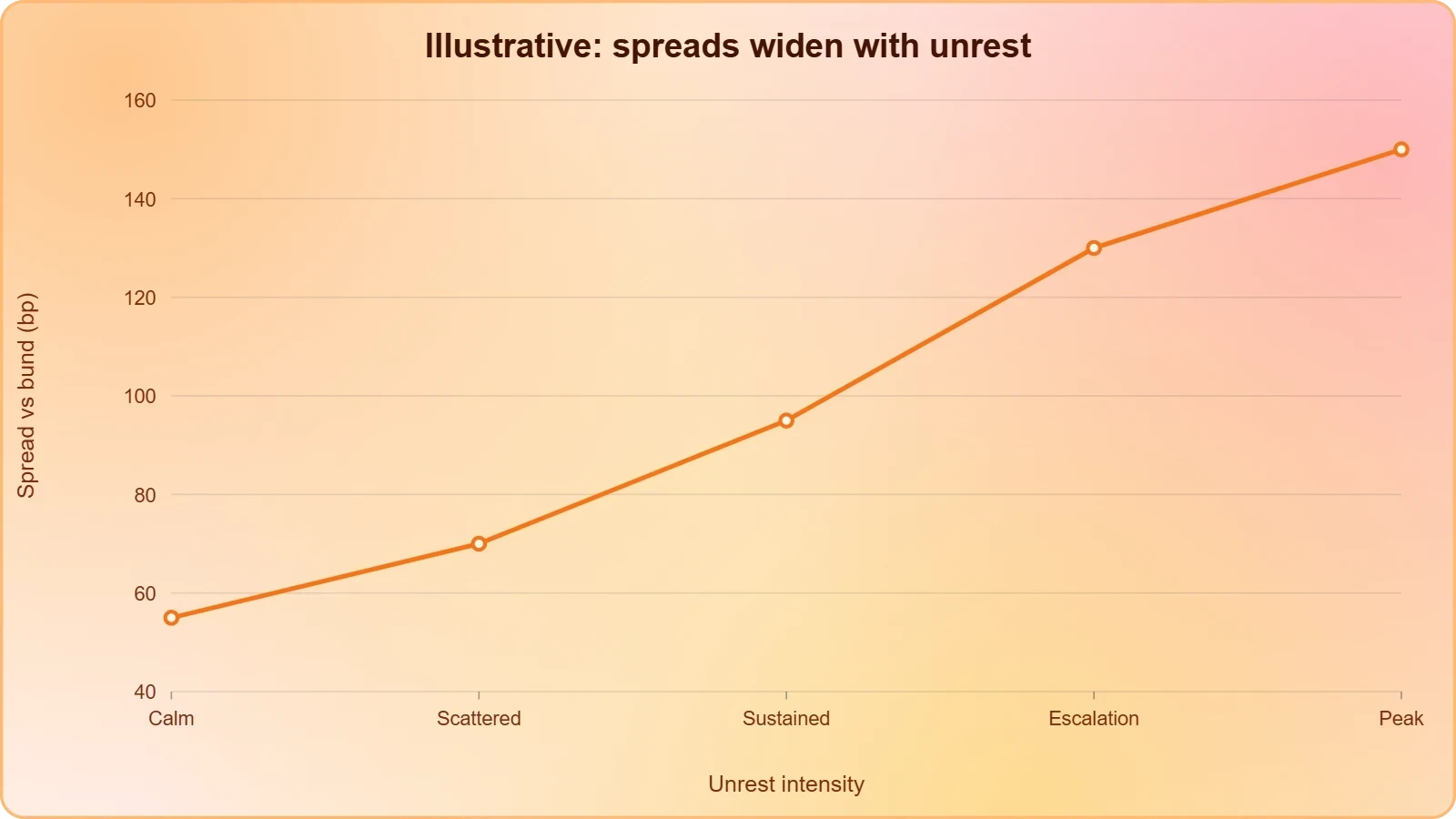
French government bond spreads against German bunds serve as a real-time barometer of perceived political risk. Extended unrest widens spreads and raises borrowing costs, compounding fiscal pressure on an already stretched budget. Macron's language aims to arrest that dynamic before it hardens into structural risk premium.
Equity markets similarly react to images of disorder, with luxury, retail, and tourism sectors particularly exposed to reputational damage. The president's promise of order is therefore an economic instrument as much as a security pledge. Credibility depends on measurable de-escalation in the weeks ahead.
Fiscal Pressure and Reform Credibility
France's fiscal position leaves little room for prolonged disruption, with deficit and debt ratios already under European scrutiny. Unrest that forces emergency spending or delays reform weakens Paris's credibility with Brussels and rating agencies. Restoring order is thus a precondition for fiscal narrative control.
Macron's reform agenda, from pensions to labor markets, depends on a baseline of social calm to survive parliamentary and public resistance. Each episode of disorder emboldens opponents and narrows the political space for structural change. The president's rhetoric must therefore convert into durable stability, not merely temporary quiet.
Geopolitical Ramifications for Europe and Beyond
France positions itself as the political and military engine of European integration, so domestic instability reverberates across the continent. A distracted, internally embattled Paris weakens momentum on defense cooperation, enlargement, and industrial policy. Allies watch French unrest with strategic anxiety, not idle curiosity.
European Leadership and the Franco-German Axis
The Franco-German partnership depends on both capitals projecting stability and purpose. French disorder complicates Berlin's calculations and can stall joint initiatives on energy, defense, and fiscal rules. Macron's insistence on sovereignty may also strain coordination with Brussels institutions.
His dismissal of foreign criticism risks alienating partners whose publics demand accountability from allies. Yet European leaders are unlikely to escalate publicly, preferring quiet diplomacy to open rupture. The episode tests whether solidarity can survive blunt presidential rhetoric.
Global Perception and Soft Power
France's soft power rests on its image as a stable, rights-respecting democracy with global reach. Images of unrest and defiant presidential language complicate that narrative, particularly in markets where French cultural and commercial influence matters. The reputational stakes extend well beyond Europe.
Authoritarian competitors may exploit the unrest to question democratic governance itself, framing disorder as inherent to open societies. Macron's response must therefore defend order without validating such critiques. The balance between firmness and democratic legitimacy defines the strategic challenge.
Public Opinion, Populism, and the 2027 Horizon
French politics is already shadowed by the 2027 presidential contest, and every crisis becomes a rehearsal for that succession battle. Macron's rhetoric must satisfy a restive electorate while denying ammunition to nationalist challengers. Restoring order is as much about narrative dominance as physical security.
Reading the Electorate's Mood
Public opinion in France oscillates between demands for firmness and sympathy for protesters' economic grievances. Macron's challenge is to appear strong without seeming indifferent to hardship. The "stupid" remark may energize supporters while alienating swing voters who value diplomatic decorum.
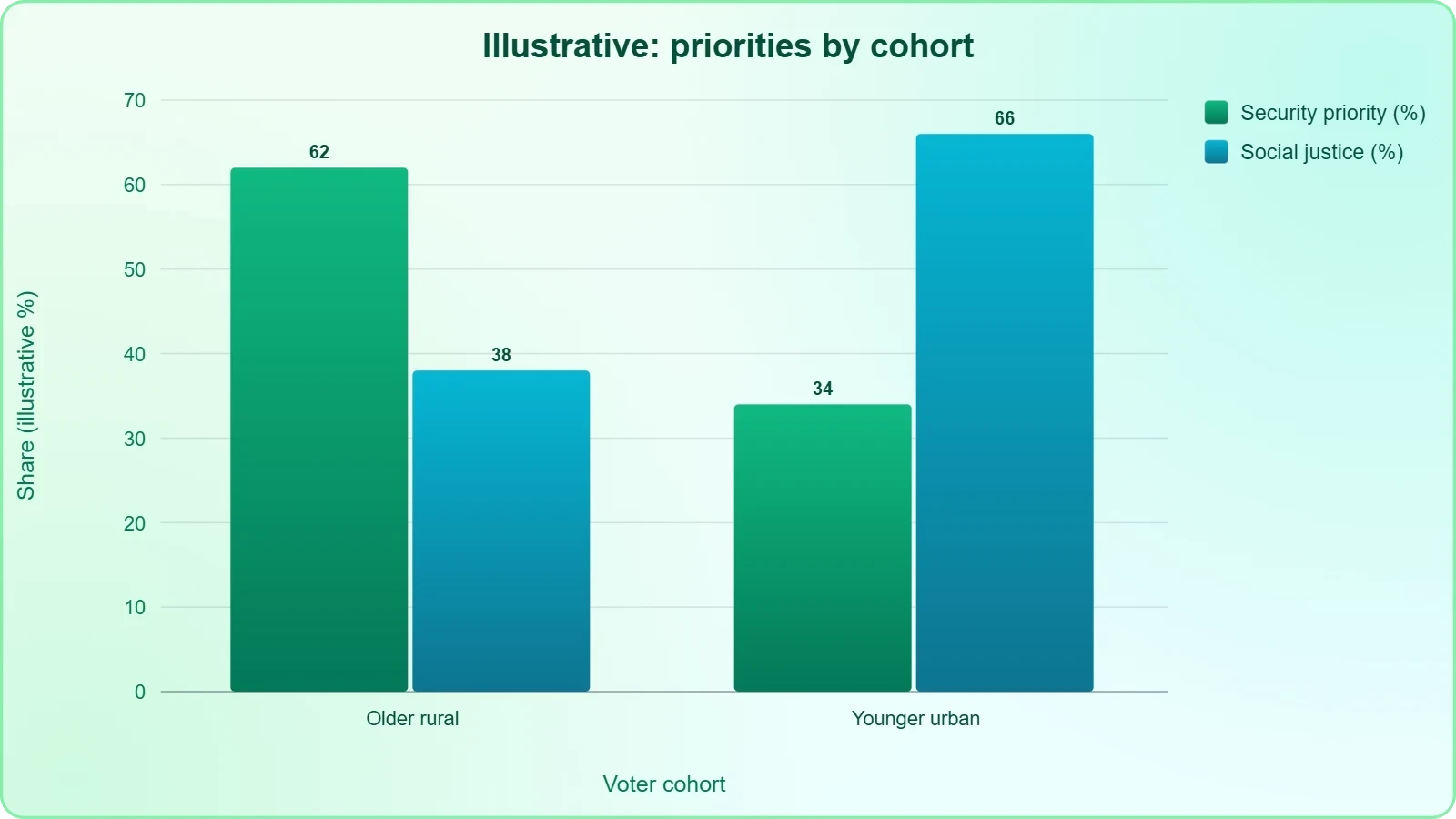
Polling patterns suggest that security concerns rank high among older and rural voters, while urban and younger cohorts prioritize social justice. A single rhetorical stance cannot satisfy both, forcing the president into careful calibration. The unrest episode will be remembered as a test of that calibration.
The Populist Challenge and Institutional Trust
Populist movements thrive on narratives of elite detachment and institutional failure, and unrest supplies them with vivid evidence. Macron's defiance may read as exactly the elitism populists denounce. Countering that perception requires visible engagement with affected communities.
Institutional trust is the ultimate prize, because democratic governance depends on citizens believing that authority serves their interests. Restoring order without restoring trust leaves the underlying crisis unresolved. The president's words must therefore be matched by credible, inclusive action.
Historical Parallels and the Republican Playbook
France has repeatedly confronted cycles of protest and presidential restoration, from the barricades of the nineteenth century to the crises of the Fifth Republic. Each era produced a distinctive playbook combining force, concession, and symbolic reassurance. Macron's approach belongs to this lineage, updated for a digital, decentralized age.
- 01
- 02
- 03
- 04
Lessons From Past Crises
De Gaulle's response to 1968 demonstrated that authority could be reasserted through a combination of firmness and electoral legitimacy. Later presidents learned that repression alone rarely resolves underlying grievance. The most durable settlements paired order with substantive reform.
Macron's rhetoric echoes this dual strategy, promising order while implicitly acknowledging the need for responsiveness. Whether he delivers the second half of the equation will determine the verdict of history. The pattern suggests that words alone cannot close the cycle.
The Fifth Republic's Structural Tensions
The Fifth Republic concentrates power in the presidency while exposing it to direct public judgment, creating a volatile accountability loop. Unrest becomes a referendum on the incumbent, magnifying political stakes. This structural tension explains why order rhetoric carries such weight.
Institutional design also shapes protest dynamics, as centralized authority invites centralized challenge. Macron's promise to restore order is thus a constitutional as well as political statement. It affirms the presidency as the ultimate guarantor of national continuity.
Strategic Outlook: What Comes Next for France
The coming weeks will reveal whether Macron's rhetoric translates into measurable calm or merely postpones escalation. Security deployments, dialogue initiatives, and economic gestures will be scrutinized as indicators of genuine intent. Markets and allies alike will price in credibility, not declarations.
Scenarios and Signposts
A de-escalation scenario would see protest intensity decline, spreads stabilize, and reform momentum resume. A prolonged scenario would feature recurring disruptions, rising political costs, and pressure on the president's authority. The difference hinges on whether grievances are addressed alongside order.
Signposts to monitor include police deployment patterns, union engagement, parliamentary activity, and polling shifts. Each offers a window into whether the crisis is being contained or compounded. Observers should track substance rather than rhetoric.
Policy Levers and Presidential Credibility
Macron retains substantial policy levers, including security resources, fiscal transfers, and legislative initiative. Deploying them credibly requires sequencing, because premature concessions can signal weakness while delayed action prolongs disorder. The president's credibility rests on disciplined execution.
Ultimately, the episode will be judged by outcomes rather than declarations, with French voters and international partners applying their own scorecards. Restoring order is necessary but insufficient; restoring confidence is the deeper objective. Macron's legacy may hinge on whether he achieves both.
From our network :
- How AI Agents Will Change the Way We Manage Personal FinancesExplore how AI agents are transforming personal finance through automated budgeting, bill payment, and investment management, while examining the critical security protocols and governance frameworks required for safe deployment.
- University Language Proficiency Exams: Why Institutional Tests Demand Different Preparation Than IELTS and TOEFLDiscover why university-specific language proficiency examinations differ fundamentally from IELTS and TOEFL, and learn strategic preparation approaches for institutional assessment success.
- The Hidden Cost of AI Convenience: Why Over-Permissioned Agents Are a Security Time BombDiscover why AI agents with excessive permissions create dangerous single points of failure, and learn how implementing least privilege principles can protect your organization from exploitation.
- CISA’s Ten-Advisory Wave: Why Generic Patching Fails in OT and How to Build Product-Specific PlaybooksCISA released ten ICS advisories in one week, exposing critical infrastructure risks. Generic patching fails in OT. Learn to build product-specific remediation playbooks.
- Mobile Learning and VR in English: What Global Evidence Reveals About Effective Language TechnologyA systematic review across 14 countries reveals which language-learning technologies genuinely work. Mobile learning, AI, and VR show measurable benefits when pedagogically integrated. This evidence-based guide helps educators and learners select technology that delivers real return on investment.
- The Final Descent: How ESA Retired the Legendary Cluster Constellation After 24 Years of Space Weather ScienceAfter 24 years mapping Earth’s magnetosphere, ESA’s Cluster mission concluded with a precisely controlled reentry over the South Pacific. This analysis explores the scientific legacy, engineering decisions, and debris mitigation principles behind one of space exploration’s most responsible retirements.
- Forbidden Matrix Patterns and Visible Lattice Points: A Geometric DictionaryExplore how multidimensional 0–1 matrices encode geometric truths, linking forbidden patterns to visible lattice points and hypergraph theory, with applications in combinatorics and computational geometry.
- Live Online English Classes for Kids: Do They Actually Reduce Anxiety?A ten-week study reveals that synchronous online English classes can significantly reduce child language anxiety while improving listening and reading skills. Discover what makes these programs effective and how parents can select the right one.
- Committed Mediterranean Precipitation Decline: Why Emissions Cuts Alone Cannot Restore Winter RainsNew NOAA research reveals that Mediterranean winter rains may decline irreversibly even with emissions cuts. Explore the science of committed climate change and regional impacts.
RESOURCES
- France's Macron vows order, calls foreign criticism of unrest 'stupid'reddit.com3 days ago ... With the chaos in the street and new protester promised on weekends, Macron struggle to restore order. He rebut foreign…
- France to deploy troops, admits to failures over weekend unrestreuters.com5 days ago ... ... restore order after rioting and looting swept Paris, Marseille, Lyon ... criticism that city centres had been left vulnerable.…
- More than 1,300 arrested after 4th night of riots in France, Macron ...pbs.orgJul 1, 2023 ... ... restore order. In the violence sparked by the teen's death on ... France's national soccer team — including international…
- France braces for new protests as Macron seeks to restore orderfacebook.com2 days ago ... MACRON VOWS TO RESTORE ORDER AFTER FRANCE UNREST French President Emmanuel Macron ... • Political tensions rise: Macron accused foreign ...
- Merz, Macron eye new European security framework amid US resetreuters.comFeb 15, 2026 ... He was later followed by Macron, who pushed back on criticism ... Taking his cue from those warning that the…
- With my friend President @emmanuelmacron , as part of his French ...instagram.comFeb 22, 2026 ... French President Emmanuel Macron has criticised foreign leaders for exploiting the unrest in France ... restoring public order while ...
- Can Macron Restore Order in France as Riots Deepen Political and ...moderndiplomacy.eu6 days ago ... French President Emmanuel Macron is facing mounting pressure to restore public order after a weekend of violent riots exposed security ...
- Germany's Chancellor Friedrich Merz, France's President Emmanuel ...instagram.comApr 18, 2026 ... ... restore order ahead of further ... French President Emmanuel Macron has criticised foreign leaders for using France's recent unrest ...
- Macron has had enough. French President Emmanuel ... - Facebookfacebook.com3 days ago ... French President Emmanuel Macron has sharply criticized foreign leaders spreading claims about the unrest ... As France struggles to restore…
- Macron's Lesson After Riots? France Needs Order 'at Every Level'nytimes.comJul 24, 2023 ... ... International Airport in Noumea, the capital of the French ... President Emmanuel Macron issued a firm call to restore…
- Macron increasingly isolated amid unrest across France | Euronewseuronews.com6 days ago ... With only months left in his presidency, Emmanuel Macron faces mounting social unrest and political criticism ... restore order if…
- France's Macron says protesters won't be allowed to 'cause chaos'aljazeera.com4 days ago ... French president criticises comments by 'foreign leaders' trying to exploit disorder for their own political agenda.
- Macron slams 'stupid' comments on protests, as France ... - CNBCcnbc.com3 days ago ... French President Emmanuel Macron condemned foreign leaders' comments on France's unrest as “unacceptable” and “stupid. ... maintain order.
- Davos 2026: Special address by Emmanuel Macron, President of ...weforum.orgJan 20, 2026 ... Facing this order and this new situation, this year, France holds the G7 presidency with a clear ambition – to…
- France's Macron vows order, calls foreign criticism of unrest 'stupid'yahoo.com4 days ago ... By Elizabeth Pineau and Dominique Patton PARIS, Oct 21 (Reuters) - President Emmanuel Macron vowed on Wednesday to prevent a…
- 01
- 02
- 03
- 04
- 05
- 06
- 07
- 08
0 Comments