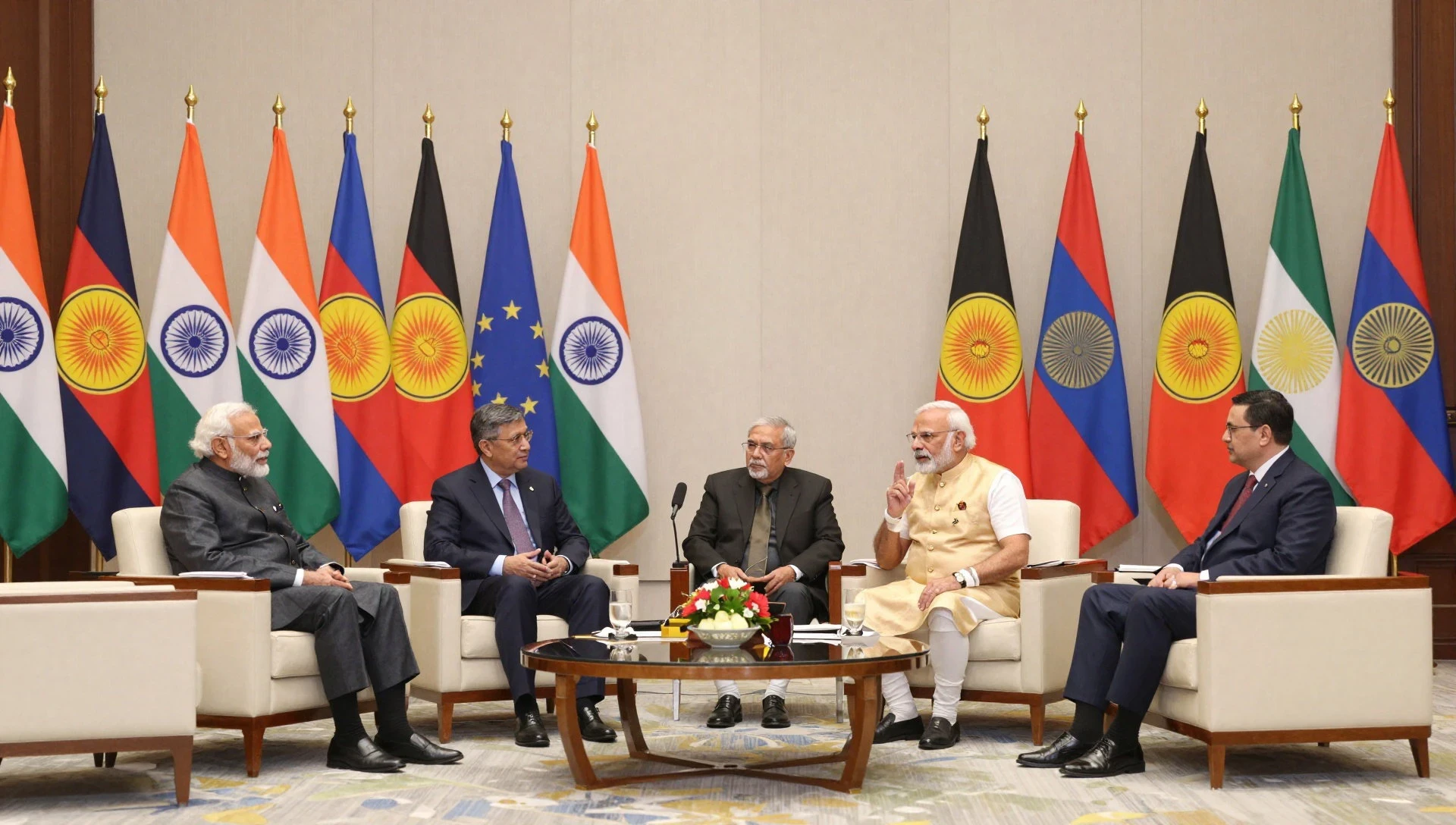
When Prime Minister Narendra Modi took the stage in Manila for three overlapping multilateral gatherings, the moment carried more weight than the routine communiqué language suggested. The ASEAN-India Summit, the East Asia Summit and the Quad Summit unfolded in close sequence, drawing U.S. President Donald Trump, Japanese Prime Minister Sanae Takaichi and Australian Prime Minister Anthony Albanese into the same diplomatic orbit. For observers of Asian geopolitics, the choreography mattered as much as the announcements: India was signalling that its Act East policy and its wider Indo-Pacific vision are no longer aspirational slogans but operating frameworks backed by concrete engagements.
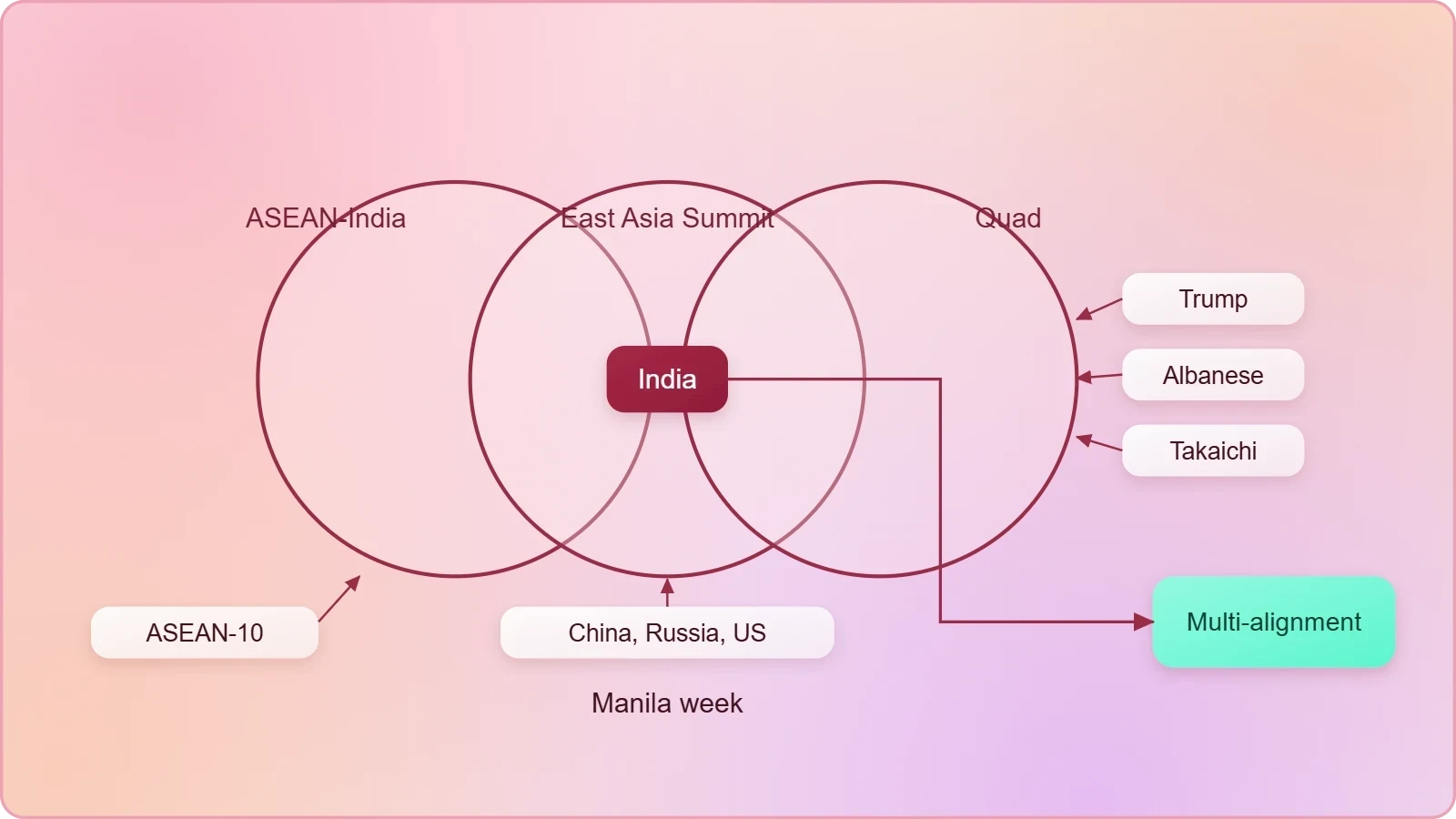
The Manila meetings also revealed the delicate balancing act that defines contemporary Indian statecraft. New Delhi must deepen security and technology cooperation with Quad partners while preserving its longstanding ties with ASEAN and managing a complicated relationship with Beijing and Moscow. The same week, global attention shifted to a trilateral meeting involving Trump, Chinese President Xi Jinping and Russian President Vladimir Putin, a reminder that the Indo-Pacific is now one theatre within a much larger contest. India's diplomatic calendar, in other words, is no longer regional in scope; it is a continuous negotiation across overlapping power centres.
Equally telling is what the reporting notes about absence. Modi did not attend the ASEAN summits in Kuala Lumpur in 2025, a decision attributed to domestic commitments around Deepavali and trade friction with Washington. That contrast between skipping one summit and attending three in Manila illuminates how attendance itself becomes a diplomatic instrument. Presence signals priority; absence signals calculation. Understanding the Manila engagements therefore requires reading both the handshakes and the empty chairs, and the strategic logic that connects them.
On This Page
- The Diplomatic Architecture of the Manila Summits
- Act East and the Indo-Pacific as Operating Frameworks
- The Quad's Evolving Character Under New Leadership
- Why the 2025 Kuala Lumpur Absence Still Matters
- Great-Power Competition and the Trilateral Subtext
- What the Manila Week Signals About India's Next Decade
TL;DR Prime Minister Narendra Modi's participation in the ASEAN-India, East Asia and Quad summits in Manila represents a deliberate consolidation of India's Act East and Indo-Pacific strategies. Alongside Trump, Takaichi and Albanese, the meetings produced concrete announcements and reinforced India's preference for multi-alignment over rigid alliance. The contrast with Modi's 2025 absence from Kuala Lumpur, driven by Deepavali commitments and trade friction with Washington, shows that summit attendance is itself a calibrated diplomatic signal. The broader message is that India intends to remain a pivotal, autonomous actor as great-power competition intensifies across Asia.
The Diplomatic Architecture of the Manila Summits
The three gatherings in Manila were not interchangeable events bundled for convenience; each serves a distinct function within Asia's layered institutional order. The ASEAN-India Summit anchors New Delhi's relationship with the ten-member bloc at the heart of Southeast Asia. The East Asia Summit widens the room to include major powers such as China, Russia and the United States, functioning as the region's principal strategic dialogue. The Quad Summit, meanwhile, convenes the four maritime democracies—India, the United States, Japan and Australia—around a shared vision of a free and open Indo-Pacific. Attending all three in a single week allowed India to address different audiences without contradiction.
Three Summits, Three Distinct Purposes
Each forum carries its own membership logic and produces its own kind of outcome. ASEAN-centred meetings emphasise consensus, economic integration and the centrality of Southeast Asian institutions. The East Asia Summit introduces hard security questions and great-power rivalry into a setting that still prizes diplomatic etiquette. The Quad operates with greater informality and speed, focusing on practical cooperation in maritime domain awareness, critical technologies, resilient supply chains and public health. By moving between these formats, India can pursue consensus-based diplomacy and minilateral initiative simultaneously, without allowing one to undermine the other.
The sequencing also matters for perception management. Beginning with ASEAN reassures Southeast Asian partners that India respects regional ownership of the Indo-Pacific concept. Elevating the Quad afterwards demonstrates that New Delhi is prepared to act through flexible coalitions when consensus bodies move slowly. This dual-track approach has become a signature of Indian foreign policy under Modi, and Manila offered a clean demonstration of how the two tracks can be walked in the same week without visible friction or contradiction.
Reading the Guest List and the Absences
The presence of Trump, Takaichi and Albanese at the Quad meeting gave the grouping a full leaders' level character, reinforcing its institutional weight despite its informal structure. Japan's leadership under Takaichi and Australia's under Albanese bring continuity to the grouping's agenda, while Washington's participation under Trump introduces an element of unpredictability that partners must manage carefully. For India, the value lies in keeping the Quad focused on tangible deliverables rather than allowing it to be defined primarily by any single member's bilateral preoccupations or rhetorical posture toward Beijing.
Absences, too, tell a story. The report notes that Modi skipped the ASEAN summits in Kuala Lumpur in 2025, citing domestic commitments around Deepavali and trade friction with Trump. Whether one reads that decision as scheduling pragmatism or strategic signalling, the contrast with Manila is instructive. Attendance is never neutral in summit diplomacy; it communicates priorities, grievances and expectations. New Delhi's return to a full three-summit schedule suggests a deliberate recalibration toward sustained regional engagement after a period of domestic and bilateral distraction.
Act East and the Indo-Pacific as Operating Frameworks
India's Act East policy began in the 1990s as an economic outreach programme toward Southeast Asia and has since matured into a full-spectrum strategic doctrine. The Manila engagements illustrate that maturation: trade and connectivity remain central, but so do maritime security, defence interoperability, digital public infrastructure and supply chain resilience. The Indo-Pacific framing extends this logic beyond Southeast Asia to encompass the Indian Ocean, the western Pacific and the sea lanes that bind them. For New Delhi, the two concepts are complementary rather than competing, with Act East providing the regional anchor and the Indo-Pacific supplying the wider strategic horizon.
From Rhetoric to Deliverables
The report notes that the meetings produced several concrete announcements, and this emphasis on deliverables reflects a broader shift in Indian diplomacy. Summitry is increasingly judged by what it produces—agreements signed, projects funded, exercises scheduled—rather than by the elegance of joint statements. Quad cooperation in particular has gravitated toward practical domains where the four members can act without lengthy treaty processes: maritime domain awareness, secure telecommunications, semiconductor supply chains, disaster response and critical minerals. These are areas where India brings distinct capabilities and where cooperation reinforces, rather than substitutes for, bilateral partnerships.
Concrete outcomes also serve a domestic political purpose. Indian governments must demonstrate to taxpayers and industry that international engagement yields tangible returns in investment, technology access and market openings. Announcements on connectivity corridors, digital payments interoperability or defence co-production translate abstract geopolitics into visible benefit. The Manila agenda, by clustering economic and security items together, allowed New Delhi to present regional engagement as an integrated proposition rather than a series of disconnected diplomatic photo opportunities.
Managing China and Russia Within the Same Week
The same week's trilateral meeting involving Trump, Xi Jinping and Putin underscores the complexity India navigates. New Delhi maintains substantive defence and energy ties with Moscow, participates in Quad security cooperation with Washington, and manages a long and contested border with Beijing. These relationships are not easily reconciled into a single doctrinal framework, and India does not attempt to do so. Instead, it practices issue-based alignment, cooperating where interests converge and diverging where they do not, while preserving strategic autonomy as a foundational principle of its foreign policy.
This approach draws criticism from partners who prefer clearer alignment and from domestic commentators who see ambiguity as weakness. Yet the Manila performance suggests the strategy retains coherence. India can attend a Quad summit one day and engage ASEAN counterparts the next without being forced to choose between them. The trilateral meeting among Washington, Beijing and Moscow is watched closely in New Delhi precisely because it could reshape the strategic environment in which India's multi-alignment operates, potentially narrowing the space for autonomous manoeuvre.
We Also Published
The Quad's Evolving Character Under New Leadership
The Quad has travelled a considerable distance from its origins as a humanitarian and maritime coordination forum after the 2004 Indian Ocean tsunami. Today it operates as a leaders-level grouping with working groups spanning critical and emerging technologies, climate and clean energy, cyber security, infrastructure and space. The Manila summit, attended by all four leaders, reinforced this institutional trajectory. For India, the Quad's value lies in its flexibility: it imposes no binding treaty obligations, allows participation without formal alliance, and can be calibrated to avoid unnecessary provocation while still delivering substantive cooperation.
Continuity and Uncertainty Among Partners
Leadership changes in Washington, Tokyo and Canberra introduce both opportunity and risk for the grouping. Japan under Sanae Takaichi is expected to maintain a firm security posture and strong commitment to Indo-Pacific frameworks. Australia under Anthony Albanese continues to invest in defence modernisation and regional partnerships. The United States under Donald Trump brings a transactional style that may prioritise bilateral trade leverage over multilateral solidarity, creating uncertainty about the durability of American commitments. India must therefore work to keep the Quad anchored in shared interests rather than dependent on any single leader's temperament.
This uncertainty explains India's emphasis on practical deliverables. Projects that build physical and digital infrastructure, strengthen maritime domain awareness or diversify critical mineral supply chains create institutional momentum that survives changes of government. They also generate domestic constituencies—businesses, researchers, port authorities—with a stake in continued cooperation. By embedding the Quad in tangible programmes, India and its partners reduce the risk that the grouping becomes a purely declaratory exercise vulnerable to political cycles in any member capital.
India's Distinctive Role Within the Grouping
India occupies a unique position in the Quad as the only member with a contested land border with China and the only one that maintains substantial defence ties with Russia. This dual exposure gives New Delhi a distinctive perspective and a particular caution. It consistently frames the Quad as a positive agenda for regional public goods rather than a containment coalition, a formulation that preserves room for dialogue with Beijing and reassures Southeast Asian states wary of being forced to choose sides. That framing is not merely rhetorical; it reflects India's assessment of its own long-term interests.
The Manila meetings allowed India to project this role to a wider audience. By participating fully in the Quad while simultaneously engaging ASEAN and East Asia formats, New Delhi demonstrated that it can be a reliable partner without becoming a subordinate one. That distinction matters in a region where smaller states watch carefully to see whether great-power competition will constrain their autonomy. India's pitch—cooperation without coercion, partnership without alliance—resonates precisely because it mirrors the anxieties of the region itself.
- 01
- 02
- 03
- 04
Why the 2025 Kuala Lumpur Absence Still Matters
The decision to skip the 2025 ASEAN summits in Kuala Lumpur is more than a scheduling footnote; it is a case study in how domestic politics and bilateral friction shape multilateral participation. The report attributes the absence to a combination of commitments around Deepavali and trade tensions with the Trump administration. Both factors are instructive. Deepavali is not merely a religious festival but a major political and commercial moment in India, with implications for leadership visibility and domestic messaging. Trade friction with Washington, meanwhile, introduces a bilateral irritant into a multilateral calendar, complicating attendance decisions.
Domestic Calendar as Diplomatic Constraint
India's political calendar exerts real influence on foreign travel. Festival seasons, parliamentary sessions, state elections and budget cycles all compete for prime ministerial attention. Deepavali in particular generates intense public engagement, and a leader's presence at home during the festival carries symbolic and political value that can outweigh the benefits of a distant summit. This is not unique to India—every democracy balances domestic obligations against international commitments—but the scale of India's festival calendar and the intensity of its political competition make the trade-offs especially visible.
The lesson for partners is that India's multilateral engagement must be planned with sensitivity to these rhythms. Summit scheduling that collides with major Indian festivals risks lower-level representation, which can be misread as diminished interest. Conversely, as the Manila attendance demonstrates, when the calendar allows, India is willing to undertake demanding multi-summit travel. Understanding this pattern helps explain apparent inconsistencies in Indian diplomacy that are often logistical and political rather than strategic in origin.
Trade Friction and the Cost of Bilateral Spillover
Trade tensions with the United States have become a recurring feature of the bilateral relationship, with tariffs, market access disputes and immigration questions periodically intruding. When such friction coincides with a multilateral summit, it can complicate the optics of attendance and the substance of sideline meetings. India's decision to skip Kuala Lumpur in 2025 may have reflected a desire to avoid a summit where bilateral tensions would dominate the narrative, or simply a calculation that the costs of attending outweighed the benefits at that moment.
The Manila sequence suggests a recalibration. Attending three summits in one week, including a Quad meeting with Trump present, indicates that New Delhi has decided engagement is preferable to avoidance even amid unresolved trade issues. That is a mature diplomatic posture: disagreements are managed through continued contact rather than suspended dialogue. For businesses and investors watching India's external posture, the signal is that New Delhi will not allow bilateral friction to derail its broader regional strategy, which reduces uncertainty about the durability of India's Indo-Pacific commitments.
Great-Power Competition and the Trilateral Subtext
While Manila hosted India's multilateral engagements, global attention later in the week turned to a trilateral meeting involving Trump, Xi Jinping and Putin. That shift is itself significant. It illustrates how quickly the centre of gravity in international politics can move from institution-building forums to great-power bargaining among the largest military and economic powers. For India, this is both an opportunity and a caution. The opportunity lies in being courted by multiple poles; the caution lies in the risk that decisions affecting Asia are made in rooms where India is not present.
Positioning Between Washington, Beijing and Moscow
India's relationships with the three capitals are structurally different. With Washington, it shares democratic values, technology partnerships and Quad cooperation, but also trade disputes and divergent views on some regional questions. With Beijing, it manages a contested border, deep economic interdependence and persistent strategic mistrust. With Moscow, it retains defence dependencies and diplomatic goodwill built over decades, even as Russia's ties with the West deteriorate. Managing all three simultaneously requires constant calibration and a clear-eyed assessment of where Indian leverage actually lies.
The trilateral meeting among Trump, Xi and Putin could reshape the strategic triangle in ways that affect India's room for manoeuvre. A grand bargain among the three, however unlikely, would alter the assumptions underpinning India's multi-alignment. Conversely, continued rivalry among them preserves the space India exploits. New Delhi therefore watches such encounters with professional interest rather than alarm, calculating how shifts in great-power relations might affect border security, energy prices, defence supplies and technology access.
Implications for Southeast Asian States
Southeast Asian states are the most immediate audience for India's Manila diplomacy. They face pressure from Washington and Beijing, value ASEAN centrality, and seek partners who can provide alternatives without demanding exclusive loyalty. India's pitch—investment, connectivity, defence cooperation and diplomatic support for ASEAN institutions—fits this demand well. The Manila summits allowed New Delhi to demonstrate that it can convene with great powers while still prioritising Southeast Asian concerns, a balance that smaller states find reassuring.
The concrete announcements from the meetings matter here. Connectivity projects, digital cooperation and maritime capacity building give Southeast Asian governments tangible reasons to deepen ties with India. They also provide diversification options in supply chains and security partnerships, reducing overdependence on any single power. For India, this is a virtuous circle: stronger Southeast Asian partnerships enhance its credibility in wider forums, while its Quad and East Asia participation gives it the weight to be a serious partner for ASEAN. The Manila week advanced both sides of that equation.
What the Manila Week Signals About India's Next Decade
Taken together, the Manila engagements offer a preview of how India intends to conduct itself in an era of intensifying competition. The pattern is consistent: participate broadly, avoid exclusive alignments, emphasise practical deliverables, and preserve autonomy. This is not a passive strategy of fence-sitting but an active one requiring constant travel, negotiation and calibration. The prime minister's willingness to attend three summits in a single week, alongside leaders whose bilateral relations with India are uneven, demonstrates the operational intensity that multi-alignment demands in practice.
Economic and Technological Priorities
The economic dimension of these summits is often underreported relative to their security symbolism. Supply chain resilience, semiconductor cooperation, critical minerals, digital public infrastructure and connectivity financing are now central to India's regional diplomacy. These are areas where India has genuine strengths—its digital payments stack, its pharmaceutical and IT sectors, its growing semiconductor ambitions—and where partners see value in cooperation. The Manila meetings provided a platform to advance these interests alongside the more visible security conversations, reflecting the integrated nature of modern statecraft.
For Indian industry, the signal is that regional engagement will increasingly be framed around market access, technology partnerships and investment facilitation. Companies in manufacturing, logistics, fintech and renewable energy should watch the follow-through on summit announcements closely, since these often translate into procurement opportunities, joint ventures and regulatory harmonisation. The gap between announcement and implementation is where commercial advantage is won or lost, and the Manila agenda's emphasis on concrete outcomes suggests New Delhi is conscious of that gap.
A Test of Diplomatic Stamina
The coming years will test whether India can sustain this level of engagement. Domestic political cycles, economic pressures and border tensions will all compete for attention. The contrast between the 2025 absence and the 2026 attendance shows how quickly priorities can shift. What matters is whether India builds institutional capacity—in its diplomatic service, its trade agencies and its defence procurement systems—to match the ambition of its Indo-Pacific vision. Summits are the visible tip of a much larger bureaucratic and commercial effort that determines whether declarations become realities.
For partners, the practical implication is to engage India consistently rather than episodically. Countries that invest in sustained relationships across government, business and civil society will find New Delhi more responsive than those that appear only when a summit approaches. The Manila week demonstrated India's willingness to show up and deliver when conditions allow. The task now is to make those conditions routine, so that Indian participation in Asian multilateralism becomes a dependable feature of the regional order rather than a periodic event dependent on calendars and bilateral moods.
From our network :
- Mobile Learning and VR in English: What Global Evidence Reveals About Effective Language TechnologyA systematic review across 14 countries reveals which language-learning technologies genuinely work. Mobile learning, AI, and VR show measurable benefits when pedagogically integrated. This evidence-based guide helps educators and learners select technology that delivers real return on investment.
- Live Online English Classes for Kids: Do They Actually Reduce Anxiety?A ten-week study reveals that synchronous online English classes can significantly reduce child language anxiety while improving listening and reading skills. Discover what makes these programs effective and how parents can select the right one.
- The Hidden Cost of AI Convenience: Why Over-Permissioned Agents Are a Security Time BombDiscover why AI agents with excessive permissions create dangerous single points of failure, and learn how implementing least privilege principles can protect your organization from exploitation.
- The Final Descent: How ESA Retired the Legendary Cluster Constellation After 24 Years of Space Weather ScienceAfter 24 years mapping Earth’s magnetosphere, ESA’s Cluster mission concluded with a precisely controlled reentry over the South Pacific. This analysis explores the scientific legacy, engineering decisions, and debris mitigation principles behind one of space exploration’s most responsible retirements.
- Forbidden Matrix Patterns and Visible Lattice Points: A Geometric DictionaryExplore how multidimensional 0–1 matrices encode geometric truths, linking forbidden patterns to visible lattice points and hypergraph theory, with applications in combinatorics and computational geometry.
- CISA’s Ten-Advisory Wave: Why Generic Patching Fails in OT and How to Build Product-Specific PlaybooksCISA released ten ICS advisories in one week, exposing critical infrastructure risks. Generic patching fails in OT. Learn to build product-specific remediation playbooks.
- How AI Agents Will Change the Way We Manage Personal FinancesExplore how AI agents are transforming personal finance through automated budgeting, bill payment, and investment management, while examining the critical security protocols and governance frameworks required for safe deployment.
- University Language Proficiency Exams: Why Institutional Tests Demand Different Preparation Than IELTS and TOEFLDiscover why university-specific language proficiency examinations differ fundamentally from IELTS and TOEFL, and learn strategic preparation approaches for institutional assessment success.
- Committed Mediterranean Precipitation Decline: Why Emissions Cuts Alone Cannot Restore Winter RainsNew NOAA research reveals that Mediterranean winter rains may decline irreversibly even with emissions cuts. Explore the science of committed climate change and regional impacts.
RESOURCES
- Resources will be updated soon.
- 01
- 02
- 03
- 04
- 05
- 06
- 07
- 08
0 Comments