When a public servant is suspended on full pay for months or even years, the cost is borne not by an abstract institution but by every taxpayer who funds the payroll. New Zealand has now been confronted with precisely this discomfort, after figures released under the Official Information Act revealed that dozens of public service employees remained on paid suspension or special leave long after ministers had publicly demanded a firmer approach. The numbers are small in absolute terms but heavy in symbolism, because they touch the central bargain of public employment: the state asks citizens for money and promises in return that it will be spent prudently, transparently, and in the public interest.
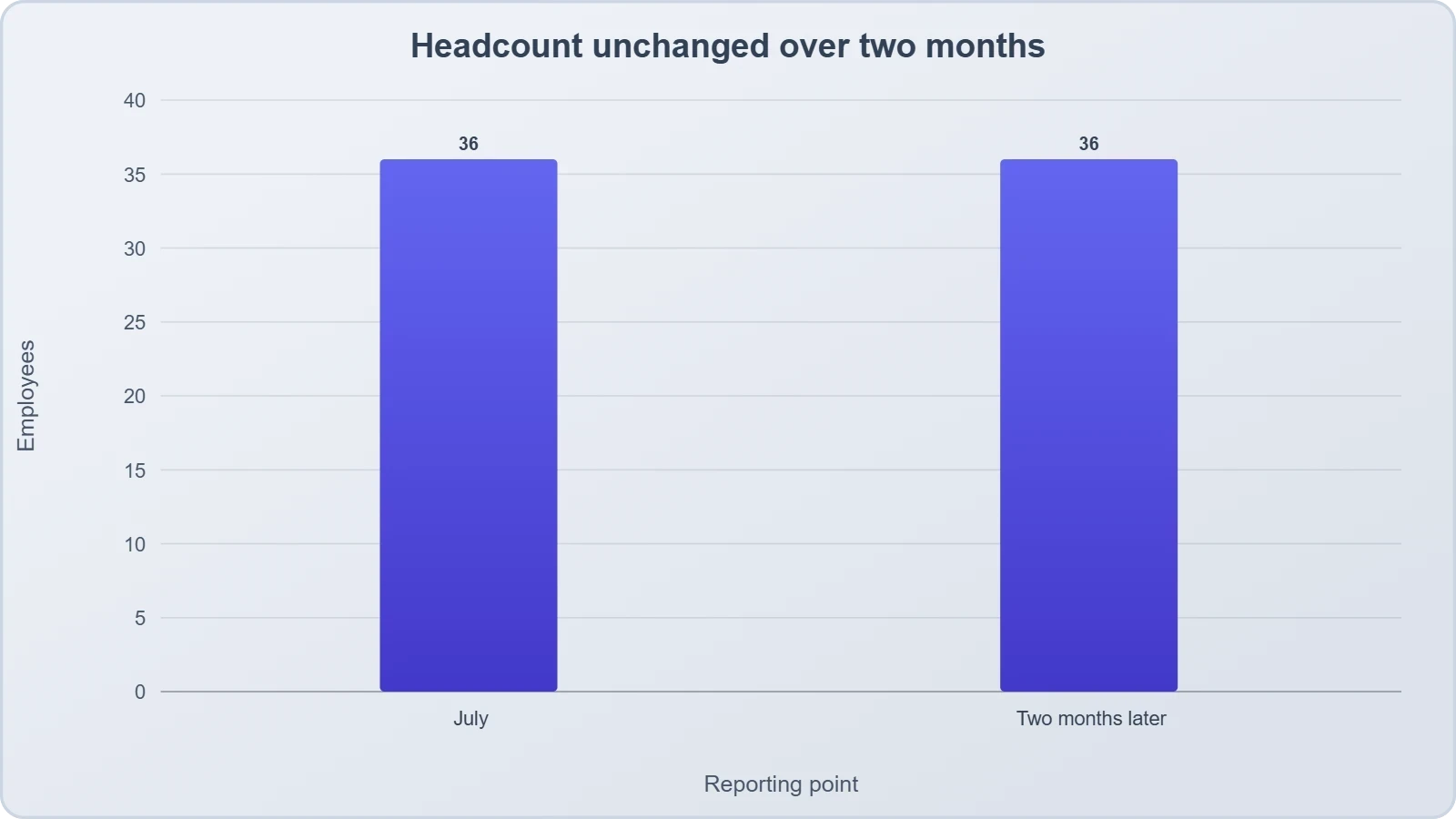
The catalyst for the current scrutiny was the extraordinary case of former Lotto presenter Russell Harrison, who reportedly received roughly NZ$500,000 across a five-year suspension by the Ministry of Justice before being dismissed in June following a guilty plea to money laundering. Public Service Minister Paul Goldsmith responded in August with a directive that agencies should actively manage such cases and make timely decisions with taxpayers in mind. Yet two months later, the count of employees on paid suspension or special leave stood unchanged at 36, a stubborn plateau that suggests directives alone do not easily dislodge entrenched administrative habits.
What follows examines the structural, legal, and ethical dimensions of this episode: how paid leave accumulates, why agencies hesitate to act, what the Public Service Commission and chief executives are now being asked to do, and what the wider pattern across police, corrections, and social services reveals about accountability in the public sector. The story is less about one notorious suspension than about the machinery that allows inertia to become expensive, and about whether the state can govern its own workforce with the discipline it demands of everyone else.
On This Page
TL;DR New Zealand's public service still had 36 employees on paid suspension or special leave as of September, unchanged from July despite an August directive from Public Service Minister Paul Goldsmith to actively manage such cases. The directive followed revelations that former Lotto presenter Russell Harrison received about NZ$500,000 over a five-year suspension before his dismissal for money laundering. Police, Corrections, Oranga Tamariki, and the Ministry of Justice all report long-running paid leave cases, some exceeding two years. The Public Service Commission argues active management does not automatically mean stopping pay, while the Taxpayers' Union insists agencies must be held to the same standard of urgency.
The Anatomy of Paid Suspension in Public Employment
Paid suspension is a legitimate instrument of public-sector management, not an abuse in itself. When an employee faces serious allegations, an employer may need to remove them from the workplace to protect colleagues, preserve evidence, or avoid interference with an investigation. Employment law in New Zealand, as in most common-law jurisdictions, generally requires that an employee receive pay while suspended unless the contract or a statute provides otherwise, because suspension is an employer-initiated act rather than a voluntary absence. The difficulty arises when a temporary protective measure hardens into an indefinite arrangement with no visible endpoint.
The figures released under the Official Information Act illustrate how quickly the temporary becomes the prolonged. Thirty-six public service employees were on paid suspension or special leave in July, and the same number remained two months later. That stasis is the crux of the controversy: it is not that suspensions exist, but that the machinery for resolving them appears to move at a pace disconnected from the cost accumulating on the public ledger. Each month of delay converts a defensible precaution into a question about managerial competence and political will.
Why Suspensions Persist Beyond Their Purpose
Several forces conspire to extend paid leave well beyond its original rationale. Investigations may depend on police processes, prosecutions, or external reviews that agencies cannot control, and employers are often advised by legal counsel to avoid action that could prejudice a criminal case or expose the Crown to personal grievance claims. Senior managers may also lack appetite for difficult decisions that could attract media attention or union challenge. The result is a kind of administrative inertia in which the safest personal choice for a manager, doing nothing, becomes the most expensive choice for the public.
Employment relations scholar Bernard Salt has observed that public institutions tend to optimise for procedural safety rather than outcomes, and paid suspension is a textbook illustration. The employer avoids the risk of a wrongful dismissal claim by keeping the person on the payroll, while the employee retains income and the investigation drifts. Nobody in the chain is individually reckless, yet the aggregate outcome is a system that pays people not to work for years. The Harrison case, at five years and roughly half a million dollars, is the extreme expression of a logic that operates more quietly across dozens of other files.
The Legal Tightrope Between Duty and Delay
New Zealand employment law imposes an implied duty of good faith on both parties, and the Employment Relations Act expects employers to act promptly and fairly when allegations arise. Delay is not neutral: it can itself constitute a breach of good faith, and employees who languish on suspension may have grounds to challenge the process. Agencies therefore face a genuine legal tightrope. Acting too quickly risks procedural error and costly remedies; acting too slowly risks breaching the duty of mutual trust and confidence while the public purse absorbs the cost. The correct path is timely investigation with clear milestones, not indefinite limbo.
The Public Service Commission's position reflects this tension. A spokesman noted that active management does not necessarily mean stopping pay for those on long-term suspension, which is legally accurate but politically unsatisfying. The law protects the employee's income during a suspension the employer imposed; it does not require the employer to let the process stagnate. The distinction matters because it locates the failure not in the payment itself but in the absence of a disciplined timetable for resolving the underlying allegation. Reform should therefore target process velocity rather than the principle of paid suspension.
The Harrison Precedent and the Ministerial Directive
The Russell Harrison affair transformed a quiet administrative issue into a public controversy. Harrison, a former Lotto presenter, was suspended by the Ministry of Justice after being charged with delivering gold bullion to a gang boss in Turkey, and he remained on paid leave for approximately five years before pleading guilty to money laundering and being dismissed in June. The duration and the sum involved, roughly NZ$500,000, made the case a natural emblem of everything critics find wrong with public-sector discipline. It also gave the minister a concrete mandate to demand change, because the facts were difficult to defend on any reading of stewardship.
Public Service Minister Paul Goldsmith's August directive was carefully worded but unmistakable in intent. He argued that paying someone for five years without work cannot be justified and that agencies should make timely decisions with taxpayers in mind. The directive did not purport to ban paid suspension or dictate outcomes; it sought to change the culture of management so that cases are actively driven toward resolution. That distinction is important, because it frames the problem as one of executive attention rather than legal constraint, and it places responsibility squarely on chief executives rather than on the minister himself.
Reading the Directive's Practical Intent
The directive's practical intent is best understood as a demand for visible ownership. It asks agencies to treat long suspensions as management failures in waiting, requiring senior oversight, documented milestones, and a clear path to resolution. In effect, it imports private-sector discipline into a public setting without altering the underlying employment law. The minister's language about taxpayers signals that the standard is not merely procedural regularity but value for money, a criterion that public managers are sometimes slower to internalise than their private counterparts, who face profit-and-loss consequences for prolonged idleness.
Critics might argue that a directive without enforcement is merely rhetoric, and the unchanged count of 36 employees two months later lends that critique some force. Yet directives can shift behaviour over time by establishing expectations that chief executives must answer for. The Public Service Commission's confirmation that the number had not moved is therefore both a political embarrassment and a useful baseline. It allows the public to measure whether the new emphasis on active management produces tangible movement in the months ahead, rather than simply generating another round of assurances.
Commissioner Roche's Sixty-Day Review
Public Service Commissioner Sir Brian Roche has asked chief executives to review every case in which an employee has been paid but not working for more than 60 days, and to ensure each case has senior oversight and a clear path to resolution. The 60-day threshold is a sensible administrative trigger: it is long enough to accommodate genuine investigative complexity but short enough to prevent the drift that characterised the Harrison case. By assigning responsibility to chief executives personally, the review also removes the diffusion of accountability that allows prolonged suspensions to persist without anyone being answerable for them.
The review's success will depend on whether it produces decisions or merely documentation. A clear path to resolution can mean many things, from a disciplinary hearing to a negotiated exit to a return to duty, and the quality of the outcome matters as much as the speed. If agencies respond by generating elaborate case-management paperwork while leaving employees in limbo, the review will have changed appearances rather than substance. The test is whether the number of long-running cases falls materially, and whether the reasons for any remaining cases are transparent enough to withstand public scrutiny.
Police, Corrections, and the Wider Pattern
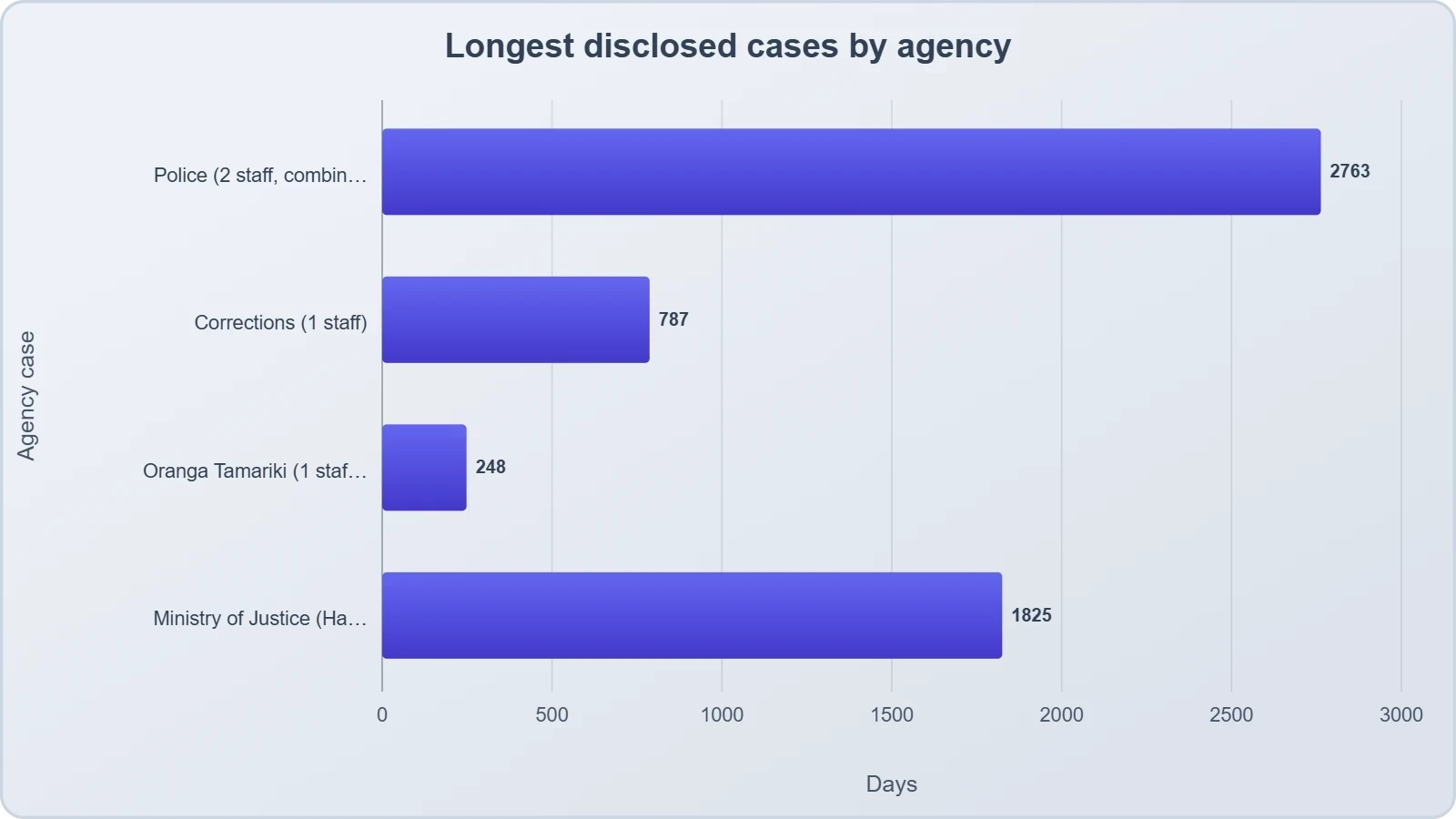
The public service figures are only part of the picture. The released data also showed that two police workers had been on restricted duties or suspension for a combined 2,763 days, more than six years, and that in August police had two staff on restricted duties or suspension for an average of more than three and a half years. In total, 41 police staff were suspended, with an average time on suspension of nearly 300 days. These numbers suggest that the challenge is not confined to a single ministry or a single notorious case but is distributed across agencies with different operational cultures and legal constraints.
Corrections reported six staff on paid special leave for alleged misconduct for more than a year, including one for 787 days. Oranga Tamariki had three staff on paid suspension for more than 150 days, including one at 248 days, while the Ministry of Justice had one employee, excluding Harrison, on paid special leave for 175 days. Each case has its own facts, and none should be prejudged, but the pattern is consistent: allegations arise, protective measures are imposed, and the clock runs while the public pays. The question is whether the pattern reflects unavoidable complexity or avoidable delay.
Comparing Agency Practices and Pressures
Different agencies face different pressures. Police suspensions often intersect with criminal investigations and prosecutions, which can take years to conclude, and restricted duties may be a more proportionate alternative to full suspension. Corrections and Oranga Tamariki deal with vulnerable populations and serious misconduct allegations, where the imperative to remove an employee from contact with the public is strong. The Ministry of Justice handles sensitive court processes. These contextual differences mean that a single uniform rule may be less useful than a common standard of urgency, transparency, and senior oversight applied with judgment to each case.
Yet context can also become a convenient explanation for inaction. The Taxpayers' Union, which obtained the figures, argued that other agencies should receive the same attention as the Harrison case, and its investigative lead, Rhys Hurley, observed that no private-sector employer would keep someone on the payroll for years without them doing their job. That comparison is not perfect, because public agencies face legal and political constraints that private firms do not, but it captures the essential point: prolonged paid idleness is a cost that requires justification, and the justification must be more compelling than the mere existence of an unresolved process.
The Taxpayers' Union and Public Accountability
The Taxpayers' Union has performed a useful function by converting scattered disclosures into a coherent public narrative. Its framing, that agencies should be held to the same standard of urgency as the Harrison case, is a demand for consistency rather than vengeance. The organisation's investigative lead, Rhys Hurley, has emphasised that private employers would not tolerate years of paid non-work, which is a rhetorical simplification but an effective one. The deeper argument is about stewardship: public money is held in trust, and the burden of proof for prolonged expenditure should rest with the agency, not with the public.
Accountability mechanisms in New Zealand are relatively strong, with the Official Information Act, parliamentary questions, and an active media all capable of surfacing uncomfortable facts. The Harrison case became public because it was extreme enough to attract attention, but the dozens of quieter cases only emerged through systematic requests. That asymmetry is itself a lesson: transparency depends on someone asking, and the public interest is best served when agencies publish aggregate data proactively rather than waiting to be probed. Proactive disclosure would also allow comparison over time and reduce the sense that each revelation is a fresh scandal.
The Economics and Ethics of Paying Without Work
The direct fiscal cost of these cases is modest relative to a national budget, but the indirect cost is more significant. Every dollar paid to an employee who is not working is a dollar unavailable for frontline services, and the opportunity cost compounds when cases last for years. More importantly, prolonged paid leave corrodes the perceived fairness of the public service. Citizens who see public employees paid for years of inactivity while they themselves face productivity pressures at work may reasonably question whether the state applies to itself the standards it imposes on others. That legitimacy cost is harder to quantify than the payroll figure but ultimately more damaging.
There is also an ethical dimension that cuts both ways. Employees on suspension are not necessarily culpable; some are later cleared, and the employer's decision to suspend may itself have been premature. The state owes such employees fair treatment, including pay, while the process unfolds. The ethical failure is not the payment but the absence of a timely process, which harms the employee's career and reputation as well as the public purse. A system that resolves cases promptly serves both justice and economy, whereas indefinite suspension serves neither.
Quantifying the Fiscal Drag
Precise aggregate costs are difficult to calculate from the disclosed figures because salary bands vary and not all cases are reported in the same way. A rough estimate can be constructed, however, by multiplying the number of employees on paid leave by an assumed average salary and the duration of leave. If 36 public servants were on paid leave for an average of, say, 200 days at an average salary of NZ$90,000, the annualised cost would be substantial, and the Harrison case alone accounts for roughly NZ$500,000. The point is not the exact figure but the order of magnitude and the fact that the cost is recurring for as long as the cases remain unresolved.
In this expression, ##N## represents the number of employees on paid leave, ##S## the average annual salary, and ##D## the average duration in days. The formula is deliberately simple, but it illustrates why duration is the decisive variable: doubling the average length of a case doubles the cost, whereas a modest reduction in average duration produces immediate savings. It also shows why the 60-day review threshold matters, because it targets the tail of long cases where the marginal cost is highest. Agencies that shorten the tail will capture most of the available fiscal benefit without compromising fairness.
Fairness, Deterrence, and Institutional Trust
Institutional trust is built through consistency. When the public sees a notorious case addressed while quieter cases continue unchecked, the impression is of selective responsiveness rather than principled management. The Taxpayers' Union's call for equal attention across agencies is therefore about fairness as much as money. A credible system would apply the same standard of urgency to a 787-day Corrections case as to the Harrison affair, and would explain publicly why any case remains unresolved beyond a defined threshold. Transparency of that kind would strengthen trust even when individual outcomes are contested.
Deterrence also matters. If employees and their representatives learn that suspension can be prolonged indefinitely without consequence for the employer, the incentive to resolve cases quickly weakens on all sides. Conversely, a clear expectation of timely resolution encourages both parties to prepare their cases and engage with the process. The goal is not to punish employees who are suspended but to ensure that suspension remains a temporary measure with a defined purpose. That requires managerial courage, legal support, and political backing, all of which the current directive and review are attempting to supply.
We Also Published
Reform Pathways and the Road Ahead
Reform need not require new legislation. Much of the improvement can come from better management practice: mandatory case reviews at defined intervals, senior executive ownership of every long-running case, clear communication with employees about timelines, and proactive publication of aggregate data. The Public Service Commission's 60-day review is a step in this direction, but it should be embedded in routine practice rather than treated as a one-off exercise. Agencies could also adopt a presumption that any suspension exceeding a set period requires written justification to the chief executive and a documented plan for resolution, creating accountability without sacrificing flexibility.
There is also a case for greater consistency across agencies. A shared framework for managing suspensions, developed by the Commission in consultation with agencies and unions, would reduce the variation that currently allows some cases to drift while others are resolved. Such a framework could specify expected timeframes for investigation stages, the circumstances in which restricted duties are preferable to suspension, and the reporting obligations that apply when cases exceed thresholds. Consistency would make the system fairer for employees and more defensible for the public, and it would make outliers like the Harrison case easier to identify early.
Designing a Timely Resolution Framework
A well-designed framework would begin with a rapid triage decision: is suspension necessary, and if so, for what purpose and for how long? It would then set milestones for investigation, decision, and any appeal, with named owners for each stage. Escalation triggers would ensure that cases exceeding the milestones reach the chief executive and, where appropriate, the Commission. The framework should also require agencies to consider alternatives such as reassignment or restricted duties, which may achieve the protective purpose at lower cost and with less disruption to the employee's career. Finally, it should mandate publication of anonymised aggregate data so that progress can be tracked publicly.
Such a framework would not eliminate hard cases, but it would make them visible and time-bound. The experience of other jurisdictions suggests that the biggest gains come from simply forcing regular review, because review creates a moment at which someone must decide whether to continue, resolve, or escalate. The 60-day threshold is a reasonable starting point, but agencies might adopt shorter intervals for less complex matters. The essential principle is that no case should continue by default; continuation should require an affirmative decision with reasons, recorded and reviewable.
What Citizens and Watchdogs Should Watch
Citizens and watchdog organisations should track three indicators over the coming year: the number of employees on paid suspension or special leave, the average duration of cases, and the proportion of cases exceeding the 60-day threshold. A falling headcount combined with falling duration would indicate genuine progress, whereas a stable headcount with rising duration would suggest that cases are being resolved only at the margins. Public reporting of these indicators, ideally quarterly, would allow the public to judge whether the directive and the review are producing results rather than merely generating activity.
The Taxpayers' Union and similar organisations will continue to play a role by requesting data and highlighting anomalies, but their effectiveness depends on the quality of disclosure. Agencies that publish aggregate figures proactively will find themselves under less adversarial scrutiny and will build credibility with the public. The ultimate test is whether the public service can demonstrate that it treats taxpayer money with the same care it expects of the citizens who fund it. That is a standard of stewardship, not of punishment, and it is achievable with disciplined management rather than dramatic reform.
Conclusion: Stewardship Over Symbolism
The New Zealand paid leave controversy is ultimately a story about stewardship. The state asks citizens to trust it with their money, and that trust is sustained by visible evidence of careful management. Thirty-six employees on paid suspension or special leave, unchanged two months after a ministerial directive, is not a catastrophic figure, but it is a revealing one. It suggests that good intentions at the political level do not automatically translate into decisions at the operational level, and that the gap between directive and outcome is where accountability lives or dies.
The Harrison case provided the spark, but the embers were already there. Police, Corrections, Oranga Tamariki, and the Ministry of Justice all reported long-running cases, and the Taxpayers' Union's comparison with private-sector practice, however simplified, captured a genuine public sentiment. The remedy is not to abandon paid suspension, which serves legitimate protective purposes, but to ensure that it remains temporary, purposeful, and subject to regular review. Commissioner Roche's 60-day review and the minister's directive are the right instruments; the question is whether they will be used with the persistence that the problem demands.
From our network :
- CISA’s Ten-Advisory Wave: Why Generic Patching Fails in OT and How to Build Product-Specific PlaybooksCISA released ten ICS advisories in one week, exposing critical infrastructure risks. Generic patching fails in OT. Learn to build product-specific remediation playbooks.
- Committed Mediterranean Precipitation Decline: Why Emissions Cuts Alone Cannot Restore Winter RainsNew NOAA research reveals that Mediterranean winter rains may decline irreversibly even with emissions cuts. Explore the science of committed climate change and regional impacts.
- How AI Agents Will Change the Way We Manage Personal FinancesExplore how AI agents are transforming personal finance through automated budgeting, bill payment, and investment management, while examining the critical security protocols and governance frameworks required for safe deployment.
- Live Online English Classes for Kids: Do They Actually Reduce Anxiety?A ten-week study reveals that synchronous online English classes can significantly reduce child language anxiety while improving listening and reading skills. Discover what makes these programs effective and how parents can select the right one.
- University Language Proficiency Exams: Why Institutional Tests Demand Different Preparation Than IELTS and TOEFLDiscover why university-specific language proficiency examinations differ fundamentally from IELTS and TOEFL, and learn strategic preparation approaches for institutional assessment success.
- Forbidden Matrix Patterns and Visible Lattice Points: A Geometric DictionaryExplore how multidimensional 0–1 matrices encode geometric truths, linking forbidden patterns to visible lattice points and hypergraph theory, with applications in combinatorics and computational geometry.
- Mobile Learning and VR in English: What Global Evidence Reveals About Effective Language TechnologyA systematic review across 14 countries reveals which language-learning technologies genuinely work. Mobile learning, AI, and VR show measurable benefits when pedagogically integrated. This evidence-based guide helps educators and learners select technology that delivers real return on investment.
- The Final Descent: How ESA Retired the Legendary Cluster Constellation After 24 Years of Space Weather ScienceAfter 24 years mapping Earth’s magnetosphere, ESA’s Cluster mission concluded with a precisely controlled reentry over the South Pacific. This analysis explores the scientific legacy, engineering decisions, and debris mitigation principles behind one of space exploration’s most responsible retirements.
- The Hidden Cost of AI Convenience: Why Over-Permissioned Agents Are a Security Time BombDiscover why AI agents with excessive permissions create dangerous single points of failure, and learn how implementing least privilege principles can protect your organization from exploitation.
RESOURCES
- Suspension - Employment New Zealandemployment.govt.nzMay 21, 2024 ... Leave and holidays. Employees are entitled to annual holidays, public holidays, sick leave, bereavement leave ... Leave without payLeave without ...
- Dozens of public servants on paid gardening leave – some for yearsnzherald.co.nz4 hours ago ... There are dozens of public servants suspended on full pay, a handful of them for longer than a year, the…
- Leave in lieu of notice | Employment New Zealandemployment.govt.nzJan 13, 2025 ... Leave in lieu of notice. An agreed period when an employee remains employed and receives full pay but does not…
- Policy – TCN: Suspension, Leave, and Absences - The Corps Networkcorpsnetwork.orgExample: If members are paid twice a month and enrolled in a 900hr, six month term of service, and the total living allowance is…
- Employment Court pauses disciplinary process against man ...thelawyermag.comAug 11, 2026 ... The New Zealand Employment Court has issued an interim injunction in favour of an employee suspended by the Public Service…
- Faculty Misconduct and Discipline (2005) | AAUPaaup.orgFor example, a New Jersey statute provides that no tenured professor in a public ... public employee without pay and failed to provide a…
- Frequently Asked Questions | CA Child Support Serviceschildsupport.ca.govDriver's License Suspension; How to Access Your Customer Connect Account; International/Out of State Cases; Legal and Family Law; Making ...
- The Financial Administration Act: Responding to Non-compliancetbs-sct.canada.caOct 25, 2005 ... Jurisdiction: Saskatchewan. Legislation and Regulations. Public Service Act. A permanent head may suspend an employee without pay for ...
- Driver compliance limited license | Minnesota Department of Public ...dps.mn.gov... suspension or revocation will inform you how long your driving privileges are withdrawn. Only one limited license is allowed in a 24-month period.…
- Public Service Act 2020 | New Zealand Legislationlegislation.govt.nzAug 6, 2020 ... allowances payable to employees serving outside New Zealand; or ... the recovery of holiday pay or leave pay. (2). Section…
- Suspending KiwiSaver deductions and contributions - Inland Revenueird.govt.nzJan 16, 2025 ... New employees with a savings suspension · deduct KiwiSaver contributions from their pay · pay compulsory employer contributions and employer ...
- Employment Relations Act 2000 | New Zealand Legislationlegislation.govt.nzAug 19, 2000 ... Part 7 Employment relations education leave. 70 Object of this Part. The object of this Part is to provide paid…
- Handling an Employee's Arrest or Incarceration | Wolters Kluwerwolterskluwer.comIf the employee's job did not entail public contact in isolated areas, perhaps suspension would not be necessary. ... employees to take personal leave…
- New Zealand travel advicetravel.gc.caOct 15, 2026 ... The Government of New Zealand maintains a public ... Your passport must be valid for at least 3 months beyond…
- Help for Boards - GovHub Resource Centreresourcecentre.org.nzStudent behaviour management, suspension meetings, and more. State ... New Zealand School Boards Association. Level 8 - 142 Lambton Quay, Wellington.
- 01
- 02
- 03
- 04
- 05
- 06
- 07
- 08
0 Comments