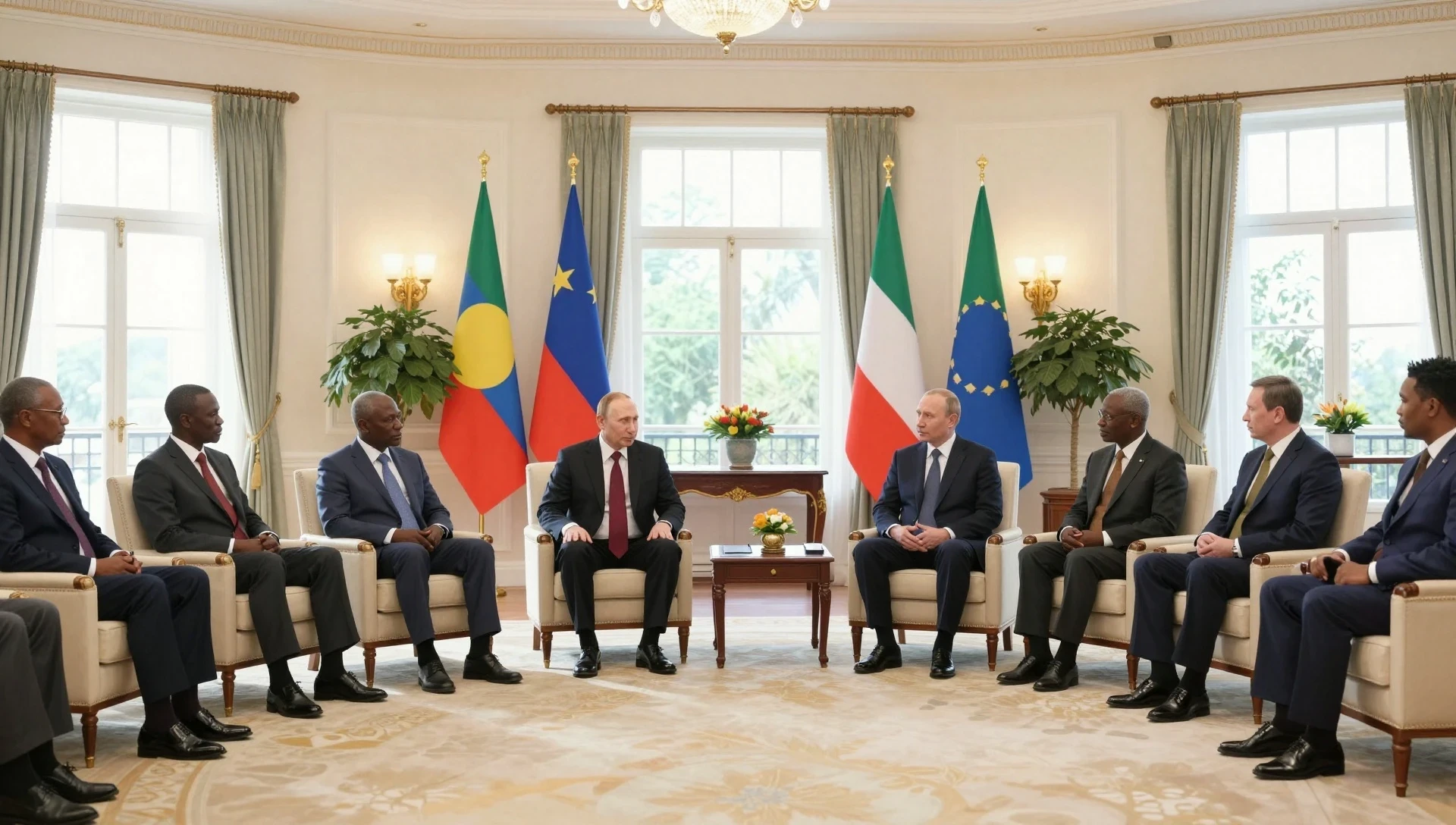
Vladimir Putin's remark to Togo's Prime Minister Faure Gnassingbe at the Kremlin carries more analytical weight than its casual phrasing suggests. When Gnassingbe observed that the Russian president looked fresher than his own exhausted delegation, Putin deflected with a proverb: time spent with friends, he said, is not counted against one's age.
The exchange, reported by TASS, occurred during the Russia-Africa Summit in Moscow, a diplomatic gathering whose scheduling density reveals as much about Russian strategy as any communiqué issued from it.
The summit's calendar is the substantive story. After Thursday's plenary session, Putin held bilateral talks with the leaders of Namibia, the Republic of the Congo, Burundi and Kenya that ran until nearly midnight.
On This Page
Friday brought a second sequence involving Sudan, Madagascar, Ghana, Mali, South Sudan, the Central African Republic, the Democratic Republic of the Congo and Togo. Twelve African heads of state in roughly forty-eight hours constitutes an unusual concentration of presidential attention, and the proverb functions as a diplomatic instrument within that schedule.
Read closely, the anecdote describes a working method rather than a personality trait. Putin's stamina is presented as evidence of commitment to African partnerships, and the "friends" framing converts a gruelling itinerary into a narrative of voluntary engagement.
This analysis examines the exchange's rhetorical mechanics, the summit's bilateral architecture, and the wider contest for influence across the continent.
TL;DR At the Russia-Africa Summit in Moscow, Vladimir Putin told Togo's Prime Minister Faure Gnassingbe that time spent with friends does not count toward one's age, a proverb deployed after a punishing schedule of bilateral meetings. The remark is best read as diplomatic signalling: it reframes twelve African leadership meetings across two days as voluntary friendship rather than transactional diplomacy. The summit's density, the composition of the guest list, and the proverb's rhetorical function together illuminate Russia's approach to African partnerships.
The Proverb as Diplomatic Instrument
The exchange between Putin and Gnassingbe follows a recognisable diplomatic pattern in which a visiting official offers a compliment and the host converts it into a statement of relationship. Gnassingbe's observation that Putin appeared less tired than his delegation was courteous but also implicitly acknowledged the asymmetry of the schedule.
Putin's reply redirected the compliment toward the African guests themselves, framing their presence as restorative rather than demanding.
Proverbs occupy a specific place in Russian political communication. They signal informality, imply shared wisdom, and allow a speaker to make a claim without appearing to boast. The saying that time with friends is not counted against one's age performs all three functions simultaneously. It converts visible fatigue into evidence of enjoyment and converts a diplomatic obligation into a personal choice.
The rhetorical effect depends on the listener accepting the premise of friendship. Gnassingbe, as the recipient, was positioned as a friend rather than a negotiating counterpart. That positioning matters in the context of sanctions and Western isolation, where Russia benefits from presenting its African relationships as warm and voluntary. The proverb does the work that a policy statement could not do without appearing defensive.
Timing amplifies the effect. The remark came after Thursday's marathon of talks and before Friday's second wave of meetings. By describing the schedule as time with friends, Putin pre-empted any reading of the summit as an exhausting obligation.
The framing also travelled: TASS reported the exchange, ensuring the proverb reached audiences beyond the room where it was spoken.
The Compliment and Its Reciprocation
Gnassingbe's thanks for Putin's "availability and patience" was more than courtesy. It acknowledged that the Russian president had granted time to a large number of delegations and had done so without visible impatience.
The phrasing also implicitly compared Putin's demeanour with that of the visiting delegation, which had endured the same schedule and looked worse for it.
Putin's response accepted the compliment but redistributed it. Rather than claiming personal stamina, he attributed his energy to the company of African friends. The move is characteristic of summit diplomacy, where hosts seek to demonstrate that relationships are substantive rather than ceremonial. It also placed the African leaders in the role of benefactors rather than supplicants.
The exchange therefore functioned as a small piece of status management. Gnassingbe offered deference; Putin returned recognition. Neither side conceded anything material, yet both emerged with their positions enhanced. Such micro-exchanges rarely appear in formal records, but they shape the atmosphere in which subsequent negotiations occur.
Analysts of diplomatic language note that reciprocity rituals matter most where power is unequal. Togo is a small state; Russia is a permanent member of the UN Security Council. By framing the meeting as friendship, Putin softened the asymmetry without denying it. The proverb allowed both leaders to occupy the same conversational plane for a moment.
Why Proverbs Travel Well
Proverbs are portable. They survive translation, require no context, and can be repeated by journalists without distortion. The Russian saying about friends and age fits neatly into a headline and carries a warm tone that policy language cannot match. TASS's decision to report the exchange suggests the agency recognised its communicative value.
The proverb also carries cultural authority. Quoting folk wisdom signals that the speaker is rooted in a national tradition rather than speaking in the technocratic register of summit declarations. For an audience sceptical of Western diplomatic formulas, that register can be appealing. It suggests authenticity, or at least the performance of it.
There is a practical dimension as well. A proverb allows a leader to make a claim about relationships without specifying commitments. Putin did not say what Russia would deliver to Africa; he said he enjoyed the company. The statement is warm, memorable and entirely non-binding, which is precisely what summit atmospherics require.
The risk is that proverbs can read as evasion when audiences expect substance. If African partners seek investment, grain shipments or security cooperation, a saying about friendship may satisfy no one. The proverb's success therefore depends on what follows it in the bilateral agenda, not on its own charm.
Reading the Room Through the Schedule
The schedule itself is a text. Thursday's talks with Namibia, the Republic of the Congo, Burundi and Kenya ran until nearly midnight, indicating that the Russian side was willing to absorb fatigue to accommodate African leaders.
Friday's sequence added Sudan, Madagascar, Ghana, Mali, South Sudan, the Central African Republic, the Democratic Republic of the Congo and Togo.
That list spans regions and resource profiles. Kenya and Ghana are significant economies; Mali, Sudan and the Central African Republic have security relationships with Russian actors; Madagascar and Togo represent smaller partners. The breadth suggests a strategy of maintaining presence across the continent rather than concentrating on a few high-value relationships.
Late-night scheduling is itself a diplomatic signal. It communicates that the host will not cut meetings short and that African leaders are not being processed in batches. Whether that signal translates into concrete outcomes is a separate question, but the optics are deliberate. The proverb about friends and age gave the optics a memorable caption.
For African leaders, the summit offered visibility and the chance to press specific interests. For Russia, it offered a demonstration that isolation is incomplete. The exchange with Gnassingbe, small as it was, served both purposes by presenting the relationship as warm, voluntary and mutually valued.
We Also Published
The Architecture of the Russia-Africa Summit
The Russia-Africa Summit is a relatively recent instrument of Russian foreign policy, first convened in Sochi in 2019 and repeated in St Petersburg in 2023. Its format mirrors other continental engagement platforms, combining a plenary session with a dense programme of bilateral meetings.
The Moscow gathering reported here continues that template, with the Kremlin serving as the venue for the bilateral track.
The summit's value to Russia lies partly in numbers. A large African turnout demonstrates that Western efforts to isolate Moscow have not succeeded uniformly. Each bilateral meeting produces a photograph, a statement and a line in the official record.
Cumulatively, these artefacts build an image of Russia as a global power with a constituency beyond Europe and North America.
For African states, the calculus is more varied. Some seek arms and security assistance; others want grain, fertiliser or energy cooperation; still others value the diplomatic option that Russia represents in multilateral forums. The summit provides a single venue where these disparate interests can be pursued. The density of the schedule reflects the breadth of that demand.
The bilateral format also allows Russia to tailor its messaging. A meeting with Kenya or Ghana will emphasise trade and investment; a meeting with Mali or the Central African Republic will emphasise security. The proverb about friends and age works across all these contexts because it makes no specific claim. It simply establishes warmth, leaving the substance to be negotiated.
From Sochi to Moscow: Continuity and Change
The first Russia-Africa Summit in 2019 was a landmark, bringing dozens of African leaders to Sochi and producing a raft of agreements. The 2023 St Petersburg edition occurred under different conditions, with the war in Ukraine shaping perceptions and complicating logistics. The Moscow meetings described here belong to that later phase, where the emphasis has shifted toward consolidation.
Continuity is visible in the format: plenary first, bilaterals second, with the Kremlin as the symbolic centre. Change is visible in the atmosphere. Sanctions and Western pressure have made some African governments more cautious about visible alignment with Moscow, even as others have deepened security ties. The summit must manage both tendencies simultaneously.
The Gnassingbe exchange illustrates how that management works in practice. Togo is not a major security partner for Russia, nor a large economy. Its prime minister's presence nonetheless matters because it adds to the count of African states engaging Moscow. The warm exchange converts a routine meeting into a visible symbol of partnership.
Over successive summits, the bilateral track has become the substantive core. Plenary sessions produce declarations; bilaterals produce deals, memoranda and understandings. The late-night scheduling reported by TASS suggests that the Russian side understands where the real work happens. The proverb was spoken in that working context, not in the plenary hall.
Sanctions, Isolation and the Optics of Friendship
Western sanctions imposed after 2022 were intended in part to reduce Russia's international engagement. Summits with large African participation complicate that objective. Every leader who travels to Moscow and appears alongside Putin is a data point against the isolation thesis. The optics therefore carry strategic weight beyond the meetings' formal content.
This is why the tone of the exchanges matters. A stiff, transactional meeting would still count in the ledger, but a warm exchange reported by state media counts more. The proverb about friends and age is a small asset in that campaign. It presents Russia as a country with friends, not a pariah seeking clients.
Critics note that warmth in photographs does not necessarily translate into material support. African leaders may attend summits while hedging their diplomatic bets. The gap between atmospherics and outcomes is real, and analysts should be cautious about reading too much into a single exchange. The proverb is evidence of intent, not of results.
Still, intent matters in diplomacy. A host who schedules twelve bilaterals in two days and jokes about stamina is signalling that Africa ranks high on the agenda. Whether that ranking survives contact with budgetary constraints is a question for the follow-up record. The summit's communiqués and subsequent agreements will provide the test.
What the Exchange Reveals About Summit Diplomacy
Summit diplomacy operates on two levels simultaneously. The formal level produces declarations, agreements and joint statements that can be cited in policy documents. The informal level produces photographs, anecdotes and quotable remarks that shape public perception.
The Putin–Gnassingbe exchange belongs firmly to the second level, but its effects can be as durable as any signed document.
Quotable remarks travel further than communiqués. A proverb about friends and age can be repeated in a headline, shared on social media and remembered long after the summit's technical annexes are forgotten. For a host seeking to project warmth, that portability is an asset. For analysts, it is a reminder that atmospherics are part of the diplomatic record.
The exchange also illustrates the role of small states in large summits. Togo's prime minister was one of many African leaders present, but his meeting produced a memorable moment. Small states can punch above their weight in summit settings by providing the human colour that larger, more scripted encounters lack. Gnassingbe's compliment and Putin's reply were unscripted enough to feel authentic.
Finally, the exchange shows how leaders manage the perception of fatigue. Politics places a premium on visible energy, and a president who appears fresh after twelve meetings projects competence. By attributing his energy to friendship, Putin converted a physical fact into a political statement. The proverb did the work of a press release in a single sentence.
Language, Translation and Reception
The proverb reached international audiences through translation, which inevitably smooths its edges. Russian sayings about time and friendship carry connotations that English renderings cannot fully capture. The version reported by TASS emphasises the idea that time with friends is not counted against one's age, a formulation that lands well in most languages.
Translation also affects how the remark is received. Audiences sceptical of Russian diplomacy may read the proverb as calculated charm; audiences sympathetic to Moscow may read it as genuine warmth. The same words support both readings, which is part of their utility. Ambiguity allows each audience to hear what it expects.
State media played a role in shaping reception by choosing to report the exchange at all. TASS could have focused exclusively on the substance of the bilaterals. Its decision to include the proverb indicates that the agency judged the human-interest angle worth amplifying. That editorial choice is itself a form of messaging.
For researchers, the lesson is that summit coverage should be read at multiple levels. The formal record and the reported anecdotes together constitute the event. Ignoring either produces an incomplete picture. The proverb is not a distraction from the summit's substance; it is part of how that substance is framed.
Friendship Rhetoric and Material Interests
Friendship rhetoric in diplomacy is rarely disinterested. When leaders describe their relationships in personal terms, they are usually preparing the ground for requests. Russia's African partnerships involve arms sales, grain exports, energy projects and diplomatic support in multilateral forums. Warm language makes those transactions easier to conduct.
The reverse is also true. Material cooperation can generate genuine goodwill, which then finds expression in friendly rhetoric. The relationship between language and interest runs in both directions. Analysts should therefore treat the proverb neither as pure decoration nor as cynical manipulation, but as one element in a complex exchange.
African leaders have their own reasons for participating in friendship rhetoric. It signals that their states are valued partners rather than passive recipients of aid. In domestic politics, a photograph with a major power's president can be useful. The warmth of the exchange serves both sides, which is why such moments recur across summits.
The test of friendship rhetoric is what follows it. If the Moscow meetings produce agreements on grain, security cooperation or investment, the proverb will look prescient. If they produce only photographs, it will look like what critics call it: atmospherics without substance. The follow-up record will settle the question.
Assessing the Summit's Significance
The Moscow summit's significance will be judged over months rather than days. Twelve bilateral meetings in two days create a dense set of expectations, and the follow-up will determine whether those expectations are met. The proverb about friends and age will be remembered, but it will not substitute for deliverables.
For Russia, the summit's primary value is symbolic: it demonstrates continued engagement with a continent of growing strategic importance. For African states, the value is more concrete: access to a major power willing to discuss security, food and energy. The two sets of interests overlap but are not identical.
The exchange with Togo's prime minister captures that overlap neatly. Gnassingbe thanked Putin for his time; Putin thanked him for his friendship. Both statements were true enough to be useful and vague enough to commit neither side. That is the essence of summit diplomacy, and it is why such moments are reported and remembered.
Analysts should watch three indicators in the coming months: the number of agreements actually signed, the pace of follow-up visits, and the tone of African statements in multilateral forums. If all three move in Moscow's favour, the proverb will look like an early signal of a deepening relationship. If they do not, it will remain a pleasant anecdote.
Conclusion: A Small Remark in a Large Strategy
The proverb Putin offered to Togo's prime minister is a minor event in a major diplomatic campaign. Its interest lies in what it reveals about method: the use of warmth to soften asymmetry, the conversion of fatigue into commitment, and the deployment of folk wisdom to make a political point memorable. These techniques are not unique to Russia, but they are used with consistency.
For readers of summit coverage, the exchange is a reminder to read both the formal and informal records. The bilaterals with twelve African leaders constitute the substance; the proverb constitutes the framing. Together they describe a diplomatic moment more fully than either could alone. That is the analytical value of paying attention to small remarks.
The Russia-Africa Summit will be judged by what it produces, not by what it says. But what it says shapes how what it produces is received. The proverb about friends and age will circulate long after the technical annexes are filed.
Whether it is remembered as a charming aside or as the opening line of a deeper partnership depends on the record that follows.
From our network :
- CISA’s Ten-Advisory Wave: Why Generic Patching Fails in OT and How to Build Product-Specific PlaybooksCISA released ten ICS advisories in one week, exposing critical infrastructure risks. Generic patching fails in OT. Learn to build product-specific remediation playbooks.
- How AI Agents Will Change the Way We Manage Personal FinancesExplore how AI agents are transforming personal finance through automated budgeting, bill payment, and investment management, while examining the critical security protocols and governance frameworks required for safe deployment.
- Mobile Learning and VR in English: What Global Evidence Reveals About Effective Language TechnologyA systematic review across 14 countries reveals which language-learning technologies genuinely work. Mobile learning, AI, and VR show measurable benefits when pedagogically integrated. This evidence-based guide helps educators and learners select technology that delivers real return on investment.
- University Language Proficiency Exams: Why Institutional Tests Demand Different Preparation Than IELTS and TOEFLDiscover why university-specific language proficiency examinations differ fundamentally from IELTS and TOEFL, and learn strategic preparation approaches for institutional assessment success.
- Live Online English Classes for Kids: Do They Actually Reduce Anxiety?A ten-week study reveals that synchronous online English classes can significantly reduce child language anxiety while improving listening and reading skills. Discover what makes these programs effective and how parents can select the right one.
- The Hidden Cost of AI Convenience: Why Over-Permissioned Agents Are a Security Time BombDiscover why AI agents with excessive permissions create dangerous single points of failure, and learn how implementing least privilege principles can protect your organization from exploitation.
- Forbidden Matrix Patterns and Visible Lattice Points: A Geometric DictionaryExplore how multidimensional 0–1 matrices encode geometric truths, linking forbidden patterns to visible lattice points and hypergraph theory, with applications in combinatorics and computational geometry.
- The Final Descent: How ESA Retired the Legendary Cluster Constellation After 24 Years of Space Weather ScienceAfter 24 years mapping Earth’s magnetosphere, ESA’s Cluster mission concluded with a precisely controlled reentry over the South Pacific. This analysis explores the scientific legacy, engineering decisions, and debris mitigation principles behind one of space exploration’s most responsible retirements.
- Committed Mediterranean Precipitation Decline: Why Emissions Cuts Alone Cannot Restore Winter RainsNew NOAA research reveals that Mediterranean winter rains may decline irreversibly even with emissions cuts. Explore the science of committed climate change and regional impacts.
RESOURCES
- Africa and summit diplomacy: global powers turn on the charmissafrica.orgApr 12, 2023 ... The upcoming Russia-Africa Summit in July is the latest in a long list of gatherings by global powers aimed at…
- South Africa grants Putin and Brics leaders diplomatic immunity for ...theguardian.comMay 30, 2023 ... South Africa has issued blanket diplomatic immunity to all leaders attending an August summit, meaning Vladimir Putin might be able…
- How Russia's Hollow Humanitarianism Hurt Its Vaccine Diplomacy ...carnegieendowment.orgApr 28, 2022 ... ... Diplomacy in Africa ... That said, Putin certainly has engaged with African leaders at multilateral summits and during the…
- Russia in Africa: An atlas | Think Tank - European Parliamenteuroparl.europa.euFeb 13, 2024 ... Russia made significant diplomatic efforts to ensure a high turnout at the second Russia Africa summit, held in Saint Petersburg…
- Russia's Growing Footprint in Africa | Council on Foreign Relationscfr.orgDec 28, 2023 ... African governments have increasingly welcomed economic, diplomatic, and security ties with Russia—leading Western countries to denounce ...
- Denis Gonchar meets African diplomats ahead of Russia-Africa ...facebook.comOct 7, 2026 ... ... African diplomats ahead of Russia-Africa summit. Denis Gonchar meets African diplomats ahead of Russia-Africa summit. Summarized by AI from ...
- Russia-Africa summit fails to deliver concrete results - Chatham Housechathamhouse.orgAug 2, 2023 ... African leaders who went to St Petersburg expecting tangible results from Putin's promised new programme of support for Africa will ...
- Russia–Africa Summit 2026: Strategic Signals, Partnerships and ...africansecurityanalysis.com4 days ago ... The third Russia–Africa Summit in Moscow will provide an important indication of how relations between Russia and African states have ...
- Russia-Africa Summit, Why Does the Youth Matter Now?moderndiplomacy.eu3 days ago ... ... Russia-Africa Youth Forum, scheduled at MGIMO University—Russia's principal school of diplomacy. Today, Africa is confidently establishing ...
- The historic engagement of Prime Minister Abiy Ahmed at the 3rd ...facebook.com3 days ago ... ... Russia #Africa #RussiaAfricaSummit #Diplomacy #Economy · 4 · Like ... Putin on the sidelines of the BRICS Summit in…
- What Putin and Kim Want From Each Other - Foreign Policyforeignpolicy.comSep 15, 2023 ... ... diplomatic isolation, crystallized by his absences from the recent G-20 and BRICS (Brazil, Russia, India, China, and South Africa)…
- South Africa's diplomatic dilemma with Putin - DW.comdw.comJun 2, 2023 ... South Africa has invited Vladimir Putin to the BRICS summit. But with an international arrest warrant out for the Russian…
- Moscow is highlighting Africa's growing role in shaping a multipolar ...instagram.com5 days ago ... ... Africa #Russia #AfricanDiplomacy ... Russian President Vladimir Putin shakes hands with an African leader at a Russia–Africa summit.
- Diplomacy in the Context of the Russian Invasion of Ukraineswp-berlin.orgNov 13, 2023 ... Russia's war diplomacy aims to weaken the “collective West” at ... At the Russia-Africa Summit in July 2023, Putin announced…
- Two-Minute Take: Four things to watch from the third Russia-Africa ...bushcenter.orgOct 20, 2026 ... Russia's efforts to cultivate African countries for security, economic, and diplomatic ... Russia-Africa Summit in Moscow. It will gather heads…
- 01
- 02
- 03
- 04
- 05
- 06
- 07
- 08
0 Comments