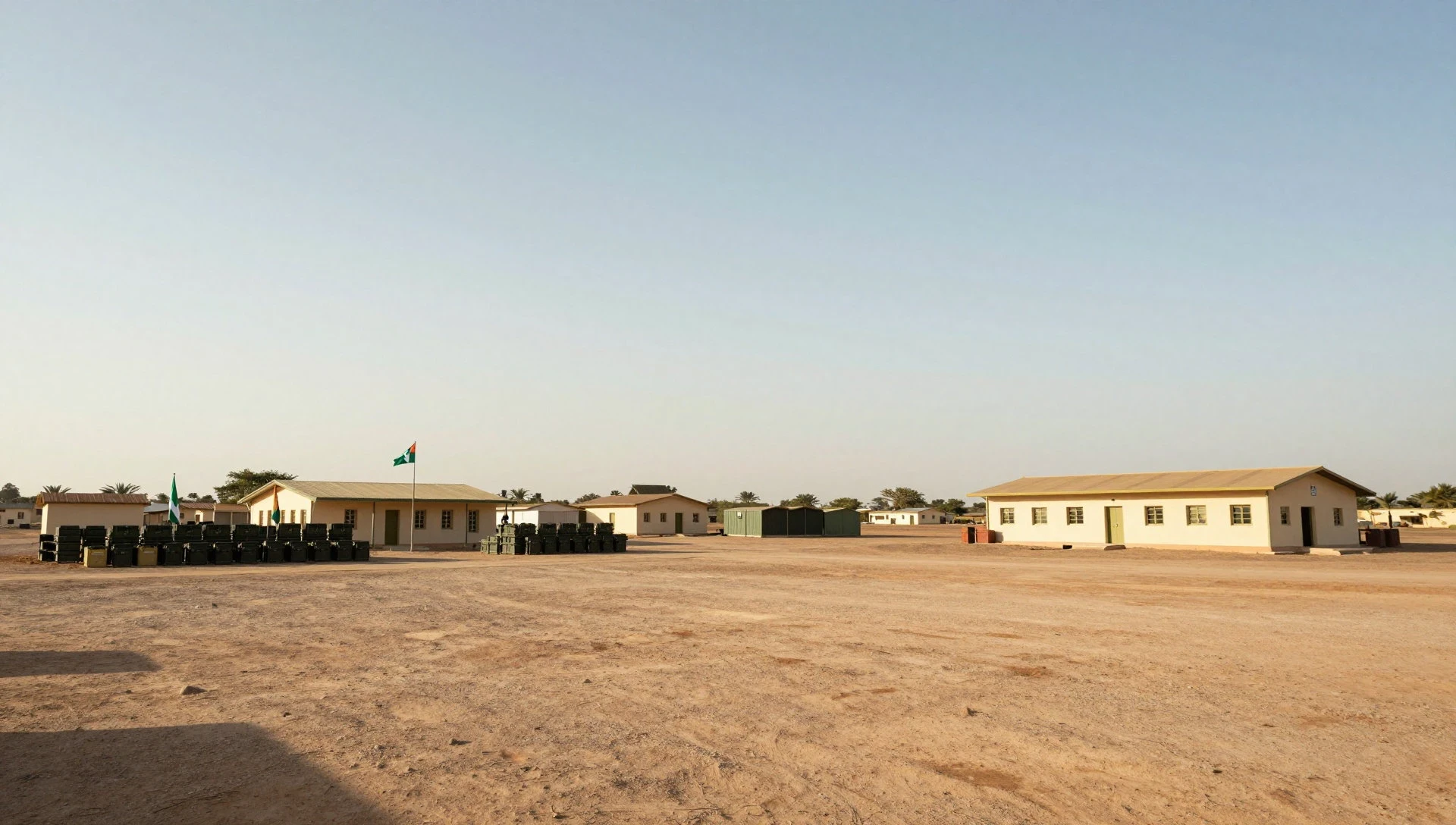
The United Nations has formally closed its political mission in Somalia, ending a continuous engagement that began in the early 1990s and survived civil war, state collapse, piracy, famine and repeated militant offensives.
The United Nations Transitional Assistance Mission in Somalia, known as UNTMIS, ceased operations on Saturday after completing a two-year transition that Mogadishu itself had requested. The closure is not a peace dividend; it is a managed handover executed while the country remains divided politically and at war with al-Shabab.
The mechanics matter more than the ceremony. UNTMIS duties have been dispersed across Somali institutions, residual UN agencies and the UN office supporting African Union troops, under a plan negotiated between the Somali government and the world body.
On This Page
Secretary-General Antonio Guterres welcomed Somalia's institutional progress but cautioned that continued international support remains necessary given political, security and humanitarian pressures. That caveat is the analytical core of the story: the mission is leaving, but the conditions that justified it have not disappeared.
The timing is instructive. President Hassan Sheikh Mohamud's government formally requested withdrawal in 2024, and Deputy Prime Minister Saleh Ahmed Jama described the closure at a Mogadishu farewell ceremony as a "day of victory," declaring that Somalia was leaving behind the "era of transition."
Yet the departure coincides with shrinking donor engagement, contested constitutional arrangements extending the president and parliament to 2027, strained relations with regional leaders, and an unresolved mediation gap that no successor body has been agreed to fill.
TL;DR The UN has closed UNTMIS, its political mission in Somalia, after more than three decades, completing a two-year transition requested by Mogadishu in 2024. Responsibilities now sit with Somali institutions, UN agencies and UNSOS, the office backing African Union troops. The handover arrives as aid funding contracts, al-Shabab remains undefeated, electoral disputes persist and no replacement mediator has been agreed. The closure signals Somali sovereignty gains and simultaneous international disengagement.
The Architecture of a Thirty-Year Engagement
UN political engagement in Somalia was never a single mission but a succession of mandates layered onto a collapsed state. Early operations combined humanitarian relief, ceasefire monitoring and mediation between warlords; later iterations added state-building, constitutional support and electoral facilitation.
Each renewal reflected a bargain: the UN supplied legitimacy and coordination, while Somali authorities supplied access and, intermittently, consent. The final transition simply formalized a rebalancing that had been underway for years.
From Peacekeeping Failure to Political Mission
The 1993 peacekeeping debacle shaped everything that followed. After the withdrawal of unified command operations, the UN retreated to a political and humanitarian posture, working through regional organizations and later the African Union mission.
This history explains Somali sensitivity toward external interference and the recurring accusation that UN envoys meddled in domestic politics. The mission's authority was always advisory, never coercive, and that constraint defined its limits.
Over time the political mission accumulated functions that no Somali institution could yet perform independently: convening rival clan and regional leaders, certifying electoral frameworks, and brokering power-sharing deals between the federal government and member states. These were consequential interventions, and they generated resentment as often as gratitude.
The 2024 withdrawal request was therefore predictable, emerging from a government confident enough to assert ownership and frustrated enough to reject oversight.
UNTMIS itself represented a deliberate downsizing. Created as a transitional arrangement, it was designed to expire rather than persist, with benchmarks tied to Somali institutional capacity. The two-year window allowed both parties to claim success: the UN could point to an orderly exit, and Mogadishu could present the closure as evidence of sovereignty restored. Neither claim is false, but neither captures the operational vacuum the handover creates.
The mission's mediation record is the clearest illustration of what disappears. When federal and regional leaders deadlocked over elections in 2021 and 2022, UN facilitation helped produce compromise. No comparable mechanism now exists, and the government's invitation to political opponents has not been confirmed by major opposition groups. Mediation capacity, once withdrawn, is difficult to reconstitute quickly.
The Withdrawal Request and Its Politics
Mogadishu's 2024 request was a calculated assertion of sovereignty. Somali governments had long accused the mission of interfering in domestic politics, particularly around electoral disputes and federal-state negotiations. Requesting withdrawal allowed the administration to convert a grievance into a diplomatic achievement, framing the exit as proof that Somalia no longer required political tutelage. The gesture carried domestic political value independent of its operational consequences.
That framing deserves scrutiny. A government that asks the UN to leave while simultaneously depending on UN logistics for its counterinsurgency campaign is making a selective sovereignty claim. The political mission was the visible, meddlesome component; the logistical support office is the invisible, indispensable one.
Mogadishu's calculus appears to distinguish sharply between the two, welcoming the former's departure while quietly relying on the latter's continuation.
Regional dynamics compound the picture. Relations between the federal government and several member states remain strained, and constitutional changes extending the president and parliament to 2027 have intensified opposition complaints about legitimacy. In that environment, an external mediator is often useful precisely because it is external.
Removing that channel raises the cost of future compromise and increases the probability that disputes are settled by leverage rather than negotiation.
The farewell ceremony's language of victory is therefore best read as political communication rather than strategic assessment. Deputy Prime Minister Jama's declaration that Somalia is leaving the "era of transition" resonates domestically, but transitions end when institutions function without external scaffolding.
By that measure, the transition is being declared complete ahead of schedule, and the declaration itself may complicate the work that remains.
What the Handover Actually Transfers
Operationally, UNTMIS responsibilities now sit with three distinct recipients: Somali federal and state institutions, residual UN agencies, and UNSOS, the office supporting African Union troops. These recipients have different capacities, different funding streams and different political vulnerabilities.
The handover is therefore less a transfer than a fragmentation, distributing functions across bodies that do not coordinate automatically and whose mandates expire on separate timelines.
Somali institutions inherit convening and coordination roles they have not consistently performed independently. UN agencies retain humanitarian and development functions but face reduced budgets. UNSOS continues logistical support for Somali forces fighting al-Shabab, yet its own future is uncertain.
Each recipient is capable in its domain, but the connective tissue that linked them, however imperfectly, has been removed without a designated successor.
The mediation gap is the most consequential element of this fragmentation. The mission had previously helped rival leaders reach election agreements, and no replacement for that role has been agreed. President Mohamud has invited political opponents to talks, but major opposition groups have not confirmed attendance.
An invitation without a trusted facilitator is a weaker instrument than a structured negotiation with an accepted third party.
Institutional memory also departs with the mission. Decades of accumulated knowledge about clan dynamics, regional power brokers and negotiation history reside partly in departing staff. Somali institutions have gained experience, but the loss of continuity at a moment of political tension is a real cost that the ceremony's optimism does not address.
Security Arithmetic: Al-Shabab, UNSOS and the Funding Cliff
The security picture is where the closure's consequences become measurable. Somali forces are fighting al-Shabab, an armed group linked to al-Qaeda, but their operations depend heavily on UNSOS for food, fuel, medical care and transport. That dependency is structural, not incidental. Removing or reducing it would degrade operational tempo regardless of Somali troop numbers or political will.
The Logistics Dependency
Reuters reported in September that UNSOS support could end by December 2027 under a US-backed plan to close the office. That timeline sits beyond the current political horizon but within the planning horizon of any serious military campaign.
Somali forces cannot substitute for UNSOS logistics at scale without significant new investment, and no such investment has been announced. The dependency is therefore a scheduled risk.
Quantifying the gap is difficult because logistics data is not public, but the structure of the dependency is clear. Fuel, rations, casualty evacuation and transport are force multipliers that Somali institutions have not yet internalized.
A force that cannot fuel its vehicles or evacuate its wounded does not conduct sustained operations, regardless of its size or motivation. UNSOS closure would therefore impose a hard operational ceiling.
The political economy of this dependency matters too. A government that has just asserted sovereignty by expelling the political mission remains dependent on UN logistics for its core security function. That contradiction is manageable in the short term but corrosive over time, because it invites external leverage precisely where Mogadishu claims independence. Sovereignty asserted rhetorically is not sovereignty secured materially.
Al-Shabab's persistence compounds the problem. The group has demonstrated resilience across more than fifteen years of counterinsurgency pressure, adapting its tactics and retaining revenue sources. Somali forces have made territorial gains, but gains are reversible when logistics and follow-on governance are absent. The mission's departure does not change al-Shabab's capabilities; it changes the government's support architecture.
Humanitarian Contraction
Humanitarian capacity is contracting simultaneously. UN humanitarian and development agencies remain in Somalia, but their funding has been reduced by cuts to international aid. In August, the UN children's agency reported that 205 health and nutrition facilities had closed because of aid cuts.
That figure is a concrete measure of how funding decisions translate into lost services, and it predates the political mission's closure.
The sequencing is unfortunate. A political exit, a security support deadline and a humanitarian contraction are arriving within the same window. Each is manageable in isolation; together they strain the same institutions and the same donor relationships.
Somalia's government inherits political responsibility at precisely the moment its external resource base is narrowing, which is the opposite of the conditions under which handovers usually succeed.
Donor fatigue is not irrational. International attention has shifted toward other crises, and the argument that Somalia has graduated to self-reliance is convenient for budget writers. But graduation claims are only credible when the graduating entity can sustain the functions being transferred.
On health and nutrition, the evidence points the other way: facilities are closing, not expanding, and the closure is attributed directly to funding cuts.
The humanitarian and political tracks are also linked. Service delivery is a counterinsurgency instrument as much as a welfare function; areas where government presence is felt through clinics and nutrition programs are areas where al-Shabab's governance claims are contested. Closing 205 facilities weakens that contest indirectly, even if no bullet is fired. Aid cuts are therefore security decisions, whether or not they are framed that way.
Governance and the 2027 Question
Governance arrangements are the third pressure point. The government says constitutional changes allow President Mohamud and parliament to remain in office until 2027, a position opposition groups dispute. Extended terms are common in fragile states facing insecurity, but they concentrate legitimacy risk.
When elections are deferred, the question of who speaks for the country becomes harder to answer, and external partners become more cautious.
Relations with some regional leaders are also strained, which matters because Somalia's federal structure requires negotiation between Mogadishu and member states. The UN mission had provided a venue and a facilitator for those negotiations.
Without it, federal-state disputes must be resolved through bilateral pressure or internal mediation, both of which favor the stronger party and generate resentment. The structural incentive toward centralization increases.
President Mohamud's invitation to political opponents is a constructive signal, but invitations are cheap and attendance is the test. Major opposition groups have not confirmed they will participate, which suggests either distrust of the process or calculation that waiting serves their interests.
A mediator with standing could bridge that gap; the government alone may not be trusted to referee its own negotiation.
The 2027 horizon concentrates these risks. Extended terms, unresolved federal-state disputes, a possible UNSOS closure and reduced humanitarian funding all converge in the same period. Somalia will face that convergence with fewer external instruments than it had in 2024.
The closure of UNTMIS is not the cause of this convergence, but it removes one of the mechanisms that previously managed it.
- 01
- 02
- 03
- 04
We Also Published
Reading the Exit: Sovereignty, Disengagement and Precedent
The closure carries meaning beyond Somalia. It is a test case for how the UN exits political missions in countries that remain unstable but are no longer willing to accept external political oversight.
The model chosen here, a requested transition with functions dispersed to national institutions and residual agencies, will be studied by governments and diplomats facing similar negotiations elsewhere. Its success or failure will shape expectations.
Two Competing Interpretations
The first interpretation reads the closure as sovereignty realized. A government asked the UN to leave, the UN complied on schedule, and national institutions assumed responsibility. On this reading, the ceremony's language of victory is accurate, and the international system respected Somali agency.
The interpretation has the merit of taking Somali political preferences seriously rather than treating them as obstacles to be managed.
The second interpretation reads the closure as disengagement dressed as devolution. Donors are fatigued, aid is contracting, and a political mission is expensive and contentious. Handing functions to national institutions allows international actors to reduce exposure while claiming to support local ownership.
On this reading, the timing reflects external budget pressures as much as Somali capacity, and the ceremony's optimism obscures a retreat.
Both interpretations contain evidence. The withdrawal was genuinely requested by Mogadishu, which supports the sovereignty reading. But the simultaneous aid cuts, the UNSOS closure plan and the absence of a mediation successor support the disengagement reading.
The most defensible conclusion is that both dynamics are operating at once, and that Somali agency and international fatigue have converged rather than one causing the other.
This convergence matters for how the exit should be assessed. If the closure were purely a sovereignty achievement, the appropriate response would be to support national institutions as they assume new functions. If it were purely a retreat, the appropriate response would be to warn of consequences.
Because it is both, the appropriate response is conditional support tied to specific institutional benchmarks, which is precisely what no agreed framework currently provides.
The Mediation Vacuum
The most underappreciated consequence is the loss of a standing mediator. The UN mission had helped rival leaders reach election agreements, and no replacement has been agreed. Mediation is a specialized function requiring trust, continuity and the ability to convene parties who refuse to meet bilaterally.
It is also the function least amenable to transfer to a government that is itself a party to the disputes.
Alternative mediators exist in principle: regional organizations, individual states, or ad hoc envoys. None has been designated, and each carries different liabilities. Regional bodies may be seen as aligned with particular member states; individual states may pursue their own interests; ad hoc envoys lack institutional backing.
The absence of a designated mediator is therefore not a neutral gap but a structural weakness that will be tested at the next political crisis.
The government's invitation to opponents is a partial substitute, but it inverts the mediation relationship. In a mediated process, a neutral third party convenes the parties and guarantees the process. In a government-convened process, the government sets the agenda and the terms.
Opposition groups that distrust the government have rational reasons to decline, and their non-confirmation suggests they are weighing exactly that calculation.
History offers a caution. Somali political crises have repeatedly been resolved through externally facilitated negotiations because internal parties could not agree on a neutral convener. Removing the external facilitator does not remove the need for one; it simply defers the problem to the next crisis, when the cost of improvisation will be higher and the available instruments fewer.
What Comes Next
The immediate agenda is defined by what was not transferred. Mediation has no home, logistics support has a deadline, and humanitarian funding is contracting. Somali institutions will need to demonstrate that they can convene, sustain and deliver without the scaffolding the mission provided. That demonstration is the real test of the transition, and it will be conducted under adverse conditions.
International actors face a corresponding choice. They can treat the closure as a graduation and reduce engagement accordingly, or they can treat it as a reconfiguration and shift support toward the functions that remain critical.
The first option is cheaper and more consistent with the sovereignty narrative; the second is more realistic given the security and humanitarian trajectory. Current signals point toward the first.
The most useful near-term step would be designating a mediation mechanism acceptable to both the government and opposition groups. Without it, political disputes will be resolved by leverage, and leverage favors incumbents. A neutral facilitator need not be a large mission; it could be a small, well-supported office with a clear mandate. The cost would be modest relative to the risk of unmediated confrontation.
On security, the UNSOS timeline requires planning now rather than in 2027. Somali forces need a credible path to self-sustaining logistics, whether through bilateral partners, regional arrangements or domestic investment. No such path has been articulated publicly.
The gap between the political exit and the logistical dependency is the central vulnerability of the post-UNTMIS arrangement, and it remains unaddressed.
The closure of UNTMIS is best understood as a conditional milestone rather than a conclusion. Somalia has gained formal ownership of functions previously exercised with international facilitation, and that ownership is genuine. But ownership without resources, mediation and logistics is a title without an instrument.
The next two years will reveal whether the transition was a handover to capable institutions or a withdrawal from difficult ones.
The evidence available now is mixed and points toward caution. A requested exit is a legitimate exit, and Somali agency should be respected. Yet the simultaneous contraction of aid, the scheduled end of troop logistics and the absence of a mediation successor are not signs of consolidation.
They are signs of a country assuming responsibility at the moment its external support is thinning, which is the hardest possible timing for any transition.
From our network :
- University Language Proficiency Exams: Why Institutional Tests Demand Different Preparation Than IELTS and TOEFLDiscover why university-specific language proficiency examinations differ fundamentally from IELTS and TOEFL, and learn strategic preparation approaches for institutional assessment success.
- CISA’s Ten-Advisory Wave: Why Generic Patching Fails in OT and How to Build Product-Specific PlaybooksCISA released ten ICS advisories in one week, exposing critical infrastructure risks. Generic patching fails in OT. Learn to build product-specific remediation playbooks.
- The Final Descent: How ESA Retired the Legendary Cluster Constellation After 24 Years of Space Weather ScienceAfter 24 years mapping Earth’s magnetosphere, ESA’s Cluster mission concluded with a precisely controlled reentry over the South Pacific. This analysis explores the scientific legacy, engineering decisions, and debris mitigation principles behind one of space exploration’s most responsible retirements.
- How AI Agents Will Change the Way We Manage Personal FinancesExplore how AI agents are transforming personal finance through automated budgeting, bill payment, and investment management, while examining the critical security protocols and governance frameworks required for safe deployment.
- Forbidden Matrix Patterns and Visible Lattice Points: A Geometric DictionaryExplore how multidimensional 0–1 matrices encode geometric truths, linking forbidden patterns to visible lattice points and hypergraph theory, with applications in combinatorics and computational geometry.
- Committed Mediterranean Precipitation Decline: Why Emissions Cuts Alone Cannot Restore Winter RainsNew NOAA research reveals that Mediterranean winter rains may decline irreversibly even with emissions cuts. Explore the science of committed climate change and regional impacts.
- The Hidden Cost of AI Convenience: Why Over-Permissioned Agents Are a Security Time BombDiscover why AI agents with excessive permissions create dangerous single points of failure, and learn how implementing least privilege principles can protect your organization from exploitation.
- Live Online English Classes for Kids: Do They Actually Reduce Anxiety?A ten-week study reveals that synchronous online English classes can significantly reduce child language anxiety while improving listening and reading skills. Discover what makes these programs effective and how parents can select the right one.
- Mobile Learning and VR in English: What Global Evidence Reveals About Effective Language TechnologyA systematic review across 14 countries reveals which language-learning technologies genuinely work. Mobile learning, AI, and VR show measurable benefits when pedagogically integrated. This evidence-based guide helps educators and learners select technology that delivers real return on investment.
RESOURCES
- Remarks by the Officer-in-Charge of the UN Transitional Assistance ...untmis.unmissions.orgClosure of UNTMIS / Xiritaanka UNTMIS. On 31 October 2026, the United Nations Transitional Assistance Mission in Somalia (UNTMIS) completed its two-year ...
- Somalia looks to the future as the UN's political mission closesnews.un.org2 days ago ... The UN Transitional Assistance Mission in Somalia, known as UNTMIS, wraps up its work on Saturday and according to Mr.…
- Transition Planning Cell | United Nations Peace Operations - UNTMISuntmis.unmissions.orgApr 21, 2026 ... ... the United Nations Country Team (UNCT), ahead of the Mission's closure. ... United Nations Transitional Assistance Mission in Somalia.…
- Secretary-General Notes Milestone as UN Somalia Mission Endspress.un.org7 days ago ... On 31 October, the United Nations Transitional Assistance Mission in Somalia (UNTMIS) ... close more than three decades of United…
- Ministry of Foreign Affairs of Somalia - Facebookfacebook.comJan 29, 2025 ... The meeting, jointly convened by the Ministry of Foreign Affairs and the United Nations Transition Assistance Mission in Somalia (UNTMIS),…
- UN closes Somalia mission, ending three decades of political ...aljazeera.com2 days ago ... The United Nations Transitional Assistance Mission in Somalia (UNTMIS) ceased operations on Saturday after completing a two-year transition ...
- Somalia marks closure of UNTMIS in Mogadishu (2026) - Facebookfacebook.com6 days ago ... Recent posts. Somalia launches United Nations Transitional Assistance Mission. Ministry of Foreign Affairs of Somalia. 1y · Public ...
- Supporting the People and Legacy of UNTMIS: UNSOS Facilitates ...unsos.unmissions.orgOct 19, 2026 ... The United Nations Support Office in Somalia (UNSOS) provides logistical support to the United Nations Transitional Assistance Mission in ...
- Somalia: Vote on a Draft Resolution - Security Council Reportsecuritycouncilreport.orgOct 29, 2024 ... It further determines that UNSOM will now be called the UN Transitional Assistance Mission in Somalia (UNTMIS). ... in closed…
- Statement attributable to the Spokesperson for the Secretary ...somalia.un.org6 days ago ... ... the United Nations Transitional Assistance Mission in Somalia (UNTMIS) ... close more than three decades of United Nations missions…
- UN Transitional Assistance Mission in Somalia (UNTMIS) - Flickrflickr.comExplore UN Transitional Assistance Mission in Somalia (UNTMIS)'s 2918 photos on Flickr!
- Somalia, October 2025 Monthly Forecast - Security Council Reportsecuritycouncilreport.orgSep 30, 2025 ... Special Representative for Somalia and Head of the UN Transitional Assistance Mission in Somalia (UNTMIS) James Swan is expected to…
- On 31 October, the United Nations Transitional Assistance Mission ...instagram.com7 days ago ... ... Mission in Somalia (UNTMIS) will complete its two-year transition and cease operations. This milestone brings to a close ...…
- UNTMIS on X: "Somalia turns a page as UN political mission ...x.com2 days ago ... The closure of the UN Transitional Assistance Mission in Somalia (UNTMIS) ... transition phase as UNTMIS in 2024. Under the…
- 01
- 02
- 03
- 04
- 05
- 06
- 07
- 08
0 Comments