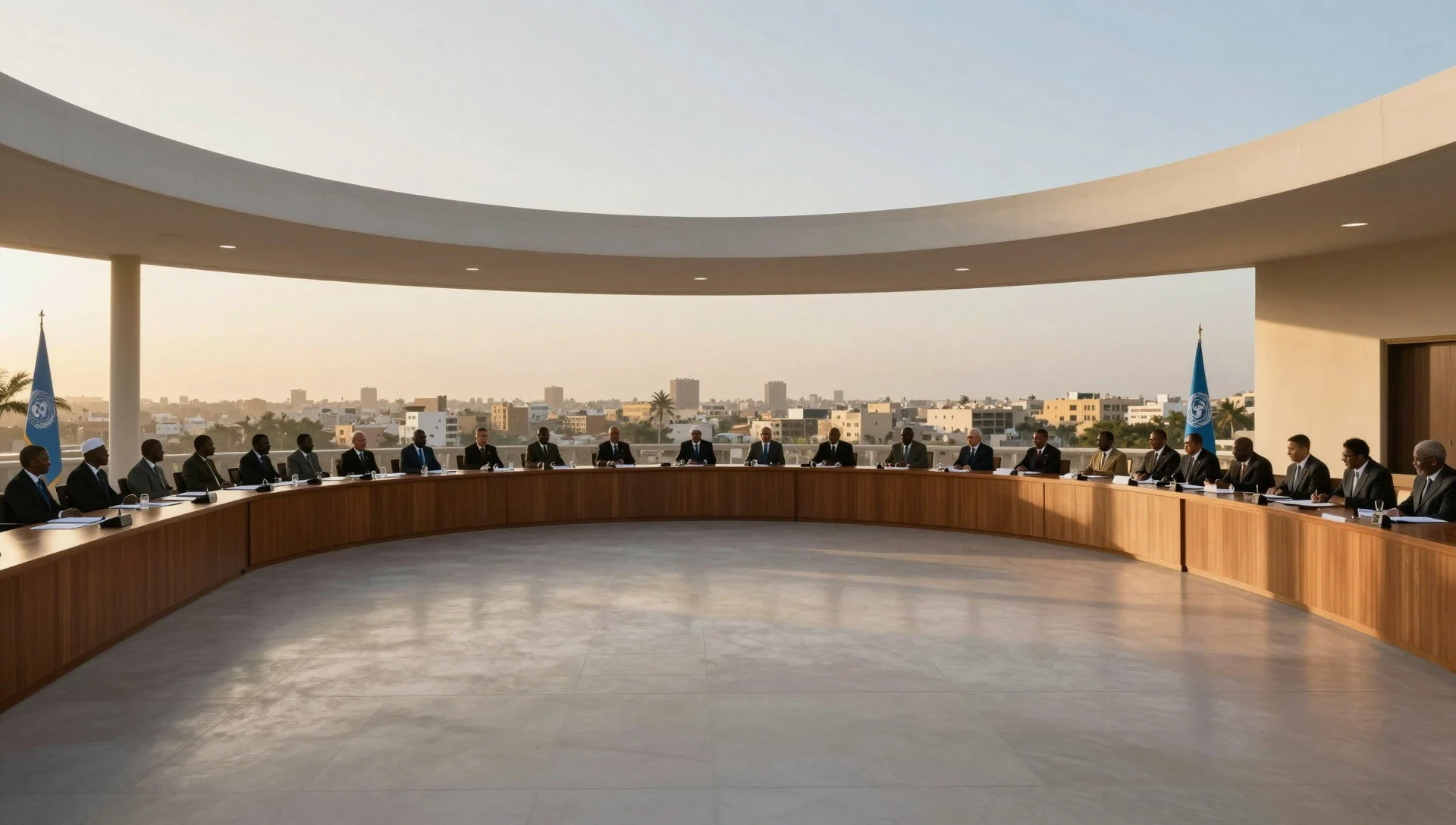
The United Nations political mission in Somalia formally concluded on Saturday, closing a chapter of more than three decades of international peacebuilding engagement in the Horn of Africa. The closure followed a two-year transition period that Somali authorities themselves requested, marking a deliberate handover rather than an abrupt withdrawal.
What ended was not merely an office, but an institutional arrangement that had shaped Somalia's relationship with the multilateral system since 1995.
The mission's lineage matters for interpreting the significance of its closure. It began as the UN Political Office for Somalia in 1995, was reconstituted by the Security Council in 2013 as UNSOM, and was renamed the UN Transitional Assistance Mission in Somalia (UNTMIS) during the wind-down.
On This Page
Each iteration reflected a recalibration of international ambition against Somali political realities, from post-conflict stabilisation toward democratic governance and the rule of law.
This analysis examines what the handover actually transfers, which capabilities remain fragile, and how the closure interacts with the ongoing campaign against Al-Shabab and the elections scheduled for next May.
The evidence points to a transition defined less by completion than by the redistribution of risk onto Somali institutions at a moment of acute fiscal and security pressure.
TL;DR The UN political mission in Somalia ended after a two-year transition, with mandates transferred to Somali institutions and the UN country team. The closure reflects genuine institutional progress since the 1990s, but it coincides with Al-Shabab's continued control of central Somalia, US withdrawal of funding for a key UN logistics operation, and contested elections due next May. The transition is best read as a transfer of responsibility under duress rather than a declaration of stabilisation.
The Architecture of a Thirty-Year Engagement
The Somali mission's duration is itself the central analytical fact. Few UN political presences have run continuously for three decades, and the length reflects the unusual depth of Somalia's state collapse after 1991. Militias, Islamist groups and criminal networks displaced central authority, forcing the international system into a prolonged substitution role.
When the Security Council established UNSOM in 2013, the mandate was explicitly transitional in ambition: support Somali authorities toward democracy and the rule of law. That framing presumed a trajectory from international tutelage to sovereign self-governance.
The 2024 request by President Hassan Sheikh Mohamud to end the mission early, later revised into a two-year transition, tested that presumption directly.
From Political Office to Transitional Mission
The institutional evolution from the 1995 Political Office to UNSOM and finally UNTMIS traces a consistent pattern: each renaming accompanied a shift in the balance between international direction and Somali ownership. The 2013 creation of UNSOM consolidated political good offices, electoral support and rule-of-law assistance under a single civilian structure.
The 2024 decision sequence is instructive. President Mohamud initially asked the UN to terminate the mission before its October 2024 mandate expiry, then proposed a two-year transition instead. That reversal suggests Somali authorities wanted the political symbolism of ending the mission without immediately absorbing its full operational burden.
The renaming to UNTMIS formalised this intermediate state. A transitional mission carries a different mandate logic than a standing political office: its purpose is to transfer functions, not to sustain them indefinitely. Raisedon Zenenga, officer-in-charge of UNTMIS, framed the closure as the end of one chapter and the start of another.
That framing is diplomatically conventional but analytically meaningful. It asserts continuity of partnership while conceding that the institutional form of that partnership has changed. The distinction matters because partnership without a dedicated political mission relies on the UN country team, which operates under different authorities and funding streams.
What the Mandates Actually Covered
UNSOM's mandate portfolio was broad: political good offices, support for federalism and constitutional review, electoral assistance, coordination of international partners, and human rights monitoring. These functions are not interchangeable with humanitarian or development programming delivered by UN agencies.
Political good offices, in particular, involve mediation between federal and regional authorities, engagement with opposition figures, and quiet diplomacy with armed actors. Transferring such functions to Somali institutions presumes those institutions possess both the capacity and the political neutrality to perform them.
Human rights monitoring presents a sharper test. International monitoring carries a credibility that domestic mechanisms often lack, particularly where security forces are themselves implicated in abuses. The closure therefore removes an external accountability layer at a moment when scrutiny of conduct in counter-insurgency operations remains relevant.
Electoral assistance is the most time-sensitive transfer. Somalia is due to hold parliamentary and presidential elections next May, and the technical and logistical groundwork for those contests was substantially supported by the mission. Whether Somali institutions can replicate that support within months is an open question.
The Politics Behind the Request
Somalia's request to end the mission carries domestic political logic that is often underweighted in international commentary. A sitting government facing elections benefits from demonstrating that sovereignty has been reclaimed from external supervision. Ending a UN political presence offers a visible, symbolic deliverable.
Yet the same government must manage the practical consequences. International partners coordinate through mission structures, and removing that hub can fragment donor engagement. The two-year transition was, in effect, a compromise between symbolic sovereignty and operational necessity.
Opposition dynamics compound the calculation. Disputes with opposition parties over electoral arrangements threaten the process, and a government that has just ended international political oversight may find fewer neutral brokers available when disputes arise. The mission's good offices functioned as a pressure valve.
Regional authorities add another layer. Somalia's federal member states have distinct relationships with the central government, and UN mediation often lubricated negotiations between Mogadishu and the regions. Whether bilateral channels can substitute for that mediation is uncertain.
Security, Funding and the Al-Shabab Variable
The transition's timing is inseparable from the counter-insurgency campaign. Al-Shabab, linked to Al-Qaeda and at war with the Somali government for two decades, continues to control large areas of central Somalia despite a major international military effort. The mission's closure does not alter that battlefield reality.
What it does alter is the civilian-political scaffolding around the military campaign. Stabilisation requires governance follow-through in areas reclaimed from insurgents, and that follow-through depended partly on mission-supported political coordination. Military gains without civilian consolidation tend to reverse.
The Funding Shock
The most consequential variable is financial. International funding cuts increasingly threaten the fight against Al-Shabab, and the United States has withdrawn all funding for a key UN logistics mission supporting operations. Logistics underpins troop mobility, casualty evacuation and sustainment across the campaign.
This withdrawal is not a marginal accounting adjustment. UN logistics support for African Union and Somali forces has historically been the connective tissue of multinational operations in Somalia. Removing funding for it raises direct doubts about the durability of military operations.
The sequencing deserves emphasis: the political mission closed in the same period that a core logistics funding stream was cut. These are separate decisions with separate rationales, but their convergence concentrates risk on Somali institutions at a single moment.
Donor fatigue is the broader context. Three decades of engagement have produced measurable progress, yet the persistence of insurgency tests the patience of legislatures funding operations far from their borders. Fiscal retrenchment follows political fatigue with a predictable lag.
What "Transfer" Means Operationally
Mandate transfer is a legal and administrative act, not a capacity transfer. Somali institutions formally assume responsibilities that the mission previously discharged, but formal assumption does not create trained staff, established procedures or budget lines overnight.
The UN country team absorbs some functions, particularly in development and humanitarian coordination. However, country teams operate under different governance arrangements than political missions, with less direct Security Council oversight and different reporting lines to headquarters.
This distinction has practical consequences for international attention. Political missions generate regular Security Council reporting, which sustains high-level engagement. Country team programming generates technical reporting, which rarely commands the same diplomatic bandwidth.
Zenenga's statement that the closure marks a new chapter rather than an end to partnership is therefore accurate in institutional terms. The partnership persists, but its visibility, authority and political weight are materially reduced by the change in form.
We Also Published
Elections, Legitimacy and the Post-Mission Test
The decisive test of the transition will be the elections due next May. Parliamentary and presidential contests will determine whether Somali institutions can manage a complex political process without the dedicated electoral and mediation support the mission previously provided.
Ongoing insecurity complicates logistics directly. Al-Shabab has historically targeted electoral gatherings and government installations, and security provision for voting sites requires coordination across federal and regional forces already stretched by the insurgency.
Opposition Disputes and Mediation Gaps
Disputes with the opposition threaten the process independently of security conditions. Electoral frameworks, seat allocation and the sequencing of parliamentary and presidential votes have all been contested in previous cycles, and the absence of a neutral international broker removes a familiar dispute-resolution channel.
This is where the loss of political good offices may prove most consequential. Mediation requires an actor trusted by both government and opposition, and domestic institutions rarely enjoy that dual confidence during contested elections. External facilitation filled that gap.
Whether regional organisations can substitute is uncertain. The African Union has substantial security responsibilities in Somalia but a thinner civilian political presence. Gulf states and other bilateral partners have interests but not necessarily the neutrality required for mediation.
The risk is not that elections fail outright, but that they proceed with diminished legitimacy. Contested outcomes without credible mediation can produce prolonged political standoffs, which in turn create openings for insurgent exploitation.
Reading the Closure Against Comparable Transitions
UN mission closures elsewhere offer instructive comparisons. Transitions in Liberia and Sierra Leone followed consolidated peace agreements and functioning security sectors, conditions that Somalia does not currently meet in central regions. The comparison highlights the unusual character of this handover.
Timor-Leste's transition involved a phased drawdown tied to benchmarked capacity milestones. Somalia's transition was driven primarily by a host government's political request, which is a legitimate basis but a different one from capacity-based sequencing.
This does not make the Somali transition wrong. Sovereignty requests deserve weight, and indefinite international political presence carries its own costs to legitimacy. The point is that the transition's rationale is political rather than technical, and its risks should be assessed accordingly.
Analysts should therefore watch specific indicators rather than broad narratives: whether electoral preparations stay on schedule, whether federal-regional disputes find resolution channels, and whether logistics funding gaps translate into operational pauses against Al-Shabab.
What the Handover Reveals About Multilateral Exit
The Somali closure illustrates a structural tension in multilateral peacebuilding: missions are easier to establish than to conclude. Exit requires a credible counterpart willing to assume responsibility, and that willingness is itself a political variable rather than a technical milestone.
Three decades of engagement produced real gains. Somalia has federal institutions, electoral processes and security forces that did not exist in the 1990s. Zenenga's reference to considerable progress since the early years of international support is defensible on the institutional record.
Yet the same record shows persistent deficits. Al-Shabab's territorial control, funding fragility and contested elections are not residual problems; they are core challenges that the transition now assigns to Somali institutions with fewer external supports.
The analytical conclusion is that this closure should be judged as a transfer of responsibility under duress, not as a certification of stabilisation. Its success will be determined over the next electoral cycle, and the indicators to watch are concrete rather than rhetorical.
The Broader Precedent
Other host governments will read the Somali transition as a template. A government can request the closure of a political mission, negotiate a transition period, and reclaim symbolic sovereignty while deferring the hardest capacity questions to a later date.
That template has appeal, but it also transfers risk to the multilateral system's credibility. If transitions are followed by renewed instability, the case for future political missions weakens, and donors become more reluctant to fund preventive engagement.
For Somalia specifically, the next twelve months will determine how the precedent is judged. A credible election conducted under transferred mandates would validate the transition's logic. A contested or delayed process would suggest the handover was premature.
The mission has ended. The partnership, as Zenenga noted, continues in another form. Whether that form is adequate to the security and political pressures now converging on Mogadishu is the question the closure leaves open.
From our network :
- How AI Agents Will Change the Way We Manage Personal FinancesExplore how AI agents are transforming personal finance through automated budgeting, bill payment, and investment management, while examining the critical security protocols and governance frameworks required for safe deployment.
- CISA’s Ten-Advisory Wave: Why Generic Patching Fails in OT and How to Build Product-Specific PlaybooksCISA released ten ICS advisories in one week, exposing critical infrastructure risks. Generic patching fails in OT. Learn to build product-specific remediation playbooks.
- Live Online English Classes for Kids: Do They Actually Reduce Anxiety?A ten-week study reveals that synchronous online English classes can significantly reduce child language anxiety while improving listening and reading skills. Discover what makes these programs effective and how parents can select the right one.
- University Language Proficiency Exams: Why Institutional Tests Demand Different Preparation Than IELTS and TOEFLDiscover why university-specific language proficiency examinations differ fundamentally from IELTS and TOEFL, and learn strategic preparation approaches for institutional assessment success.
- The Final Descent: How ESA Retired the Legendary Cluster Constellation After 24 Years of Space Weather ScienceAfter 24 years mapping Earth’s magnetosphere, ESA’s Cluster mission concluded with a precisely controlled reentry over the South Pacific. This analysis explores the scientific legacy, engineering decisions, and debris mitigation principles behind one of space exploration’s most responsible retirements.
- Mobile Learning and VR in English: What Global Evidence Reveals About Effective Language TechnologyA systematic review across 14 countries reveals which language-learning technologies genuinely work. Mobile learning, AI, and VR show measurable benefits when pedagogically integrated. This evidence-based guide helps educators and learners select technology that delivers real return on investment.
- The Hidden Cost of AI Convenience: Why Over-Permissioned Agents Are a Security Time BombDiscover why AI agents with excessive permissions create dangerous single points of failure, and learn how implementing least privilege principles can protect your organization from exploitation.
- Committed Mediterranean Precipitation Decline: Why Emissions Cuts Alone Cannot Restore Winter RainsNew NOAA research reveals that Mediterranean winter rains may decline irreversibly even with emissions cuts. Explore the science of committed climate change and regional impacts.
- Forbidden Matrix Patterns and Visible Lattice Points: A Geometric DictionaryExplore how multidimensional 0–1 matrices encode geometric truths, linking forbidden patterns to visible lattice points and hypergraph theory, with applications in combinatorics and computational geometry.
RESOURCES
- Somalia looks to the future as the UN's political mission closesnews.un.org2 days ago ... ... Representative for Somalia has said, as three decades of UN political missions in the Horn of Africa country comes…
- UN closes Somalia mission, ending three decades of political ...aljazeera.com2 days ago ... ... more than three decades of efforts to help the country rebuild after civil war. The United Nations Transitional Assistance…
- UN Ends Its Political Mission in Somalia After Three Decadesbloomberg.com1 day ago ... The United Nations completed a two-year transition of its political mission in Somalia, formally ending more than three decades of…
- Secretary-General Notes Milestone as UN Somalia Mission Endspress.un.org7 days ago ... This milestone brings to a close more than three decades of United Nations missions in support of peacebuilding, State-building, governance…
- UN ends its Somalia political mission after three decades - Arab Newsarabnews.com2 days ago ... NAIROBI: The United Nations political mission in Somalia ended on Saturday after a two-year transition, closing a chapter of more…
- UN political mission in Somalia ends after more than three decadesfacebook.com2 days ago ... This marks the end of 13 years of UN special political missions in the country. The speech details a two-year…
- UN ends its Somalia political mission after three decades - The Hinduthehindu.com2 days ago ... "Today is not an end to the partnership between the United Nations and Somalia-rather, it marks the conclusion of one…
- UN closes Somalia mission, ending three decades of political ...lemkininstitute.com18 hours ago ... The closure follows years of sometimes strained relations between Somali governments and the UN mission, whose involvement in domestic politics ...
- UN political mission ends in Somalia with no agreed replacement to ...wral.com4 days ago ... MOGADISHU, Somalia (AP) — The United Nations' political mission in Somalia ends Saturday, closing more than three decades of successive…
- Somalia turns a page as UN political mission concludes after two ...untmis.unmissions.org2 days ago ... “The story of the UN's political engagement in Somalia has been one of persistence, partnership and adaptation over more than…
- UN political mission ends in Somalia with no agreed replacement to ...washingtonpost.com4 days ago ... The United Nations' political mission in Somalia closes Saturday, ending three decades of mediation and support for rebuilding institutions ...
- The United Nations political mission in Somalia ended on Saturday ...instagram.com2 days ago ... The United Nations' political mission in Somalia will end Saturday, bringing to a close more than three decades of successive…
- Conflict With Al-Shabaab in Somalia - Council on Foreign Relationscfr.orgUN Political Mission in Somalia Concludes. October 29, 2026. The UN ... Over the past three decades, Somalia has faced multiple climate change-induced ...
- UN mission in Somalia closes after three decades | Somali Guardiansomaliguardian.com2 days ago ... MOGADISHU (Somaliguardian) – The United Nations Transitional Assistance Mission in Somalia (UNTMIS) ceased operations on Saturday, ending ...
- UN political mission in Somalia ends after more than three decadesnewsaf.cgtn.com2 days ago ... The United Nations has ended its political mission in Somalia, concluding a two-year transition that transferred its responsibilities to ...
- 01
- 02
- 03
- 04
- 05
- 06
- 07
- 08
0 Comments