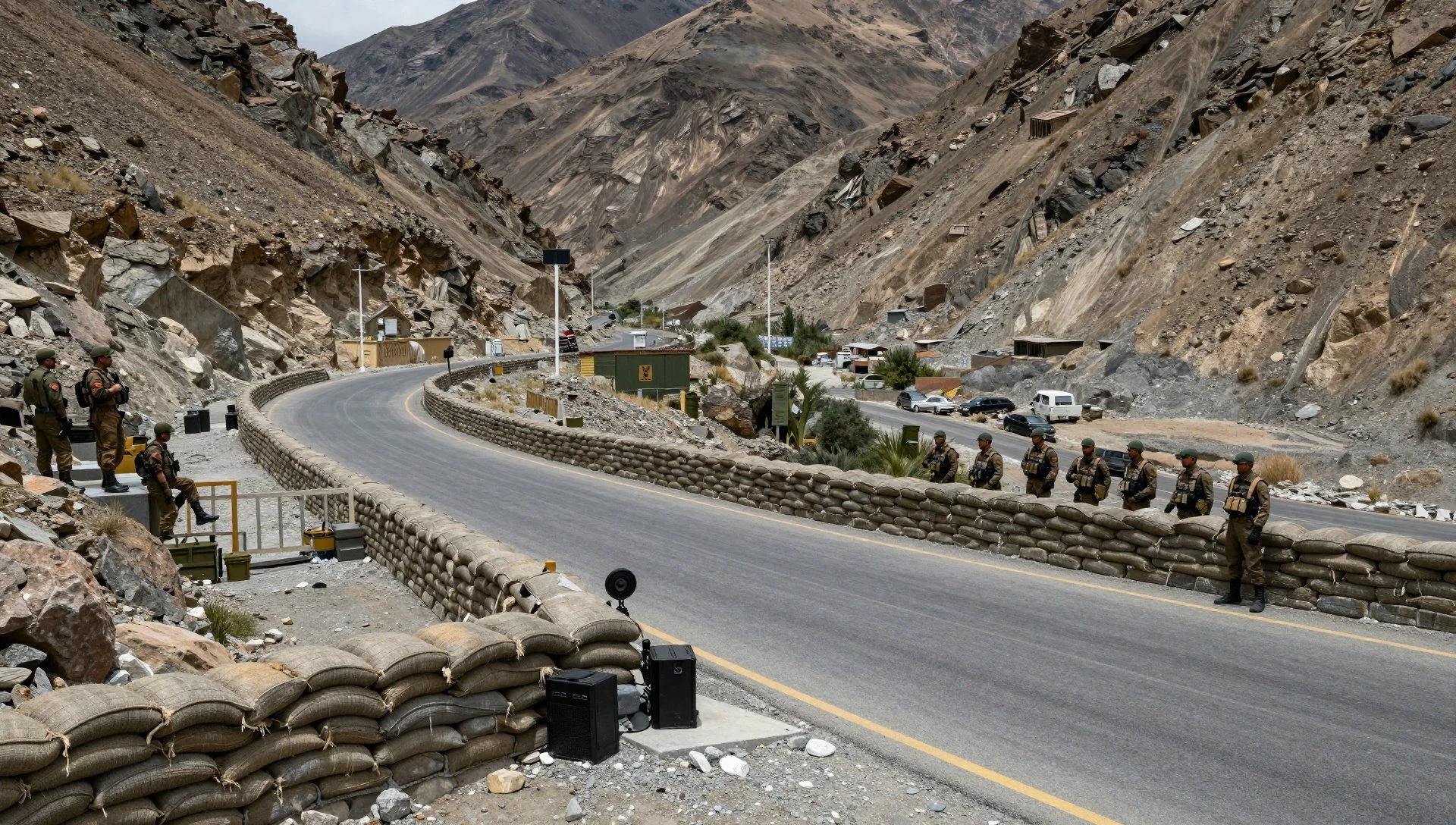
On the afternoon of 11 November 2026, a motorcycle-borne assailant opened fire on a security checkpoint in the Kulgam district of Jammu and Kashmir, wounding three personnel of the
. The incident, which unfolded at roughly 2:15 p.m., represents the kind of sudden, small-footprint attack that has long defined the tactical texture of counter-insurgency operations in the Kashmir Valley. The injured troopers were evacuated to a hospital in neighbouring Anantnag district, and senior leadership moved quickly to confirm the casualty count and signal that a manhunt was already in motion.
What elevates this episode beyond a routine security bulletin is its timing and symbolic weight. The firing occurred on a day when Lieutenant Governor Manoj Sinha was scheduled to attend an official event in Kulgam itself, a coincidence that inevitably sharpens questions about threat assessment, route security, and the ability of attackers to probe the state's protective envelope. CRPF Director General G.P. Singh publicly confirmed the number of injured, pledged the best available medical care, and stated that operations to locate those responsible were underway — a measured response that reflects how carefully security communications are calibrated in a region where every statement carries political consequence.
This analysis examines the Kulgam checkpoint shooting as a case study in modern asymmetric violence: the choice of a motorcycle as a weapons platform, the targeting of a static security post, the rapid reinforcement and search protocol that followed, and the broader institutional context of CRPF deployment in Jammu and Kashmir. It also considers what such incidents reveal about the evolving threat landscape, the mechanics of official response, and the human cost borne by the personnel who man these checkpoints day after day.
TL;DR Three CRPF personnel were injured on 11 November 2026 when motorcycle-borne attackers fired on a security checkpoint in Kulgam, Jammu and Kashmir, at approximately 2:15 p.m. The wounded were hospitalised in Anantnag, CRPF Director General G.P. Singh confirmed the casualty figure and launched a search operation, and additional forces were rushed to the site. The attack coincided with a scheduled visit by Lieutenant Governor Manoj Sinha to Kulgam, raising fresh questions about checkpoint vulnerability, hit-and-run tactics, and the protective architecture surrounding high-profile official movements in the Valley.
On This Page
The Anatomy of a Checkpoint Ambush in Kulgam
The Kulgam shooting belongs to a recognisable tactical genre: a two-wheeler-borne strike on a fixed security position, executed with speed and abandoned almost immediately. Such attacks exploit the inherent asymmetry between a stationary checkpoint and a mobile assailant, compressing the entire engagement into seconds before reinforcements can react. Understanding this incident requires looking past the headline casualty figure and examining the operational logic that makes checkpoints simultaneously essential to security and structurally exposed to precisely this kind of violence.
Sequence of Events and Immediate Response
According to official accounts, the firing began around 2:15 p.m. when attackers on a motorcycle opened fire at the checkpoint, striking three CRPF personnel with bullet wounds. The injured were transported to a hospital in Anantnag district, where they received treatment, while additional security forces were dispatched to the site and a search operation was launched to locate the fleeing attackers. The speed of the response — reinforcement, evacuation, and cordon — reflects standing protocols refined over years of similar incidents across the Valley.
The confirmation by CRPF Director General G.P. Singh that operations were underway, alongside his assurance that the injured would receive the best possible medical care, illustrates the dual imperative facing security leadership: demonstrating operational resolve while projecting institutional care for personnel. In a region where information moves rapidly and rumour can outpace official channels, such prompt, senior-level confirmation serves both transparency and morale, reassuring the force that its wounded are not forgotten and that accountability for the attack is being pursued actively.
Why Motorcycle-Borne Attacks Persist
The motorcycle remains a favoured platform for hit-and-run attacks because it offers mobility, low visibility, and rapid egress through congested or narrow routes that larger vehicles cannot negotiate. A two-rider team can approach a checkpoint appearing as ordinary traffic, discharge weapons at close range, and disappear into the surrounding network of lanes before a coordinated response crystallises. This tactical economy — minimal manpower, minimal logistics, maximum disruption — makes the method resilient against conventional countermeasures.
For defenders, the challenge is formidable. Hardening every checkpoint against a fleeting, close-range strike demands layered measures: stand-off barriers, elevated overwatch, rapid-reaction teams, and intelligence that anticipates movement rather than merely reacting to it. The Kulgam incident underscores that even well-manned posts remain vulnerable when the attacker controls the moment of initiation, and that deterrence must therefore rest as much on predictive intelligence as on physical fortification of static positions.
The CRPF's Role and Institutional Response
The Central Reserve Police Force occupies a distinctive position in India's internal security architecture, functioning as a heavily deployed paramilitary instrument in counter-insurgency theatres such as Jammu and Kashmir. Its personnel staff checkpoints, conduct area domination patrols, and provide static protection for vulnerable points — duties that place them on the front line of asymmetric threats. When three of its troopers are wounded in a single afternoon, the institutional response becomes a matter of both operational doctrine and organisational credibility.
Command Communication and Force Morale
The Director General's prompt public confirmation served several functions at once. It established an authoritative account before speculation could harden, demonstrated that the highest levels of command were personally engaged, and reaffirmed the force's commitment to the welfare of its wounded. In paramilitary organisations, where morale is closely tied to the perception that leadership stands behind its personnel, such visible engagement is not merely procedural courtesy but a strategic asset that sustains cohesion during prolonged deployments far from home.
Beyond the immediate statement, the response pattern — reinforcement of the site, launch of a search operation, and medical evacuation to a specialised facility — reflects a mature incident-management cycle. Each element addresses a distinct requirement: securing the area against follow-on attack, pursuing the perpetrators while trails remain fresh, and ensuring the wounded receive care beyond what a forward post can provide. The integration of these steps under senior direction illustrates how institutional protocols convert a chaotic event into a managed sequence.
Deployment Pressures in the Valley
Sustained counter-insurgency deployment imposes cumulative strain on paramilitary units: long separations from family, high operational tempo, and the constant cognitive load of vigilance at static posts that are, by design, predictable targets. The Kulgam attack highlights how this structural predictability can be exploited. Checkpoints must remain in place to serve their deterrent and screening functions, yet their fixed locations and routines create openings for attackers who study patterns before striking.
Addressing this tension requires more than additional manpower. It demands rotational unpredictability, intelligence-led repositioning, and technological augmentation such as surveillance coverage and rapid-alert systems. The human dimension remains decisive, however: the discipline of individual sentries, the quality of local intelligence networks, and the speed with which a post can transition from routine screening to active defence all determine outcomes when seconds separate calm from crisis.
Timing, Symbolism, and the Official Visit
The coincidence of the attack with Lieutenant Governor Manoj Sinha's scheduled event in Kulgam is difficult to overlook. Whether or not the timing was deliberate, the overlap invites scrutiny of how security planners assess and mitigate risk around high-profile movements. In conflict-affected regions, the calendar of official visits is often known in advance, creating windows that adversaries may seek to exploit for maximum symbolic effect — striking not merely at personnel but at the state's projection of control.
Reading the Coincidence
Two interpretations compete. The first holds that the attack was opportunistically timed to coincide with the visit, amplifying its psychological impact and embarrassing the security apparatus on a day designed to showcase normalcy and governance. The second suggests the overlap was incidental, a product of the dense security footprint that accompanies such visits, which may itself concentrate targets in a given area. Distinguishing between these readings requires intelligence that the public record does not yet supply.
Either way, the episode reinforces a durable lesson from counter-insurgency practice: symbolic events and security operations are entangled, and adversaries calibrate violence to the political calendar as readily as to the tactical one. Protective planning must therefore treat official visits not as isolated logistics but as threat-relevant events requiring dedicated intelligence, route diversification, and coordination across police, paramilitary, and civil administration layers.
Protective Architecture Under Review
High-profile visits in Jammu and Kashmir typically involve multi-layered security: advance teams, route sanitisation, sniper coverage, quick-reaction forces, and communications coordination. The Kulgam attack occurred at a checkpoint rather than at the venue itself, which may indicate that the protective cordon functioned as intended in shielding the principal, even as peripheral positions absorbed the violence. This distinction matters for assessing whether the architecture failed or merely encountered an attack at its outer edge.
Still, every such incident prompts review. Questions arise about whether checkpoint staffing, positioning, and rules of engagement are optimised for the current threat picture, and whether intelligence sharing between agencies is timely enough to anticipate small-team strikes. The answers will shape adjustments in deployment patterns, but the underlying challenge persists: a determined attacker retains the initiative at the moment of choosing, and defence must succeed continuously while offence need succeed only once.
We Also Published
Jammu and Kashmir's Evolving Security Landscape
Kulgam sits within the broader security geography of south Kashmir, a region that has witnessed repeated cycles of militancy, counter-operations, and uneasy calm over the past three decades. Each incident such as this one feeds into a larger narrative about the trajectory of violence in the Union Territory — whether it is declining, plateauing, or mutating into new forms. Analysts track not only casualty counts but the character of attacks, since shifts in tactics often signal changes in capability, intent, or the availability of recruits and resources.
Patterns Beyond a Single Incident
Isolated shootings can be misleading if read in isolation. The more instructive question is whether hit-and-run strikes on security personnel are becoming more frequent, more sophisticated, or more brazen in their targeting. A single attack on a checkpoint may reflect local initiative rather than central direction; a cluster of similar incidents would suggest a coordinated campaign. Distinguishing between these possibilities is essential for calibrating response, since the appropriate countermeasures differ substantially between sporadic violence and organised insurgency.
Public reporting on such incidents tends to emphasise immediate facts — casualties, location, official statements — while the deeper pattern analysis unfolds quietly within security agencies. For outside observers, the Kulgam shooting is best understood as a data point within a longer series, one whose significance will become clearer as subsequent weeks reveal whether it was an aberration or part of an intensifying trend in the region's security environment.
Civilian Life and the Psychology of Presence
Beyond the operational calculus lies the human context of daily life in Kulgam and its surrounding districts. Checkpoints are not merely military installations; they are fixtures of civilian routine, shaping how people move, trade, and perceive safety. When violence erupts at such a site, it reverberates through the local community, affecting confidence in public order and the willingness of residents to cooperate with security forces — a factor that intelligence gathering depends upon heavily.
The psychological dimension cuts both ways. Visible security presence can reassure, but repeated attacks on that presence can erode the perception of control. Managing this perception is part of the broader challenge of governance in conflict-affected areas, where the state must demonstrate both firmness and sensitivity. The Kulgam incident, in this light, is not only a tactical event but a test of how institutions communicate, reassure, and rebuild trust in the aftermath of violence.
Operational Lessons for Static Security Posts
Static checkpoints endure because they perform indispensable functions: screening movement, deterring infiltration, and projecting state presence. Yet their fixed nature is also their principal liability, and the Kulgam attack offers a compact tutorial in that vulnerability. Extracting operational lessons requires examining not only what happened but what nearly happened, and what might have happened had the attackers chosen a different moment or a softer target within the same protective perimeter.
- 01
- 02
- 03
- 04
Hardening Without Paralysis
The instinct after any attack is to fortify — add barriers, increase manpower, tighten procedures. Fortification has real value, but it carries costs: heavier positions become more predictable, more resource-intensive, and potentially more alienating to local populations whose cooperation is essential. The art lies in hardening selectively, concentrating protective measures where threat intelligence indicates risk while preserving mobility and adaptability elsewhere. A checkpoint that cannot reposition itself becomes a monument to its own routines.
Effective hardening also incorporates technological layers: surveillance cameras, motion sensors, and communication systems that shorten the interval between detection and response. These tools extend the sentry's awareness beyond line of sight and create records that aid investigation. But technology is an enabler, not a substitute, for trained judgment. The decisive variable remains the human decision-maker who must interpret ambiguous signals under pressure and act within seconds.
Intelligence, Community, and Prevention
Prevention ultimately rests on intelligence, and intelligence in counter-insurgency settings depends heavily on community relationships. Local residents who trust security forces are more likely to report suspicious movement, identify unfamiliar faces, and provide the granular information that allows analysts to anticipate attacks. Conversely, heavy-handed tactics that alienate communities can dry up the information stream precisely when it is most needed, creating a vicious cycle of violence and mistrust.
The Kulgam incident therefore invites reflection on the balance between force protection and community engagement. Security forces operate in populated areas where every interaction shapes perceptions. Building durable intelligence networks requires patience, consistency, and accountability — qualities that are difficult to sustain under the pressure of repeated attacks but are ultimately more decisive than any single fortification. The search operation launched after the shooting will pursue the perpetrators; the longer campaign is won through relationships.
Aftermath, Accountability, and the Road Ahead
The immediate aftermath of the Kulgam shooting follows a familiar arc: hospitalisation of the wounded, reinforcement of the site, a search operation, and public statements from senior command. What matters for the longer term is whether these steps translate into accountability and deterrence, or whether the incident becomes another entry in a recurring ledger of violence. The distinction depends on investigative follow-through, the quality of intelligence developed in the coming weeks, and the willingness to adapt tactics in response to what is learned.
Pursuit and the Question of Justice
The search operation launched after the attack represents the first phase of the pursuit, but successful resolution requires more than a cordon. It demands forensic capability, witness cooperation, communications analysis, and the patient assembly of evidence that can withstand legal scrutiny. In conflict zones, the gap between apprehending suspects and securing convictions is often wide, and public confidence in justice mechanisms can be fragile. Each stage of the process carries implications for deterrence.
For the injured personnel and their families, the assurance of the best possible medical care is a concrete commitment that must be honoured through rehabilitation and support. Beyond the physical wounds lie psychological and professional consequences that can affect careers and families. Institutional care in these dimensions is as important as tactical response, and it shapes how the force's personnel perceive their own value to the organisation they serve.
What Comes Next for the Region
Looking forward, the Kulgam incident will inform security planning across south Kashmir, likely prompting reviews of checkpoint protocols, intelligence coordination, and protective arrangements for official visits. Whether it presages a broader uptick in violence or remains an isolated episode will depend on factors that unfold over months rather than days. Analysts will watch for patterns in attack frequency, targeting, and method as indicators of the direction the security environment is taking.
For the public, the episode is a reminder that the relative calm of recent years in parts of Jammu and Kashmir remains contingent and reversible. The state's response — measured, senior-led, and operationally focused — reflects lessons absorbed over decades. Yet the persistence of such attacks underscores that durable peace requires more than security measures alone: it requires governance, economic opportunity, and political processes that address underlying grievances. The road ahead is neither short nor simple.
From our network :
- CISA’s Ten-Advisory Wave: Why Generic Patching Fails in OT and How to Build Product-Specific PlaybooksCISA released ten ICS advisories in one week, exposing critical infrastructure risks. Generic patching fails in OT. Learn to build product-specific remediation playbooks.
- The Final Descent: How ESA Retired the Legendary Cluster Constellation After 24 Years of Space Weather ScienceAfter 24 years mapping Earth’s magnetosphere, ESA’s Cluster mission concluded with a precisely controlled reentry over the South Pacific. This analysis explores the scientific legacy, engineering decisions, and debris mitigation principles behind one of space exploration’s most responsible retirements.
- Forbidden Matrix Patterns and Visible Lattice Points: A Geometric DictionaryExplore how multidimensional 0–1 matrices encode geometric truths, linking forbidden patterns to visible lattice points and hypergraph theory, with applications in combinatorics and computational geometry.
- University Language Proficiency Exams: Why Institutional Tests Demand Different Preparation Than IELTS and TOEFLDiscover why university-specific language proficiency examinations differ fundamentally from IELTS and TOEFL, and learn strategic preparation approaches for institutional assessment success.
- Live Online English Classes for Kids: Do They Actually Reduce Anxiety?A ten-week study reveals that synchronous online English classes can significantly reduce child language anxiety while improving listening and reading skills. Discover what makes these programs effective and how parents can select the right one.
- The Hidden Cost of AI Convenience: Why Over-Permissioned Agents Are a Security Time BombDiscover why AI agents with excessive permissions create dangerous single points of failure, and learn how implementing least privilege principles can protect your organization from exploitation.
- Committed Mediterranean Precipitation Decline: Why Emissions Cuts Alone Cannot Restore Winter RainsNew NOAA research reveals that Mediterranean winter rains may decline irreversibly even with emissions cuts. Explore the science of committed climate change and regional impacts.
- Mobile Learning and VR in English: What Global Evidence Reveals About Effective Language TechnologyA systematic review across 14 countries reveals which language-learning technologies genuinely work. Mobile learning, AI, and VR show measurable benefits when pedagogically integrated. This evidence-based guide helps educators and learners select technology that delivers real return on investment.
- How AI Agents Will Change the Way We Manage Personal FinancesExplore how AI agents are transforming personal finance through automated budgeting, bill payment, and investment management, while examining the critical security protocols and governance frameworks required for safe deployment.
RESOURCES
- "Kashmir may have changed significantly since 2019, but the terror ...facebook.com7 hours ago ... The reporter explains that two terrorists on a motorcycle attacked a CRPF checkpoint in Akhran, Kulgam, about two hours away…
- Kulgam terror attack: Terrorists were on motorcycle, search ...timesofindia.indiatimes.com7 hours ago ... ... fire on Central Reserve Police Force (CRPF) personnel deployed at a checkpoint in Jammu and Kashmir's.
- The attack on a CRPF checkpoint in J&K's Kulgam raises ...facebook.com7 hours ago ... This news report details a major anti-terrorist operation by the Indian Army, Jammu & Kashmir Police, and CRPF in the…
- NewsMobile (@newsmobileindia) · Gurugram - Instagraminstagram.com” TERROR ATTACK IN JAMMU AND KASHMIR Motorcycle-borne terrorists open fire at a CRPF checkpoint in Kulgam, injuring three personnel. ... Three ...
- Three CRPF personnel injured as motorcycle-borne terrorists strike ...swarajyamag.com4 hours ago ... ... security checkpoint in Jammu and Kashmir's Kulgam district. The attack occurred around 2:15 PM in the Akhran area near…
- Three Central Reserve Police Force (#CRPF) personnel were ...instagram.com7 hours ago ... ... on a CRPF checkpoint in Jammu and Kashmir's Kulgam district on Wednesday. The attackers, who arrived on motorcycles, fired…
- 3 CRPF jawans injured in terror attack in Jammu-Kashmir's Kulgamindianexpress.com7 hours ago ... Suspected terrorists targeted a checkpoint in Kulgam's Mirabazar during which the CRPF jawans were injured ... security personnel deployed at…
- J&K: Two CRPF personnel injured in suspected terror attack in Kulgamnationalheraldindia.com5 hours ago ... ... security checkpoint in South Kashmir's Kulgam district on Wednesday, officials said. ... Jammu and Kashmir · Kulgam. Comment(s). ADVERTISEMENT.…
- Kulgam Terrorist Attack: 2 jawans of CRPF 46th Battalion injuredorganiser.org7 hours ago ... ... security checkpoint in Kulgam, J&K, triggering a security response ... Further details of the incident are awaited. VIDEO |…
- Kulgam Terror Attack: Three CRPF Personnel Injured in J&Knationpathindia.com6 hours ago ... ... security checkpoint in Jammu and Kashmir's Kulgam district on November 11, 2026. The incident occurred around 2:15 pm in…
- IADN Centre | LinkedInlinkedin.comOver fourteen years of successful operations, that conviction has shaped every article published, every analysis ... CRPF checkpoint in Jammu and Kashmir's Kulgam ...
- Terrorists fire at CRPF checkpost in Jammu and Kashmir's Kulgam ...tribuneindia.com7 hours ago ... Security heightened after three CRPF personnel were injured in a terror attack on a CRPF camp, in Kulgam district of…
- 30 bullets in 15 seconds: CCTV records gunfire as terrorists attack ...moneycontrol.com3 hours ago ... ... attacked a Central Reserve Police Force (CRPF) checkpoint in Jammu and Kashmir's Kulgam district on Wednesday afternoon. Three CRPF ...
- Motorcycle-borne terrorists attack CRPF team in J-K's Kulgamhindustantimes.com4 hours ago ... The terror attack in Kulgam district of Jammu and Kashmir took place at around 2.15 pm when terrorists opened fire…
- Jammu and Kashmir terror attack: Three CRPF personnel injured ...ground.news7 hours ago ... Assailants opened fire at a security checkpoint in Nowpora, Akhran, near Mir Bazar before fleeing the area, according to officials.…
- 01
- 02
- 03
- 04
- 05
- 06
- 07
- 08
0 Comments