Political rhetoric often strains against the hard boundaries of chronology, and few recent remarks illustrate that tension more vividly than Donald Trump's assertion that he could have ended the Vietnam War within a single week.
The statement, reported in late 2026, describes a swift resolution to a conflict that formally concluded in April 1975 with the fall of Saigon, decades before Trump held any office capable of shaping foreign policy.
The claim therefore rests on a counterfactual that cannot be tested, because the war had already finished long before the speaker possessed the authority he now invokes.
On This Page
- The Chronology That Makes the Claim Impossible
- The Anatomy of Counterfactual Political Claims
- Domestic Incentives Behind Impossible Boasts
- Media Amplification and the Attention Economy
- Historical Memory and Public Understanding of War
- Accountability When Claims Cannot Be Disproven
- Reading the Remark as a Case Study in Political Communication
What makes the episode analytically interesting is not the substance of the boast but its structure. It belongs to a familiar genre of retrospective political counterfactuals, in which leaders claim they would have resolved historical crises faster, cheaper, or more decisively than those who actually governed.
Such claims flourish precisely because they are unfalsifiable: no committee can convene to test a decision that was never available to be made. The Vietnam remark draws attention because it collapses two distinct timelines, treating a closed historical chapter as though it were an open policy question awaiting a decisive hand.
This analysis examines the remark through several lenses: the chronology of the Vietnam War, the mechanics of counterfactual political claims, the domestic incentives that sustain them, and the way media ecosystems amplify statements that are chronologically impossible.
It also considers what such rhetoric reveals about how publics process historical memory and how accountability functions when a claim cannot be disproven by evidence alone. The aim is not partisan scoring but a clearer understanding of why impossible claims persist in political discourse.
TL;DR Donald Trump claimed he could have ended the Vietnam War in a week, but the conflict concluded in 1975 with the fall of Saigon, decades before he entered politics. The remark is a textbook counterfactual: it cannot be verified or falsified because the historical window for action had closed. Such statements persist because they serve domestic political purposes, thrive in media environments that reward provocation, and exploit the public's imperfect grasp of chronology. Understanding them requires separating rhetorical performance from historical fact.
The Chronology That Makes the Claim Impossible
The Vietnam War's timeline is not ambiguous. Major American combat involvement began in the early 1960s, escalated sharply after the 1964 Gulf of Tonkin Resolution, and wound down through the Paris Peace Accords of January 1973.
The conflict ended definitively on 30 April 1975, when North Vietnamese forces entered Saigon and the South Vietnamese government surrendered. By that date, Donald Trump was a thirty-year-old real estate developer in New York, entirely removed from foreign policy decision-making.
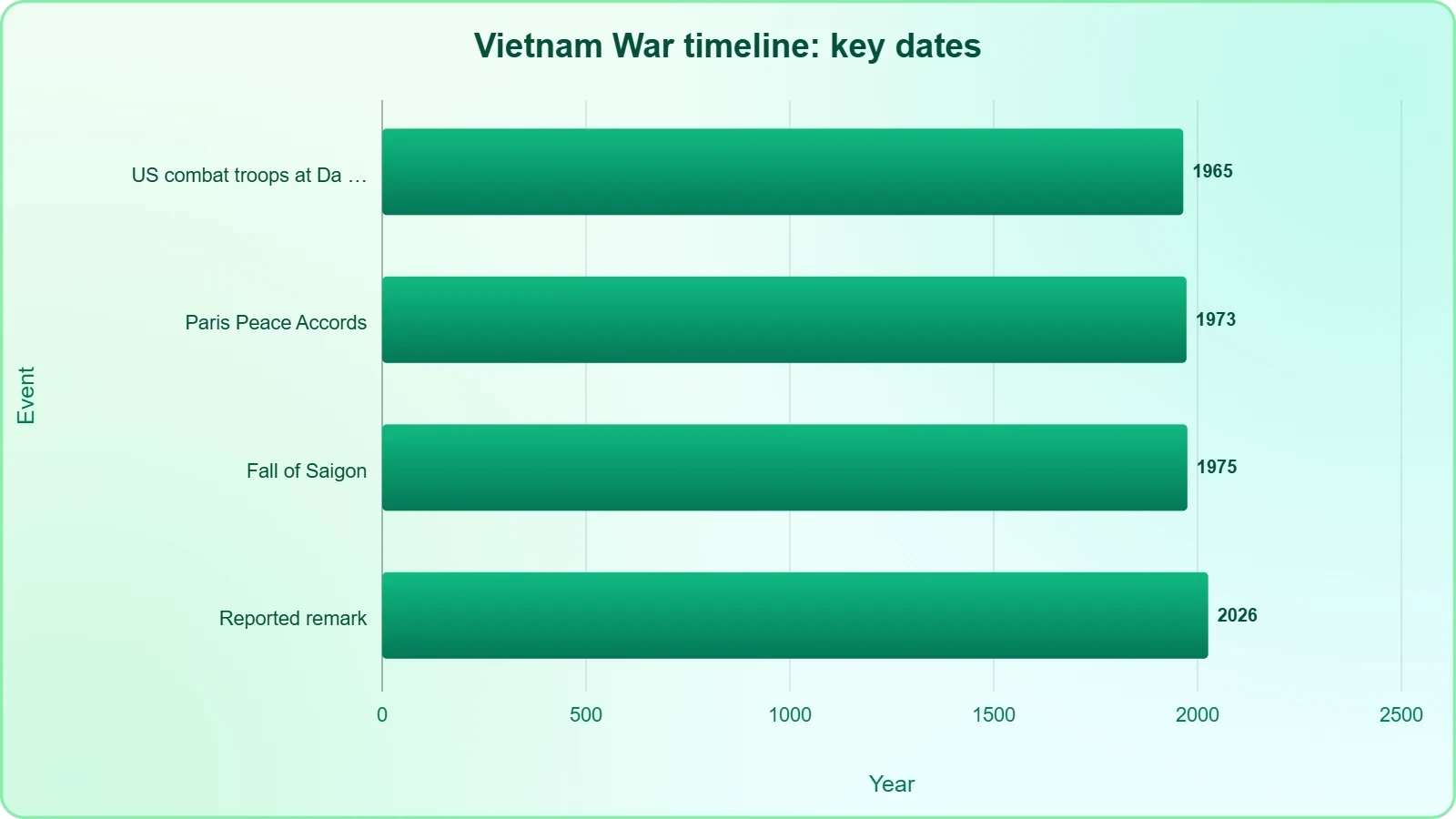
Trump was born in 1946, meaning he was nineteen when the first American combat troops landed at Da Nang in 1965. He did not hold public office until 2017, more than four decades after Saigon fell.
Any claim to have influenced the war's conduct or conclusion therefore requires a timeline in which the speaker possessed authority he did not have. The arithmetic alone forecloses the possibility, independent of any assessment of strategic competence.
The Fall of Saigon as a Fixed Historical Marker
The fall of Saigon functions as an unusually crisp endpoint in modern history. Unlike gradual withdrawals or negotiated settlements that blur into ambiguity, the city's capture produced iconic images, a formal surrender, and an immediate refugee exodus.
Historians treat 1975 as the terminal date because the political entity the United States had defended ceased to exist. There is no scholarly dispute about whether the war was still ongoing when Trump entered politics.
This clarity matters because counterfactual claims often exploit ambiguity. When an event's boundaries are fuzzy, a speaker can imply influence without specifying dates. Vietnam offers no such shelter. The war's conclusion is documented, commemorated, and taught, making the chronological gap between 1975 and Trump's political career impossible to obscure. The claim's impossibility is therefore not a matter of interpretation but of calendar arithmetic.
Why Precision About Dates Matters in Political Claims
Dates anchor accountability. When a politician claims they would have handled a crisis differently, the claim's plausibility depends on whether they were positioned to act at the relevant moment. Precision about chronology separates legitimate retrospective critique from fantasy.
A former official who served during a war can credibly argue for alternative strategies; a person who was a private citizen decades removed cannot.
Media coverage of the remark focused on exactly this gap, noting that the war had ended before Trump could have intervened. That framing reflects a broader journalistic instinct to check claims against timelines.
Yet the coverage also illustrates a limitation: fact-checking an impossible counterfactual can inadvertently treat it as a serious policy proposal rather than a rhetorical gesture. Precision about dates clarifies the category of statement being made.
The Anatomy of Counterfactual Political Claims
Counterfactual claims are a staple of political communication because they impose no burden of proof. A statement about what would have happened under different leadership cannot be tested against outcomes, since the alternative scenario never occurred.
This structural immunity makes counterfactuals attractive to speakers seeking to signal competence without exposing themselves to empirical scrutiny. The Vietnam remark fits this pattern precisely.
Scholars of political rhetoric distinguish between counterfactuals that illuminate and those that merely assert. Illuminating counterfactuals specify mechanisms: which decisions would have changed, which resources would have been deployed, which constraints would have been relaxed. Assertive counterfactuals skip these details and rely on the speaker's presumed competence.
The claim to end a war in a week belongs to the second category, offering speed as a substitute for strategy.
Why Unfalsifiable Statements Persist
Unfalsifiable statements persist because they serve functions unrelated to truth. They signal confidence, rally supporters, and frame opponents as incompetent. When a claim cannot be disproven, debate shifts from evidence to identity: supporters accept it as consistent with the speaker's brand, while critics reject it as implausible. The statement becomes a loyalty marker rather than a proposition about the world.
Media incentives reinforce this dynamic. Outlandish claims generate coverage, and coverage generates attention, regardless of whether the claim is accurate. The Vietnam remark traveled widely precisely because its impossibility was obvious, making it a ready-made story.
Outlets could report the claim and the correction in the same breath, producing a narrative that satisfied both novelty and fact-checking instincts.
The Difference Between Confidence and Competence
Confidence and competence are frequently conflated in political evaluation. A speaker who promises swift victory projects decisiveness, a trait voters often reward. Yet decisiveness without knowledge of constraints can produce disaster, as the Vietnam War itself demonstrated through successive administrations that escalated without clear strategy. The war's history is a cautionary tale about confident claims meeting intractable realities.
Competence involves understanding what is possible within a given context. A leader who grasps logistical limits, diplomatic constraints, and the cost of escalation is better positioned than one who promises speed. The Vietnam claim inverts this relationship, treating the absence of constraints as evidence of skill. That inversion is rhetorically effective but analytically hollow, substituting bravado for the hard work of strategic reasoning.
Domestic Incentives Behind Impossible Boasts
Impossible boasts serve domestic audiences more than foreign ones. They communicate strength, impatience with establishment caution, and faith in decisive leadership. For supporters, the literal accuracy of the claim matters less than the disposition it signals.
The Vietnam remark thus functions as a brand statement: the speaker presents himself as someone who would cut through bureaucratic delay and act swiftly, regardless of historical specifics.
This dynamic is not unique to any single politician. Across democracies, leaders invoke hypothetical triumphs over past crises to contrast themselves with predecessors. The genre rewards boldness and punishes nuance, since hedged counterfactuals lack the punch of absolute promises.
The result is an arms race of retrospective confidence, in which each claim must outdo the last to command attention.
Signaling Strength to Supporters
Strength signaling works because voters often prioritize perceived resolve over detailed policy knowledge. A candidate who promises to win quickly appeals to frustration with prolonged conflicts and institutional inertia. The Vietnam claim taps this reservoir, offering a fantasy of clean resolution against a war remembered for its grinding cost. The appeal lies in the contrast, not the feasibility.
Supporters may also interpret the claim charitably, reading it as shorthand for a general approach rather than a literal timetable. This interpretive flexibility protects the speaker from charges of error: if the claim is understood as symbolic, factual objections miss the point. Critics, meanwhile, treat it literally and find it absurd. Both readings can coexist, which is precisely why the claim survives scrutiny.
The Cost of Normalizing Fantasy in Policy Debate
Normalizing fantasy carries costs. When impossible claims become routine, the boundary between aspiration and deception erodes. Voters lose a reliable signal for distinguishing leaders who understand constraints from those who ignore them. Policy debate suffers because attention shifts from feasible options to spectacular promises, crowding out discussion of trade-offs, timelines, and resources.
The cost compounds over time. Each unchallenged fantasy raises the bar for the next, encouraging ever more extravagant claims. Eventually, the political marketplace fills with promises that no government could deliver, and public trust erodes when reality intervenes.
The Vietnam remark is a small data point in this larger pattern, but it illustrates the mechanism clearly.
Media Amplification and the Attention Economy
Modern media ecosystems reward provocation. A statement that is obviously false but vividly phrased travels faster than a careful policy analysis, because it triggers engagement across the political spectrum.
Outlets on the left share it to mock, outlets on the right share it to defend, and the resulting circulation dwarfs what a sober claim would achieve. The Vietnam remark benefited from this dynamic.
The attention economy compounds the effect. Platforms optimize for time spent and interactions, which favors content that provokes strong reactions. Impossible claims are ideal fuel: they generate outrage, amusement, and defensiveness in equal measure. Journalists face a dilemma, since ignoring the claim cedes the narrative while covering it amplifies the original statement. Most choose coverage, accepting amplification as the cost of correction.
How Outrage Cycles Reward Provocation
Outrage cycles follow a predictable arc. A provocative statement appears, critics respond, supporters counter-respond, and the exchange generates metrics that platforms reward. The original claim's accuracy becomes secondary to its role as a conversation starter. Participants on all sides gain visibility, creating incentives to keep the cycle spinning rather than resolve it.
This structure disadvantages careful correction. A fact-check that calmly notes the war ended in 1975 competes poorly against a dramatic assertion of swift victory. The correction may be accurate, but accuracy is not what the algorithm optimizes.
Over time, the asymmetry between provocation and correction shapes which claims reach mass audiences and which fade quietly.
Fact-Checking Limits in a Fragmented Information Space
Fact-checking faces structural limits in fragmented media environments. Audiences self-select into information ecosystems that reinforce prior beliefs, so corrections rarely reach those most likely to accept the original claim. Even when corrections circulate, they can backfire by repeating the false statement, a phenomenon researchers call the continued influence effect. The correction becomes part of the claim's footprint.
These limits do not make fact-checking useless, but they clarify its role. Fact-checks serve the record, provide ammunition for the persuadable, and constrain the most egregious claims. They cannot, however, neutralize a claim designed to thrive on controversy.
The Vietnam remark illustrates the boundary: correction was easy and immediate, yet the claim's circulation was largely unaffected.
- 01
- 02
- 03
- 04
Historical Memory and Public Understanding of War
Public understanding of the Vietnam War has thinned over time. For younger generations, the conflict is a textbook chapter rather than a lived experience, which makes it easier for impossible claims to pass without immediate objection.
When historical memory weakens, the space for counterfactual fantasy expands, because fewer people can recall the war's actual chronology and costs.
This thinning is not unique to Vietnam. As direct witnesses age, wars become abstractions, and the public relies on media portrayals and educational curricula for understanding. Those portrayals often emphasize drama over chronology, leaving audiences with vivid images but fuzzy dates.
The result is a population vulnerable to claims that would have seemed absurd to those who lived through the events.
The Vietnam War's Contested Legacy
The Vietnam War's legacy remains contested, which complicates public memory. Debates over the war's justification, conduct, and lessons continue to shape American politics, and different factions emphasize different aspects. This contestation creates openings for selective claims that draw on one strand of memory while ignoring others. The claim to have ended the war quickly exploits this ambiguity.
Contestation also means that the war's chronology is sometimes subordinated to its symbolism. Vietnam stands for quagmire, for elite failure, for the limits of military power. A speaker invoking the war may be reaching for these symbols rather than making a literal historical claim. Understanding the remark requires distinguishing between symbolic invocation and factual assertion.
Why Chronological Literacy Matters
Chronological literacy is a civic skill. Knowing when events occurred allows citizens to evaluate claims about who could have influenced what. Without this baseline, impossible statements become indistinguishable from plausible ones, and accountability weakens. The Vietnam remark is a reminder that dates are not trivia; they are the scaffolding of political accountability.
Improving chronological literacy requires sustained effort from educators, journalists, and public institutions. Schools can emphasize timelines alongside themes, journalists can anchor claims to dates, and museums can keep historical events vivid.
None of these measures is glamorous, but together they raise the cost of impossible claims by making them immediately recognizable as such.
Accountability When Claims Cannot Be Disproven
Accountability becomes difficult when claims cannot be disproven. Traditional mechanisms, such as fact-checking, legislative oversight, and electoral judgment, rely on the possibility of establishing what happened. Counterfactuals about unoccurred alternatives resist these mechanisms because there is no record to examine.
The Vietnam remark thus raises a broader question: how should institutions respond to claims that are immune to evidence?
One approach is to reframe the question from truth to function. Instead of asking whether the claim is accurate, ask what it is doing and whether that function serves the public interest.
A claim that signals strength may be harmless in small doses but corrosive when it becomes the dominant mode of political communication. Reframing allows accountability to focus on patterns rather than isolated statements.
Institutional Responses to Unfalsifiable Rhetoric
Institutions can respond to unfalsifiable rhetoric by emphasizing process and constraints. Rather than debating hypothetical outcomes, officials can explain the actual decision environment, including legal limits, diplomatic realities, and resource constraints.
This approach shifts attention from fantasy to feasibility, making it harder for impossible claims to dominate debate without engaging the conditions that shape real policy.
Institutions can also maintain historical records that anchor public memory. Archives, museums, and educational programs preserve chronology and context, providing reference points against which claims can be measured. These efforts are slow and unglamorous, but they create the infrastructure for accountability. Without them, each generation must reconstruct the past from scratch, leaving openings for manipulation.
The Role of Civic Education in Resisting Manipulation
Civic education is the long-term defense against manipulation. Citizens who understand how government works, what leaders can and cannot do, and when key events occurred are better equipped to evaluate claims. This understanding does not require expertise; it requires basic literacy about institutions and timelines. The Vietnam remark would be immediately recognizable as impossible to such citizens.
Education also cultivates habits of skepticism that extend beyond any single claim. Students who learn to ask when, who, and under what authority develop a reflex for checking plausibility. These habits are more valuable than memorized facts because they generalize to new situations. Investing in civic education is therefore an investment in the resilience of public discourse itself.
Reading the Remark as a Case Study in Political Communication
The Vietnam remark is best understood as a case study rather than an isolated gaffe. It demonstrates how counterfactual claims operate, how media amplifies them, how domestic incentives sustain them, and how historical memory shapes their reception.
Each of these elements can be observed in other claims about past conflicts, economic crises, and social upheavals. The pattern is general, even if the specifics vary.
Treating the remark as a case study also clarifies what is at stake. The issue is not whether one politician is more or less truthful than another, but whether publics can maintain the conditions for accountability.
Those conditions include chronological literacy, institutional records, media practices that prioritize accuracy, and educational systems that cultivate skepticism. When these conditions erode, impossible claims flourish.
Lessons for Evaluating Future Claims
Future claims can be evaluated using a simple framework. First, establish the timeline: when did the relevant events occur, and where was the speaker at that time? Second, identify the mechanism: what specific actions would have produced the claimed outcome?
Third, assess the constraints: what legal, diplomatic, and resource limits would have applied? Claims that fail these tests deserve skepticism.
The framework is not partisan. It applies equally to claims from any political tradition, and it protects against manipulation from all directions. Its value lies in its generality: it does not require expertise in any particular policy domain, only a commitment to asking basic questions about time, mechanism, and constraint. Citizens who internalize it become harder to mislead.
Balancing Skepticism With Openness
Skepticism must be balanced with openness, or it curdles into cynicism. Not every bold claim is false, and some unconventional proposals deserve serious consideration. The goal is not to reject confidence but to test it against evidence and feasibility.
A claim that survives scrutiny is more valuable than one accepted on faith, and a leader who welcomes scrutiny is more trustworthy than one who avoids it.
Balancing these dispositions requires judgment, which is why civic education matters. Citizens need the tools to distinguish between claims that are bold but feasible and those that are bold but impossible. That distinction cannot be reduced to a formula, but it can be taught through practice, example, and exposure to well-reasoned argument. The Vietnam remark offers a clear example of the impossible variety.
From our network :
- Forbidden Matrix Patterns and Visible Lattice Points: A Geometric DictionaryExplore how multidimensional 0–1 matrices encode geometric truths, linking forbidden patterns to visible lattice points and hypergraph theory, with applications in combinatorics and computational geometry.
- How AI Agents Will Change the Way We Manage Personal FinancesExplore how AI agents are transforming personal finance through automated budgeting, bill payment, and investment management, while examining the critical security protocols and governance frameworks required for safe deployment.
- Committed Mediterranean Precipitation Decline: Why Emissions Cuts Alone Cannot Restore Winter RainsNew NOAA research reveals that Mediterranean winter rains may decline irreversibly even with emissions cuts. Explore the science of committed climate change and regional impacts.
- Mobile Learning and VR in English: What Global Evidence Reveals About Effective Language TechnologyA systematic review across 14 countries reveals which language-learning technologies genuinely work. Mobile learning, AI, and VR show measurable benefits when pedagogically integrated. This evidence-based guide helps educators and learners select technology that delivers real return on investment.
- The Final Descent: How ESA Retired the Legendary Cluster Constellation After 24 Years of Space Weather ScienceAfter 24 years mapping Earth’s magnetosphere, ESA’s Cluster mission concluded with a precisely controlled reentry over the South Pacific. This analysis explores the scientific legacy, engineering decisions, and debris mitigation principles behind one of space exploration’s most responsible retirements.
- CISA’s Ten-Advisory Wave: Why Generic Patching Fails in OT and How to Build Product-Specific PlaybooksCISA released ten ICS advisories in one week, exposing critical infrastructure risks. Generic patching fails in OT. Learn to build product-specific remediation playbooks.
- The Hidden Cost of AI Convenience: Why Over-Permissioned Agents Are a Security Time BombDiscover why AI agents with excessive permissions create dangerous single points of failure, and learn how implementing least privilege principles can protect your organization from exploitation.
- University Language Proficiency Exams: Why Institutional Tests Demand Different Preparation Than IELTS and TOEFLDiscover why university-specific language proficiency examinations differ fundamentally from IELTS and TOEFL, and learn strategic preparation approaches for institutional assessment success.
- Live Online English Classes for Kids: Do They Actually Reduce Anxiety?A ten-week study reveals that synchronous online English classes can significantly reduce child language anxiety while improving listening and reading skills. Discover what makes these programs effective and how parents can select the right one.
RESOURCES
- Presidential Message on National Vietnam War Veterans Daywhitehouse.govMar 29, 2026 ... The VA is processing record numbers of disability claims. And earlier this month, the VA announced the Claim Assist Portal,…
- Trump's Escalating Exaggerations on Blumenthal - FactCheck.orgfactcheck.orgOct 8, 2018 ... Richard Blumenthal, a Marine Corps reservist during the Vietnam War, wrongly claimed ... Vietnam Service Differ From History.” The story ...
- Fact Sheet: President Donald J. Trump Imposes Tariffs on Imports ...whitehouse.govFeb 1, 2025 ... ... Vietnam War. BUILDING ON PAST SUCCESS: President Trump continues to demonstrate his commitment to ensuring U.S. trade policy serves…
- When will the Iran war end? Tracing the Trump administration's ...bbc.comApr 3, 2026 ... ... wars such as World War Two and the Vietnam War, then gave an updated timeline. "Over the next two…
- Was Trump's order to strike Iran constitutional? Bay Area experts ...abc7news.comJun 21, 2025 ... ... Vietnam War. As the Vietnam War came to a close, Congress tried to reassert power with the War Powers…
- Presidential 2025 Tariff Actions: Timeline and Status | Congress.govcongress.govJan 12, 2026 ... Trump, Truth Social Post [Vietnam], July 2, 2025, https ... On September 4, 2025, U.S. President Trump issued an executive…
- Trump made up injury to dodge Vietnam service, his former lawyer ...militarytimes.comFeb 27, 2019 ... Trump has downplayed his relationship with Cohen and claimed he is fabricating stories about their work together in order to…
- 7 Ways Americans Avoided the Draft During the Vietnam Warhistory.comMay 28, 2024 ... On August 26, 1965, President Lyndon Johnson signed an executive order ending the exemption for married men from being drafted…
- Interior Takes Bold Steps to Expand Energy, Local Control and Land ...doi.govOct 23, 2025 ... ... Vietnam war. Established under the 2019 Dingell Act, the program ... The order implements President Trump's Executive Order on ...
- Minister rebuffs Trump's claims about allies in Afghanistan | CBC Newscbc.caJan 23, 2026 ... Anger was further fuelled by the fact that Trump himself has not ever served in the military, deferring service in…
- A timeline of Trump's tariff actions so far | PBS Newspbs.orgApr 3, 2025 ... Long-threatened tariffs from U.S. President Donald Trump have plunged the country into trade wars abroad — all while on-again, off-again…
- President Trump's executive order means faster access ... - VA Newsnews.va.govSep 8, 2026 ... ... claims by 46%, from 141.5 days to 76.1 days. Sharing of military ... Trump and Department of War Secretary…
- Congress hasn't officially declared war since WWII. Here's ... - PBSpbs.orgMar 5, 2026 ... Like many predecessors, President Donald Trump claims broad, even unlimited power over U.S. forces.
- President Trump and Administrator Zeldin Deliver Single Largest ...epa.govFeb 13, 2026 ... President Trump and Administrator Zeldin Deliver Single Largest Deregulatory Action in U.S. History. Trump Admin Eliminates Obama-Era ...
- 01
- 02
- 03
- 04
- 05
- 06
- 07
- 08
0 Comments