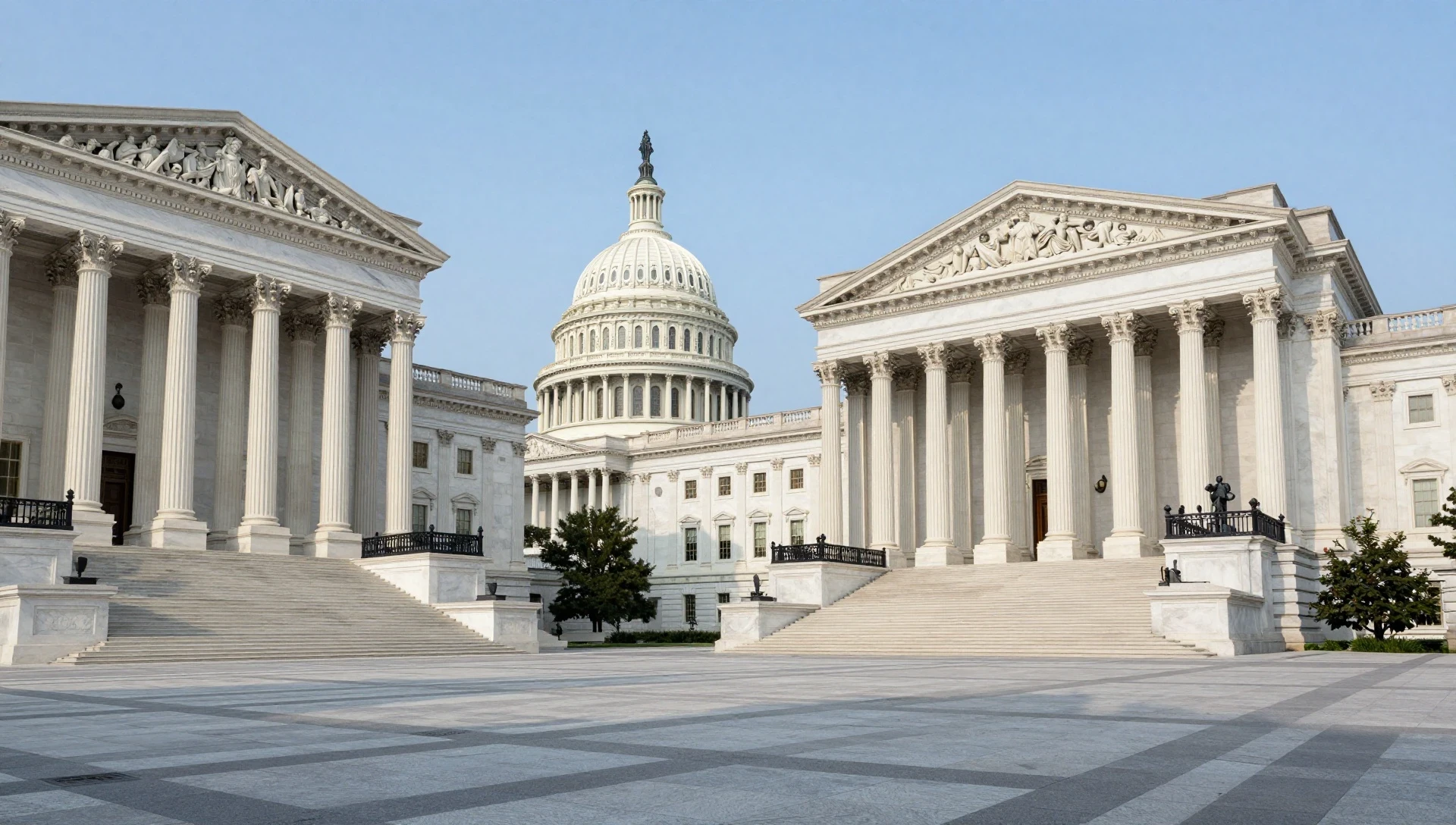
Virginia and the District of Columbia have jointly filed a lawsuit challenging a proposed triumphal arch tied to Donald Trump, adding a fresh legal front to a project already contested on multiple sides.
The action arrives as federal officials push to begin construction, creating a direct collision between state-level litigation and the government's building timetable. The dispute now turns on whether a monument of this scale can proceed while its legal standing remains unresolved.
The filing is the latest episode in a broader pattern of American memorial politics, where land use, federal authority, and executive legacy intersect. Virginia and Washington, D.C., are not merely registering objection; they are asking a court to test the project's compliance with planning and environmental rules before ground is broken. That procedural framing matters, because it determines whether construction pauses or continues during litigation.
On This Page
This analysis examines the legal architecture of the suit, the federal government's incentive to accelerate work, and the wider implications for monument approval in the capital region. It weighs the arguments on both sides, compares this dispute with earlier memorial conflicts, and assesses what the outcome could signal about executive-sponsored construction projects.
TL;DR Virginia and Washington, D.C., have sued over a proposed Trump-linked arch while the federal government seeks to start construction. The case tests whether large commemorative projects can proceed before legal challenges are resolved, and it exposes the tension between state oversight, federal land authority, and executive legacy building. The outcome will shape how future monument proposals navigate litigation, environmental review, and public consultation in the capital region.
The Legal Architecture of the Arch Dispute
The lawsuit filed by Virginia and the District of Columbia is best understood as a procedural instrument rather than a symbolic protest. By contesting the project in court, the two jurisdictions force the government to justify its approvals against statutory standards, including planning review and environmental assessment. That converts a political disagreement into a docketed legal question with defined burdens of proof.
Who Is Suing and on What Grounds
Virginia brings its claim as a neighboring jurisdiction with direct interest in sightlines, traffic, and regional planning coherence. The District of Columbia asserts authority over local land-use impacts and public space considerations within its boundaries. Together they frame the arch as a project with cross-jurisdictional consequences that cannot be approved unilaterally.
The legal grounds typically invoked in such cases include failure to follow required review procedures, inadequate environmental documentation, and conflicts with local planning statutes. Each ground carries a different standard of judicial deference, and courts tend to scrutinize procedural compliance more closely than substantive design choices. That makes the paperwork as decisive as the architecture.
Standing is the threshold question. Both plaintiffs must show concrete injury, not merely aesthetic displeasure, and regional governments usually clear that bar by citing infrastructure, tourism, or environmental effects. If standing holds, the case proceeds to the merits, where the government's administrative record becomes the central battleground.
Remedies matter as much as liability. A court could enjoin construction, remand the approval for further review, or allow work to continue under conditions. Each outcome carries different practical consequences for the project's timeline and for the precedent it sets regarding executive-sponsored monuments.
The Government's Push to Begin Work
The federal government's desire to start construction is a strategic as well as logistical choice. Beginning work creates facts on the ground, and courts are historically reluctant to order demolition of partially built structures. Speed therefore functions as a legal tactic, not merely a scheduling preference.
Federal officials typically argue that statutory review has been satisfied and that delay imposes public costs. They may also contend that the project falls within federal authority over commemorative works on federal land, limiting the scope of local objection. That argument tests the boundary between federal supremacy and municipal planning control.
Contractual obligations add pressure. Once construction contracts are awarded, cancellation carries financial penalties and political embarrassment, which strengthens the incentive to proceed. This dynamic explains why litigation and groundbreaking often race each other in high-profile infrastructure disputes.
Precedent From Earlier Memorial Conflicts
American history offers several parallels. Disputes over the Vietnam Veterans Memorial's design, the World War II Memorial's placement on the National Mall, and various presidential library proposals all involved litigation or intense regulatory negotiation. In each case, procedural challenges delayed construction and reshaped final designs.
The pattern is consistent: courts rarely block monuments outright, but they frequently remand approvals for better documentation. That outcome typically adds months, not years, yet it can alter siting, scale, and public consultation. The arch dispute is likely to follow a similar trajectory.
Comparative evidence suggests that projects with early, genuine consultation face fewer successful challenges. Where sponsors treat review as a formality, litigation risk rises sharply. The arch's legal exposure therefore reflects the quality of its approval process as much as the merits of its design.
We Also Published
Federal Authority, Local Consent, and the Politics of Monuments
The arch dispute exposes a structural tension in American governance: federal land and federal projects often sit inside or adjacent to jurisdictions with their own planning laws. When those authorities diverge, litigation becomes the default resolution mechanism. The case therefore tests how far local consent can constrain federally sponsored commemorative construction.
The Scope of Federal Land Authority
Federal enclaves and federally owned parcels are generally governed by federal law, which limits the reach of state and municipal regulation. However, projects frequently spill beyond those boundaries through traffic, viewsheds, and infrastructure. Plaintiffs exploit that spillover to establish a legitimate local interest.
Courts have consistently held that federal agencies must still comply with applicable environmental and historic preservation statutes. Those statutes create procedural obligations that local governments can enforce through citizen-suit provisions. This is the legal lever that converts a land-use objection into a viable federal claim.
The practical result is a layered approval regime. Federal authority does not eliminate local influence; it channels that influence into procedural challenges. Understanding this layering is essential to predicting how the arch case will unfold.
Executive Legacy and Commemorative Politics
Monuments sponsored by sitting or former presidents carry unusual political weight. They function as statements about historical memory, and their approval processes attract scrutiny disproportionate to their physical scale. The arch is no exception, and its association with Donald Trump intensifies both support and opposition.
Legacy projects also create incentives for acceleration. Sponsors want visible progress within political timeframes, while opponents want delay long enough to change administrations or public opinion. This asymmetry explains why construction timing becomes a contested legal issue rather than a neutral scheduling matter.
Public opinion data on memorial projects is sparse, but polling generally shows support for commemoration in principle and skepticism about specific designs and costs. That gap gives litigants room to argue that approval lacked genuine public consultation.
Economic and Planning Consequences
Large monuments generate measurable economic effects, including tourism revenue, construction employment, and long-term maintenance costs. They also impose planning burdens such as traffic management and security requirements. These factors give local governments a concrete stake that courts recognize.
Cost overruns are common in commemorative construction. Comparable projects have exceeded initial budgets by wide margins, and maintenance endowments are often underfunded. Litigation adds its own costs, including delay premiums and legal fees borne by taxpayers or sponsors.
The planning dimension extends beyond the site itself. Viewsheds, pedestrian flows, and emergency access all interact with surrounding infrastructure. A monument that works in isolation can still impose regional costs, which is precisely the argument local plaintiffs tend to advance.
What the Outcome Signals for Future Commemorative Projects
The arch case is unlikely to end with a dramatic judicial veto. More probable is a remand requiring additional review, followed by a revised approval and eventual construction. That pattern has repeated across decades of monument disputes, and it reflects courts' preference for procedural correction over substantive prohibition.
Scenarios and Their Probabilities
Three broad outcomes are plausible. First, the court denies injunctive relief and construction proceeds while litigation continues. Second, the court pauses work pending fuller review, adding months of delay. Third, the case settles through design or siting concessions that satisfy plaintiffs without a ruling.
Historical base rates favor the second and third scenarios. Courts are cautious about halting federal projects entirely, but they are also reluctant to bless inadequate review. The most likely result is a negotiated or remanded middle path that preserves the project while strengthening its documentation.
Probability estimates should be treated cautiously, since they depend on the administrative record's quality. If the government's review is thorough, its litigation position improves markedly. If gaps exist, plaintiffs gain leverage regardless of the project's political salience.
Implications for Sponsors and Regulators
The clearest lesson for future sponsors is that procedural rigor is cheaper than litigation. Early consultation, complete environmental documentation, and transparent cost disclosure reduce legal exposure substantially. Sponsors who treat review as an obstacle invite the very delays they seek to avoid.
Regulators face a parallel incentive. Rushed approvals that later collapse in court waste more time than careful ones. Agencies that build defensible records protect both the project and their own institutional credibility, which matters for future proposals.
Local governments, meanwhile, gain a template. By framing objections in procedural terms rather than aesthetic ones, they convert political disagreement into enforceable legal claims. That approach is more durable and more likely to produce concrete concessions.
Broader Lessons for Monument Governance
Monuments are public infrastructure with long horizons, and their approval should reflect that timescale. Short political cycles push toward acceleration, while legal review pushes toward deliberation. The arch dispute illustrates the cost of letting those forces collide rather than sequencing them properly.
Comparative practice offers useful models. Some jurisdictions require independent design review and mandatory public consultation before any federal approval. Others separate sponsorship from approval, reducing the appearance of executive self-dealing. These structural choices shape litigation risk long before a lawsuit is filed.
The deeper issue is legitimacy. A monument approved through contested procedures may stand physically but remain politically fragile. Projects that survive legal challenge and public scrutiny tend to endure because their approval process conferred legitimacy, not merely permission.
From our network :
- The Final Descent: How ESA Retired the Legendary Cluster Constellation After 24 Years of Space Weather ScienceAfter 24 years mapping Earth’s magnetosphere, ESA’s Cluster mission concluded with a precisely controlled reentry over the South Pacific. This analysis explores the scientific legacy, engineering decisions, and debris mitigation principles behind one of space exploration’s most responsible retirements.
- How AI Agents Will Change the Way We Manage Personal FinancesExplore how AI agents are transforming personal finance through automated budgeting, bill payment, and investment management, while examining the critical security protocols and governance frameworks required for safe deployment.
- University Language Proficiency Exams: Why Institutional Tests Demand Different Preparation Than IELTS and TOEFLDiscover why university-specific language proficiency examinations differ fundamentally from IELTS and TOEFL, and learn strategic preparation approaches for institutional assessment success.
- Mobile Learning and VR in English: What Global Evidence Reveals About Effective Language TechnologyA systematic review across 14 countries reveals which language-learning technologies genuinely work. Mobile learning, AI, and VR show measurable benefits when pedagogically integrated. This evidence-based guide helps educators and learners select technology that delivers real return on investment.
- Committed Mediterranean Precipitation Decline: Why Emissions Cuts Alone Cannot Restore Winter RainsNew NOAA research reveals that Mediterranean winter rains may decline irreversibly even with emissions cuts. Explore the science of committed climate change and regional impacts.
- CISA’s Ten-Advisory Wave: Why Generic Patching Fails in OT and How to Build Product-Specific PlaybooksCISA released ten ICS advisories in one week, exposing critical infrastructure risks. Generic patching fails in OT. Learn to build product-specific remediation playbooks.
- Forbidden Matrix Patterns and Visible Lattice Points: A Geometric DictionaryExplore how multidimensional 0–1 matrices encode geometric truths, linking forbidden patterns to visible lattice points and hypergraph theory, with applications in combinatorics and computational geometry.
- The Hidden Cost of AI Convenience: Why Over-Permissioned Agents Are a Security Time BombDiscover why AI agents with excessive permissions create dangerous single points of failure, and learn how implementing least privilege principles can protect your organization from exploitation.
- Live Online English Classes for Kids: Do They Actually Reduce Anxiety?A ten-week study reveals that synchronous online English classes can significantly reduce child language anxiety while improving listening and reading skills. Discover what makes these programs effective and how parents can select the right one.
RESOURCES
- Trump's memorial arch faces a new lawsuit from Arlington County ...pbs.orgOct 9, 2026 ... The Arlington County Board in Virginia filed a lawsuit Thursday opposing the construction of the Triumphal Arch, becoming the first ...
- Virginia and DC sue to stop Trump's arch as government looks to ...theguardian.com2 days ago ... In the latest lawsuit, two attorneys general, Brian Schwalb of Washington DC and Jay Jones of Virginia, argue that “as…
- Virginia and D.C. sue over Trump's arch, adding to legal challenges ...pbs.org2 days ago ... Golf course and Kennedy Center projects also have wound up in court. The lawsuits are among several that have been…
- Virginia and D.C. sue to block construction of Trump arch - NPRnpr.org1 day ago ... ... lawsuit on Saturday to block construction on President Donald Trump's proposed triumphal arch. The 45-page lawsuit in the United…
- Virginia and D.C. sue to stop proposed Trump arch - NBC Newsnbcnews.com2 days ago ... Virginia and the District of Columbia filed a lawsuit in federal court Saturday in a last-ditch effort to stop the…
- D.C. and Virginia sue to block Trump's proposed triumphal archwashingtonpost.com1 day ago ... The lawsuit by the two jurisdictions, which called the arch “flagrantly unlawful,” increases legal pressure against the president's planned ...
- Trump's planned DC arch faces new lawsuit - Al Jazeeraaljazeera.comOct 9, 2026 ... Local authorities in Arlington, Virginia, have sued the United States Department of the Interior and the National Park Service, seeking…
- Northern Virginia county sues to block Trump from building his archwashingtonpost.comOct 8, 2026 ... ... in their push to begin work on the structure. The lawsuit, filed in federal court in Virginia, argues that…
- Arlington County Takes Legal Action to Stop Trump's 250-Foot-Tall ...democracyforward.orgOct 8, 2026 ... The arch, the latest vanity project proposed by Trump, will occupy more than 15,000 square feet of ground space in…
- DC and Virginia sue to block Trump arch construction - POLITICOpolitico.com2 days ago ... Washington, D.C., and Virginia filed a lawsuit Saturday seeking to block the construction of President Donald Trump's planned Triumphal Arch ...
- DC, Virginia file suit to block construction on Trump's proposed archabcnews.com1 day ago ... Washington D.C. and Virginia are asking a judge to block the president's Triumphal Arch.
- D.C. and Virginia Join the Fight to Block Trump's Triumphal Arch ...time.com2 days ago ... A new lawsuit comes with construction set to begin next week, adding to legal battles over the President's plans to…
- Trump's Arch Faces New Legal Challenge From Virginia and D.C.nytimes.com2 days ago ... The suit was filed by Jay Jones, Virginia's attorney general, and Brian L. Schwalb, Washington's attorney general. It is one…
- DC, Virginia file lawsuit to stop Trump's 250-foot Triumphal Archsanluisobispo.com2 days ago ... Virginia's and D.C.'s attorneys general argue in the suit that the Trump administration is bypassing legally required authorization from ...
- D.C., Virginia file suit to block Trump's arch project - UPI.comupi.com2 days ago ... Washington, D.C., and the Commonwealth of Virginia filed a lawsuit Saturday to block construction of President Donald Trump's arch.
- 01
- 02
- 03
- 04
- 05
- 06
- 07
- 08
0 Comments