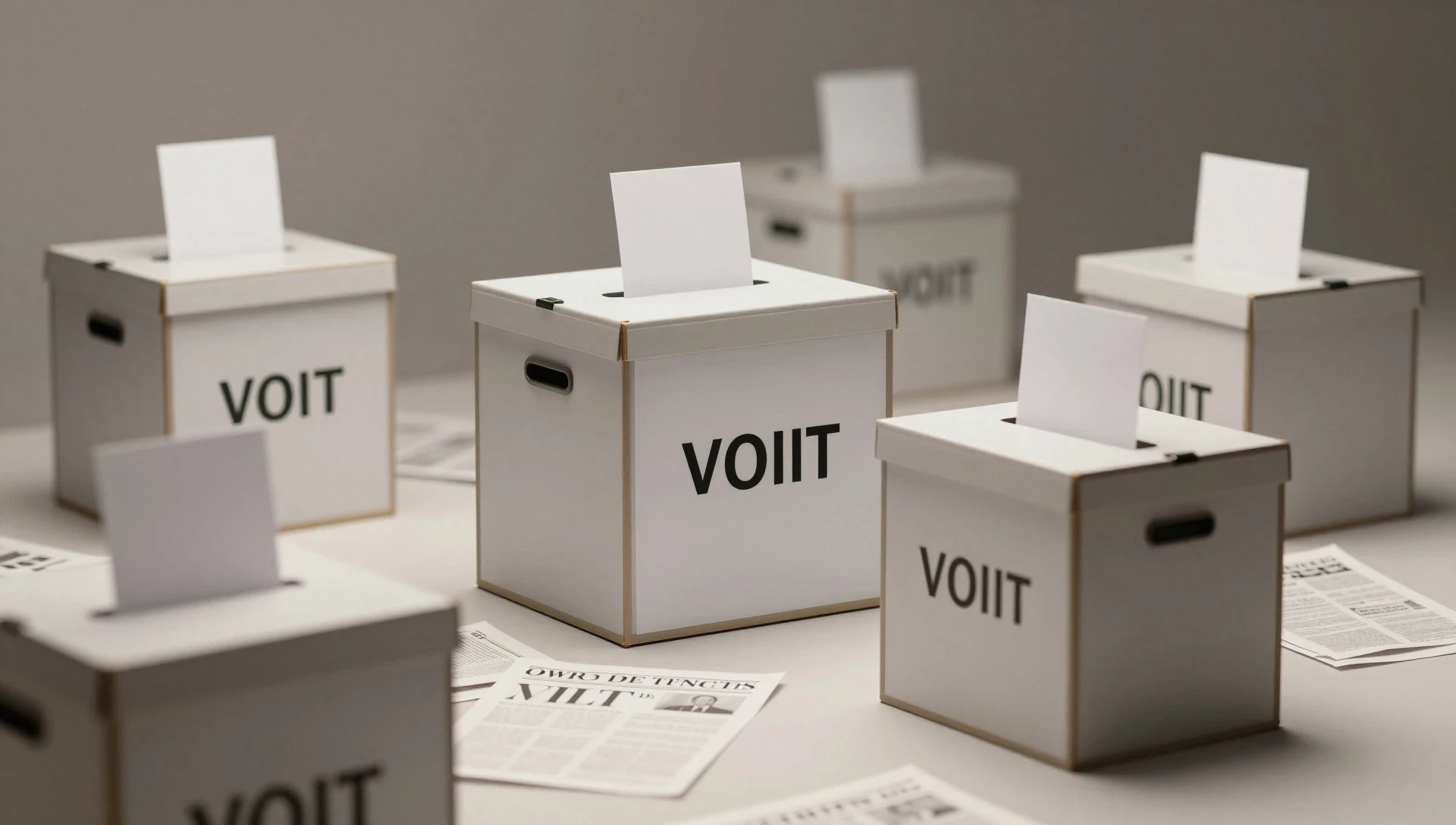
The New York Times opinion section published a column on 31 October 2026 under the headline "Brace Yourself for an 'Unusual Election.'" The framing is deliberate: quotation marks around "unusual" signal that the abnormality is contested rather than settled, and the imperative "brace yourself" positions readers as participants preparing for disruption.
The source material supplies the headline, the section, the date and the URL slug referencing midterms, races and Democrats, but no body text. What follows therefore reads the artifact as a signal rather than a report.
Opinion journalism operates under a different evidentiary contract than news reporting. A column reflects its author's argument, and the Times labels it accordingly, so the piece's value to analysts lies less in any factual claim than in what an editorial board chooses to amplify weeks before a national vote.
On This Page
Headline language in prestige outlets functions as agenda-setting: it tells politically attentive readers which risks deserve attention. The word "brace" implies anticipation of turbulence, not mere difference.
The URL slug is the most concrete evidence available. It references midterms, races and Democrats, which anchors the column in the 2026 congressional cycle rather than a generic electoral essay. That specificity matters, because "unusual election" claims typically cluster around four variables: turnout composition, candidate quality, institutional trust and post-election dispute risk. Each variable carries measurable historical baselines against which any 2026 anomaly can be assessed.
TL;DR A New York Times opinion column headlined "Brace Yourself for an 'Unusual Election'" signals that the 2026 midterms may deviate from historical patterns, though the source provides only the headline, section, date and URL slug. This analysis treats the piece as an agenda-setting artifact, examining how opinion journalism frames electoral risk, what "unusual" has meant in prior cycles, and which measurable indicators — turnout, polarization, trust and dispute risk — determine whether the label is warranted.
Reading the Headline as an Editorial Signal
Headlines in elite opinion pages are editorial decisions, not neutral descriptions. When the Times places quotation marks around "unusual," it distances the paper from the claim while still promoting it, a rhetorical move that invites scrutiny rather than asserting fact.
The construction lets columnists argue abnormality without committing the newsroom to a contested premise. For analysts, the headline is data about editorial priorities.
What the Source Actually Contains
The available record is thin and should be treated as such. We have a title, an opinion-section designation, a timestamp of 31 October 2026 at 11:00 UTC, and a URL slug naming midterms, races and Democrats. No quotations, no thesis statement, no cited polling.
Any interpretation beyond this metadata is inference, and responsible analysis must flag the boundary between evidence and speculation.
The timestamp itself carries weight. Publishing on the final Saturday before a Tuesday election maximizes reader attention during the closing news cycle, when undecided voters and donors are most receptive. Opinion desks time high-salience columns to this window deliberately.
A "brace yourself" framing released at that moment functions as a closing argument rather than a considered retrospective.
The slug's reference to Democrats suggests the column's argument concerns the party's prospects or internal dynamics, not a neutral procedural anomaly. Midterm coverage in opinion pages frequently centers on which party benefits from unusual conditions. That directional hint, however faint, distinguishes this piece from a generic essay on electoral mechanics.
The Function of Opinion Journalism in Election Cycles
Opinion columns shape elite discourse before they shape public opinion. Political operatives, donors and journalists read prestige-page columns as cues about which narratives will dominate coverage. A column declaring an election unusual can legitimize storylines that campaigns then amplify. The causal chain runs from editorial page to insider conversation to broadcast framing, often within days.
Research on agenda-setting consistently finds that media salience influences what audiences consider important, even when it does not dictate what they think. A headline about an "unusual election" primes readers to interpret ordinary events — a gaffe, a poll shift, a legal ruling — as symptoms of abnormality. That priming effect is the column's real mechanism, independent of its argument's merits.
Opinion pages also perform a risk-communication function. When editorial boards anticipate contested outcomes, columns prepare audiences emotionally and intellectually. The "brace yourself" imperative fits this pattern: it lowers surprise if results are delayed, disputed or historically anomalous. Preparation reduces the shock that can erode institutional trust when events deviate from expectation.
Historical Precedents for "Unusual" Framing
The label has precedent. The 2000 election produced a 36-day recount and a Supreme Court decision, an outcome almost no columnist predicted. In 2016, most prestige outlets framed the cycle as conventional until results contradicted forecasts.
In 2020, pandemic conditions, expanded mail voting and litigation risk made "unusual" a near-consensus descriptor well before November.
Each precedent shares a structural feature: the anomaly was visible in measurable indicators before election day, not merely asserted. Mail-ballot volumes, litigation filings, candidate refusals to commit to concession and polling dispersion all provided early warning. A credible "unusual" claim in 2026 would rest on similar observable signals rather than editorial intuition alone.
We Also Published
Decomposing "Unusual": Four Measurable Variables
Abnormality in elections is not a single condition but a bundle of variables, each with its own baseline. Turnout composition, candidate quality, institutional trust and dispute risk can each deviate independently. A cycle may be unusual on one dimension and entirely ordinary on the others. Analysts should score each variable separately rather than accept a composite label.
Turnout Composition and Participation Shifts
Midterm turnout in the United States has historically run well below presidential years, typically in the 40 percent range of eligible voters against roughly 60 percent in presidential cycles. The 2018 midterms broke that pattern with turnout near 50 percent, the highest in over a century. Any 2026 deviation from this elevated baseline would itself be a measurable anomaly.
Composition matters more than aggregate volume. Shifts in the educational, age and geographic mix of the electorate can swing outcomes without changing total turnout. When columnists call an election unusual, they often mean the likely electorate looks different from prior cycles. That claim is testable through early-voting data, registration files and validated-voter surveys.
Early-voting statistics deserve caution. They measure when ballots are cast, not how they are marked, and partisan differences in early-voting propensity have shifted repeatedly across cycles. Analysts who infer outcomes from early-vote totals have repeatedly erred. The metric is useful for logistics and turnout modeling, not for projecting margins.
Candidate Quality and Institutional Norms
Candidate quality has become a quantifiable variable. Political scientists measure it through prior officeholding, fundraising capacity and scandal exposure, and find that quality gaps between parties correlate with seat outcomes. A cycle in which one party fields notably weaker candidates is unusual in a measurable, consequential sense.
Norm adherence is harder to score but equally relevant. Refusals to commit to accepting results, attacks on election administration and departures from concession traditions all mark deviation from post-2000 norms. When such behaviors cluster in one cycle, the "unusual" label acquires empirical content beyond editorial mood.
Institutional responses also shift. Courts, secretaries of state and election administrators prepare differently when they anticipate disputes. Pre-election litigation filings, changes to certification rules and public messaging from officials all serve as leading indicators. Their volume in 2026 would tell analysts more than any headline.
Trust, Polarization and Dispute Risk
Public trust in election integrity has declined unevenly and asymmetrically. Survey research since 2016 shows confidence diverging sharply by party depending on which party holds power. That asymmetry creates structural dispute risk: losing partisans are predisposed to doubt results. A cycle with elevated pre-election distrust is unusual in a way that matters operationally.
Affective polarization compounds the problem. When partisan identity is strong and out-group hostility high, close outcomes are more likely to be contested regardless of evidence. The relevant metric is not average trust but the trust gap between parties, which has widened substantially over two decades of survey data.
Dispute risk can be modeled probabilistically. Analysts combine margin expectations, litigation likelihood and certification-rule variation to estimate the chance of a contested result. When that probability rises materially above historical norms, the "unusual election" framing becomes defensible on quantitative grounds rather than rhetorical ones.
Implications for Readers, Markets and Institutional Trust
An opinion column cannot change vote counts, but it can change how results are received. If prestige outlets prepare audiences for abnormality, contested outcomes may feel expected rather than shocking. That expectation cuts both ways: it can inoculate institutions against surprise, or it can normalize dispute as the default posture. The net effect depends on how the framing is used.
Media Framing and Reader Calibration
Readers should calibrate claims to evidence. A headline asserting an unusual election is a hypothesis, not a finding. The appropriate response is to ask which variables deviate, by how much, and against what baseline. Columns that supply those numbers earn credibility; those that trade in mood do not. Distinguishing the two is a basic media-literacy skill.
Opinion pieces also shape what gets asked. When a column raises dispute risk, reporters begin querying officials about certification plans. That questioning produces information the public would otherwise lack. The agenda-setting function can therefore serve accountability even when the column's argument is contestable or wrong.
Conversely, framing can crowd out competing stories. A cycle declared unusual on one dimension may obscure ordinary developments elsewhere, such as local races, ballot measures or administrative changes. Readers who consume only the headline narrative risk missing the bulk of what actually determines outcomes.
Market and Institutional Readouts
Prediction markets and volatility indices respond to perceived uncertainty, not to editorial tone directly. When dispute risk rises, markets price it through wider spreads and higher implied volatility around event dates. Analysts watching these instruments can infer whether professional traders share the column's premise. Divergence between commentary and pricing is itself informative.
Institutional preparation is the more consequential readout. Courts staffing election-dispute dockets, secretaries of state issuing certification guidance and parties training poll watchers all signal anticipated friction. These are observable, budgeted actions rather than rhetoric. Their scale in 2026 would provide the strongest evidence for or against the "unusual" label.
Trust metrics close the loop. If pre-election confidence gaps widen and post-election acceptance diverges by party, the cycle will have earned the descriptor. If acceptance holds despite close margins, the framing will look like anticipatory alarmism. Either outcome yields lessons for how opinion pages should calibrate future warnings.
What Would Confirm or Refute the Premise
Falsifiability is the test. The premise would be confirmed by turnout deviating sharply from the 2018–2022 baseline, by elevated pre-election litigation, by widened partisan trust gaps and by measurable candidate-quality asymmetry. It would be refuted by ordinary turnout, routine certification and acceptance of results across parties. These are observable conditions, not interpretive ones.
Analysts should pre-register their indicators before election day to avoid post-hoc rationalization. The temptation to declare any outcome "unusual" after the fact is strong, because close elections always contain surprising elements. Fixing the metrics in advance preserves the claim's informational value and disciplines commentary.
The column's ultimate significance may lie less in its prediction than in its timing and placement. A prestige outlet choosing to publish a "brace yourself" piece on the final Saturday before voting tells us the editorial class expects turbulence. Whether that expectation proves correct is an empirical question the coming weeks will answer.
From our network :
- The Final Descent: How ESA Retired the Legendary Cluster Constellation After 24 Years of Space Weather ScienceAfter 24 years mapping Earth’s magnetosphere, ESA’s Cluster mission concluded with a precisely controlled reentry over the South Pacific. This analysis explores the scientific legacy, engineering decisions, and debris mitigation principles behind one of space exploration’s most responsible retirements.
- How AI Agents Will Change the Way We Manage Personal FinancesExplore how AI agents are transforming personal finance through automated budgeting, bill payment, and investment management, while examining the critical security protocols and governance frameworks required for safe deployment.
- Forbidden Matrix Patterns and Visible Lattice Points: A Geometric DictionaryExplore how multidimensional 0–1 matrices encode geometric truths, linking forbidden patterns to visible lattice points and hypergraph theory, with applications in combinatorics and computational geometry.
- The Hidden Cost of AI Convenience: Why Over-Permissioned Agents Are a Security Time BombDiscover why AI agents with excessive permissions create dangerous single points of failure, and learn how implementing least privilege principles can protect your organization from exploitation.
- Mobile Learning and VR in English: What Global Evidence Reveals About Effective Language TechnologyA systematic review across 14 countries reveals which language-learning technologies genuinely work. Mobile learning, AI, and VR show measurable benefits when pedagogically integrated. This evidence-based guide helps educators and learners select technology that delivers real return on investment.
- University Language Proficiency Exams: Why Institutional Tests Demand Different Preparation Than IELTS and TOEFLDiscover why university-specific language proficiency examinations differ fundamentally from IELTS and TOEFL, and learn strategic preparation approaches for institutional assessment success.
- Committed Mediterranean Precipitation Decline: Why Emissions Cuts Alone Cannot Restore Winter RainsNew NOAA research reveals that Mediterranean winter rains may decline irreversibly even with emissions cuts. Explore the science of committed climate change and regional impacts.
- Live Online English Classes for Kids: Do They Actually Reduce Anxiety?A ten-week study reveals that synchronous online English classes can significantly reduce child language anxiety while improving listening and reading skills. Discover what makes these programs effective and how parents can select the right one.
- CISA’s Ten-Advisory Wave: Why Generic Patching Fails in OT and How to Build Product-Specific PlaybooksCISA released ten ICS advisories in one week, exposing critical infrastructure risks. Generic patching fails in OT. Learn to build product-specific remediation playbooks.
RESOURCES
- Brace Yourself for an 'Unusual Election' - The New York Timesnytimes.com2 days ago ... Want to catch “The Opinions” live? Join us at the Brooklyn Public Library on Nov. 5 at 7 p.m. The…
- Opinion | Ben Sasse: What Dying Feels Like - The New York Timesnytimes.comApr 9, 2026 ... ... as Midterms Near. The Justice Department's Unusual Election-Year Activity. Opinion. Democrats Are in Their Elder Millennial Era.
- What the New York Times got wrong – and right - SCOTUSblogscotusblog.comApr 21, 2026 ... 9, 2016, by a 5-4 vote, the Supreme Court granted the stay. The New York Times piece frames this as…
- The New York Times Opinion Section (@nytopinion) - Facebookfacebook.comThe New York Times Opinion Section. 1073793 followers · 90900 talking ... Opinion | Brace Yourself for an 'Unusual Election'. Democratic sweep or not ...
- Why the Myth of Noncitizen Voting Persistsbrennancenter.orgAug 21, 2024 ... Analysis & Opinion; Why the Myth of Noncitizen Voting ... On Sunday, the New York Times reported that former President…
- 01
- 02
- 03
- 04
- 05
- 06
- 07
- 08
0 Comments