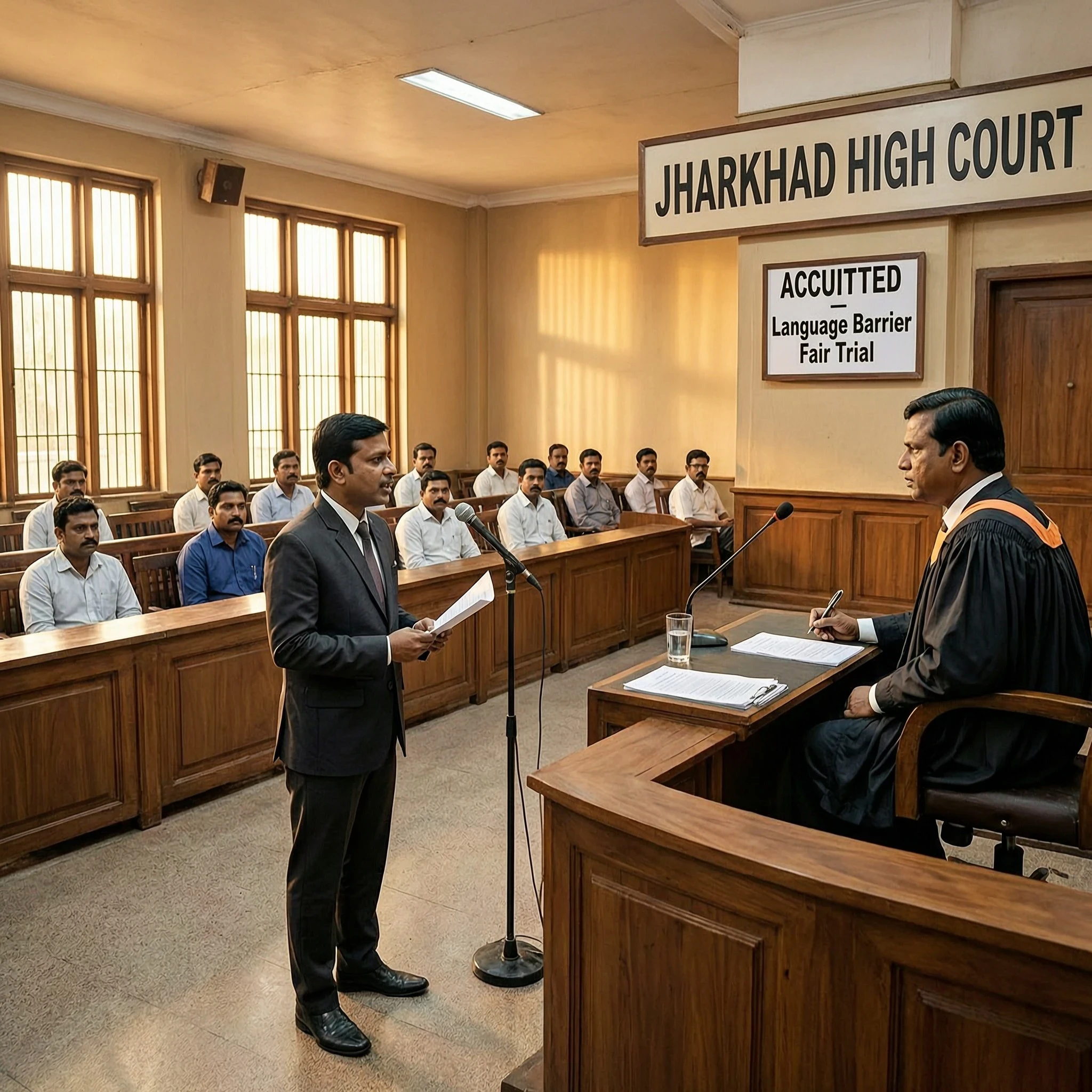
The Jharkhand High Court's decision to acquit a murder convict because his trial was conducted in a language he could not comprehend represents far more than a single legal correction.
It is a profound statement about the architecture of constitutional justice, where procedural fairness is not a courtesy extended to the accused but an enforceable right woven into the fabric of Article 21.
When the bench described the recording of Chamara Oraon's evidence as a "farce," it was diagnosing a systemic failure rather than merely rebuking a lower court. The judgment, uploaded on a Wednesday in October 2026, has quietly become a landmark meditation on what it truly means to be heard in a courtroom.
On This Page
- The Constitutional Foundation of Fair Trial and Language Rights
- Anatomy of the Ranchi Trial: What Went Wrong
- Language as a Barrier to Justice: The Broader Systemic Problem
- Appellate Review and the Power to Quash Convictions
- Implications for Criminal Justice Reform and Legal Education
- Conclusion: A Verdict That Redefines Fairness
At the heart of the matter lies a 2009 murder allegation in Ranchi, where the prosecution claimed Oraon drowned a woman in a well amid a land dispute. A sessions court convicted him in April 2018 and imposed life imprisonment, seemingly closing the chapter.
Yet the manner in which his statement was recorded during trial—questions posed in English, answers transcribed in English, and a thumb impression affixed a full day later—exposed a chasm between the form of legal process and its substance.
The High Court found that circumstances against him were never explained in a language he understood, rendering the entire exercise hollow.
This analysis unpacks the judgment's layered significance, tracing how language accessibility intersects with the fundamental right to a free and fair trial. It examines the mechanics of evidence recording under the Bharatiya Sakshya Adhiniyam and its predecessor, the evidentiary weight of thumb impressions, and the appellate standards that allow High Courts to quash convictions outright.
Beyond doctrine, the case raises uncomfortable questions about legal aid quality, interpreter availability, and the silent miscarriages that never reach appellate scrutiny. The acquittal of a man who spent years in prison is both a vindication and an indictment.
TL;DR The Jharkhand High Court acquitted murder convict Chamara Oraon after finding that his trial was fundamentally unfair because he was examined in English, a language he did not understand, with his evidence recorded in English and his thumb impression added a day later. The bench termed the recording a "farce," held that the circumstances against him were never explained in a language he knew, and ruled that this violated his constitutional right to a free and fair trial under Article 21. The conviction and life sentence imposed by a Ranchi sessions court in 2018 were quashed. The judgment underscores that procedural fairness in evidence recording is not optional, and that language accessibility is a core component of due process rather than a mere administrative convenience.
The Constitutional Foundation of Fair Trial and Language Rights
India's constitutional framework treats a fair trial as an inseparable facet of the right to life and personal liberty, and courts have repeatedly held that this guarantee extends to every procedural stage.
The Supreme Court has, across decades, interpreted Article 21 to include the right to be heard, the right to legal representation, and the right against self-incrimination. Language, though rarely named explicitly, sits at the intersection of all three.
An accused who cannot comprehend the questions posed to him is effectively silenced, and a trial conducted in that vacuum becomes a ritual without meaning.
Article 21 and the Jurisprudence of Procedural Fairness
The Supreme Court's jurisprudence has steadily expanded the content of procedural fairness, treating it as a substantive safeguard rather than a technical formality. In cases ranging from Maneka Gandhi to subsequent rulings on legal aid, the Court has insisted that procedure must be just, fair, and reasonable.
A trial where the accused does not understand the language of examination fails this test at its most elementary level. The Jharkhand High Court's reasoning draws directly from this lineage, framing the language failure as a constitutional violation rather than a curable irregularity.
What distinguishes the Oraon judgment is its refusal to treat the defect as harmless error. The bench observed that answers given without comprehension could actively harm the defence, because an accused might inadvertently concede facts or fail to offer explanations. This recognition transforms language from a logistical concern into an evidentiary one.
When the record itself is unreliable, appellate courts cannot presume prejudice—they must presume its possibility, and that presumption tilts decisively toward quashing.
Statutory Obligations Under the Evidence and Criminal Procedure Framework
Indian law imposes clear obligations on magistrates and judges when recording statements and examinations of accused persons. The Bharatiya Sakshya Adhiniyam, which replaced the Indian Evidence Act, and the Bharatiya Nagarik Suraksha Sanhita carry forward the principle that confessions and statements must be recorded in a manner the accused understands.
Section 164 CrPC, now mirrored in the new framework, mandates that statements be recorded in the language of the accused or translated accurately. These provisions exist precisely to prevent the kind of procedural theatre that unfolded in Ranchi.
The requirement that circumstances appearing against an accused be explained to him—historically rooted in Section 313 CrPC—is another critical safeguard. This examination is not a formality; it is the accused's opportunity to respond to the prosecution's case. When that opportunity is delivered in an alien language, it collapses into a nullity.
The High Court's finding that the circumstances were never explained in a language Oraon knew strikes at the heart of this statutory guarantee, rendering the trial defective from within.
Anatomy of the Ranchi Trial: What Went Wrong
The factual record of the Oraon case reads like a catalogue of procedural neglect, each lapse compounding the next. The alleged offence dates to February 26, 2009, when the prosecution claimed Oraon drowned a woman named Parmeshwari Devi in a well during a land dispute.
Nearly a decade later, on April 25, 2018, a Ranchi sessions court convicted him and sentenced him to life imprisonment. The trial that produced this outcome, however, was conducted in a manner the High Court found deeply compromised, with the accused's examination reduced to a linguistic formality he could neither follow nor contest.
The Examination in English and the Delayed Thumb Impression
The most damning detail concerns the recording of Oraon's statement. Questions were put to him in English, a language the court found he did not understand, and his responses were transcribed in English as well. More troubling still, his thumb impression was affixed to the record a full day after the examination.
This temporal gap raises serious questions about authenticity and voluntariness, because a signature or mark obtained after the fact cannot reliably certify what was said in the moment. The bench's characterization of the exercise as a "farce" reflects its recognition that the record was manufactured rather than witnessed.
In a properly conducted examination, the accused's responses are recorded contemporaneously, read back to him in a language he understands, and acknowledged immediately. The delay in obtaining the thumb impression breaks this chain of custody, undermining the evidentiary value of the entire statement.
Defence counsel Ananda Sen and Pradeep Kumar Srivastava argued that this procedural breakdown denied Oraon the opportunity to meaningfully respond to the allegations. The High Court accepted this submission, finding that the circumstances against him were never explained in a language he knew.
Evidentiary Consequences of an Unreliable Record
When the record of an accused's examination is unreliable, the appellate court faces a stark choice: remand for retrial or acquit outright. Remand is ordinarily preferred where the defect is curable and the prosecution retains a viable case.
But where the foundational fairness of the trial is compromised, and where the accused has already endured years of incarceration, the scales tilt toward acquittal. The Jharkhand High Court chose the latter course, quashing both conviction and sentence and ordering Oraon's release.
This outcome reflects a settled appellate principle: prejudice need not be proven where the procedure itself is fundamentally flawed. The court reasoned that answers given without comprehension could harm the defence, because an accused might fail to raise exculpatory explanations or might inadvertently admit facts.
In such circumstances, the trial's verdict cannot be trusted, and the only remedy consistent with constitutional guarantees is to set it aside. The acquittal is therefore not a finding of innocence but a declaration that the state failed to prove guilt through a fair process.
We Also Published
Language as a Barrier to Justice: The Broader Systemic Problem
The Oraon case is not an isolated aberration but a symptom of a deeper structural deficiency in India's criminal justice system. Jharkhand, like many states, is home to numerous tribal communities whose first languages—Kurukh, Mundari, Santhali, and others—differ substantially from Hindi and English.
When courts default to English or Hindi without ensuring comprehension, they create a two-tier system where linguistic minorities face a distinct disadvantage. The problem is compounded by the scarcity of trained interpreters and the absence of standardised protocols for language assessment at the trial stage.
The Gap Between Legal Aid and Effective Representation
Legal aid, though constitutionally mandated, often falls short of meaningful assistance for accused persons from marginalised communities. Overburdened legal aid lawyers may lack the resources or linguistic competence to bridge the communication gap. In Oraon's case, the defect was caught on appeal, but countless similar cases likely proceed unnoticed.
The absence of a systematic mechanism to verify comprehension at the time of examination means that language barriers are routinely overlooked until they surface as appellate grounds, if they surface at all.
Effective representation requires more than the presence of a lawyer; it demands that the accused understand the proceedings and participate meaningfully in his defence. When a lawyer cannot communicate with his client, or when the court does not ensure translation, the right to counsel becomes illusory.
The Jharkhand High Court's judgment implicitly recognises this by treating the language failure as a denial of fair trial rather than a mere technical lapse. It is a reminder that access to justice is measured not by the existence of institutions but by their accessibility to those who need them most.
Interpreter Availability and Judicial Infrastructure
India's court system lacks a robust, standardised interpreter cadre, particularly in district and sessions courts where most trials occur. Interpreters are often ad hoc, untrained, and unfamiliar with legal terminology, raising concerns about accuracy and neutrality.
The problem is especially acute in states with high tribal populations, where the gap between the language of the court and the language of the accused can be vast. Without investment in interpreter infrastructure and mandatory language assessment protocols, judgments like Oraon's will remain necessary correctives rather than preventive safeguards.
Technology offers partial solutions, including remote interpretation and digital translation tools, but these require funding, training, and institutional will. The deeper challenge is cultural: courts must treat language accessibility as a core judicial function rather than an administrative afterthought.
The High Court's decision sends a clear signal that appellate scrutiny will not tolerate linguistic shortcuts. Whether that signal translates into systemic reform depends on how seriously the lower judiciary and state governments take the underlying problem.
- 01
- 02
- 03
- 04
Appellate Review and the Power to Quash Convictions
High Courts wield substantial appellate authority to examine both the facts and the law, and this power extends to setting aside convictions where procedural fairness has been compromised. The Jharkhand High Court's decision to acquit rather than remand reflects a considered exercise of this discretion.
The bench weighed the nature of the defect, the passage of time, and the accused's prolonged incarceration before concluding that the interests of justice favoured finality over retrial. This balancing act is central to appellate jurisprudence, where the remedy must fit the constitutional injury.
Standards for Interference with Trial Court Findings
Appellate courts are ordinarily reluctant to disturb concurrent findings of fact, but procedural irregularities receive closer scrutiny. Where the defect goes to the root of the trial—such as a failure to explain circumstances to the accused—the High Court can intervene without the usual deference.
The Oraon judgment fits within this tradition, treating the language failure as a jurisdictional flaw rather than a mere evidentiary quibble. The court's language, describing the recording as a "farce," signals that the trial court's conduct fell below the minimum threshold of judicial propriety.
The standard for quashing a conviction on procedural grounds requires the appellate court to assess whether the irregularity caused prejudice. In this case, the court found that prejudice was inherent in the failure to communicate, because the accused could not meaningfully respond to the allegations.
This reasoning aligns with Supreme Court precedents holding that where the accused's right to be heard is compromised, the trial is vitiated regardless of the strength of the prosecution's evidence. The acquittal is thus a vindication of process over outcome.
Remand Versus Acquittal: The Court's Discretion
The choice between remand and acquittal is among the most consequential decisions an appellate court makes. Remand allows the prosecution to cure defects and retry the accused, but it also prolongs uncertainty and may violate the right to a speedy trial.
Acquittal, by contrast, provides finality but may allow a guilty person to go free. The Jharkhand High Court chose acquittal, implicitly finding that the defect was so fundamental that retrial would not cure it and that the accused's prolonged incarceration weighed heavily in favour of release.
This discretion is not unbounded; it must be exercised judicially, with reasons that reflect the competing interests at stake. The court's judgment, though brief in its reported form, rests on the principle that constitutional guarantees cannot be sacrificed for procedural convenience.
By acquitting Oraon, the bench affirmed that the state bears the burden of conducting a fair trial, and that failure to do so carries consequences that cannot be remedied by belated correction. The message to trial courts is unmistakable.
Implications for Criminal Justice Reform and Legal Education
The Oraon judgment carries implications that extend well beyond the individual case, touching on how courts, legislatures, and legal educators approach language in criminal proceedings. It invites a re-examination of trial court practices, particularly in regions with diverse linguistic populations.
The decision also underscores the need for continuing judicial education on constitutional safeguards, so that trial judges internalise the importance of comprehension rather than treating examination as a routine formality. Reform, if it comes, will likely be incremental, but judgments like this provide the necessary pressure.
Strengthening Trial Court Practices and Protocols
Trial courts can adopt simple but effective measures to prevent language failures, including mandatory comprehension checks before recording statements. Judges should confirm on the record that the accused understands the language of examination or arrange for a qualified interpreter.
These steps are neither costly nor complex, yet they are frequently skipped under docket pressure. The Oraon case demonstrates that such shortcuts carry significant costs, both in appellate reversals and in the erosion of public confidence in the justice system.
Standardised forms and checklists could help institutionalise these practices, ensuring that language assessment becomes a routine part of the trial process. Judicial academies could incorporate language accessibility into their training curricula, emphasising its constitutional basis.
The goal is to shift the default from assumption to verification, so that no accused is examined in a language he does not understand. Such reforms would reduce the burden on appellate courts and strengthen the legitimacy of trial outcomes.
The Role of Legal Education and Awareness
Law schools and legal aid clinics have a role to play in preparing future lawyers to recognise and address language barriers. Clinical programmes that expose students to marginalised communities can build sensitivity to linguistic diversity and its legal consequences.
Awareness campaigns for accused persons and their families can also help them assert their rights at the earliest stage. The Oraon case is a reminder that rights are only as effective as the knowledge and will to enforce them.
Bar associations and civil society organisations can advocate for interpreter services and monitor trial proceedings for language-related defects. Public interest litigation has historically played a role in expanding access to justice, and language rights may be the next frontier.
The judgment provides a foundation for such efforts, offering a clear statement that language accessibility is constitutionally required. Whether it catalyses broader reform depends on how effectively these stakeholders mobilise around the issue.
Conclusion: A Verdict That Redefines Fairness
The Jharkhand High Court's acquittal of Chamara Oraon is a verdict that redefines fairness in practical terms, insisting that justice must be comprehensible to be just. By quashing a conviction obtained through a trial the accused could not follow, the bench affirmed that constitutional guarantees are not abstractions but lived protections.
The judgment's language—calling the recording a "farce"—captures the frustration of a court confronted with a process that had lost its moral and legal moorings. It is a decision that will be cited, debated, and hopefully heeded.
For Oraon, the acquittal ends years of incarceration but cannot restore what was lost. For the justice system, it offers a chance to learn, to reform, and to ensure that no future accused is examined in a language he does not understand.
The case is a reminder that the quality of justice is measured not by the severity of sentences but by the fairness of the process that produces them. In that sense, the Jharkhand High Court has done more than acquit a man; it has reaffirmed the constitutional promise that every accused deserves to be heard.
From our network :
- The Hidden Cost of AI Convenience: Why Over-Permissioned Agents Are a Security Time BombDiscover why AI agents with excessive permissions create dangerous single points of failure, and learn how implementing least privilege principles can protect your organization from exploitation.
- How AI Agents Will Change the Way We Manage Personal FinancesExplore how AI agents are transforming personal finance through automated budgeting, bill payment, and investment management, while examining the critical security protocols and governance frameworks required for safe deployment.
- Forbidden Matrix Patterns and Visible Lattice Points: A Geometric DictionaryExplore how multidimensional 0–1 matrices encode geometric truths, linking forbidden patterns to visible lattice points and hypergraph theory, with applications in combinatorics and computational geometry.
- Live Online English Classes for Kids: Do They Actually Reduce Anxiety?A ten-week study reveals that synchronous online English classes can significantly reduce child language anxiety while improving listening and reading skills. Discover what makes these programs effective and how parents can select the right one.
- Committed Mediterranean Precipitation Decline: Why Emissions Cuts Alone Cannot Restore Winter RainsNew NOAA research reveals that Mediterranean winter rains may decline irreversibly even with emissions cuts. Explore the science of committed climate change and regional impacts.
- University Language Proficiency Exams: Why Institutional Tests Demand Different Preparation Than IELTS and TOEFLDiscover why university-specific language proficiency examinations differ fundamentally from IELTS and TOEFL, and learn strategic preparation approaches for institutional assessment success.
- The Final Descent: How ESA Retired the Legendary Cluster Constellation After 24 Years of Space Weather ScienceAfter 24 years mapping Earth’s magnetosphere, ESA’s Cluster mission concluded with a precisely controlled reentry over the South Pacific. This analysis explores the scientific legacy, engineering decisions, and debris mitigation principles behind one of space exploration’s most responsible retirements.
- Mobile Learning and VR in English: What Global Evidence Reveals About Effective Language TechnologyA systematic review across 14 countries reveals which language-learning technologies genuinely work. Mobile learning, AI, and VR show measurable benefits when pedagogically integrated. This evidence-based guide helps educators and learners select technology that delivers real return on investment.
- CISA’s Ten-Advisory Wave: Why Generic Patching Fails in OT and How to Build Product-Specific PlaybooksCISA released ten ICS advisories in one week, exposing critical infrastructure risks. Generic patching fails in OT. Learn to build product-specific remediation playbooks.
RESOURCES
- High Court Overturns Life Sentence Due To Language Barrier In Trialrediff.com3 days ago ... The Jharkhand High Court acquitted a man serving a life sentence for murder, ruling that his fundamental right to a…
- The Death Penalty - The Advocates for Human Rightstheadvocatesforhumanrights.orgThe trial court eventually acquitted Anokhilal after receiving competent legal assistance and a fair ... death on the same day as their conviction. 68 ...
- India - State.gov2009-2017.state.govThere were no reports of political detainees during the year. e. Denial of Fair Public Trial ... On August 17, the Supreme Court instructed…
- 2023 SCC OnLine SC 1103 In the Supreme Court of India Munna ...judicialacademy.nic.inJun 1, 2023 ... The High Court dismissed the appeal filed by the appellant convict and confirmed the capital sentence imposed by the Trial…
- 2022 Country Reports on Human Rights Practices: Indiastate.govThe Supreme Court deferred to the Telangana High Court to proceed with a trial against the police officers accused of the killing. The Telangana…
- India - State.gov2009-2017.state.govIn June 2004 the Delhi High Court found several police officers guilty in the custodial death of an auto-rickshaw driver, and fined them each…
- 2023 Country Reports on Human Rights Practices: Indiastate.govThe Supreme Court criticized the failure of the central government and the Manipur state government to halt the violence and appointed officials to investigate ...
- HUMAN RIGHTS, TERRORISM, AND SECURITY LAWS IN INDIAnycbar.orgCourt also has recognized a constitutional right to a fair criminal trial, ... two were acquitted by the Delhi High Court. The Supreme Court…
- Delay in Process, Denial of Justice: The Jurisprudence and Empirics ...repository.law.indiana.edu... High Court will take steps for the purpose of expediting the trial of such ... prison awaiting their day in court, how much…
- Project 39A - ohchrohchr.orgsentenced to death by trial courts of India and 6 confirmed by High Courts.1 ... due process and fair trial guarantees in all stages…
- Amnesty International Report 2022/23amnesty.orgMar 19, 2023 ... ... language: English. Except where otherwise noted, content in this ... Court. ICCPR. International Covenant on Civil and Political. Rights.
- Criminal Court Rules - Jharkhand High Courtjharkhandhighcourt.nic.ina prisoner on bail pending the hearing of an appeal or an application for revision, ... (a) acquit or convict the accused under sections…
- matters of judgment - The Death Penalty Projectdeathpenaltyproject.org... death penalty caSeS. Babloo was convicted and sentenced to death by the trial court ... The High Court has upheld Babloo's conviction and…
- READING MATERIAL ON CRIMINAL TRIALjajharkhand.inThe Jharkhand High Court was vexed with the question whether the order of conviction can ... This was a case of murder wherein the…
- 1997 Human Rights Report - India - state.gov1997-2001.state.govThese problems are acute in Jammu and Kashmir, where the judicial system has been disrupted by terrorist threats, by judicial tolerance of the Government's ...
- 01
- 02
- 03
- 04
- 05
- 06
- 07
- 08
0 Comments