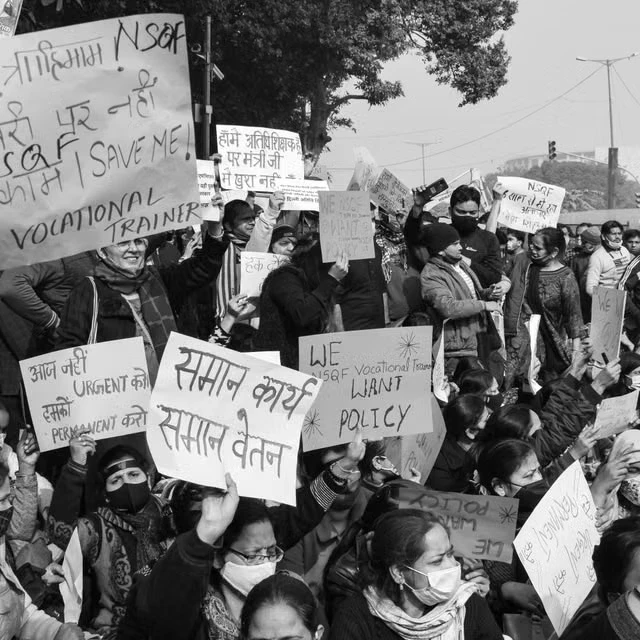
Delhi’s protest detentions have become more than a domestic law-and-order episode; they now sit inside a larger contest over civil liberties, state authority, and international scrutiny. The core dispute is simple in outline but charged in consequence: the United Nations human rights office has voiced alarm over reports that demonstrators, lawyers, journalists, and civil society members were detained around protests against Chief Election Commissioner Gyanesh Kumar, while India has flatly rejected the criticism as unwarranted interference.
That collision matters because it touches the most sensitive nerve in any democracy: the balance between the right to assemble peacefully and the state’s claim that restrictions were imposed to preserve public order. When security is visibly heavy, internet access is disrupted, and trains are cancelled, the political meaning of the protest changes immediately. What one side presents as necessary crowd control, the other may read as pre-emptive suppression.
The result is a familiar but serious pattern in modern governance. Human rights institutions demand necessity, proportionality, and prompt release where detention is arbitrary; governments answer with sovereignty, constitutional structure, and legal process. In Delhi, both narratives are now competing in public view, and the credibility of each side will depend not on rhetoric, but on the evidence produced, the legality of the detentions, and the transparency of the authorities involved.
On This Page
TL;DR The OHCHR has expressed concern over reports of mass detentions during protests in Delhi, urging India to protect peaceful assembly and free those held arbitrarily. India rejects the criticism, insisting its actions were lawful and necessary for public order. The episode highlights a sharper tension between civil liberties, state security, and the politics of international accountability.
What Happened in Delhi and Why It Drew Attention
The episode centers on protests in Delhi against Chief Election Commissioner Gyanesh Kumar, where multiple accounts described detentions before and during the demonstrations. According to the OHCHR, those taken into custody included demonstrators as well as protest leaders, civil society participants, lawyers, and journalists, which widened the concern beyond ordinary crowd management.
Attention intensified because the reported response was not limited to arrests alone. A substantial security presence in central Delhi, suspension of internet services, and the cancellation of trains created the unmistakable impression of a city placed under exceptional control. In such moments, the dispute ceases to be only about one protest and becomes a test of democratic restraint.
The Trigger Was a Protest, But the Issue Is Larger
The immediate trigger was opposition to the Chief Election Commissioner, yet the broader issue is whether citizens can demonstrate without being met by sweeping preventive action. In democratic systems, protest is not a privilege granted by the state; it is a protected form of political speech, constrained only where public order genuinely requires intervention.
That is why the details matter so much. If detentions occurred selectively, without individualized justification, the state’s case weakens. If authorities can show specific threats, lawful grounds, and proportionate measures, their defense becomes stronger. The legitimacy of the entire response depends on that factual record.
Reported Controls Reframed the Protest Atmosphere
Security deployments, internet shutdowns, and transport disruptions can be defended as preventive tools, but they also reshape the public meaning of dissent. They may deter disorder, yet they may also suppress visibility, coordination, and coverage, which is why rights monitors treat them as measures requiring strict justification.
Once journalists and lawyers are reportedly among those detained, the incident acquires an added institutional weight. It is no longer merely a street confrontation; it becomes a question about access to legal support, documentation, and independent reporting, all of which are essential to accountability in any rule-of-law framework.
We Also Published
The OHCHR’s Position and Its Legal Logic
The Office of the High Commissioner for Human Rights framed the matter in classic rights language: peaceful assembly must be respected, detention must never be arbitrary, and any restriction must be necessary and proportionate. That formulation is not decorative; it is the backbone of international human rights law on protest.
By urging the release of anyone held without lawful basis, the OHCHR signaled that the burden sits on the authorities to justify each deprivation of liberty. This is an exacting standard, but it is meant to be. In a democracy, emergency instincts cannot become a substitute for individualized legal assessment.
Necessity and Proportionality Are the Crucial Tests
Necessity asks whether a less restrictive response could have managed the situation. Proportionality asks whether the measure taken was too broad in relation to the threat faced. Together, these principles force governments to justify why a protest required such a large and disruptive security response.
If detentions are preventive rather than evidence-based, legal scrutiny becomes more severe. Rights bodies are especially wary of broad sweeps that capture activists, observers, and media workers alongside demonstrators, because such action can chill lawful dissent far beyond the original protest site.
Why Arbitrary Detention Changes the Entire Debate
Arbitrary detention is not limited to unlawful arrest in the narrow sense. It also includes detention that may be procedurally dressed up yet substantively unjustified. That is why civil liberties advocates insist on prompt release, access to lawyers, and clear records of the grounds for custody.
The OHCHR’s intervention therefore reflects more than sympathy for protesters. It is a warning that the combination of mass detention, communication controls, and transport disruption can create an environment in which rights are formally preserved but practically weakened. That distinction is central and unavoidable.
India’s Rebuttal and the Sovereignty Argument
India’s Permanent Mission in Geneva rejected the OHCHR’s concerns as misplaced and intrusive. The rebuttal rested on a familiar constitutional claim: India is a democracy where assembly is protected, but still subject to reasonable restrictions for public order. That language is deliberate and legally significant.
The government’s stance also emphasized that authorities operate according to law and that courts are available to hear grievances. This is an important institutional defense because it shifts the debate from street-level confrontation to judicial review, where the legality of actions can be tested under domestic legal standards.
Public Order Is the Government’s Central Justification
Public order is one of the oldest and most flexible grounds for limiting assemblies. But flexibility is precisely why it attracts scrutiny. When governments rely too heavily on it, critics worry that the exception will swallow the rule and allow nearly any disruptive protest to be restricted.
India’s defense will therefore be judged on specificity. Broad claims that the state acted lawfully are not enough on their own; authorities must demonstrate what threat existed, why detention was necessary, and why less intrusive measures were not sufficient. That is the real legal test.
Judicial Remedies Matter, But They Do Not End the Debate
The availability of courts does matter, because a functioning legal system gives aggrieved individuals a pathway to challenge state action. Yet the existence of judicial remedies does not automatically excuse potentially excessive conduct on the ground, especially when the alleged harm is immediate and difficult to reverse.
In practice, this means post-facto legal review cannot fully substitute for frontline restraint. If the state overreaches during a protest, the injury to liberty, participation, and press freedom may already be done before any court has an opportunity to intervene meaningfully.
- 01
- 02
- 03
- 04
Why This Dispute Matters Beyond One Protest
This case carries significance far beyond the streets of Delhi because it tests how a major democracy responds when civic pressure collides with institutional authority. International concern is not necessarily a verdict, but it does force transparency and compels governments to explain themselves under scrutiny.
It also exposes the fragile ecology around protest rights: assembly, legal counsel, media access, internet connectivity, and transportation are all part of the same democratic environment. Remove too many of those supports at once, and public dissent becomes functionally harder even if it remains formally legal.
The Pattern Is Familiar Across Democracies
Across the world, states often justify strong controls by invoking security, misinformation, or anticipated unrest. Human rights advocates counter that exceptional controls are frequently overused and can mutate into an ordinary tool for weakening dissent. Delhi fits squarely within that broader global argument.
What makes the episode especially consequential is that it involves not just the right to protest, but also the visibility of protest. When internet access is cut and train movement is disturbed, the public narrative can be shaped as much by restriction as by persuasion, and that is a democratic risk.
Accountability Will Depend on Evidence
In the end, the decisive question is not who spoke loudest, but what the records show. Arrest logs, legal grounds, timing of detentions, and the instructions given to police will matter far more than slogans. That is how public controversy moves from outrage to adjudication.
If the state acted narrowly and lawfully, it should be able to demonstrate that fact. If it did not, then the OHCHR’s alarm will carry lasting weight. Either way, the episode has already underlined a hard truth: in a democracy, the handling of dissent is itself a measure of democratic confidence.
Bottom Line: A Test of Democratic Restraint
The central message of this dispute is stark: democratic systems are judged not only by how they encourage participation, but by how they treat dissent when it becomes inconvenient. The Delhi detentions controversy is therefore a test of whether legal rights survive contact with political tension.
Both sides have now drawn their lines. The OHCHR insists on immediate respect for peaceful assembly and protection against arbitrary detention. India insists on lawful enforcement, public order, and sovereign competence. The truth of the matter will depend on records, review, and whether authority can be shown to have stayed within proper bounds.
The Real Measure Is Proportional State Power
Proportionality is the governing standard because it prevents the state from responding to protest as if it were rebellion. A democracy need not be passive, but it must be disciplined. Heavy-handedness may secure a street temporarily, yet it can erode confidence in the institutions meant to arbitrate conflict.
That is why this story should be read less as a passing headline and more as a diagnostic case. It reveals how quickly protest, policing, rights, and sovereignty can collide—and how essential it is that law, not fear, determine the outcome.
What Comes Next Will Shape the Narrative
If further evidence confirms arbitrary detention, the criticism will harden into a lasting reputational issue. If, however, authorities can substantiate each action with lawful grounds, the official rebuttal will gain credibility. Either way, the episode has already forced a public accounting of democratic practice under pressure.
In that sense, the controversy is larger than one day in Delhi. It is a reminder that the health of a democracy is often best measured when crowds gather, tensions rise, and the state must decide whether to restrain power or to expand it.
From our network :
- How AI Agents Will Change the Way We Manage Personal FinancesExplore how AI agents are transforming personal finance through automated budgeting, bill payment, and investment management, while examining the critical security protocols and governance frameworks required for safe deployment.
- Live Online English Classes for Kids: Do They Actually Reduce Anxiety?A ten-week study reveals that synchronous online English classes can significantly reduce child language anxiety while improving listening and reading skills. Discover what makes these programs effective and how parents can select the right one.
- CISA’s Ten-Advisory Wave: Why Generic Patching Fails in OT and How to Build Product-Specific PlaybooksCISA released ten ICS advisories in one week, exposing critical infrastructure risks. Generic patching fails in OT. Learn to build product-specific remediation playbooks.
- Committed Mediterranean Precipitation Decline: Why Emissions Cuts Alone Cannot Restore Winter RainsNew NOAA research reveals that Mediterranean winter rains may decline irreversibly even with emissions cuts. Explore the science of committed climate change and regional impacts.
- The Final Descent: How ESA Retired the Legendary Cluster Constellation After 24 Years of Space Weather ScienceAfter 24 years mapping Earth’s magnetosphere, ESA’s Cluster mission concluded with a precisely controlled reentry over the South Pacific. This analysis explores the scientific legacy, engineering decisions, and debris mitigation principles behind one of space exploration’s most responsible retirements.
- Forbidden Matrix Patterns and Visible Lattice Points: A Geometric DictionaryExplore how multidimensional 0–1 matrices encode geometric truths, linking forbidden patterns to visible lattice points and hypergraph theory, with applications in combinatorics and computational geometry.
- The Hidden Cost of AI Convenience: Why Over-Permissioned Agents Are a Security Time BombDiscover why AI agents with excessive permissions create dangerous single points of failure, and learn how implementing least privilege principles can protect your organization from exploitation.
- University Language Proficiency Exams: Why Institutional Tests Demand Different Preparation Than IELTS and TOEFLDiscover why university-specific language proficiency examinations differ fundamentally from IELTS and TOEFL, and learn strategic preparation approaches for institutional assessment success.
- Mobile Learning and VR in English: What Global Evidence Reveals About Effective Language TechnologyA systematic review across 14 countries reveals which language-learning technologies genuinely work. Mobile learning, AI, and VR show measurable benefits when pedagogically integrated. This evidence-based guide helps educators and learners select technology that delivers real return on investment.
RESOURCES
- India: Concerns over mass detentions before and during protestsohchr.org3 days ago ... ... Delhi.We call on the authorities to ensure that the right to peaceful assembly is fully respected and fulfilled. Restrictions…
- India: Invoking of extraordinary police powers amid Delhi protests an ...amnesty.orgJul 24, 2026 ... We urge the Delhi Police not to invoke the NSA against peaceful protesters or use administrative detention to bypass legal…
- India: UN rights office urges release of 'arbitrarily detained' protestersnews.un.org3 days ago ... The UN human rights office (OHCHR) has voiced concern over reports of mass detentions ... protests in Delhi on Saturday.
- Leaders from India's 'Cockroach' movement released from detention ...pbs.org2 days ago ... NEW DELHI (AP) — Leaders of a popular Indian youth movement vowed to continue protests Sunday after being released from…
- Indian farmers say detentions foil Delhi protest, police say no one heldreuters.comMar 6, 2024 ... Dozens of protesting Indian farmers were detained en route to New Delhi on Wednesday, delaying their plan again to converge…
- India's 'Cockroach' movement founder and leaders released from ...cnn.com4 days ago ... India's 'Cockroach' movement founder and leaders released from detention after Delhi protest crackdown ... Supporters of the Cockroach Janta Party ...
- India to deploy thousands of security forces in Delhi for protest over ...reuters.com4 days ago ... Authorities in India's capital Delhi are deploying thousands of police and paramilitary personnel ahead of a protest called for Saturday…
- We are concerned by reports of mass detentions of demonstrators ...instagram.com3 days ago ... UN Human Rights has raised concern over mass detentions during protests in Delhi and called on authorities to respect the…
- India's 'Cockroach' leaders released from detention after police ...aljazeera.com2 days ago ... The Hindu newspaper, citing Delhi police sources, said nearly 2,500 protesters were detained across the capital. The Reuters news agency, ...
- India's 'Cockroach' party accuses government of mass detention of ...theguardian.com4 days ago ... ... protest in Delhi. Opposition parties, their student units, and the “Cockroach” youth movement have been holding almost daily demonstrations ...
- India's Delhi Braces for More Protests After Mass Detentionsbloomberg.com1 day ago ... India is bracing for a third straight day of tensions in its capital, with opposition parties on Monday planning a…
- India: End Crackdown on Protesters, Arbitrary Detentionshrw.org5 hours ago ... Indian authorities are using abusive methods to crack down on thousands of peaceful protesters in New Delhi and other Indian…
- Mass detention of Delhi protesters draws scrutiny from legal expertsthehindu.com3 days ago ... Delhi Police has maintained that detentions in the capital followed violations of prohibitory orders imposed under Section 163 of the…
- 'I won't stop fighting,' says 'cockroach' protester after alleged detentionbbc.comJul 30, 2026 ... Protesters in Delhi and other states have accused police of unlawful detentions. The Supreme Court has directed authorities not to…
- We are concerned by reports of mass detentions of demonstrators ...facebook.com3 days ago ... ... protest is a fundamental pillar of democracy. Mass detentions ... #Congress #DelhiPolice #Protest #FreedomOfExpression #EngageInDialogue #delhi # ...
- 01
- 02
- 03
- 04
- 05
- 06
- 07
- 08
0 Comments