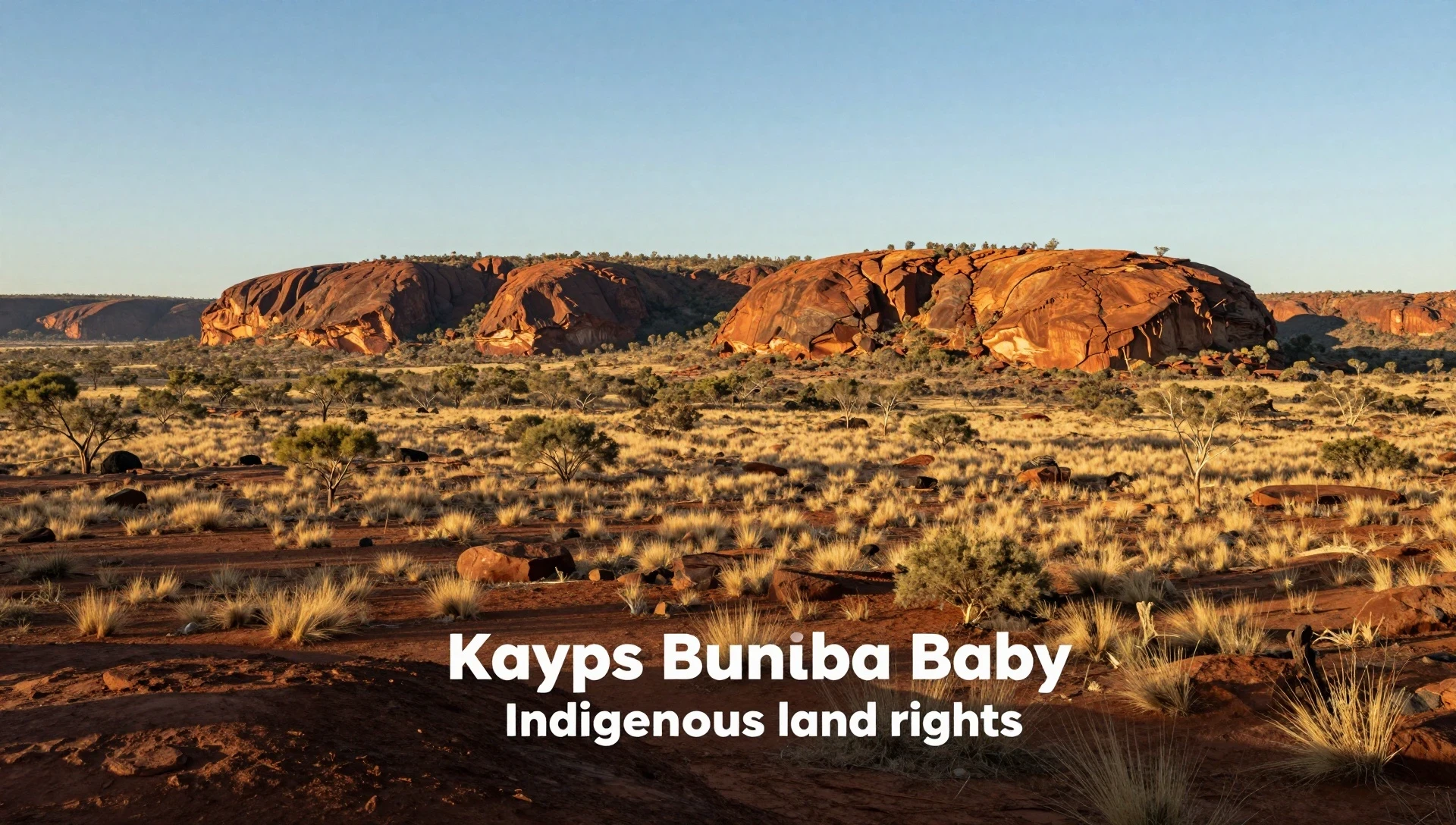
Kayps, a 21-year-old rapper of Walmatjarri and Bunuba heritage, released his debut album "Bunuba Baby" in August 2026, and it climbed to number two on the Australian hip hop charts within a week. The record carries a nomination for a major Australian music award, but its significance extends well beyond chart position.
Its cover reproduces a 1979 photograph of his grandfather blocking drilling trucks at Noonkanbah in the Kimberley, turning a family archive into a public statement about land rights.
The album's commercial performance matters because it demonstrates that politically explicit Indigenous storytelling can find a mainstream Australian audience. Kayps, born Kurrungaya Bieundurry in Broome and raised in the remote Kimberley community of Wangkatjungka, built the record from family memory rather than industry formula.
On This Page
His grandmother was a blues artist; his father played guitar and sang. That lineage, combined with a childhood move to Perth at roughly age five and a hip hop discovery at 13, produced a body of work rooted in place and inheritance.
What distinguishes this release from routine debut narratives is the artist's explicit reckoning with his own earlier output. Kayps has described his previous projects as abrasive, containing misogynistic and violent lyrics that he now finds disrespectful and difficult to listen to.
That admission, paired with a shift toward more politically charged writing, frames "Bunuba Baby" as both a cultural reconnection and a correction. The analysis below examines the Noonkanbah history behind the album, the economics of an independent Australian music career, and the cultural stakes of Indigenous representation in contemporary hip hop.
TL;DR Kayps, a 21-year-old Walmatjarri and Bunuba rapper, turned a 1979 photograph of his grandfather at the Noonkanbah land rights protest into the cover of his debut album "Bunuba Baby," which reached number two on Australian hip hop charts and earned a major award nomination. The record marks a deliberate political turn from earlier, self-described misogynistic and violent material, and positions family history as the foundation of a mainstream music career.
The Noonkanbah Protest and the Politics of Sacred Land
The album's central artifact is a photograph from 1979, when Aboriginal people in the Kimberley blocked drilling trucks from entering a sacred site at Noonkanbah. Kayps's grandfather and other relatives stood among the demonstrators. The company eventually broke the blockade, but according to Kayps, it found nothing after disturbing the land. That detail carries the moral weight of the story: the intrusion produced no resource reward, only damage.
What Happened at Noonkanbah in 1979
Noonkanbah Station became a national flashpoint when a mining company sought to drill on land held sacred by the Yungngora people. The blockade drew Aboriginal protesters, trade union support, and sustained media attention across Australia. State authorities ultimately forced access, and the drilling proceeded under police protection. The episode exposed the fragility of Aboriginal land rights before statutory recognition matured.
The historical sequence matters for interpreting the album. The protest preceded the Mabo decision by more than a decade and predated the Native Title Act by roughly fourteen years. Noonkanbah therefore belongs to a period when Aboriginal communities relied on direct action rather than legal title.
Kayps's grandfather appears in the photograph as a participant in that earlier, more exposed phase of the struggle.
Kayps has said the company found nothing after disturbing the land. Whether read literally as a dry drilling result or symbolically as a judgment on extraction, the outcome reinforces the album's argument.
The land carried value the survey could not measure, and the people who defended it understood that before any court confirmed it.
Family Memory as Creative Source Material
The cover also features a symbol painted by Kayps's father, layering two generations of family authorship onto a single image. This is not incidental decoration. It converts the album into an inherited object, where the grandfather supplies the historical event, the father supplies the visual mark, and the son supplies the music.
Kayps grew up in Wangkatjungka shaped by family gatherings centered on music. His grandmother worked as a blues artist, and his father played guitar and sang. That environment gave him an early model of performance as a household practice rather than an industry career path. The album formalizes what he absorbed informally.
Moving to Perth at about age five placed the family outside the remote community context. Kayps has described struggling in high school as the only Black student in his year, feeling pressure to conform.
The album's return to Bunuba and Walmatjarri heritage reads as a response to that dislocation, reasserting a cultural anchor that urban schooling had strained.
Reading the Album's Political Turn
Kayps characterizes the lyrics on "Bunuba Baby" as more politically charged than his earlier work. The shift is significant because it moves from personal posturing toward collective history. Land rights, heritage, and family legacy replace the abrasive themes he now disowns, giving the record a coherent argument rather than a collection of tracks.
His willingness to describe prior songs as misogynistic and violent, and to call them disrespectful, is unusual in an industry that rarely rewards public self-correction. The admission establishes credibility for the new material. It also signals an artist thinking about audience responsibility, particularly toward younger Aboriginal listeners he hopes to reach.
The political content operates at two levels. Explicitly, the album narrates Noonkanbah and the defense of sacred ground. Implicitly, it models a young Indigenous artist choosing cultural continuity over the commercial incentives of shock value. Both levels reinforce the same thesis: heritage is a resource, not a constraint.
We Also Published
Chart Performance, Award Recognition, and the Independent Music Economy
"Bunuba Baby" reached number two on the Australian hip hop charts within a week of its August release and has been nominated for a major Australian music award. Those two data points describe different kinds of validation. Chart position measures immediate consumer demand; an award nomination measures industry peer assessment. Together they indicate that the record crossed from niche release into national conversation.
Deconstructing the Number Two Chart Position
A number two debut on a national genre chart implies sustained streaming and sales activity across the first seven days. For an independent or emerging artist, that window is decisive, because algorithmic playlisting and radio attention follow early momentum. The placement suggests the album found listeners beyond a purely local Western Australian audience.
Genre charts in Australia aggregate streaming platforms, digital sales, and physical units, though the exact weighting varies by compiler. A high debut therefore reflects breadth rather than a single channel.
For an album built on regional family history, that breadth is the more notable figure, since the subject matter is specific to the Kimberley.
The Weight of an Award Nomination
An award nomination performs a function that chart position cannot. It signals that industry gatekeepers, including peers and critics, regard the work as artistically significant. For a debut album with explicit political content, that recognition legitimizes the material and can extend its commercial life well past the initial release window.
Nomination cycles also generate performance opportunities, media coverage, and festival bookings. These secondary effects often exceed the direct value of the award itself. For an artist on a national tour, the nomination functions as marketing infrastructure that no independent budget could easily purchase.
How Kayps Financed His Early Career
Before the album, Kayps busked at a farmers market playing the didgeridoo to buy music production software. He later performed his own songs in Fremantle. This detail describes a common pathway for independent artists: self-financed tooling, incremental performance income, and gradual skill accumulation without institutional support.
The economics are instructive. Music production software represents a fixed capital cost, while busking provides variable daily revenue with no intermediary. By converting street performance directly into production capacity, Kayps avoided the debt or label advance that often constrains young artists. The model is modest but structurally sound.
Fremantle performances marked the transition from instrumental busking to original material. That shift matters because it moved him from interpreting an instrument associated with Aboriginal culture to authoring songs in a genre he discovered at 13. The album completes that progression from street corner to national chart.
Representation, Cultural Reconnection, and the Future of Indigenous Hip Hop
Kayps has said he hopes the album will encourage younger Aboriginal people to connect with their culture. That ambition reframes the record as an instrument of transmission rather than a purely commercial product.
The intended audience includes listeners who, like the artist himself, grew up removed from remote community life and may feel the same pressure to conform.
From Assimilation Pressure to Cultural Assertion
Kayps has described struggling in high school as the only Black student in his year, feeling pressure to conform. That experience is a familiar pattern in Australian education, where Aboriginal students in predominantly non-Indigenous settings often report isolation. The album responds by making heritage the center of the work rather than a private background detail.
The trajectory from conformity pressure to public assertion is not linear, and the album does not present it as resolved. Instead, it documents a process of reconnection through family, language references, and historical narrative.
That honesty gives the record credibility with younger listeners who may recognize the same tension in their own schooling.
Representation in hip hop carries particular weight because the genre's global vocabulary centers Black American experience. An Aboriginal artist working in that form must negotiate two distinct traditions. Kayps resolves the tension by grounding his lyrics in Walmatjarri and Bunuba specificity, using the genre's structure without surrendering cultural particularity.
Accountability and the Rejection of Earlier Lyrics
Kayps's public rejection of his earlier misogynistic and violent lyrics sets a precedent worth examining. He described those songs as reflecting his youth and now finds them disrespectful and difficult to listen to. That stance acknowledges harm without excusing it, and it models a form of accountability rarely voiced by emerging artists.
The admission also raises questions about how audiences and platforms handle older material. If an artist disavows prior work, the recordings remain accessible regardless. Kayps's approach implicitly argues that artists should address their catalog directly rather than allow problematic content to circulate unexamined while they promote newer, more considered work.
For younger Aboriginal listeners specifically, the message is that growth is permitted and expected. The album does not present cultural reconnection as a purity test but as a direction of travel. That framing is more useful than moral absolutism, because it allows for imperfect beginnings and visible change over time.
The National Tour and Long-Term Cultural Impact
Kayps is performing the album as part of a national tour, which extends the record's reach beyond streaming audiences. Live performance matters disproportionately for politically charged material, because it creates shared space for the themes to be discussed rather than merely consumed. The tour also generates revenue independent of platform payouts.
The long-term impact will depend on whether the album functions as a gateway for other Indigenous artists. A number two chart position and an award nomination establish that the market exists.
If subsequent releases from similar artists follow, the commercial case for culturally specific work strengthens, and gatekeepers gain evidence to justify further investment.
For Kayps personally, the record marks a transition from self-financed busking to national recognition at 21. The risk is that early success narrows future options by fixing expectations. The opportunity is that it grants creative latitude to develop the political and cultural themes the album introduces. Which outcome prevails will be determined by the next release.
From our network :
- CISA’s Ten-Advisory Wave: Why Generic Patching Fails in OT and How to Build Product-Specific PlaybooksCISA released ten ICS advisories in one week, exposing critical infrastructure risks. Generic patching fails in OT. Learn to build product-specific remediation playbooks.
- Mobile Learning and VR in English: What Global Evidence Reveals About Effective Language TechnologyA systematic review across 14 countries reveals which language-learning technologies genuinely work. Mobile learning, AI, and VR show measurable benefits when pedagogically integrated. This evidence-based guide helps educators and learners select technology that delivers real return on investment.
- University Language Proficiency Exams: Why Institutional Tests Demand Different Preparation Than IELTS and TOEFLDiscover why university-specific language proficiency examinations differ fundamentally from IELTS and TOEFL, and learn strategic preparation approaches for institutional assessment success.
- How AI Agents Will Change the Way We Manage Personal FinancesExplore how AI agents are transforming personal finance through automated budgeting, bill payment, and investment management, while examining the critical security protocols and governance frameworks required for safe deployment.
- Live Online English Classes for Kids: Do They Actually Reduce Anxiety?A ten-week study reveals that synchronous online English classes can significantly reduce child language anxiety while improving listening and reading skills. Discover what makes these programs effective and how parents can select the right one.
- The Final Descent: How ESA Retired the Legendary Cluster Constellation After 24 Years of Space Weather ScienceAfter 24 years mapping Earth’s magnetosphere, ESA’s Cluster mission concluded with a precisely controlled reentry over the South Pacific. This analysis explores the scientific legacy, engineering decisions, and debris mitigation principles behind one of space exploration’s most responsible retirements.
- Committed Mediterranean Precipitation Decline: Why Emissions Cuts Alone Cannot Restore Winter RainsNew NOAA research reveals that Mediterranean winter rains may decline irreversibly even with emissions cuts. Explore the science of committed climate change and regional impacts.
- Forbidden Matrix Patterns and Visible Lattice Points: A Geometric DictionaryExplore how multidimensional 0–1 matrices encode geometric truths, linking forbidden patterns to visible lattice points and hypergraph theory, with applications in combinatorics and computational geometry.
- The Hidden Cost of AI Convenience: Why Over-Permissioned Agents Are a Security Time BombDiscover why AI agents with excessive permissions create dangerous single points of failure, and learn how implementing least privilege principles can protect your organization from exploitation.
RESOURCES
- Indigenous hip hop artist Kayps explores identity and culture in ...abc.net.au1 day ago ... ... , known professionally as Kayps, takes inspiration from the Indigenous land rights movement for his new album, Bunuba Baby.
- Western Australian rapper Kurrungaya Bieundurry, known ...facebook.com1 day ago ... ... Indigenous land rights movement for his new album, Bunuba Baby. WA ... KAYPS wins the Unearthed High Indigenous Initiative…
- Kayps' Bunuba Baby Traces Culture and Land Rights - Oz Arab Mediaozarab.mediaAccording to ABC News, Walmatjarri and Bunuba rapper Kayps has used his debut album Bunuba Baby to explore identity, family history and culture. The…
- Walmatjarri and Bunuba rapper Kurrungaya Bieundurry, known ...facebook.com1 day ago ... ... Kayps, takes inspiration from the Indigenous land rights movement for his ... Indigenous land rights movement for his new…
- Kayps | Season XXI - Phoenix Central Parkphoenixcentralpark.com.au... Bunuba artist, Kayps explores identity and cultural reconnection through his work. August 14th 2026, Kayps is set to release his album titled BUNUBA…
- KAYPS - Bad Apples Musicbadapplesmusic.com.au... land that our ancestors walked on for thousands and thousands of generations.'' In 2026, Kayps is set to release his album titled BUNUBA…
- Kayps reveals story behind 'SHIPS' in new music videonit.com.auAug 3, 2026 ... The Boorloo-based songwriter and producer created the track while working on his upcoming album 'Bunuba Baby', which was written and…
- WA rapper pays tribute to family's land rights battle, defends lyricscedarnews.net1 day ago ... ... Kayps, takes inspiration from the Indigenous land rights movement ... Indigenous land rights movement for his new album, Bunuba…
- Kayps Announces Debut Album, Shares New Single - Music Feedsmusicfeeds.com.auJun 25, 2026 ... Kayps Announces Debut Album 'BUNUBA BABY', Shares New Single '765' ... land, but also growing to gain a better understanding…
- The 10 most inspiring new protest albums right nowgreenleft.org.auAug 30, 2026 ... ... Aboriginal community took control of health services from whites. LISTEN>>>. KAYPS - BUNUBA BABY album artwork. 5. KAYPS -…
- Hip Hop News | Stay Trill Mediastaytrillmedia.comWestern Australian rapper Kurrungaya Bieundurry, known professionally as Kayps ... Indigenous land rights movement for his new album, Bunuba Baby. abc.net.au ...
- Lavinia Anthony - Creative Director | Journalist - LinkedInau.linkedin.com... Aboriginal Corporation · Education: Curtin University · Location: Perth · 34 connections on LinkedIn. View Lavinia Anthony's profile on LinkedIn, a ...
- Indigenous hip hop artist Kayps explores identity and culture in ...reddit.com1 day ago ... ... as Kayps, takes inspiration from the Indigenous land rights movement for his new album, Bunuba Baby. Open. Upvote 6.…
- A Month of Protest: August - The Ongoing History of Protest Musicongoinghistoryofprotestsongs.comSep 4, 2026 ... BUNUBA BABY – Kayps. We got another release by an Aboriginal Australian, with the debut album by Kayps. Similar to…
- 01
- 02
- 03
- 04
- 05
- 06
- 07
- 08
0 Comments