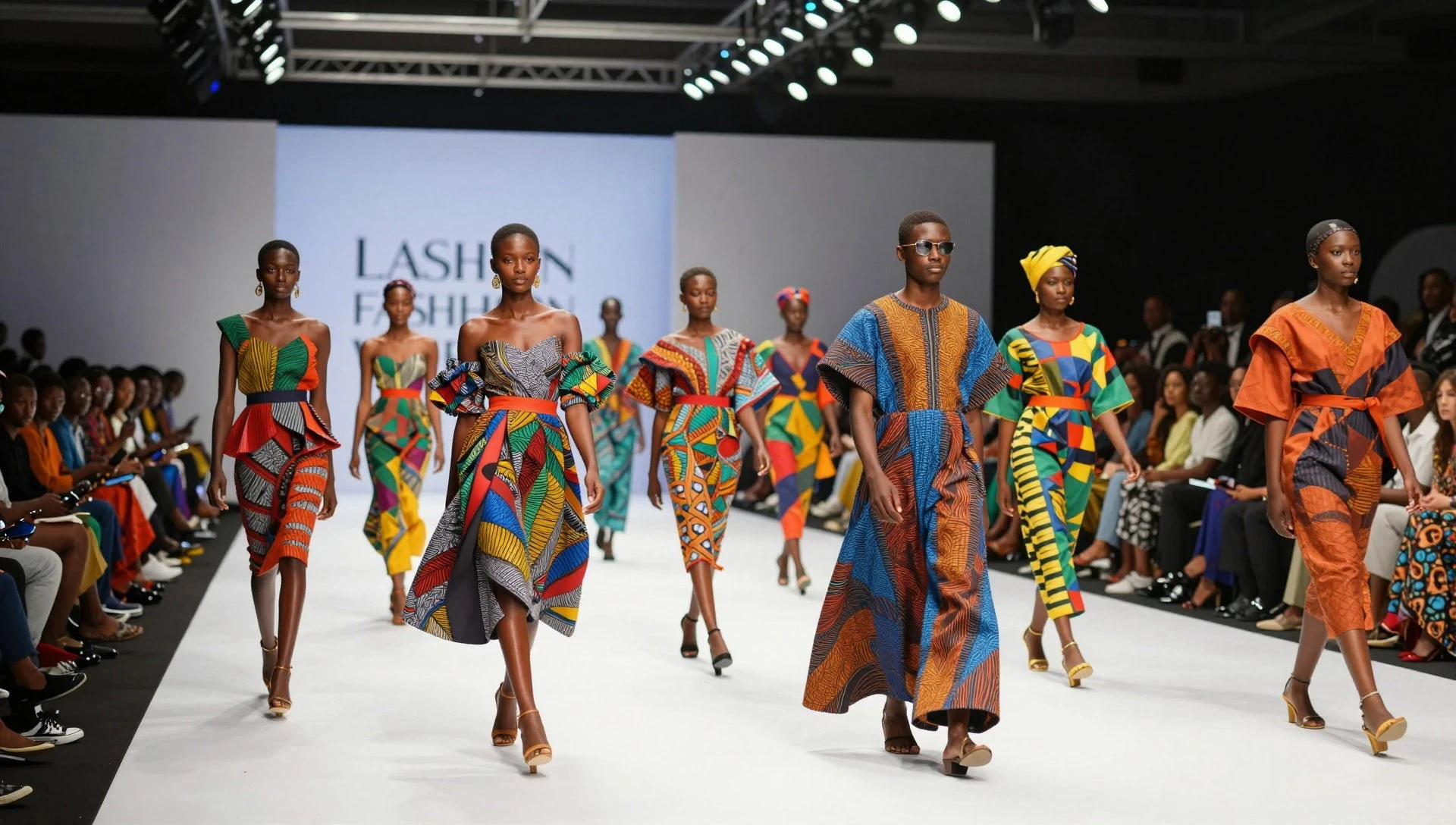
On Saturday, 1 November 2026, Lagos State Governor Babajide Sanwo-Olu stepped onto the Lagos Fashion Week runway wearing a collection by Nigerian designer Ugo Monye, and the audience responded with audible recognition and applause.
The appearance was not a ceremonial photo opportunity but a deliberate signal: the governor of Nigeria's commercial capital publicly aligned his office with the creative economy. In a state whose annual budget runs into trillions of naira, the gesture carries weight precisely because it was performed in front of buyers, editors and international media rather than in a government chamber.
The episode matters because fashion in Lagos is no longer a peripheral cultural pursuit. Lagos Fashion Week, founded in 2011 by Omoyemi Akerele, has grown into a multi-day fixture that places Nigerian and wider African designers in front of global buyers and press.
On This Page
- The Symbolic and Economic Logic of a Governor on the Runway
- Lagos Fashion Week as Trade Infrastructure
- From Symbolism to Structure: What Lagos Fashion Still Needs
- Financing Gaps and the Cost of Capital
- Manufacturing, Power and the Production Chain
- Structural Constraints Facing Lagos Designers
- What Durable Government Support Would Look Like
- Assessing the Net Effect of the Runway Moment
- Symbolic Versus Structural Support: A Scorecard
- Timeline of Lagos Fashion Week Milestones
When a sitting governor walks a runway, the message travels through the same distribution channels as the clothes themselves. Sanwo-Olu later confirmed on X that he had set aside routine government duties to participate, framing Lagos as a growing home for fashion, creativity and culture.
This analysis examines what the runway walk actually signifies, how Lagos Fashion Week functions as an economic platform, and where the gap between symbolic endorsement and structural support still lies.
The evidence points to a consistent pattern: African fashion weeks have become trade infrastructure, and political participation is increasingly read as investment signalling rather than mere spectacle.
TL;DR Governor Babajide Sanwo-Olu's runway appearance at Lagos Fashion Week on 1 November 2026 was a calculated endorsement of Lagos's creative economy, staged before buyers, media and international observers. Lagos Fashion Week, founded in 2011 by Omoyemi Akerele, has evolved from a showcase into trade infrastructure for Nigerian and African designers. The gesture signals political recognition of fashion as an industry, yet symbolic participation does not automatically translate into the financing, manufacturing capacity and export logistics the sector still requires.
The Symbolic and Economic Logic of a Governor on the Runway
A governor walking a runway is an unusual act of political communication, and its meaning depends on context. In Lagos, fashion sits at the intersection of culture, entertainment and commerce, and the state government has repeatedly positioned the creative sector as a growth pillar.
Sanwo-Olu's appearance therefore functioned as a public confirmation that his administration treats designers as constituents worth courting, not merely as cultural ornament.
Reading the Gesture as Industrial Policy
The audience's cheers, reported by Punch Newspapers, indicate that the recognition ran in both directions. Spectators were not simply surprised by a familiar face; they were acknowledging that the state's highest executive had chosen their industry as a stage.
In political economy terms, this is cheap signalling with potentially expensive follow-through, because visibility invites expectations of tangible support.
Governments across Africa increasingly treat creative industries as export sectors. Nigeria's film industry, Nollywood, already demonstrates that cultural production can generate substantial revenue and employment. Fashion follows a comparable logic: design, textiles, tailoring, modelling and event production form a value chain that employs far more people than the headline designers alone.
Sanwo-Olu's statement on X emphasised that Lagos is increasingly known as a home for fashion, creativity and culture. That framing is strategic. It positions the city alongside established fashion capitals and invites international buyers to treat Lagos as a sourcing destination rather than a curiosity. The governor's presence was, in effect, a branding exercise conducted at the point of sale.
Yet the gesture also carries risk. When a public official claims credit for an industry's momentum, scrutiny follows. Designers will reasonably ask whether the visibility translates into access to credit, reduced import duties on fabric, reliable electricity for production, or support for participation in international trade shows. Applause on a runway is not a policy instrument.
Why Political Presence Travels Further Than Policy Papers
Policy documents rarely generate international headlines; a governor in a designer outfit does. That asymmetry explains why creative-industry advocacy increasingly relies on visible participation. The image of Sanwo-Olu on the runway circulated through social platforms far faster than any industrial strategy white paper could, reaching audiences that include diaspora consumers and foreign buyers.
There is a measurable precedent. When political figures attend cultural trade events, media impressions multiply because the story acquires a human angle. Fashion weeks in Lagos, Cape Town and Nairobi have all benefited from such amplification.
The coverage extends beyond specialist fashion press into general news, which broadens the audience for African design considerably.
The risk, however, is that visibility substitutes for substance in public perception. A governor who walks a runway may be credited with supporting an industry he has not materially funded. Analysts should therefore separate the communicative act from the policy record, examining budget allocations to arts and culture alongside the photographs.
The Designer Behind the Collection
Ugo Monye, the Nigerian designer whose collection the governor wore, gained a platform that money cannot easily buy. A sitting governor modelling a local label places that label within a national conversation about craftsmanship and identity. For emerging designers, such moments can accelerate buyer interest and social media reach substantially.
This dynamic is familiar in global fashion. When public figures wear domestic designers, the resulting coverage often outperforms paid advertising. The mechanism is credibility transfer: the wearer's authority lends legitimacy to the garment, and the designer inherits a fraction of that authority. In markets where international buyers are still learning local names, this matters enormously.
Yet the benefit concentrates on a single label rather than the sector. A more durable strategy would distribute attention across multiple designers, perhaps through structured government procurement of local fashion for official events. That approach would convert one-off visibility into recurring demand, which is the difference between a headline and an industry.
Lagos Fashion Week as Trade Infrastructure
Founded in 2011 by Omoyemi Akerele, Lagos Fashion Week has matured from a local showcase into a multi-day event that attracts buyers, media professionals and fashion enthusiasts from across the continent and beyond.
Its function now resembles that of a trade fair: designers present collections, buyers place orders, and journalists transmit the narrative outward. The runway is the visible layer of a commercial architecture beneath it.
From Showcase to Marketplace
The distinction between a fashion show and a fashion market is consequential. A show generates images; a market generates orders. Lagos Fashion Week has progressively moved toward the latter by curating buyer attendance and creating structured opportunities for designers to convert exposure into revenue. That shift is what makes political endorsement economically meaningful.
Africa's fashion calendar has expanded considerably over the past decade, with events in Lagos, Cape Town, Nairobi, Dakar and Accra competing for international attention. Each week functions as a node in a continental network, and designers often travel between them to reach different buyer pools. Lagos benefits from Nigeria's population scale and cultural influence.
The event's longevity is itself evidence of institutional durability. Many African fashion weeks have launched and folded within a few seasons, often due to funding instability. Surviving since 2011 implies a working model, sustained relationships with sponsors, and a consistent value proposition for both designers and buyers.
The Buyer Economy Behind the Applause
Fashion weeks exist, commercially speaking, for the buyers in the room. Designers invest heavily in collections and presentations because a single wholesale order can sustain a label for a season. Lagos Fashion Week's value therefore depends on the quality and quantity of buyers it convenes, not on the size of its audience.
International buyer attendance at African fashion weeks has grown but remains uneven. Logistics, payment systems and production reliability influence purchasing decisions as much as design quality. A buyer impressed by a Lagos collection must still resolve questions about manufacturing capacity, delivery timelines and quality control before committing capital.
This is where government support could be decisive. Trade facilitation, export credit and quality certification are unglamorous interventions that determine whether a designer's international debut converts into repeat orders. A governor's runway walk draws attention to the opportunity; only policy addresses the friction that prevents it from being realised.
Continental Competition and Comparative Position
Lagos does not operate in isolation. South Africa's fashion weeks benefit from a more developed retail sector and stronger textile manufacturing base. Kenya and Senegal have cultivated distinct design identities. Nigeria's advantage lies in population, cultural export power and the global reach of its music and film industries.
That adjacency matters. Afrobeats has already demonstrated how Nigerian cultural products can achieve global distribution. Fashion can ride similar channels, with musicians wearing Nigerian designers in videos and on tour. The crossover is not hypothetical; it is an established marketing mechanism that Lagos designers increasingly exploit.
Comparative advantage, however, requires coordination. Without shared standards, reliable production and accessible financing, individual designers carry burdens that should be distributed across an ecosystem. Fashion weeks can catalyse coordination, but they cannot substitute for it indefinitely.
We Also Published
- 01
- 02
- 03
- 04
From Symbolism to Structure: What Lagos Fashion Still Needs
The runway walk generated attention, but attention is a depreciating asset. What persists is infrastructure: financing, manufacturing, logistics and market access. Lagos's creative economy will be judged by whether designers can scale production, meet international quality standards and secure predictable payment terms. These are the conditions that convert cultural momentum into durable industrial capacity.
Financing Gaps and the Cost of Capital
Access to credit remains the binding constraint for most Nigerian designers. Interest rates are high, collateral requirements are stringent, and lenders rarely understand inventory cycles in fashion. A designer who receives a large wholesale order may lack the working capital to fulfil it, turning a commercial victory into a cash-flow crisis.
Specialised creative-industry finance vehicles exist in other markets, often backed by development banks or public-private partnerships. Nigeria has experimented with intervention funds for small businesses, but fashion-specific instruments remain limited. The gap between a governor's endorsement and a designer's bank statement is precisely where policy should operate.
Consider the arithmetic. A mid-sized label producing a seasonal collection may require substantial upfront expenditure on fabric, sampling and production before any revenue arrives. If the cost of borrowing exceeds the margin on wholesale orders, growth becomes self-defeating. Lower-cost capital, not applause, changes that equation.
Manufacturing, Power and the Production Chain
Reliable electricity is an underappreciated input in fashion production. Tailoring, dyeing and finishing all depend on consistent power, and generators raise costs while reducing competitiveness. Lagos's industrial clusters face the same energy constraints as the rest of Nigeria's manufacturing sector, and fashion is not exempt.
Textile supply presents a second bottleneck. Nigeria once hosted a substantial textile industry, but decades of decline left designers dependent on imported fabric. Reviving domestic textile production would shorten supply chains, reduce foreign-exchange exposure and create employment, though it requires sustained industrial policy rather than event sponsorship.
Skills represent a third constraint. Garment construction at export quality demands trained pattern cutters, sample machinists and quality controllers. Fashion weeks showcase design talent, but the technical workforce behind the runway receives far less attention and investment, despite being equally essential to scaling output.
What Durable Government Support Would Look Like
Effective support would be measurable. It might include concessional credit lines for creative enterprises, subsidised participation in international trade shows, and technical training partnerships with vocational institutions. Each intervention addresses a specific bottleneck and produces outcomes that can be audited, unlike a runway appearance whose impact is largely reputational.
Procurement offers a straightforward lever. Governments purchase uniforms, ceremonial attire and event wardrobes at scale. Directing a portion of that spending toward local designers would create predictable demand, allowing labels to plan production and hire staff. The policy costs little and signals commitment more concretely than any photograph.
Export promotion is another avenue. Trade missions that pair designers with foreign buyers, coupled with support for compliance with international standards, could accelerate market entry. Several Asian economies used comparable strategies to build textile and apparel export industries, and the model is well documented.
Assessing the Net Effect of the Runway Moment
On balance, the governor's appearance was a net positive. It raised the profile of Lagos Fashion Week, validated designers publicly, and generated international coverage that no advertising budget could easily replicate. The gesture cost little and communicated much, which is the definition of efficient political signalling.
Its limitations are equally clear. Symbolic endorsement does not alter interest rates, repair electricity infrastructure or train pattern cutters. The risk is that the image becomes the policy, and that future assessments of government support for fashion cite the runway walk rather than budget lines. Analysts should resist that substitution.
The more instructive question is what happens next. If the appearance is followed by concrete instruments, it will be remembered as the moment political attention converted into industrial strategy.
If it stands alone, it will be remembered as a photograph, and Lagos fashion will continue to grow despite, rather than because of, official support.
From our network :
- CISA’s Ten-Advisory Wave: Why Generic Patching Fails in OT and How to Build Product-Specific PlaybooksCISA released ten ICS advisories in one week, exposing critical infrastructure risks. Generic patching fails in OT. Learn to build product-specific remediation playbooks.
- Committed Mediterranean Precipitation Decline: Why Emissions Cuts Alone Cannot Restore Winter RainsNew NOAA research reveals that Mediterranean winter rains may decline irreversibly even with emissions cuts. Explore the science of committed climate change and regional impacts.
- Mobile Learning and VR in English: What Global Evidence Reveals About Effective Language TechnologyA systematic review across 14 countries reveals which language-learning technologies genuinely work. Mobile learning, AI, and VR show measurable benefits when pedagogically integrated. This evidence-based guide helps educators and learners select technology that delivers real return on investment.
- University Language Proficiency Exams: Why Institutional Tests Demand Different Preparation Than IELTS and TOEFLDiscover why university-specific language proficiency examinations differ fundamentally from IELTS and TOEFL, and learn strategic preparation approaches for institutional assessment success.
- How AI Agents Will Change the Way We Manage Personal FinancesExplore how AI agents are transforming personal finance through automated budgeting, bill payment, and investment management, while examining the critical security protocols and governance frameworks required for safe deployment.
- The Final Descent: How ESA Retired the Legendary Cluster Constellation After 24 Years of Space Weather ScienceAfter 24 years mapping Earth’s magnetosphere, ESA’s Cluster mission concluded with a precisely controlled reentry over the South Pacific. This analysis explores the scientific legacy, engineering decisions, and debris mitigation principles behind one of space exploration’s most responsible retirements.
- The Hidden Cost of AI Convenience: Why Over-Permissioned Agents Are a Security Time BombDiscover why AI agents with excessive permissions create dangerous single points of failure, and learn how implementing least privilege principles can protect your organization from exploitation.
- Live Online English Classes for Kids: Do They Actually Reduce Anxiety?A ten-week study reveals that synchronous online English classes can significantly reduce child language anxiety while improving listening and reading skills. Discover what makes these programs effective and how parents can select the right one.
- Forbidden Matrix Patterns and Visible Lattice Points: A Geometric DictionaryExplore how multidimensional 0–1 matrices encode geometric truths, linking forbidden patterns to visible lattice points and hypergraph theory, with applications in combinatorics and computational geometry.
RESOURCES
- I had a great time on the runway at Lagos Fashion Week ... - Facebookfacebook.com1 day ago ... Babajide Sanwo-Olu You should be a model for other governors and public office holders. Governance is about the people; public…
- Lagos Fashion Week closed the season with the NGX ... - Instagraminstagram.comNov 3, 2025 ... ... Governor of Lagos State, Babajide Sanwo-Olu, in recognition of the industry's growing impact and contribution to the creative economy.".
- Lagos governor walks runway at Lagos Fashion Week - Facebookfacebook.com1 day ago ... Not your regular Governor! My boss shows out for the incredibly talented Lagosians in the creative arts—movies, music and fashion.
- Thank you HE Mr Governor Repost jidesanwoolu ・・・ Hearty ...instagram.comDec 30, 2025 ... ... runway presentations, creative exchange, and offsite shows back to Lagos. ... Lagos Fashion Week, has helped transform Nigeria's fashion ...
- Sanwo-Olu returns to Lagos Fashion Week runway for Ugo Monyeguardian.ng1 day ago ... At the time, the governor also linked his participation to his administration's support for the creative economy. “Closing the Emmy…
- PHOTOS: Sanwo-Olu Returns To Lagos Fashion Week Runwaytvcnews.tv22 hours ago ... Lagos State Governor, Babajide Sanwo-Olu, has returned to the runway ... fashion and creative industries. During the 2025 edition of…
- BusinessDayNG on Xx.com19 hours ago ... Lagos State Governor ... Lagos' fashion and creative industries. This is his second documented runway appearance at Lagos Fashion Week.
- Mixed Reactions As Sanwo-Olu Walks The Runway At Lagos ...channelstv.comOct 30, 2023 ... Governor Babajide Sanwo-Olu Closed The Emmy Kasbit Show At Lagos Fashion Week ... creativity isn't just about fashion; it's an…
- Lagos Governor Stuns Audience with Runway Appearancevon.gov.ng18 hours ago ... “Lagos continues to grow as a home for fashion, creativity and ... The Lagos Fashion Week is one of Africa's…
- Sanwo-Olu makes runaway appearance at Lagos Fashion Week ...premiumtimesng.com23 hours ago ... ... Governor Babajide Sanwo-Olu surprised attendees at the 2026 Lagos Fashion Week ... creative industry and expand its contribution to…
- Sanwo-Olu makes second Lagos Fashion Week runway appearancegalaxytvonline.com22 hours ago ... ... creative and fashion industry on the global stage. This marks the governor's second documented appearance at the event, following…
- 01
- 02
- 03
- 04
- 05
- 06
- 07
- 08
0 Comments