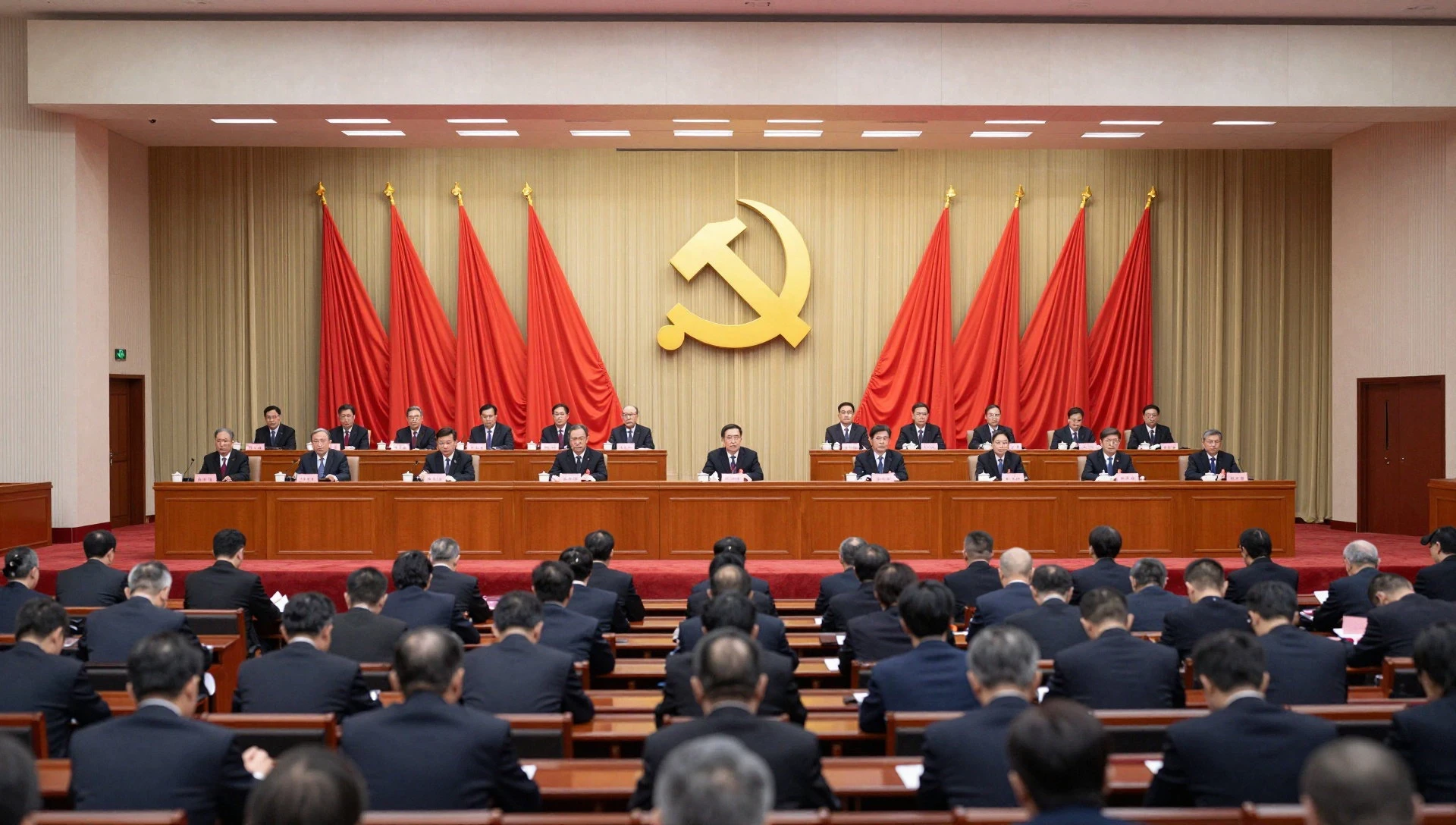
The fifth plenum of China's Communist Party, convened in Beijing from Monday to Thursday, concluded with the expulsion of 33 senior members and a reshuffling of the top leadership.
Attendance figures tell the sharper story: only 279 of the 376 full and alternate Central Committee members named in 2022 were present, meaning more than a quarter of the body was absent.
Analysts widely interpret those absences as a signal that dozens of officials are under investigation, a structural purge rather than an isolated disciplinary episode.
On This Page
The meeting's agenda centered on anti-corruption and party discipline, but its political function ran deeper. Joseph Torigian of American University argues the plenum shows Xi Jinping consolidating alignment ahead of next year's party congress, ensuring the incoming body reflects his authority.
Neil Thomas of the Asia Society Policy Institute frames the same evidence differently: the gathering reveals how much work Xi believes remains before the party becomes sufficiently effective and loyal to his design.
Among the expelled were Zhang Youxia, formerly China's most senior military general, and Liu Jianchao, a senior diplomat once seen as a likely foreign minister. General Zhang Shengmin, a central figure in the anti-corruption drive, was elevated to the Politburo, a body of more than twenty top officials.
Since late 2012, official figures record 7.9 million people punished in the campaign, including over 960 senior officials.
TL;DR China's fifth plenum ended with 33 expulsions and more than a quarter of the 2022 Central Committee absent, pointing to an anti-corruption purge that has reshaped military and diplomatic leadership. Xi Jinping is consolidating alignment before the 2027 party congress, promoting discipline enforcers such as General Zhang Shengmin to the Politburo while removing figures like Zhang Youxia and Liu Jianchao. Analysts read the meeting as evidence of both Xi's control and his anxiety about party loyalty, with direct implications for Taiwan, the South China Sea, and U.S.-China risk calculations.
The Plenum as a Discipline Mechanism: Attendance, Expulsions, and Institutional Signals
The fifth plenum belongs to a fixed calendar of party gatherings, but its outcomes are rarely this concentrated. Thirty-three expulsions from a body of 376 named members represents roughly 8.8 percent of the Central Committee removed in a single session.
The attendance gap of 97 members, or 25.8 percent, exceeds the expulsion count, suggesting additional absences tied to ongoing investigations or undisclosed disciplinary proceedings.
Reading the Attendance Numbers
Attendance at plenums is itself a disclosure mechanism. When more than a quarter of the Central Committee fails to appear, the party is signaling that its internal vetting process is active and unresolved.
The gap between 376 named members and 279 attendees implies a rolling purge that extends beyond the 33 formally expelled, leaving the remainder in an ambiguous status that discourages factional organizing.
This pattern differs from earlier plenums where absences were minimal and expulsions were announced retrospectively. The current session front-loads the disciplinary outcome, converting the meeting itself into a demonstration of enforcement. For outside observers, the numbers provide a rare quantitative window into internal party turnover, even if the underlying causes remain opaque.
Comparative context matters here. The 7.9 million punished since 2012, including more than 960 senior officials, establishes a scale that dwarfs most anti-corruption campaigns in modern authoritarian systems. The plenum's 33 expulsions are a small fraction of that total, but their concentration at the apex of the hierarchy gives them disproportionate political weight.
Expulsions at the Apex: Military and Diplomatic Purges
Zhang Youxia's removal carries particular weight because he was China's most senior military general. Neil Thomas notes that the military leadership has been almost completely purged over the past three to four years, a turnover without clear precedent in the post-1949 period. The removal of a figure at that rank signals that no institutional position guarantees protection.
Liu Jianchao's expulsion is equally consequential for foreign policy. A senior diplomat previously viewed as a plausible next foreign minister, his removal narrows the pool of experienced negotiators at a moment of acute tension with Washington. Personnel instability in the diplomatic corps complicates the continuity of U.S.-China engagement channels.
The two expulsions together illustrate how the campaign crosses institutional boundaries. Military and diplomatic elites are subject to the same disciplinary logic, and their removal reshapes the succession calculus for the 2027 congress.
Torigian's observation that the changes raise questions about whom Xi will rely on to fill those positions captures the core uncertainty.
Promotion as Doctrine: Zhang Shengmin and the Politburo
General Zhang Shengmin's elevation to the Politburo is the plenum's most instructive promotion. As a key figure in the anti-corruption campaign, his rise to a body of more than twenty top officials demonstrates that enforcement credentials now function as a primary qualification for advancement. Thomas reads the promotion as evidence of anti-corruption's centrality to military governance.
The logic is self-reinforcing. Officials who build careers through discipline work acquire institutional knowledge of surveillance and investigation, and their promotion embeds that expertise at the highest level. The Politburo gains a member whose authority derives from the campaign itself, which strengthens the mechanism's durability beyond any single leader's tenure.
This pattern has implications for how the party selects successors. If enforcement experience outweighs regional governance or economic management in promotion decisions, the composition of future leadership bodies will skew toward security and discipline backgrounds. That shift affects the policy priorities those bodies pursue once in office.
Xi's Succession Calculus and the Ideology of Party Purity
The plenum's disciplinary outcomes serve a forward-looking purpose. Torigian's assessment that Xi is preparing for next year's party congress by ensuring alignment identifies the meeting's strategic horizon. A congress that seats a Central Committee purged of dissenters and populated by loyalists converts the anti-corruption campaign into a succession instrument, shaping the body that will govern after Xi.
Aligning the Congress: Loyalty as the Selection Criterion
Party congresses determine the composition of the Central Committee, Politburo, and Standing Committee for the following term. By removing 33 members and leaving 97 absent, the plenum effectively pre-screens the candidate pool.
Those who remain are, by construction, individuals whose loyalty has survived scrutiny, which reduces the risk of factional challenge during the congress itself.
Thomas's framing adds a second dimension: the meeting shows how much work Xi believes the party still needs to become more effective and loyal. That admission is analytically significant because it implies the leadership views current institutional performance as inadequate. The purge is therefore not merely punitive but remedial, aimed at rebuilding capacity through personnel replacement.
The scale of replacement required is substantial. Filling 33 expelled seats plus any vacancies created by absent members demands a deep bench of vetted candidates. Torigian's question about whom Xi will rely on to fill those positions points to a genuine constraint: the pool of officials with both loyalty credentials and governing competence may be thinner than the purge assumes.
Purity, Decline, and the Generational Project
Torigian identifies a deeper ideological current: Xi wants to maintain the party's commitment across generations by persuading people to place the party at the center of their lives rather than their own interests.
This is a project of moral formation, not merely organizational discipline, and it addresses a question Xi reportedly cares about deeply, namely how a communist regime stays pure and avoids decline.
The historical reference is the Soviet collapse, which Chinese leadership has long studied as a cautionary case of ideological decay preceding institutional failure. Framing anti-corruption as a defense against decline converts a governance tool into an existential safeguard.
The 7.9 million punished since 2012 become evidence of the threat's scale rather than merely a statistic of enforcement.
Generational transmission is the harder problem. Persuading officials to subordinate personal interest to party interest requires sustained ideological work, and the plenum's emphasis on party governance signals that the leadership sees this as unfinished. The promotion of discipline enforcers to the Politburo institutionalizes the effort at the highest level.
Governance Capacity and the Limits of Discipline
Strengthening party governance was the plenum's second stated theme, and it connects directly to the effectiveness question Thomas raises. Discipline removes unreliable officials, but it does not by itself produce competent ones.
The leadership's challenge is to convert a purged apparatus into an effective one without reintroducing the risk that competence breeds independent authority.
This tension is structural rather than incidental. Systems that prioritize loyalty in selection tend to sacrifice technical expertise, while systems that prioritize expertise accumulate officials with independent power bases. Xi's approach resolves the tension in favor of loyalty, accepting short-term capacity costs in exchange for long-term control over the apparatus.
The 7.9 million figure illustrates the scale of that trade-off. Punishing millions of officials over more than a decade disrupts administrative continuity at every level, from county governments to ministries.
The plenum's emphasis on governance suggests the leadership recognizes the cost and is now attempting to rebuild capacity within the loyalty framework it has established.
We Also Published
- 01
- 02
- 03
- 04
Strategic Consequences: Taiwan, the South China Sea, and U.S.-China Risk
The plenum's internal politics carry direct external consequences. Thomas argues the meeting matters for the United States because it affects how likely China would be to use force over Taiwan, the South China Sea, and disputes with Washington.
His reasoning is that Xi is unlikely to take such risks until he feels more confident about the party he leads, which makes internal consolidation a precondition for external assertiveness.
Internal Confidence as a Constraint on Military Action
The logic runs counter to a common assumption that purges weaken restraint. If military leadership has been almost completely purged over three to four years, the officer corps operating under new commanders lacks the institutional cohesion that sustained campaigns require.
Xi's caution, on this reading, reflects uncertainty about whether a freshly reconstituted military can execute complex operations reliably.
Thomas's formulation places party confidence at the center of the risk calculus. A leader who doubts the loyalty of his own apparatus has reason to avoid ventures that could expose its weaknesses.
The plenum's disciplinary outcomes therefore function as a signal of caution rather than aggression, at least in the near term, until the rebuilt hierarchy stabilizes.
This does not imply permanent restraint. As the new leadership settles and the 2027 congress seats a vetted Central Committee, confidence may rise, and with it the willingness to accept risk.
The plenum is best read as a consolidation phase whose completion date, not whose direction, is the open question for U.S. planners.
Diplomatic Vacancies and Negotiation Capacity
Liu Jianchao's expulsion removes a diplomat widely regarded as a plausible future foreign minister. Vacancies at that level reduce the number of officials empowered to negotiate with Washington and complicate the continuity of engagement channels. Personnel instability in the foreign ministry affects the pace and reliability of any bilateral dialogue.
The military purge compounds the problem. When senior commanders are removed, their replacements require time to establish authority and familiarity with operational files. During that interval, crisis communication between U.S. and Chinese military counterparts becomes more fragile, raising the risk that incidents escalate through miscommunication rather than intent.
These effects are measurable in institutional terms even if individual intentions remain opaque. Each expulsion creates a vacancy, each vacancy requires a replacement, and each replacement introduces a period of reduced institutional memory.
The cumulative effect of 33 expulsions plus 97 absences is a leadership structure operating below its normal level of continuity.
Reading the Plenum Correctly: What the Evidence Supports
The plenum's significance lies in what it reveals about the mechanics of power rather than in any single expulsion. The attendance gap, the promotion of an enforcement figure, and the removal of the military's most senior general together describe a system in active internal reconstruction.
Analysts Torigian and Thomas converge on the conclusion that Xi is consolidating before the congress, even as they differ on whether the campaign reflects strength or anxiety.
Consolidation Versus Weakness: Two Readings
The consolidation reading emphasizes control. Thirty-three expulsions and a Politburo promotion demonstrate that Xi can reshape the apex of the party at will, and the 2027 congress will seat a body selected under his supervision.
On this account, the plenum is a display of authority that strengthens rather than weakens the leadership's position.
The weakness reading emphasizes the effort required. Thomas's observation that Xi believes the party still needs substantial work to become effective and loyal implies dissatisfaction with current performance. A leader confident in his apparatus would not need to remove a quarter of its members from a single meeting, nor would he describe purity as an unresolved generational problem.
Both readings can be true simultaneously. Consolidation and anxiety are not opposites; a leader can tighten control precisely because he perceives the existing structure as unreliable. The plenum's evidence supports a synthesis: Xi is strong enough to purge at scale, and the scale of the purge indicates he considers the threat serious.
What to Watch Before the 2027 Congress
Three indicators will clarify the trajectory. First, the pace of replacements for the 33 expelled members and any absentees will show how deep the vetted candidate pool runs. Second, the composition of the next Politburo will reveal whether enforcement backgrounds continue to dominate promotions or whether governance experience returns to favor.
Third, military appointments will indicate whether the purge has stabilized or continues. Thomas's assessment that the military leadership has been almost completely purged over three to four years implies a rebuilding process still underway.
A settled command structure would reduce the near-term caution he attributes to Xi on Taiwan and the South China Sea.
For U.S. policymakers, the practical implication is to treat internal consolidation as a leading indicator of external posture. The plenum's outcomes suggest a period of caution extending toward the congress, followed by a possible shift as the new leadership settles. Planning should account for both phases rather than assuming continuity in either direction.
Institutional Continuity and the Cost of Turnover
Every purge imposes an administrative cost that accumulates across levels of government. When 33 senior members are removed and 97 are absent, the committees they served on lose institutional memory, and their replacements require time to acquire comparable expertise. The plenum's governance theme implicitly acknowledges this cost.
The anti-corruption campaign's scale, 7.9 million punished since 2012, suggests the cost has been sustained over more than a decade. Whether that investment produces a more effective party, as Xi intends, or a more cautious and risk-averse one remains an open empirical question that the 2027 congress will help answer.
For now, the plenum's record stands as a precise measurement of internal turnover at the apex of the world's largest ruling party. The numbers, 33 expulsions, 97 absences, 279 attendees, and a single consequential promotion, provide the clearest available evidence of how Xi is preparing the party for its next chapter.
From our network :
- Committed Mediterranean Precipitation Decline: Why Emissions Cuts Alone Cannot Restore Winter RainsNew NOAA research reveals that Mediterranean winter rains may decline irreversibly even with emissions cuts. Explore the science of committed climate change and regional impacts.
- Forbidden Matrix Patterns and Visible Lattice Points: A Geometric DictionaryExplore how multidimensional 0–1 matrices encode geometric truths, linking forbidden patterns to visible lattice points and hypergraph theory, with applications in combinatorics and computational geometry.
- Mobile Learning and VR in English: What Global Evidence Reveals About Effective Language TechnologyA systematic review across 14 countries reveals which language-learning technologies genuinely work. Mobile learning, AI, and VR show measurable benefits when pedagogically integrated. This evidence-based guide helps educators and learners select technology that delivers real return on investment.
- Live Online English Classes for Kids: Do They Actually Reduce Anxiety?A ten-week study reveals that synchronous online English classes can significantly reduce child language anxiety while improving listening and reading skills. Discover what makes these programs effective and how parents can select the right one.
- How AI Agents Will Change the Way We Manage Personal FinancesExplore how AI agents are transforming personal finance through automated budgeting, bill payment, and investment management, while examining the critical security protocols and governance frameworks required for safe deployment.
- The Final Descent: How ESA Retired the Legendary Cluster Constellation After 24 Years of Space Weather ScienceAfter 24 years mapping Earth’s magnetosphere, ESA’s Cluster mission concluded with a precisely controlled reentry over the South Pacific. This analysis explores the scientific legacy, engineering decisions, and debris mitigation principles behind one of space exploration’s most responsible retirements.
- University Language Proficiency Exams: Why Institutional Tests Demand Different Preparation Than IELTS and TOEFLDiscover why university-specific language proficiency examinations differ fundamentally from IELTS and TOEFL, and learn strategic preparation approaches for institutional assessment success.
- The Hidden Cost of AI Convenience: Why Over-Permissioned Agents Are a Security Time BombDiscover why AI agents with excessive permissions create dangerous single points of failure, and learn how implementing least privilege principles can protect your organization from exploitation.
- CISA’s Ten-Advisory Wave: Why Generic Patching Fails in OT and How to Build Product-Specific PlaybooksCISA released ten ICS advisories in one week, exposing critical infrastructure risks. Generic patching fails in OT. Learn to build product-specific remediation playbooks.
RESOURCES
- Record number of purges as Xi emphasises 'party discipline ... - BBCbbc.com3 days ago ... A record 33 members have been expelled from China's Communist Party ... Xi Jinping has made the fight against corruption…
- Key takeaways from this week's political meeting in Beijing - NPRnpr.org2 days ago ... ... expulsion of 33 senior party members, as leader Xi Jinping's anti-corruption campaign continues to widen. The political meeting, known…
- China expels a record number from Communist party amid Xi's ...theguardian.com3 days ago ... A record 33 members were expelled at this week's fifth plenum, a ... Since coming to power in 2012 Xi…
- China's Communist Party conclave on toughening discipline sees ...reuters.com4 days ago ... China's Communist Party concluded its fifth plenum on Thursday ... Xi Jinping is expected to extend his rule for another…
- China's Communist Party expels 33 officials in post-Mao-era record ...nbcnews.com4 days ago ... ... Xi Jinping's anti-corruption campaign and wider political shake-up. ... The plenum formally confirmed the expulsions of 33 officials from…
- China widens PLA anti-corruption campaign, expels corporate ...scmp.com3 days ago ... The communique said the party leadership under President Xi Jinping ... China's fifth plenum focuses on discipline and loyalty to…
- China & Taiwan Update, October 30, 2026 | ISWunderstandingwar.org2 days ago ... Xi's anti-corruption efforts since 2023 have expelled senior ... CCP Purges: The Chinese Communist Party (CCP) held its Fifth Plenum ...
- Key takeaways from this week's political meeting in Beijing - NHPRnhpr.org2 days ago ... ... expulsion of 33 senior party members, as leader Xi Jinping's anti-corruption campaign continues to widen. The political meeting, known…
- Record number of purges as Xi emphasises 'party discipline ... - BBCbbc.co.uk4 days ago ... A record 33 members have been expelled from China's Communist Party ... Xi Jinping has made the fight against corruption…
- China's Communist Party Expels Record 33 Members After Xi ...newscord.org3 days ago ... Record 33 party members expelled at fifth plenum amid discipline push. ... Xi Jinping framed the campaign as a fight…
- The unending purge in Xi's China - The Hinduthehindu.com6 hours ago ... Xi Jinping's ongoing anti-corruption purge intensifies ... China's Fifth Plenum confirmed the expulsion of 33 Central Committee ...
- Key takeaways from this week's political meeting in Beijing - WETSwets.org2 days ago ... ... expulsion of 33 senior party members, as leader Xi Jinping's anti-corruption campaign continues to widen. The political meeting, known…
- Key takeaways from this week's political meeting in Beijing - WPRLwprl.org2 days ago ... ... expulsion of 33 senior party members, as leader Xi Jinping's anti-corruption campaign continues to widen. The political meeting, known…
- Key takeaways from this week's political meeting in Beijing | KGOUkgou.org2 days ago ... ... expulsion of 33 senior party members, as leader Xi Jinping's anti-corruption campaign continues to widen. The political meeting, known…
- Xi's party: What to look for at the upcoming Chinese Communist ...brookings.eduFrom October 26 to 29, Chinese President Xi Jinping will convene a major annual Chinese Communist Party meeting focused on party governance. In the…
- 01
- 02
- 03
- 04
- 05
- 06
- 07
- 08
0 Comments