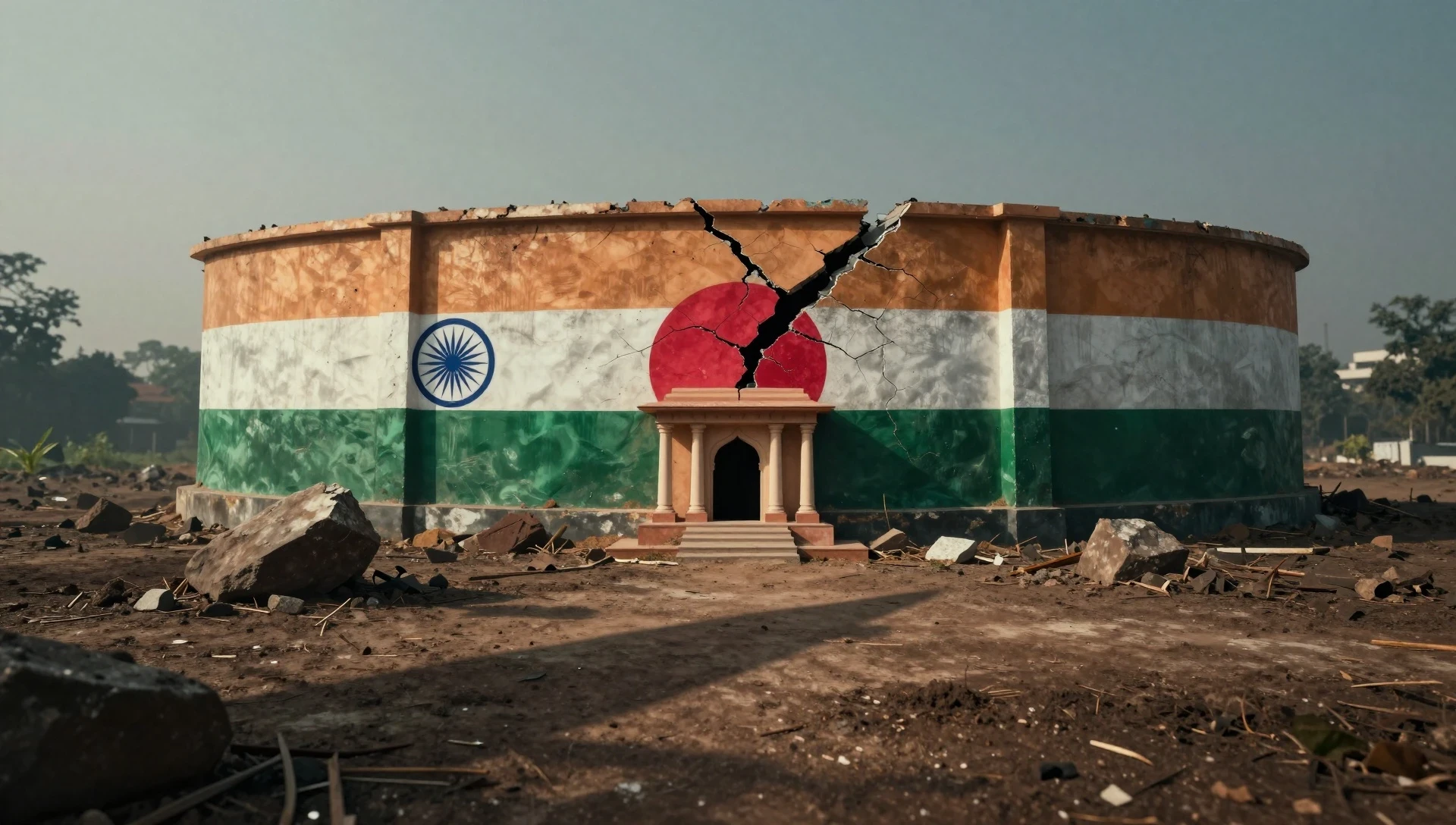
Bangladesh's democratic transition is being tested less by ballots than by bricks. Since the Awami League government fell on 5 August 2024, a pattern of mob attacks, office vandalism and police detention has targeted political parties that were never banned, including the Communist Party of Bangladesh, Jatiya Samajtantrik Dal and the Jatiyo Party. Analysts argue that tolerating such coercion corrodes the very freedoms the uprising was meant to restore.
The incidents share a common architecture: a peaceful gathering, a dispute over slogans, a crowd identifying itself with the ruling BNP or its affiliates, and police intervention that detains the victims rather than the aggressors.
On 26 October, two CPB activists were beaten in Paltan; on 26 September, 289 JaSoD participants were detained in Gulistan, with 27 formally arrested for chanting "Joy Bangla." On 12 October, bricks shattered windows at Jatiyo Party chairman GM Quader's Uttara residence.
On This Page
This analysis examines what those events reveal about Bangladesh's political equilibrium, why analysts treat them as structural rather than incidental, and what the historical record suggests about parties that inherit power without restraining their street-level supporters.
The evidence points to a narrow window in which the BNP can either consolidate a pluralist order or repeat the exclusionary habits that undermined its predecessor.
TL;DR Political analysts in Bangladesh warn that attacks on unbanned parties — CPB, JaSoD and the Jatiyo Party — threaten democratic practice and freedom of expression. Incidents since August 2024 include assaults on CPB activists in Paltan, the detention of 289 JaSoD participants in Gulistan, and a brick attack on GM Quader's residence. Analysts argue that democracy requires parties to operate freely, and that the BNP risks the Awami League's fate if it tolerates such coercion.
The Anatomy of Post-Transition Political Coercion
Democratic consolidation depends on a simple test: whether parties that lose power, or never held it, can organise without fear. Bangladesh is failing that test in measurable ways. The incidents documented since August 2024 are not random street crime; they cluster around identifiable party offices, scheduled meetings and public processions, suggesting coordination rather than spontaneity.
Documented Incidents and Their Patterns
The CPB case illustrates the sequence most clearly. On 26 October, party activists marched in Paltan chanting "Joy Bangla, Joy Samajtantra." According to the party, roughly 40 to 50 self-identified Jubo Dal and Chhatra Dal activists objected, an argument followed, and two CPB members were beaten. The group later gathered outside the CPB central office with sticks.
Police briefly detained CPB members Iran Molla and Sohel Fakir during that confrontation. The detention pattern matters analytically: when authorities hold the targets of violence rather than its perpetrators, they signal that certain political expression carries risk.
That signal suppresses participation more efficiently than any formal ban, because it operates through uncertainty rather than statute.
The JaSoD episode on 26 September was larger in scale. Police detained 289 people at a representatives' meeting in Gulistan; 27 were formally arrested on allegations of creating fear and instability by chanting "Joy Bangla." Almost all were later released on bail.
JaSoD maintains the meeting had police permission and that BNP activists attacked the office before police encircled it.
The Jatiyo Party attack on 12 October followed a different template — a targeted strike on a leader's home rather than a meeting. Bricks shattered windowpanes at GM Quader's Uttara residence; no one entered. Police confirmed the attack but said they had not identified those responsible. The party's central office had earlier faced attacks, vandalism and arson under the interim government.
The Slogan as Flashpoint
"Joy Bangla" functions in this period as a contested symbol rather than a neutral greeting. Its use triggered the JaSoD arrests and preceded the Paltan confrontation. When a phrase becomes grounds for detention, the state effectively delegates speech regulation to crowds, which is precisely the mechanism analysts describe as a threat to freedom of expression.
Prof Mojibur Rahman of Dhaka University's Institute of Education and Research framed the stakes directly. He noted that the mob attacks and vandalism seen after 5 August 2024 were expected to end once a democratic government took office, yet similar incidents persist. Such events, he argued, obstruct the building of a democratic government and a democratic state.
His definition of democracy is instructive because it moves beyond electoral procedure. Democracy, he said, is not limited to elections; it requires political parties to operate freely and to express differing views.
By that standard, a government elected cleanly but tolerant of street coercion against rivals has not consolidated democracy — it has merely changed its management.
Why Unbanned Status Matters
The legal status of these parties is the crux. None has been banned. Under any coherent regulatory framework, an unbanned party retains the right to hold meetings, publish positions and contest elections.
Analysts therefore argue that disagreements or anger over a party's past actions do not justify violence or restrictions on its activities.
This principle protects governing parties as much as opposition ones. A precedent that permits mobs to police political speech will eventually be turned against whoever holds power next. The CPB's Kazi Sajjad Zahir Chandan made the point explicitly, warning that the BNP could face the same fate as the Awami League if it does not restore the democratic system.
That warning carries historical weight. The Awami League's tenure ended in mass uprising partly because it had narrowed the space for dissent. A new government that inherits the same enforcement habits — detentions for slogans, tolerated attacks on offices — reproduces the conditions of its own eventual delegitimisation, regardless of its electoral mandate.
Institutional Failure and the Erosion of Political Trust
Coercion becomes systemic when institutions stop distinguishing between lawful assembly and public disorder. The JaSoD meeting had police permission, yet participants were detained en masse. That contradiction — authorised gathering, unauthorised attendance — is the signature of discretionary enforcement, where legality depends on who is present rather than what was approved.
Police Conduct Under Scrutiny
Police confirmed the Jatiyo Party attack but said they had not identified those responsible. In the CPB case, officers briefly detained party members at the scene. Across three incidents, the state's visible action fell on the victims. Analysts read this asymmetry as evidence that enforcement discretion is being exercised along partisan lines.
The scale of the JaSoD detention — 289 people, with 27 formally arrested and nearly all later bailed — raises a separate concern about due process. Mass detention followed by mass release suggests the arrests served a deterrent function rather than a prosecutorial one. Deterrence without conviction is precisely how informal censorship operates.
Prof Rahman's observation that such incidents obstruct democratic state-building connects police conduct to institutional legitimacy. When citizens observe that the same behaviour produces different outcomes depending on political affiliation, trust in courts, police and parliament erodes together. That erosion is difficult to reverse because it is cumulative and generational.
The Ruling Party's Structural Dilemma
The BNP faces a dilemma familiar to parties that inherit power through protest. Its affiliated organisations — Jubo Dal and Chhatra Dal — possess mobilisational capacity that was useful during opposition and is now difficult to discipline. When those wings act autonomously, the party's leadership must choose between restraint and plausible deniability.
Chandan's warning that the BNP could share the Awami League's fate is therefore not rhetorical. It describes a causal mechanism: tolerate coercion, lose legitimacy, invite counter-mobilisation. The Awami League's trajectory from landslide to uprising took roughly fifteen years. Compressed political cycles in the digital era may shorten that timeline considerably.
Analysts also note that anger over a party's past conduct is a weak justification for restricting present activity. The CPB, JaSoD and Jatiyo Party all operated during previous governments, sometimes controversially.
If historical association were sufficient grounds for exclusion, no party in Bangladesh would qualify for protection, and the political field would empty.
Freedom of Expression as the Binding Constraint
Every incident in this sequence involves expression: a slogan, a procession, a meeting, a protest against restrictions on female Baul singers. The common thread is not ideology but the act of speaking publicly. Restrictions on that act, however locally justified, aggregate into a national chilling effect that no single incident explains.
The Dhanmondi case is especially telling. Dipak Shil, former president of the Bangladesh Chhatra Union, was detained during a protest against attempts to stop female Baul singers in Sunamganj. The underlying cause — cultural performance by women — sits far from party politics, yet it drew the same enforcement response.
This suggests the coercion is not exclusively partisan. It reflects a broader discomfort with public dissent that predates the transition and has survived it. Analysts who focus only on BNP-affiliated crowds may therefore miss the deeper continuity: the state's instinct to manage rather than accommodate public expression remains intact.
We Also Published
- 01
- 02
- 03
- 04
Comparative Lessons and the Path to Consolidation
Bangladesh's situation is not unique, and comparison sharpens the diagnosis. Transitions in South Asia and beyond show a recurring pattern: movements that win power through street mobilisation struggle to demobilise their own supporters once in office. The difference between consolidation and regression lies in whether the new government disciplines its affiliated organisations early.
Historical Parallels in South Asia
Post-transition governments across the region have faced similar tests. Where ruling parties restrained their youth and student wings, pluralist politics took root; where they did not, opposition space narrowed and legitimacy decayed. The variable that mattered was not ideology but the willingness to police one's own coalition.
Bangladesh's compressed timeline makes the comparison urgent. The Awami League governed for fifteen years before its collapse; the current government has held office for months. Early signals — mass detentions, unidentified attackers, police passivity — are the same signals that preceded the previous government's decline, merely accelerated.
Analysts therefore treat the CPB, JaSoD and Jatiyo Party incidents as leading indicators rather than isolated grievances. If unbanned parties cannot meet safely in Dhaka, the constraint will extend to smaller parties, civil society and eventually the press. Democratic regression rarely announces itself; it accumulates through tolerated exceptions.
What a Democratic Government Must Do
The analysts' prescription is straightforward and legally grounded. Parties that have not been banned should be allowed to operate freely and safely, and the government must protect them. Protection means visible policing of offices, prosecution of attackers regardless of affiliation, and clear statements that political violence is unacceptable.
Beyond protection, the government must restore the principle that disagreement is not grounds for restriction. Anger over a party's past actions, however widely shared, cannot substitute for legal process.
If a party has broken the law, the remedy is a court, not a crowd; if it has not, its activities are protected by default.
Prof Rahman's distinction between elections and democracy provides the closing standard. Elections are a mechanism; democracy is a practice. A government that wins the former while permitting the latter's erosion has achieved power without legitimacy, and legitimacy is the only durable currency in a transition.
Indicators to Watch
Three measurable indicators will reveal the trajectory within months. First, whether police identify and charge perpetrators in the Jatiyo Party and CPB cases. Second, whether JaSoD and CPB can hold scheduled meetings without detention. Third, whether the government publicly disciplines its affiliated organisations when they disrupt rivals.
Each indicator is binary and observable, which makes the assessment falsifiable rather than rhetorical. If all three move toward protection, consolidation is plausible. If none do, the pattern documented here will extend, and the warning Chandan issued — that the BNP could share the Awami League's fate — will read less as a threat than a forecast.
The evidence assembled since August 2024 does not yet prove democratic collapse. It does establish a consistent pattern in which unbanned parties face violence and detention while perpetrators remain unidentified. In transitions, patterns precede outcomes; the question is whether Bangladesh's new government recognises the pattern in time to reverse it.
From our network :
- The Final Descent: How ESA Retired the Legendary Cluster Constellation After 24 Years of Space Weather ScienceAfter 24 years mapping Earth’s magnetosphere, ESA’s Cluster mission concluded with a precisely controlled reentry over the South Pacific. This analysis explores the scientific legacy, engineering decisions, and debris mitigation principles behind one of space exploration’s most responsible retirements.
- Mobile Learning and VR in English: What Global Evidence Reveals About Effective Language TechnologyA systematic review across 14 countries reveals which language-learning technologies genuinely work. Mobile learning, AI, and VR show measurable benefits when pedagogically integrated. This evidence-based guide helps educators and learners select technology that delivers real return on investment.
- Committed Mediterranean Precipitation Decline: Why Emissions Cuts Alone Cannot Restore Winter RainsNew NOAA research reveals that Mediterranean winter rains may decline irreversibly even with emissions cuts. Explore the science of committed climate change and regional impacts.
- CISA’s Ten-Advisory Wave: Why Generic Patching Fails in OT and How to Build Product-Specific PlaybooksCISA released ten ICS advisories in one week, exposing critical infrastructure risks. Generic patching fails in OT. Learn to build product-specific remediation playbooks.
- Live Online English Classes for Kids: Do They Actually Reduce Anxiety?A ten-week study reveals that synchronous online English classes can significantly reduce child language anxiety while improving listening and reading skills. Discover what makes these programs effective and how parents can select the right one.
- How AI Agents Will Change the Way We Manage Personal FinancesExplore how AI agents are transforming personal finance through automated budgeting, bill payment, and investment management, while examining the critical security protocols and governance frameworks required for safe deployment.
- University Language Proficiency Exams: Why Institutional Tests Demand Different Preparation Than IELTS and TOEFLDiscover why university-specific language proficiency examinations differ fundamentally from IELTS and TOEFL, and learn strategic preparation approaches for institutional assessment success.
- The Hidden Cost of AI Convenience: Why Over-Permissioned Agents Are a Security Time BombDiscover why AI agents with excessive permissions create dangerous single points of failure, and learn how implementing least privilege principles can protect your organization from exploitation.
- Forbidden Matrix Patterns and Visible Lattice Points: A Geometric DictionaryExplore how multidimensional 0–1 matrices encode geometric truths, linking forbidden patterns to visible lattice points and hypergraph theory, with applications in combinatorics and computational geometry.
RESOURCES
- Bangladesh's Democratic Erosion: How Democracy Assistance Can ...cfr.orgJun 4, 2018 ... Bangladesh's Democratic Erosion: How Democracy Assistance Can Help. Lawyers supporting the Bangladesh Nationalist Party (BNP) shout slogans ...
- Violent Democracy in Bangladesh - Political Violence at a Glancepoliticalviolenceataglance.orgFeb 14, 2018 ... The scale of political violence is puzzling because up until the elections of 2014–which the opposition Bangladesh Nationalist Party (BNP) ...
- Democracy in darkness: Attacks on journalists silence pre-election ...thenewhumanitarian.orgFeb 11, 2026 ... ... Bangladesh National Party or the Jamaat-e-Islami party. Repression ... political rallies, and rely on party-supplied photos instead of independent ...
- Bangladesh Democratic Participation and Reform Programdemocracyinternational.comIn Bangladesh in 2011, Democracy International implemented the Democratic Participation and Reform Program (DPR), a USAID- and DFID-funded political party ...
- A Damaged Democracy: Sheikh Hasina's Authoritarian Rule in ...humanrightsresearch.orgApr 24, 2025 ... Since 1991, the BNP and the Awami League emerged as the main parties in Bangladesh politics. Although there was much…
- The Uphill Battle to Safeguard Rights | Freedom Housefreedomhouse.org... political parties was an important achievement for democracy in Southern Africa. ... democracies around the world: elected leaders who attack democratic ...
- Preliminary Statement: "A credible electoral process propels ... - EEASeeas.europa.euFeb 14, 2026 ... ... political parties. However, its new and stringent campaign rules ... The Bangladesh Nationalist Party (BNP-) and Jamaat-e-Islami (JeI ...
- Democracy in the Crossfire: Opposition Violence and Government ...hrw.orgApr 29, 2014 ... Bangladesh's political parties, particularly Jammat-e-Islami, the Bangladesh Nationalist Party ... party workers attacked those not heeding ...
- Bangladesh: Political Turmoil and Transition - EveryCRSReport.comeverycrsreport.comMay 30, 2008 ... ... Bangladesh's democracy, which is destabilized by political violence. ... group Harkat ul-Jihad-al-Islami is responsible for the attacks. Such ...
- Bangladesh's political unrest threatens economic gains, democracywashingtonpost.comMar 22, 2014 ... Most people reject violence, but there has been a surge of high-profile attacks by extremists, some linked to Jamaat-e-Islami, an…
- Türk urges Bangladesh to change course, create conditions for truly ...ohchr.orgJan 8, 2024 ... ... Bangladesh Nationalist Party. Acts of political violence, including arson attacks allegedly committed by opposition groups, have also been ...
- Will Religious Instability Destroy Bangladesh? - Cato Institutecato.orgJan 16, 2018 ... ... attack by political Islamists who want ... Bangladesh's past, has created political instability without a shared commitment to democracy.
- Bangladesh: Islamist Militancy, Democracy Deficit and Where to Next?studies.aljazeera.netJun 28, 2016 ... These attacks have increased at a time when the main opposition party is in disarray, democratic space has shrunk and…
- Assessment of Online Violence Against Politically and Civically ...ifes.orgApr 6, 2021 ... Political parties and the Bangladesh Election Commission (BEC) should conduct widespread civic and voter education to encourage women's ...
- Khaleda Zia, first female prime minister of Bangladesh, dies at 80pbs.orgDec 30, 2025 ... "Her role in the struggle to establish democracy, a multi-party political culture, and the rights of the people in Bangladesh…
- 01
- 02
- 03
- 04
- 05
- 06
- 07
- 08
0 Comments