
A single sitemap page can read like a compressed diary of a nation's anxieties, and the CNN index dated November 2026 performs precisely that function. Rather than delivering one narrative, it assembles dozens of headlines into a mosaic of American civic life at a decisive moment: midterm elections, natural disasters, public health warnings, courtroom dramas, and foreign policy flashpoints.
Each entry is a doorway, and the index itself becomes a map of what a major newsroom judged important enough to publish.
Understanding such an artifact requires reading it as infrastructure rather than journalism. Sitemaps exist for crawlers and archivists, yet they inadvertently reveal editorial priorities with unusual honesty, stripped of layout, photography, and promotional framing.
On This Page
- What a Sitemap Actually Is and Why It Matters
- The Midterm Elections at the Center of the Index
- Disasters, Health, and the Domestic Emergency Ledger
- Technology, Finance, and the Binance Hack
- International Flashpoints and Diplomatic Signals
- Human Interest, Courts, and the Texture of the Month
- Reading Headlines Responsibly in an Aggregated World
The result is a raw inventory of stories, and from that inventory we can reconstruct the preoccupations of a specific week in November 2026 with surprising precision.
This analysis examines what that index actually contains, why its structure matters, and how headline-level evidence should be interpreted responsibly. It separates confirmed signals from speculative inference, weighs the risks of treating an index as a finished report, and draws out the broader lessons for anyone who consumes or produces news in an era of automated aggregation.
TL;DR The CNN sitemap for November 2026 is an index, not an article, and it lists headlines spanning U.S. midterm elections, a fatal Learjet crash in Florida, regional flooding, a measles death in New York, a Supreme Court ruling on California ballots, and a major Binance cryptocurrency hack. International entries include U.S. strikes on Iran's Qeshm Island, diplomatic talks with Tehran, and a new Greenland airport. Because sitemaps supply titles without context, the page is best read as evidence of editorial priorities and newsroom output rather than as verified reporting on any single event.
What a Sitemap Actually Is and Why It Matters
A sitemap is a machine-readable directory that helps search engines discover and index a publisher's pages. For a news organization of CNN's scale, the daily and monthly sitemap files function as a public ledger of everything published, timestamped and organized by date.
They are plumbing, not prose, yet that plumbing carries real informational value for researchers, archivists, and media analysts who need to reconstruct what was reported and when.
The November 2026 index is therefore best understood as a snapshot of output volume and topical range. It confirms that certain stories existed on the publisher's site during that period, and it reveals the breadth of coverage across domestic politics, weather, health, courts, technology, and international affairs. What it cannot do is explain motive, verify facts, or supply the nuance that full articles contain.
The Difference Between an Index and a Report
An index lists; a report explains. The sitemap entry for a Senate race tells us a story was filed, but not who won, what the polling showed, or how the outcome was framed.
Readers who mistake the listing for the substance risk forming conclusions from titles alone, a habit that headline-level consumption actively encourages and that careful analysis should resist.
This distinction matters because sitemaps are increasingly scraped and republished by aggregators. When a headline travels without its article, context collapses. The midterm entries, for instance, could describe previews, results, or analysis pieces, and only the underlying reporting would clarify which. Treating the index as a finished account misrepresents what the source actually provides.
Why Newsrooms Publish These Files
Publishers expose sitemaps primarily for search visibility. A well-structured index ensures that fresh reporting is crawled quickly, which matters enormously in competitive breaking-news environments where minutes determine traffic. The files also support archival integrity, giving future researchers a dated record of publication activity that survives redesigns and content migrations.
There is an incidental public benefit as well. Because sitemaps are openly accessible, they offer a transparent window into editorial decision-making that paywalled front pages obscure. Analysts can measure how many stories a newsroom produced on a given topic, compare coverage volume across outlets, and track how priorities shift over time.
The Midterm Elections at the Center of the Index
Domestic politics dominates the listing, as one would expect from a November index in an even-numbered year. Senate races, early voting tallies, and closing campaign messages appear repeatedly, signaling a newsroom devoting substantial resources to electoral coverage.
The presence of multiple election-related entries suggests sustained reporting across the final stretch of the campaign cycle rather than a single wrap-up piece.
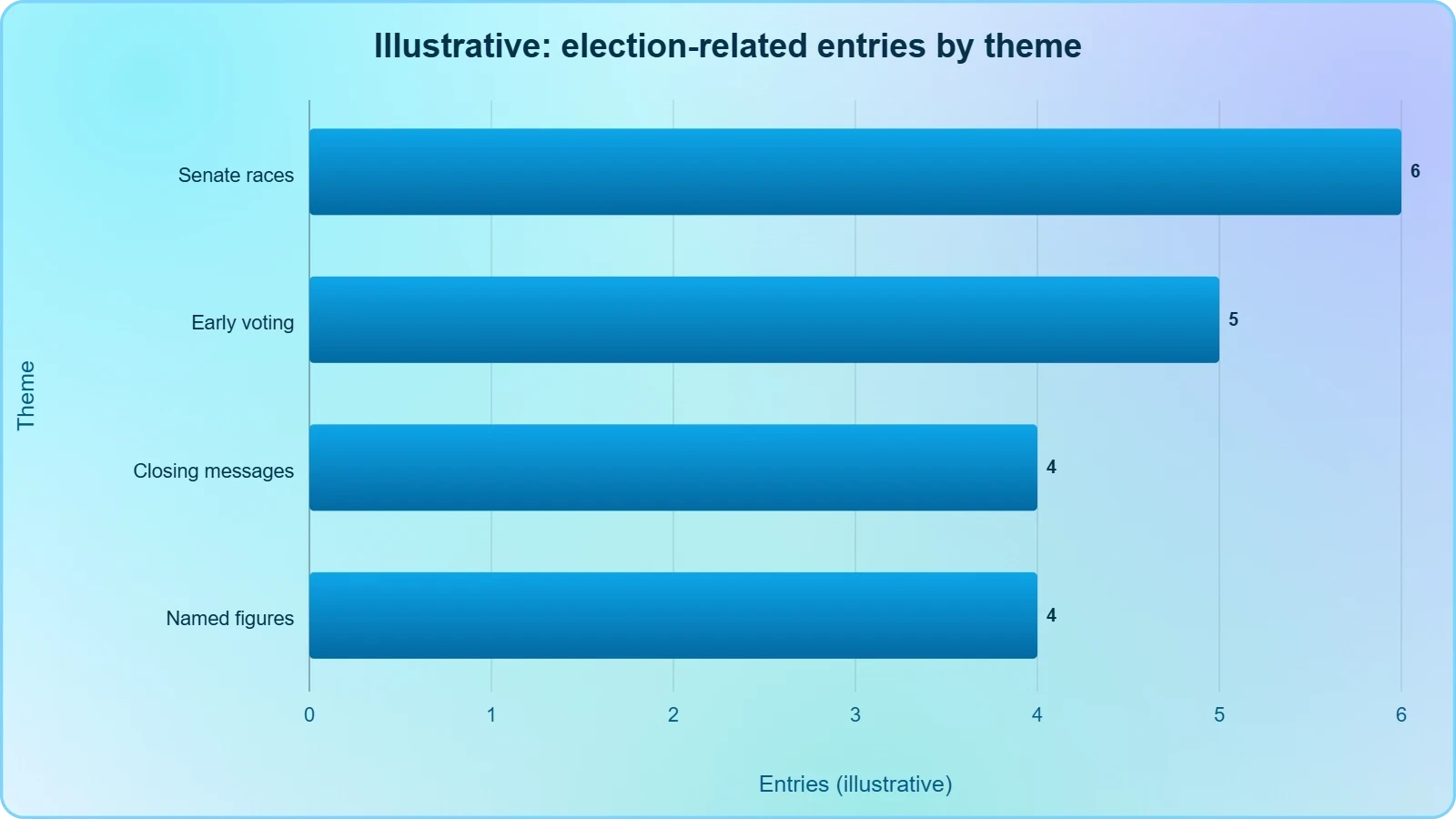
Named political figures sharpen the picture. References to Marjorie Taylor Greene, Gavin Newsom, Hillary Clinton, and Abdul El-Sayed indicate coverage extending beyond horse-race reporting into personality, factional politics, and national messaging.
Such names function as shorthand for broader ideological currents, and their appearance in an index hints at how campaigns nationalized local contests.
Senate Races and the Mechanics of Voting
Senate contests typically determine control of the chamber, and coverage of early voting reflects the modern reality that elections unfold over weeks rather than a single Tuesday. Early-voting stories serve practical and interpretive purposes: they inform voters about access while supplying analysts with turnout signals that shape expectations before results arrive.
Final campaign messages, meanwhile, represent the closing argument phase, when candidates distill their pitches into memorable appeals. Index entries describing such messages tell us the cycle had reached its terminal intensity. They do not tell us the outcome, and readers should resist inferring winners from the prominence of any single headline.
Figures Who Frame the Political Moment
The named politicians span the ideological spectrum, from Greene's combative populism to Newsom's national-profile positioning and Clinton's enduring symbolic weight. Their presence in a single index illustrates how midterms increasingly function as referenda on broader cultural and partisan identities rather than isolated local decisions.
Abdul El-Sayed's inclusion points toward progressive insurgencies within the Democratic coalition, a dynamic that has reshaped primaries across several cycles. Together these names sketch a political landscape in which individual candidacies carry outsized meaning, and where a newsroom's decision to cover a figure signals perceived national relevance.
Disasters, Health, and the Domestic Emergency Ledger
Beyond politics, the index records a cluster of domestic emergencies that any newsroom would treat as urgent. A fatal Learjet crash in Florida, flooding across the Southwest and Florida, and a measles death in New York each represent a distinct category of risk: aviation safety, extreme weather, and vaccine-preventable disease. Their coexistence in one month's listing is itself a statement about compound vulnerability.
These entries illustrate how disaster coverage has become routine rather than exceptional. Flooding in multiple regions suggests sustained meteorological stress, while a measles death signals erosion in public health protection. Aviation accidents, though statistically rare, command attention because they concentrate risk into discrete, dramatic events that demand immediate explanation.
Weather, Infrastructure, and Recurring Floods
Flooding in the Southwest and Florida points to the intersection of climate patterns, land use, and infrastructure capacity. Newsrooms cover such events in phases: immediate warnings, damage assessment, and longer inquiries into preparedness. An index entry captures only the existence of that coverage, not which phase it represents or what officials concluded.
Recurring flood stories also reveal a structural story about insurance, zoning, and federal disaster relief. Each event strains local budgets and raises questions about rebuilding in vulnerable zones. Readers encountering only headlines should recognize that the substantive debate lives in the articles, where costs, culpability, and policy responses are actually examined.
Public Health Signals and Legal Repercussions
A measles death in New York carries particular weight because the disease was declared eliminated in the United States decades ago. Its reappearance reflects declining immunization rates in some communities and the fragility of herd immunity. Coverage of such a death typically combines epidemiological reporting with scrutiny of vaccination policy and public messaging.
The Supreme Court decision on California ballots adds a legal dimension to the domestic ledger, addressing how votes are counted or challenged. Election law has become a recurring battleground, and rulings issued close to voting periods carry outsized consequences. The index confirms the decision existed; only the underlying reporting explains its scope and reasoning.
Technology, Finance, and the Binance Hack
One entry stands apart for its financial gravity: a large cryptocurrency hack at Binance. Exchange breaches concentrate systemic risk because centralized platforms hold customer assets at scale, and a significant loss can ripple through markets, trigger regulatory scrutiny, and erode confidence in digital asset infrastructure. The index confirms the story existed without specifying the amount stolen or the mechanism used.
Placing this alongside election and disaster coverage reveals how technology failures now sit comfortably within the general news agenda. Crypto is no longer a niche beat; breaches at major exchanges are treated as mainstream financial events with implications for consumers, regulators, and institutional investors alike.
Why Exchange Breaches Matter Systemically
Centralized exchanges function as custodians, and custody is precisely where risk accumulates. When a platform is compromised, the loss is not abstract; it lands on depositors who trusted an intermediary. Recovery is often partial, insurance is limited, and legal recourse varies wildly across jurisdictions, leaving users exposed.
Regulators have responded with reserve requirements, disclosure mandates, and stricter licensing, but enforcement remains uneven globally. Each major breach becomes a case study that shapes the next round of rules. The Binance entry, whatever its eventual details, belongs to that ongoing cycle of incident, investigation, and regulatory adjustment.
Reading Financial Headlines Without Numbers
A headline announcing a hack conveys shock but not scale. Without figures for stolen funds, affected users, or remediation timelines, readers cannot assess severity. This is the central limitation of index-level information: it flags importance while withholding the quantitative substance that would allow genuine evaluation.
Responsible interpretation therefore requires restraint. The presence of a hack story tells us something significant occurred; it does not tell us whether the event was a minor exploit or a market-moving catastrophe. Only the full article, with confirmed figures and official statements, can support that judgment.
- 01
- 02
- 03
- 04
International Flashpoints and Diplomatic Signals
The index's international entries are striking for their concentration on Iran. U.S. military strikes on Qeshm Island and simultaneous reports of talks with Tehran present an apparent contradiction: escalation and diplomacy proceeding in parallel.
Such duality is common in statecraft, where military pressure and negotiation often serve as complementary instruments rather than opposing strategies.
Qeshm Island's strategic position near the Strait of Hormuz gives any military action there disproportionate significance. The strait is a chokepoint for global energy shipments, and instability in its vicinity can move oil markets within hours. A single headline thus carries implications far beyond the immediate tactical event.
Strikes, Talks, and the Logic of Coercive Diplomacy
Coercive diplomacy rests on the premise that limited force can improve negotiating leverage. Strikes may be calibrated to signal resolve without triggering full-scale conflict, while talks offer an off-ramp. Whether such a strategy succeeds depends on communication channels, credible commitments, and the adversary's own domestic constraints.
Reading these entries together suggests a moment of acute tension rather than resolution. The index cannot tell us the sequence, the scale, or the outcome, but it does establish that both military and diplomatic tracks were active enough to generate separate stories within the same period.
Greenland's Airport and Arctic Ambition
A new airport in Greenland seems a quieter item, yet it belongs to a larger geopolitical story about Arctic access. Improved aviation infrastructure expands connectivity, supports resource exploration, and strengthens sovereign presence in a region where great-power interest has intensified. Greenland's strategic value has grown as ice retreats and shipping routes shift.
Infrastructure stories often carry more long-term consequence than dramatic headlines, precisely because their effects accumulate slowly. An airport reshapes logistics, tourism, and emergency response for decades. Placing it beside strike reports reminds us that the international agenda includes both sudden crises and patient investments in geography.
Human Interest, Courts, and the Texture of the Month
Not every entry concerns power or peril. A man completing a 28-year walk around the world offers a counterpoint of endurance and curiosity, the kind of story that reminds readers of human persistence beyond the news cycle.
Such features serve a real function, providing narrative relief and a sense of scale that political coverage rarely supplies.
The trial in England involving sexual assault charges represents another register entirely: the slow, procedural work of courts. Legal reporting is unglamorous but essential, documenting how allegations are tested and how justice systems handle sensitive cases. Its presence in the index confirms that the newsroom maintained coverage of judicial processes alongside breaking events.
Why Long-Form Human Stories Endure
Stories of extraordinary personal endeavor persist because they satisfy a durable appetite for meaning. A twenty-eight-year journey invites reflection on commitment, sacrifice, and the passage of time, themes that resonate independently of daily headlines. Editors know such pieces attract loyal readers and generate conversation.
They also balance a publication's emotional register. A month composed solely of elections, disasters, and breaches would feel relentless. Human-interest features provide contrast, and their inclusion in an index signals a newsroom attentive to the full spectrum of reader interest rather than crisis alone.
Court Reporting as Civic Infrastructure
Court coverage functions as civic infrastructure, translating legal procedure into public understanding. Trials involving serious charges require careful, restrained reporting that respects presumption of innocence while documenting proceedings. The index entry confirms such coverage existed without revealing verdicts or testimony details.
This restraint is appropriate. Legal outcomes carry consequences for real people, and premature inference from headlines can distort public perception. Readers should treat trial entries as markers of ongoing process, not as conclusions, and seek the full reporting before forming judgments about guilt, credibility, or fairness.
Reading Headlines Responsibly in an Aggregated World
The deepest lesson of this index concerns method. Sitemaps, feeds, and aggregators increasingly mediate how audiences encounter news, and each layer of mediation strips context. A headline that reaches a reader through three intermediaries may bear little resemblance to the reporting beneath it, yet it shapes belief all the same.
Responsible consumption therefore demands deliberate verification. When a headline claims a strike, a ruling, or a breach, the reader should locate the underlying article, check the date, and identify the sourcing. These habits are unglamorous but they are the difference between informed citizenship and reflexive reaction to fragments.
Verification Habits That Actually Work
Start with the primary document whenever one exists. Court rulings, official statements, and regulatory filings carry more weight than summaries. Cross-reference at least two independent outlets, note whether they cite original reporting or repeat a wire, and check timestamps to confirm the event's recency.
For quantitative claims, demand numbers and their provenance. A hack's severity depends on confirmed losses; a flood's impact depends on measured rainfall and insured damages. Without such figures, assertions remain provisional. Readers who internalize this discipline become considerably harder to mislead by dramatic phrasing.
What This Index Teaches About Editorial Judgment
Finally, the index offers a portrait of editorial judgment at scale. A newsroom chose to cover elections intensively, to treat a measles death as significant, to report both strikes and talks with Iran, and to reserve space for a man who walked the world. Those choices reveal priorities that no single article could show.
For analysts, that is the genuine value of such artifacts: not the individual headlines, but the pattern they form. Patterns expose what an institution considers important, how it balances crisis against curiosity, and where it directs resources. Read that way, a humble sitemap becomes a document of considerable interpretive richness.
From our network :
- University Language Proficiency Exams: Why Institutional Tests Demand Different Preparation Than IELTS and TOEFLDiscover why university-specific language proficiency examinations differ fundamentally from IELTS and TOEFL, and learn strategic preparation approaches for institutional assessment success.
- The Final Descent: How ESA Retired the Legendary Cluster Constellation After 24 Years of Space Weather ScienceAfter 24 years mapping Earth’s magnetosphere, ESA’s Cluster mission concluded with a precisely controlled reentry over the South Pacific. This analysis explores the scientific legacy, engineering decisions, and debris mitigation principles behind one of space exploration’s most responsible retirements.
- Live Online English Classes for Kids: Do They Actually Reduce Anxiety?A ten-week study reveals that synchronous online English classes can significantly reduce child language anxiety while improving listening and reading skills. Discover what makes these programs effective and how parents can select the right one.
- Forbidden Matrix Patterns and Visible Lattice Points: A Geometric DictionaryExplore how multidimensional 0–1 matrices encode geometric truths, linking forbidden patterns to visible lattice points and hypergraph theory, with applications in combinatorics and computational geometry.
- CISA’s Ten-Advisory Wave: Why Generic Patching Fails in OT and How to Build Product-Specific PlaybooksCISA released ten ICS advisories in one week, exposing critical infrastructure risks. Generic patching fails in OT. Learn to build product-specific remediation playbooks.
- The Hidden Cost of AI Convenience: Why Over-Permissioned Agents Are a Security Time BombDiscover why AI agents with excessive permissions create dangerous single points of failure, and learn how implementing least privilege principles can protect your organization from exploitation.
- Mobile Learning and VR in English: What Global Evidence Reveals About Effective Language TechnologyA systematic review across 14 countries reveals which language-learning technologies genuinely work. Mobile learning, AI, and VR show measurable benefits when pedagogically integrated. This evidence-based guide helps educators and learners select technology that delivers real return on investment.
- How AI Agents Will Change the Way We Manage Personal FinancesExplore how AI agents are transforming personal finance through automated budgeting, bill payment, and investment management, while examining the critical security protocols and governance frameworks required for safe deployment.
- Committed Mediterranean Precipitation Decline: Why Emissions Cuts Alone Cannot Restore Winter RainsNew NOAA research reveals that Mediterranean winter rains may decline irreversibly even with emissions cuts. Explore the science of committed climate change and regional impacts.
RESOURCES
- Resources will be updated soon.
- 01
- 02
- 03
- 04
- 05
- 06
- 07
- 08
0 Comments