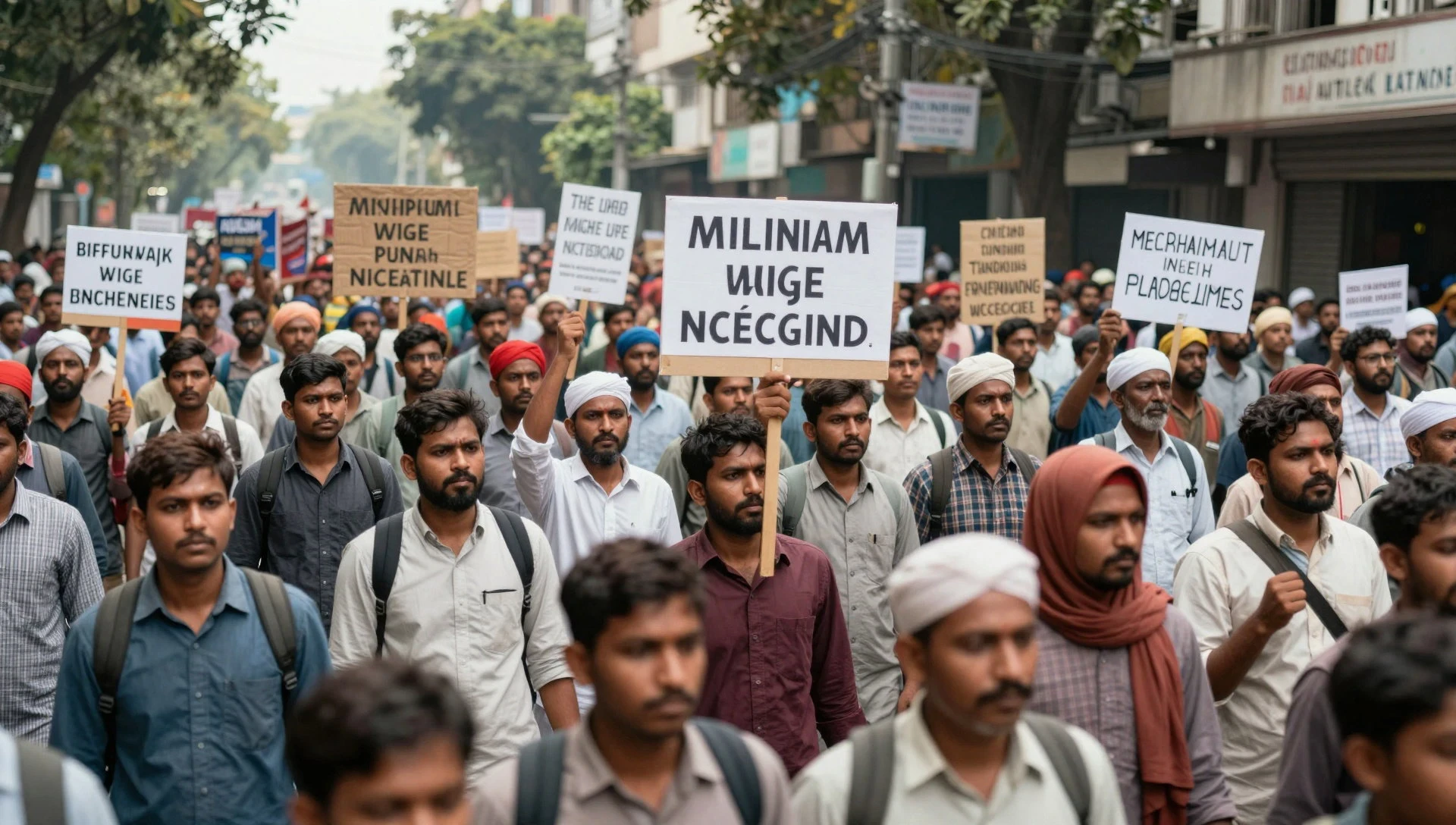
Bangladesh's ready-made garment industry is the quiet engine behind the global wardrobe, supplying major fashion labels across Europe and North America while generating more than 80 percent of the nation's export earnings.
That sector reached roughly $39 billion in the last financial year, a figure that underscores how profoundly the country's macroeconomic fate is tethered to the stitching floors of Dhaka and Gazipur.
Yet the workers who produce this wealth increasingly find that their wages cannot sustain the most basic household needs, and in late 2026 that contradiction erupted into sustained street protests.
On This Page
- The Economic Architecture of Bangladesh's Garment Export Machine
- Wage Arithmetic: What 15,000 Taka Actually Buys
- The Protest Movement and the State's Response
- Global Supply Chains and the Ethics of Cheap Apparel
- Inflation, Purchasing Power, and the Real Wage Question
- What the Bangladesh Wage Standoff Means for the Future
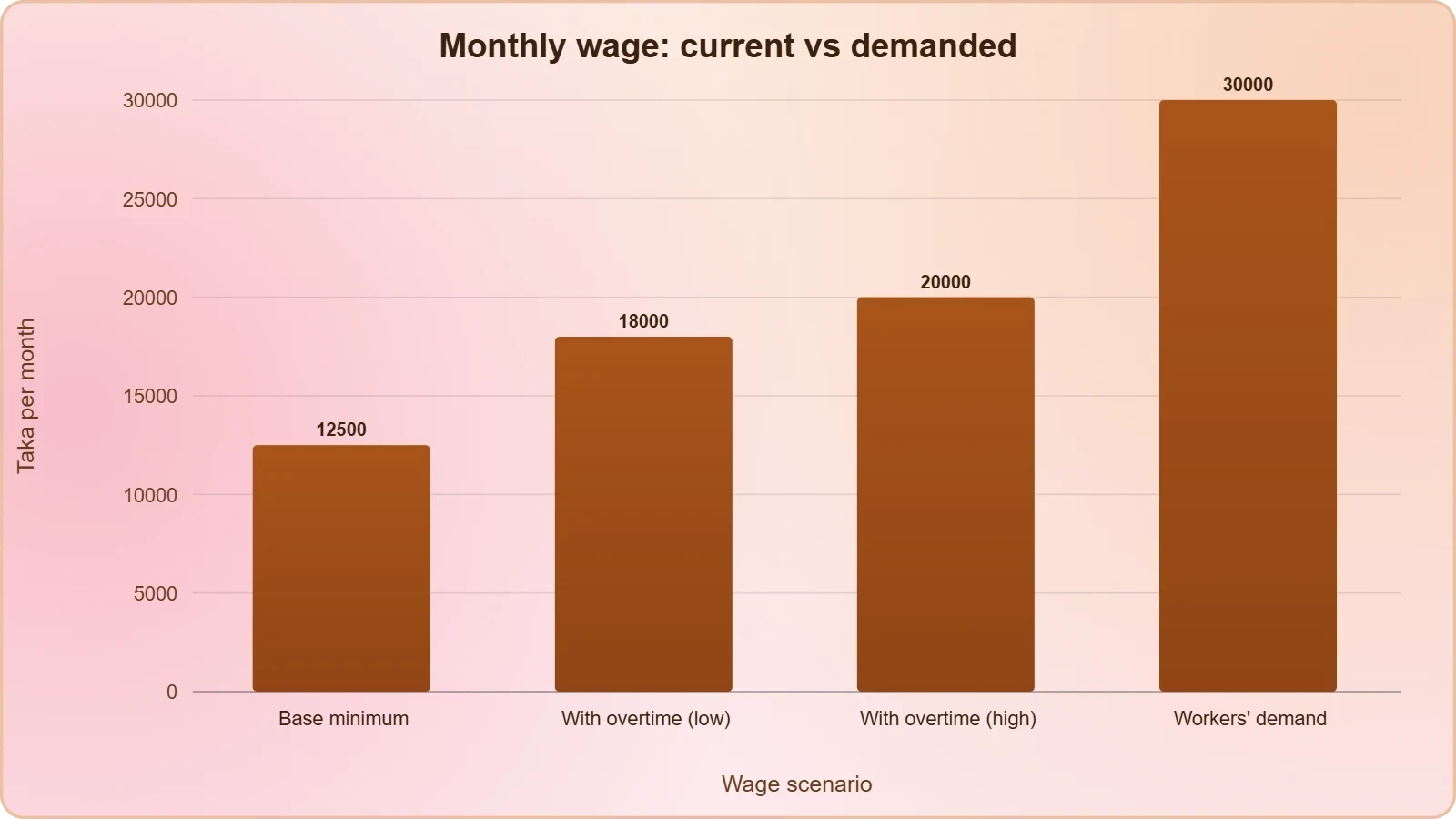
The immediate trigger was a demand for a higher minimum wage, but the underlying crisis is one of arithmetic and dignity. A sewing operator earning about 15,000 taka monthly, occasionally reaching 18,000 to 20,000 taka with overtime, is confronting food inflation, school fees, and rent that have outpaced any wage adjustment.
When a mother of two describes her children dropping out of school and days sustained on puffed rice alone, the dispute ceases to be an industrial relations story and becomes a question of whether export-led growth can coexist with human subsistence.
What follows examines the structural economics of Bangladesh's garment sector, the regional wage comparisons that frame worker demands, the state's response, and the wider implications for global supply chains that depend on low-cost apparel.
The analysis draws on reporting from Al Jazeera and situates the protests within the longer arc of labor organizing, inflation, and the fragile bargain between manufacturers, government, and international buyers.
TL;DR Thousands of Bangladeshi garment workers protested in November 2026 demanding a minimum wage of 30,000 taka ($241), more than double the current 12,500 taka ($102), arguing that inflation has rendered existing pay insufficient for basic living costs. Police responded with tear gas and arrests in Ashulia, while the manufacturers' association reported disruptions at 529 factories affecting nearly a million workers. The government formed a six-member review committee, but protests continued, exposing the tension between Bangladesh's $39 billion export engine and the subsistence wages underpinning it.
The Economic Architecture of Bangladesh's Garment Export Machine
Bangladesh's apparel sector is not merely an industry; it is the load-bearing wall of the national economy. Ready-made garments account for over 80 percent of export earnings, and the $39 billion generated last financial year represents the country's principal source of foreign currency, employment, and industrial identity. Any wage adjustment therefore ripples directly into fiscal stability, trade balances, and the confidence of international buyers.
This concentration creates a peculiar vulnerability. When a single sector dominates exports, the government faces a structural disincentive to raise labor costs aggressively, fearing that buyers will shift orders to Vietnam, Cambodia, or African competitors.
Workers, meanwhile, understand that their labor underwrites national prosperity, which sharpens the moral force of their demand for a living wage.
The Concentration Risk in Export Dependence
An economy deriving four-fifths of its export revenue from one sector operates without a meaningful buffer. Diversification into pharmaceuticals, leather, and light engineering has been discussed for years, yet garment remains the employer of last resort for millions of rural migrants, particularly women entering the formal workforce for the first time.
This dependence means wage policy is never purely a labor question. It is simultaneously trade policy, monetary policy, and social policy, and the government must weigh each dimension against the others whenever the minimum wage is revisited.
Who Actually Bears the Cost of Low Wages
The cost of suppressed wages is absorbed disproportionately by households, and within households by women and children. Laili Begum's account of her children leaving school illustrates how a wage shortfall transmits into lost human capital, with consequences that outlast any single production cycle.
International buyers, meanwhile, capture the benefit of low unit costs while publicly committing to ethical sourcing standards. The gap between corporate codes of conduct and the wage floor on the ground remains one of the most persistent contradictions in global fashion supply chains.
Wage Arithmetic: What 15,000 Taka Actually Buys
The protest's central grievance is quantifiable. A base wage of 12,500 taka converts to roughly $102 monthly, and even with overtime a worker may reach 18,000 to 20,000 taka, or $145 to $161.
Against food, rent, transport, and schooling, that sum leaves virtually nothing, and any inflationary shock pushes the household into deficit.
Workers are demanding 30,000 taka, approximately $241, which is more than double the current floor. The demand is not aspirational luxury; it is an attempt to restore the purchasing power that earlier wage settlements assumed. In real terms, the erosion has been steady and cumulative.
Inflation and the Erosion of Real Income
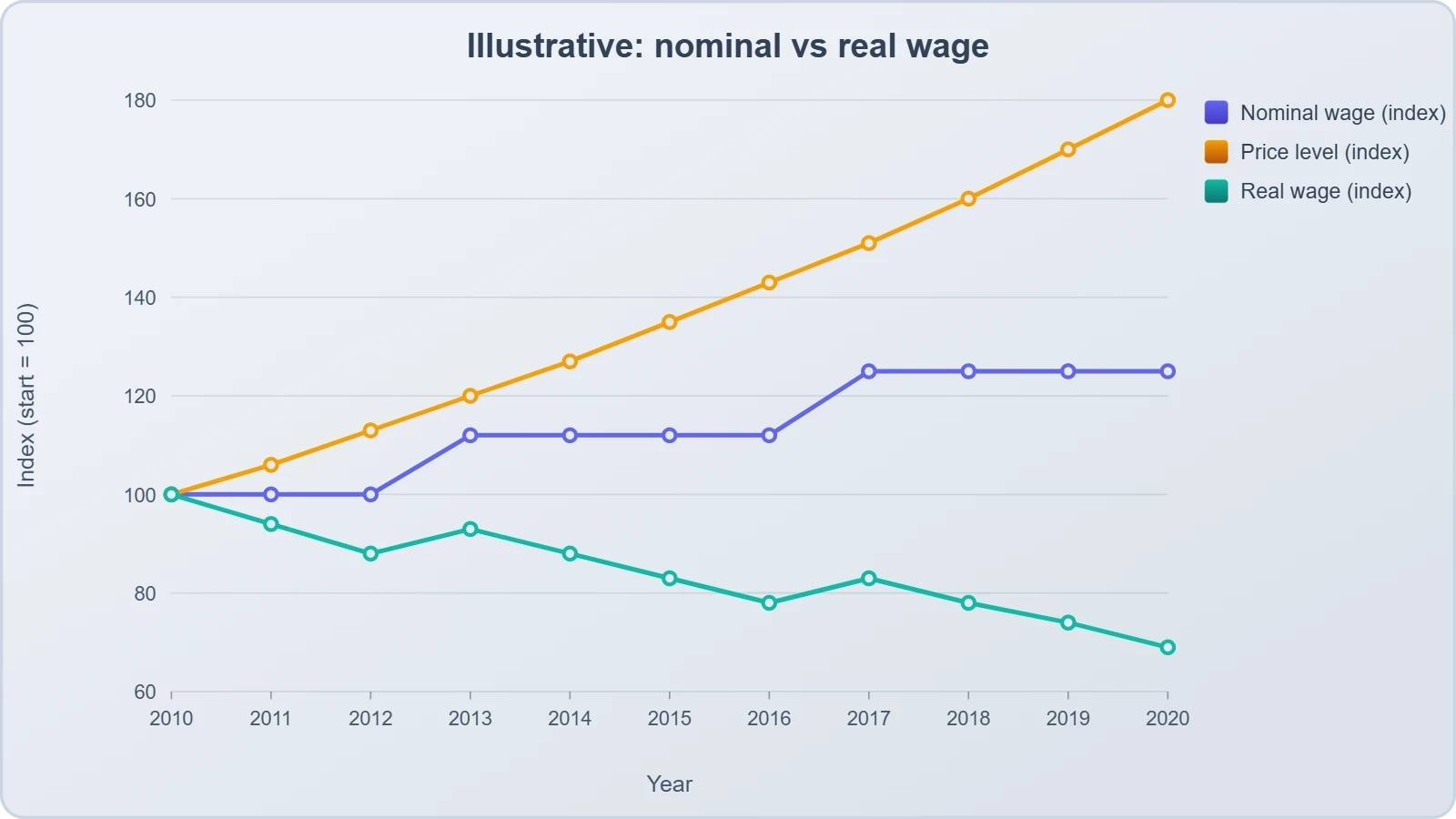
Nominal wage revisions in Bangladesh have historically lagged price movements, meaning each settlement begins from a diminished base. When food inflation accelerates, the gap between the statutory minimum and the subsistence threshold widens faster than any periodic review can close.
The mathematical relationship is straightforward: if prices rise faster than wages, real income falls even when the nominal figure increases. Workers experience this as a slow squeeze, where the same paycheck buys progressively less each month.
The Human Ledger Behind the Numbers
Statistics obscure the specific losses. Children withdrawn from school represent foregone future earnings; reduced meals represent compromised health and productivity; and the absence of savings means any medical emergency becomes a debt crisis. These costs compound across generations.
Begum's testimony, that her family sometimes has only puffed rice and a snack with nothing for lunch, is the human ledger entry that no export figure captures. It is also the reason the protests persisted beyond a single day.
The Protest Movement and the State's Response
Protests began on a Saturday and escalated rapidly. By Sunday, police had fired tear gas and stun grenades and arrested dozens of demonstrators in the Ashulia industrial area near Dhaka. The manufacturers' association reported that operations at 529 factories were disrupted, affecting nearly a million workers.
Rather than subsiding, the movement entered a third day on Monday, with workers blocking a highway in Gazipur and clashes reported in Mirpur. The geography of the unrest, spreading from Ashulia to Gazipur and Mirpur, signals that the grievance is shared across the industrial belt rather than confined to a single factory or employer.
Policing, Arrests, and the Cost of Dissent
The use of tear gas and stun grenades against garment workers raises familiar questions about the space for lawful assembly in Bangladesh. Arrests of demonstrators can chill future organizing, yet they also risk hardening worker resolve and drawing international scrutiny from buyers and rights groups.
For a sector so dependent on global brand relationships, images of police confronting sewing operators carry reputational risk. Buyers increasingly audit labor conditions, and visible suppression can complicate sourcing decisions that manufacturers can ill afford to lose.
The Six-Member Committee and Its Limits
The government's response was procedural: a six-member committee to review the workers' demands. Committees can buy time, but they do not put food on tables. Workers noted that promises have been made before without any indication of when wages might rise or by how much.
This credibility gap is central to why the protests continued. When prior commitments have gone unfulfilled, a new review body reads less as a concession and more as a delaying tactic, and the street becomes the only venue where demands are heard.
Global Supply Chains and the Ethics of Cheap Apparel
Bangladesh's wage floor cannot be understood without reference to the buyers who set the commercial terms. Major global fashion brands source heavily from the country precisely because unit costs are low, and that low cost is transmitted directly into the wage structure of the factories they contract.
Consumers in wealthy markets have grown accustomed to inexpensive clothing, and the price differential is underwritten by labor arrangements that workers now contest. The protest therefore reaches beyond Dhaka into the procurement offices and sustainability reports of European and American retailers.
Buyer Pressure and the Price-Per-Unit Problem
When brands negotiate aggressively on price, manufacturers absorb margin pressure by restraining wages. Unless buyers accept higher unit prices or commit to wage-linked sourcing agreements, factory owners face a genuine squeeze between contractual expectations and worker demands.
Some brands have experimented with paying a wage premium or funding productivity improvements. These initiatives remain limited in scale, and their effectiveness depends on whether the additional money actually reaches the workers rather than being absorbed upstream.
Reputational Risk for Fashion Brands
For international labels, the reputational calculus is delicate. Public commitments to ethical sourcing sit awkwardly beside reports of tear gas deployed against the workers producing their garments. Activists and journalists increasingly connect the two, and brand equity is exposed accordingly.
This dynamic gives workers a form of leverage that does not require formal bargaining power. Visibility in global media can translate into buyer pressure, which in turn can influence government and manufacturer behavior more effectively than domestic protest alone.
- 01
- 02
- 03
- 04
Inflation, Purchasing Power, and the Real Wage Question
At the heart of the dispute is a concept every economics student encounters but few policymakers apply with rigor: real versus nominal wages. A minimum wage expressed in taka is meaningless without reference to what those taka can purchase, and purchasing power has been steadily eroding.
The relationship can be expressed simply, where real wage equals nominal wage divided by the price level:
When ##P## rises faster than ##W_{nominal}##, the worker's effective compensation declines even if the paycheck looks larger. This is precisely the mechanism workers describe when they say their wages no longer cover basic needs.
Why Periodic Reviews Fall Behind
Minimum wage boards typically convene every few years, creating long intervals during which inflation runs unchecked. By the time a revision arrives, it often restores only a fraction of the lost purchasing power, and the cycle begins again from a lower real base.
Indexation mechanisms, common in some economies, would tie wages to price movements automatically. Bangladesh has not adopted such a system, leaving workers exposed to the full force of food and fuel inflation between reviews.
The Macroeconomic Counterargument
Opponents of sharp wage increases warn of competitiveness losses, order migration, and inflationary pressure on export costs. These concerns are not imaginary, but they must be weighed against the productivity gains workers have delivered and the social costs of suppressed consumption.
Higher wages also expand domestic demand, which can support broader growth. The policy question is therefore one of sequencing and support, not a binary choice between competitiveness and subsistence.
What the Bangladesh Wage Standoff Means for the Future
The standoff carries implications that extend well beyond a single wage cycle. Bangladesh's garment sector faces automation pressure, shifting buyer preferences, and competition from lower-cost entrants, all of which will shape whether wage gains can be sustained or reversed.
Workers have demonstrated that they can halt production at scale, and that capacity gives them leverage even without formal union recognition. How the government and manufacturers respond will determine whether future disputes are resolved through negotiation or confrontation.
Paths Toward a Sustainable Wage Settlement
A durable settlement likely requires three elements: a wage floor indexed to inflation, buyer commitments to price structures that accommodate higher labor costs, and enforcement mechanisms ensuring compliance across thousands of factories. Each element depends on the others to function.
Without buyer participation, manufacturers will resist; without enforcement, even generous settlements will be circumvented through subcontracting. The problem is systemic, and piecemeal fixes have historically produced only temporary relief.
The Broader Lesson for Export Economies
Bangladesh's experience is instructive for any economy that has built prosperity on labor-intensive exports. Growth achieved through suppressed wages creates a structural fragility, because the workforce that produces the wealth cannot consume enough to sustain domestic demand or invest in the next generation.
The protests are therefore not an anomaly but a correction. They signal that the social contract underpinning export-led development must be renegotiated, and that the terms of that renegotiation will shape Bangladesh's economic trajectory for years to come.
From our network :
- How AI Agents Will Change the Way We Manage Personal FinancesExplore how AI agents are transforming personal finance through automated budgeting, bill payment, and investment management, while examining the critical security protocols and governance frameworks required for safe deployment.
- The Hidden Cost of AI Convenience: Why Over-Permissioned Agents Are a Security Time BombDiscover why AI agents with excessive permissions create dangerous single points of failure, and learn how implementing least privilege principles can protect your organization from exploitation.
- CISA’s Ten-Advisory Wave: Why Generic Patching Fails in OT and How to Build Product-Specific PlaybooksCISA released ten ICS advisories in one week, exposing critical infrastructure risks. Generic patching fails in OT. Learn to build product-specific remediation playbooks.
- The Final Descent: How ESA Retired the Legendary Cluster Constellation After 24 Years of Space Weather ScienceAfter 24 years mapping Earth’s magnetosphere, ESA’s Cluster mission concluded with a precisely controlled reentry over the South Pacific. This analysis explores the scientific legacy, engineering decisions, and debris mitigation principles behind one of space exploration’s most responsible retirements.
- Mobile Learning and VR in English: What Global Evidence Reveals About Effective Language TechnologyA systematic review across 14 countries reveals which language-learning technologies genuinely work. Mobile learning, AI, and VR show measurable benefits when pedagogically integrated. This evidence-based guide helps educators and learners select technology that delivers real return on investment.
- Committed Mediterranean Precipitation Decline: Why Emissions Cuts Alone Cannot Restore Winter RainsNew NOAA research reveals that Mediterranean winter rains may decline irreversibly even with emissions cuts. Explore the science of committed climate change and regional impacts.
- Forbidden Matrix Patterns and Visible Lattice Points: A Geometric DictionaryExplore how multidimensional 0–1 matrices encode geometric truths, linking forbidden patterns to visible lattice points and hypergraph theory, with applications in combinatorics and computational geometry.
- Live Online English Classes for Kids: Do They Actually Reduce Anxiety?A ten-week study reveals that synchronous online English classes can significantly reduce child language anxiety while improving listening and reading skills. Discover what makes these programs effective and how parents can select the right one.
- University Language Proficiency Exams: Why Institutional Tests Demand Different Preparation Than IELTS and TOEFLDiscover why university-specific language proficiency examinations differ fundamentally from IELTS and TOEFL, and learn strategic preparation approaches for institutional assessment success.
RESOURCES
- Garment workers in Bangladesh need justice - Amnesty Internationalamnesty.orgMay 1, 2024 ... ... workers and at least four garment workers have died during protests around the national minimum wage between October and…
- Bangladesh garment workers fighting for pay face brutal violence ...theguardian.comNov 15, 2023 ... Bangladeshi security personnel charge to disperse garment workers protesting in Gazipur on 9 November 2023,. Bangladeshi woman killed after ...
- Bangladesh garment workers stage fourth day of wage protestsreuters.com12 hours ago ... Garment workers in Bangladesh staged a fourth day of wage protests on Tuesday, with police firing tear gas to disperse…
- 'Going hungry': Garment workers in Bangladesh say wages barely ...aljazeera.com11 hours ago ... That disparity – worsened by rising inflation and the growing cost of living – pushed the workers to strike and…
- Bangladesh hikes minimum wage for garment workers after protestsreuters.comNov 7, 2023 ... The minimum wage for workers will be increased from 8,000 taka to 12,500 taka ($114) per month from Dec. 1,…
- Bangladesh forms wage board as garment workers protestaljazeera.com2 days ago ... Workers are demanding a minimum monthly wage of 30,000 taka ($242), more than double the current wage of 12,500 taka…
- Wage protests force hundreds of garment factories to close - BBCbbc.com16 hours ago ... Hundreds of garment factories in Bangladesh have been forced to close after days-long protests by workers demanding higher wages.
- Why the garment workers of Bangladesh are feeling poorer than evernpr.orgOct 23, 2024 ... Meanwhile, since the uprising, some garment workers have been protesting for higher pay. ... Even those who make slightly more…
- Reps. Omar, McGovern, Schakowsky Lead Letter Demanding Living ...omar.house.govDec 18, 2023 ... ... Living Wages for Bangladeshi Garment Workers ... Recent negotiations over a new minimum wage for garment workers have led…
- Bangladeshi garment workers protest for a higher minimum wage ...nvdatabase.swarthmore.eduDuring the minimum wage board's meetings, from 1 January to 30 June 2010, labor groups led a series of protests and demonstrations to pressure…
- Bangladesh raises monthly minimum wage for garment workers ...nbcnews.comNov 8, 2023 ... Bangladesh raises monthly minimum wage for garment workers to $113 after protests ... The decision came after weeks of violent…
- Bangladesh garment workers clash with police protesting higher ...france24.com2 days ago ... Thousands of Bangladeshi garment workers blocked a major highway and clashed with police on Monday, demanding a monthly minimum wage…
- Is Your Brand Paying Its Share to Reduce Bangladesh Workers ...hrw.orgNov 16, 2023 ... Garment worker protests, a brutal police crackdown, worker deaths, arrests and repression, and finally, an official minimum wage ...
- 2023 Bangladesh garment workers strike - Wikipediaen.wikipedia.orgThe strike began on October 23, 2023, in Dhaka, Bangladesh, causing over 600 factories to shut down. On November 4, striking garment workers clashed…
- 01
- 02
- 03
- 04
- 05
- 06
- 07
- 08
0 Comments