The Shonky Awards, now in their twenty-first year, have become one of the most closely watched rituals in Australian consumer affairs. Organised by the advocacy group Choice, the awards deliberately invert the language of celebration, handing out trophies for failure rather than excellence. The 2026 cohort is a telling cross-section of modern commerce: two ticketing giants, a national airline, a whitegoods manufacturer, a snack brand, a pet insurer and a consumer electronics corporation. Each recipient represents a distinct category of consumer harm, from opaque pricing algorithms to the quiet confiscation of money that customers had already paid.
What unites these disparate cases is not malice but architecture. In almost every instance, the harm emerged from a business model, a pricing mechanism or a disclosure practice that was technically lawful yet plainly hostile to the customer's interests. Dynamic pricing that inflates a seat by fifty dollars because demand is high, energy ratings measured only under settings nobody uses, and flight credits that expire before passengers can redeem them all share a common logic: extract value by exploiting the gap between what consumers expect and what the fine print permits. The Shonkys exist precisely to close that gap through publicity.
This analysis examines the 2026 awards in depth, unpacking the mechanics behind each citation, the regulatory environment that allowed these practices to flourish, and the reforms now gathering pace. It also considers what the awards reveal about the broader relationship between consumers, corporations and the state in an era of algorithmic pricing and subscription economics. The findings matter well beyond Australia, because the practices named here are global in origin and increasingly global in reach.
On This Page
TL;DR Choice's 21st Shonky Awards named Ticketek and Ticketmaster for unfair dynamic ticket pricing, Virgin Australia for retaining $75 million in expired flight credits, Hisense for a misleading 8-star energy rating achievable only through 25-hour wash cycles, and Quest protein chips for an 886 per cent price premium over ordinary Doritos. The awards expose how lawful but hostile business practices extract value from consumers, and they arrive as Australian Consumer Law prepares to ban certain forms of dynamic pricing from July 2027.
The Anatomy of a Shonky Award
The Shonky Awards occupy a peculiar position in the regulatory landscape. They carry no legal force, impose no fine and confer no binding obligation on the companies named. Yet their influence is considerable, because reputational damage in consumer markets is often more immediate than the slow machinery of statutory enforcement. Choice has refined the format over two decades into something resembling a public tribunal, complete with evidence, testimony and a verdict delivered in plain language that any shopper can understand.
The selection criteria are deliberately broad. A product or service qualifies if it misleads, overcharges, underdelivers or exploits a structural advantage over the consumer. That breadth allows the awards to capture harms that fall between the cracks of existing law, including practices that are technically compliant but ethically indefensible. The 2026 list is a case study in this approach, spanning pricing algorithms, warranty design, energy labelling and the economics of expiry dates.
Why Reputation Functions as Regulation
For publicly listed companies, a Shonky can translate into measurable commercial pressure. Virgin Australia's citation arrived alongside disclosure in its annual report that $75 million in expired COVID-era credits had flowed into its underlying net profit of $404 million. That accounting detail transforms a customer grievance into an investor-facing fact, and it invites scrutiny from analysts, journalists and eventually regulators. Reputation, in this context, is not vanity but a transmission mechanism that converts consumer anger into boardroom attention.
The mechanism works because modern consumers are unusually well informed about corporate conduct. Social media amplifies the awards within hours, and the named brands must decide whether to contest the finding, absorb the criticism or change their behaviour. Choice's editorial director has argued that the awards succeed precisely because companies hate appearing on the list, and the pattern of responses, ranging from defensive statements to quiet policy adjustments, tends to confirm that assessment.
The Limits of Naming and Shaming
Critics of the naming-and-shaming model note that it can substitute for structural reform rather than accelerate it. A company may endure a week of bad headlines and continue the underlying practice, particularly where the financial gains dwarf the reputational cost. The Shonkys are therefore most effective when they coincide with legislative momentum, as they do in 2026, when the federal government has already committed to banning certain dynamic pricing practices from July 2027.
The awards also risk concentrating attention on individual brands while leaving industry-wide practices untouched. Choice itself acknowledged this tension in the Hisense case, noting that almost every whitegoods manufacturer exploits the energy rating system. When a problem is systemic, singling out one company can obscure the need for regulatory overhaul, and the Shonkys work best when they are read as an indictment of a market rather than a single participant.
Dynamic Pricing and the Ticketing Duopoly
Ticketek and Ticketmaster have become the recurring villains of Australian consumer advocacy, and their 2026 citations mark the second time each has appeared on the Shonky list. The grievance this year centres on dynamic pricing, the practice of adjusting ticket prices in real time according to demand. Choice documented tickets to a John Farnham tribute concert sold through Ticketek at up to $1,650, and National Rugby League fans buying through Ticketmaster charged fifty dollars more for "in demand" seats that sat barely a row or a bay away from standard-priced seating.
The companies dispute the characterisation. A Ticketek spokesperson noted that variable pricing applied to fewer than seven per cent of tickets for the tribute concert and did not affect the $1,650 seats. Ticketmaster insisted it does not use surge pricing and that event organisers set prices for sought-after seats closer to market value. Both defences are technically coherent, yet they miss the consumer's lived experience, in which two adjacent seats carry wildly different prices with no transparent explanation of why.
The Psychology of Algorithmic Surcharges
Dynamic pricing works because it exploits a well-documented asymmetry between buyer and seller. The seller knows the demand curve, the inventory and the algorithm; the buyer knows only the price on the screen and the fear of losing a seat. Choice's complaint that such pricing "unreasonably manipulates customers or distorts their decision-making" captures the essence of the problem. The surcharge is not a reflection of superior value but a toll extracted from urgency, and consumers have no practical way to verify whether the premium is justified.
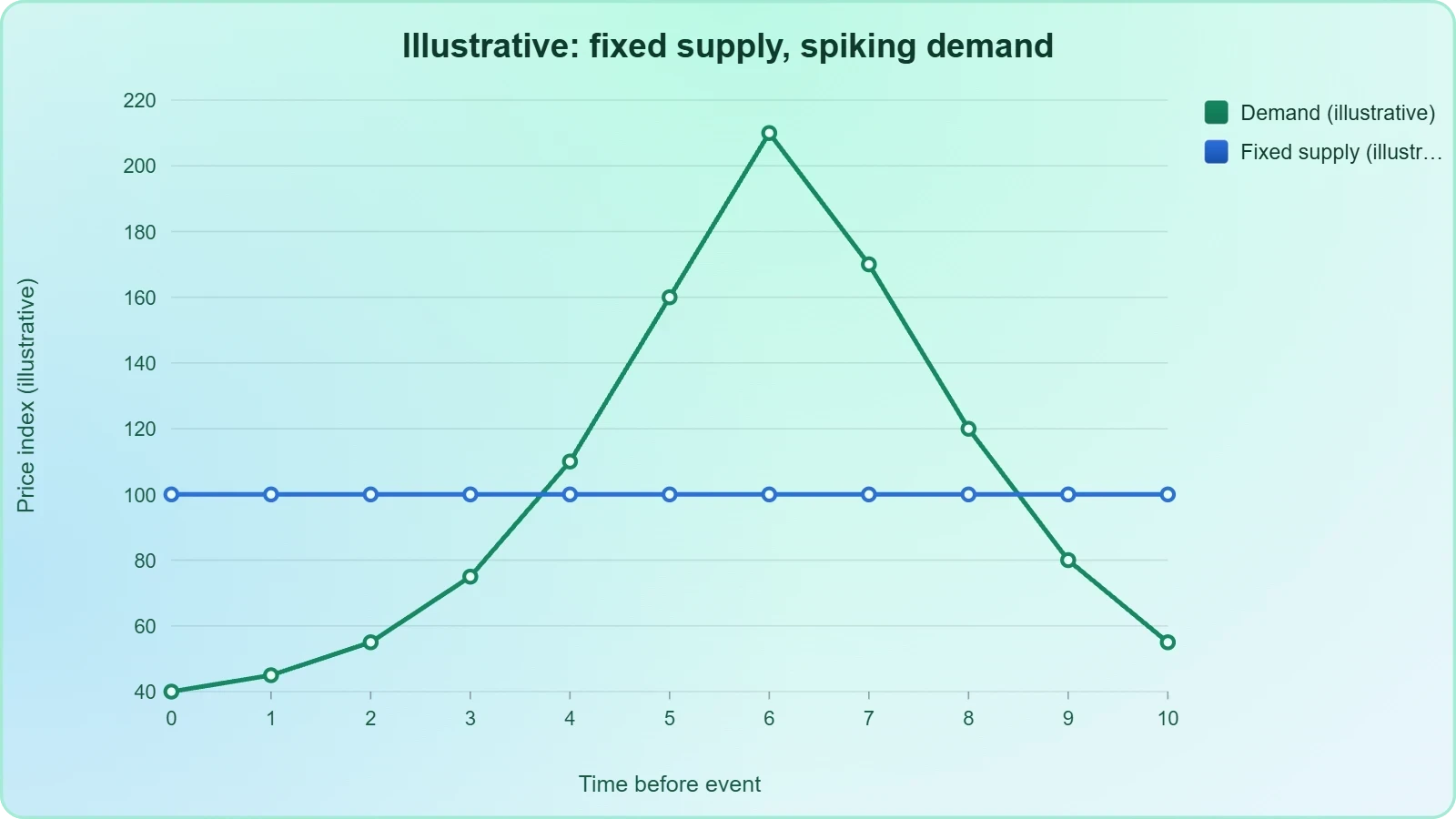
The economics are straightforward. When supply is fixed and demand spikes, a seller maximises revenue by raising prices until the marginal buyer drops out. In a transparent auction, this process is visible and arguably fair. In ticketing, it is opaque, because the buyer cannot see how many seats remain at each price tier or whether the "in demand" label reflects genuine scarcity or a pricing rule. The result is a market that functions efficiently for the seller and confusingly for everyone else.
The Coming Legislative Ban
Australian Consumer Law will change from July 2027 to prohibit dynamic pricing in certain circumstances where it unreasonably manipulates customers or distorts their decision-making. The reform represents a significant shift in how the state treats algorithmic pricing, moving from a disclosure-based model to a substantive prohibition. The precise scope of the ban will matter enormously, because the line between legitimate demand-based pricing and manipulative surcharging is not self-evident and will require regulatory guidance.
The ticketing industry will be the first test case. If the ban is drawn narrowly, companies may restructure their pricing to fit within the letter of the law while preserving the substance of the practice. If it is drawn broadly, the economics of live events could shift, with promoters absorbing more risk and consumers facing fewer price surprises. Either way, the 2026 Shonkys will be remembered as the moment the practice became politically untenable.
Virgin Australia and the Economics of Expired Credits
Virgin Australia's first Shonky award concerns a quieter but arguably more consequential harm: the retention of $75 million in expired flight credits. The airline cancelled numerous flights between April 2020 and July 2022, during the COVID-19 pandemic, and held roughly $93 million in unused credits as of February this year. Customers were required to book trips by June 30 and to fly by May 27, 2027, a timetable that many found impossible to meet given the disruption the pandemic had already caused to their finances and plans.
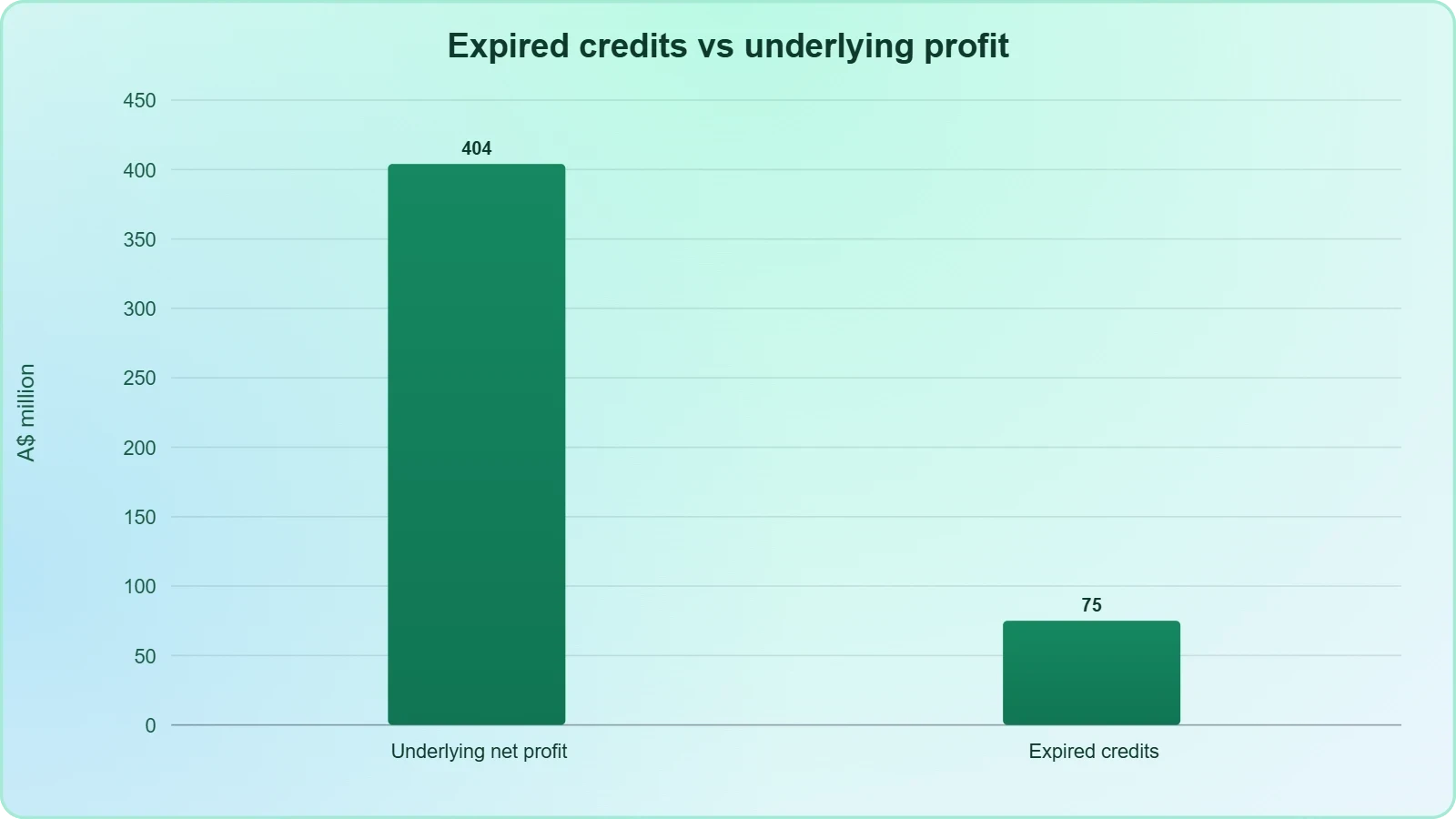
The company's 2025/26 annual report discloses that $75 million worth of expired COVID-19 credits affected its underlying net profit of $404 million. That disclosure is the crux of the Shonky citation, because it converts a customer-service failure into a line item that directly boosted reported earnings. A Virgin Australia spokesperson countered that more than 93 per cent of COVID credits were redeemed and that the airline regularly communicated the expiry date and later extended the fly-by date.
Accounting for Breakage
In accounting terms, unredeemed credits are known as breakage, and they are a recognised feature of gift cards, loyalty programmes and travel vouchers. Companies estimate breakage and recognise revenue accordingly, often treating expired balances as a windfall. The practice is lawful, but its ethics depend heavily on context. When credits arise from a global pandemic that prevented travel, the argument that customers simply failed to use what they were given becomes considerably weaker, and the windfall begins to look like a transfer of value from consumers to shareholders.
The scale matters too. A $75 million gain is not incidental to a $404 million profit; it represents nearly a fifth of the underlying result. That proportion invites questions about whether the airline's recovery was partly financed by customers who never flew. Choice's decision to name Virgin Australia reflects a judgment that the expiry regime, however well communicated, was designed to convert pandemic disruption into permanent revenue.
Consumer Expectations and the Fairness Test
Australian consumer law does not generally prohibit expiry dates on credits, but it does prohibit misleading conduct and unconscionable behaviour. The Virgin case sits in the grey zone between the two. The airline communicated the deadlines and extended them, which weakens any claim of deception. Yet the underlying structure, in which a customer who could not travel during a pandemic forfeits the money entirely, may still offend community standards of fairness, and that is the terrain on which the Shonky verdict rests.
The broader lesson concerns the difference between legality and legitimacy. A business can comply with every disclosure requirement and still behave in a way that consumers regard as unfair. The Shonkys are designed to surface that gap, and the Virgin citation suggests that pandemic-era credit schemes will remain a reputational liability for years, long after the travel restrictions that created them have faded from memory.
We Also Published
- 01
- 02
- 03
- 04
Energy Ratings, Protein Premiums and the Illusion of Choice
Hisense's first Shonky award targets a different kind of deception: the gap between a label and lived performance. The company's washer-dryer carries an 8-star energy rating, marketed as "super energy efficient," but the rating applies only to eco settings that take twelve hours to wash and thirteen hours to dry, a total of twenty-five hours per load. Choice editorial director Mark Serrels observed that the energy rating system is due for an overhaul, that almost all whitegoods manufacturers exploit it, and that the ratings are not very accurate for everyday use.
The Quest Nacho Cheese Protein Chips citation illustrates a parallel problem in food marketing. Priced at more than $20 per 100 grams, the chips cost 886 per cent more than a pack of Doritos without the protein label. The premium is justified by the protein claim, yet the underlying product is a snack food with a health halo attached. Both cases show how certification and labelling systems, originally designed to inform consumers, can be gamed to create an appearance of virtue that the product does not deliver.
When Certification Becomes Marketing
Energy rating schemes and nutrition claims share a structural vulnerability: they measure a narrow attribute under controlled conditions and then allow the resulting badge to stand in for overall quality. A washer that earns eight stars on a twenty-five-hour cycle is not an efficient appliance in any meaningful sense; it is an appliance that can be operated efficiently if the user is willing to accept a schedule that no household would tolerate. The label is accurate and misleading at the same time, which is precisely the kind of paradox the Shonkys were created to expose.
The same logic applies to protein claims on snack foods. Adding protein to a chip does not transform it into a health product, but it does allow the manufacturer to charge a substantial premium and to position the item in a different category on the shelf. Consumers who pay for the protein label are buying a narrative rather than a nutritional outcome, and the price differential of 886 per cent is a measure of how much value the narrative can carry.
The Regulatory Response to Label Gaming
Australia's energy rating system is administered under the Greenhouse and Energy Minimum Standards framework, which sets testing protocols and labelling requirements. The Hisense case suggests that the framework's reliance on eco-mode testing creates a gap between the label and typical use. Reform would require either testing under default settings or disclosing the conditions under which the rating is achieved, and both options would reduce the marketing value of a high star count.
Food labelling faces a comparable challenge. Protein claims are regulated, but the regulations govern accuracy rather than proportionality, so a product can truthfully claim a protein content that is trivial relative to its price. Closing that gap would require a different kind of rule, one that ties claims to meaningful nutritional benefit rather than mere presence. Until then, consumers will continue to pay premiums for labels that promise more than the product delivers.
Pet Insurance, Sony and the Wider Consumer Landscape
The 2026 awards also named a pet insurer and Sony, though Choice's public summary offered less detail on those citations than on the ticketing, airline and appliance cases. The inclusion is nonetheless significant, because it extends the Shonky lens into two sectors that have attracted growing consumer frustration. Pet insurance has expanded rapidly as veterinary costs have risen, and the sector's claims practices, exclusions and renewal pricing have become a recurring source of complaints to consumer bodies.
Sony's citation reflects the company's position as a gatekeeper across gaming, audio and consumer electronics. Platform holders in these markets exercise considerable control over pricing, warranty terms and digital storefronts, and that control can translate into consumer harm when it is exercised without transparency. The Shonky serves as a reminder that market power, even when lawfully acquired, carries responsibilities that are not always discharged, and that the largest players attract scrutiny precisely because their decisions affect so many people.
The Pet Insurance Problem
Pet insurance occupies an awkward position in the financial services landscape. It is not always regulated as rigorously as human health insurance, yet it performs a similar function, pooling risk against unpredictable medical costs. Consumers often discover the limits of their cover only when they claim, and the gap between expectation and payout can be substantial. The Shonky citation signals that Choice regards the sector's disclosure and claims practices as falling short of what customers reasonably expect when they pay premiums for years.
The economics of the sector explain part of the friction. Veterinary costs have climbed sharply, insurers have responded by raising premiums and tightening exclusions, and policyholders face renewal increases that are difficult to compare across providers. In that environment, the quality of disclosure becomes critical, and any insurer that obscures exclusions or delays claims will find itself on the wrong side of consumer sentiment.
Platform Power and Consumer Electronics
Sony's presence on the list highlights the growing scrutiny of platform economics. Digital storefronts, subscription services and proprietary accessories all create lock-in effects that can limit consumer choice and raise prices. When a platform holder controls both the hardware and the marketplace, it can set terms that independent retailers cannot match, and consumers may have little practical alternative but to accept them. The Shonky draws attention to that asymmetry, even if the specific grievance is narrower than the broader structural concern.
The citation also reflects a shift in consumer advocacy itself. Choice has increasingly focused on digital markets, where harm is diffuse and difficult to quantify, rather than on individual defective products. That shift is appropriate, because the most consequential consumer problems of the decade are likely to arise from algorithms, platforms and subscription models rather than from faulty toasters, and the Shonkys are adapting accordingly.
What the 2026 Shonkys Reveal About Modern Consumer Protection
The 2026 awards arrive at a transitional moment in Australian consumer law. The ban on certain dynamic pricing practices from July 2027 represents the most significant intervention in pricing transparency in years, and it follows a broader pattern of regulatory assertiveness on issues ranging from unfair contract terms to subscription traps. The Shonkys both anticipate and reinforce that shift, providing the public narrative that makes legislative action politically feasible. In that sense, the awards function as a bridge between consumer grievance and statutory reform.
Yet the deeper lesson is that regulation alone cannot close every gap. The Hisense case shows how a compliant label can mislead, the Virgin case shows how a lawful expiry date can confiscate value, and the Quest case shows how a truthful nutrition claim can justify an extraordinary premium. Each of these harms emerged from a system that was working as designed, which means that reform must address design rather than merely enforce existing rules. The Shonkys are valuable precisely because they identify where the design has failed.
The Shift Toward Outcome-Based Regulation
Regulators are increasingly moving from rules that prescribe conduct to rules that prescribe outcomes. The dynamic pricing ban is an example: rather than requiring disclosure of how prices are set, it prohibits pricing that unreasonably manipulates customers. That approach is more flexible but also more contestable, because it requires regulators and courts to define what counts as unreasonable in specific cases. The Shonkys provide a body of evidence that can inform those judgments, documenting patterns of conduct that consumers consistently experience as unfair.
The same logic applies to energy labelling and nutrition claims. Outcome-based rules would ask whether a label accurately represents typical use or meaningful benefit, rather than whether it complies with a testing protocol. That shift would be more demanding for manufacturers, but it would also be more honest, and it would reduce the incentive to design products around certification rather than around the consumer's actual needs.
Consumer Agency in an Age of Complexity
Individual consumers cannot audit pricing algorithms, verify energy ratings or compare insurance exclusions across dozens of policies. The complexity of modern markets has outpaced the capacity of individual diligence, which is why collective institutions such as Choice, regulators and the courts have become essential. The Shonkys are a reminder that consumer protection is not merely a matter of informing shoppers but of holding firms accountable when information alone cannot correct the imbalance.
That insight has implications beyond Australia. Dynamic pricing, subscription auto-renewal and health-halo marketing are global phenomena, and the regulatory responses developed in one jurisdiction tend to diffuse across others. The 2026 Shonkys may therefore be read as an early signal of how consumer law will evolve in the coming decade, with greater emphasis on outcomes, transparency and the accountability of platforms that mediate access to goods and services.
From our network :
- Committed Mediterranean Precipitation Decline: Why Emissions Cuts Alone Cannot Restore Winter RainsNew NOAA research reveals that Mediterranean winter rains may decline irreversibly even with emissions cuts. Explore the science of committed climate change and regional impacts.
- How AI Agents Will Change the Way We Manage Personal FinancesExplore how AI agents are transforming personal finance through automated budgeting, bill payment, and investment management, while examining the critical security protocols and governance frameworks required for safe deployment.
- Forbidden Matrix Patterns and Visible Lattice Points: A Geometric DictionaryExplore how multidimensional 0–1 matrices encode geometric truths, linking forbidden patterns to visible lattice points and hypergraph theory, with applications in combinatorics and computational geometry.
- University Language Proficiency Exams: Why Institutional Tests Demand Different Preparation Than IELTS and TOEFLDiscover why university-specific language proficiency examinations differ fundamentally from IELTS and TOEFL, and learn strategic preparation approaches for institutional assessment success.
- CISA’s Ten-Advisory Wave: Why Generic Patching Fails in OT and How to Build Product-Specific PlaybooksCISA released ten ICS advisories in one week, exposing critical infrastructure risks. Generic patching fails in OT. Learn to build product-specific remediation playbooks.
- The Hidden Cost of AI Convenience: Why Over-Permissioned Agents Are a Security Time BombDiscover why AI agents with excessive permissions create dangerous single points of failure, and learn how implementing least privilege principles can protect your organization from exploitation.
- Live Online English Classes for Kids: Do They Actually Reduce Anxiety?A ten-week study reveals that synchronous online English classes can significantly reduce child language anxiety while improving listening and reading skills. Discover what makes these programs effective and how parents can select the right one.
- Mobile Learning and VR in English: What Global Evidence Reveals About Effective Language TechnologyA systematic review across 14 countries reveals which language-learning technologies genuinely work. Mobile learning, AI, and VR show measurable benefits when pedagogically integrated. This evidence-based guide helps educators and learners select technology that delivers real return on investment.
- The Final Descent: How ESA Retired the Legendary Cluster Constellation After 24 Years of Space Weather ScienceAfter 24 years mapping Earth’s magnetosphere, ESA’s Cluster mission concluded with a precisely controlled reentry over the South Pacific. This analysis explores the scientific legacy, engineering decisions, and debris mitigation principles behind one of space exploration’s most responsible retirements.
RESOURCES
- Resources will be updated soon.
- 01
- 02
- 03
- 04
- 05
- 06
- 07
- 08
0 Comments