When armed drones first entered modern battlefields, they carried the promise of decisive advantage: persistent surveillance, precision strike, and the ability to reshape a fight without committing large formations. Sudan's civil war has tested that promise under conditions no laboratory or doctrine could fully anticipate. According to reporting from The New York Times, drones are indeed being flown over Sudan's contested cities and corridors, yet they have not delivered a decisive military advantage to either side. Instead, they have become one more instrument in a grinding war of attrition, where both parties wear each other down without producing a clear winner.
The finding matters far beyond Sudan's borders. It challenges a widespread assumption that technological sophistication automatically translates into battlefield dominance, and it invites a more careful reading of how drones actually function in conflicts fought between irregular forces, across urban terrain, and under severe logistical strain. The report does not specify precisely which groups operate the drones or quantify their impact, and that ambiguity is itself instructive: in messy civil wars, the line between a weapon of consequence and a weapon of noise is often blurred. What emerges is a portrait of stalemate sustained by technology rather than broken by it.
This analysis examines what the Sudanese case reveals about drone warfare, attrition, and the limits of military advantage. It considers why airpower of any kind struggles to convert tactical effects into strategic outcomes, how drones reshape the human and economic costs of prolonged fighting, and what the stalemate implies for civilians caught between armed parties. The core message is sobering but essential: a weapon can be ubiquitous, lethal, and modern without being decisive, and conflating proliferation with victory misreads both the technology and the war it inhabits.
On This Page
- The Anatomy of a Stalemate: Why Drones Have Not Decided Sudan's War
- Technology Without Decisiveness: The Wider Pattern
- Attrition, Endurance, and the Economics of Prolonged War
- The Human Dimension: Civilians Under Persistent Aerial Threat
- Reading the Stalemate: What It Signals About Modern Conflict
- Conclusion: A Weapon That Changed the Fighting Without Changing the Outcome
TL;DR Drones are being used extensively in Sudan's civil war, but reporting indicates they have not given either side a decisive military advantage. The conflict has settled into a war of attrition in which both parties exhaust each other without a clear winner, and the technology has amplified the fighting's intensity without altering its fundamental stalemate. The case illustrates a broader truth about modern warfare: proliferation of advanced systems does not guarantee strategic payoff, particularly in irregular, urbanized conflicts where logistics, manpower, and endurance matter more than novelty. Understanding this gap between capability and outcome is essential for anyone assessing military technology, conflict resolution, or the humanitarian consequences of protracted war.
The Anatomy of a Stalemate: Why Drones Have Not Decided Sudan's War
Sudan's conflict has defied the quick, decisive outcomes that planners on either side might have imagined. Drones have added a new layer of lethality and surveillance, yet the frontlines have hardened rather than collapsed. The New York Times report describes a war of attrition in which both parties are wearing each other down without a clear winner, and the drone dimension fits neatly into that pattern. Rather than serving as a war-winning instrument, drones have become part of the ambient violence of a conflict that grinds forward on manpower, supply lines, and sheer endurance.
The absence of a decisive advantage is not evidence that drones are irrelevant. It is evidence that decisiveness in war is rarely a function of any single system. Attritional conflicts reward depth—reserves of fighters, stocks of ammunition, access to revenue, and the political will to absorb losses. A drone can destroy a vehicle or a position, but it cannot occupy ground, administer a city, or reconcile a divided society. Those tasks remain stubbornly human and political, and they are precisely where Sudan's war has stalled.
What the Reporting Actually Establishes
The source material is deliberately modest in its claims. It states that drones are being used in the conflict, that they have not provided a decisive military advantage to either side, and that the situation is best described as a war of attrition. It does not identify which groups operate the drones, nor does it quantify their effects. That restraint is worth respecting: in fast-moving civil wars, attribution is difficult, and inflated claims about any weapon's impact often outrun the evidence. The honest reading is that drones are present, consequential in local engagements, and insufficient to break the deadlock.
This evidentiary caution has analytical value. It prevents us from treating a single report as a definitive verdict on drone warfare while still allowing a meaningful inference: if drones were truly decisive, the stalemate would be visibly eroding. The fact that observers continue to describe attrition suggests that whatever tactical advantages drones confer are being absorbed, countered, or offset. In that sense, the report's silence on specifics is not a gap to be filled with speculation but a signal that the strategic picture remains unresolved.
Attrition as the Dominant Logic
Attrition is often misunderstood as a failure of imagination, when in reality it is a strategy with its own grim logic. Each side calculates that the other will exhaust its fighters, money, or external support first. In such a framework, weapons are valued less for the battles they win than for the losses they impose over time. Drones fit this logic uncomfortably well: they are relatively cheap, expendable, and capable of inflicting steady casualties without risking pilots. They sustain the attritional engine rather than redirecting it toward a decision.
The consequence is a conflict that becomes self-perpetuating. Every drone strike that degrades an opponent also hardens the resolve of survivors and raises the price of compromise. Attritional wars tend to produce exactly this paradox: the more effective a weapon is at inflicting pain, the more distant a negotiated settlement can become. Sudan's stalemate is therefore not merely a military fact but a political trap, and drones, whatever their tactical utility, have done little to spring it.
We Also Published
Technology Without Decisiveness: The Wider Pattern
Sudan is not the first conflict to expose the gap between technological sophistication and strategic payoff. History is littered with weapons that were expected to transform war and instead settled into the background of prolonged slaughter. Machine guns, artillery, and airpower all promised decision at various moments and frequently delivered stalemate. The pattern suggests that decisiveness depends less on the tool than on the political and organizational conditions surrounding it. A weapon becomes decisive when one side can convert its effects into control, and control requires institutions, manpower, and legitimacy that drones cannot supply.
This is why analysts increasingly speak of the "tactical-strategic gap." Tactical effects are local, immediate, and measurable: a destroyed truck, a disrupted patrol, a suppressed position. Strategic outcomes are cumulative, political, and often intangible: the collapse of a coalition, the erosion of external support, the willingness of a population to accept a settlement. Drones excel at the former and are largely irrelevant to the latter. In Sudan, that gap has widened into a chasm, and the technology has been swallowed by the war rather than shaping it.
The Proliferation Paradox
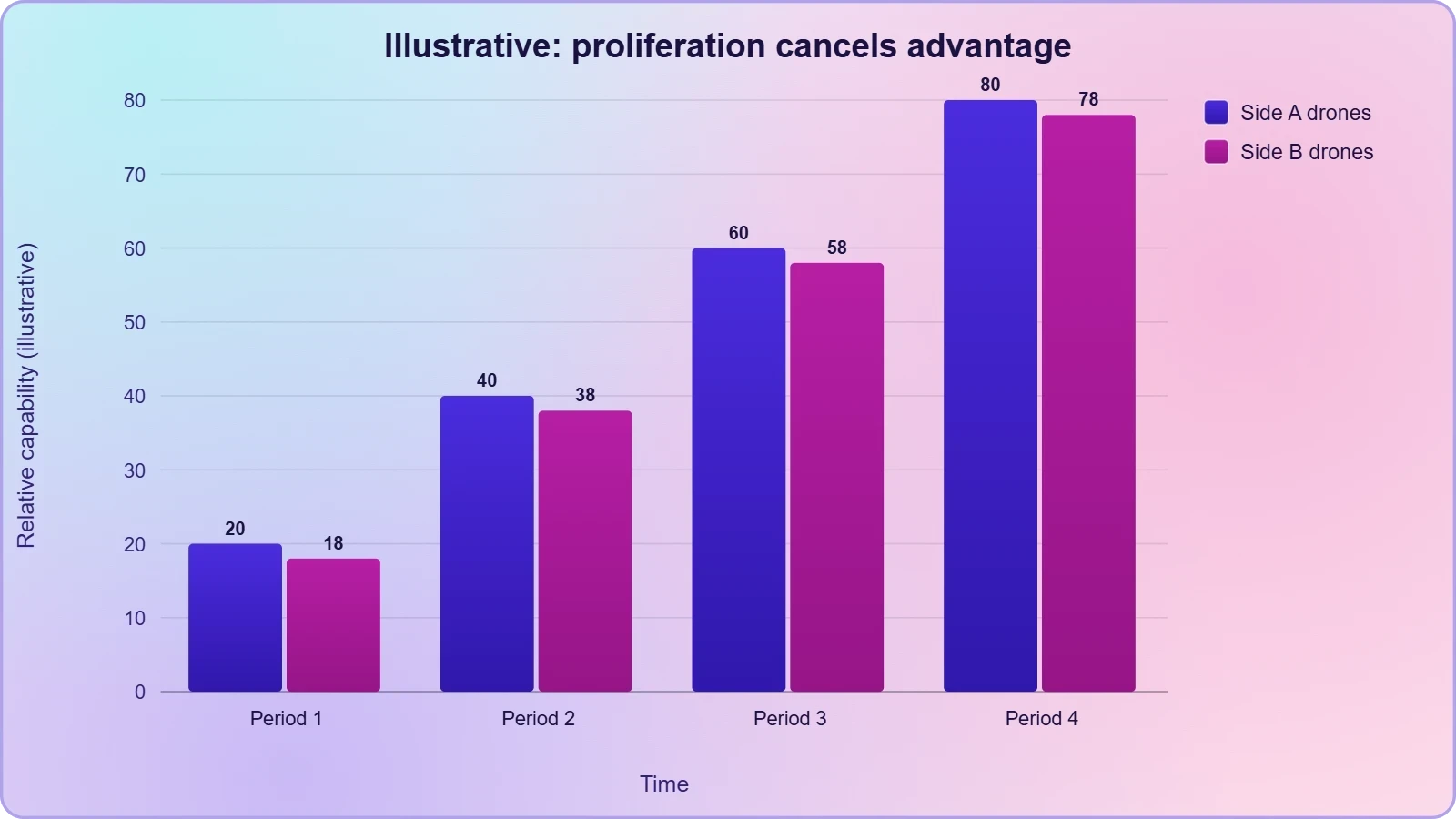
Drones have proliferated precisely because they are accessible. Commercial platforms can be modified, small armed systems can be acquired through shadowy supply chains, and operators can be trained quickly. This democratization of airpower is genuinely novel, but it carries a paradox: when everyone has drones, no one has a decisive edge. The advantage that early adopters enjoyed in conflicts such as those in Ukraine or Nagorno-Karabakh was partly a function of asymmetry—one side had them, the other did not, or one side had far better integration. In Sudan, where both parties field them, the technology cancels itself out.
The proliferation paradox also explains why drones intensify attrition without resolving it. Each side can now strike deeper, see farther, and impose costs that were previously reserved for conventional air forces. But because both sides can do this, the net effect is a higher baseline of violence rather than a shift in the balance of power. The war becomes more lethal and more expensive without becoming more decisive, and civilians bear a disproportionate share of that escalation.
Integration, Not Invention, Determines Impact
Military effectiveness is rarely about the invention of a system; it is about its integration into a coherent way of fighting. A drone that feeds targeting data into a responsive command chain, supported by logistics and intelligence, can be formidable. A drone operated in isolation, with poor maintenance and no doctrine, is little more than a noisy nuisance. The Sudanese case likely reflects uneven integration on both sides, which helps explain why the technology has not produced a breakthrough. Capability on paper and capability in the field are very different things.
Integration also depends on the human dimension: trained operators, maintainers, and commanders who understand how to use the system without overrelying on it. In conflicts where institutions are fractured, these human enablers are scarce. The result is a familiar pattern in irregular warfare, where advanced equipment is used in improvised ways that yield improvised results. Drones in Sudan appear to be employed as tactical tools of harassment and attrition rather than as components of a decisive campaign, and that employment pattern is itself a product of organizational weakness.
Attrition, Endurance, and the Economics of Prolonged War
Wars of attrition are ultimately contests of endurance, and endurance is measured in resources rather than heroism. Drones alter the economics of such contests in subtle ways. They lower the cost of inflicting casualties, which makes sustained pressure more affordable for poorer belligerents. But they also raise the cost of concentration, forcing both sides to disperse, harden, and hide. The net effect is a war that becomes cheaper to continue and harder to win, a combination that favors prolongation over decision and exhaustion over resolution.
The economic dimension extends beyond the battlefield. Protracted conflict drains state revenues, disrupts agriculture and trade, and pushes populations toward displacement and dependence on aid. Drones contribute to this dynamic by making violence persistent and pervasive, even in areas far from traditional frontlines. When any gathering can be struck and any road watched, the ordinary rhythms of economic life become hazardous. The war's cost is thus socialized across the population while its conduct remains concentrated among armed actors.
Cheap Weapons, Expensive Wars
The cheapness of drones is often cited as a democratizing feature, but cheap weapons can produce expensive wars. A system that costs a few thousand dollars can destroy an asset worth many times more, and the asymmetry of cost favors the attacker. Defenders must invest in countermeasures—jamming, camouflage, dispersal, hardened shelters—that are themselves costly and imperfect. Over time, the cumulative burden of defense can exceed the cost of offense, trapping both sides in an arms race they can ill afford. Sudan's stalemate reflects this trap in miniature.
There is also a human economy at work. Drones reduce the political cost of casualties for the side operating them, since operators are remote and losses are machines rather than people. That reduction can make leaders more willing to accept prolonged violence, because the domestic price of continuing the war is lower than it would be with manned aircraft. The technology thus insulates decision-makers from the consequences of their choices, which is precisely the opposite of what accountability requires.
Endurance and the Limits of Exhaustion
Attritional wars end when one side can no longer endure, and endurance is shaped by factors that drones barely touch: access to revenue, external patronage, the cohesion of fighting forces, and the patience of civilians. In Sudan, these factors have proven resilient enough to sustain the conflict despite its costs. Drones may accelerate exhaustion at the margins, but they do not determine who exhausts first. That determination rests on political economy and organization, domains where technology is a tool rather than a cause.
The limits of exhaustion also explain why stalemates can persist for years. Each side believes the other is closer to collapse than it actually is, and each interprets the other's suffering as evidence that one more push will succeed. Drones feed this illusion by delivering vivid, immediate evidence of damage inflicted, which can be mistaken for progress toward victory. The result is a conflict that continues because both sides misread the same signals, and the technology amplifies the misreading rather than correcting it.
- 01
- 02
- 03
- 04
The Human Dimension: Civilians Under Persistent Aerial Threat
Behind every strategic abstraction lies a human reality, and in Sudan that reality is defined by fear from above. The New York Times reporting links the drone campaign to civilians, particularly in urban areas such as Nyala, where the presence of armed drones transforms daily life. Markets, hospitals, and transport routes become potential targets, and the psychological toll of constant surveillance and sudden strike is profound. For civilians, the question is not whether drones are decisive but whether they are survivable, and the answer is often uncertain.
The humanitarian consequences compound the military stalemate. When neither side can win, the war's burden is transferred to those who cannot fight, and drones make that transfer more efficient. Displacement accelerates, livelihoods collapse, and access for aid agencies becomes more dangerous. The technology that was supposed to bring clarity to the battlefield instead brings a diffuse and persistent threat to the home, the school, and the clinic. That is a form of decisiveness, but it is decisiveness against the wrong target.
Urban Terrain and the Vulnerability of Density
Cities concentrate people, infrastructure, and economic activity, which makes them both the prize of conflict and its most vulnerable terrain. Drones are well suited to operating over dense urban areas, where they can observe and strike with limited exposure to ground fire. The result is a form of siege conducted from the air, in which the mere presence of drones can restrict movement and commerce. In places like Nyala, the threat is not only the strike itself but the anticipation of it, which reshapes behavior and erodes normal life.
Urban drone warfare also blurs the distinction between combatants and civilians. In dense environments, targeting is difficult, collateral damage is likely, and the psychological effects radiate far beyond any actual strike. The law of armed conflict demands distinction and proportionality, but the practical application of those principles under persistent aerial threat is fraught. When every rooftop could conceal an operator and every street could be watched, civilians live in a state of suspended vulnerability that no doctrine fully addresses.
Displacement, Aid, and the Cost of Indecision
Stalemate is not a neutral condition for civilians; it is an active harm. Prolonged fighting displaces families repeatedly, strips assets, and interrupts education and health care. Aid agencies face access constraints that drones exacerbate, since convoys and distribution points can be observed and targeted. The humanitarian system is designed for acute crises and transitions, not for indefinite attrition, and it strains under the weight of a war that neither ends nor stabilizes. The cost of indecision is thus paid in lives and futures, not merely in territory.
There is also a moral dimension to the technology's role. When a weapon is used extensively but changes little, it can still inflict enormous suffering, and the absence of strategic effect is no consolation to those harmed. The international community's attention tends to follow decisive events, which means attritional wars can become invisible even as they remain lethal. Sudan's civilians are caught in precisely this blind spot, and the drone dimension, however inconclusive strategically, is deeply consequential for them.
Reading the Stalemate: What It Signals About Modern Conflict
Sudan's experience offers a corrective to the technological optimism that has shaped much recent defense thinking. The assumption that advanced systems will deliver quick, clean victories has been repeatedly tested and repeatedly found wanting. What matters more is the interaction between technology, organization, and politics, and in Sudan that interaction has produced a draw. The stalemate is not an anomaly to be explained away but a representative outcome of a certain kind of war, one fought by fragmented forces in contested terrain with external patrons and limited institutional capacity.
This reading has implications for how analysts, policymakers, and observers should interpret similar conflicts elsewhere. Claims that a particular weapon will "change the game" deserve skepticism, especially when the underlying political conditions favor prolongation. The more useful question is not whether a system is advanced but whether it is integrated into a strategy capable of converting effects into outcomes. In Sudan, the answer appears to be no, and the result is a war that continues because neither side can translate its tools into a decision.
Implications for Doctrine and Procurement
For militaries and defense planners, the Sudanese case argues for humility in procurement and realism in doctrine. Buying advanced systems without the command, logistics, and intelligence architecture to support them is a recipe for expensive stalemate. The lesson is not that drones are useless but that they are enablers whose value depends on the system around them. Forces that invest in integration, training, and counter-drone capability will extract more from the same technology than forces that treat acquisition as an end in itself.
There is also a counter-drone dimension that deserves attention. If drones proliferate and cancel each other out, the side that can deny the other's drones may gain an edge. Electronic warfare, improved air defense, and passive measures such as dispersal and camouflage become as important as the drones themselves. The next phase of this competition is likely to be about resilience and denial rather than raw capability, and the conflicts that resolve will be those where one side masters that competition while the other does not.
Implications for Diplomacy and Peacemaking
Stalemates are often described as ripe for negotiation, but attritional wars can also be resistant to diplomacy. When both sides believe they can outlast the other, the incentive to compromise weakens, and the presence of drones can reinforce that belief by providing a steady stream of apparent progress. Mediators therefore face a paradox: the very violence that makes the war costly also makes it seem winnable. Breaking that perception requires credible pressure and credible guarantees, neither of which technology can supply.
The international community's role is complicated by the diffusion of drone technology. Suppliers are numerous, attribution is difficult, and the tools are easy to transfer, which makes arms control and accountability harder to enforce. Any serious effort to reduce the harm of such conflicts must grapple with this diffusion, not merely with the conduct of the belligerents. Sudan's stalemate is thus a local tragedy with global causes, and its resolution will require attention to the networks that sustain the fighting as much as to the frontlines themselves.
Conclusion: A Weapon That Changed the Fighting Without Changing the Outcome
The Sudanese case resists easy conclusions, which is precisely why it deserves attention. Drones are present, lethal, and consequential at the tactical level, yet they have not delivered a decisive military advantage to either side. The war remains an attritional struggle in which both parties wear each other down without a clear winner. That outcome is not a failure of the technology in any simple sense; it is a demonstration that technology operates within political and organizational constraints that determine whether its effects compound into something decisive.
The broader lesson is about expectations. Advanced weapons are often marketed as solutions to strategic problems, but they are better understood as amplifiers of existing conditions. In a fragmented, urbanized, externally supported civil war, drones amplify attrition, prolong suffering, and complicate diplomacy. They do not resolve the underlying contest. Recognizing this does not diminish the importance of the technology; it clarifies where attention should go, toward integration, countermeasures, political settlement, and the protection of civilians who bear the cost of indecision.
For observers of global conflict, Sudan offers a caution against equating proliferation with progress. The spread of drones is real and consequential, but its strategic meaning depends on context. Where institutions are weak and wars are fragmented, the likely result is more stalemate, not less. The task for analysts and policymakers is to see that pattern clearly, to resist the allure of technological shortcuts, and to focus on the human and political dimensions that ultimately determine whether wars end. Drones may shape how Sudan fights, but they will not decide how it ends.
From our network :
- Mobile Learning and VR in English: What Global Evidence Reveals About Effective Language TechnologyA systematic review across 14 countries reveals which language-learning technologies genuinely work. Mobile learning, AI, and VR show measurable benefits when pedagogically integrated. This evidence-based guide helps educators and learners select technology that delivers real return on investment.
- CISA’s Ten-Advisory Wave: Why Generic Patching Fails in OT and How to Build Product-Specific PlaybooksCISA released ten ICS advisories in one week, exposing critical infrastructure risks. Generic patching fails in OT. Learn to build product-specific remediation playbooks.
- Live Online English Classes for Kids: Do They Actually Reduce Anxiety?A ten-week study reveals that synchronous online English classes can significantly reduce child language anxiety while improving listening and reading skills. Discover what makes these programs effective and how parents can select the right one.
- How AI Agents Will Change the Way We Manage Personal FinancesExplore how AI agents are transforming personal finance through automated budgeting, bill payment, and investment management, while examining the critical security protocols and governance frameworks required for safe deployment.
- Forbidden Matrix Patterns and Visible Lattice Points: A Geometric DictionaryExplore how multidimensional 0–1 matrices encode geometric truths, linking forbidden patterns to visible lattice points and hypergraph theory, with applications in combinatorics and computational geometry.
- Committed Mediterranean Precipitation Decline: Why Emissions Cuts Alone Cannot Restore Winter RainsNew NOAA research reveals that Mediterranean winter rains may decline irreversibly even with emissions cuts. Explore the science of committed climate change and regional impacts.
- University Language Proficiency Exams: Why Institutional Tests Demand Different Preparation Than IELTS and TOEFLDiscover why university-specific language proficiency examinations differ fundamentally from IELTS and TOEFL, and learn strategic preparation approaches for institutional assessment success.
- The Final Descent: How ESA Retired the Legendary Cluster Constellation After 24 Years of Space Weather ScienceAfter 24 years mapping Earth’s magnetosphere, ESA’s Cluster mission concluded with a precisely controlled reentry over the South Pacific. This analysis explores the scientific legacy, engineering decisions, and debris mitigation principles behind one of space exploration’s most responsible retirements.
- The Hidden Cost of AI Convenience: Why Over-Permissioned Agents Are a Security Time BombDiscover why AI agents with excessive permissions create dangerous single points of failure, and learn how implementing least privilege principles can protect your organization from exploitation.
RESOURCES
- Sudan war evolving into a proxy conflict fueled by gold - GIS Reportsgisreportsonline.comMay 7, 2026 ... ... war of attrition. The United Arab Emirates serves as the ... stalemate of 2025 will become the permanent disintegration…
- Minding the drone gap: Drone warfare and the EUiss.europa.euOct 11, 2024 ... Gressel, G., 'Beyond the counter-offensive: Attrition, stalemate, and the future of the war in Ukraine', Policy Brief, ECFR, January 2024,…
- Can the RSF seize El Obeid? - ACLEDacleddata.com“The military situation in El Obeid, North Kordofan, is defined by a strategic stalemate ... Amieth Market drone strikes: The first attack since Sudan's…
- Drone Warfare Escalation and Systemic Collapse of Civilian ...africansecurityanalysis.comFrom Civil War to Regionalized Attrition Conflict with Expanding Technological Warfare. EXECUTIVE ASSESSMENT. As of late March 2025, Sudan's conflict has ...
- Where is Sudan's frontline moving next? - ACLEDacleddata.com“Meanwhile, in El Obeid, RSF drone strikes on the city have sharply declined — falling to just two airstrikes reaching their targets, on 1…
- How foreign-backed drones are fueling atrocities in Sudan and ...arabnews.jpFeb 25, 2026 ... Drone strikes have caused damage across Sudan. (Reuters/File) ... war of attrition, a stalemate.” As the Janjaweed militia, “(some) 20 ...
- How Will The Masters Of War Divide Sudan's Cake? - Worldcrunchworldcrunch.comJun 7, 2024 ... Sudanese civilians are the main victims of this stalemate. Strategies of attrition include striking social incubators. The RSF attacked Arab ...
- Divided Sudan, Elusive Peace | International Crisis Groupcrisisgroup.orgApr 13, 2026 ... It also stepped up drone and artillery strikes, including on ... war of attrition. The sharp discord between Saudi Arabia…
- Conflict in Yemen and the Red Sea | Global Conflict Trackercfr.orgYemeni Government and Houthi Forces Exchange Strikes Around Taiz. November 1, 2026. Houthi forces conducted a drone strike on a family's home in Taiz,…
- How Ankara and Riyadh Are Engineering Sudan's Collapsemeforum.orgDec 13, 2025 ... Sudan Has Ceased to Be a Sovereign State at War with Itself and Has Become a Battlespace for Competing Regional…
- The state of Russia's war on Ukraine as it nears 2024 - Atlantic Councilatlanticcouncil.orgOct 16, 2023 ... ... war as a stalemate are misleading. We are currently witnessing a period of intense attrition, but this may well…
- A Diplomatic Option To Avoid Endless War In Ukraine - NOEMAnoemamag.comDec 5, 2022 ... But such a time may come if and when a stalemate ensues or a prolonged war of attrition commences. ...…
- International Schemes, Libyan Realitiesswp-berlin.orgNov 25, 2019 ... Major advances by Haftar would likely prompt renewed mobilisation. War of Attrition. As the stalemate persists, each side hopes that…
- Video Commentary | Royal United Services Institute - RUSIrusi.orgFour Years After Russia's Invasion of Ukraine: Can the Stalemate be Broken? Video Commentary. Sanctions: A War of Attrition Between Russia and The West.…
- North Africa Weekly: June 24, 2026 - Stimson Centerstimson.orgJun 24, 2026 ... UN official says drone strikes kill over 1,000 civilians in Sudan this year ... war of attrition between the SAF…
- 01
- 02
- 03
- 04
- 05
- 06
- 07
- 08
0 Comments