October 2026 delivered a measured but meaningful reprieve for fixed-income investors across the Arabian Peninsula, as Gulf bond and sukuk markets clawed back ground lost during a punishing stretch of rising global yields. The catalyst was unmistakably external: a sharp retreat in developed-market government bond yields, led by the United States, where the ten-year Treasury yield fell 35.7 basis points to 4.93 percent and the thirty-year yield dropped 32.1 basis points to 5.31 percent. That easing in the world's benchmark risk-free curve rippled swiftly through the Gulf Cooperation Council's dollar-denominated debt complex, lifting valuations across sovereign, corporate, conventional and Sharia-compliant instruments alike.
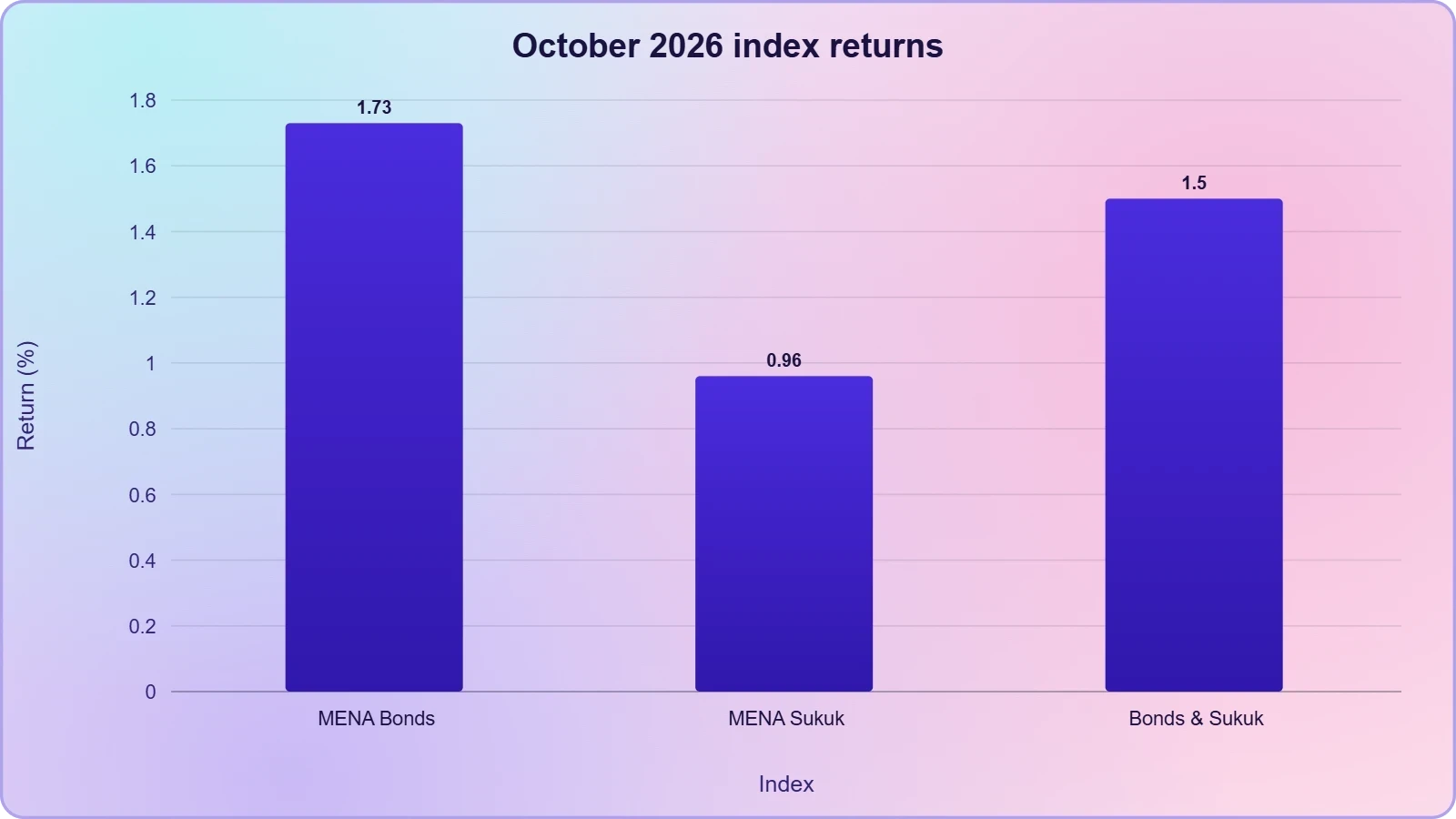
The numbers tell a story of broad, if uneven, recovery. The MENA Bonds Index advanced 1.73 percent during the month, the MENA Sukuk Index added 0.96 percent, and the combined MENA Bonds & Sukuk Index rose 1.5 percent, according to analysis attributed to Kamco Invest. The GCC Credit + HY Index gained 1.24 percent, tracking closely the 1.26 percent rise in the Emerging Markets USD Agg Index, a reminder that Gulf credit remains tightly correlated with the broader emerging-market complex. Yet the year-to-date picture remains sobering: MENA Bonds were still down 2.58 percent and GCC Credit + HY down 2.19 percent, underscoring that a single month of relief does not erase a difficult annual trajectory.
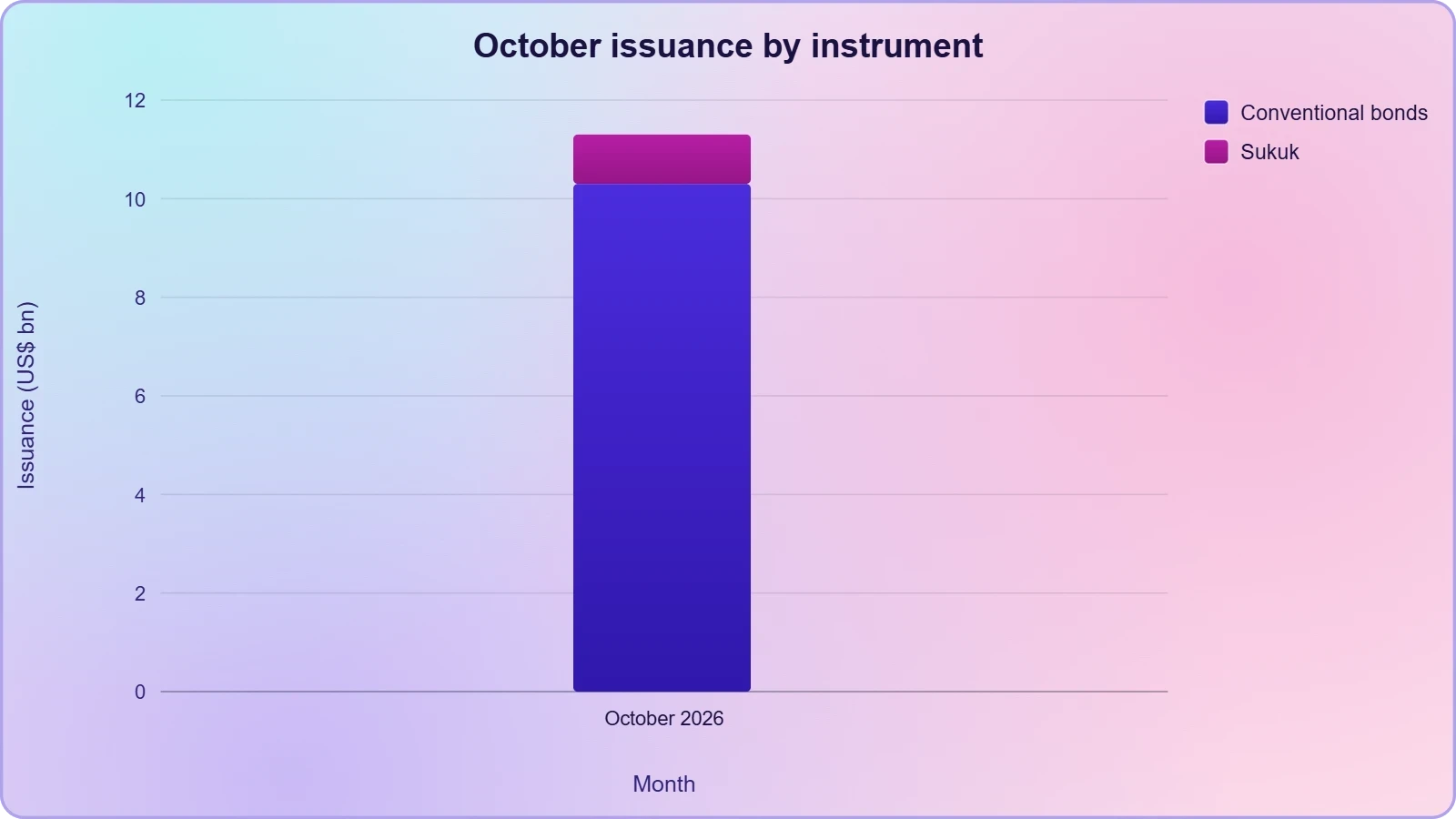
Beneath the headline index moves lies a more textured narrative about issuance, maturity profiles and regional concentration. New GCC bond and sukuk issuance with maturities exceeding one year totaled roughly $11.3 billion in October, a 33.5 percent decline from September's $17 billion but comfortably above August's $7.3 billion. Conventional bonds dominated, accounting for about $10.3 billion, or more than 90 percent of the total, while sukuk activity fell sharply after an exceptionally strong September. The overall GCC debt capital market surpassed $1.2 trillion at the end of the third quarter of 2026, with Saudi Arabia commanding 48 percent of outstanding debt, the UAE 27 percent and Qatar 12 percent.
On This Page
- The Macro Backdrop: Why Falling US Yields Lifted Gulf Debt
- Issuance Dynamics: A September Surge, an October Cool-Down
- The $1.2 Trillion Debt Capital Market: Concentration and Scale
- Sukuk Outlook: Moody's Projections and Regional Headwinds
- Year-to-Date Reality Check: Recovery Within a Downtrend
- Strategic Implications for Issuers and Investors
- Conclusion: A Rally Worth Contextualizing
TL;DR Gulf bond and sukuk markets recovered in October 2026 as falling US Treasury yields eased pressure across the GCC fixed-income complex. The MENA Bonds Index rose 1.73 percent, the MENA Sukuk Index gained 0.96 percent, and the combined benchmark added 1.5 percent, though year-to-date returns remained negative. New GCC issuance of roughly $11.3 billion was down sharply from September but above August levels, with conventional bonds exceeding 90 percent of the total. The GCC debt capital market now exceeds $1.2 trillion, dominated by Saudi Arabia, the UAE and Qatar, while Moody's projects sukuk issuance of $140–150 billion for the second half of 2026.
The Macro Backdrop: Why Falling US Yields Lifted Gulf Debt
The October rebound in Gulf fixed income was not a story of regional fundamentals suddenly improving; it was a story of external financial conditions loosening. When the yield on the ten-year US Treasury note falls by more than 35 basis points in a single month, the entire architecture of global credit pricing shifts. Dollar-denominated Gulf bonds, which compete directly with US Treasuries for the attention of international asset allocators, become more attractive as the spread between their yields and the risk-free benchmark widens in relative terms. That mechanical relationship explains why the GCC Credit + HY Index's 1.24 percent gain so closely mirrored the 1.26 percent advance in the Emerging Markets USD Agg Index.
Kamco Invest framed the improvement explicitly in these terms, noting that the decline in government bond yields across major developed markets supported a broad rebound across GCC and MENA fixed-income benchmarks. The transmission mechanism is well understood by fixed-income professionals: duration-sensitive assets benefit disproportionately when benchmark yields fall, and Gulf sovereign curves carry meaningful duration. The thirty-year Treasury's 32.1 basis point decline to 5.31 percent was particularly consequential for long-dated Gulf sovereigns and for the sukuk structures that often carry extended maturities. Investors who had spent much of 2026 watching mark-to-market losses accumulate suddenly found their positions recovering value.
The Treasury Yield Transmission Channel
The relationship between US Treasury yields and Gulf dollar debt deserves closer scrutiny because it governs so much of the region's cost of capital. Gulf sovereigns and corporates issue predominantly in dollars, meaning their bonds are priced off the US curve plus a credit spread. When the risk-free component compresses, the total yield offered to investors falls, and existing bonds with higher coupons appreciate in price. This is straightforward duration mathematics, but its practical implications are profound for issuers planning new deals and for portfolio managers benchmarking against emerging-market indices. The October move was large enough to register across every duration bucket.
What makes the Gulf case distinctive is the region's currency architecture. Most GCC currencies are pegged to the dollar, which means local monetary policy broadly tracks the Federal Reserve and local investors have limited currency-hedging friction when holding dollar assets. This peg structure amplifies the pass-through from US yields to Gulf fixed income, making the region unusually sensitive to shifts in American monetary conditions. When Treasury yields fall, Gulf bonds rally with a velocity that often surprises investors accustomed to more insulated markets. October's 1.5 percent combined index gain is a direct expression of that structural linkage.
Emerging-Market Correlation and Contagion
The near-identical performance of the GCC Credit + HY Index and the Emerging Markets USD Agg Index is not coincidental. Gulf credit has become deeply integrated into the global emerging-market debt universe, and the same global risk appetite that lifts Brazilian, Indonesian or Mexican dollar bonds tends to lift Gulf paper. When developed-market yields fall and the dollar softens, emerging-market debt broadly benefits, and the Gulf rides that wave. The 1.24 percent versus 1.26 percent comparison illustrates how tightly the region's fortunes are now bound to the wider EM complex rather than to idiosyncratic regional factors.
This correlation cuts both ways, however. The year-to-date losses of 2.58 percent for MENA Bonds and 2.19 percent for GCC Credit + HY reflect the same global forces that produced the October rebound, simply in reverse. Earlier in 2026, rising yields and a stronger dollar would have pressured Gulf valuations, and the region's heavy issuance calendar added supply-side technicals to the mix. Understanding this dual exposure, to US rates and to EM risk sentiment, is essential for anyone assessing Gulf fixed income as an asset class rather than as a collection of individual credits.
Issuance Dynamics: A September Surge, an October Cool-Down
The primary market told a more volatile story than the secondary market in October. Total GCC bond and sukuk issuance with maturities exceeding one year reached approximately $11.3 billion, a figure that sits awkwardly between two very different months. September's $17 billion represented a surge of activity, while August's $7.3 billion reflected a quieter summer. October's 33.5 percent month-on-month decline is therefore best read as normalization after an unusually busy September rather than as a signal of deteriorating issuer confidence. The absolute level remained healthy by historical standards, and the composition revealed important structural preferences among Gulf issuers.
Conventional bonds dominated the October calendar, accounting for roughly $10.3 billion, or more than 90 percent of total issuance. This overwhelming preference for conventional structures reflects several factors: the depth and liquidity of the conventional dollar market, the speed with which issuers can execute large benchmark deals, and the pricing advantage that conventional bonds often command over sukuk for comparable credits. Government bond issuance contributed about $3.7 billion, while corporate bond issuance was $6.5 billion, indicating that the private sector and government-related entities remained active participants in the capital markets even as sovereigns moderated their pace.
The Sukuk Slowdown After a Blockbuster September
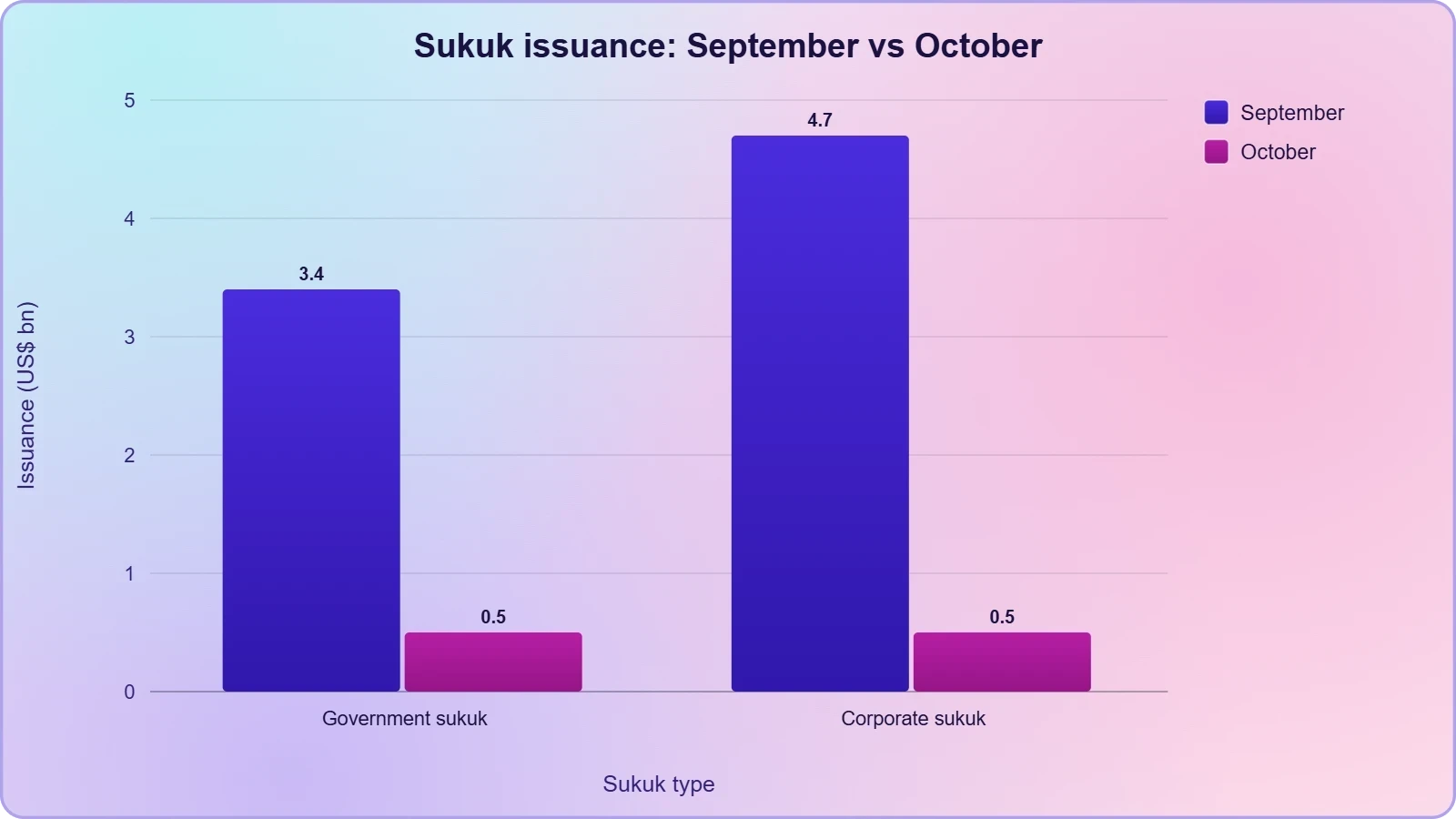
The sukuk market's October retreat was dramatic by any measure. Government sukuk issuance fell to about $500 million from $3.4 billion in September, while corporate sukuk issuance dropped to $500 million from $4.7 billion. Combined, sukuk activity collapsed from roughly $8.1 billion to $1 billion, a decline of nearly 88 percent. Such volatility is characteristic of the Islamic finance market, where issuance is lumpy and driven by a relatively small number of large sovereign and quasi-sovereign deals. A single major Saudi or Emirati sukuk can swing monthly totals dramatically, so October's weakness should be interpreted with caution rather than as evidence of structural decline.
Nevertheless, the sukuk slowdown raises questions about pipeline timing and investor demand. September's surge may have pulled forward issuance that would otherwise have occurred in October, leaving a vacuum. Alternatively, issuers may have chosen to wait for more favorable pricing conditions or to align deals with specific funding needs. Moody's expects sukuk issuance to recover gradually in the second half of 2026, projecting volumes of $140 billion to $150 billion, though the agency acknowledged that conflicts in the region weighed on activity in several key markets. That geopolitical caveat is important: sukuk issuance is particularly sensitive to perceived stability in the Middle East.
Why Conventional Bonds Dominated the Calendar
The overwhelming preference for conventional bonds in October reflects the practical realities of global capital markets. Conventional dollar bonds offer issuers access to the deepest, most liquid investor base in the world, allowing large benchmark deals to be priced efficiently and traded actively in secondary markets. For Gulf sovereigns and corporates with substantial funding requirements, this liquidity premium is difficult to ignore. Sukuk, while growing rapidly and attracting a dedicated pool of Islamic investors, still operates within a narrower market with fewer participants and less secondary-market depth.
There is also a pricing dimension. Conventional bonds often price tighter than comparable sukuk because the investor base is broader and the structuring is simpler. Issuers seeking to minimize their cost of funding will therefore favor conventional structures unless they have specific reasons, such as diversifying their investor base or catering to Sharia-compliant demand, to issue sukuk. October's 90-plus percent conventional share is an extreme reading, but it illustrates the default preference that governs most Gulf issuance decisions. The sukuk market's growth trajectory remains intact, but its month-to-month rhythm will continue to be uneven.
We Also Published
The $1.2 Trillion Debt Capital Market: Concentration and Scale
The GCC debt capital market's passage beyond $1.2 trillion at the end of the third quarter of 2026 marks a significant milestone for a region that barely registered on global fixed-income maps two decades ago. Citing Fitch data, Kamco Invest reported this figure alongside a striking concentration profile: Saudi Arabia accounts for 48 percent of outstanding debt, the UAE for 27 percent and Qatar for 12 percent. Together, these three issuers represent 87 percent of the entire market, leaving the remaining GCC members, Bahrain, Kuwait and Oman, with a combined 13 percent share. This concentration has profound implications for diversification and risk assessment.
Saudi Arabia's dominance reflects both the scale of its sovereign borrowing program and the depth of its corporate and quasi-sovereign issuance. Vision 2030's ambitious investment agenda has required substantial external funding, and the Kingdom has become one of the most prolific emerging-market issuers globally. The UAE's 27 percent share reflects Dubai's established role as a financial hub and Abu Dhabi's substantial sovereign wealth-backed issuance. Qatar's 12 percent, while smaller, represents a remarkable concentration given the country's population, reflecting its liquefied natural gas revenues and its need to fund diversification away from hydrocarbons.
Concentration Risk for Index Investors
For portfolio managers benchmarked against MENA or GCC fixed-income indices, this concentration is a defining feature of the asset class. A passive allocation to Gulf debt is, in practice, a large bet on Saudi Arabia and the UAE, with Qatar providing a meaningful but secondary exposure. This has implications for risk budgeting: idiosyncratic Saudi fiscal or political developments can move the entire index, and diversification benefits within the region are limited. Investors seeking genuine diversification must either supplement Gulf exposure with other emerging markets or adopt active strategies that deliberately underweight the dominant issuers.
The concentration also shapes liquidity dynamics. Saudi and UAE bonds trade most actively, enjoy the tightest bid-ask spreads and attract the broadest investor base. Bahraini, Kuwaiti and Omani paper, by contrast, trades less frequently and may require larger liquidity premiums. For issuers in the smaller GCC markets, this creates a structural funding disadvantage: they must offer higher yields to compensate investors for reduced liquidity and perceived risk. The market's tiered structure is therefore self-reinforcing, with the largest issuers enjoying the lowest funding costs and the smallest paying the most.
Vision 2030 and the Saudi Issuance Engine
Saudi Arabia's 48 percent share of GCC outstanding debt is inseparable from the Kingdom's economic transformation agenda. Vision 2030's giga-projects, including NEOM, the Red Sea development and Qiddiya, require capital expenditures measured in hundreds of billions of dollars, and the sovereign has tapped international bond markets repeatedly to fund them. This issuance has been supplemented by substantial borrowing from domestic banks and by drawdowns from the Public Investment Fund, but external debt remains a critical financing pillar. The Kingdom's willingness to issue at scale has made it the anchor of the Gulf fixed-income market.
This dependence on external funding creates a two-way relationship with global bond markets. When US yields fall, as they did in October, Saudi issuance becomes cheaper and the sovereign may accelerate its borrowing calendar. When yields rise, the cost of funding Vision 2030 increases, potentially forcing the Kingdom to adjust spending plans or seek alternative financing sources. The October yield decline therefore had a dual benefit for Riyadh: it lifted the mark-to-market value of existing debt and improved the economics of future issuance. That alignment of secondary-market gains and primary-market opportunity is a recurring feature of the Gulf's relationship with global rates.
- 01
- 02
- 03
- 04
Sukuk Outlook: Moody's Projections and Regional Headwinds
Moody's expectation that sukuk issuance will recover gradually in the second half of 2026, with volumes likely to range between $140 billion and $150 billion, offers a constructive medium-term view of the Islamic finance market. The projection implies that October's slowdown is a temporary interruption rather than a structural reversal. Several factors support this optimism: the growing pool of Sharia-compliant savings globally, the increasing familiarity of international investors with sukuk structures, and the commitment of Gulf sovereigns to maintaining a regular sukuk presence as part of their funding mix.
Yet the rating agency's caveat that conflicts in the region weighed on activity in several key markets cannot be dismissed. Geopolitical risk is a persistent feature of Middle Eastern finance, and sukuk issuance is particularly sensitive to perceived instability because Islamic investors often have longer time horizons and greater sensitivity to reputational and ethical considerations. When conflict escalates, issuers may postpone deals and investors may demand higher risk premiums, creating a self-reinforcing slowdown. The gap between Moody's $140–150 billion projection and October's depressed volumes illustrates the uncertainty embedded in any sukuk forecast.
Geopolitical Risk as a Structural Variable
The Middle East's geopolitical landscape has always been a factor in fixed-income pricing, but its influence on sukuk issuance is particularly pronounced. Conflicts in the region affect investor sentiment, raise risk premiums and can delay or derail planned deals. For issuers, the calculus involves weighing the urgency of funding needs against the cost of issuing into a risk-averse market. For investors, geopolitical risk creates both danger and opportunity: periods of elevated tension may offer attractive entry points for long-term holders willing to look through short-term volatility, but they also carry the risk of prolonged disruption.
The October data captures this tension neatly. Despite the geopolitical backdrop, Gulf issuers still brought $11.3 billion of new paper to market, demonstrating that capital markets remained open and functional. The sukuk segment's sharp decline may partly reflect geopolitical caution, but it also reflects the lumpiness of a market dominated by a few large deals. Distinguishing between these explanations requires careful attention to pipeline announcements and issuer guidance in the coming months. The recovery Moody's anticipates will depend on both improved sentiment and a resumption of the large sovereign and corporate deals that drive sukuk volumes.
Year-to-Date Reality Check: Recovery Within a Downtrend
The most important context for interpreting October's gains is the year-to-date picture. MENA Bonds remained down 2.58 percent and GCC Credit + HY down 2.19 percent through October, meaning the month's rally recovered only a fraction of earlier losses. For investors who entered 2026 with Gulf fixed-income allocations, the year has been a lesson in duration risk and the power of global rate movements. The October rebound is welcome, but it does not change the fundamental narrative of a challenging year for emerging-market and Gulf debt.
This pattern, a strong month within a weak year, is characteristic of fixed-income markets during periods of rate volatility. Bond returns are driven by the interaction of carry, duration and spread movements, and when benchmark yields rise sharply, duration losses can overwhelm the income component. The October yield decline provided duration gains that offset some of the earlier pain, but the year-to-date figures confirm that the overall direction of rates has been upward. Investors must therefore distinguish between tactical rallies and strategic trends when assessing Gulf fixed income.
Duration, Carry and the Investor's Dilemma
For fixed-income investors, the Gulf's October experience illustrates the classic duration-versus-carry trade-off. Gulf bonds offer attractive carry, with yields well above those available in developed markets, but they also carry significant duration risk because of their sensitivity to US rates. In a falling-rate environment, duration works in the investor's favor, amplifying returns. In a rising-rate environment, it becomes a liability. The year-to-date figures suggest that duration has been the dominant force in 2026, overwhelming the positive contribution from carry.
This dilemma has practical implications for portfolio construction. Investors seeking to reduce duration risk can shift toward shorter-maturity Gulf bonds or floating-rate instruments, sacrificing yield for stability. Those with a longer time horizon may choose to maintain duration exposure, accepting volatility in exchange for higher income and the potential for capital appreciation when rates eventually decline. The October rally rewarded the latter approach, but the year-to-date losses remind investors that timing such calls is difficult. A balanced approach, blending duration exposure with shorter-dated carry, may offer the most resilient path.
What the Data Signals for 2027
The October data offers tentative signals for 2027, though any forecast must be heavily qualified by the uncertainty surrounding global rates and regional geopolitics. On the positive side, the GCC debt capital market's $1.2 trillion scale, the region's continued issuance needs and Moody's constructive sukuk outlook all point to a market that will remain active and relevant. The October rebound demonstrates that Gulf bonds can rally sharply when external conditions improve, offering investors meaningful upside when the rate cycle turns. The region's structural funding requirements ensure a steady supply of new paper for investors seeking exposure.
On the negative side, the concentration of outstanding debt in three issuers, the persistence of geopolitical risk and the year-to-date losses all caution against complacency. The Gulf fixed-income market is not a monolith; it is a collection of sovereign and corporate credits with varying risk profiles, and investors who treat it as a single asset class may miss important distinctions. The most sophisticated participants will continue to differentiate between Saudi, UAE and Qatari exposure, between conventional and Islamic structures, and between sovereign and corporate risk, extracting value from the market's heterogeneity rather than treating it as a uniform bet on global rates.
Strategic Implications for Issuers and Investors
The October recovery carries distinct lessons for the two sides of the Gulf fixed-income market. For issuers, the message is that windows of opportunity open and close with global rate movements, and that flexibility in funding calendars is valuable. The sharp decline in sukuk issuance after September's surge suggests that some issuers may have accelerated deals to capture favorable conditions, while others waited and missed the window. A disciplined approach to pipeline management, with the ability to execute quickly when yields fall, can meaningfully reduce funding costs over time.
For investors, the lesson is about the importance of understanding the drivers of Gulf bond returns. The October rally was not caused by improved regional fundamentals or credit upgrades; it was caused by falling US Treasury yields. Investors who recognize this transmission mechanism can position themselves more effectively, using duration as a deliberate tool rather than an accidental exposure. The year-to-date losses also highlight the value of active management in a market where macro forces dominate, since passive exposure to Gulf debt offers little protection against rate-driven drawdowns.
Funding Calendar Discipline for Gulf Issuers
The contrast between September's $17 billion and October's $11.3 billion illustrates how quickly issuance conditions can shift. Issuers who executed in September, when global yields were higher but demand was strong, locked in funding at levels that may now look expensive relative to October's improved pricing. Conversely, issuers who waited for the October yield decline benefited from lower coupons but faced a more crowded calendar and potentially less favorable investor attention. The optimal strategy is not to predict rate movements perfectly but to maintain a diversified funding calendar that spreads issuance across market conditions.
This discipline is particularly important for sukuk issuers, whose market is thinner and more sensitive to timing. The collapse in October sukuk volumes suggests that some issuers may have been caught off guard by the sudden change in conditions, or that they deliberately paused to reassess. A more systematic approach, with pre-arranged documentation and ready-to-launch structures, would allow sukuk issuers to respond quickly when windows open. The Gulf's largest sovereigns have developed such capabilities, which is one reason they dominate issuance, but smaller issuers may need to invest in similar readiness to compete effectively.
Portfolio Construction in a Rate-Sensitive Market
For investors building Gulf fixed-income portfolios, the October experience reinforces the value of diversification across duration, credit quality and instrument type. A portfolio concentrated in long-dated Saudi sovereign bonds would have enjoyed strong October gains but suffered heavily earlier in the year. A portfolio blending shorter-dated corporate bonds, sukuk and diversified sovereign exposure would have experienced a smoother path. The region's concentration in three major issuers makes this diversification challenging, but it can be achieved by supplementing Gulf exposure with other emerging markets or by using derivatives to manage duration explicitly.
The sukuk segment deserves particular attention in portfolio construction because of its distinct investor base and risk characteristics. Sukuk often trade at a premium to conventional bonds from the same issuer, reflecting the scarcity of Sharia-compliant paper and the dedicated demand from Islamic investors. This premium can be a source of outperformance, but it can also compress quickly when supply increases, as September's surge demonstrated. Investors who understand these dynamics can use sukuk allocations strategically, capturing the structural demand while managing the timing risk that comes with a lumpy issuance calendar.
Conclusion: A Rally Worth Contextualizing
October 2026 will be remembered in Gulf fixed-income circles as the month when global yields finally eased and the region's bond and sukuk markets breathed a collective sigh of relief. The 1.73 percent gain in the MENA Bonds Index, the 0.96 percent rise in the MENA Sukuk Index and the 1.5 percent advance in the combined benchmark are meaningful achievements after a difficult year. The GCC Credit + HY Index's 1.24 percent gain, closely tracking the Emerging Markets USD Agg Index's 1.26 percent, confirms that Gulf credit remains firmly embedded in the global emerging-market complex, benefiting when external conditions improve and suffering when they deteriorate.
Yet the year-to-date figures, with MENA Bonds down 2.58 percent and GCC Credit + HY down 2.19 percent, remind us that October's rally is a recovery within a downtrend rather than a reversal of fortune. The Gulf's $1.2 trillion debt capital market, dominated by Saudi Arabia, the UAE and Qatar, continues to grow and mature, but it remains acutely sensitive to US monetary conditions and regional geopolitics. The sukuk market's sharp October slowdown, following September's surge, illustrates the lumpiness that characterizes Islamic finance, while Moody's $140–150 billion projection for the second half of 2026 offers a constructive medium-term outlook tempered by conflict-related risks.
For issuers, the lesson is that funding calendars must be flexible enough to capture windows of opportunity when global yields fall. For investors, the lesson is that Gulf fixed income rewards those who understand its drivers, particularly the transmission of US Treasury yields to dollar-denominated regional debt, and who manage duration and concentration risk deliberately. The region's structural funding needs ensure that new issuance will continue, and the growing sophistication of its capital markets suggests that the Gulf will remain a central pillar of emerging-market fixed income for years to come. October's recovery, modest though it was, offers a glimpse of the upside that awaits when the global rate cycle eventually turns.
From our network :
- The Hidden Cost of AI Convenience: Why Over-Permissioned Agents Are a Security Time BombDiscover why AI agents with excessive permissions create dangerous single points of failure, and learn how implementing least privilege principles can protect your organization from exploitation.
- CISA’s Ten-Advisory Wave: Why Generic Patching Fails in OT and How to Build Product-Specific PlaybooksCISA released ten ICS advisories in one week, exposing critical infrastructure risks. Generic patching fails in OT. Learn to build product-specific remediation playbooks.
- Forbidden Matrix Patterns and Visible Lattice Points: A Geometric DictionaryExplore how multidimensional 0–1 matrices encode geometric truths, linking forbidden patterns to visible lattice points and hypergraph theory, with applications in combinatorics and computational geometry.
- Mobile Learning and VR in English: What Global Evidence Reveals About Effective Language TechnologyA systematic review across 14 countries reveals which language-learning technologies genuinely work. Mobile learning, AI, and VR show measurable benefits when pedagogically integrated. This evidence-based guide helps educators and learners select technology that delivers real return on investment.
- The Final Descent: How ESA Retired the Legendary Cluster Constellation After 24 Years of Space Weather ScienceAfter 24 years mapping Earth’s magnetosphere, ESA’s Cluster mission concluded with a precisely controlled reentry over the South Pacific. This analysis explores the scientific legacy, engineering decisions, and debris mitigation principles behind one of space exploration’s most responsible retirements.
- University Language Proficiency Exams: Why Institutional Tests Demand Different Preparation Than IELTS and TOEFLDiscover why university-specific language proficiency examinations differ fundamentally from IELTS and TOEFL, and learn strategic preparation approaches for institutional assessment success.
- Committed Mediterranean Precipitation Decline: Why Emissions Cuts Alone Cannot Restore Winter RainsNew NOAA research reveals that Mediterranean winter rains may decline irreversibly even with emissions cuts. Explore the science of committed climate change and regional impacts.
- How AI Agents Will Change the Way We Manage Personal FinancesExplore how AI agents are transforming personal finance through automated budgeting, bill payment, and investment management, while examining the critical security protocols and governance frameworks required for safe deployment.
- Live Online English Classes for Kids: Do They Actually Reduce Anxiety?A ten-week study reveals that synchronous online English classes can significantly reduce child language anxiety while improving listening and reading skills. Discover what makes these programs effective and how parents can select the right one.
RESOURCES
- GCC Bank Dollar Debt Issuance Falls; Geopolitics, Rates Key to ...fitchratings.comOct 6, 2026 ... ... October 2026: GCC banks' gross US dollar debt issuance is lik. ... This reflects higher borrowing costs, with yields…
- Can Gulf banks fund postwar recovery? - Al Majallaen.majalla.comOct 9, 2026 ... ... Gulf countries continue to turn to debt markets despite disruptions to energy supplies and shipping. Borrowing through bonds, sukuk,…
- Global Sukuk Activity to Continue 3Q26 Rebound Trajectoryfitchratings.comOct 7, 2026 ... Fitch Ratings-Dubai/Jakarta/Toronto-07 October 2026: Global sukuk ... 5 billion in 3Q26, while dollar bond issuance fell 25.9%. African ...
- GCC bond markets rebound in October as global yields easearabnews.com23 hours ago ... In September, Moody's said that sukuk issuance is expected to recover gradually in the second half of 2026, amid hopes…
- GCC debt markets have rallied since the ceasefire, but tight liquidity ...fortune.comJun 30, 2026 ... The easing of geopolitical tensions has fueled a surge in GCC bond and sukuk issuance ... By Melissa HancockOctober 28,…
- The Gulf Capital Market Association The Voice of the Capital Marketgulfcapitalmarket.orgUAE Treasury sukuk and bonds attract $1.24bn in bids, with $300m issued and yields of 4.95% and 5.05% in the October 2026 auction. ...…
- Global Financial Stability Report - International Monetary Fundimf.orgOctober 12, 2026. Description: AI-related market corrections, sharp rises in sovereign bond ... recovery. Policymakers will need to confront the structural ...
- Emerging Market Debt Market Commentary: August 2026ssga.comExplore GCC bond and sukuk markets, including sovereign credit, issuance ... 23 October 2026. Emerging Market Debt. Emerging market debt Market commentary: Q3 ...
- Higher borrowing costs cool Gulf debt issuance while sukuk reboundcij.world4 October 2026. Debt fundraising across the ... GCC governments and companies raised USD 42.5 billion through bonds and sukuk during Q3, a decline…
- Emerging Market Debt Commentary: February 2026ssga.comFeb 27, 2026 ... Explore GCC bond and sukuk markets, including sovereign credit, issuance ... 23 October 2026. Emerging Market Debt. Emerging market debt…
- Gulf Bond Demand Holds Firm Despite Higher Rates in Q3 2026gccbusinesswatch.comOct 6, 2026 ... Gulf bond demand, robust sovereign order books and increased sukuk issuance ... The Gulf's Recovery Could Be Bigger Than Expected.…
- Gulf Cooperation Council (GCC)— Enhancing Resilience to Global ...elibrary.imf.orgDec 6, 2025 ... ... 2026 relative to the October 2024 WEO. In ... In mid-2025, staff surveyed authorities on local bond market development…
- The impact of COVID-19 on GCC equity and debt markets - Frontiersfrontiersin.orgWe found the persistent shock transmitter roles of equity markets to bond and Sukuk markets in the GCC region, and the total dynamic connectedness…
- GCC markets log biggest foreign sell-off since 2019 as Saudi ...facebook.comOct 16, 2026 ... ... october-2026/ #markets #gulf #egypt #saudiarabia #qatar · May be an ... Bond and sukuk issuance in the six-nation Gulf…
- GCC Sukuk: A Primer – 4th Edition - Saturna Capitalsaturna.comApr 17, 2026 ... ... GCC bonds and sukuk in its emerging market indices.76 The inclusion ... In late October of 2023 Israel's markets…
- 01
- 02
- 03
- 04
- 05
- 06
- 07
- 08
0 Comments