When Lufthansa's finance chief told journalists that ticket prices would climb by double digits in the coming year, he was articulating something far larger than a single carrier's pricing decision. The German aviation group had just disclosed that its annual fuel bill would swell by roughly two billion euros, reaching 9.3 billion euros in 2026, driven by an energy shock traceable to the near-total closure of the Strait of Hormuz following the Middle East conflict that began in February. That single maritime chokepoint, through which a substantial share of global oil and gas normally flows, became the pressure point transmitting geopolitical rupture directly into the cost base of every airline flying today.
What makes the Lufthansa disclosure instructive is the way it layers immediate operational pain atop genuinely strong commercial performance. The group reported a thirty percent rise in profit for the July–September period, with net profit of 1.26 billion euros and revenue up nine percent to 12.2 billion euros, described by CEO Carsten Spohr as the strongest quarter in the company's history on the revenue line. Premium demand to Asia and North America held firm, the cargo division tripled its core profit on data-centre equipment shipments tied to artificial intelligence buildouts, and shares rose more than three percent in Frankfurt. Yet the same quarter carried an extra half-billion euros in fuel costs, and the forward outlook narrowed rather than widened.
This analysis examines how a fuel shock travels through an airline's income statement, why hedging converts volatility into a timing problem rather than eliminating it, and what the Lufthansa case reveals about pricing power across the wider industry. Ryanair's simultaneous decision to raise fares and launch cost-cutting confirms the pattern is structural, not idiosyncratic. The story sits at the intersection of energy geopolitics, treasury risk management, and consumer pricing, and each layer deserves separate scrutiny.
On This Page
TL;DR Lufthansa expects its fuel bill to reach 9.3 billion euros in 2026, roughly two billion higher than the prior year, after the near-total closure of the Strait of Hormuz following the Middle East conflict that began in February. Finance chief Till Streichert signalled double-digit ticket price increases for the following year and noted fuel costs could rise again in 2027. The group has hedged over 80 percent of 2026 fuel exposure and more than 60 percent for 2027, softening but not removing the blow. Despite this, Lufthansa posted its strongest-ever revenue quarter, with net profit of 1.26 billion euros, a tripled cargo result, and narrowed full-year guidance of 1.7 to 2.0 billion euros in core profit.
The Anatomy of an Energy Shock in Commercial Aviation
Fuel is the single largest variable cost in airline operations, typically consuming between a fifth and a third of operating expenditure depending on route mix and fleet efficiency. When the Strait of Hormuz closes, the mechanism of transmission is brutally direct: crude benchmarks spike, refining margins for jet kerosene widen, and every carrier's cost per available seat kilometre shifts upward within weeks. Lufthansa's two-billion-euro increase is not an abstraction but the arithmetic consequence of thousands of daily departures multiplied by a higher price per tonne of kerosene, compounded across an entire network and calendar year.
Why the Strait of Hormuz Matters to Ticket Prices
The Strait of Hormuz is the world's most consequential oil transit chokepoint, historically carrying around twenty million barrels per day of crude and refined products. Its near-total closure removes supply from the market faster than alternative pipelines or rerouted tankers can compensate, and the resulting risk premium embeds itself in forward energy contracts. Airlines do not buy crude directly, but jet fuel pricing tracks crude plus a refining spread, so the shock arrives with amplification rather than attenuation. For passengers, the practical translation is straightforward: the geopolitical map of a distant waterway becomes visible in the fare quoted at checkout.
There is a second-order effect that deserves attention. Energy shocks of this kind rarely resolve cleanly, and Lufthansa explicitly warned that fuel costs could rise again in 2027. That expectation changes corporate behaviour: carriers accelerate fleet renewal toward more fuel-efficient aircraft, trim marginal routes, and negotiate harder with suppliers. The industry's response to the 2022 energy disruption demonstrated that airlines can adapt, but adaptation takes years while fuel bills arrive quarterly. The gap between the two timelines is precisely where pricing pressure accumulates.
The Ryanair Signal and Industry-Wide Contagion
Ryanair's announcement on the Monday before Lufthansa's results, confirming both fare increases and a cost-cutting programme, matters because Ryanair is the industry's structural low-cost benchmark. When the carrier with the lowest unit costs in Europe concludes that fares must rise, the pricing floor for the entire market shifts. Passengers who might otherwise trade down to budget carriers find the discount narrowing, and full-service carriers gain a degree of cover for their own increases. The result is a synchronised upward movement in fares that no single airline could sustain alone.
This synchronisation is not collusion but shared exposure. Every carrier faces the same kerosene price, the same hedging market, and the same demand elasticity. What differs is balance-sheet strength and route portfolio. Lufthansa's premium exposure to Asia and North America gives it pricing power that leisure-heavy operators lack, which is why its revenue held up even as costs climbed. Weaker carriers with thin liquidity and no hedging cover will absorb the shock through margin compression or, in the worst cases, through consolidation.
Hedging as Risk Management, Not Risk Elimination
Streichert's disclosure that Lufthansa has hedged more than eighty percent of its 2026 fuel costs and over sixty percent for 2027 is the most technically significant detail in the entire briefing. Hedging does not make fuel cheaper; it converts an uncertain future price into a known one, purchased in advance through swaps, options, or collars. For a carrier burning billions of euros of kerosene annually, that certainty is worth paying for, because it allows route planning, fleet deployment, and fare setting to proceed on stable assumptions rather than speculative ones.
Reading the Coverage Ratios Correctly
An eighty percent hedge ratio means one-fifth of 2026 consumption remains exposed to spot prices, and that residual slice is where the pain concentrates when markets spike. The mathematics is unforgiving: if spot kerosene doubles, the unhedged portion doubles with it, and the hedged portion may also carry opportunity cost if the airline locked in prices above where the market eventually settles. Hedging is therefore a trade-off between certainty and flexibility, and the optimal ratio depends on a carrier's balance sheet, its pricing power, and management's appetite for volatility.
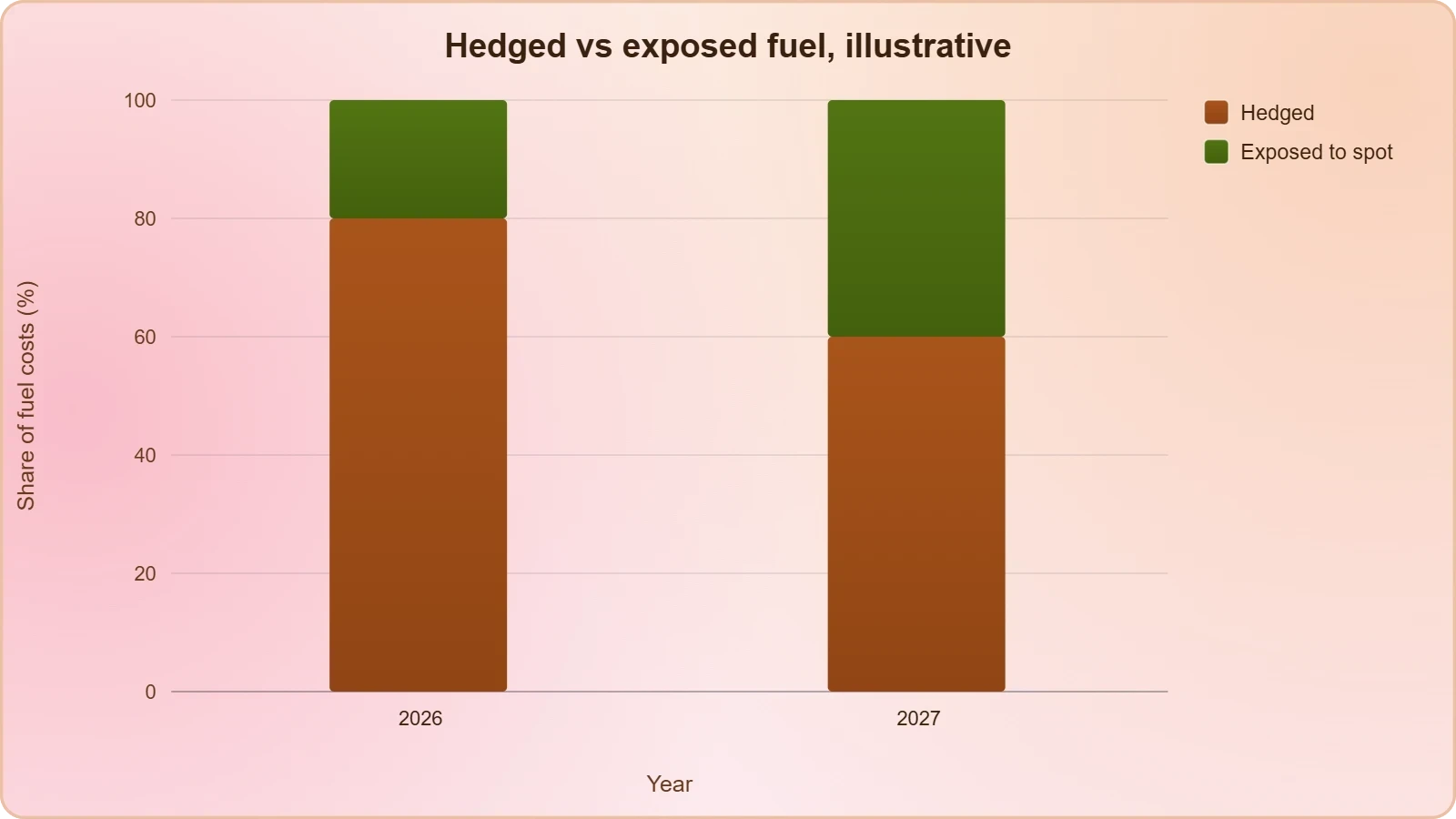
The declining coverage from 2026 to 2027 is equally telling. Hedges are typically layered forward in tranches, and the lower 2027 figure reflects both the thinner liquidity of longer-dated energy contracts and management's reluctance to lock in prices during an acute geopolitical spike. If the Hormuz situation eases, unhedged 2027 exposure becomes an advantage; if it deteriorates, the airline will need to hedge further at elevated levels. This is the essential dilemma of treasury management during an energy shock, and Lufthansa's disclosure lays it out with unusual candour.
The Cost of Certainty in a Volatile Market
Hedging programmes carry real costs: premiums on options, margin calls on swaps, and the administrative burden of a dedicated treasury function. Airlines that hedge heavily during calm periods often appear to underperform when prices fall, and critics periodically question whether the insurance is worth the premium. The Lufthansa case answers that question conditionally. With fuel costs rising two billion euros year-on-year, the hedged position almost certainly saved the group a larger hit, but the residual exposure still forced a guidance narrowing and a double-digit fare increase.
For investors, the lesson is that hedging smooths earnings rather than protecting them absolutely. A carrier with eighty percent coverage will still report fuel-driven volatility, just less of it. The market's reaction, a three percent share price gain in Frankfurt, suggests investors understood this distinction and rewarded the combination of strong underlying demand with disciplined risk management. The alternative, an unhedged carrier facing the same shock, would have faced a far harsher reception.
We Also Published
Reading the Quarterly Results Beneath the Headlines
The headline numbers from the July–September quarter are genuinely impressive and deserve to be separated from the fuel narrative. Net profit of 1.26 billion euros represented a thirty percent increase year-on-year, revenue rose nine percent to 12.2 billion euros, and Spohr characterised it as the strongest revenue quarter in the group's history. These are not the figures of a company in distress; they are the figures of a company managing a cost shock from a position of commercial strength, which is precisely why the guidance narrowing rather than a profit warning is the more revealing signal.
Premium Demand and the Cargo Windfall
Two engines drove the quarter. First, premium demand for travel to Asia and North America remained robust, allowing Lufthansa to sell high-margin seats even as economy fares faced pressure. Second, the cargo division tripled its core profit, supported by shipments of equipment for data centres being built to serve artificial intelligence workloads. That AI-driven cargo boom is a genuinely new revenue stream for aviation, and it arrived at a fortunate moment, offsetting some of the fuel-driven margin erosion on the passenger side.
The cargo windfall also illustrates a broader truth about diversified airline groups. A carrier with only passenger operations would have faced the fuel shock with no offsetting lever; Lufthansa's logistics arm provided exactly that. The tripling of cargo profit is unlikely to repeat indefinitely, since data-centre construction is cyclical, but it demonstrates the strategic value of portfolio breadth during commodity shocks. Investors should watch whether other network carriers with cargo exposure report similar offsets in their own quarterly disclosures.
Strike Costs and the Flagship Carrier's Squeeze
Beneath the group-level strength, the flagship airline's operating profit fell, partly due to strikes by cabin crew and pilots. Labour disruption is a recurring feature of European aviation and carries direct costs in cancelled flights, compensation, and rebooking, plus indirect costs in damaged customer goodwill. The fact that group profit still rose thirty percent despite these strikes speaks to the strength of the cargo and premium segments, but it also flags a vulnerability: industrial relations remain a live risk that can erode margins independently of fuel prices.
Spohr's framing, that rising revenues, steady demand, and strict cost discipline more than offset a half-billion-euro fuel increase, is accurate but incomplete. Cost discipline has limits, and the airline has already signalled that fares must carry more of the burden going forward. The interplay between labour costs, fuel costs, and pricing power will determine whether the group can sustain its current profitability into 2027, when hedging coverage drops and the fuel outlook remains uncertain.
Guidance, Forecasts, and What the Narrowing Signals
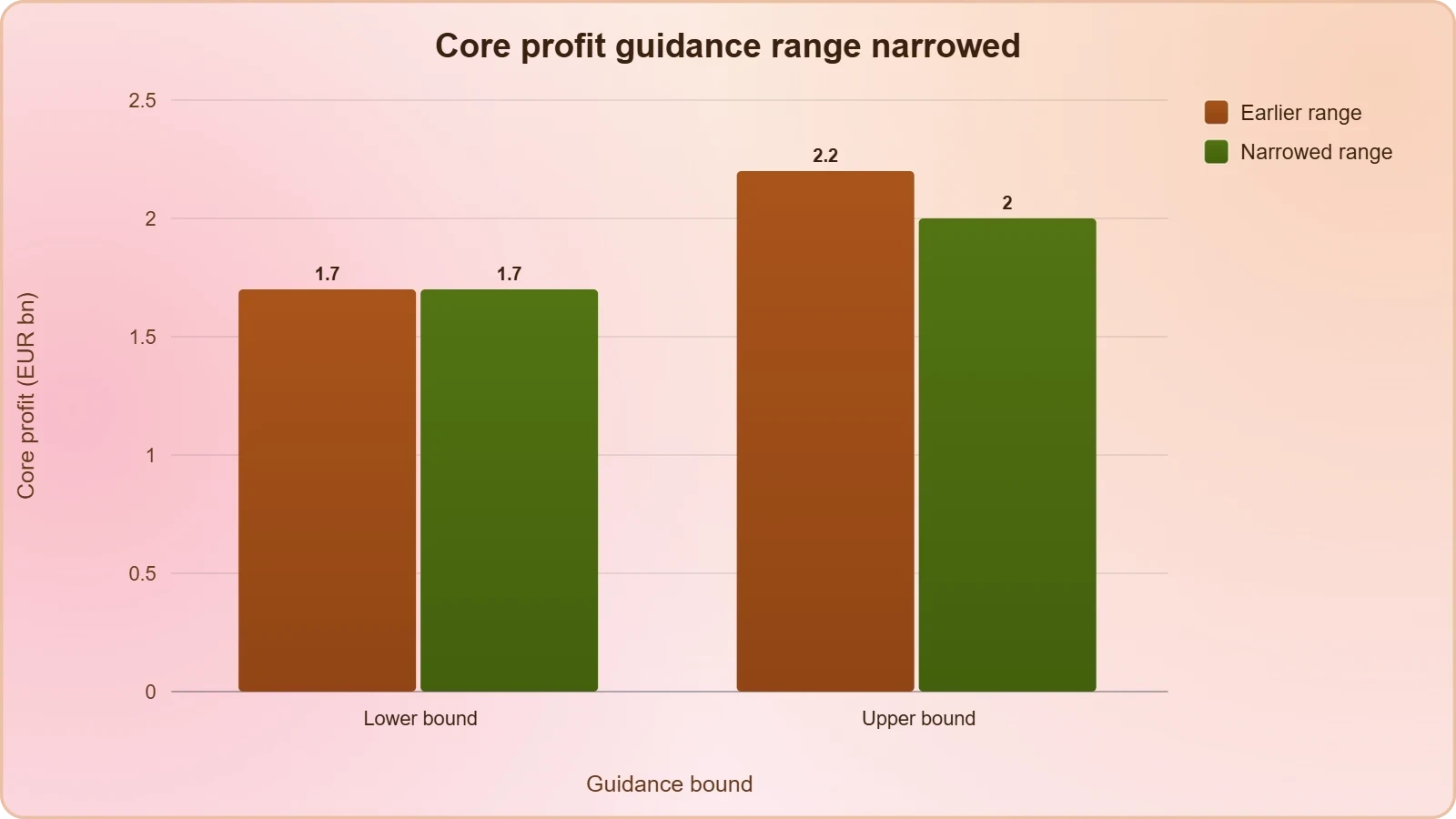
Lufthansa narrowed its 2026 core profit forecast to between 1.7 and 2.0 billion euros, down from an earlier range of 1.7 to 2.2 billion. The lower bound held steady while the upper bound fell by two hundred million euros, a pattern that tells a specific story: management remains confident about the floor but has lost confidence in the ceiling. That asymmetry is characteristic of cost shocks, which rarely destroy a business outright but reliably compress the best-case scenario, and it gives analysts a cleaner read than a simple midpoint revision would.
Why the Upper Bound Fell, Not the Lower
The floor held because demand is genuinely strong and the hedged fuel position caps the downside. The ceiling fell because the unhedged residual, combined with strike risk and the possibility of further fuel escalation into 2027, makes the optimistic scenario harder to defend. Management is effectively telling the market that the base case is intact but the upside is constrained by forces outside its control. Investors responded by bidding the shares up three percent, which suggests the market had feared worse.
Guidance narrowing of this kind also functions as expectation management. By trimming the top of the range early, Lufthansa reduces the risk of a negative surprise later and preserves credibility with analysts. The technique is standard among well-run European corporates, and its use here signals that management views the fuel shock as serious but manageable. The real test will come when 2027 guidance is issued, since hedging coverage drops to sixty percent and the geopolitical backdrop remains unresolved.
Scenario Planning for 2027
Three broad scenarios present themselves. In a de-escalation scenario, the Hormuz disruption eases, kerosene prices retreat, and Lufthansa's unhedged 2027 exposure becomes an advantage, allowing the group to capture lower costs than competitors who locked in at elevated levels. In a prolonged-conflict scenario, prices stay high, the sixty percent hedge provides partial protection, and further fare increases become necessary. In an escalation scenario, prices spike again, the unhedged forty percent bites hard, and guidance would need to be reset downward.
Each scenario carries different implications for passengers, investors, and competitors. Passengers face the most direct impact through fares, which management has already signalled will rise by double digits. Investors face earnings volatility that hedging can soften but not eliminate. Competitors face a market where the strongest balance sheets and broadest route portfolios will outperform, potentially accelerating consolidation among weaker carriers. The Lufthansa briefing, read carefully, is a scenario map as much as a results announcement.
The Wider Economic Ripple Effects
Airline fuel costs are not an isolated corporate concern; they propagate through the economy in ways that rarely make headlines. Higher fares feed into business travel budgets, tourism spending, and the cost of air-freighted goods, from pharmaceuticals to electronics. When Lufthansa and Ryanair both raise prices, the effect compounds across the travel ecosystem, and the consumer price index for transport services registers the shift with a lag. The Hormuz closure thus reaches households far from any airport through the price of a holiday or the cost of imported components.
Inflation Channels and Central Bank Attention
Energy shocks of this magnitude complicate monetary policy. Central banks distinguish between headline inflation, which includes fuel, and core inflation, which excludes it, but sustained energy pressure can bleed into core through transport costs and wage demands. The 2022 European energy crisis demonstrated how quickly a fuel shock can become a broader inflation problem, and policymakers will be watching the Hormuz situation closely for signs of persistence. Airlines raising fares by double digits are, in effect, transmitting the shock into the services inflation basket.
The transmission is not uniform. Economies with strong domestic energy production or diversified supply chains will absorb the shock more easily than import-dependent economies. Europe, which imports most of its energy, is particularly exposed, and its airlines are among the first to feel the pressure. The Lufthansa briefing is therefore a leading indicator for European inflation data, and its warning about 2027 suggests the pressure will not dissipate quickly.
Competitive Dynamics and Consolidation Pressure
Energy shocks are historically accelerants of industry consolidation. Carriers with weak balance sheets, limited hedging, and leisure-heavy route portfolios face margin compression that can become existential within a few quarters. Stronger carriers with diversified revenue, cargo exposure, and premium demand can weather the storm and emerge with greater market share. Lufthansa's position, with its tripled cargo profit and robust premium demand, places it firmly in the second category, and its competitors know it.
Consolidation in European aviation has been predicted for years without fully materialising, partly because governments have intervened to protect national carriers. But a sustained fuel shock combined with labour disruption and thin liquidity could force the issue. The market will watch for signs of distress among smaller operators, and any consolidation that does occur will reshape route networks and pricing power across the continent. The Lufthansa results are, in this sense, a signal about the industry's future structure as much as its present performance.
What Passengers and Investors Should Watch Next
For travellers, the practical implication is that fares booked for the following year will be materially higher than those of the current period, with management explicitly guiding to double-digit increases. Booking early, using points where available, and remaining flexible on routing will all become more valuable strategies. Premium cabins, which drove the quarter's strength, may see less aggressive increases than economy, since demand there has proven resilient. Passengers should also expect ancillary revenue to rise as carriers seek non-ticket income to offset fuel pressure.
Signals for the Investment Community
Investors should track three indicators over the coming quarters. First, the trajectory of kerosene prices and the Hormuz situation, which will determine whether the 2027 scenario is benign or severe. Second, the pace of fare increases across the industry, which will reveal whether pricing power holds as demand potentially softens. Third, the cargo division's performance, which provided an unexpected offset this quarter but may normalise as data-centre construction cycles mature. Each indicator carries different weight, and their interaction will shape earnings revisions.
The share price reaction, up more than three percent in Frankfurt, suggests the market had positioned for worse. That is a useful reminder that expectations matter as much as outcomes. A company that narrows guidance but beats on profit and demonstrates hedging discipline can still be rewarded. The risk is that the market's relief proves temporary if the 2027 outlook deteriorates, and investors should size their positions accordingly rather than extrapolating a single quarter's relief rally.
Preparing for a Higher-Cost Aviation Era
Beyond the immediate shock, the Lufthansa briefing points toward a structurally higher-cost aviation era. Fuel efficiency will become an even more decisive competitive variable, favouring carriers with younger fleets and newer engine technology. Sustainable aviation fuel, still expensive and scarce, will gradually enter the cost base, adding another layer of upward pressure. Airlines that invested early in fleet renewal and hedging infrastructure will be better positioned than those that deferred capital expenditure during the cheap-fuel years.
For the broader economy, the lesson is that energy security is not an abstraction. A single chokepoint closing can raise the cost of flying for hundreds of millions of people and complicate the inflation outlook for central banks. The Lufthansa results are a case study in how quickly geopolitical events become line items on an income statement, and how disciplined management, diversified revenue, and prudent hedging can soften but never fully neutralise the blow. The next twelve months will reveal whether the industry's adaptation is sufficient.
From our network :
- CISA’s Ten-Advisory Wave: Why Generic Patching Fails in OT and How to Build Product-Specific PlaybooksCISA released ten ICS advisories in one week, exposing critical infrastructure risks. Generic patching fails in OT. Learn to build product-specific remediation playbooks.
- Live Online English Classes for Kids: Do They Actually Reduce Anxiety?A ten-week study reveals that synchronous online English classes can significantly reduce child language anxiety while improving listening and reading skills. Discover what makes these programs effective and how parents can select the right one.
- Forbidden Matrix Patterns and Visible Lattice Points: A Geometric DictionaryExplore how multidimensional 0–1 matrices encode geometric truths, linking forbidden patterns to visible lattice points and hypergraph theory, with applications in combinatorics and computational geometry.
- Mobile Learning and VR in English: What Global Evidence Reveals About Effective Language TechnologyA systematic review across 14 countries reveals which language-learning technologies genuinely work. Mobile learning, AI, and VR show measurable benefits when pedagogically integrated. This evidence-based guide helps educators and learners select technology that delivers real return on investment.
- Committed Mediterranean Precipitation Decline: Why Emissions Cuts Alone Cannot Restore Winter RainsNew NOAA research reveals that Mediterranean winter rains may decline irreversibly even with emissions cuts. Explore the science of committed climate change and regional impacts.
- The Final Descent: How ESA Retired the Legendary Cluster Constellation After 24 Years of Space Weather ScienceAfter 24 years mapping Earth’s magnetosphere, ESA’s Cluster mission concluded with a precisely controlled reentry over the South Pacific. This analysis explores the scientific legacy, engineering decisions, and debris mitigation principles behind one of space exploration’s most responsible retirements.
- The Hidden Cost of AI Convenience: Why Over-Permissioned Agents Are a Security Time BombDiscover why AI agents with excessive permissions create dangerous single points of failure, and learn how implementing least privilege principles can protect your organization from exploitation.
- University Language Proficiency Exams: Why Institutional Tests Demand Different Preparation Than IELTS and TOEFLDiscover why university-specific language proficiency examinations differ fundamentally from IELTS and TOEFL, and learn strategic preparation approaches for institutional assessment success.
- How AI Agents Will Change the Way We Manage Personal FinancesExplore how AI agents are transforming personal finance through automated budgeting, bill payment, and investment management, while examining the critical security protocols and governance frameworks required for safe deployment.
RESOURCES
- Resources will be updated soon.
- 01
- 02
- 03
- 04
- 05
- 06
- 07
- 08
0 Comments