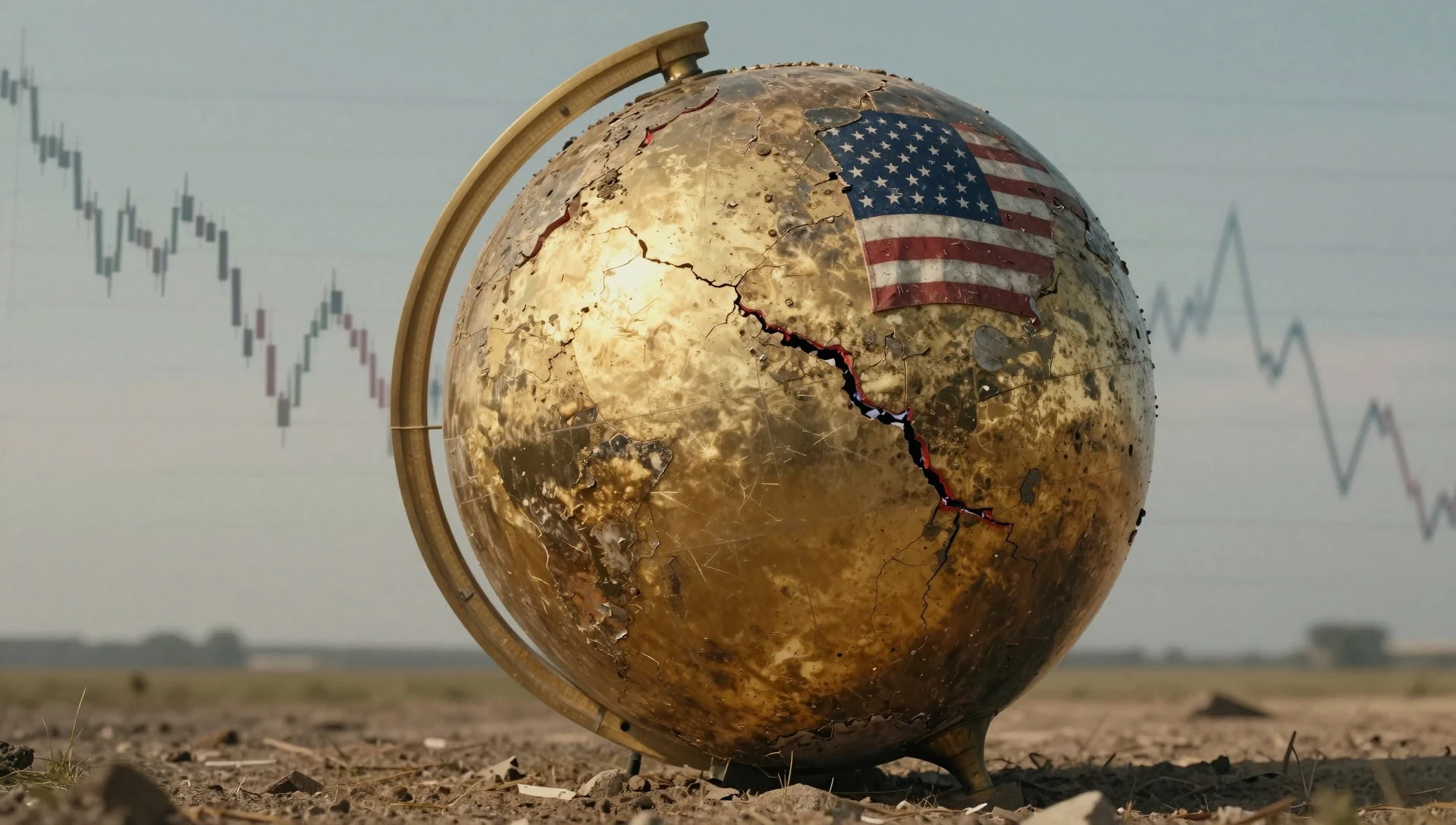
When American voters delivered control of both chambers of Congress to the Democratic Party in the 2026 midterm elections, they did more than rebuke a sitting president's style of governance. They altered the balance of economic power in Washington at a moment when the United States was already entangled in a costly Middle Eastern war, wrestling with resurgent inflation, and navigating an artificial intelligence boom that had become the principal engine of equity market returns. The result placed Donald Trump in the weakest position of his second term, stripped his party of the votes needed to confirm key appointments, and handed Democrats leverage over regulation, spending, and oversight during the final two years of his presidency.
Financial markets processed the outcome with characteristic ambivalence. Asian equities dipped in early trading before recovering as investors concluded that the republic's institutional checks had held, that the president had accepted defeat, and that a diplomatic opening on Iran might be within reach. Yet the relief was tempered by the recognition that divided government in a nuclear-armed superpower introduces its own breed of uncertainty, particularly when the incumbent retains a veto pen he has promised to wield aggressively. The interplay between political gridlock, energy shocks, and monetary tightening now defines the global economic outlook far more than any single legislative agenda.
What follows is a structured examination of how a weakened American presidency transmits through currency markets, sovereign bond yields, inflation expectations, and household living standards from Berlin to Brasília. The analysis draws on the immediate market reaction, the mechanics of Federal Reserve independence, the inflationary channel opened by the Strait of Hormuz closure, and the regulatory risk now hanging over the data centre buildout that has underpinned the AI-driven rally. Each dimension matters because the United States remains the world's largest economy and the issuer of its reserve currency, meaning its domestic political fractures are, by definition, everyone's problem.
On This Page
- The Political Earthquake and Its Immediate Market Verdict
- Inflation, Energy Shocks, and the War That Reshaped Prices
- Central Banks, the Fed, and the Fight Over Monetary Independence
- Artificial Intelligence Regulation and the Engine of Market Growth
- Foreign Policy Risk and the Iran War's Next Phase
- What Divided Government Means for the Global Economic Order
TL;DR Democratic victories in both the House and Senate have weakened President Trump's grip on domestic policy during his final two years, introducing divided government at a moment of war-driven inflation and AI-fuelled market growth. Markets initially fell then recovered, reassured that institutional checks functioned and that the president conceded the result. However, his vow to act as "Mr Veto," the loss of Senate confirmation power over Federal Reserve appointments, and the risk of a more aggressive foreign policy stance in Iran all inject fresh uncertainty. Brent crude briefly fell below $100 yet remains far above prewar levels, headline inflation has climbed to 3.7%, and the IMF projects global inflation of 4.7%, forcing central banks into renewed tightening that raises borrowing costs for indebted nations everywhere.
The Political Earthquake and Its Immediate Market Verdict
The Democratic sweep of both legislative chambers represented the most consequential midterm reversal in a generation, and its significance lay less in any single policy promise than in what it removed from the president's hands. Control of the Senate deprives the Republican Party of the votes required to confirm new appointments to key public bodies, including seats on the Federal Reserve's board of governors. Control of the House grants Democrats subpoena power, budget leverage, and the ability to block legislation. For a president who had governed through executive energy and party discipline, the loss converted a commanding position into a defensive one overnight.
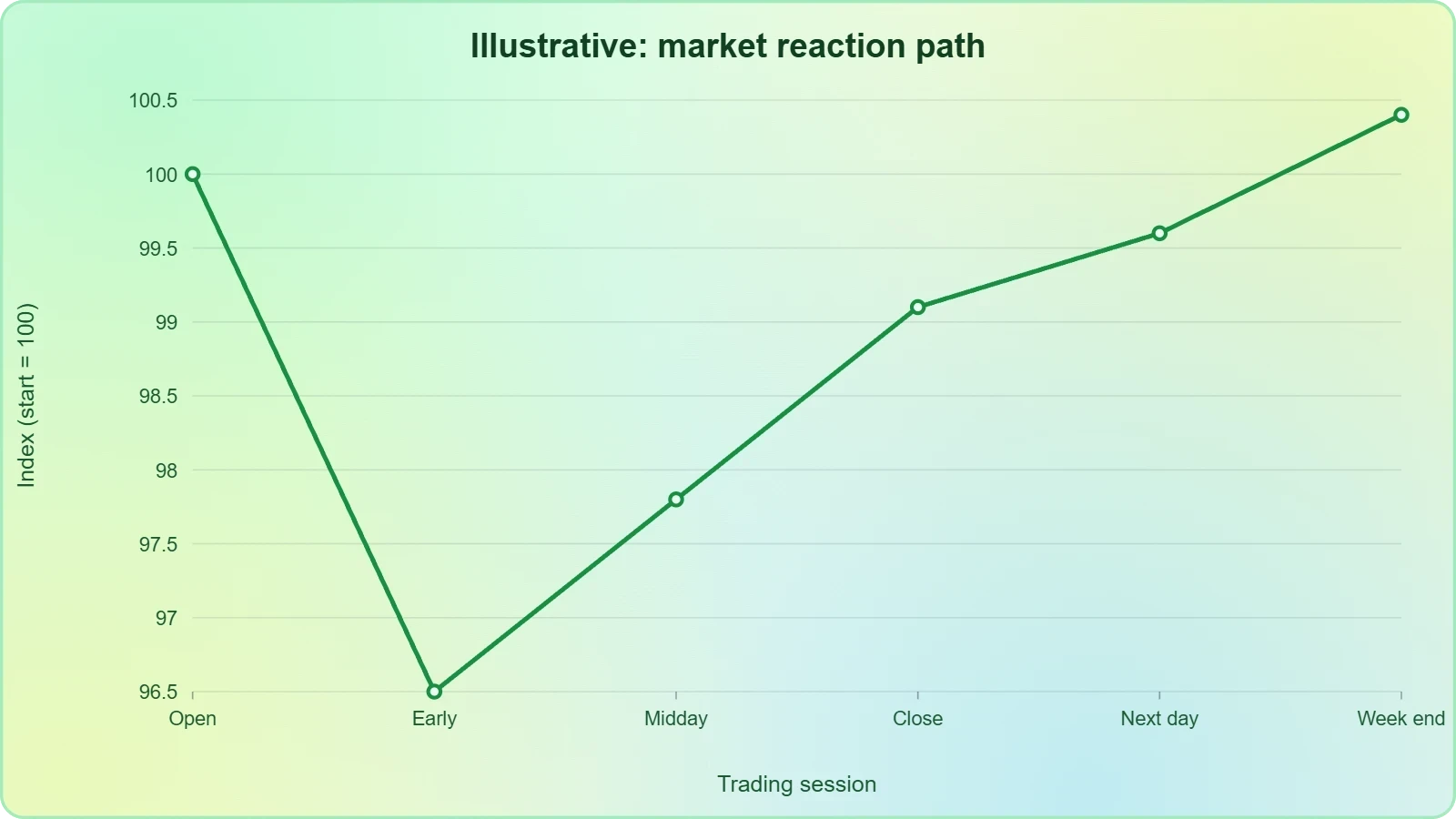
Markets, as is their habit, priced the news before they understood it. Early Asian trading saw equities fall as algorithms and human traders alike confronted the unfamiliar spectacle of a superpower's legislature flipping mid-war. The recovery that followed reflected a more considered judgment: that the transfer of power occurred peacefully, that the president publicly accepted the outcome and acknowledged the war's costs, and that American institutions had demonstrated the resilience that foreign investors ultimately pay a premium for. Holger Schmieding, chief economist at Berenberg, captured the sentiment by observing that voters had rejected a style of leadership and that the system of checks and balances was functioning as designed.
Why Investors Initially Flinched
Investors dislike uncertainty with an almost physiological intensity, and midterm reversals generate uncertainty in concentrated form. Every legislative priority of the outgoing majority becomes contingent, every regulatory trajectory becomes contestable, and every fiscal projection acquires a wider error band. The initial selloff in Asia was less a verdict on Democratic policies than a reflex triggered by the sudden widening of possible futures. When the sun rose over Europe and the Americas, the same investors reassessed and concluded that the institutional continuity on display was worth more than the policy predictability they had lost.
The deeper anxiety concerned timing. A government divided against itself cannot respond nimbly to shocks, and the shocks were arriving with unusual frequency. War in the Middle East, an energy price spike, and a monetary tightening cycle were already testing the economy's absorptive capacity. Adding legislative paralysis to that list raised the prospect that any future crisis would be met with delay rather than dispatch. Markets recovered because the immediate crisis did not materialise, but the structural vulnerability remains embedded in every forward-looking valuation model.
The "Mr Veto" Warning and Its Implications
The president's declaration that he would act as "Mr Veto" signalled a strategy of obstruction rather than accommodation, and analysts read it as a forecast of turbulent final years. A veto can be overridden only by two-thirds majorities in both chambers, a threshold that Democratic leaders will struggle to reach on contentious legislation. The practical effect is that Trump retains a powerful negative instrument even while losing the positive ones. He can block, delay, and force compromise, but he cannot initiate. For markets, this means policy change will arrive slowly and unpredictably, in negotiated fragments rather than coherent packages.
That asymmetry carries particular weight for fiscal policy. Government borrowing costs have already risen on the back of war-driven inflation and rate increases, and the prospect of legislative gridlock removes any near-term possibility of a coordinated response to debt sustainability concerns. Countries with high public debt, already squeezed by higher global interest rates, now face the additional risk that American fiscal dysfunction will keep upward pressure on yields for longer than anyone would like. The veto pen, in other words, is not merely a domestic political weapon; it is a variable in every sovereign debt calculation worldwide.
Inflation, Energy Shocks, and the War That Reshaped Prices
The inflationary backdrop that shaped the midterm verdict originated far from the ballot box. The US-Israeli invasion of Iran led to the closure of the Strait of Hormuz, the narrow maritime chokepoint through which a substantial share of global petroleum and liquefied natural gas normally passes. That closure functioned as a physical constraint on supply, and physical constraints on energy supply transmit into consumer prices with brutal efficiency. US diesel prices reached a record high in August, freight and agricultural costs followed, and the headline inflation rate climbed to 3.7%, a figure that had seemed unthinkable only a year earlier when disinflation appeared entrenched.
Tariff policy compounded the pressure. Duties imposed on imported goods raised input costs for small businesses that lacked the scale to absorb them or the bargaining power to renegotiate supply contracts. The result was a cost-of-living squeeze that voters experienced directly at fuel pumps and supermarket checkouts, and exit polling suggested that pocketbook concerns outweighed ideological considerations for a decisive slice of the electorate. Inflation, in this reading, was not merely an economic statistic but the proximate cause of a political realignment, and the new Democratic majority will be judged on whether it can bring prices down without strangling growth.
The Strait of Hormuz and Global Price Transmission
Energy economists have long treated the Strait of Hormuz as the single most consequential chokepoint in the global oil system, and its closure validated every worst-case model. The immediate effect was a price spike that rippled through every economy dependent on imported energy, with the International Monetary Fund projecting global headline inflation of 4.7% this year and identifying energy-importing nations as the hardest hit. For countries already carrying heavy external debt, the combination of higher import bills and higher global interest rates created a double squeeze that threatens fiscal stability and, in extreme cases, social cohesion.
The transmission mechanism operates through multiple channels simultaneously. Direct fuel costs raise transport and manufacturing expenses; higher energy prices feed into electricity tariffs and industrial input costs; and the resulting inflation expectations push wage demands upward, embedding price growth into the structure of the economy rather than leaving it as a transient shock. Central banks, watching these second-round effects with alarm, have responded by tightening monetary policy, which in turn raises borrowing costs for governments, businesses, and households alike. The war, in short, exported inflation to the entire world.
Oil's Partial Retreat and What It Signals
Brent crude's fall of as much as 9% to below $100 a barrel, its first dip beneath that threshold in a month, offered markets a rare piece of good news. The decline reflected both the midterm results and growing hopes of a diplomatic breakthrough on Iran, and it demonstrated how quickly energy prices can move when political probabilities shift. Yet context matters enormously: at roughly $94, Brent remains far above its prewar level of about $70, meaning the inflationary impulse has eased at the margin but has not been reversed. Consumers are still paying substantially more for energy than they were before the conflict began.
Analysts caution against reading the retreat as a durable trend. Oil markets remain hostage to events in the Gulf, and any escalation, any renewed closure, or any collapse in negotiations could send prices surging past previous highs within days. The partial decline therefore functions as a conditional relief rather than a resolution. It buys central banks a little room and offers households modest respite, but it does not alter the fundamental arithmetic of a world in which energy security has become a live geopolitical variable rather than a settled assumption.
Central Banks, the Fed, and the Fight Over Monetary Independence
The Federal Reserve's decision to raise borrowing costs for the first time since 2023 marked a turning point in the post-pandemic monetary cycle, and it arrived despite explicit pressure from the White House for easier money. That the Fed acted anyway demonstrated the durability of its operational independence, but the midterm result has now altered the institutional terrain on which future battles over that independence will be fought. With Democrats controlling the Senate, the president's ability to reshape the Fed's board through new appointments has effectively evaporated, removing a source of market anxiety even as it removes a source of presidential influence.
Investors expect at least one further rate increase, and the Bank of England and the European Central Bank are widely anticipated to follow suit. The synchronised tightening reflects a shared diagnosis: that war-driven energy inflation requires a monetary response regardless of the political discomfort it generates. For governments carrying heavy debt burdens, the consequence is a rising interest bill that competes with health, education, and defence spending. For households, it means mortgage rates, credit card costs, and business loan pricing all drift upward, compressing disposable income at precisely the moment when energy bills are already elevated.
Why the Loss of Confirmation Power Matters
Senate confirmation is the mechanism through which presidents shape the Federal Reserve, and its loss is among the most consequential structural effects of the midterm outcome. Without the votes to confirm new governors, Trump cannot install officials sympathetic to his preference for lower rates, nor can he reshape the board's composition to influence future policy decisions. Markets, which had priced in some risk of politicised monetary policy, responded with quiet relief. The Fed's independence is now protected less by convention and more by arithmetic: the votes simply do not exist to alter its direction.
This protection cuts both ways. A president who cannot appoint allies also cannot claim credit for monetary outcomes, and a Fed insulated from political pressure may feel emboldened to tighten further if inflation proves stubborn. The arrangement restores a measure of predictability to monetary policy, which bond markets value highly, but it also removes a channel through which the executive branch might have coordinated fiscal and monetary strategy. In a period requiring nimble macroeconomic management, the separation of powers now extends into the conduct of interest rate policy itself.
The Global Cost of Higher Borrowing
American interest rates set the floor for borrowing costs across much of the world, and the Fed's tightening therefore exports financial pain to every economy that borrows in dollars or benchmarks against US yields. Emerging markets with dollar-denominated debt face the sharpest adjustment, as higher servicing costs consume budget resources and pressure currencies. Even advanced economies with deep domestic bond markets are not immune; the Bank of England and the European Central Bank are tightening partly to prevent capital flight and currency depreciation rather than because their own inflation dynamics demand it.
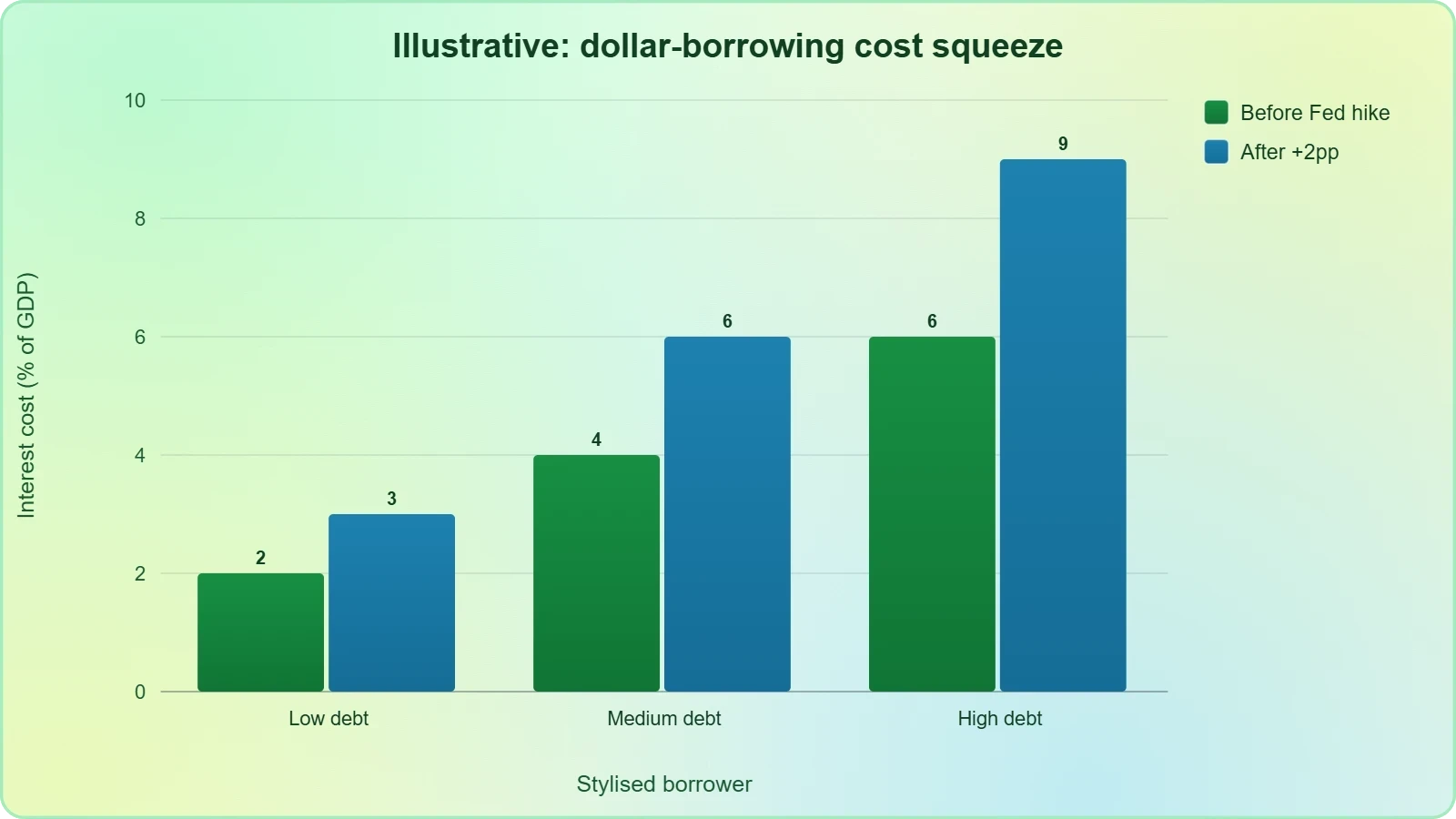
The compounding effect is a global rise in the cost of public debt at a time when many governments had already borrowed heavily to cushion the pandemic and the energy shock. Countries with high debt-to-GDP ratios now confront a refinancing wall at precisely the wrong moment, and the political consequences of austerity, whether imposed by markets or chosen by governments, are rarely gentle. The IMF has repeatedly warned that debt sustainability is the defining fiscal challenge of the decade, and the midterm result, by removing any prospect of coordinated American fiscal leadership, makes that challenge harder to meet.
Artificial Intelligence Regulation and the Engine of Market Growth
The equity rally that has defined the past several years rests disproportionately on a single narrative: that artificial intelligence will transform productivity, corporate earnings, and ultimately the structure of the economy. Data centre construction, semiconductor demand, and the capital expenditure plans of the largest technology firms have become the load-bearing pillars of index-level returns. Traders now expect Democrats to take a tougher approach to AI regulation and data centre expansion, and that expectation introduces a regulatory risk premium into assets that had previously been priced as though policy would remain permanently permissive.
The precise form that regulation will take remains uncertain, and uncertainty itself is the market's least favourite condition. Stricter oversight could slow permitting for data centres, impose transparency requirements on model developers, strengthen consumer protections, or attach environmental conditions to the enormous electricity consumption that AI infrastructure demands. Each of these possibilities raises costs or delays revenue, and equity valuations that embed aggressive growth assumptions are acutely sensitive to such changes. The AI trade is not dead, but it now trades with a political discount that did not exist before the votes were counted.
Data Centres, Energy Demand, and Regulatory Friction
The physical footprint of artificial intelligence is enormous and growing. Data centres consume electricity at a scale that strains local grids, requires new transmission capacity, and in some regions competes directly with household and industrial demand. Democratic legislators have signalled greater scrutiny of these externalities, including water usage for cooling, land use, and the ratepayer impact of utility contracts signed to serve hyperscale facilities. Any tightening of permitting or cost allocation would lengthen project timelines and increase capital requirements, altering the economics of the buildout that has driven so much of the market's gains.
Regulatory friction also interacts with the energy shock in ways that compound both problems. Higher electricity prices make data centre operation more expensive just as stricter oversight makes new construction slower and costlier. The combination could compress margins for cloud providers and force a reassessment of the capital expenditure guidance that has anchored technology valuations. None of this means the AI buildout will halt, but it does mean the pace and profitability of that buildout are now subject to political variables that investors had previously ignored.
Innovation, Competitiveness, and the Risk of Overreach
There is a counterargument worth taking seriously: that well-designed regulation strengthens rather than weakens an industry by establishing clear rules, building public trust, and preventing the kind of catastrophic failure that could trigger a backlash far more damaging than any statute. European regulators have made this case for years, and Democratic lawmakers are likely to draw on that template. The risk is calibration. Rules that are too vague, too burdensome, or too hastily drafted could push development offshore and cede competitive advantage to jurisdictions with lighter touch regimes, a concern that industry lobbyists will press vigorously in the months ahead.
Markets will watch the legislative drafting process closely for signals about which version of regulation will prevail. A transparent, principles-based framework focused on safety and disclosure would likely be absorbed without major disruption. A sprawling compliance regime with unclear standards and expansive liability could trigger significant repricing in technology equities and a broader reassessment of the growth assumptions embedded in index valuations. The difference between these outcomes will be determined by negotiation in a divided Congress, which is precisely why the midterm result matters so much to anyone holding technology exposure.
- 01
- 02
- 03
- 04
We Also Published
Foreign Policy Risk and the Iran War's Next Phase
Analysts have identified a specific and uncomfortable risk embedded in the midterm outcome: a president with diminished control over domestic policy may redirect his energies toward the arena where executive power remains comparatively unchecked. Foreign policy, and military action in particular, offers a president latitude that domestic legislation does not. The concern is that Trump, frustrated by legislative gridlock and eager to project strength, might escalate the conflict with Iran rather than pursue the diplomatic opening that markets have begun to price. Such an escalation would reverse the recent oil price decline and reignite the inflationary spiral that central banks are still fighting.
The relationship between war and markets is rarely linear, but the current configuration is unusually direct. The closure of the Strait of Hormuz demonstrated that Middle Eastern conflict can transmit into global consumer prices within weeks. Any intensification of hostilities would threaten shipping lanes, energy infrastructure, and regional stability, and the resulting risk premium would appear immediately in oil, freight, insurance, and currency markets. For importers of energy, the effect would be a second shock layered atop the first, with fiscal and monetary consequences that few governments are prepared to absorb.
The Diplomatic Opening and Its Fragility
The hope of a diplomatic breakthrough on Iran was among the factors that allowed oil prices to retreat and equity markets to recover, and it represents the single most important variable in the near-term outlook. Negotiations, however, are fragile by nature, and a weakened president facing a hostile Congress may find compromise politically costly. Hardliners in his own party would likely denounce any settlement as capitulation, while Democratic legislators might demand concessions that Tehran finds unacceptable. The space for a durable agreement is narrow, and the consequences of failure are measured in dollars per barrel.
Markets have priced a probability of success rather than a certainty, which means the diplomatic opening is a source of upside that could evaporate without warning. Every statement from Washington, Tehran, and the regional capitals will be parsed for signals, and volatility in energy markets is likely to remain elevated regardless of the direction of travel. Investors would be wise to treat the recent oil price decline as a conditional gift rather than a structural improvement, and to maintain hedges against the possibility that the war's next phase proves more disruptive than its first.
Living Standards and the Human Ledger
Beneath the abstractions of yields, spreads, and inflation prints lies a human ledger that is rarely captured in market commentary. Higher energy prices, elevated borrowing costs, and slower growth translate into tangible hardship: families choosing between heating and eating, small businesses shuttering because input costs outran their pricing power, and workers in energy-intensive industries facing reduced hours or redundancy. The IMF's projection of 4.7% global headline inflation is not a technical forecast but a statement about how much less purchasing power households around the world will command this year compared with last.
The political consequences of that hardship are already visible. Voters in the United States punished the incumbent party for inflation, and similar dynamics are playing out across Europe and the developing world, where the cost-of-living squeeze has fuelled populist movements and destabilised governing coalitions. The midterm result was, in this sense, a local expression of a global phenomenon: electorates holding governments accountable for price levels they cannot control. Whether the new Democratic majority can deliver relief depends on forces, from the Strait of Hormuz to the Federal Reserve, that lie largely beyond its reach.
What Divided Government Means for the Global Economic Order
The midterm result has produced a configuration of American governance that is familiar in form but novel in context: a president entering his final two years without legislative majorities, presiding over a war, an inflation problem, and a technological transformation that demands active policy management. Divided government historically moderates policy swings, and in calmer times that moderation is a virtue. In the present environment, however, it removes the capacity for decisive action at precisely the moment when energy shocks, debt sustainability, and AI governance all require coordinated responses that only a functioning legislature can authorise.
For the rest of the world, the implications are paradoxical. A weakened American president is less able to disrupt global trade through abrupt tariff action, which is welcome news for exporters and supply chains. But he is also less able to deliver the fiscal leadership, the debt ceiling stability, and the diplomatic breakthroughs that global markets depend upon. Allies must now calibrate their strategies to a Washington that can block but not build, and adversaries may calculate that a divided America is a distracted one. The net effect is a world order with more veto points and fewer solutions.
Alliances, Trade, and the Search for Stability
America's trading partners have spent years adapting to unpredictable tariff announcements and renegotiated agreements, and the midterm result offers them a measure of relief by constraining the executive's ability to impose new trade measures without legislative support. That relief is partial, because presidents retain substantial unilateral authority over tariffs under existing statutes. Nevertheless, the political cost of aggressive trade action rises when a hostile Congress can investigate, subpoena, and publicise the consequences, and that prospect may temper the administration's instincts in the months ahead.
Alliances face a more complicated adjustment. Partners who had invested in relationships with the administration must now cultivate congressional leaders as well, and the diplomatic bandwidth of a weakened president is likely to narrow toward the issues he prioritises most. European capitals, already managing their own inflation and energy crises, will watch Washington for signals about American commitment to collective security arrangements. The risk is not abandonment but drift, as a distracted superpower allows alliances to atrophy through inattention rather than deliberate rupture.
The Road to 2028 and the Price of Uncertainty
Every midterm result is also the opening move in the next presidential campaign, and the Democratic sweep positions the party to contest the 2028 election from a strengthened institutional base. For markets, that means a prolonged period of policy uncertainty stretching across two years of divided government and then into a campaign whose outcome is unknowable. Investors can price known risks; they struggle with open-ended ambiguity, and the prospect of a presidential election fought over inflation, war, and AI regulation guarantees that volatility will remain a persistent feature of the investment landscape.
The deeper lesson of the midterm result may be about the fragility of the assumptions that underpinned the recent market rally. Investors had grown accustomed to a world of predictable policy support, cheap energy, and permissive regulation, and each of those assumptions has now been challenged simultaneously. The economy that emerges from this period will be shaped less by any single political outcome than by how governments, central banks, and firms adapt to a world in which energy security, institutional resilience, and technological governance are all contested terrain. That adaptation, not the election itself, will determine living standards in the years ahead.
From our network :
- The Final Descent: How ESA Retired the Legendary Cluster Constellation After 24 Years of Space Weather ScienceAfter 24 years mapping Earth’s magnetosphere, ESA’s Cluster mission concluded with a precisely controlled reentry over the South Pacific. This analysis explores the scientific legacy, engineering decisions, and debris mitigation principles behind one of space exploration’s most responsible retirements.
- University Language Proficiency Exams: Why Institutional Tests Demand Different Preparation Than IELTS and TOEFLDiscover why university-specific language proficiency examinations differ fundamentally from IELTS and TOEFL, and learn strategic preparation approaches for institutional assessment success.
- Live Online English Classes for Kids: Do They Actually Reduce Anxiety?A ten-week study reveals that synchronous online English classes can significantly reduce child language anxiety while improving listening and reading skills. Discover what makes these programs effective and how parents can select the right one.
- The Hidden Cost of AI Convenience: Why Over-Permissioned Agents Are a Security Time BombDiscover why AI agents with excessive permissions create dangerous single points of failure, and learn how implementing least privilege principles can protect your organization from exploitation.
- Mobile Learning and VR in English: What Global Evidence Reveals About Effective Language TechnologyA systematic review across 14 countries reveals which language-learning technologies genuinely work. Mobile learning, AI, and VR show measurable benefits when pedagogically integrated. This evidence-based guide helps educators and learners select technology that delivers real return on investment.
- Forbidden Matrix Patterns and Visible Lattice Points: A Geometric DictionaryExplore how multidimensional 0–1 matrices encode geometric truths, linking forbidden patterns to visible lattice points and hypergraph theory, with applications in combinatorics and computational geometry.
- Committed Mediterranean Precipitation Decline: Why Emissions Cuts Alone Cannot Restore Winter RainsNew NOAA research reveals that Mediterranean winter rains may decline irreversibly even with emissions cuts. Explore the science of committed climate change and regional impacts.
- CISA’s Ten-Advisory Wave: Why Generic Patching Fails in OT and How to Build Product-Specific PlaybooksCISA released ten ICS advisories in one week, exposing critical infrastructure risks. Generic patching fails in OT. Learn to build product-specific remediation playbooks.
- How AI Agents Will Change the Way We Manage Personal FinancesExplore how AI agents are transforming personal finance through automated budgeting, bill payment, and investment management, while examining the critical security protocols and governance frameworks required for safe deployment.
RESOURCES
- After the US midterms, what will a lame duck Trump mean for the ...theguardian.com13 hours ago ... After the US midterms, what will a lame duck Trump mean for the global economy? ... weakened, could take a…
- Will the United States Attack Iran After the Midterms?cfr.orgOct 23, 2026 ... Tehran may even believe that a blue wave in the midterm elections will weaken Trump ... These included how much…
- What the US midterms could mean for Trump's powerchathamhouse.orgSep 9, 2026 ... The Democrats are projected to make big gains in November's midterm elections. But this will not necessarily constrain President Trump.
- After US midterms, a weakened Trump may pose a greater threat to ...euronews.com18 hours ago ... After the midterms, Europe will not get a weaker Trump but one who turns even more to global politics, warns…
- Trump strikes deal with Putin for Russian diesel in sharp ... - PBSpbs.orgTrump strikes deal with Putin for Russian diesel in sharp reversal of U.S. policy ahead of midterms. World Oct 9, 2026 6:06 PM EST.…
- Why Big Tech is Betting on the US Midtermsglobalaffairs.orgOct 27, 2026 ... Overall, US President Donald Trump's second term has been a win for Big Tech. In the last two years, the…
- Iran war won't end until after US midterm elections, says Trump - BBCbbc.comSep 10, 2026 ... He added that Iran was "desperate to try and affect the election, so that we can get a nice weak…
- Trump Global Weakness Watch: How Trump Is Undermining ...americanprogress.orgJan 12, 2026 ... Tracking 150 ways the Trump administration weakens America's security, economy, and global influence. ... Trump imposes a new global tariff…
- Strong dollar, weak hand for Trump before midterms | Reutersreuters.comOct 19, 2026 ... A surging dollar is exposing a central contradiction in President Trump's economic agenda: currency markets are delivering the opposite of ...
- Are the midterms important for Trump? And for the US?caixabankresearch.comOct 15, 2026 ... POLITICO (2026), «Democrats Have Made Up Ground in Nearly Every Election Since Trump Took Office». ... Global economic outlook and…
- What history tells us about the 2026 midterm elections | Brookingsbrookings.eduAug 28, 2025 ... Since reentering the White House in January, President Trump has enjoyed the support of narrow but unified Republican majorities in…
- Analysis: Trump election win could add 4bn tonnes to US emissions ...carbonbrief.orgMar 6, 2024 ... US greenhouse gas emissions have been falling steadily since 2005, due to a combination of economic shifts, greater efficiency, the…
- The future of the US dollar: Will it maintain its safe-haven status or ...juliusbaer.comFeb 23, 2026 ... We delve into the drivers behind the dollar's decline, examine the potential consequences for investors and the global economy, and…
- Trump's foes abroad question whether midterm loss will weaken or ...washingtonpost.com8 hours ago ... But with Democrats set to control both houses of Congress, U.S. allies and foes alike are now wondering whether Trump…
- After US midterms, a weakened Trump may pose a greater threat to ...sg.news.yahoo.com18 hours ago ... After the midterms, Europe will not get a weaker Trump but one who turns even more to global politics, warns…
- 01
- 02
- 03
- 04
- 05
- 06
- 07
- 08
0 Comments