
When MSCI speaks, emerging markets listen — and few have listened more anxiously than Indonesia. The index provider's repeated warnings over market governance have become a recurring feature of Jakarta's capital market calendar, each one exposing the same unresolved weaknesses in free-float transparency, ownership disclosure, and enforcement against coordinated trading. What makes the November 2026 warning especially pointed is not the substance of the complaint but its timing: it arrived after a year of announced reforms, interim freezes, and partial disclosures that were supposed to restore confidence. The gap between regulatory promises and measurable outcomes now sits at the center of the story.
The stakes are difficult to overstate. A downgrade from emerging market to standalone status would push Indonesian equities out of the benchmarks that anchor trillions of dollars in passive and active allocations worldwide. Portfolio managers tracking the MSCI Emerging Markets Index would be forced to liquidate or reclassify holdings, and the resulting capital flight would likely pressure the rupiah, widen sovereign spreads, and raise the cost of capital for Indonesian corporates across the board. For a market that has spent a decade courting foreign institutional money, the prospect of exclusion represents a structural setback rather than a cyclical dip.
This analysis examines how the MSCI dispute unfolded across 2025 and 2026, why the regulatory response has been judged insufficient, and what the underlying governance failures reveal about the political economy of Indonesian markets. It traces the sequence from the January 2026 index freeze through the May reprieve and the October escalation, weighs the credibility of the OJK's eight-point reform package, and considers the uncomfortable questions raised by the Jhonlin Baratama–Bayan Resources transaction. The through-line is a familiar one in emerging markets: reforms announced under external pressure tend to be narrow, reactive, and vulnerable to reversal when politically connected interests are at stake.
On This Page
- The Anatomy of a Recurring Warning
- Free-Float Transparency and the Ownership Mirage
- Coordinated Trading and the Enforcement Deficit
- The Bayan Resources Transaction and the Credibility Question
- What a Standalone Downgrade Would Actually Mean
- The Reform Agenda: What Would Actually Satisfy MSCI
- Implications for Investors and the Road Ahead
TL;DR MSCI has warned Indonesia that it risks reclassification from emerging market to standalone status, citing persistent failures in market governance, free-float transparency, and enforcement against coordinated trading. The warning followed an interim freeze on index additions in January 2026, a partial reprieve in May that still removed nineteen stocks from MSCI benchmarks, and a fresh October escalation after regulators failed to demonstrate meaningful enforcement. The OJK's eight-point reform package and the IDX's 1 percent shareholder disclosure rule address symptoms rather than the pyramidal ownership structures and political connections that sustain the problem. The Jhonlin Baratama–Bayan Resources transaction, approved with a quota expansion shortly after signing, illustrates why investors doubt the consistency of reform.
The Anatomy of a Recurring Warning
MSCI's relationship with Indonesia has followed a pattern that emerging market watchers recognize well: concerns raised privately, warnings issued publicly, reforms promised, and then a partial implementation that satisfies the letter of the complaint while leaving its spirit untouched. The November 2026 warning was the third formal escalation in under two years, and its language reflected a provider that had run out of patience with incremental gestures. The core allegations — coordinated trading, insufficient enforcement, opaque ownership — were not new. What changed was MSCI's willingness to name standalone status as a live possibility rather than a distant hypothetical.
The mechanics of index classification matter here. MSCI's market classification framework weighs three pillars: economic development, market size and liquidity, and market accessibility. The accessibility pillar covers foreign ownership limits, capital flow restrictions, and — critically — the transparency and stability of the institutional framework. Indonesia scores adequately on size and economic development but has repeatedly stumbled on accessibility, particularly the free-float and ownership transparency sub-criteria. A downgrade to standalone would not merely reduce weights; it would remove Indonesian securities from the standard benchmark family entirely, forcing index-tracking funds to divest regardless of their view on individual companies.
The January Freeze and Its Immediate Aftermath
The interim freeze imposed in January 2026 was the first concrete consequence of MSCI's dissatisfaction. By halting index additions and weight increases for Indonesian securities, the provider effectively told global investors that new capital should not be directed toward Jakarta until the transparency issues were resolved. The freeze targeted specific deficiencies: free-float data that did not reliably reflect shares available for trading, ownership structures that obscured ultimate beneficial owners, and liquidity conditions that made large positions difficult to exit without moving prices. For asset managers running emerging market mandates, the freeze functioned as a caution flag on any Indonesia overweight.
Jakarta's response was swift but familiar. The Financial Services Authority announced eight capital market reforms, including higher free-float requirements, greater transparency of ultimate beneficial ownership, and demutualization of the Indonesia Stock Exchange. The IDX separately began disclosing shareholders holding more than 1 percent of listed companies' shares. These measures represented genuine progress on direct ownership transparency, and they gave MSCI enough cover to maintain Indonesia's emerging market classification in May. But the reforms left the deeper architecture of control untouched, and both regulators and investors understood that the May decision was a stay of execution rather than an acquittal.
The May Reprieve and the Nineteen Deletions
The May 2026 review produced a result that was superficially reassuring and substantively damaging. Indonesia retained its emerging market classification, avoiding the worst-case scenario, but the review removed six stocks from the MSCI Global Standard Index and thirteen from the Global Small Cap Index without adding any new constituents. Those deletions reduced Indonesia's overall index weighting and signaled that MSCI was applying a stricter standard to the market even while keeping it in the fold. For affected companies, the loss of index membership meant reduced passive demand and, in several cases, a measurable liquidity discount that persists today.
The deletions also carried a reputational message. MSCI was demonstrating that it could shrink Indonesia's footprint without triggering the systemic disruption of a full reclassification, a calibrated approach that preserves pressure while limiting collateral damage. Investors reading the decision understood that the next review would bring harsher treatment unless enforcement improved. The May outcome thus functioned as a probationary sentence: Indonesia kept its status but lost ground, and the burden shifted to regulators to prove that the reform package was more than a public relations exercise.
Free-Float Transparency and the Ownership Mirage
At the heart of MSCI's complaint lies a deceptively technical issue with profound practical consequences: the gap between disclosed shareholding and actual control. Indonesia's free-float data has long been treated with skepticism by index providers because the shares classified as freely tradable often include stakes held through affiliated entities, nominee arrangements, or family vehicles that do not genuinely circulate in the market. When free float is overstated, index weights are inflated relative to the true investable universe, and passive funds end up holding more of a stock than the available liquidity can comfortably absorb. The correction, when it comes, is painful.
The IDX's decision to disclose shareholders holding more than 1 percent of listed companies represented a meaningful step toward direct ownership transparency. Investors can now see the first layer of the ownership stack with greater clarity than before. But the measure stops precisely where the problem begins. Pyramidal structures, layered holding companies, and cross-shareholdings allow controlling shareholders to exercise voting power far exceeding their economic interest, and a 1 percent disclosure threshold does not penetrate those layers. The ultimate beneficial owner — the person or family whose interests actually drive corporate decisions — frequently remains obscured behind a chain of intermediate entities.
Why Pyramidal Structures Defeat Disclosure Rules
Consider a typical Indonesian conglomerate structure. A family holding company owns 51 percent of a listed subsidiary, which in turn owns 60 percent of another listed entity, which holds a stake in a third. At each layer, the family's economic interest dilutes while its voting control persists, because minority shareholders at each level are dispersed and passive. The family might control the operating company with an effective economic stake of 18 percent while commanding a majority of votes. Disclosure rules that require naming shareholders above 1 percent reveal the intermediate entities but not the family behind them, and the resulting picture is technically accurate yet substantively misleading.
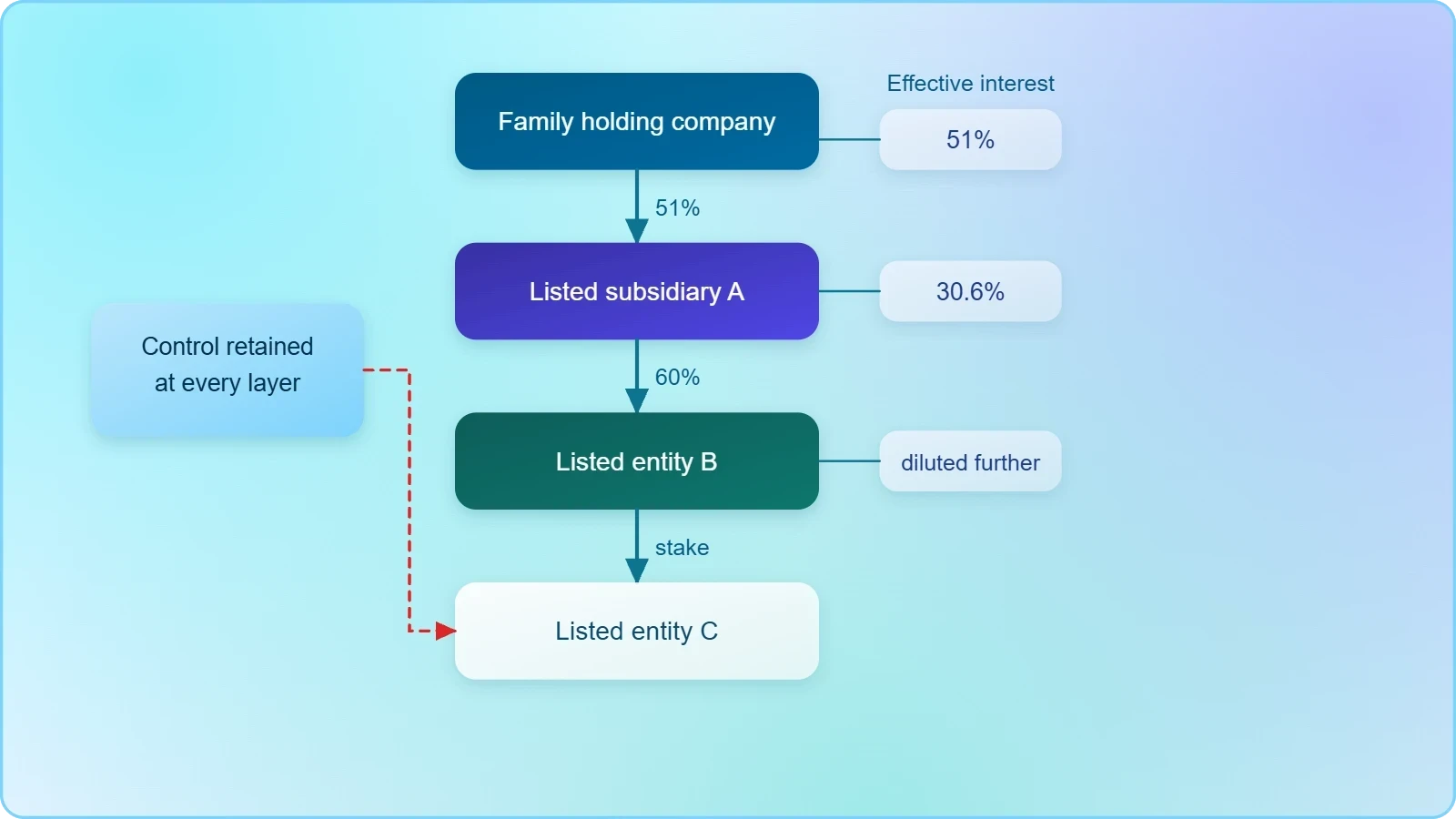
MSCI's framework treats this as a market accessibility problem because it affects the reliability of index construction and the enforceability of minority shareholder rights. When control is opaque, related-party transactions, quota allocations, and capital raises can be structured to benefit insiders at the expense of public investors, and the legal remedies available to minority holders are limited by the difficulty of proving who actually made the decision. The demutualization of the stock exchange, one of the OJK's eight reforms, addresses a different governance concern — the exchange's dual role as regulator and commercial entity — but does little to penetrate ownership pyramids.
The Liquidity Dimension
Free-float opacity compounds liquidity risk in ways that matter acutely for institutional investors. If a stock's apparent free float is larger than its true tradable supply, index funds building positions will discover that liquidity evaporates precisely when they need it most, during rebalancing events or market stress. Indonesia's experience during past episodes of foreign outflow illustrates the pattern: bid-ask spreads widen sharply, prices gap lower, and the cost of exiting a position exceeds the modeled tracking error by a wide margin. MSCI's liquidity concerns are therefore not academic; they reflect the practical difficulty of managing a benchmarked portfolio in a market where the investable supply is uncertain.
The January freeze on weight increases was designed in part to prevent index funds from being forced to accumulate positions in stocks whose true float could not be verified. By capping exposure, MSCI protected passive investors from the risk of holding more than the market could absorb. The measure also created an incentive for Jakarta to improve disclosure, since the freeze would only lift once MSCI was satisfied. That incentive structure has produced partial results, but the persistence of the freeze through 2026 suggests that the verification standard has not yet been met.
Coordinated Trading and the Enforcement Deficit
MSCI's October warning introduced a dimension that had been implicit in earlier communications but never stated so directly: coordinated trading. The allegation is that certain market participants act in concert to influence prices, creating artificial liquidity and volatility patterns that distort index calculations and disadvantage ordinary investors. Detecting coordinated trading requires sophisticated surveillance infrastructure, cross-market data sharing, and — crucially — a willingness to prosecute. MSCI's assessment that Indonesia has produced insufficient evidence of meaningful enforcement suggests that the surveillance may exist on paper while the follow-through does not.
The enforcement deficit is not unique to Indonesia, but its persistence in a market seeking emerging status carries outsized consequences. Regulators in comparable jurisdictions have demonstrated that coordinated trading can be identified through order-book analytics, communication records, and beneficial ownership linkage analysis. When a market authority announces reforms but produces few enforcement actions, index providers and foreign investors read the gap as evidence that political will is lacking. The result is a credibility discount that shows up in valuations, capital flows, and — most visibly — in MSCI's classification decisions.
The Political Economy of Weak Enforcement
Enforcement against coordinated trading inevitably touches powerful interests. In Indonesia, as in many emerging markets, the boundary between legitimate market-making, family-coordinated investment, and manipulative trading can be blurry, and the participants involved often have political connections that complicate prosecution. Regulators face pressure from multiple directions: foreign investors demand rigorous enforcement, domestic constituents resist scrutiny, and political patrons prefer stability over confrontation. The OJK's reform package addressed structural issues like free float and demutualization but said comparatively little about the enforcement machinery that would detect and punish coordinated behavior.
This asymmetry helps explain MSCI's frustration. Structural reforms are visible, announceable, and relatively low-cost to implement because they do not threaten specific actors. Enforcement is different: it requires naming names, building cases, and weathering the political backlash that follows. When a regulator announces eight reforms but cannot point to a single successful prosecution of coordinated trading, the market reasonably concludes that the reforms are designed to satisfy external reviewers rather than to change behavior. MSCI's October statement effectively made that inference explicit.
What Meaningful Enforcement Would Require
A credible enforcement regime would rest on several pillars. First, surveillance systems capable of detecting patterns across accounts, brokers, and asset classes in near real time, with algorithms tuned to flag wash trades, layering, and spoofing. Second, a legal framework that allows regulators to pierce beneficial ownership when investigating suspected coordination, including the power to compel disclosure from offshore entities. Third, an adjudication process that produces timely, public outcomes, because deterrence depends on visible consequences. Fourth, and most difficult, institutional independence sufficient to pursue cases regardless of the political connections of the parties involved.
Indonesia has made progress on the first pillar, with the IDX investing in market surveillance technology in recent years. The second remains constrained by the opacity of pyramidal structures and the limited reach of domestic regulators into offshore holding vehicles. The third has produced few high-profile outcomes, and the fourth is the binding constraint that MSCI has implicitly identified. Without demonstrable independence, the other pillars cannot deliver credible deterrence, and the enforcement deficit persists regardless of how many reforms are announced.
The Bayan Resources Transaction and the Credibility Question
No single episode better illustrates why investors doubt the consistency of Indonesia's reforms than the September 2026 agreement for Jhonlin Baratama to acquire a 30 percent stake in Bayan Resources at an 80.76 percent discount. Jhonlin Baratama is controlled by Haji Isam, a businessman with documented ties to the President, and the transaction's timing relative to regulatory decisions on Bayan's coal production quotas raised immediate questions. The government approved additional quotas shortly after the agreement was signed, a sequence that, while not evidence of impropriety, created an appearance of regulatory accommodation that markets could not ignore.
The discount itself demands scrutiny. An 80.76 percent discount to prevailing market value is extraordinary by any standard, and such pricing typically reflects either severe distress, restricted transferability, or a negotiated arrangement that compensates for non-market considerations. Bayan Resources is a major coal producer with substantial reserves, and the regulatory uncertainty surrounding its production quotas at the time of the agreement provided a plausible rationale for a steep discount. But the subsequent quota approval, arriving so soon after signing, undercut that rationale and suggested that the buyer may have had visibility into regulatory outcomes unavailable to public shareholders.
Regulatory Consistency as an Investor Protection Issue
For MSCI and foreign investors, the Bayan episode matters less for its specific facts than for what it signals about the predictability of regulation. A market where quota decisions, ownership approvals, and enforcement actions appear to correlate with political connections cannot offer the institutional stability that index inclusion requires. Investors can price risk when rules are clear and consistently applied; they cannot price the possibility that a connected buyer will receive favorable treatment that disadvantages minority holders. The resulting uncertainty premium suppresses valuations across the entire market, not just the companies directly involved.
The government's position — that there is no evidence linking the quota approval to the transaction — is legally defensible but institutionally insufficient. Modern market governance requires not only the absence of proven impropriety but the presence of procedures that make impropriety difficult and its appearance unlikely. When approvals follow connected transactions too closely, the burden shifts to regulators to demonstrate that decision-making was independent, documented, and consistent with published criteria. Indonesia's response to the Bayan questions did not meet that standard, and MSCI's October warning reflected the market's awareness of the gap.
Why Timing Undermines Reform Credibility
The broader lesson concerns sequencing. Reforms announced in response to external pressure, implemented partially, and then followed by transactions that appear to benefit connected parties create a pattern that investors interpret as evidence of superficial compliance. Each element individually might be explained away; together they form a narrative of a market where formal rules coexist with informal channels of influence. MSCI's repeated warnings are, in essence, a refusal to accept that narrative at face value while acknowledging that the formal reforms have not yet changed the underlying dynamics.
Breaking the pattern requires more than additional announcements. It requires visible cases where connected interests are denied favorable treatment, where enforcement actions proceed regardless of political ties, and where the timing of regulatory decisions is demonstrably independent of commercial transactions. Until such cases exist, each new reform package will be discounted by the market, and each new warning from MSCI will carry greater weight. The credibility deficit is cumulative, and it cannot be resolved by the same methods that created it.
We Also Published
- 01
- 02
- 03
- 04
What a Standalone Downgrade Would Actually Mean
The phrase "standalone market" carries a technical meaning that understates its practical severity. In MSCI's taxonomy, standalone markets are those that do not meet the accessibility criteria for inclusion in any of the standard regional or global indexes. Securities in such markets are excluded from the MSCI Emerging Markets Index, the MSCI ACWI, and the entire family of benchmarks that pension funds, sovereign wealth funds, and asset managers use to allocate capital. The exclusion is not a reduction in weight; it is a removal from the investable universe as defined by the world's most widely followed index provider.
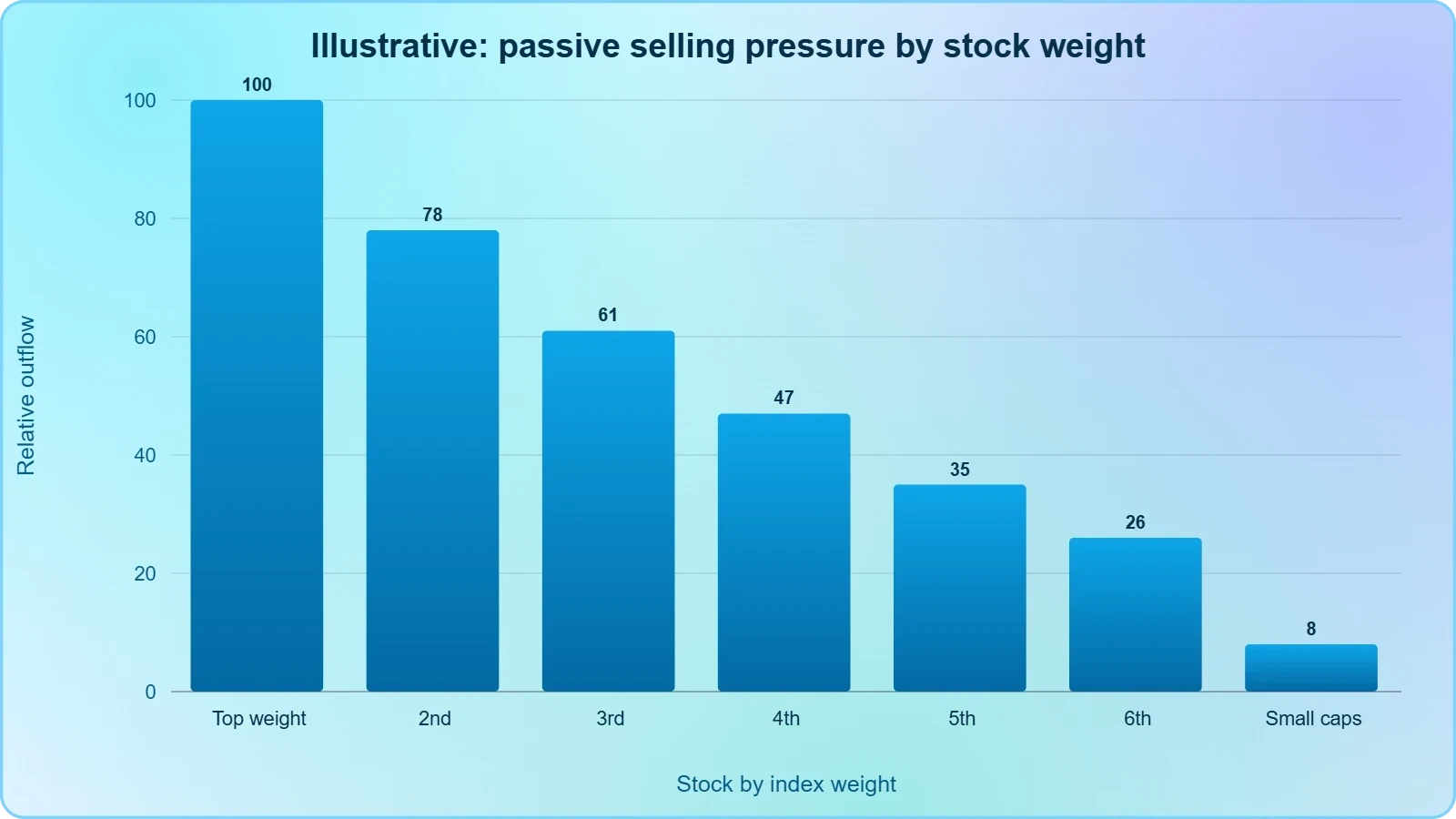
The capital flow consequences would be immediate and substantial. Passive funds tracking emerging market benchmarks would be required to sell Indonesian holdings, and the selling would be concentrated in the large, liquid names that currently carry the most weight. Active managers could theoretically maintain positions, but many operate under mandates that restrict investment to indexed markets, and benchmark-relative performance measurement becomes meaningless when the benchmark no longer includes the market. The result would be a structural reduction in the foreign investor base, with corresponding effects on liquidity, valuation, and the cost of capital.
Second-Order Effects on Corporates and the Currency
Beyond the direct portfolio flows, a standalone classification would raise borrowing costs for Indonesian corporates and the sovereign. Foreign investors price Indonesian assets with reference to comparable emerging markets; exclusion from the benchmark universe would widen spreads as the market loses its natural buyer base. The rupiah would likely face depreciation pressure as portfolio outflows accelerate, complicating the central bank's inflation management and potentially forcing defensive interest rate moves. Companies seeking to raise equity capital abroad would find fewer willing buyers and lower valuations, while domestic conglomerates might face reduced competition for assets, further entrenching existing ownership structures.
The irony is that a downgrade would disproportionately harm the reform-minded segments of the market — the companies that have improved disclosure, the investors who have engaged constructively, and the regulators who have pushed for change — while leaving the politically connected actors who benefit from opacity relatively insulated. This asymmetry helps explain why the reform process has been so difficult: the costs of failure are broadly distributed, but the costs of genuine enforcement are concentrated among powerful interests. MSCI's warnings are, in effect, an attempt to change that calculus by making the broad costs visible before they materialize.
Historical Precedents and Their Lessons
MSCI has reclassified markets before, and the precedents offer instructive parallels. Argentina's 2009 downgrade to frontier status followed years of capital controls and governance concerns, and the market did not regain emerging status until 2018 after sustained reforms. Qatar and the United Arab Emirates were upgraded in 2014 after addressing foreign ownership limits and settlement infrastructure. Greece was downgraded to emerging from developed in 2013 and has not returned. The common thread is that reclassification, once executed, tends to persist for years, and the path back requires demonstrable, sustained institutional change rather than announced intentions.
For Indonesia, the lesson is that the window for preventive action is narrowing. Each MSCI review that passes without meaningful enforcement strengthens the case for downgrade, and the provider's patience has already been tested across multiple cycles. The reforms announced in early 2026 bought time but did not resolve the underlying issues, and the October warning suggests that the credit has been largely exhausted. A decisive enforcement action against coordinated trading, coupled with genuine beneficial ownership transparency, could still alter the trajectory, but the political obstacles to such action are precisely why the market remains skeptical.
The Reform Agenda: What Would Actually Satisfy MSCI
MSCI's classification framework is published, transparent, and applied consistently across markets, which means the requirements for Indonesia are knowable rather than mysterious. The provider has been explicit about what it needs: reliable free-float data, transparent ultimate beneficial ownership, effective surveillance and enforcement against market manipulation, and a stable institutional framework insulated from political interference. The OJK's eight reforms address parts of this agenda, but the gaps are precisely in the areas that matter most for the classification decision, and closing them requires measures that go beyond what has been announced.
A genuinely credible reform program would begin with beneficial ownership disclosure that penetrates pyramidal structures, requiring listed companies to identify the natural persons who ultimately control them regardless of the number of intermediate entities. It would strengthen the IDX's surveillance capabilities and, more importantly, establish an independent enforcement unit with the authority and resources to pursue coordinated trading cases without political interference. It would reform the quota allocation process for commodities like coal to ensure that decisions are made according to published criteria and documented in a way that allows retrospective scrutiny. And it would establish a track record of enforcement actions that demonstrate the rules apply to everyone.
Beneficial Ownership: From Disclosure to Verification
The distinction between disclosure and verification is critical. Indonesia's current regime requires companies to disclose shareholders above certain thresholds, but it does not systematically verify that the disclosed information captures ultimate control. A verification regime would cross-reference corporate filings, offshore registry data, and transaction records to identify discrepancies, and it would impose penalties for inaccurate disclosure. Several jurisdictions have implemented such regimes in response to international standards, and the technology to support them — beneficial ownership registries, data matching algorithms, and international information exchange — is increasingly accessible.
Verification also requires international cooperation, because many Indonesian ownership structures route through Singapore, Hong Kong, and other offshore jurisdictions. Mutual legal assistance treaties and tax information exchange agreements provide channels for obtaining beneficial ownership data, but their use in market regulation has been limited. Strengthening these channels, and demonstrating a willingness to use them in specific cases, would signal to MSCI that Indonesia is serious about penetrating the structures that currently obscure control. Without such signals, disclosure reforms will continue to be discounted as incomplete.
Enforcement Independence as the Binding Constraint
The most difficult reform is also the most important: creating an enforcement apparatus that can act against politically connected parties. This requires institutional design that insulates decision-making from short-term political pressure, whether through fixed terms for enforcement officials, independent funding, or oversight mechanisms that include international participation. It also requires a cultural shift within the regulatory agencies, where career incentives have historically favored caution over confrontation. MSCI's assessment that enforcement evidence is insufficient reflects an observation about outcomes, but the underlying cause is institutional, and it will not be resolved by announcing additional reforms.
Comparable markets offer models. Malaysia's Securities Commission has pursued high-profile enforcement actions against connected parties, and South Korea's Financial Services Commission has demonstrated willingness to act against chaebol-affiliated entities. These examples show that enforcement independence is achievable in Asian markets with similar political economies, but they also show that it requires sustained political commitment at the highest levels. Indonesia's reform trajectory will depend on whether such commitment exists, and MSCI's warnings are, in part, a test of whether the political system will tolerate the consequences of genuine enforcement.
Implications for Investors and the Road Ahead
For foreign institutional investors, the MSCI warnings create a practical dilemma. Indonesia offers genuine growth exposure, a large domestic market, and commodity-linked earnings that diversify emerging market portfolios. But the governance discount is real, and the risk of reclassification introduces a tail scenario that portfolio construction must account for. Prudent managers are likely to maintain exposure at benchmark weight or below, avoid concentrated positions in stocks with opaque ownership, and build in liquidity buffers for the possibility of forced selling if a downgrade materializes. The cost of these precautions is a persistent valuation discount for Indonesian assets.
Domestic investors face a different calculus. A downgrade would reduce foreign competition for assets and could lower valuations, but it would also reduce market liquidity and increase volatility. Pension funds and insurance companies with long horizons might view the dislocation as an opportunity, but they would also bear the costs of a less liquid market and weaker price discovery. The net effect depends on the severity of the reclassification and the speed of any subsequent recovery, both of which are uncertain. What is clear is that the governance issues MSCI has identified affect all market participants, not just foreign ones.
Signals to Watch in the Coming Reviews
The next MSCI review will be read as a referendum on whether Indonesia's reforms have moved from announcement to implementation. Specific signals to monitor include the lifting of the interim freeze on index additions, which would indicate that free-float and ownership transparency concerns have been addressed; the announcement of enforcement actions against coordinated trading, which would demonstrate that the enforcement deficit is being closed; and the treatment of any new connected-party transactions, which would reveal whether regulatory decisions have become more independent. Absence of progress on these fronts would strengthen the case for downgrade.
Beyond MSCI, other index providers and rating agencies are watching. FTSE Russell, S&P Dow Jones Indices, and the major credit rating agencies all incorporate governance assessments into their methodologies, and a negative MSCI decision would likely be followed by similar actions elsewhere. The reputational cascade matters because it affects not only equity flows but also the cost of sovereign and corporate debt. Indonesia's fiscal position and infrastructure ambitions depend on access to international capital markets at reasonable rates, and a governance-driven risk premium would raise the cost of both.
The Longer-Term Institutional Question
Ultimately, the MSCI dispute is a symptom of a deeper institutional question: whether Indonesia can build market governance that is genuinely independent of political and business interests. The reforms announced in 2026 represent progress, but they were reactive, partial, and implemented under external pressure. Sustainable improvement requires domestic constituencies that demand transparency and enforcement — institutional investors, minority shareholder associations, academic researchers, and a free press willing to investigate connected transactions. Building those constituencies is a longer project than satisfying an index provider, but it is the only path to durable reform.
The historical record suggests that markets can make this transition. South Korea, Taiwan, and more recently Saudi Arabia have all moved from governance profiles that concerned index providers to profiles that satisfy them, and each did so through a combination of external pressure and domestic institutional development. Indonesia's trajectory is not predetermined, but the current pattern — warnings, partial reforms, connected transactions, renewed warnings — is not sustainable. At some point, the market must either demonstrate that the reforms are real or accept the consequences of a downgrade. MSCI's repeated warnings are an invitation to choose the former, and the window for doing so is narrowing.
From our network :
- The Hidden Cost of AI Convenience: Why Over-Permissioned Agents Are a Security Time BombDiscover why AI agents with excessive permissions create dangerous single points of failure, and learn how implementing least privilege principles can protect your organization from exploitation.
- How AI Agents Will Change the Way We Manage Personal FinancesExplore how AI agents are transforming personal finance through automated budgeting, bill payment, and investment management, while examining the critical security protocols and governance frameworks required for safe deployment.
- University Language Proficiency Exams: Why Institutional Tests Demand Different Preparation Than IELTS and TOEFLDiscover why university-specific language proficiency examinations differ fundamentally from IELTS and TOEFL, and learn strategic preparation approaches for institutional assessment success.
- Forbidden Matrix Patterns and Visible Lattice Points: A Geometric DictionaryExplore how multidimensional 0–1 matrices encode geometric truths, linking forbidden patterns to visible lattice points and hypergraph theory, with applications in combinatorics and computational geometry.
- Mobile Learning and VR in English: What Global Evidence Reveals About Effective Language TechnologyA systematic review across 14 countries reveals which language-learning technologies genuinely work. Mobile learning, AI, and VR show measurable benefits when pedagogically integrated. This evidence-based guide helps educators and learners select technology that delivers real return on investment.
- The Final Descent: How ESA Retired the Legendary Cluster Constellation After 24 Years of Space Weather ScienceAfter 24 years mapping Earth’s magnetosphere, ESA’s Cluster mission concluded with a precisely controlled reentry over the South Pacific. This analysis explores the scientific legacy, engineering decisions, and debris mitigation principles behind one of space exploration’s most responsible retirements.
- Committed Mediterranean Precipitation Decline: Why Emissions Cuts Alone Cannot Restore Winter RainsNew NOAA research reveals that Mediterranean winter rains may decline irreversibly even with emissions cuts. Explore the science of committed climate change and regional impacts.
- CISA’s Ten-Advisory Wave: Why Generic Patching Fails in OT and How to Build Product-Specific PlaybooksCISA released ten ICS advisories in one week, exposing critical infrastructure risks. Generic patching fails in OT. Learn to build product-specific remediation playbooks.
- Live Online English Classes for Kids: Do They Actually Reduce Anxiety?A ten-week study reveals that synchronous online English classes can significantly reduce child language anxiety while improving listening and reading skills. Discover what makes these programs effective and how parents can select the right one.
RESOURCES
- Top Indonesian financial regulators quit after $80 billion market ...reuters.comJan 30, 2026 ... ... market rout and mounting concerns over transparency and governance. The departures followed a warning from MSCI that it may…
- MSCI Launches a Consultation on a Proposal to Reclassify ...ir.msci.comOct 15, 2026 ... ... MSCI Indonesia Indexes from Emerging Market to Standalone Market status. ... market governance and functioning to warrant reconsideration.
- Barbican's Chris Leahy on Indonesia's MSCI Index Risk - LinkedInlinkedin.comOct 16, 2026 ... Indonesia's stock market sold off as the result of an MSCI warning over governance ...
- MSCI Warning On Indonesia Highlights Power Of Its Market ...finance.yahoo.comFeb 1, 2026 ... MSCI has issued a warning on data transparency and trading irregularities on the Indonesia Stock Exchange. The index provider signaled…
- MSCI Ignites Indonesia Market Reckoning After Months of Warningsbloomberg.comOct 16, 2026 ... signaled it expects to remove Indonesia from its global indexes barring major improvements in market governance, which would strip Indonesia…
- LISTEN: What's next for Indonesia after MSCI's downgrade warning ...facebook.comOct 24, 2026 ... What's Next? BLOOMBERG.COM. Live Q&A: MSCI's Double Downgrade Warning Whipsaws Indonesian Markets. What's ...
- Indonesia Stocks Sink Most in 28 Years on MSCI Downgrade Warningbloomberg.comOct 16, 2026 ... ... market governance. Indonesian Stocks Plunge as MSCI Mulls Downgrade. Source: Bloomberg. At the heart of MSCI's concerns are opaque ...
- MSCI's Indonesia Warning: A Welcome Catalyst for Changenicheam.comJan 30, 2026 ... MSCI stated this week that it sees “fundamental investability issues” in the Indonesian equity market, citing persistently low free-float levels ...
- Indonesia's belated response to MSCI's downgrade warning ...facebook.com6 hours ago ... Indonesia's belated response to MSCI's downgrade warning exposes how long market governance flaws were ignored.
- Letter: MSCI owes investors an explanation for its Indonesia warningft.comOct 28, 2026 ... Indeed, Indonesia's capital market ... Shortly after the warning, Indonesia's government reportedly began considering restrictions on gas exports ...
- MSCI Fires Downgrade Warning Shot At Indonesia, Equities Weakenwealthbriefing.comOct 20, 2026 ... ... MSCI Indonesia Indexes from “Emerging Market” to “Standalone Market ... market governance and functioning to warrant reconsideration,” it said.
- MSCI's warning does not define Indonesia's economybusinesstimes.com.sg2 days ago ... MSCI is questioning the investability and governance of Indonesia's equity market, not declaring that South-east Asia's largest economy has lost ...
- Indonesia stocks sink on MSCI downgrade warning - Taipei Timestaipeitimes.comOct 17, 2026 ... ... market governance. At the heart of MSCI's concerns are opaque shareholding structures, suspected coordinated trading and weak enforcement ...
- Free Float, Ownership Transparency and Governance Qualityglasslewis.comFeb 11, 2026 ... This article examines recent volatility in Indonesia's equity market following MSCI's investability and ownership transparency concerns in ...
- Shock MSCI move triggers Indonesian market chaos | ACGAacga-asia.orgFeb 2, 2026 ... ... warning, the results of a recent consultation on free float ... Another source familiar with US government thinking told…
- 01
- 02
- 03
- 04
- 05
- 06
- 07
- 08
0 Comments