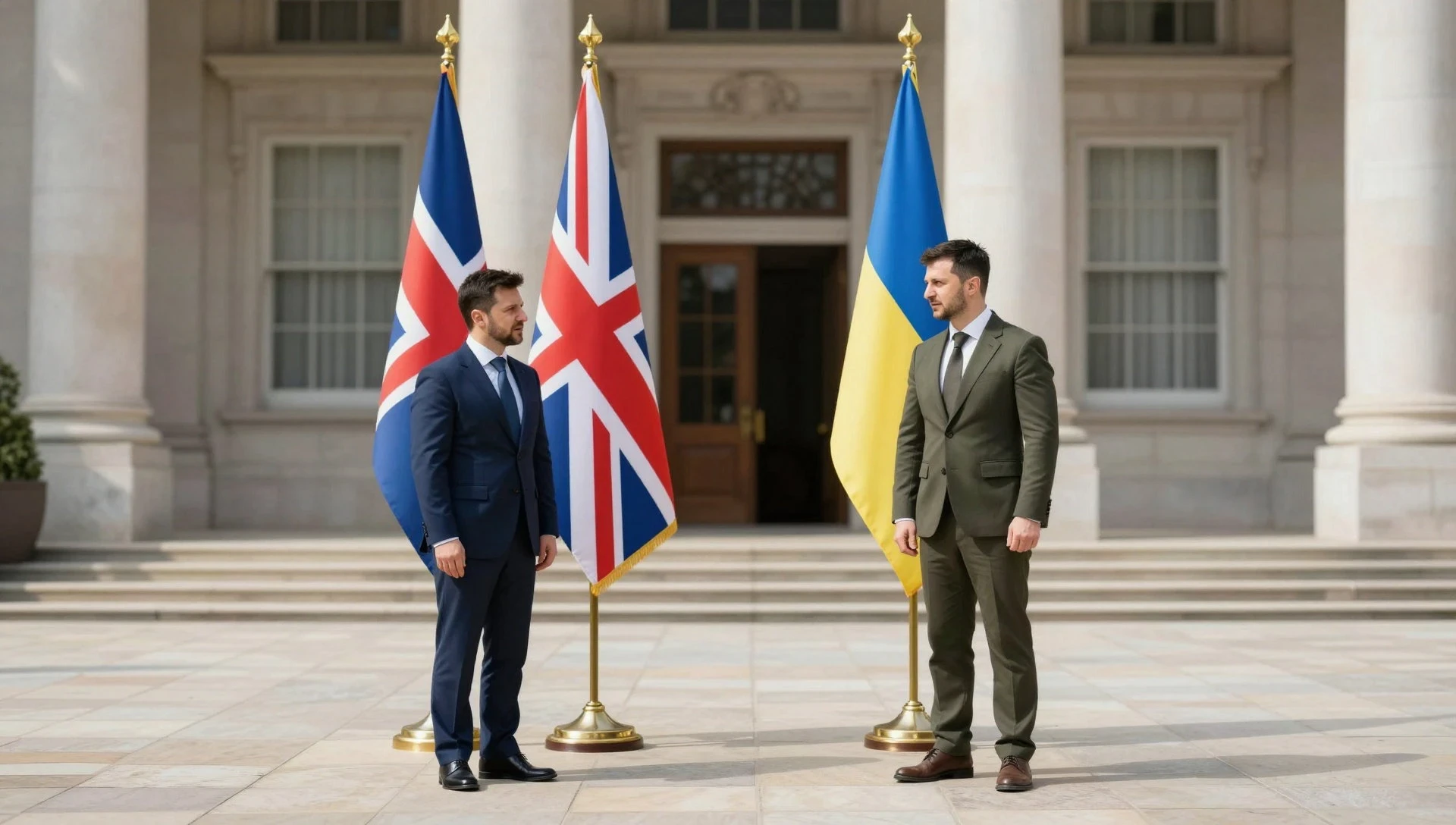
When British and Ukrainian officials sat down in Kyiv on 11–12 November 2026 for their annual Strategic Dialogue, the meeting was less a diplomatic formality than a working session on how a modern state sustains a long war. The two delegations reviewed progress under the 100-Year Partnership, the bilateral framework that has become the spine of their relationship, and took stock of the UK's £10.5 billion support package.
The agenda was unglamorous and urgent: countering winter strikes on energy infrastructure, thickening air defences, and advancing a Special Tribunal for the Crime of Aggression.
What makes the dialogue consequential is not any single announcement but the architecture it represents. Across Europe, bilateral "century pacts" are steadily displacing the open-ended, ad-hoc multilateral aid packages that defined the first years of the response to Russia's invasion. These agreements convert emergency generosity into institutional commitment, embedding a long-term war footing into treaty text, budget lines and industrial planning. The shift is quiet, technical and largely unnoticed outside specialist circles, yet it is reshaping how European security is financed, organised and sustained.
On This Page
- The Kyiv Dialogue and the Logic of the 100-Year Partnership
- The £10.5 Billion Package and the Economics of Sustained Support
- Winter Strikes and the Defence of Energy Infrastructure
- Air Defences and the Layered Shield
- The Special Tribunal and the Pursuit of Accountability
- Bilateral Century Pacts and the Reshaping of European Security
- What the Dialogue Reveals About Long-Term War Footing
This analysis examines the Kyiv dialogue as a case study in that transition. It traces the substance of the 100-Year Partnership, the mechanics of the £10.5 billion package, the winter-strike threat to energy infrastructure, the air-defence dimension, and the legal ambition behind the Special Tribunal. It then situates the bilateral model within the wider European security architecture, weighing what such pacts achieve and where their limits lie.
TL;DR The UK–Ukraine Strategic Dialogue of 11–12 November 2026 reviewed the 100-Year Partnership and a £10.5 billion support package, prioritising winter energy defence, air defences and a Special Tribunal, and illustrating how bilateral century pacts are institutionalising a long-term European war footing.
The Kyiv Dialogue and the Logic of the 100-Year Partnership
The annual Strategic Dialogue is the operational heartbeat of a relationship that both governments have chosen to frame in generational terms. Held in Kyiv over two days, the November 2026 session brought together British and Ukrainian officials to audit delivery rather than merely declare intent. The 100-Year Partnership supplies the overarching framework, a long-horizon agreement that commits both sides to cooperation across defence, security, reconstruction and institutional reform. The dialogue is where that framework is tested against reality.
Framing a partnership over a century is a deliberate act of political signalling. It tells allies, adversaries and domestic publics that support is not contingent on a single budget cycle or election. For Kyiv, such a commitment offers predictability amid the uncertainty of coalition politics elsewhere. For London, it anchors influence in a region that will shape European security for decades. The dialogue therefore functions as a recurring accountability mechanism for a promise designed to outlast the governments that made it.
From Declaration to Delivery
The value of a long-horizon pact lies in whether it survives contact with delivery schedules. The Kyiv session reviewed progress across the partnership's workstreams, converting broad commitments into tracked obligations. Officials examined what had been funded, what had been shipped and what remained outstanding, with the £10.5 billion support package serving as the principal yardstick. This is the unglamorous machinery of statecraft: procurement timelines, training pipelines and legal drafting rather than communiqués.
That emphasis on delivery reflects a broader lesson drawn across European capitals. Declarations of solidarity age quickly; institutionalised commitments endure. By meeting annually and reviewing concrete progress, the two governments create a rhythm of scrutiny that makes drift visible. The dialogue thus performs a function similar to a corporate audit, checking whether the strategy on paper matches the resources actually deployed on the ground.
Why Bilateral Framing Matters
Bilateral framing offers advantages that multilateral packages struggle to match. A single partner can move faster, tailor support to specific needs and avoid the lowest-common-denominator compromises that large coalitions often produce. The UK–Ukraine relationship illustrates this: the two sides can align on priorities such as air defence and energy protection without waiting for consensus across dozens of capitals. Speed and specificity become the currency of the partnership.
Yet bilateralism also concentrates risk. A century pact binds the fortunes of one supporter to one partner, exposing the arrangement to shifts in domestic politics, fiscal pressure and strategic fashion. The dialogue's annual cadence is partly a hedge against that risk, creating regular opportunities to recalibrate. The model works best when it is nested within wider multilateral structures rather than substituting for them entirely.
The £10.5 Billion Package and the Economics of Sustained Support
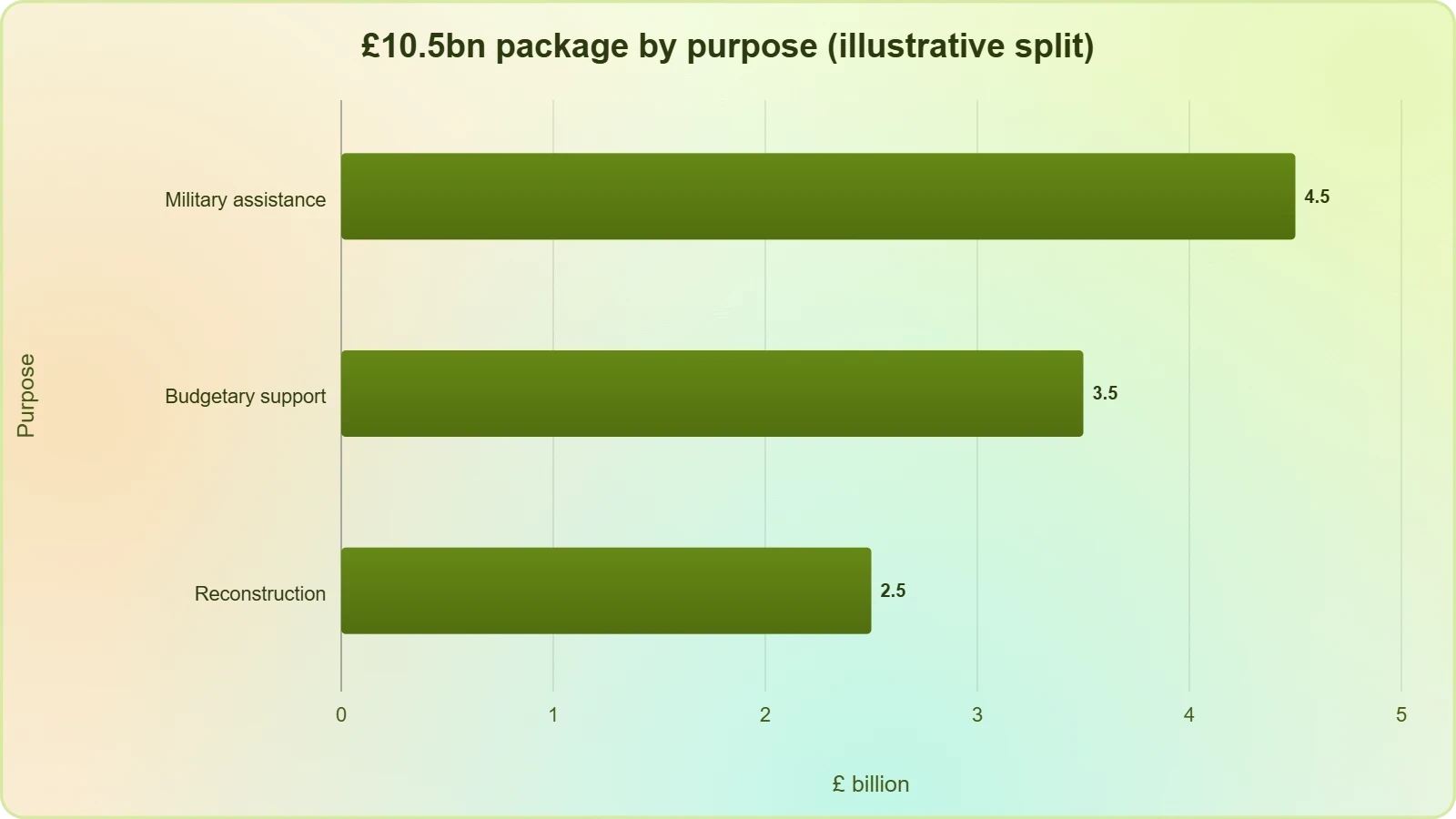
Money is the clearest measure of commitment, and the £10.5 billion support package reviewed in Kyiv is the partnership's most tangible expression. The figure spans military assistance, financial support and reconstruction-related commitments, and the dialogue treated it as a living ledger to be audited rather than a headline to be celebrated. Officials examined disbursement against pledges, the balance between immediate military need and longer-term rebuilding, and the administrative capacity required to absorb support at scale.
The economics of sustained support differ sharply from those of emergency aid. Emergency packages are designed for speed and visibility; long-term support demands predictable financing, multi-year budgeting and integration with the recipient's own planning. The dialogue's focus on delivery reflects an awareness that the hardest part of a large package is not announcing it but converting it into functioning capability. That conversion depends on procurement, training, logistics and maintenance as much as on the headline sum.
Composition and Disbursement
The composition of the package matters as much as its size. Military assistance, budgetary support and reconstruction funding serve different purposes and operate on different timelines. Military aid must respond to the tempo of the war; budgetary support keeps the state functioning; reconstruction investment looks years ahead. The dialogue reviewed how these strands interact, since a shortfall in any one can undermine the others. A government that cannot pay salaries cannot absorb weapons effectively.
Disbursement is where ambition meets bureaucracy. Large pledges must pass through procurement rules, parliamentary approvals and delivery chains before they reach the front line or the reconstruction site. The Kyiv session examined these bottlenecks, treating administrative friction as a strategic problem rather than a technical footnote. The lesson is that the credibility of a century pact rests on the mundane efficiency of its financial plumbing.
Predictability as Strategic Value
For a partner fighting a long war, predictability is itself a form of capability. Multi-year commitments allow planners to schedule training, order equipment and design defences without lurching from one funding crisis to the next. The 100-Year Partnership's value lies partly in this stabilising effect, giving Ukrainian institutions a horizon against which to plan. The £10.5 billion package, reviewed annually, becomes a recurring anchor rather than a one-off gesture.
Predictability also shapes the behaviour of adversaries. A supporter whose commitment is visibly institutionalised is harder to outlast than one whose aid depends on shifting political moods. The dialogue's annual rhythm signals durability, and durability is a strategic asset in a war of attrition. The financial architecture thus carries a message that extends well beyond the balance sheet.
Winter Strikes and the Defence of Energy Infrastructure
Winter has become a season of strategic vulnerability in this war, and the dialogue placed the threat to energy infrastructure at the top of its agenda. Cold weather raises demand for heat and power at precisely the moment when attacks on generation and transmission can inflict the widest civilian harm.
Countering winter strikes is therefore not a humanitarian afterthought but a core defensive mission, requiring the protection of substations, the dispersal of generation and the rapid repair of damage.
The challenge is asymmetric. Defending scattered infrastructure against sustained attack demands layered protection, redundancy and repair capacity, while the attacker needs only to find gaps. The dialogue's focus on this problem reflects a recognition that energy resilience is now inseparable from military resilience. A grid that fails in January undermines both civilian morale and industrial output, and it complicates the logistics on which the armed forces depend.
Protecting the Grid
Grid protection combines physical hardening, air defence and rapid restoration. Substations can be shielded, critical nodes can be duplicated, and repair crews can be pre-positioned with spare equipment. Each measure reduces the duration of outages even when attacks succeed. The dialogue reviewed how British support can reinforce these layers, treating energy security as a system to be defended rather than a set of assets to be guarded individually.
Redundancy is the organising principle. A grid with multiple paths for power and stocked reserves of transformers and cables can absorb damage that would otherwise cascade. The lesson from previous winters is that resilience is built before the cold arrives, through planning and stockpiling, rather than improvised during a crisis. The November timing of the dialogue is itself a recognition that preparation must precede the freeze.
Repair Capacity as Deterrence
Repair capacity functions as a form of deterrence. If an adversary knows that damage will be restored quickly, the military value of each strike falls. Stockpiles of critical components, trained crews and pre-arranged logistics all shorten restoration times and blunt the attacker's intended effect. The dialogue's attention to repair reflects a mature understanding that defence is not only about interception but about recovery.
This approach also has an economic dimension. Prolonged outages damage industrial output, tax revenue and public confidence, with effects that outlast the immediate emergency. Investing in repair capacity protects the economic base that sustains the war effort. Energy resilience thus sits at the intersection of military, humanitarian and economic strategy, which is why it earned a central place in the Kyiv discussions.
Air Defences and the Layered Shield
Air defence is the most visible dimension of the partnership and the one on which the winter agenda most directly depends. Protecting cities, infrastructure and front-line forces requires a layered shield that spans short-range interception, medium-range coverage and strategic systems. No single system covers every threat, and the dialogue reviewed how British support fits into a broader architecture that must integrate radars, interceptors, command networks and trained crews.
The challenge is as much about sustainability as capability. Air defence consumes interceptors at a high rate, and a shield that cannot be resupplied becomes a temporary gesture. The dialogue therefore examined not only what systems are provided but how they are sustained over time, including maintenance, training and the industrial capacity to replenish stocks. A layered shield is only as strong as its weakest logistical link.
Integration and Command
Integration is where air defence succeeds or fails. Radars must feed a common picture, commanders must allocate interceptors efficiently, and crews must train against realistic threats. The dialogue's emphasis on integration reflects the recognition that disparate systems, however capable individually, deliver less than the sum of their parts unless they are networked. Command arrangements determine whether a shield responds coherently or piecemeal.
Training is the human counterpart to hardware. Operators must recognise threats, manage engagements under pressure and maintain complex equipment in austere conditions. The partnership's support for training therefore complements the transfer of systems, ensuring that capability is not merely delivered but absorbed. The dialogue treated this as a long-term investment rather than a short-term transaction.
Sustainability and Resupply
Sustainability is the quiet determinant of air-defence effectiveness. Interceptor stocks deplete quickly under sustained attack, and resupply depends on production lines, contracts and logistics that stretch far beyond the battlefield. The dialogue reviewed how to keep the shield supplied over a long horizon, treating industrial capacity as part of the defence architecture. A century pact must plan for decades of production, not just a single delivery.
This is where bilateral partnerships show their value. A single committed supplier can align production, training and maintenance with a partner's specific needs, avoiding the coordination costs of a large coalition. The trade-off is dependence, which is why the partnership's long horizon matters: it converts a transactional relationship into a structural one, with the predictability that sustained defence requires.
We Also Published
The Special Tribunal and the Pursuit of Accountability
The third pillar of the dialogue, the Special Tribunal for the Crime of Aggression, addresses a legal question with profound political consequences. Aggression is a leadership crime, and prosecuting it requires a tribunal with jurisdiction over the individuals who ordered it. The dialogue reviewed progress toward establishing such a body, treating accountability as integral to the partnership rather than as a separate diplomatic track. Law, in this framing, is part of the architecture of deterrence.
The legal ambition is considerable. A tribunal must be grounded in a defensible jurisdictional basis, supported by evidence-gathering mechanisms and integrated with existing institutions. The dialogue's attention to these technical questions reflects an awareness that legitimacy depends on procedure as much as on principle. A tribunal that is seen as fair and lawful carries far greater weight than one that is merely political.
Jurisdiction and Legitimacy
Jurisdiction is the central legal puzzle. The crime of aggression sits awkwardly within existing frameworks, and constructing a tribunal requires careful legal design to ensure its rulings are accepted internationally. The dialogue examined how to build a body whose authority rests on law rather than power, since legitimacy is the tribunal's ultimate currency. The technical work is unglamorous but decisive.
Legitimacy also depends on the breadth of support. A tribunal endorsed by a wide coalition of states carries more weight than one backed by a narrow group. The partnership's diplomatic effort therefore extends beyond the bilateral relationship, seeking to build the international consensus that a credible tribunal requires. Accountability becomes a collective project rather than a single partner's initiative.
Evidence and Long Horizons
Evidence-gathering is a long-horizon enterprise. Testimony must be preserved, documentation secured and chains of custody maintained across years. The dialogue's focus on these mechanisms reflects an understanding that accountability is a marathon, not a sprint. The 100-Year Partnership's long horizon is well suited to this work, providing the institutional continuity that evidence collection demands.
The pursuit of accountability also serves a forward-looking purpose. A tribunal that establishes legal precedent shapes the norms that constrain future aggression. The dialogue therefore treated the tribunal not only as a response to past acts but as an investment in the international order. Law becomes a form of deterrence, and the partnership a vehicle for building it.
- 01
- 02
- 03
- 04
Bilateral Century Pacts and the Reshaping of European Security
The Kyiv dialogue is best understood as an instance of a wider pattern. Across Europe, bilateral century pacts are replacing open-ended, ad-hoc multilateral aid packages as the preferred instrument of long-term security commitment. These agreements bind individual partners to individual recipients over generational horizons, embedding support in treaty text and multi-year budgets. The shift is quiet but consequential, changing how European security is financed, organised and sustained.
The appeal of the bilateral model lies in its specificity and durability. A single partner can tailor support, move quickly and plan over decades, avoiding the coordination costs and political fragility of large coalitions. The trade-off is concentration of risk and potential fragmentation, as overlapping bilateral arrangements may produce a patchwork rather than a coherent architecture. The dialogue illustrates both the strengths and the tensions of this approach.
From Ad-Hoc Aid to Institutional Commitment
Ad-hoc aid packages were designed for emergencies, and they served that purpose. But emergencies give way to protracted conflicts, and protracted conflicts demand predictable, institutionalised support. Century pacts respond to this shift by converting generosity into obligation, embedding commitments in frameworks that outlast governments. The dialogue's annual review mechanism is the operational expression of that conversion, turning a promise into a recurring audit.
Institutionalisation also changes the politics of support. A commitment embedded in a long-horizon framework is harder to reverse than a discretionary package, raising the political cost of withdrawal. This durability is precisely what the bilateral model offers, and it is why such pacts are proliferating. The trade-off is reduced flexibility, since long commitments constrain future choices as well as securing them.
Fragmentation and Coordination Risks
Fragmentation is the principal risk of the bilateral turn. If every partner negotiates its own century pact, the result may be a mosaic of overlapping commitments rather than a coherent strategy. Coordination mechanisms become essential to prevent duplication and gaps. The dialogue's emphasis on integration, whether in air defence or energy resilience, reflects an awareness that bilateral arrangements must be nested within wider structures to function effectively.
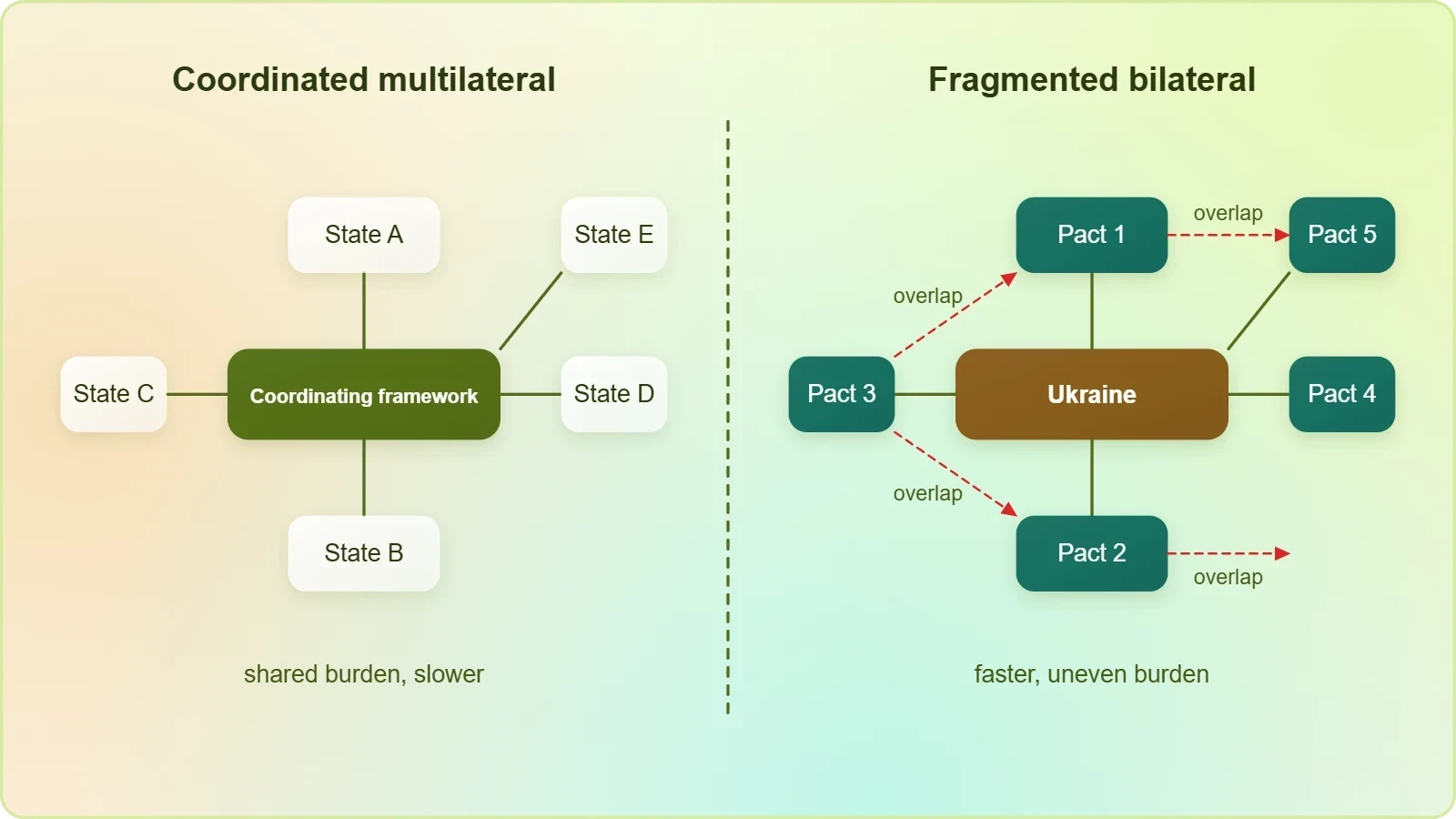
Coordination also matters for burden-sharing. A patchwork of bilateral deals may distribute costs unevenly, placing disproportionate weight on the most committed partners. Multilateral frameworks can balance burdens in ways that bilateral pacts struggle to achieve. The future of European security architecture therefore lies not in choosing between bilateral and multilateral models but in combining them intelligently.
What the Dialogue Reveals About Long-Term War Footing
The Kyiv dialogue reveals a broader truth about how modern states prepare for prolonged conflict. Long-term war footing is not a single decision but an accumulation of institutional choices: multi-year budgets, treaty commitments, industrial planning and legal frameworks. The 100-Year Partnership and the £10.5 billion package are expressions of this accumulation, converting a political promise into a structure that can survive changes of government and shifts in public attention.
This institutionalisation carries costs as well as benefits. Long commitments constrain future choices, and structures built for war can outlast the circumstances that justified them. The dialogue's annual review mechanism is a partial answer to this problem, creating opportunities for recalibration. But the deeper question, of how democracies sustain long commitments without losing the flexibility to adapt, remains unresolved and will shape European security for years.
Institutionalising Commitment
Institutionalisation is the mechanism by which short-term resolve becomes long-term capacity. Budget lines, procurement contracts and treaty obligations all embed commitment in structures that persist beyond individual leaders. The dialogue's review of the £10.5 billion package illustrates this process, treating support as a managed portfolio rather than a series of gestures. The result is a war footing that is planned rather than improvised.
This has implications beyond the bilateral relationship. If century pacts become the norm, European security will be organised around a web of long-horizon commitments rather than a single multilateral framework. Such a system may be more resilient to individual political shocks but harder to coordinate. The dialogue offers a preview of both the promise and the complexity of that emerging architecture.
Risks and Recalibration
The risks of long-term war footing are real. Commitments can become rigid, resources can be locked into outdated priorities, and publics can tire of conflicts that seem endless. The dialogue's annual cadence is designed to mitigate these risks by creating regular moments of review. Whether that mechanism is sufficient to keep a century pact responsive to changing circumstances is a question that only time will answer.
Recalibration also requires political courage. Adjusting a long-horizon commitment is harder than making one, because it invites accusations of retreat. The partnership's durability will therefore depend not only on its legal architecture but on the political skill of those who manage it. The Kyiv dialogue is a snapshot of that management in action, and its lessons extend well beyond the two capitals involved.
Disclaimer: This article is an analytical commentary based on the publicly issued UK–Ukraine joint statement following the Strategic Dialogue of 11–12 November 2026. It is intended for informational purposes only and does not constitute legal, political or investment advice. Readers should consult primary sources for authoritative details.
Disclaimer: This article is for general information and education only. It describes what historical prices and technical indicators showed on the date mentioned and does not predict future movements. It is not investment advice, a recommendation, or an offer to buy or sell any security. Indicators are calculated from past data and can mislead, and all investments carry risk. Please consult a SEBI-registered investment adviser before making any financial decision.
From our network :
- Forbidden Matrix Patterns and Visible Lattice Points: A Geometric DictionaryExplore how multidimensional 0–1 matrices encode geometric truths, linking forbidden patterns to visible lattice points and hypergraph theory, with applications in combinatorics and computational geometry.
- Committed Mediterranean Precipitation Decline: Why Emissions Cuts Alone Cannot Restore Winter RainsNew NOAA research reveals that Mediterranean winter rains may decline irreversibly even with emissions cuts. Explore the science of committed climate change and regional impacts.
- CISA’s Ten-Advisory Wave: Why Generic Patching Fails in OT and How to Build Product-Specific PlaybooksCISA released ten ICS advisories in one week, exposing critical infrastructure risks. Generic patching fails in OT. Learn to build product-specific remediation playbooks.
- The Hidden Cost of AI Convenience: Why Over-Permissioned Agents Are a Security Time BombDiscover why AI agents with excessive permissions create dangerous single points of failure, and learn how implementing least privilege principles can protect your organization from exploitation.
- The Final Descent: How ESA Retired the Legendary Cluster Constellation After 24 Years of Space Weather ScienceAfter 24 years mapping Earth’s magnetosphere, ESA’s Cluster mission concluded with a precisely controlled reentry over the South Pacific. This analysis explores the scientific legacy, engineering decisions, and debris mitigation principles behind one of space exploration’s most responsible retirements.
- How AI Agents Will Change the Way We Manage Personal FinancesExplore how AI agents are transforming personal finance through automated budgeting, bill payment, and investment management, while examining the critical security protocols and governance frameworks required for safe deployment.
- Mobile Learning and VR in English: What Global Evidence Reveals About Effective Language TechnologyA systematic review across 14 countries reveals which language-learning technologies genuinely work. Mobile learning, AI, and VR show measurable benefits when pedagogically integrated. This evidence-based guide helps educators and learners select technology that delivers real return on investment.
- Live Online English Classes for Kids: Do They Actually Reduce Anxiety?A ten-week study reveals that synchronous online English classes can significantly reduce child language anxiety while improving listening and reading skills. Discover what makes these programs effective and how parents can select the right one.
- University Language Proficiency Exams: Why Institutional Tests Demand Different Preparation Than IELTS and TOEFLDiscover why university-specific language proficiency examinations differ fundamentally from IELTS and TOEFL, and learn strategic preparation approaches for institutional assessment success.
RESOURCES
- UK-Ukraine 100 Year Partnership Declaration - GOV.UKgov.ukJan 17, 2025 ... The UK will support Ukrainian defence and security leadership through education and mentoring. We will establish a permanent security dialogue ...
- Joint Leaders Statement of Ukraine and the UK on Strategic Dialoguepresident.gov.uaMar 17, 2026 ... It ensures the progress of commitments made in the landmark 100 Year Partnership, the 2020 Strategic Partnership Agreement and the…
- UK and Ukraine sign landmark 100 Year Partnership to deepen ...gov.ukJan 16, 2025 ... UK and Ukraine sign landmark 100 Year Partnership to deepen security ties and strengthen partnership for future generations ... The…
- UK-Ukraine 100-year partnership agreement: House of Lords ...lordslibrary.parliament.ukApr 16, 2025 ... The UK signed a 100-year partnership agreement with Ukraine in January 2025, setting out commitments to cooperate on defence and…
- “UK-Ukraine 100 Year Partnership Agreement” UK Government ...committees.parliament.ukthe UK – Ukraine Strategic Dialogue. Defence and security cooperation. We would urge the Government to develop more concrete plans on how effective ...
- Joint Statement on the 2026 Ukraine-UK Strategic Dialoguemfa.gov.ua1 day ago ... Ukraine and the UK welcomed progress under the 100-Year Partnership since it was signed in January 2025, including deeper cooperation…
- Starmer and Zelenskyy sign '100-year partnership' agreement ... - PBSpbs.orgJan 16, 2025 ... ... 100-year partnership' agreement between UK and Ukraine. World ... U.K. would "play our part" in guaranteeing Ukraine's post-war security.
- Canada-Ukraine declaration for a 100 year partnershipinternational.gc.caOct 6, 2026 ... Building upon the Canada–Ukraine Strategic Security Partnership ... strategic dialogue led by the Ministers of Foreign Affairs and of Defence.
- U.K.'s Starmer in Kyiv for security talks with a pledge for a '100-year ...nbcnews.comJan 16, 2025 ... The British government said Starmer and Ukrainian President Volodymyr Zelenskyy will sign a “100-Year Partnership” treaty in Kyiv covering areas ...
- What has the UK promised Ukraine in Starmer's 100-year deal?aljazeera.comJan 17, 2025 ... Prime Minister Keir Starmer said the partnership agreement would ensure Ukraine's 'security'.
- UK-Ukraine 100 Year Partnership Agreement - Parliament UKpublications.parliament.ukMar 26, 2025 ... It covers a broad range of areas, from defence and maritime security to trade and investment, outlining key principles to…
- UK's '100-year partnership' with Ukraine is a meaningless political ...aljazeera.comJan 24, 2025 ... Unlike in the US, UK policy towards Ukraine enjoys strong ... The strategic dialogue announced last week was included in…
- House of Lords - UK-Ukraine 100 Year Partnership Agreementpublications.parliament.ukThe question of security guarantees became still more prominent in early 2025, when the US initiated peace talks in an attempt to bring the…
- Bridget Phillipson's post - Facebookfacebook.comMay 20, 2026 ... It was a pleasure to celebrate another landmark moment in the UK-Ukraine 100-Year Partnership, as I met with Ukrainian Education…
- UK pledges support for Ukraine with 'landmark' 100-year deal - BBCbbc.comJan 16, 2025 ... ... collaboration on maritime security and drone technology. The UK will also continue to train Ukrainian troops. More than 50,000…
- 01
- 02
- 03
- 04
- 05
- 06
- 07
- 08
0 Comments