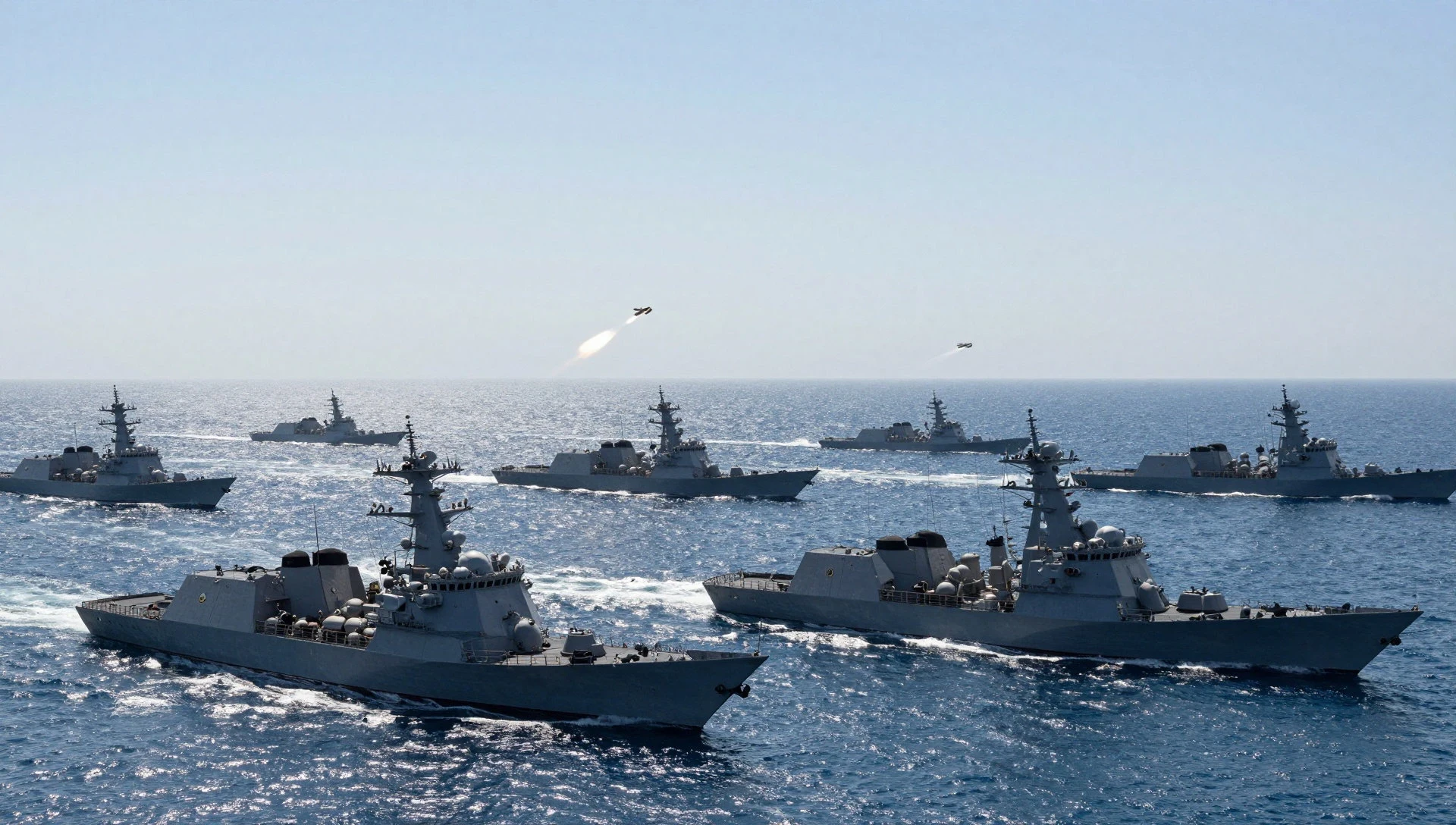
The establishment of Task Force Iron Gate on November 7, 2026, marks a defining moment in the intersection of American domestic politics and Middle Eastern security commitments. CENTCOM created this dedicated naval formation to protect the Red Sea and Gulf transit lanes against renewed drone and missile strikes by Iranian-backed Houthi forces, a mission that carries immediate operational weight and long-term strategic consequences.
What makes this deployment especially consequential is its timing: it arrived in the immediate aftermath of U.S. midterm elections that reshaped the legislative landscape, placing a new set of congressional majorities in direct conversation with an executive branch that has already committed forces abroad.
The core tension the source identifies is institutional rather than tactical. A divided government, in which the legislature and the executive are controlled by different parties or factions, has historically served as a check on prolonged military engagements. Yet naval deterrence missions possess a peculiar inertia: once ships are deployed and transit lanes are declared vital, reversing course becomes politically costly.
On This Page
The question at the heart of this analysis is whether post-midterm legislative majorities will act as a brake on the mission or whether the operational realities of Red Sea security will lock in a protracted commitment regardless of partisan composition on Capitol Hill.
Congressional debates have escalated along three interlocking axes: military expenditures, the scope of overseas engagements, and the boundaries of executive foreign policy authority. Each of these debates touches the Iron Gate mission directly, because sustaining a naval task force requires appropriations, because the mission's open-ended character invites scrutiny under war powers frameworks, and because the executive's ability to initiate and sustain such operations without explicit legislative authorization remains contested.
Understanding how these three threads interact is essential to grasping what the mission signals about American governance, alliance credibility, and the future of deterrence in one of the world's most economically vital waterways.
TL;DR CENTCOM established Task Force Iron Gate on November 7, 2026, to secure Red Sea and Gulf transit lanes against renewed Houthi drone and missile strikes, while post-midterm congressional majorities debate military spending, overseas engagements, and executive foreign policy authority — testing whether divided government constrains or cements protracted naval deterrence.
The Strategic Logic Behind Task Force Iron Gate
The Red Sea and the Gulf together constitute one of the most consequential maritime corridors in the global economy. A substantial share of seaborne trade, including energy shipments and containerized goods, passes through these waters, and any disruption ripples outward into insurance premiums, shipping schedules, and consumer prices across continents.
When Houthi forces renewed drone and missile strikes, the threat was not merely military but economic, targeting the assumption of safe passage upon which international commerce depends. Task Force Iron Gate was conceived as a direct response to that threat, consolidating naval assets under a single command structure with a clearly defined protective mandate.
The naming of the task force is itself instructive. "Iron Gate" evokes permanence, fortification, and controlled passage — a framing that signals resolve to allies and adversaries alike. CENTCOM's decision to establish a named, dedicated formation rather than rely on ad hoc deployments suggests an institutional commitment that transcends any single incident.
This matters because deterrence is as much a psychological posture as a physical one; adversaries calibrate their behavior based on whether they believe a protective umbrella will hold. A named task force communicates that the umbrella is not temporary.
Operational Mandate and Force Composition
The mission's stated purpose is the security of transit lanes, which in practice means escorting commercial shipping, maintaining surveillance over approaches, and intercepting incoming projectiles where feasible. Naval deterrence of this kind relies on a layered defense: radar pickets, interceptor systems, and rapid-response vessels working in coordination.
The task force's effectiveness depends less on any single platform than on the sustained integration of sensors and shooters across a wide maritime expanse, a demanding logistical and command challenge that consumes significant resources month after month.
Force composition for such a mission typically draws on destroyers equipped with area-defense capabilities, supported by maritime patrol aircraft and allied contributions. The source does not specify exact vessel counts, and prudence dictates against inventing them. What can be said with confidence is that sustaining a formation of this kind requires rotational deployments, maintenance cycles, and supply chains stretching back to home ports — all of which translate into budgetary commitments that Congress must ultimately fund or decline to fund.
Deterrence Theory and the Problem of Credibility
Deterrence rests on the adversary's belief that aggression will be met with costs exceeding any expected gain. In the maritime domain, that belief is tested continuously: every intercepted drone, every escorted convoy, and every visible patrol either reinforces or erodes the credibility of the protective commitment. A task force that appears constrained by domestic political divisions may invite probing behavior, as adversaries test whether the commitment will hold under pressure. This is why debates in Washington are read closely in the region.
The credibility problem is compounded by the asymmetric nature of the threat. Houthi drone and missile strikes are relatively inexpensive to mount and difficult to fully suppress, meaning the defender must sustain a high-cost posture against a low-cost offense. Over time, this asymmetry places a premium on political endurance: the side willing to bear costs longer tends to prevail in a war of attrition. Task Force Iron Gate therefore tests not only naval capability but the durability of American political will.
Divided Government and the War Powers Question
Divided government creates a distinctive dynamic in foreign policy: the executive retains broad latitude to deploy forces, while the legislature controls the purse and possesses constitutional war powers that it exercises unevenly. When midterm elections produce new majorities hostile to the president's party, the stage is set for friction over military commitments.
The Iron Gate mission arrived precisely in this window, making it an immediate test case for how the separation of powers operates under conditions of partisan divergence and heightened public scrutiny of overseas engagements.
Historically, Congress has rarely voted to defund ongoing military operations, even when majorities opposed them in principle. The political costs of appearing to abandon troops or allies in harm's way are substantial, and appropriations bills bundle countless priorities together, making targeted defunding difficult. This structural reality means that divided government often produces rhetorical opposition rather than operational constraint. Whether the post-midterm Congress follows this pattern or breaks from it is the central uncertainty the source identifies.
Appropriations as Leverage
The power of the purse is Congress's most concrete tool for shaping military policy. By attaching conditions to funding, adjusting line items, or demanding regular reporting, legislators can influence the scope and tempo of operations without directly challenging the mission's existence.
For a naval task force, funding decisions translate into deployment durations, maintenance schedules, and the availability of munitions — all of which determine how long the protective umbrella can be sustained at current intensity.
Escalating debates over military expenditures therefore carry direct operational implications. If appropriators slow-walk supplemental funding or impose stricter oversight requirements, the task force may face resource constraints even absent any explicit political decision to wind it down. This indirect mechanism of influence is often more consequential than headline votes, because it operates quietly through the budget process and shapes what commanders can actually do with the forces assigned to them.
War Powers Authority Under Scrutiny
The executive's authority to initiate military action without prior congressional authorization has been contested for decades, with successive administrations of both parties asserting broad latitude under Article II and various statutory frameworks. Naval deterrence missions occupy a gray zone: they are defensive in stated purpose yet can involve offensive strikes against launch sites and storage facilities. Each escalation invites legislators to argue that the mission has crossed a threshold requiring explicit authorization.
When new majorities arrive with mandates to reassert legislative prerogatives, war powers resolutions and authorization debates tend to resurface. The Iron Gate mission provides a fresh occasion for such debates, particularly if operations expand beyond pure escort and interception. The outcome will shape not only this mission but the precedent for future deployments, determining whether Congress can meaningfully constrain executive action in the maritime security domain.
The Houthi Threat and the Economics of Maritime Security
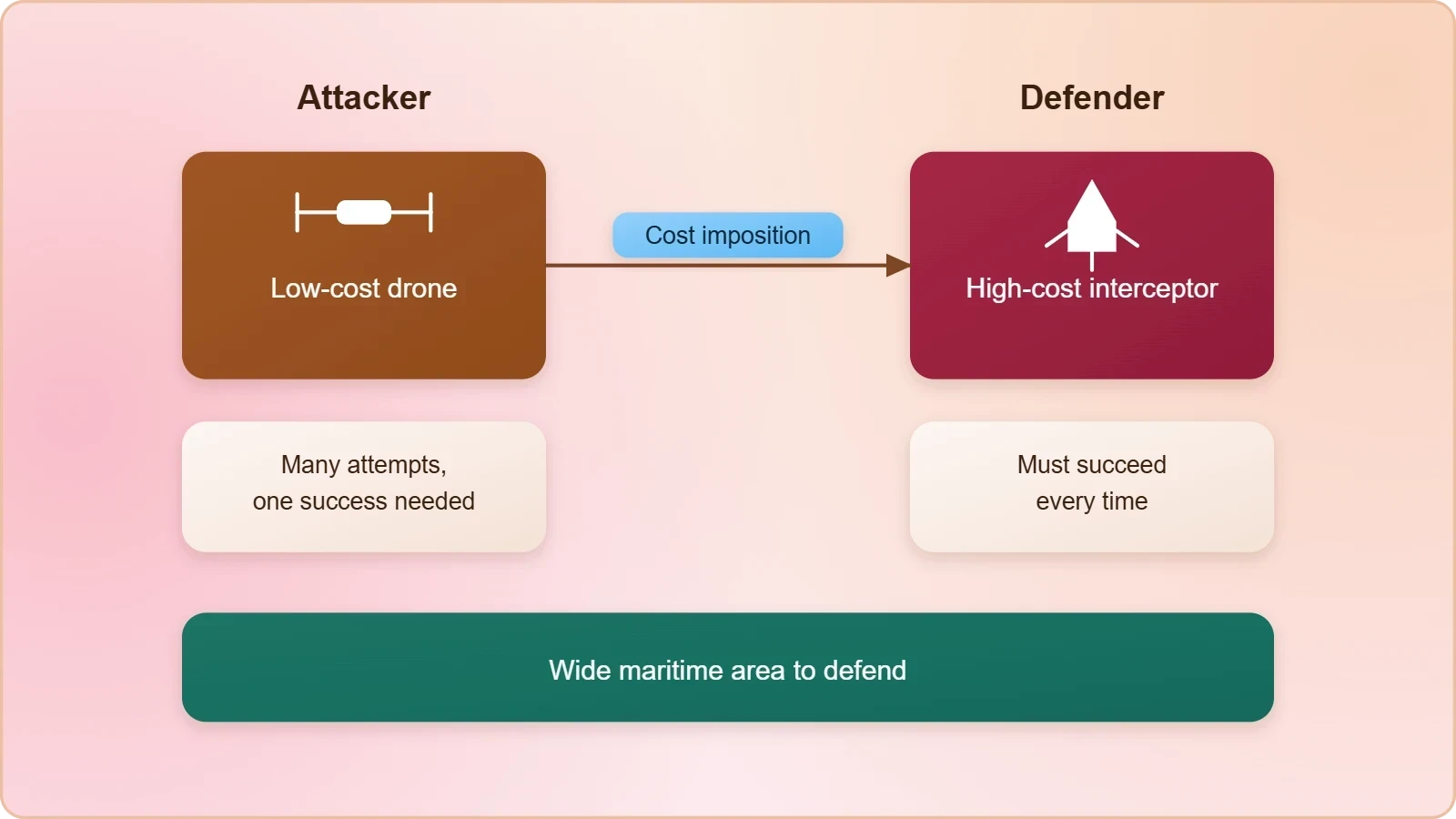
The renewal of Houthi drone and missile strikes represents a persistent challenge to maritime order in the Red Sea corridor. These weapons are inexpensive relative to the defensive systems arrayed against them, creating a cost-imposition dynamic that favors the attacker over time.
Defending a wide maritime area against small, fast, low-flying threats demands continuous vigilance and expensive interceptors, and the defender must succeed every time while the attacker need only succeed once to inflict significant damage or deter shipping traffic.
The economic stakes extend well beyond the vessels involved. Shipping companies reroute when risk rises, adding days to voyages and increasing fuel costs, while insurers raise premiums for transit through threatened waters. These costs cascade through supply chains and ultimately reach consumers.
Securing transit lanes is therefore not merely a military objective but an economic stabilization measure, and the task force's presence is intended in part to reassure commercial operators that passage remains viable.
Asymmetric Warfare and Cost Imposition
Asymmetric threats exploit the gap between the defender's high-value platforms and the attacker's low-cost munitions. A single interceptor missile may cost far more than the drone it destroys, and sustained engagements deplete stockpiles that take years to replenish. This imbalance is a deliberate strategy of attrition, designed to exhaust the defender's resources and political patience rather than to achieve decisive battlefield outcomes. Understanding this logic is essential to evaluating whether a naval task force can achieve durable deterrence.
Countering cost imposition requires innovation: cheaper interception methods, directed-energy systems, and intelligence-driven disruption of launch sites and supply chains. The task force's long-term effectiveness may depend less on the number of ships deployed than on the ability to shift the cost curve in the defender's favor.
This is a technological and doctrinal challenge as much as a naval one, and it unfolds against the backdrop of congressional debates over how much to invest.
Alliance Burden-Sharing and Coalition Legitimacy
Maritime security operations gain legitimacy and durability when conducted with allies rather than unilaterally. Coalition participation distributes costs, broadens the diplomatic basis for action, and complicates adversary calculations by presenting a collective rather than singular commitment. The source does not detail specific allied contributions, and none should be assumed. What matters analytically is that burden-sharing arrangements are themselves subject to legislative scrutiny, as legislators ask why partners are not contributing more.
Questions of coalition legitimacy intersect with domestic politics in predictable ways. When expenditures rise, legislators often point to allied contributions as a benchmark for fairness. A mission framed as a collective endeavor may therefore enjoy greater political durability than one perceived as a unilateral American burden. The task force's diplomatic architecture thus becomes as important as its naval architecture in determining whether the commitment can be sustained over the long term.
Scenarios: Constraint or Lock-In
Two broad scenarios frame the future of Task Force Iron Gate. In the constraint scenario, post-midterm majorities use appropriations riders, reporting requirements, and war powers resolutions to narrow the mission's scope, cap its duration, or force periodic reauthorization votes. In the lock-in scenario, the operational realities of Red Sea security — combined with the political costs of appearing to retreat — entrench the mission despite partisan opposition. The source frames this as the central question, and the answer will emerge from the interaction of legislative will and strategic necessity.
Neither scenario is binary. A likely middle path involves rhetorical opposition paired with continued funding, as legislators criticize the mission while declining to bear responsibility for its collapse. This pattern has characterized many past engagements, and it reflects the structural incentives of divided government: opposition is electorally useful, but defunding carries blame. The task force may therefore persist in a state of contested legitimacy, sustained by inertia and the absence of a politically viable alternative.
Signals to Watch in the Coming Months
Several observable indicators will reveal which scenario is unfolding. Supplemental funding requests and their treatment in committee signal legislative appetite for the mission. The frequency and content of war powers resolutions indicate the intensity of constitutional challenge. Deployment extension announcements reveal operational expectations. And the tempo of Houthi attacks shapes the political environment in which all these decisions occur, since visible threats tend to suppress opposition to protective missions.
Alliance behavior offers another signal. If partners increase contributions, the mission gains legitimacy and durability; if they hedge, the American burden becomes more politically salient. Similarly, the mission's success in reducing successful strikes against shipping will determine whether it is perceived as effective or as an open-ended commitment without measurable returns. Effectiveness, more than ideology, tends to determine whether military missions survive legislative scrutiny.
Implications Beyond the Red Sea
The precedent set by Iron Gate will shape future debates over overseas deployments. If divided government proves unable to constrain the mission, the episode reinforces executive primacy in foreign policy and may encourage future administrations to act unilaterally. If Congress successfully imposes limits, the precedent strengthens legislative prerogatives and may make future deployments more difficult to initiate. Either outcome reverberates well beyond the Red Sea, affecting how America conducts security commitments globally.
The mission also tests the durability of deterrence architecture in an era of asymmetric threats. If a named task force with dedicated resources cannot suppress low-cost drone and missile attacks, the model may require fundamental revision. The lessons learned — about cost curves, coalition management, and political sustainability — will inform how the United States approaches maritime security in other contested corridors, from the Strait of Hormuz to the South China Sea.
- 01
- 02
- 03
- 04
We Also Published
Reading the Signals: A Framework for Observers
For analysts tracking this story, the challenge is distinguishing meaningful signals from political noise. Not every congressional statement indicates a shift in policy, and not every funding delay reflects deliberate constraint. A disciplined framework focuses on concrete actions: votes, appropriations language, deployment orders, and observable changes in operational tempo. These are the data points that reveal whether the mission is being constrained, locked in, or left in a state of contested legitimacy.
The framework should also account for the adversary's role as a co-author of the outcome. Houthi decisions about when and where to strike shape the political environment in Washington, sometimes suppressing opposition by making the threat vivid and sometimes inflaming it by demonstrating the mission's limits. Observers who track only domestic politics miss half the causal picture; the mission's fate is determined by the interaction of legislative will and battlefield reality.
Key Indicators and Their Meaning
Several indicators merit close attention. Supplemental funding requests reveal the executive's assessment of resource needs and Congress's willingness to meet them. War powers resolutions, even when they fail, signal the intensity of constitutional objection. Deployment extensions indicate operational expectations that may outlast political cycles. And public opinion data on overseas engagements provides the background against which legislators calibrate their positions, since electoral incentives ultimately shape legislative behavior.
Each indicator should be read in context rather than in isolation. A failed war powers resolution may paradoxically strengthen the mission by demonstrating that opposition lacks votes, while a successful funding delay may signal constraint even without an explicit policy vote. The skilled observer weighs multiple signals together, looking for convergence rather than treating any single data point as decisive.
What the Mission Reveals About American Strategy
Beyond the immediate question of constraint versus lock-in, the Iron Gate episode illuminates broader patterns in American grand strategy. It reveals a continued willingness to shoulder maritime security burdens, even amid domestic political division. It demonstrates the enduring importance of the Red Sea corridor to economic and strategic interests.
And it exposes the tension between the executive's instinct for decisive action and the legislature's impulse toward oversight and restraint, a tension as old as the republic itself.
The mission also highlights the growing salience of asymmetric threats in strategic planning. Drones and missiles deployed by non-state actors can impose costs that rival those of conventional adversaries, and defending against them requires sustained investment and political endurance. How the United States adapts to this reality — doctrinally, technologically, and politically — will shape its ability to protect interests in contested maritime domains for years to come.
Conclusion: The Test Ahead
Task Force Iron Gate embodies a familiar American dilemma: the tension between global commitments and domestic political constraints. Established on November 7, 2026, in the wake of midterm elections that reshaped legislative majorities, the mission tests whether divided government can meaningfully constrain a naval deterrence operation once it is underway.
The answer will depend on the interaction of legislative will, operational necessity, and adversary behavior — three forces that are difficult to predict and impossible to control.
What is clear is that the mission's significance extends beyond the Red Sea. It is a case study in how the United States balances its security commitments against its political divisions, and the outcome will inform future debates over military expenditures, overseas engagements, and executive authority.
Observers should watch the concrete signals — funding votes, war powers resolutions, deployment orders — rather than the rhetoric, because it is in these actions that the real trajectory of the mission will be revealed.
Disclaimer: This article is an analytical interpretation of a geopolitical source brief and is provided for informational purposes only. It does not constitute military, political, or financial advice. Readers should consult primary sources and official statements for verified details.
Disclaimer: This article is for general information and education only. It describes what historical prices and technical indicators showed on the date mentioned and does not predict future movements. It is not investment advice, a recommendation, or an offer to buy or sell any security. Indicators are calculated from past data and can mislead, and all investments carry risk. Please consult a SEBI-registered investment adviser before making any financial decision.
From our network :
- The Final Descent: How ESA Retired the Legendary Cluster Constellation After 24 Years of Space Weather ScienceAfter 24 years mapping Earth’s magnetosphere, ESA’s Cluster mission concluded with a precisely controlled reentry over the South Pacific. This analysis explores the scientific legacy, engineering decisions, and debris mitigation principles behind one of space exploration’s most responsible retirements.
- How AI Agents Will Change the Way We Manage Personal FinancesExplore how AI agents are transforming personal finance through automated budgeting, bill payment, and investment management, while examining the critical security protocols and governance frameworks required for safe deployment.
- CISA’s Ten-Advisory Wave: Why Generic Patching Fails in OT and How to Build Product-Specific PlaybooksCISA released ten ICS advisories in one week, exposing critical infrastructure risks. Generic patching fails in OT. Learn to build product-specific remediation playbooks.
- The Hidden Cost of AI Convenience: Why Over-Permissioned Agents Are a Security Time BombDiscover why AI agents with excessive permissions create dangerous single points of failure, and learn how implementing least privilege principles can protect your organization from exploitation.
- Mobile Learning and VR in English: What Global Evidence Reveals About Effective Language TechnologyA systematic review across 14 countries reveals which language-learning technologies genuinely work. Mobile learning, AI, and VR show measurable benefits when pedagogically integrated. This evidence-based guide helps educators and learners select technology that delivers real return on investment.
- Committed Mediterranean Precipitation Decline: Why Emissions Cuts Alone Cannot Restore Winter RainsNew NOAA research reveals that Mediterranean winter rains may decline irreversibly even with emissions cuts. Explore the science of committed climate change and regional impacts.
- University Language Proficiency Exams: Why Institutional Tests Demand Different Preparation Than IELTS and TOEFLDiscover why university-specific language proficiency examinations differ fundamentally from IELTS and TOEFL, and learn strategic preparation approaches for institutional assessment success.
- Forbidden Matrix Patterns and Visible Lattice Points: A Geometric DictionaryExplore how multidimensional 0–1 matrices encode geometric truths, linking forbidden patterns to visible lattice points and hypergraph theory, with applications in combinatorics and computational geometry.
- Live Online English Classes for Kids: Do They Actually Reduce Anxiety?A ten-week study reveals that synchronous online English classes can significantly reduce child language anxiety while improving listening and reading skills. Discover what makes these programs effective and how parents can select the right one.
RESOURCES
- Iran downplays new U.S. task force aimed at disrupting ... - CBS Newscbsnews.com6 days ago ... Central Command also announced the creation of Task Force Iron Gate ... "The domino effect of crises, from Gaza to…
- U.S. Central Command (CENTCOM) Official Website Homepagecentcom.mil14, 2026. CENTCOM Launches First-Ever Multinational Attack Drone Task Force Aug. 13, 2026. CJTF-OIR Welcomes New Commander during Ceremony in Middle East Aug ...
- Iran's northern routes test the limits of US bid to extend blockade ...iranintl.com6 days ago ... A graphic released by CENTCOM on November 7, 2026, outlining Task Force Iron Gate's focus on Iran's land borders and…
- Iran Update Special Report, April 14, 2026: US Central Command ...instagram.comApr 14, 2026 ... ... attacks on international shipping in the Red Sea during the war thus far. ... Washington also announced a new…
- US Force Posture in the Middle East vis-à-vis Iran - INSSinss.org.il7 days ago ... On November 7, CENTCOM commander Adm. Brad Cooper ordered the establishment of Task Force Iron Gate, a staff of about…
- Iran War Update: November 7–9, 2026 | JINSAjinsa.org7 days ago ... On November 7, CENTCOM established Task Force Iron Gate, which is tasked with “coordi- ... Gap in American Red Sea…
- Trump Says 'Very Unlikely' To Launch Fresh Iran Strikes If Talks ...rferl.org6 days ago ... Separately on social media, Trump touted what he called "Task Force Iron Gate ... Houthi group. The coalition subsequently reported ...
- U.S. forces disabled a commercial cargo vessel in the Gulf of Oman ...facebook.com7 days ago ... On the same day, the command announced Task Force Iron Gate to disrupt Iranian overland and Caspian Sea movements of…
- Task Force Iron Gate: Washington's Overland Blockade Tests Iran's ...epis-thinktank.com4 days ago ... Iron Gate aims at the overland and Caspian routes Tehran uses to rebuild its military industries: Russian detonators and drone…
- live Trump Says 'Very Unlikely' To Launch Fresh Iran Strikes If Talks ...rferl.org6 days ago ... ... Sea. Task Force Iron Gate, which will coordinate with other US government agencies, comprises around 20 military and civilian…
- At odds with reality | Counterfirecounterfire.org4 days ago ... US Central Command announced Task Force Iron Gate on Saturday ... Red Sea. The impact of this on the global…
- Trump says US forces destroyed Iranian 'anti-aircraft device'foxnews.com7 days ago ... "The establishment of Task Force Iron Gate reinforces the success of our ironclad blockade against Iran at sea," added Cooper,…
- Saudi Aramco building in Riyadh damaged in attempted attackthenationalnews.comOct 17, 2026 ... ... Sea, the US Central Command (CENTCOM) said on Saturday. Task Force Iron Gate, as it will be called, will…
- Conflict-Driven Chokepoint Disruptions - Council on Foreign Relationscfr.orgJul 23, 2026 ... ... attacks commercial shipping at or near a chokepoint—for example, Houthi forces, assisted by Iran, attacking Red Sea shipping in…
- Brad Cooper (admiral) - Wikipediaen.wikipedia.orgCharles Bradford Cooper II (born 1967) is an American admiral who has served as the commander of the United States Central Command since 2025…
- 01
- 02
- 03
- 04
- 05
- 06
- 07
- 08
0 Comments