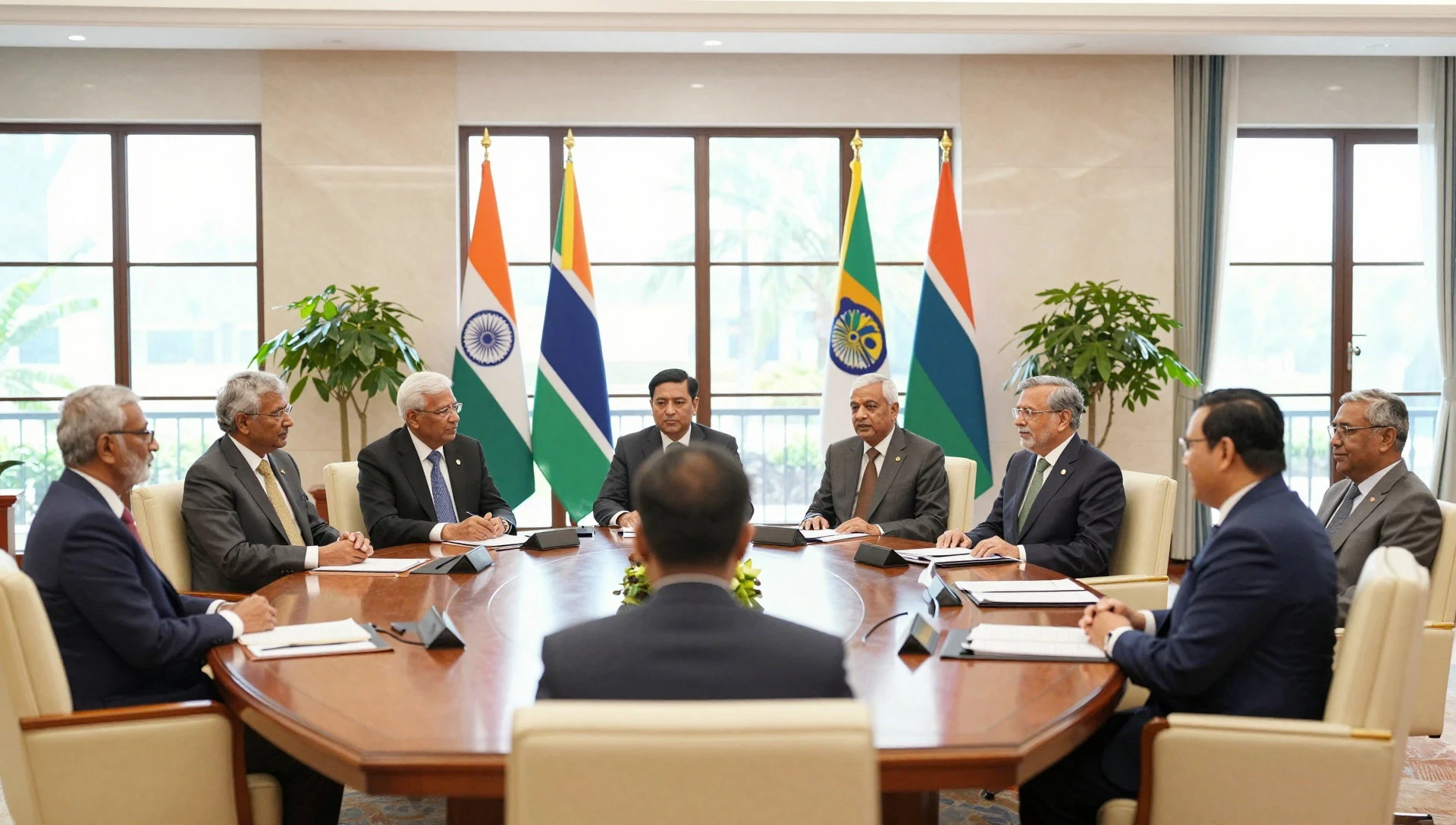
The 12th round of India–South Africa Foreign Office Consultations, convened in Pretoria on 11 November 2026, represents far more than a routine diplomatic calendar entry. It marks a deliberate consolidation of bilateral strategic machinery between two powers that increasingly see themselves as architects of a reformed multilateral order rather than passive participants within it.
The consultations brought senior officials together across trade, defence collaboration, counter-terrorism and the coordination of positions inside BRICS Plus and the G20, signalling that both capitals now treat structured, recurring dialogue as the foundation of influence rather than an occasional courtesy.
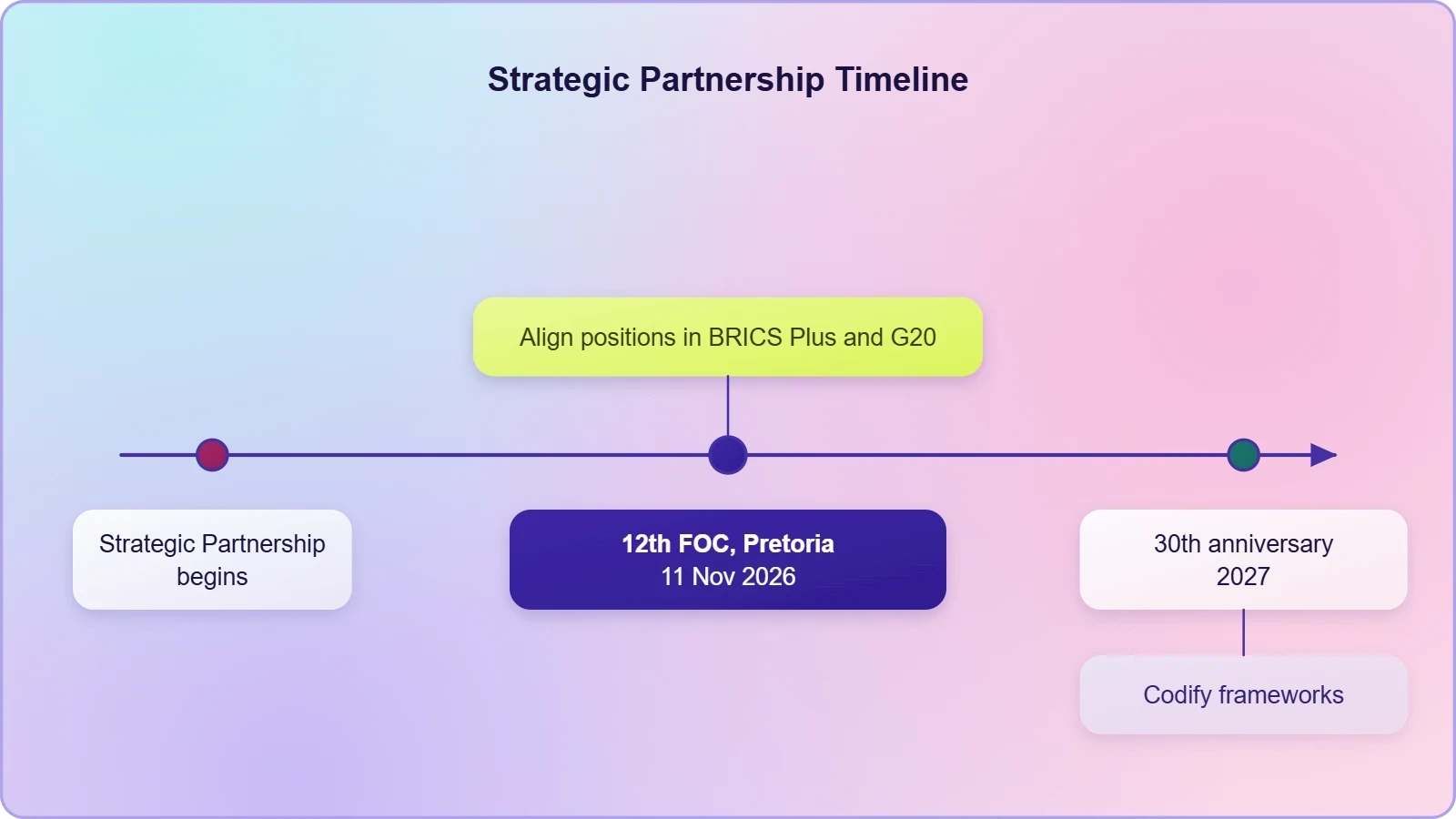
What gives this round particular weight is its timing. It arrives ahead of 2027, when the two nations mark the 30th anniversary of their Strategic Partnership, a milestone that invites both governments to convert accumulated goodwill into durable institutional architecture. India and South Africa have long shared a rhetorical commitment to Global South solidarity, but the Pretoria consultations suggest a shift from declaration to design.
On This Page
The agenda was not symbolic; it was operational, touching the practical levers through which coordinated positions are built, defended and projected into multilateral forums where the two countries seek greater voice.
Understanding this development requires looking past the communiqué language to the underlying logic. Middle powers seeking systemic reform cannot achieve it alone, and bilateral machinery is how they aggregate leverage before entering larger rooms. The sections that follow examine the consultations' substantive agenda, the BRICS Plus and G20 alignment strategy, the trade and defence dimensions, the counter-terrorism cooperation, the 2027 anniversary horizon, and the broader meaning of institutionalising a Global South voice.
TL;DR India and South Africa concluded their 12th Foreign Office Consultations in Pretoria on 11 November 2026, advancing trade, defence and counter-terrorism cooperation while aligning positions inside BRICS Plus and the G20 ahead of the 30th anniversary of their Strategic Partnership in 2027.
The Pretoria Consultations in Context
Foreign Office Consultations are the working spine of any mature bilateral relationship, the recurring official-level meetings where agendas are set, disagreements are managed and follow-up is assigned. The 12th round between India and South Africa, held in Pretoria on 11 November 2026, fits this template but carries added significance because of the breadth of its agenda.
Trade, defence collaboration, counter-terrorism and multilateral coordination were all on the table, reflecting a relationship that has moved well beyond the symbolic solidarity of the anti-apartheid era into practical, interest-based cooperation.
The choice of Pretoria as host continues a rotational pattern that gives both partners ownership of the process. For India, South Africa is a pivotal African anchor and a fellow BRICS member; for South Africa, India is a large economy, a technology partner and a like-minded voice on reform of global governance.
The consultations therefore function as a calibration exercise, allowing officials to test positions, identify convergences and prepare the ground for higher-level political engagement without the pressure of summit-level deliverables.
Why Recurring Dialogue Matters
Diplomacy that depends on occasional summits tends to produce declarations without implementation. Recurring consultations create institutional memory, allowing officials to track commitments, revisit stalled files and build the personal networks that make crisis communication possible. The 12th round is significant precisely because it is the twelfth: repetition is the mechanism through which trust becomes routine, and routine is what allows two countries to coordinate quickly when circumstances demand it.
This institutionalisation also insulates the relationship from political weather. Governments change, priorities shift and external shocks intrude, but a standing consultation framework provides continuity. For India and South Africa, both of which navigate complex domestic and regional pressures, having a predictable channel for strategic conversation is an asset that compounds over time, turning episodic engagement into a dependable habit of cooperation.
The Strategic Partnership Horizon
The Strategic Partnership between the two countries reaches its 30th anniversary in 2027, a milestone that gives the current consultations a natural forward momentum. Anniversaries are often dismissed as ceremonial, but in diplomacy they function as deadlines for stocktaking and renewal. The Pretoria round effectively begins the preparatory work for that moment, identifying which strands of cooperation have matured and which require fresh political impetus.
Looking toward 2027, the two governments have an opportunity to codify achievements into frameworks that outlast individual administrations. Whether through upgraded agreements, new sectoral mechanisms or a refreshed joint vision statement, the anniversary provides a focal point around which bureaucratic energy can be organised. The consultations are the quiet groundwork for that visible moment.
We Also Published
Trade and Defence: Building the Economic Spine
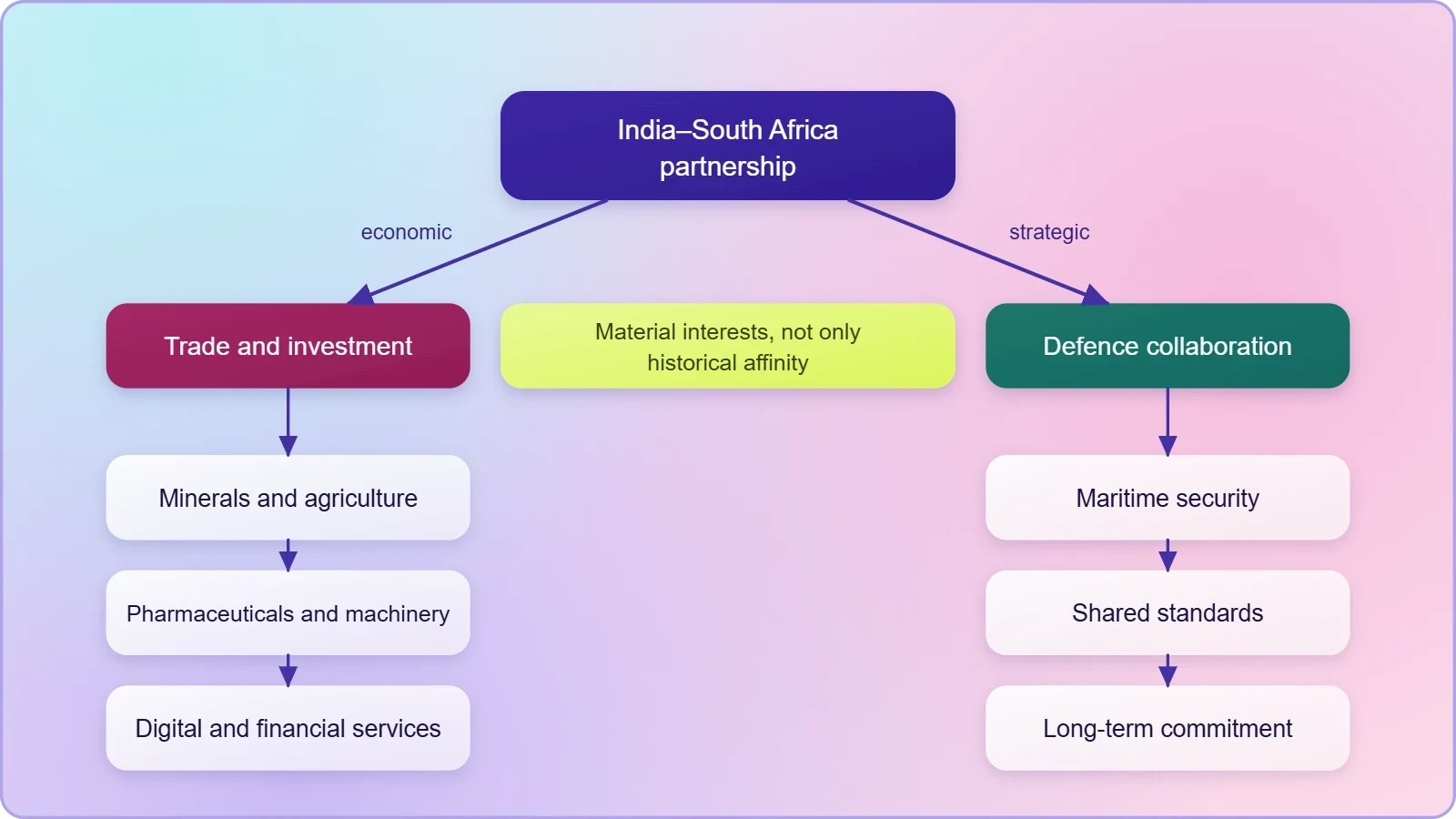
Trade and defence collaboration formed the practical core of the Pretoria agenda, reflecting a relationship that increasingly rests on material interests rather than historical affinity alone. Both economies are diversified and complementary in specific sectors, and both governments recognise that commercial depth gives diplomatic coordination its credibility.
A partnership that cannot point to tangible economic exchange struggles to persuade others of its strategic seriousness, and officials on both sides appear conscious of that arithmetic.
Defence collaboration adds a further layer of trust. It requires sustained engagement, shared standards and long-term commitment, and it signals a relationship that has moved into the category of strategic confidence. The consultations provided a forum to review where cooperation stands and where the machinery needs strengthening, without the public pressure that accompanies headline announcements.
Commercial Complementarities
India and South Africa trade across a broad basket, from minerals and agricultural goods to pharmaceuticals, machinery and services. South Africa's resource base and India's manufacturing and services capacity create natural exchange, while both countries share an interest in diversifying trade relationships away from over-concentration on traditional partners. The consultations allow officials to identify bottlenecks and to align commercial diplomacy with the broader political relationship.
Beyond goods, services and investment flows matter increasingly. Both economies have growing digital, financial and professional services sectors, and both seek to attract capital and expertise. Coordinating on investment facilitation, dispute resolution and regulatory predictability is unglamorous work, but it is precisely the kind of technical groundwork that recurring consultations are designed to advance.
Defence Cooperation and Strategic Trust
Defence ties between India and South Africa rest on a shared interest in maritime security along the Indian Ocean rim, a corridor of growing strategic consequence. Cooperation in this domain involves exchanges, training and dialogue on regional security, all of which build familiarity and reduce the risk of miscalculation. The consultations serve as the venue where such cooperation is reviewed and calibrated.
Strategic trust is not declared; it is accumulated through repeated, reliable interaction. Defence collaboration is among the most demanding tests of that trust because it touches sovereignty, capability and doctrine. The fact that it features on the consultation agenda indicates a relationship mature enough to discuss sensitive matters candidly, which in turn strengthens the foundation for coordinated positions in multilateral settings.
Counter-Terrorism and Shared Security Interests
Counter-terrorism featured prominently in the Pretoria discussions, a reflection of shared exposure to transnational security threats and a shared interest in stronger international cooperation against them. Both countries have experienced the consequences of terrorism and both advocate multilateral approaches to combating it, including through the United Nations framework. The consultations provided a setting to compare assessments and explore practical cooperation.
Security cooperation of this kind is rarely dramatic in public, but it is consequential in practice. Information exchange, capacity building and coordinated positions in multilateral bodies all flow from the kind of official-level trust that recurring consultations cultivate. The inclusion of counter-terrorism on the agenda signals that the relationship is being treated as a security partnership, not merely a commercial one.
Multilateral Frameworks Against Terrorism
India and South Africa both favour comprehensive international conventions and strengthened UN mechanisms for countering terrorism. Their positions converge on the principle that terrorism must be addressed through collective action rather than unilateral measures, and that the financing, recruitment and ideological dimensions require coordinated responses. The consultations allow officials to harmonise language and priorities before these issues reach larger forums.
Aligning positions in advance is a practical multiplier. When like-minded countries enter multilateral negotiations with shared drafting and common priorities, their collective influence exceeds the sum of their individual weight. The counter-terrorism track is therefore not separate from the broader Global South agenda; it is one of the concrete areas where that agenda acquires operational content.
Capacity Building and Information Exchange
Beyond declarations, counter-terrorism cooperation involves training, technical assistance and the sharing of best practices in border management, financial surveillance and investigative technique. These are areas where both countries have accumulated experience and where mutual learning is feasible. The consultations serve as the clearing house for such cooperation, identifying where resources and expertise can be matched.
Information exchange carries particular value because terrorism is transnational by nature. Threats that emerge in one region often migrate to another, and early warning depends on reliable channels between security establishments. Building those channels through official consultations is slow, patient work, but it is the foundation on which effective cooperation rests.
Aligning Inside BRICS Plus and the G20
The most strategically significant element of the Pretoria consultations was the explicit focus on aligning positions inside BRICS Plus and the G20. Both forums are central to the two countries' ambitions for global governance reform, and both offer platforms where coordinated action can shape outcomes.
The consultations represent an effort to move from ad hoc coordination to systematic preparation, ensuring that India and South Africa enter multilateral negotiations with shared understanding rather than divergent expectations.
BRICS Plus, with its expanded membership, has become a more complex and more consequential grouping. Managing that complexity requires bilateral channels among members, and the India–South Africa consultations are one such channel. The G20, meanwhile, remains the premier forum for economic coordination, and both countries have an interest in ensuring that its agenda reflects the priorities of developing economies rather than only those of the largest advanced economies.
The Logic of Pre-Coordination
Multilateral negotiations reward preparation. Countries that arrive with agreed positions, shared drafting and coordinated tactics exert influence disproportionate to their individual weight. Pre-coordination through bilateral consultations is how that preparation happens, and it is why the Pretoria agenda devoted explicit attention to aligning positions rather than merely exchanging views. The aim is convergence before the negotiating table, not improvisation at it.
This approach also reduces the risk of fragmentation within the Global South. When developing countries speak with many voices, their collective bargaining power weakens and their agenda is easily diluted. By coordinating bilaterally, India and South Africa contribute to a broader effort to build coherence among like-minded states, strengthening the case for reforms to institutions that have long resisted them.
Reform Agendas and Institutional Voice
Both countries have consistently argued for reform of the United Nations Security Council, international financial institutions and global trade governance. These reform agendas are long-standing, but progress has been slow, and the two governments appear to have concluded that sustained bilateral coordination is a necessary complement to advocacy in plenary. The consultations are the mechanism through which that coordination is maintained.
Institutional voice is not granted; it is built. It requires persistence, technical preparation and alliances that endure across negotiating cycles. The India–South Africa consultations are an investment in that long game, creating the habits of cooperation that allow two middle powers to act together with the coherence of a larger bloc.
- 01
- 02
- 03
- 04
The 2027 Anniversary and Institutional Legacy
The 30th anniversary of the Strategic Partnership in 2027 provides a natural focal point for the relationship's next phase. Anniversaries in diplomacy are opportunities to take stock, renew commitments and set new targets, and both governments appear to be using the current consultations to prepare for that moment.
The legacy of three decades of partnership is substantial, but the question facing both capitals is how to convert accumulated goodwill into structures that can carry the relationship through the next three decades.
Institutional legacy is built through frameworks, agreements and mechanisms that persist beyond individual leaders. The consultations themselves are part of that legacy, a recurring forum that has survived changes of government and shifts in global circumstance. Preparing for 2027 involves identifying which mechanisms need strengthening and which new ones are required to address emerging challenges.
From Symbolism to Structure
The India–South Africa relationship has deep historical roots, forged in the shared struggle against apartheid and sustained by personal and political ties. That history provides a reservoir of goodwill, but goodwill alone does not deliver results in a complex multilateral environment. The shift toward structured, recurring consultations reflects a recognition that sentiment must be complemented by machinery if the partnership is to achieve its ambitions.
Structure also makes the relationship more resilient. When cooperation is embedded in regular meetings, working groups and agreed agendas, it can withstand disagreements and external shocks. The consultations are therefore an investment in durability, ensuring that the partnership rests on institutional foundations rather than on the preferences of any single government.
Preparing the Next Phase
Looking toward 2027, both countries have an interest in defining a forward agenda that reflects contemporary realities. Trade and investment, defence and security, counter-terrorism and multilateral coordination are likely to remain central, but new areas such as digital cooperation, climate finance and technology governance may also feature. The consultations provide the venue for shaping that agenda incrementally.
Preparation is incremental by nature. Each round adds detail, refines priorities and builds consensus, and the cumulative effect is a relationship that is more capable and more coherent than it was a decade earlier. The 12th round in Pretoria is one step in that longer process, and its significance lies as much in the pattern it continues as in any single outcome.
What Institutionalising a Global South Voice Means
The phrase "Global South voice" is often used loosely, but the Pretoria consultations give it concrete meaning. A voice is institutionalised when it is prepared, coordinated and sustained, rather than improvised at moments of crisis. India and South Africa are building the machinery that allows them to speak with coherence across forums, and that machinery is what distinguishes a genuine strategic partnership from a rhetorical one.
This institutionalisation has implications beyond the bilateral relationship. It contributes to a broader effort among developing countries to build coherence and bargaining power in a multilateral system that has often marginalised their priorities. The India–South Africa consultations are one node in a wider network of coordination, and their significance lies partly in the example they set for others.
Coherence as Bargaining Power
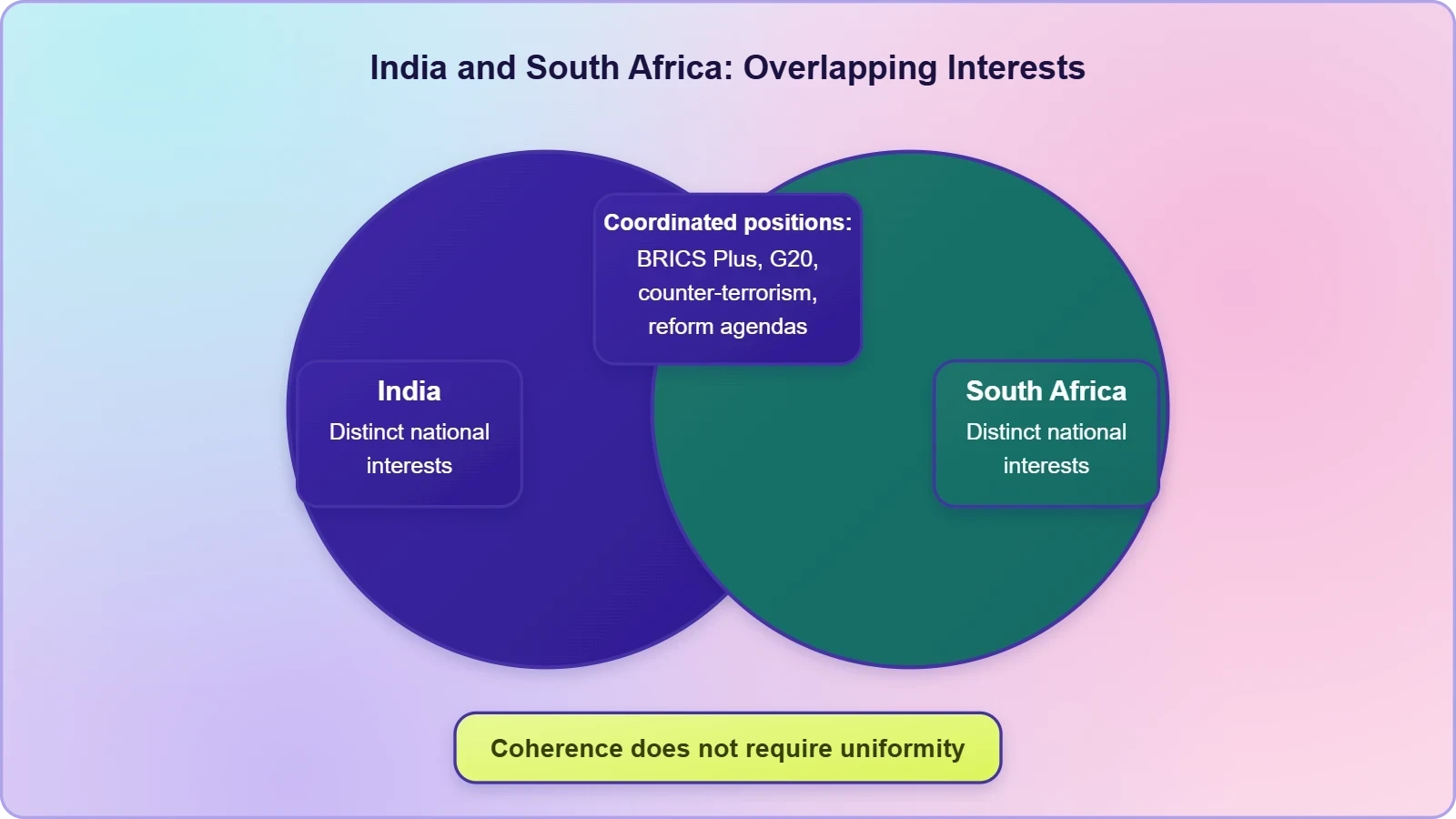
Developing countries have long been disadvantaged in multilateral negotiations by fragmentation. When priorities diverge and positions multiply, the collective weight of the Global South is diluted, and reforms that would benefit the majority stall. Coordination through bilateral consultations is a practical remedy, allowing like-minded states to identify common ground and present a united front where interests genuinely converge.
Coherence does not require uniformity. India and South Africa have distinct national interests and will not agree on everything, but they can coordinate where convergence exists and manage divergence where it does not. The consultations provide the space for that nuanced work, which is more valuable than superficial unanimity.
Lessons for South-South Cooperation
The India–South Africa model offers lessons for other South-South partnerships. Recurring official-level consultations, explicit attention to multilateral alignment and a focus on practical cooperation across trade, defence and security are all transferable practices. The model is not dramatic, but it is effective, and its effectiveness lies in its regularity and its breadth.
South-South cooperation is often discussed in aspirational terms, but its substance is built through patient institutional work. The Pretoria consultations demonstrate that two middle powers can construct meaningful strategic machinery without the fanfare of summitry. That quiet construction is where the future of Global South coordination is being written.
Disclaimer: This article is based on publicly available information from the source brief and is intended for informational purposes only. It does not constitute advice or a recommendation of any kind.
Disclaimer: This article is for general information and education only. It describes what historical prices and technical indicators showed on the date mentioned and does not predict future movements. It is not investment advice, a recommendation, or an offer to buy or sell any security. Indicators are calculated from past data and can mislead, and all investments carry risk. Please consult a SEBI-registered investment adviser before making any financial decision.
From our network :
- How AI Agents Will Change the Way We Manage Personal FinancesExplore how AI agents are transforming personal finance through automated budgeting, bill payment, and investment management, while examining the critical security protocols and governance frameworks required for safe deployment.
- The Final Descent: How ESA Retired the Legendary Cluster Constellation After 24 Years of Space Weather ScienceAfter 24 years mapping Earth’s magnetosphere, ESA’s Cluster mission concluded with a precisely controlled reentry over the South Pacific. This analysis explores the scientific legacy, engineering decisions, and debris mitigation principles behind one of space exploration’s most responsible retirements.
- University Language Proficiency Exams: Why Institutional Tests Demand Different Preparation Than IELTS and TOEFLDiscover why university-specific language proficiency examinations differ fundamentally from IELTS and TOEFL, and learn strategic preparation approaches for institutional assessment success.
- Mobile Learning and VR in English: What Global Evidence Reveals About Effective Language TechnologyA systematic review across 14 countries reveals which language-learning technologies genuinely work. Mobile learning, AI, and VR show measurable benefits when pedagogically integrated. This evidence-based guide helps educators and learners select technology that delivers real return on investment.
- Committed Mediterranean Precipitation Decline: Why Emissions Cuts Alone Cannot Restore Winter RainsNew NOAA research reveals that Mediterranean winter rains may decline irreversibly even with emissions cuts. Explore the science of committed climate change and regional impacts.
- Live Online English Classes for Kids: Do They Actually Reduce Anxiety?A ten-week study reveals that synchronous online English classes can significantly reduce child language anxiety while improving listening and reading skills. Discover what makes these programs effective and how parents can select the right one.
- Forbidden Matrix Patterns and Visible Lattice Points: A Geometric DictionaryExplore how multidimensional 0–1 matrices encode geometric truths, linking forbidden patterns to visible lattice points and hypergraph theory, with applications in combinatorics and computational geometry.
- The Hidden Cost of AI Convenience: Why Over-Permissioned Agents Are a Security Time BombDiscover why AI agents with excessive permissions create dangerous single points of failure, and learn how implementing least privilege principles can protect your organization from exploitation.
- CISA’s Ten-Advisory Wave: Why Generic Patching Fails in OT and How to Build Product-Specific PlaybooksCISA released ten ICS advisories in one week, exposing critical infrastructure risks. Generic patching fails in OT. Learn to build product-specific remediation playbooks.
RESOURCES
- 11th Round of Foreign Office Consultations between India and ...mea.gov.inAug 3, 2022 ... The 11th Session of India-South Africa Foreign Office Consultations was held on 03 August 2022 in New Delhi.
- The 12th round of Foreign Office Consultations between India and ...instagram.com2 days ago ... The 12th round of Foreign Office Consultations between India and South Africa was co-chaired by Mr. Janesh Kain, Joint Secretary…
- India in SouthAfrica on Xx.com2 days ago ... The 12th round of Foreign Office Consultations between India and South Africa was co-chaired by Mr. Janesh Kain, Joint Secretary…
- The 12th round of Foreign Office Consultations between India and ...facebook.com2 days ago ... A valuable step toward strengthening India South Africa relations through meaningful dialogue and cooperation. Which areas offer the greatest ...
- International Relations on South Africa and India Foreign Office ...gov.zaJan 18, 2018 ... The Consultations form part of the structured mechanism which governs bilateral relations between the two countries. This mechanism comprises a ...
- Strengthening South Africa–India Relations South Africa and ...facebook.com4 days ago ... ... South Africa–India Foreign Office Consultations (FOC) on 11 ... Secretary for East and Southern Africa at India's Ministry of…
- India and South Africa review Strategic Partnership during 12th ...tribuneindia.com2 days ago ... New Delhi [India], November 12 (ANI): India and South Africa held the 12th Foreign Office Consultations (FOC) on Wednesday and…
- Foreign travel advice - GOV.UKgov.ukCountries starting with H. Haiti · Honduras · Hong Kong · Hungary. Countries starting with I. Iceland · India ... South Africa · South…
- Travel advice and advisoriestravel.gc.caAug 28, 2026 ... Make informed decisions and travel safely while you are outside Canada. Check the page for your destination often, as safety…
- Travel Advice By Destination | Department of Foreign Affairsireland.ieIndia · Indonesia · Iran · Iraq · Israel · Italy. J. Jamaica · Japan · Jordan. K ... South Africa · South Sudan…
- India and South Africa review Strategic Partnership during 12th ...theindianeye.comIndia and South Africa review Strategic Partnership during 12th Foreign Office Consultations. Published: November 12, 2026 - TIE Staff. Views: 208 ...
- India, South Africa hold 12th round of Foreign Office Consultationsgreaterkashmir.com2 days ago ... The Indian delegation was led by Mr. Janesh Kain, Joint Secretary (East & Southern Africa), Ministry of External Affairs and…
- USTR Initiates Section 301 Investigations Relating to Structural ...ustr.govMar 11, 2026 ... “The Trump Administration's reindustrialization efforts continue to face significant challenges due to foreign economies' structural excess ...
- New Delhi: India South Africa 12th Foreign Office Consultations ...socialnews.xyz2 days ago ... New Delhi: Janesh Kain, Joint Secretary (East and Southern Africa), Ministry of External Affairs and David Malcomson, Acting Deputy ...
- 01
- 02
- 03
- 04
- 05
- 06
- 07
- 08
0 Comments