
When a measles outbreak moves through a rural Anabaptist settlement, the decisive variable is rarely the strength of the virus alone. It is the quality of the relationships that public health institutions have, or have failed to build, with the families living there. Reporting from central New York describes a family nurse practitioner and public health researcher, Kristan Sharratt, who began treating members of an Amish community only after a friend recommended him to an Amish neighbor. That single referral, passed person to person, opened a practice serving hundreds of people and illustrates a principle that formal vaccination campaigns routinely overlook.
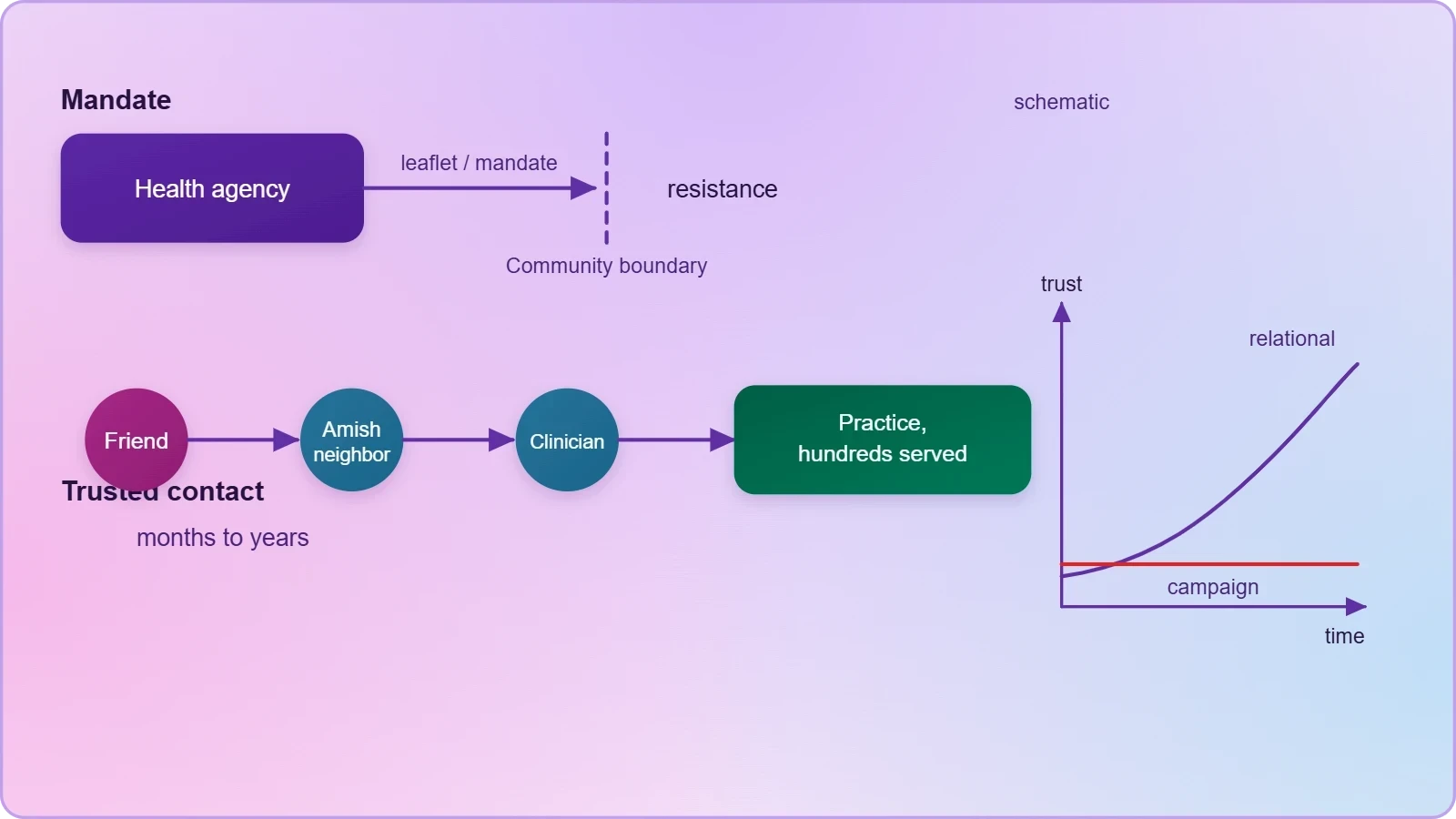
The outbreak in question has killed at least eight people in Pennsylvania, two in Wisconsin, one in New York and one in Virginia, a toll that places it among the more serious measles clusters in recent American memory. Sharratt's account, drawn from his clinical work and research, argues that trusted local messengers — neighbors, co-workers, customers, midwives and long-distance drivers — matter more than any leaflet or mandate. Building that trust takes months or years, and it cannot be manufactured by arriving in a community and urging vaccination. The outbreak, he suggests, is an opportunity to begin long-term connections rather than a crisis to be managed and abandoned.
The deeper story concerns rural public health investment, religious conviction, and the way vaccine misinformation travelled into Plain communities during the Covid pandemic. Understanding it requires attention to Gelassenheit, the central Amish belief that life belongs to God and that joy and suffering alike are God's will, and to the informal economies of trust through which outsiders are gradually accepted. What follows examines the outbreak's human cost, the mechanics of trusted contact, the theological and cultural context, the role of outside activists, and the funding failures that left these communities exposed.
On This Page
- The Human Cost of a Preventable Outbreak
- Trusted Messengers and the Architecture of Trust
- Gelassenheit: Theology, Plain Living and the Meaning of Suffering
- Measles in Plain Communities: A Recurring Pattern
- Rebuilding Public Health as a Long-Term Relationship
- Conclusion: Connection as the First Intervention
TL;DR A measles outbreak has killed at least twelve people across Pennsylvania, Wisconsin, New York and Virginia, and health experts argue that trusted local contacts inside Amish and Mennonite communities are the most effective route to containment. Family nurse practitioner Kristan Sharratt describes trust-building that takes months or years, rooted in the Amish principle of Gelassenheit and in informal relationships formed at farm stands and building sites. He also points to anti-vaccine messaging that reached Plain Anabaptist publications during the Covid pandemic, and to chronic underinvestment in rural public health that left these communities poorly served long before the outbreak began.
The Human Cost of a Preventable Outbreak
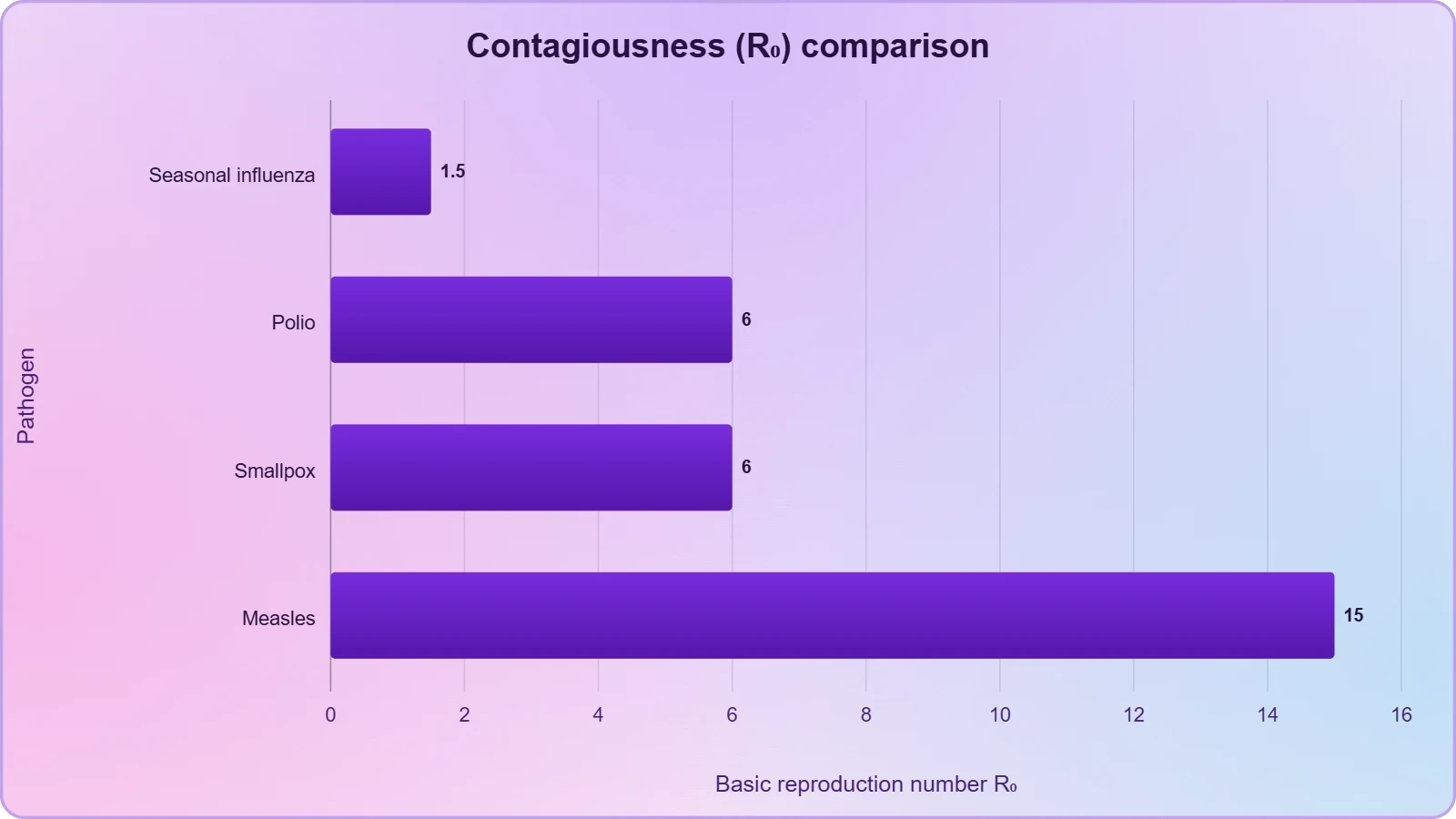
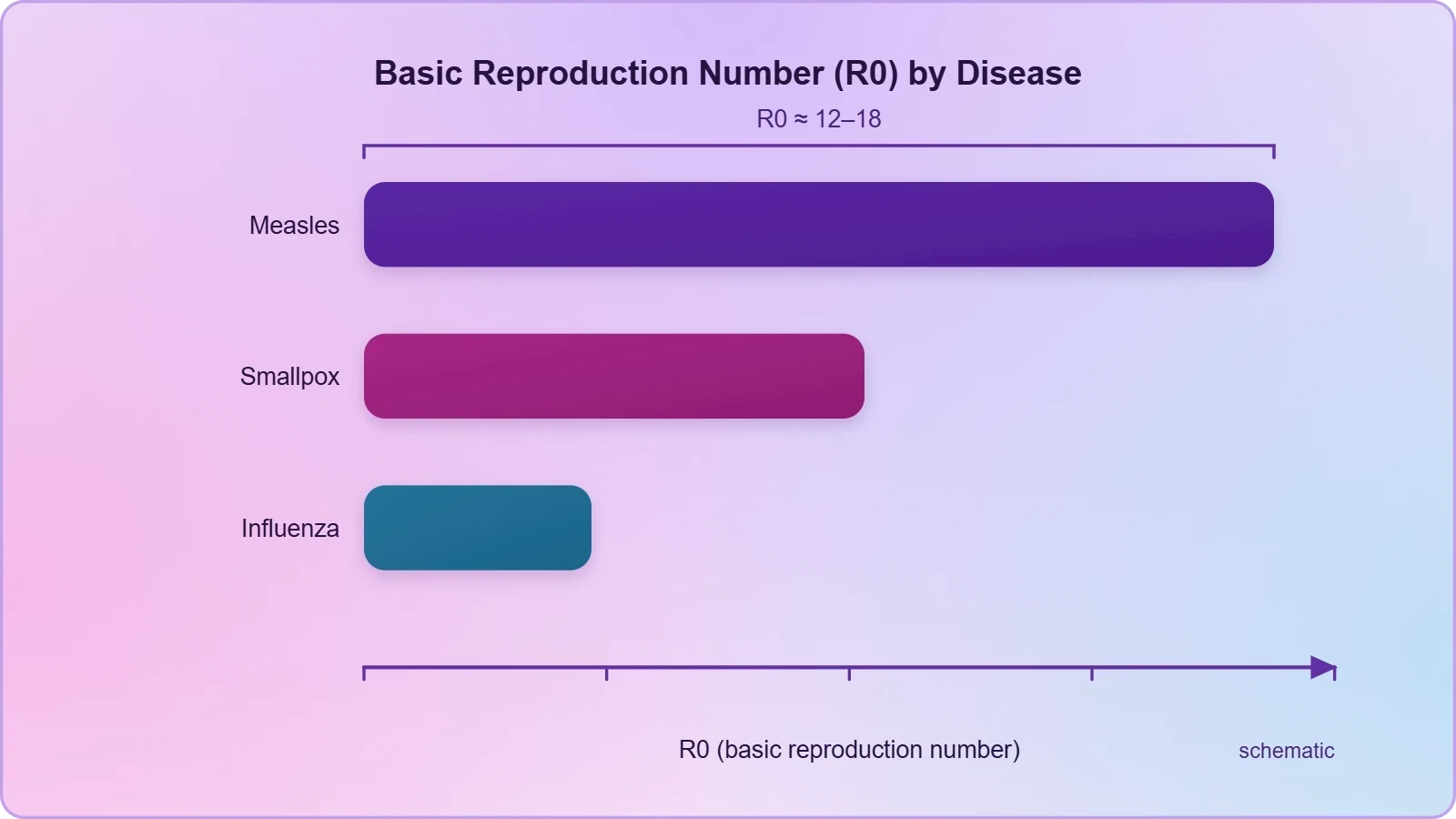
Measles is among the most contagious pathogens known to medicine, with a basic reproduction number that in unvaccinated populations can approach ##R_0 \approx 12## to 18, far exceeding influenza or even smallpox. In a community where vaccination coverage has slipped, that transmissibility converts a single introduction into a rapid cascade, and the clinical consequences fall hardest on infants, pregnant women and the immunocompromised. The fatalities recorded across four states are therefore not statistical abstractions but the predictable arithmetic of a virus meeting a susceptible population.
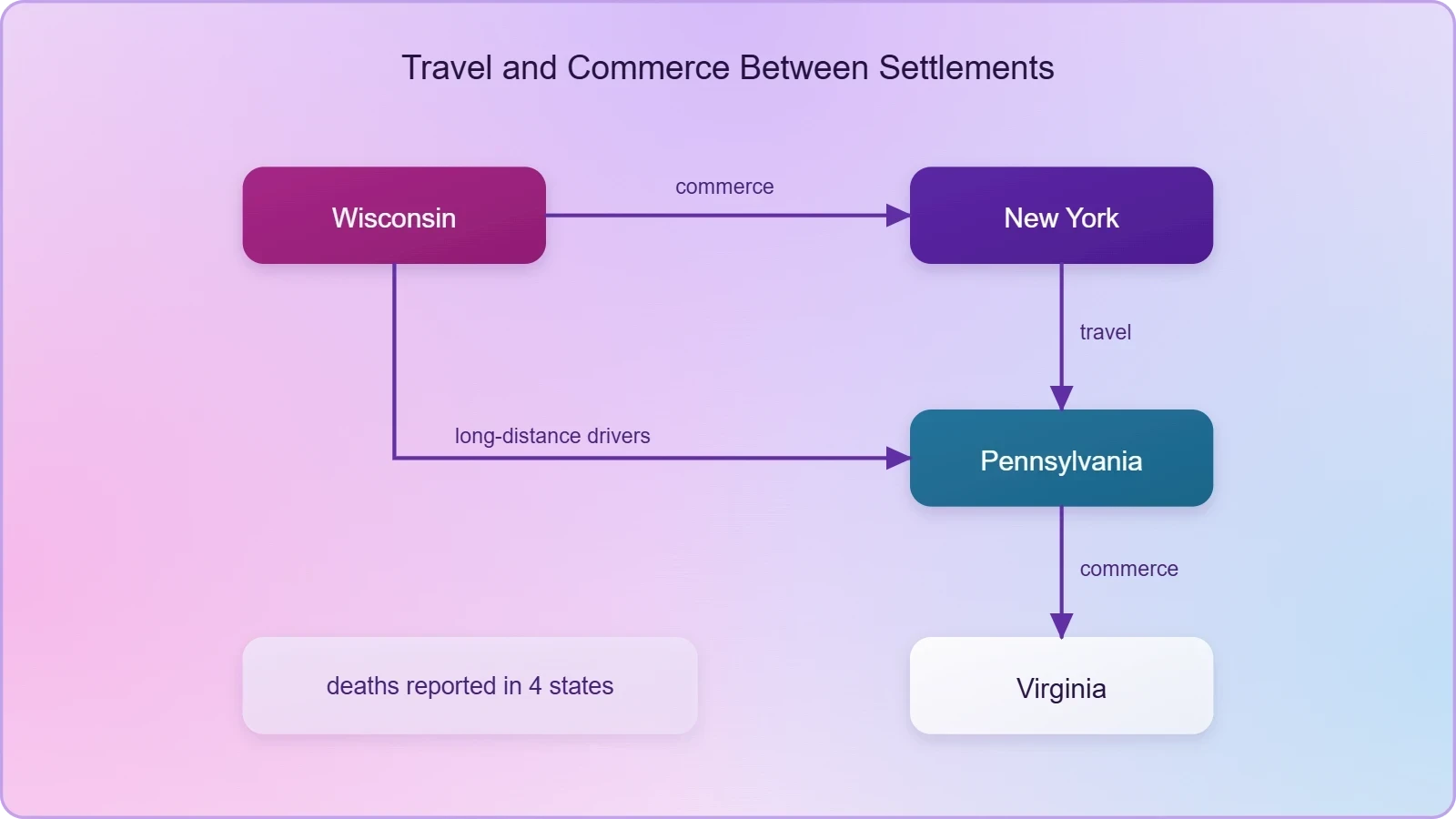
The geographic spread is itself instructive. Pennsylvania, Wisconsin, New York and Virginia are not adjacent states, and the pattern suggests transmission through the travel and commerce that connect Plain communities across long distances. Long-distance drivers, a group Sharratt specifically names among trusted messengers, are both vectors and potential educators. Recognizing that mobility is built into Amish economic life reframes the outbreak from a local failure into a network phenomenon requiring a network response.
Why Rural Populations Bear the Burden
Sharratt's observation that Plain Anabaptist communities are representative of many rural communities that public health has not reached well deserves emphasis. Rural counties frequently lack pediatric capacity, public health staffing and reliable transport to clinics, and the distances involved make outbreak investigation slow. When a virus with an ##R_0## in the low teens enters such a setting, the window for containment closes before surveillance systems have finished counting cases. The fatalities are therefore a measure of structural neglect as much as of vaccine hesitancy.
There is also a reporting problem. Deaths in rural communities may be attributed to pneumonia or other complications rather than to measles, particularly where laboratory confirmation is delayed. The official toll of twelve across four states should be read as a floor rather than a ceiling. Public health researchers have long argued that rural mortality data undercounts infectious disease burden, and outbreaks in close-knit communities where families may decline autopsy or hospital transfer amplify that distortion considerably.
The Economics of Long-Term Prevention
Sharratt frames the outbreak as evidence for sustained public health funding, extending the argument from vaccination to water fluoridation and road safety. The logic is that rural health infrastructure is a portfolio, not a series of discrete campaigns, and that defunding any element weakens the whole. A county health department that cannot afford a community liaison also cannot run effective outbreak investigation, and the savings booked in one budget cycle reappear as emergency costs in the next.
Prevention economics are unforgiving in this respect. The cost of a single hospitalization for measles complications can exceed the annual salary of a part-time outreach worker, and the cost of a death is not measurable in currency at all. Yet appropriations tend to follow visible crises rather than quiet maintenance, which is precisely why Sharratt describes the outbreak as a chance to start building long-term connections rather than a problem to be closed out once case counts fall.
Trusted Messengers and the Architecture of Trust
The most practical insight in the reporting is that influence inside Amish communities travels through specific, identifiable people. Neighbors, co-workers, customers, midwives and long-distance drivers carry credibility that no external authority can replicate, and they are consulted in the ordinary course of business rather than in a clinic. Sharratt's own entry into practice came through exactly this channel: a friend recommended him to an Amish neighbor, and that recommendation did the work that advertising, outreach letters and official notices could not.
This is not sentimentality; it is epidemiology applied to social structure. In a community where formal institutions are viewed with caution, the informal network is the only reliable distribution system for information. Public health succeeds when it recruits that network rather than competing with it. The corollary is that campaigns which bypass trusted messengers, however well designed, tend to produce compliance in the short term and resistance in the long term, because they leave the underlying relationship unbuilt.
Months, Not Weeks: The Timeline of Credibility
Sharratt is explicit that building trust with such communities takes months or years and cannot be done by simply arriving and urging vaccination. This timeline is incompatible with the funding cycles and political horizons under which most health agencies operate, which is why the work is so often skipped. A liaison hired for a twelve-month grant has barely finished introductions when the money runs out, and the community learns that the relationship was transactional after all.
The alternative is to treat trust as capital that compounds. Each honest conversation, each visit that does not end in a request, each small favor returned builds a balance that can be drawn on during an outbreak. Sharratt's practice, which now serves hundreds of people, began with one referral and grew through the ordinary accumulation of good outcomes. That is a slow model, but it is the only one that survives contact with a community that has learned to be wary of outsiders bearing agendas.
Informal Inroads: Farm Stands and Building Sites
The reporting offers concrete images of how inroads are made: a public health official buying vegetables from an Amish farm stand, or talking with Amish subcontractors on a building site. These encounters are unremarkable by design. They place the official in the role of customer or colleague rather than inspector or authority, and they allow conversation to proceed without the pressure of a clinical agenda. Over time, the official becomes a familiar face rather than an institutional presence.
This approach requires a particular temperament. It rewards patience, curiosity and a willingness to be a guest in someone else's world, and it punishes haste and condescension. Sharratt's framing is that people should be approached as people and relationships built as peers first. That is a professional discipline as much as an ethical stance, and it is teachable, which means it can be built into how rural health departments recruit and train staff.
Gelassenheit: Theology, Plain Living and the Meaning of Suffering
Any serious engagement with Amish health behavior must begin with Gelassenheit, the central conviction that life belongs to God and that both joy and suffering are God's will. The term is often translated as yieldedness or resignation, but in practice it describes a posture of surrender that shapes decisions about technology, medicine and community obligation. It is not fatalism in the colloquial sense; it is a disciplined orientation toward accepting what is given rather than seizing control.
Sharratt describes part of his conversations with community members as an attempt to understand why scientific advances are not seen as fitting into that perspective. The question is not whether vaccines work but whether the act of seeking protection expresses trust in God or distrust of Him. Answering that question requires theological literacy on the part of health workers, and it requires humility about the limits of evidence in a framework where evidence is not the final authority.
Plain Living as an Outcome, Not a Deficit
Sharratt's careful formulation is that being unvaccinated in Plain Anabaptist communities is usually an outcome of the idea of plain living, not a rejection of science as such. This distinction matters enormously for how health workers frame their approach. Treating non-vaccination as ignorance invites condescension and closes conversations; treating it as a coherent consequence of a valued way of life invites dialogue about how protection might fit within that life rather than against it.
The practical implication is that messaging built around individual risk and personal choice may resonate less than messaging built around community protection and the welfare of children and neighbors. Amish life centers on community, and appeals framed in communal terms align with existing values. Sharratt's insistence that outreach efforts should also center community is therefore not merely courteous; it is a strategic reading of how decisions are actually made in these settings.
When Outside Activists Enter the Conversation
The reporting adds a complicating layer: the work of anti-vaccine activists grew during the Covid pandemic and has begun to reach Amish communities. Non-Amish groups, including Children's Health Defense, then led by Robert F Kennedy Jr, now the US health secretary, wrote articles for Plain Anabaptist publications that targeted the communities with vaccine misinformation. The significance is that hesitancy which once flowed from theology is now being reinforced by an organized external campaign with national reach.
This changes the strategic problem. Public health is no longer competing only with tradition and distance but with a well-resourced messaging operation that speaks in the idiom of religious liberty and parental authority. Countering it requires the same channels it uses, which means trusted local voices rather than institutional rebuttals. A midwife or neighbor who can speak credibly to a specific claim will always outperform a generic fact sheet, and the reporting suggests that is where effort should be concentrated.
- 01
- 02
- 03
- 04
We Also Published
Measles in Plain Communities: A Recurring Pattern
Sharratt notes that measles has spread through Plain Anabaptist communities, including Amish and Mennonites, in this and earlier outbreaks. The pattern is well documented in the historical record, with notable clusters in Ohio, Pennsylvania and elsewhere over the past two decades. Each episode tends to follow a similar arc: introduction through travel or commerce, rapid spread in under-vaccinated households, delayed recognition, and eventual containment through a combination of clinical care and community negotiation.
The recurrence suggests that the underlying conditions have never been addressed. Each outbreak produces attention, resources and promises, and then the attention moves elsewhere. What distinguishes the current episode is its lethality, with fatalities across four states, and the explicit argument from a clinician embedded in one community that the response should build durable relationships rather than dissolve once the crisis passes.
Lessons From Earlier Clusters
Previous outbreaks in Plain communities have shown that containment accelerates once local leaders and trusted practitioners are engaged. Where health departments invested in liaisons and respected community preferences about how care was delivered, coverage improved and spread slowed. Where they relied on mandates and public shaming, resistance hardened and cooperation became harder to obtain in subsequent years. The historical record is consistent enough to function as guidance rather than anecdote.
What has been missing is institutional memory. Staff turnover in rural health departments means that lessons learned in one outbreak are often lost before the next. Sharratt's call for long-term funding is partly a call for continuity of personnel, since relationships built over years cannot be transferred in a briefing document. The knowledge that matters most in these settings lives in people, not in files.
Surveillance Gaps in Rural Settings
Effective surveillance depends on clinicians who recognize measles early and report it promptly, and on laboratories that can confirm cases without delay. In rural areas both links are fragile. A family practitioner seeing a child with fever and rash may not consider measles if the disease has been absent for a generation, and specimens may travel long distances before testing. The result is that outbreaks are recognized later than they should be, when chains of transmission are already long.
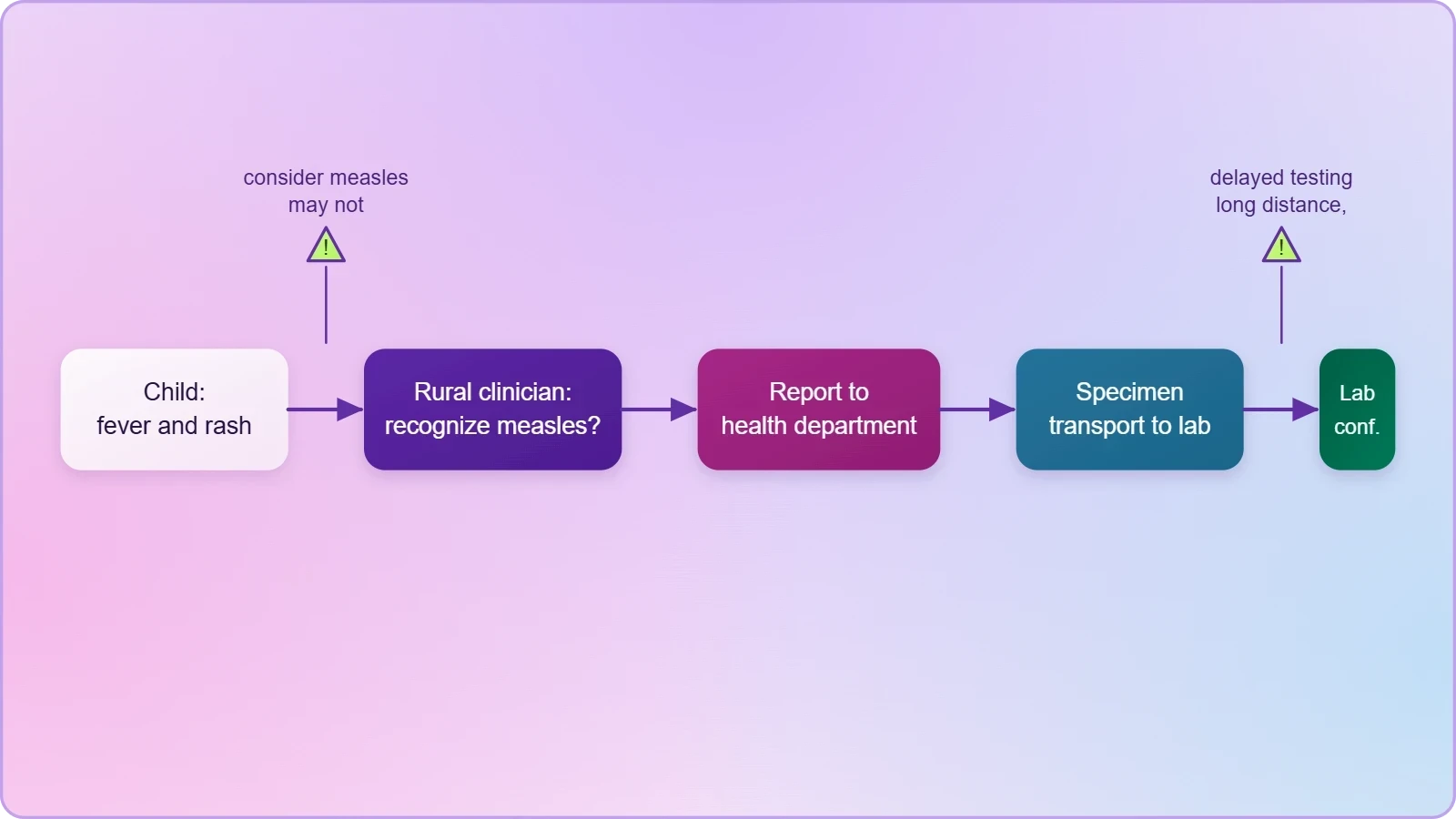
Closing these gaps is unglamorous work: training, transport, laboratory capacity and stable staffing. It rarely attracts political attention because its successes are invisible. Yet the alternative, as the current outbreak demonstrates, is a death toll that commands attention precisely because the quiet work was not done. Sharratt's broader point about funding from water fluoridation to road safety applies with full force to surveillance infrastructure.
Rebuilding Public Health as a Long-Term Relationship
The through-line of Sharratt's account is that public health in rural America has been treated as a series of episodic interventions rather than a standing relationship. He argues that rural communities have not received enough public health investment for a long time, and that the consequences are visible not only in measles but in dental health, road safety and chronic disease. The outbreak is a symptom of a system that responds to emergencies while neglecting the conditions that produce them.
Reframing public health as relationship changes what counts as success. A county that has a known, trusted liaison in every Plain settlement is better prepared than one with a glossy campaign and no relationships, even if the liaison's work cannot be captured in a quarterly metric. The professional challenge is to build institutions capable of valuing that invisible capital and defending it through budget cycles that reward visible outputs.
What Practitioners Should Do Differently
For clinicians and health officials working in or near Plain communities, the practical guidance is straightforward even if it is demanding. Approach people as people, build relationships as peers, and expect the first several encounters to have no clinical purpose at all. Buy vegetables, talk about weather and work, and let the relationship develop on the community's terms. The clinical conversation becomes possible only after that groundwork exists.
Equally important is to avoid treating every interaction as an opportunity to persuade. Communities are alert to instrumental friendliness, and a relationship that exists only to deliver a message will be recognized as such. Sharratt's model is a practice that serves people's actual needs first, which is why it has grown to serve hundreds. Credibility earned through service is the platform from which any future conversation about vaccination can proceed.
The Policy Horizon
The policy implications extend beyond any single outbreak. Sustained funding for rural public health, stable staffing, laboratory access and support for trusted community liaisons are the measures most likely to prevent the next cluster. None of them is novel, and all of them are chronically underfunded because their benefits are diffuse and delayed. The current outbreak provides the kind of evidence that occasionally shifts appropriations, though history suggests the shift is temporary.
Sharratt's framing offers a way to make the case in durable terms. Public health is not a series of campaigns but an ongoing relationship between institutions and the people they serve, and relationships require maintenance. Measles in Plain communities is a reminder that when maintenance is deferred, the cost arrives later and larger, borne by families who were never offered a meaningful connection in the first place.
Conclusion: Connection as the First Intervention
The measles outbreak in Plain Anabaptist communities is a story about virology only at its surface. Beneath it lies a question of institutional posture: whether public health will arrive as an authority demanding compliance or as a guest willing to earn trust over months and years. Sharratt's experience suggests the second path works, and that it begins with unremarkable gestures like a referral from a friend, a purchase at a farm stand, or a conversation with a subcontractor on a building site.
The fatalities in Pennsylvania, Wisconsin, New York and Virginia are a measure of what happens when that posture is absent. They are also, in Sharratt's reading, an opportunity to begin building connections that outlast the current crisis. The work is slow, relational and difficult to quantify, which is precisely why it has been neglected. But it is the only approach that addresses both the outbreak in front of us and the conditions that will produce the next one.
From our network :
- The Hidden Cost of AI Convenience: Why Over-Permissioned Agents Are a Security Time BombDiscover why AI agents with excessive permissions create dangerous single points of failure, and learn how implementing least privilege principles can protect your organization from exploitation.
- CISA’s Ten-Advisory Wave: Why Generic Patching Fails in OT and How to Build Product-Specific PlaybooksCISA released ten ICS advisories in one week, exposing critical infrastructure risks. Generic patching fails in OT. Learn to build product-specific remediation playbooks.
- Mobile Learning and VR in English: What Global Evidence Reveals About Effective Language TechnologyA systematic review across 14 countries reveals which language-learning technologies genuinely work. Mobile learning, AI, and VR show measurable benefits when pedagogically integrated. This evidence-based guide helps educators and learners select technology that delivers real return on investment.
- Live Online English Classes for Kids: Do They Actually Reduce Anxiety?A ten-week study reveals that synchronous online English classes can significantly reduce child language anxiety while improving listening and reading skills. Discover what makes these programs effective and how parents can select the right one.
- The Final Descent: How ESA Retired the Legendary Cluster Constellation After 24 Years of Space Weather ScienceAfter 24 years mapping Earth’s magnetosphere, ESA’s Cluster mission concluded with a precisely controlled reentry over the South Pacific. This analysis explores the scientific legacy, engineering decisions, and debris mitigation principles behind one of space exploration’s most responsible retirements.
- How AI Agents Will Change the Way We Manage Personal FinancesExplore how AI agents are transforming personal finance through automated budgeting, bill payment, and investment management, while examining the critical security protocols and governance frameworks required for safe deployment.
- University Language Proficiency Exams: Why Institutional Tests Demand Different Preparation Than IELTS and TOEFLDiscover why university-specific language proficiency examinations differ fundamentally from IELTS and TOEFL, and learn strategic preparation approaches for institutional assessment success.
- Forbidden Matrix Patterns and Visible Lattice Points: A Geometric DictionaryExplore how multidimensional 0–1 matrices encode geometric truths, linking forbidden patterns to visible lattice points and hypergraph theory, with applications in combinatorics and computational geometry.
- Committed Mediterranean Precipitation Decline: Why Emissions Cuts Alone Cannot Restore Winter RainsNew NOAA research reveals that Mediterranean winter rains may decline irreversibly even with emissions cuts. Explore the science of committed climate change and regional impacts.
RESOURCES
- Resources will be updated soon.
- 01
- 02
- 03
- 04
- 05
- 06
- 07
- 08
0 Comments