
Sovereign development assistance has historically functioned through a labyrinth of legacy correspondent banking rails that degrade capital efficiency before aid reaches vulnerable populations. Multilateral lending institutions, national aid agencies, and non-governmental entities depend on bilateral clearing arrangements that route funds through multiple intermediary jurisdictions. This fragmentation introduces compounding transaction fees, unpredictable foreign exchange spreads, and severe administrative delays that routinely prevent capital from arriving when crises materialize. As economic shocks and ecological disasters grow increasingly acute, the systemic friction inherent in multi-tiered correspondent settlement has become a critical bottleneck for multilateral institutions seeking to maximize their on-the-ground operational impact.
To address these chronic structural impediments, the
has initiated a landmark pilot integrating Circle’s
(USDC) within its proprietary FundsChain infrastructure, backed by the global clearing capabilities of Citigroup. This multilateral initiative pairs enterprise-grade commercial banking safeguards with cryptographic tokenization to establish programmable, auditable channels for sovereign grant and loan disbursement. By establishing direct settlement pathways between supranational treasuries and recipient market endpoints, the pilot tests whether public blockchain rails can compress settlement timeframes from weeks into instantaneous liquidity events. The initiative represents a pivotal maturation in digital asset utility, positioning dollar-pegged stablecoins not as speculative instruments, but as essential public financial infrastructure.
Examining this integration reveals an institutional blueprint for modernization across development finance institutions, treasury departments, and global clearinghouses. Rather than circumventing the traditional banking system, the pilot embeds commercial clearing expertise inside regulated blockchain frameworks, ensuring strict adherence to anti-money laundering and know-your-customer statutory mandates. As cross-border financial flows encounter heightened regulatory inspection and balance-sheet constraints, the hybrid model developed by the World Bank, Citi, and Circle presents an operational benchmark. Modernizing foreign aid delivery transforms administrative overhead into direct community support, fundamentally altering how development capital circulates throughout emerging market economies.
TL;DR The World Bank Group, in partnership with Citigroup and Circle, has integrated USDC into its FundsChain platform to modernize cross-border development aid disbursement. By replacing legacy correspondent banking channels with dollar-backed stablecoin settlement, the initiative eliminates multi-day clearing delays, reduces foreign exchange slippage, and ensures end-to-end programmatic transparency for sovereign funding across emerging economies.
On This Page
- The Structural Inefficiencies of Conventional Foreign Aid Settlement
- Architecture of the FundsChain, Citi, and Circle Collaboration
- Financial Mechanics of Dollar-Pegged Stablecoins in Multilateral Aid
- Regulatory Alignment and Systemic Risk Management
- Last-Mile Delivery and On-the-Ground Economic Impact
- Long-Term Implications for Multilateral Development Finance
The Structural Inefficiencies of Conventional Foreign Aid Settlement
The traditional machinery governing international foreign aid allocation was constructed during the post-war era, prioritizing procedural risk mitigation over operational velocity. Multilateral development institutions disburse hundreds of billions of dollars annually, yet the financial pipelines delivering this capital remain encumbered by legacy messaging networks, manual administrative verifications, and fragmented liquidity corridors. Consequently, capital intended for urgent humanitarian relief or critical infrastructure initiatives frequently remains trapped in clearing queues, losing purchasing power to transactional friction before reaching recipient governments.
Correspondent Banking Frictions and Capital Leakage

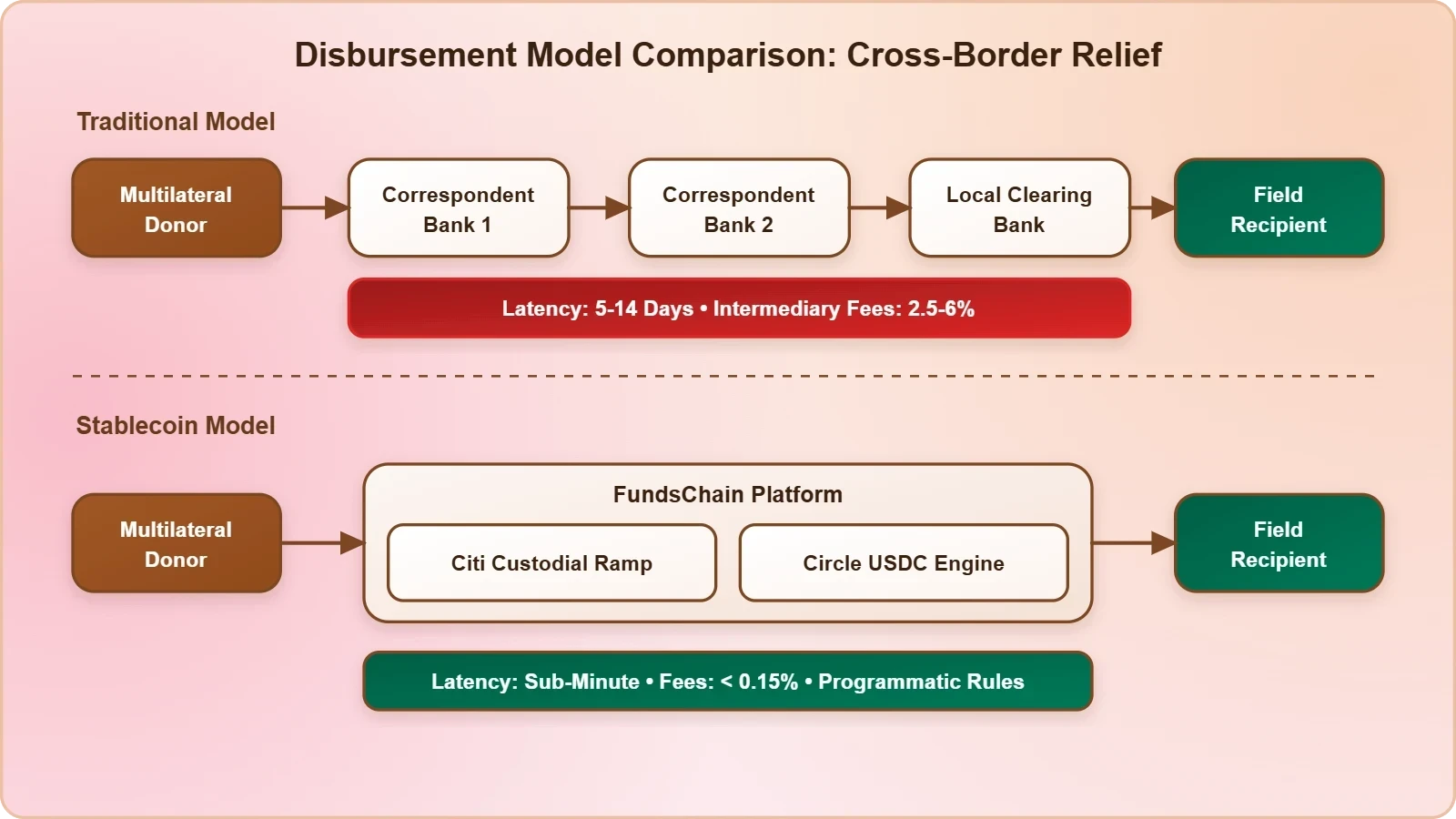
The core structural weakness of legacy foreign aid settlement resides in the correspondent banking network. When a multilateral lender dispatches capital to an emerging economy, the transfer rarely follows a straight path. Instead, the transaction traverses intermediate clearing banks, each operating independent ledgers, operating schedules, and compliance protocols. Every participant in this relay assesses transaction charges and foreign exchange spreads, compounding overhead before funds reach local executing agencies.
Beyond explicit fees, correspondent networks produce administrative friction that exacerbates fiscal drag across sovereign loan programs. Reconciling transaction records between disparate institutional ledgers requires continuous human intervention, increasing exposure to clerical errors and compliance freezes. These systemic vulnerabilities fall disproportionately on low-income countries, where domestic commercial banks maintain limited bilateral clearing arrangements with primary financial hubs, resulting in punitive capital haircuts during transmission.
Settlement Latency During Humanitarian Emergencies
When environmental or political catastrophes strike, capital velocity directly influences human outcomes. Under conventional interbank protocols, releasing disaster relief funds demands multiple administrative authorizations, batch processing schedules, and inter-bank liquidity confirmations that can extend disbursement cycles for weeks. While institutional donors announce financial commitments rapidly, local relief coordinators often wait for funds to clear local central banks before acquiring medical supplies, emergency shelter, or clean water.
This settlement lag forces local administrators to arrange high-interest bridge financing or rely on depleted domestic reserves while awaiting international wire confirmations. The inability to rapidly verify fund arrivals undermines municipal coordination and inflates procurement costs across regional supply chains. Resolving this clearing lag is not merely an exercise in accounting optimization; it constitutes an operational necessity for preserving stability and minimizing economic loss during large-scale systemic emergencies.
Architecture of the FundsChain, Citi, and Circle Collaboration
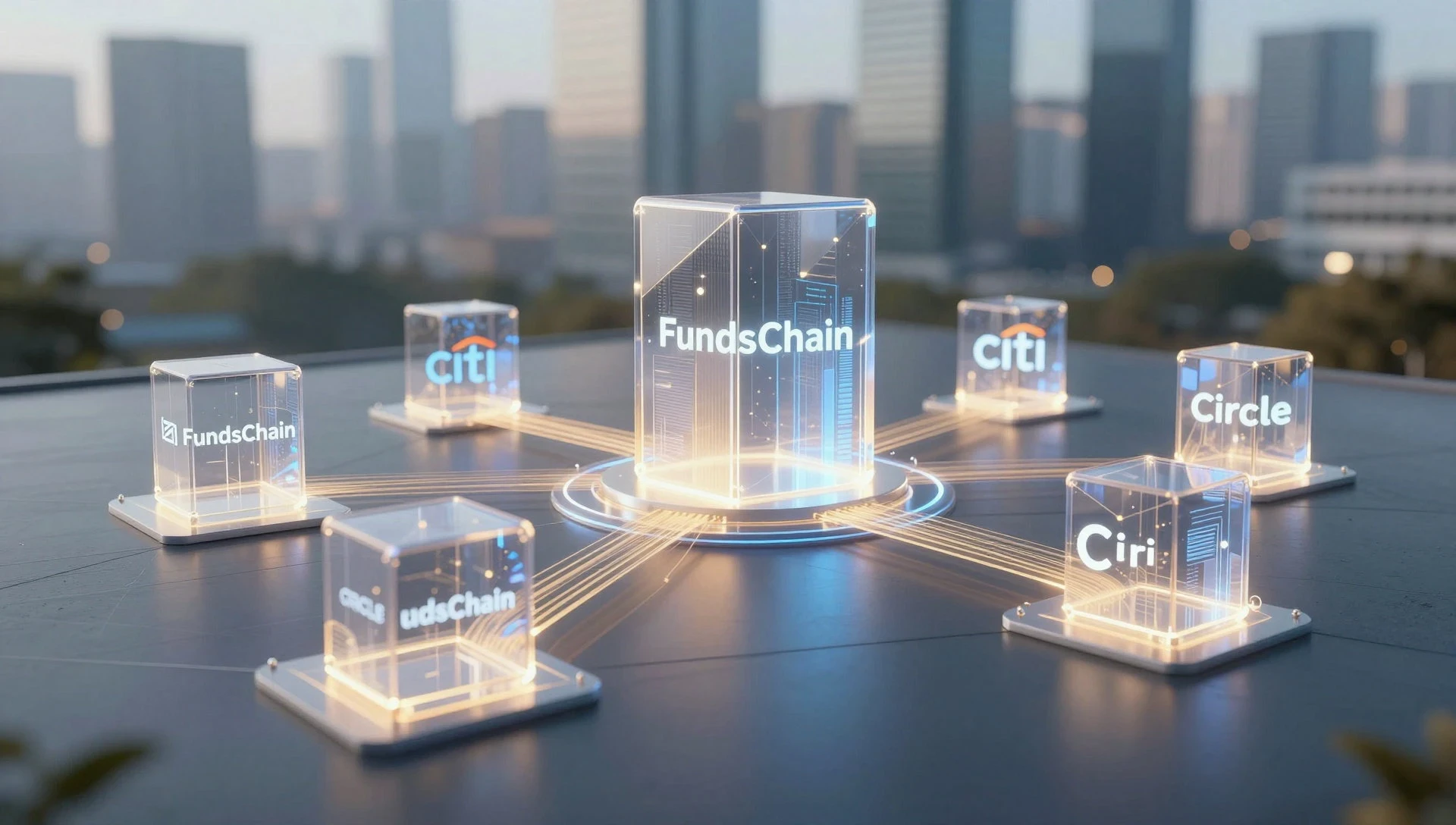
The collaborative trial initiated by the World Bank Group unites sovereign development institutions with premier commercial banking entities and compliant digital asset issuers. FundsChain serves as the administrative backbone, linking enterprise accounting systems to programmatic cryptographic ledgers. By integrating Citigroup’s institutional clearing architecture alongside Circle’s regulated stablecoin infrastructure, the framework bridges traditional fiat liquidity pools with public distributed networks, establishing a resilient structure for institutional capital management.
Citi Institutional Clearing Meets Regulated Stablecoins
Citigroup occupies an indispensable position within this architecture by providing the regulatory gateway connecting sovereign treasuries with distributed financial infrastructure. Rather than routing payments through external commercial entities, the pilot channels fiat capital into Citi’s custodial accounts, where it converts directly into USDC. This structure guarantees that funds comply with international capital adequacy mandates and statutory clearing regulations before tokenization occurs.
By leveraging Citi’s global clearing network, the World Bank preserves seamless interoperability with conventional banking rails. Sovereign recipients who lack immediate digital infrastructure can still receive capital, as funds can be systematically redeemed into local fiat currencies via Citi’s domestic branches. This integrated dual-rail mechanism removes adoption barriers, allowing developing countries to benefit from blockchain speeds without exposing domestic balance sheets to settlement discontinuities.
Programmable Compliance Within the FundsChain Platform
The integration of Circle’s smart contract infrastructure into FundsChain introduces programmatic compliance mechanisms previously unattainable via messaging networks like SWIFT. Programmers can write algorithmic disbursement criteria directly into smart contracts, guaranteeing that capital releases only when verified project milestones or auditing criteria are met. This capability replaces manual bureaucratic checkpoints with verifiable cryptographic conditions.
Furthermore, automated ledger verification ensures strict asset allocation fidelity. The programmatic rules govern how recipient addresses handle capital, eliminating unauthorized redirects or unbudgeted administrative expenditures. By embedding governance directly within token contracts, multilateral lenders attain continuous oversight over development disbursements, reducing reporting overhead for recipient ministries while improving sovereign accountability across the disbursement lifecycle.
Financial Mechanics of Dollar-Pegged Stablecoins in Multilateral Aid
The mathematical stability of dollar-denominated assets offers an indispensable hedge for emerging economies experiencing monetary volatility. When aid is provided via dollar-backed stablecoins, the nominal value of the grant or loan remains constant against baseline international reserve assets. This pricing certainty shields development projects from interim currency depreciations that frequently distort programmatic budgets during multi-year procurement cycles.
Capital Velocity and Balance Sheet Efficiency
The mathematical velocity of capital within public financial networks can be understood through classic monetary formulations. When settlement clearing delays ##t_s## decline toward near-zero thresholds, the effective velocity of institutional reserves increases proportionally. Mathematically, the effective funding capacity ##C_{eff}## for a fixed treasury reserve pool ##R## circulating over active projects across planning horizon ##T## can be expressed as:
Where ##t_p## represents internal project execution time and ##t_s## denotes settlement clearing latency. Under traditional correspondent banking, ##t_s## often introduces substantial friction that depresses aggregate operational throughput. By minimizing settlement time via smart contracts, treasury managers achieve superior liquidity efficiency without requiring additional taxpayer commitments or expanded bond issuances from member nations.
Mitigating Foreign Exchange Slippage in Developing Markets
Foreign exchange slippage presents an enduring operational risk in multilateral development operations. Emerging market currencies frequently trade in illiquid corridors dominated by wide bid-ask spreads. When institutional lenders convert major reserve currencies into thin domestic markets through traditional correspondent arrangements, local banking cartels extract significant transaction premiums that erode overall project budgets.
Disbursing funds via stablecoins allows domestic contractors and regional organizations to manage the timing of fiat liquidations. Instead of converting entire capital allocations instantaneously during unfavorable market conditions, managers can execute conversions in discrete increments matching immediate material expenses. This phased conversion capability diminishes market distortion, lowers localized inflation risk, and preserves working capital for development activities.
We Also Published
- 01
- 02
- 03
- 04
Regulatory Alignment and Systemic Risk Management
Adopting distributed digital currencies for sovereign financing requires stringent alignment with evolving international regulatory standards. Supranational organizations cannot compromise on statutory anti-money laundering frameworks or counter-terrorist financing obligations. Therefore, the FundsChain framework incorporates enterprise identity verification and tracking mechanisms that mirror and strengthen the standards established by the Financial Action Task Force and domestic banking supervisors worldwide.
Anti-Money Laundering and Counter-Terrorist Financing Controls
A prevalent criticism of tokenized instruments in cross-border finance involves their perceived exposure to illicit money flows. The FundsChain deployment dispels this vulnerability through cryptographic whitelisting. Only verified institutional wallets associated with vetted partner ministries or non-governmental entities can receive or transmit funds within the system. Non-whitelisted addresses cannot interact with the underlying disbursement smart contracts, eliminating unmonitored capital leakage.
In parallel, the transparent nature of distributed ledgers establishes an immutable record for forensic auditors. Unlike opaque correspondent banking paths, where transaction histories must be assembled post-facto from separate institutions, on-chain transactions are instantaneously documented. Regulatory analysts can verify the origin, transit path, and final disbursement of every digital dollar, establishing an unprecedented audit trail that exceeds legacy interbank transparency.
Reserve Audits and Insolvency Protections Under Commercial Scrutiny
For multilateral development institutions, counterparty risk represents an existential operational consideration. Using an uncollateralized or poorly backed digital token would jeopardize public funds and donor confidence. The partnership mitigates reserve risk by exclusively employing USDC, an asset fully backed by cash equivalents and short-dated United States Treasury securities held in segregated, bankruptcy-remote accounts within regulated commercial banking institutions.
Third-party accounting firms conduct monthly attestations verifying that the volume of outstanding tokens strictly matches the reserve assets held by custodians. This transparency guarantees that sovereign recipients can execute one-to-one conversions into traditional fiat currency without encountering redemption cliffs or liquidity shortages. This verifiable reserve structure bridges decentralized technological innovation with sovereign-grade fiduciary conservatism, satisfying risk management committees across international institutions.
Last-Mile Delivery and On-the-Ground Economic Impact
Modernizing the wholesale settlement tier yields tangible operational benefits at the microeconomic level. While high-level clearing reforms enhance treasury operations, their ultimate value must be measured in local communities where aid projects operate. Bridging institutional balance sheets with local financial institutions enables field agencies, construction firms, and healthcare providers to receive critical funding without enduring the lengthy administrative delays that traditionally degrade project execution.
Local Liquidity Pools and Merchant Off-Ramp Networks
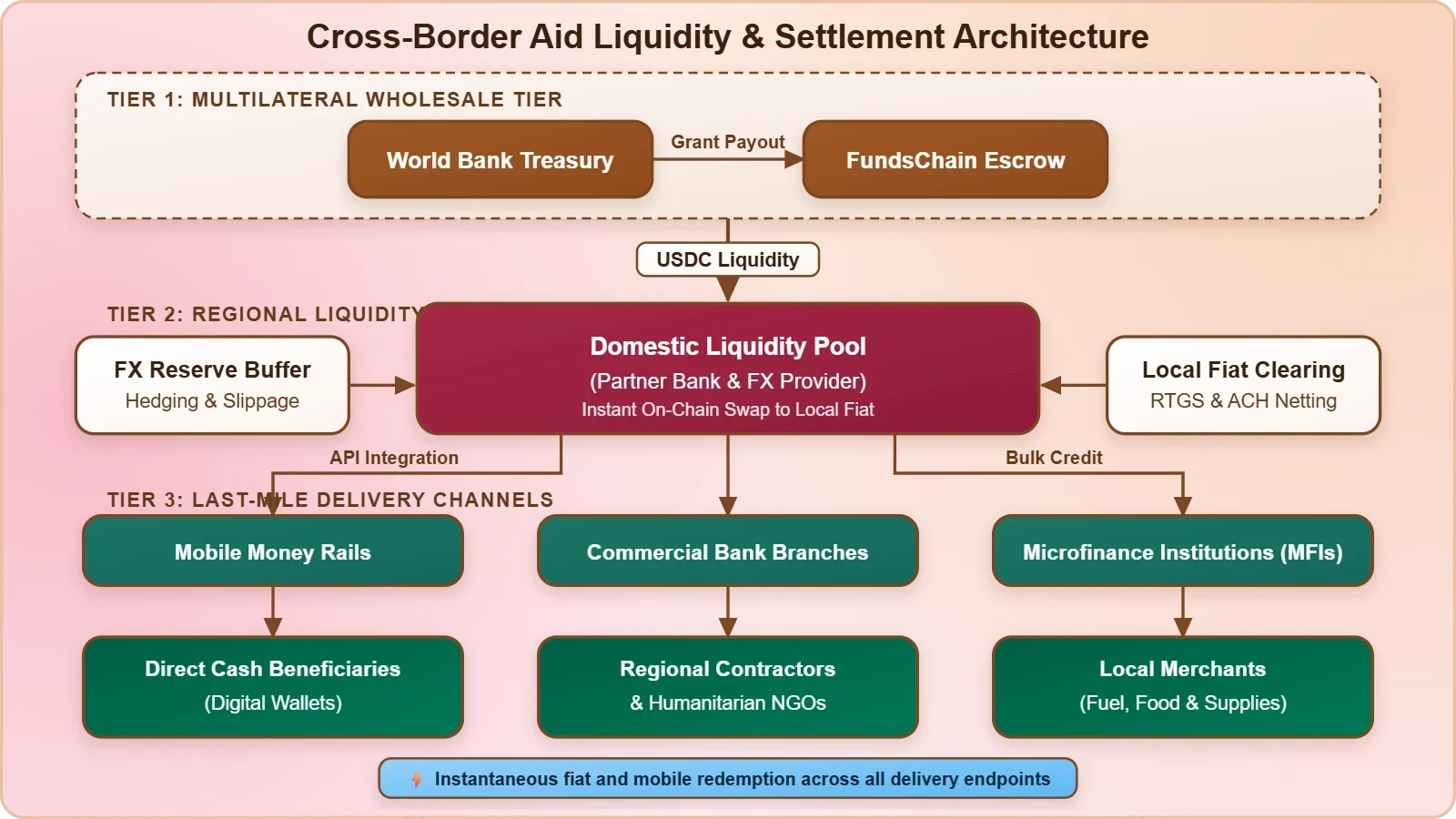
The practical success of stablecoin disbursement rests entirely upon the availability of reliable localized off-ramps. If an emergency relief organization receives digital currency but cannot convert it into local legal tender for regional supply purchases, operational progress stalls. To solve this bottleneck, the FundsChain initiative pairs token transfers with regional banking syndicates and authorized mobile network providers capable of processing on-demand conversions.
These local partnerships create robust regional liquidity pools that absorb digital assets in exchange for local cash or mobile money balances without distorting regional pricing structures. Local merchants supplying fuel, building supplies, or grain can settle balances digitally or withdraw sovereign fiat currency on demand. The architecture reduces dependence on physical bank branches, unlocking financial access across remote or unbanked jurisdictions.
Empowering Microfinance Institutions and Direct Beneficiaries
Beyond capital disbursements directed to sovereign governments, programmatic stablecoin infrastructure establishes efficient operational channels for community microfinance institutions. Traditional international wires to community development lenders are systematically penalized by minimum transfer fee thresholds, creating an economic barrier that prevents the disbursement of micro-grants or targeted loans. Tokenized infrastructure removes these fixed transactional minimums, allowing international donors to send fractional distributions safely.
This capability accelerates targeted conditional cash transfer programs aimed at poverty mitigation. Multilateral aid managers can disburse fractional digital allocations directly to individual recipients’ cryptographic mobile wallets. Beneficiaries retain control over their financial assets without relying on intermediaries, insulating vulnerable households from administrative corruption and significantly accelerating recovery timelines following environmental or economic crises.
Long-Term Implications for Multilateral Development Finance
The successful integration of USDC across the World Bank’s FundsChain platform establishes an operational precedent that will influence the broader development finance landscape. Supranational lenders across Asia, Africa, and Latin America face similar structural inefficiencies within legacy correspondent corridors. Proving that commercial clearing operations can interface with public cryptographic rails without compromising regulatory adherence offers a scalable template for global developmental institutions.
Scalability Across Regional Development Banks
Regional development institutions, such as the Asian Development Bank and the African Development Bank, face operational bottlenecks when attempting to disburse assistance across dispersed, heterogeneous jurisdictions. By adopting the FundsChain operational framework, these institutions can overcome local correspondent banking deficiencies. Standardizing on-chain clearing enables unified liquidity sharing between distinct multilateral banks without requiring costly administrative integrations.
This institutional interoperability facilitates coordinated international responses to complex transnational crises. When multiple lenders collaborate to fund joint infrastructure programs or climate mitigation efforts, using a shared programmable settlement asset eliminates ledger reconciliations. Rather than managing distinct correspondent chains, all participating lenders can track asset movement and milestone compliance through synchronized, real-time cryptographic accounting architectures.
Redefining Sovereign Debt and Capital Allocation Standards
The long-term consequence of integrating digital assets into multilateral development operations extends beyond payment velocity; it reshapes sovereign borrowing dynamics. By eliminating transactional friction, development lenders can implement more flexible, milestone-contingent debt contracts. Instead of transferring vast sums upfront and carrying significant non-performance exposure, loans can disburse programmatically as verified infrastructure development benchmarks are achieved.
This structural transparency fundamentally alters debt sustainability tracking for emerging countries. Finance ministries, domestic stakeholders, and foreign creditors gain complete visibility into project cash flows, mitigating sovereign risk premiums and expanding capital access for responsible governments. By marrying enterprise banking safety with the efficiency of distributed ledgers, the World Bank, Citi, and Circle collaboration sets a modern precedent for public financial management.
From our network :
- University Language Proficiency Exams: Why Institutional Tests Demand Different Preparation Than IELTS and TOEFLDiscover why university-specific language proficiency examinations differ fundamentally from IELTS and TOEFL, and learn strategic preparation approaches for institutional assessment success.
- Committed Mediterranean Precipitation Decline: Why Emissions Cuts Alone Cannot Restore Winter RainsNew NOAA research reveals that Mediterranean winter rains may decline irreversibly even with emissions cuts. Explore the science of committed climate change and regional impacts.
- CISA’s Ten-Advisory Wave: Why Generic Patching Fails in OT and How to Build Product-Specific PlaybooksCISA released ten ICS advisories in one week, exposing critical infrastructure risks. Generic patching fails in OT. Learn to build product-specific remediation playbooks.
- How AI Agents Will Change the Way We Manage Personal FinancesExplore how AI agents are transforming personal finance through automated budgeting, bill payment, and investment management, while examining the critical security protocols and governance frameworks required for safe deployment.
- Mobile Learning and VR in English: What Global Evidence Reveals About Effective Language TechnologyA systematic review across 14 countries reveals which language-learning technologies genuinely work. Mobile learning, AI, and VR show measurable benefits when pedagogically integrated. This evidence-based guide helps educators and learners select technology that delivers real return on investment.
- Forbidden Matrix Patterns and Visible Lattice Points: A Geometric DictionaryExplore how multidimensional 0–1 matrices encode geometric truths, linking forbidden patterns to visible lattice points and hypergraph theory, with applications in combinatorics and computational geometry.
- The Hidden Cost of AI Convenience: Why Over-Permissioned Agents Are a Security Time BombDiscover why AI agents with excessive permissions create dangerous single points of failure, and learn how implementing least privilege principles can protect your organization from exploitation.
- Live Online English Classes for Kids: Do They Actually Reduce Anxiety?A ten-week study reveals that synchronous online English classes can significantly reduce child language anxiety while improving listening and reading skills. Discover what makes these programs effective and how parents can select the right one.
- The Final Descent: How ESA Retired the Legendary Cluster Constellation After 24 Years of Space Weather ScienceAfter 24 years mapping Earth’s magnetosphere, ESA’s Cluster mission concluded with a precisely controlled reentry over the South Pacific. This analysis explores the scientific legacy, engineering decisions, and debris mitigation principles behind one of space exploration’s most responsible retirements.
RESOURCES
- World Bank Group Explores Regulated Stablecoins to Modernize ...worldbank.org6 days ago ... Central to this initiative will be Citi's existing connections to established banking rails and Circle's stablecoin payments infrastructure to ...
- World Bank partners Citi and Circle to test stablecoins for ...finextra.com5 days ago ... ... stablecoins could help modernise payments ... World Bank Group funds disbursement arrangements based on correspondent banking architecture.
- Digital Dollars - Citicitigroup.comApr 14, 2025 ... ... World Bank, Citi Institute. Figure 4. Stablecoin Transaction Volume vs ... The World Bank is responsible for disbursing billions…
- Circle agrees $400m Tazapay acquisition - FinTech Futuresfintechfutures.comSep 9, 2026 ... ... disbursementsWorld Bank enlists Citi and Circle to test stablecoin-based disbursements ... help accelerate its global adoption, says Jeremy ...
- World Bank Circle Citi Pilot Targets Stablecoin Disbursements After ...onebullex.com5 days ago ... World Bank Group partners with Circle and Citi on a 2026 stablecoin pilot to cut disbursement time and cost, after…
- World Bank Taps Circle and Citi to Test Stablecoins for ...finance.yahoo.com6 days ago ... The institution will test whether Circle's USDC and blockchain rails can speed up and cut the cost of disbursing development…
- World Bank Taps Circle and Citi to Test Stablecoins for ... - Decrypt.Codecrypt.co6 days ago ... The institution will test whether Circle's USDC and blockchain rails can speed up and cut the cost of disbursing development…
- The World Bank Group is studying whether Circle's USDC ...instagram.com5 days ago ... The World Bank Group is studying whether Circle's USDC stablecoin and Citi's banking network could move its development payouts faster…
- DBS, Citi and the World Bank | Marcel van Oost - LinkedInlinkedin.com4 days ago ... ... Circle and Citi to disburse development funds. Here's what caught my ... Circle is clearly winning the race to…
- The World Bank is exploring stablecoin payments with Citi and ...instagram.com5 days ago ... The World Bank is exploring stablecoin payments with Citi and Circle to make development funding faster, cheaper and more transparent.
- Citi and Circle to Help World Bank Study Stablecoin Payoutsunchainedcrypto.com5 days ago ... The World Bank Group will study using regulated dollar stablecoins to move its development project payments. Citi's banking links and…
- World Bank Group Explores USDC Payments With Citiglenbrook.com"The World Bank Group said it will explore stablecoin-based fund disbursements with Citi and Circle, with infrastructure for minting and settling USDC ...
- World Bank Group will explore paying out development funds in ...mlq.ai5 days ago ... World Bank Group will explore paying out development funds in Circle's USDC stablecoin with Citi ... disbursement arrangements, which run ...
- MoonPay Agrees To Acquire SEC-Registered North Capital In All ...newscord.orgSep 23, 2026 ... World Bank Group Explores USDC Stablecoin Payments With Citi and Circle. This article is an automated aggregation of coverage from…
- Citigroup (C) Joins World Bank Pilot For USDC Development ...simplywall.st4 days ago ... Citigroup (NYSE:C) is working with the World Bank and Circle to pilot USDC stablecoin payments for development projects.
- 01
- 02
- 03
- 04
- 05
- 06
- 07
- 08
0 Comments